24
■Article■
Dakshina Rules of Bombay Presidency (183(-1851):
Its Constitution and Principles
●
Kyosuke Adachi
Introduction
The authority over religious activity had been generally given to Brah-mans. Brahmans as priests monopolized the access to the learning as well
as the right of teaching Vedas. Kingship patronized these Brahmanical
learning in various ways. In the context of 18th century western India, a sort of cash allowance was given to learned Brahmans under the Peshwa
government. This cash allowance was called "Dakshina" which
origi-nally means "gift" to the purohita who administers rituals. It functioned
to build important religious bond between Kings and Brahmans.1) Above all, the Peshwa in Poona who were Chitpavan Brahmans established the
system of Dakshina as encouragement to the learned Brahmans and did
acts of charity through it.2) If India was a paradise of priests, "Poona is their terrestrial heaven of heavens". On the ceremony of Dakshina in the traditional Hindu Shravan month, large amount of cash allowances were given to learned Brahmans at Parvati temple in Poona.3) This allowance
reached its peak when it amounted to Rs. 1,300,000 and drew 70,000
Brahmans not only from Maharashtra but also from other parts of India
in a year. Its large scale had an impact on the population and economy of Poona [Gokhale 1988: 189-193].
Peshwa government was quite generous to patronize religion and
learn-ing as a part of their legitimacy, however, this method of distribution of
足 立享祐 Kyosuke Adachi, Graduate Student, Tokyo University of Foreign Studies.
Dakshina Rules of Bombay Presidency (1836-1851): Its Constitution and Principles 25
Dakshina by Peshwas was abolished by the British government. Dakshina
was transformed for the promotion of Marathi and the award of
fellow-ships after 1850s.4) The point that requires clarification is the process of
transformation of Dakshina and its logic in which this religious
allow-ance for Brahmans was turned into prizes for vernacular literature. R.
Kumar [1968: 264-275] and Parulekar [1953: xiii-xxxiv] concisely deal
with this transformation itself. 5)
The purpose of this paper is to re-examine the colonial shift of
cul-tural patronage and its logic through dealing with the transformation of
Dakshina policy in the earlier transition period from Peshwa to early
British government. The issues that we address are: what principle of
Dakshina rules from 1836 to 1851 enabled the government to exercise
their hegemony over Brahmans in Bombay Presidency and how the prin-ciple affected "traditional learning" of Brahmans.
A preliminary conclusion of this paper is that the transformation of
Dakshina shows the problems the government had to face were the
laicization of indigenous cultural patronage according to the general policy
of "religious neutrality" by the British government and the substitution
of the new government's educational policy for the precedent cultural
patronage. This new educational policy was accompanied with the new
hierarchy in learning and the colonial intellectuals adapted themselves to the new circumstances.
1. Debate on Dakshina Rules: Laicization of Learning
Before analysing the formation of Dakshina rule in 1836, it is
neces-sary to give the information regarding the colonial government policy
towards Dakshina immediately after the succession of Peshwa territory. At first, British officials realized the difficulties to interfere with the
complexity in which religion and learning were interwoven. After the
succession of Peshwa territory, Elphinstone, the Commissioner in the
Deccan preserved indigenous rights to appease newly conquered people.
He issued the proclamation that "All Wuttuns and Enams (hereditary
lands), Wurshashun (annual stipends) and all religious and charitable
establishments will be protected, and all religious sects will be tolerated
and their customs maintained as far as is just and reasonable" on 11
26 Journal of the Japanese Association for South Asian Studies, 13, 2001
on the principle of this proclamation. He sanctioned Rs. 80,000 for the
Dakshina that year.
The minute on education by Elphinstone shows his anxiety that he
was convinced that western education was essential to "improve" natives and intended to utilize indigenous religious allowances for that purpose;
nevertheless, the matter in hand was "we must not forget that we are
founding (or rather keeping up with modifications) a seminary among a
most bigoted people, where knowledge has always been in the hands of
the priesthood, and where science itself is considered as a branch of
religion".7) With regard to Dakshina, he only reduced the total amount
of Dakshina into Rs. 50,000 in a year. The government had to accept
new candidates as recipients of the Dakshina when some old recipients were not in a position to receive it. His successor, W. Chaplin
estab-lished Poona Sanskrit College in 1821 and appropriated Rs. 20,000 from
Dakshina for it, but he could not appropriate any further amount from
the Dakshina money. This was indispensable to maintain official stance
towards religious institutions for their publicity.8)
The distribution of Dakshina was highly influenced by orthodox
Brahmanical culture. Examinations of Dakshina candidates were held by
the panchayat of learned Brahmans, whose nature was the matter of
concerns for Brahmans. Dakshina candidates had to prove themselves
qualified in orthodox Brahmanical belief than in attainment of learning.
For instance, in 1828 an examiner of Dakshina candidates was accused
by a candidate who claimed that the examiner took bribery from the
Sonar community after the examiner showed some religious favour to
the community.9) The government had to reluctantly give Dakshina to
the candidate though he lacked the necessary qualification." In another
instance, there was a case where a Brahman got converted to
Christian-ity. The orthodox Brahmans forced the government to stop his Dakshina
for the reason of apostasy, despite the fact that he possessed enough
Shastric knowledge. The government was obliged to pay him from
an-other fund in 1833.11)
An intervention in Dakshina was viewed as interference in Brahmans'
religion. The governmental role in the educational policy was restricted
during early period of colonial rule in Bombay Presidency. They did not interfere with "traditional learning" effectively; rather they were follow-ing more or less the previous way of cultural patronage in the names of
Dakshina Rules of Bombay Presidency (1836-1851): Its Constitution and Principles 27
"religious neutrality" .
1.1 Dakshina Distribution Rule in 1836
The Dakshina distribution rule established in 1836, however, became
a watershed that the formula for patronage of the government was deci-sively changed. After this point, the government found it no longer nec-essary to encourage the learning preserved in Peshwa period. The tide
began to turn after Bombay government started intervening not only in
the total amount but also in the distribution of Dakshina itself. The rule
for distribution of Dakshina was proposed by A. Bell, the Agent for
Sirdars in the Deccan on 20 September 1836 to prevent inconveniences
and difficulties due to different opinions.12) The important points of the
distribution rule were as follows:
1. The present committee of Brahmans is to be dissolved. (1st para-graph)
2. The Collector is to order the descriptive certificate to be compared with the register and to pay the Dakshina. (5th paragraph)
3. All Brahmans are to attend in person within the prescribed period
and no Dakshina is to be paid to their agents. (6th paragraph) 4. The claims to arrears of Dakshina cannot be admitted. (7th
para-graph)
5. The Dakshina being a charitable donation is not continued to
heirs. (8th paragraph)
6. All Brahmans who received Dakshina till then, are to receive their Dakshina in future. (9th paragraph)
7. The government henceforth admits no new candidates. (12th para-graph)
8. Any Brahmans whose name recorded in the last list fail to attend
to receive a descriptive certificate during the year of
implementa-tion, forfeit their claim to the Dakshina. (16th paragraph)
Dakshina had hitherto been left to the panchayat of Brahmans, and
the government could not control the distribution substantially.
There-fore the government dissolved the existing problematic panchayat of
Brahmans and substituted a new examination committee of Brahmans.
Further, the managing committee was founded to control over examina-tion and examiners. The managing committee for Dakshina consisted of
28 Journal of the Japanese Association for South Asian Studies, 13, 2001
Agent for Sirdars.13) The managing committee proposed the Dakshina
Distribution Rule in 1836. The government did not immediately abolish
Dakshina but secured a deep-laid measure to bring about a decisive
change of Dakshina by these contents. The government was concerned
with the reduction of Dakshina amount in the end. The government
hitherto required to authorize the balance of Dakshina for the new
can-didates whom the Brahman panchayat had nominated. The government
prohibited new applicants and thereby intended to make surplus amount applicable to educational policy in general.
It should be noted that Dakshina began to distinguish itself from
religious allowance for the government principle of "real neutrality".
This rule was born as a result of the criticism by T. H. Baber, the
Principle Collector of Poona. In his opinion, huge expenditure like
Dakshina should be used to instruct the new generation that showed
respect and attachment to the British government; instead it produced
those who retained native education and ways of thinking. He believed that Brahmans were "so calculated to keep alive as this remnant of
en-couragement to their superstitious habits and modes of thinking and
resist all government's attempts to open to them superior stores of
learn-ing". He was afraid that "consequently they are left to brood over their
present exclusion and former independence". He argued that the sooner
they abandon Dakshina, the nearer they approach to the state of "real
neutrality" towards religious activity. W. H. Williamson, the Revenue
Commissioner agreed with Barber's opinion. Although natives gave the
new government some credit for the religious toleration that continued
temple and charitable grants, the government's duty and policy should
withhold such measures as to foster superstition. In order to avoid losing
native subjects' confidence in the continuance of largesse, he suggested
the logic that Dakshina distribution was "miscellaneous and general charity
to Brahmans, and cannot be claimed like personal pensions, or fixed
allowance to temples, mosques and so on" .14)
The Dakshina Distribution Rule in 1836 stirred up the indigenous
society, especially the Brahman community. They considered it as
inter-ference with their "religion". Dakshina allowance was a mirror of a
candidate's attainment judged by Brahman panchayat, even though it
would be controlled capriciously as British officials pointed out. Nearly
Dakshina Rules of Bombay Presidency (1836-1851): Its Constitution and Principles 29
November 1836.15) Their claim was like blackmail menacing that
gov-ernment should continue to support Brahmans. The petitioners claimed that the late rule has been a source of much grief to both the old and young Brahmans. The Brahmans' view was that all the students of Vedas and other Hindu learning were prohibited to take on any other occupa-tion than the praise of God and offering prayers for the welfare and
prosperity of the kingdom; therefore, the government ought to support
them. Otherwise, its effects were "ruinous to their religion, and to the
propagation of learning" and "tend to the diminution of that learning
which is essential to mercantile concerns", so that the people would
suffer in the end.
This rule meant depriving Brahmans of their privilege as well as their learning of their caste preserved for a long time. Above all, Brahmans raised hue and cry against the 12th paragraph of the rule that prescribed admission of new candidate to be stopped. Brahmans approved the
re-maining paragraphs of the rule as satisfactory. It may be presumed that
all Brahmans did not necessarily consider Dakshina as a heritable right since their opposition was not against the 8th paragraph.16) Dakshina was
not necessarily succeeded to the heirs; nevertheless, the heirs who had
sufficient knowledge could enjoy their Dakshina, if new candidates were
admitted. For example, before the Dakshina Distribution Rule in 1836
was implemented, when a senile father, who had received Dakshina to
manage school in his enam village, applied for the succession of Dakshina
to his son, the government fulfilled his requirement by examining the
heir as a new candidate.") Therefore, it was the 12th paragraph rather
than the other paragraphs that Brahmans arrayed themselves against.
The fact that the government would admit no new candidates meant a
crisis for Brahmans' community, because they would lose vested
inter-ests decisively in the future by the 12th paragraph. Thus, it implied
more than a mere reduction of the total amount.
The government assumed that the surplus amount had become
appli-cable to educational policy as a whole by distinguishing Dakshina from
other religious donations. The government rejected to comply with the
petition to make an arrangement for new candidates about the balance
after the lapse of recipients. The Brahmans demanded that after the
distribution of ensuing Dakshina the government should distribute the
30 Journal of the Japanese Association for South Asian Studies, 13, 2001
the usual examination. The government, however, was not required to
authorize the balance of Dakshina for the new candidates whom
Brah-man panchayat had nominated, and could optionally appropriate the
balance to the "useful" field of learning of India. W. H. Wathen, the
Chief Secretary to the government, addressed the letter of General
De-partment, no. 142 dated 19 January 1837 to the managing committee:18)
...Government is of opinion, that the whole of that allowance should
continue to be made available to the general purpose of promoting education and rewarding those who distinguish themselves in the ac-quisition of science and that the best mode of rendering it a means of encouraging alone the prosecution of useful knowledge and of general modifying the existing system with a view to that object will be con-sidered and an arrangement for such purpose will be proposed at a future period by government....
1.2 The Superintendence of Education
The Government of India had already issued the famous Bentinck's
Resolution in 1835. It shows their intention that the government should
give artificial encouragement to branches of learning, which would be
superseded by more useful studies.19) The Bombay government's
opin-ion about native educatopin-ion was also shifting in favour of intensifying the
superintendence by the Europeans in the middle of 1830s. T. Candy
especially played an important role in this process. After the accession of Peshwa territory, the British government established Poona College (1821)
and Elphinstone Institution (1827) besides some government and
pri-vate schools managed in Bombay Presidency. Bombay Native
School-book and School Society (1822), which was renamed Bombay Native
Education Society (1827) had hitherto given some support to these
insti-tutions. However, it is insufficient to hegemonize over native education
to diffuse "useful knowledge" that the government intended to promote.
The government ordered to report the condition of government schools.
Candy who compiled Marathi-English dictionary along with J. T.
Molesworth, submitted a report to the government on 27 May 1837. He
emphasized the important point that the government should put their
schools under the European supervision. Collectors, assistant collectors
or other civil officers formerly had supervised these institutions to make progress of the native education but their other various duties had
pre-Dakshina Rules of Bombay Presidency (1836-1851): Its Constitution and Principles 31
vented them from giving more than occasional supervision. Candy thought that the regular supervision over education by the European was indis-pensable to improve the moral and intellect of natives:20)
7. I do not suppose that any one acquainted with the native mind can question the high importance of having the government schools under regular European superintendence. If the government desired nothing more than that the children should learn to read and write, and keep accounts, the schools might be left under native superintendence, with occasional inspection by a European. But, if the moral and intellec-tual instruction of the children be an object of importance, if it be desirable that the Masters should not only teach their pupils to read but should teach them to read with understanding, and should draw out and exercise their faculties, and if it be of importance to secure the progressive improvement of the character of the Schools then it may be confidently said that regular European superintendence of them is absolutely necessary . . . . [sic]
R. Grant, the Governor of Bombay paid attention to the post of
su-perintending native schools and encouraged to establish it. As for the
supervision of Poona College and government schools, there were
opin-ions that designing Brahmans might misinterpret the government's
in-tentions to the natives. J. Keane, the Commander-in-Chief was afraid of
losing guarantee obtained by Elphinstone's policy that religious
dona-tion should be preserved, by the interference of government authority
over the College.21) Nevertheless, Bombay government required the
Government of India to found the office of superintendent of Poona
College and government schools and to appoint Candy as the
superin-tendent to reform them. The Government of India also supposed that
the appointment of officers versed in the native literature would bring
about favourable results to the institutions. There were such
appoint-ments in similar native institutions, both Muslims and Hindus, in the
Bengal Presidency.22)
In the tide of expanding supervision, the question that the
govern-ment in particular had to face was the problem of Poona College and
Dakshina, for which the government had hitherto spent a large amount
of budget. The government had two choices concerning these
32 Journal of the Japanese Association for South Asian Studies, 13, 2001
into more useful means, or to improve them by placing them under the
European superintendence. The officials like Baber had already
recom-mended that the institutions, which had degenerated into the state of
inefficiency and worthless encumbrance, should be abolished. Candy,
however, supposed that Poona College would be benefited considerably by the supervision and many useful reforms could be introduced.
Candy insisted that if the government left the Poona College to
Brah-mans without the incentives by European superintendence, Brahmans
would be "apt to subside into indolence and passiveness", instead, the
government should discontinue the useless branches of learning. He
ex-pected that through the reform, the college become "powerful
instru-ment for the dissemination of liberal knowledge, and the introduction of
improved habits, among our native subjects".23) He proposed the reform
of curriculum in Poona College to employ it as an engine for
enlighten-ing and instructenlighten-ing the higher classes of the native community in the
Deccan. In the Poona College, branches of the seven Shastras (Vyakarana, Alankara, Dharma Shastra, Jyotisha, Vaidya, Nyaya, and Vedanta) and two Vedas (Rig-Veda and Yajur-Veda) had been taught since 1821. These
branches became the targets of improvement in the 1830s. Eventually,
the government abolished the curricula of Vedanta and two Vedas.24)
At the same time, the government made arrangements in order that
College and Dakshina would be in consonance with each other in the form of preserving learning. The reform for Poona College regarding its
branch was applied to Dakshina as well. The government regretted that
Dakshina should have been applied to eliminate abuses, however it was
"not in the least degree to contribute to the promotion of learning but on
the contrary to the mere support of laziness and learned ignorance" .25)
The General Department of the government issued the memorandum
no. 83 dated the 6 January 1838. This memorandum prescribed that
unspent Dakshina balance should be distributed to candidates who were
qualified in the branches of learning the government had reformed to be
studied in the Poona College since the government education should
encourage "useful" learning. W. H. Wathen, the Chief Secretary to the
government informed the Agent for Sirdars about this new
memoran-dum:26)
Dakshina Rules of Bombay Presidency (1836-1851): Its Constitution and Principles 33 should be restricted to the branches of useful learning ordered to be kept up in the college, viz. the branches of Jyotish Vyakurn, Nyaya, Dhurm Shastur, , Ulnkar and Wuedya Shasturs . . . . [sic]
The examination committee for Dakshina candidates was also directed
to examine the students in Poona College. This arrangement established
firm relationship between Poona College and Dakshina. It had been
customary for the principal of college to assemble a committee of learned
men from those who might have happened to be at Poona at the time.
The examiners had not been in the regular employment of government
and consequently not under government's control. Therefore, they
usu-ally had performed the duty in a cursory and unsatisfactory way for the
government. On the contrary, the government regularly remunerated
the committee appointed for the Dakshina for their duty to examine
Dakshina candidates every year. It was felt to be advantageous to
ap-point a permanent committee of qualified men with a fixed remuneration
for the performance of both duties. The government therefore decided
to pay the salary for the examination in Poona College from surplus
amount of Dakshina and the committee appointed for Dakshina exam-ined the students of the College whenever called upon to do so by the
superintendent. 27)
The formula for patronage from the government had clearly changed.
The government no longer needed to encourage the learning preserved
in Peshwa period. Dakshina transformed its implication from a religious
allowance to a scholarship in the educational policy. Dakshina which was only given to the branch held in Poona College, namely, "sacred" Vedic knowledge was no longer the criterion of official learning. Between 1838
and 1840, Vedics at Poona, Wai and Satara presented a petition to the
government against this policy.28) They begged that the examination of
all new candidates for the Dakshina should be conducted, according to
the ancient ways and customs. The Agent for Sirdars thereby was
re-quested to admit all Vedics indiscriminately to participate in the benefits
of the Dakshina. The government, however, determined to continue the
support except Vedic knowledge at the time. The measure was supposed
highly detrimental to the interests of the Hindu religion for Brahmans.
Because, they insisted that for the Hindu religion and in the public
34 Journal of the Japanese Association for South Asian Studies, 13, 2001
of the Shastras". The government, however, did not approve the
peti-tion, and confirmed the memorandum of the General Department no.
83 of 6 January 1838.
The sanction for Dakshina after accession of Deccan had the origin in
the policy that appeased the class which was most influential among
newly conquered people. The circumstance, however, changed by the
constitution of Dakshina distribution rule in 1836. With regard to the
dispute of the 12th paragraph, Brahmans claimed that Dakshina was
indispensable for the preservation of "religion and morality" but the
government rejected their claim. According to the logic of British
gov-ernment, Dakshina was for the "promotion of learning". They were
aware of the necessity of education, while being afraid of the danger of
interfering with religion. To overcome this ambivalence, they laicized
Dakshina that had elements of both religious act and promoting
learn-Table 1 Account awarded to Dakshina between 1816 and 1839
Dakshina Rules of Bombay Presidency (1836-1851): Its Constitution and Principles 35
ing, by considering Dakshina not as a religious donation but as an edu-cational fund.
Brahmanical culture was no longer the arbiter of taste. The government's educational policy was discharged from composite arena based on reli-gious principle. As stated in the letter of the government no. 142 on 19 January 1837, the balance of fund became available for the general pur-pose of promotion of learning. Through the superintendence of native education, the government held all the cards to decide about learning itself. The government could exclude various participants who did not have the attainment of learning prescribed for Dakshina, and made sur-plus amount by the lapse of old candidates appropriated to those who had attainment of "useful" learning accredited by the government. This structure continued under the formation of public instruction.
2. Dakshina in Public Instruction: New Hierarchy of Learn-ing
The circumstances neither obliged the government to continue such grant, nor to refrain from intervention with Dakshina distribution. Table
1 shows the number of Dakshina recipients according to the field of learning admitted between 1816 and 1839 from the English register of Dakshina distribution of 1851.29) For instance, 1350 people received Dakshina and they were from the Veda account. They constituted of 91.03% of the total number of Dakshina recipients. The lapse of right by the absence or death of recipients is apparently contained in this data; even so, it can be presumed that no admission of Veda means that Dakshina had not only changed quantitatively but also qualitatively. Brahmans were requested to understand that Dakshina was not a religious donation but a reward for attainment in learning.
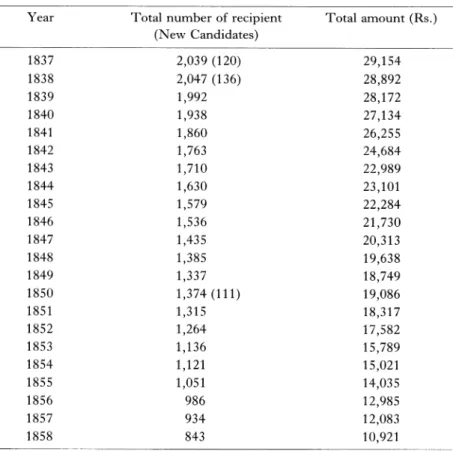
Table 2 shows the number of Brahmans and total amount of Dakshina distributed according to the Dakshina Distribution Rule of 1836. It will reveal that the government policy contributed to the tendency of reduc-tion. It lasted fundamentally by the invalidation •\ death and absence •\ of Dakshina recipients. In 1837, an amount of Rs. 29,154 was distrib-uted among 2,039 Brahmans, however, in 1858 the amount was reduced to Rs. 10,921. As stated in the former section, Brahmans hoped for the modification of Dakshina distribution rule because it seemed to deprive
36 Journal of the Japanese Association for South Asian Studies, 13, 2001
them of conventional indulgence. The government prescribed that new Dakshina candidates should not be admitted and that the fund should be available for "general purpose of promoting learning". Although the bal-ance of each year was in fact used for the salary of Candy as well as his pundits who composed the examination committee for Poona College and Dakshina, new candidates were not admitted for the reason of insufficient fund after 1839.3°) The lapse of precedent recipients gradu-ally produced surplus amount in the fund. It resulted in a large surplus amount, which accumulated to Rs. 18,479 in 1849.31)
Table 2 Dakshina Distribution by Years
Data from the statement of actual receipt and disbursement on account of annual Dakshina for each year in Bombay General Proceedings.
Dakshina Rules of Bombay Presidency (1836-1851): Its Constitution and Principles 37
2.1 Factionalism
When Brahmans of Poona and the adjacent towns came to know the
fact that a large surplus amount of money got accumulated, they
pre-sented a petition to the government to relieve their feelings. They
in-sisted that whenever a surplus amount was left in the Dakshina fund, it
should be properly applied to the Dakshina, and that the Agent for
Sirdars should restore the system of admitting new candidates to the
Dakshina distribution. The Agent for Sirdars also felt that the
discon-tinuation of new candidate to Dakshina distribution had been very stressing
to Brahmins. Since a large amount of balance was available for the
pur-pose of Dakshina at that time, the Agent for Sirdars propur-posed that it would be acceptable to comply with the request of petitioners. The
gov-ernment sanctioned the distribution of Rs. 3,000 a year for the new
candidates who would pass the usual examination.32)
However, the notice that new candidate for Dakshina might be admit-ted also led the students of the English schools at Poona to get up a
petition claiming a share in the bounty of this arrangement. It should be
noted that English school students regarded Dakshina distribution to
Sanskrit students as a sinecure for life. They considered Dakshina as an educational fund, which should be given to any student whether he may
belong to the government English schools or to Poona College. They
were willing to offer their services to the government as translators and
authors in the least expensive way. On the contrary, they accused Vedics as "mere rectors of the Vedas" and insisted that Vedics had "no ground
to complain of the injustice of government". The students of English
School at Poona proposed that the condition of producing Marathi
origi-nal works or translations should be simultaneous with the exclusion of
the Vedics:33)
. . . Your petitioners regret to find that one institution only should nowadays be favoured by government and the students of a dead language rewarded with sinecure premiums for life while those of others should be excluded although they most willingly tender their useful services. Your petitioners especially feel it a hardship and degradation that because students of the English should not obtain premiums which are given to their brethren in the sangscrit college as sinecure and for life . . . [sic]
38 Journal of the Japanese Association for South Asian Studies, 13, 2001
The circumstance around English education had changed greatly
through the 1840s in Bombay Presidency. English education was hith-erto sustained mainly by Bombay Native Education Society, a voluntary
organisation largely developed after the foundation of Bombay Board of
Education, a semi-official organisation in 1840. E. Perry succeeded to
the presidency of the Board of Education in 1843 and gave new direction to the Board. He was a strong advocate of the English schools and of "the filtration theory" which Maca
uley put forward.34) In 1849 when the petition was filed, there were seven English schools run by the
govern-ment. They were located at Poona (with 121 students), Ahmedabad (90),
Thana (43), Ratnagiri (51), Dharwar (43), Surat (299) and Ahmadnagar
(50) respectively.35) Furthermore, Poona College started selecting some
of its students to attend English classes at the Government English Schools at Poona. The classes increased in their number to two in 1844 and to five in 1849.36)
There were already some Brahmans acquainted with European
sci-ences. Although they did not necessarily know Sanskrit, they could write
vernacular books on the most "useful" subject. They were willing to
offer their services as translators and authors. They disdained to receive
sinecure grants without making a good return to the government or to
the public.37) The Poona branch of Paramhansa Sabha represented by
Keshav Shivaram Bhavalkar made worthwhile contributions to this
dis-pute. Paramhansa Sabha was the secret society organized by the students
when Dadoba Pandurang was in charge of Bombay Normal School. Its
Poona branch was formed when Bhavalkar left for the post at the
Gov-ernment English School there. They condemned the existing Dakshina
system as a colossal waste of public money serving no useful purpose except breeding idleness among Brahman recipients [Naik 1974-76: 153].
The old elite group preserving traditional learning and the rising new elite group educated in English came into conflict with each other under
this circumstance. However, adepts of traditional leaning were not
nec-essarily monolithic. The petition for new admission from Vedics, who
blamed the government of trespass on the rights of Veda, insisted on the
higher good of Vedas than any other learning. They felt humiliated
when they came to know the predicament that the government gave
sanction to new admission only for learning prescribed as Shastra at
Dakshina Rules of Bombay Presidency (1836-1851): Its Constitution and Principles 39
. . .In the first place your petitioners will take the liberty of calling your attention to the meaning of the word "Dukshuna" and the object
of that institution. The Dukshuna means the money, with which those who are morally pure and who are engaged in the acquisition of knowledge are rewarded and the object of this institution is to encour-age people in the acquisition of knowledge, hence arises a question, who are morally pure? and who are engaged in the acquisition of knowledge? The answer to this query is those who are versed either in the "Shasters" or "Veds". The latter is the book of Divine revelation and therefore the foundation of all knowledge. Those who are versed in this Divine Book are more respected than those who study the "Shastras" . The old usage is that marks of adoration are first paid to those who study the "Veds" . . . [sic]
On the other hand, Shastris were also disaffected to Vedics who even abused the study of Shastra in order to make them admitted for Dakshina. Shastris demanded that the government should fulfill their decision of 1838.39)
. . . If Wydicks object to the distribution of Rupees 3,000 among
Shastrees they act the part of unjust and self interested men and
government ought not to listen to their prayers becausethe order
issued by government is to this effect that Rupees 3,000 should be awarded only to those who are well versed in any of the Six Shastras.
Your Petitioners are reduced to very needy circumstances. They there-fore beseech your Lordship in Council to succour them in distress by issuing an order to the Agent for Sirdars in the Deccan to distribute Rupees 3,000 as Duxna among Shastrees . . . [sic]
A sort of factionalism by their knowledge was formed among intellec-tual community: Shastris, Vedics and students of English schools. First, the Shastris were in conformity with the rules in 1838 and were
conver-sant with "the more useful branches of Hindu learning". Second, the Vedics were excluded by the operation of that rule and appealed
unsuc-cessfully against their exclusion. Third, the students of English schools learned in languages other than Sanskrit. These factions criticized each other and hoped to receive Dakshina money. The government was aware of the difference of these three groups, and intervened in this cleavage. The government disposed not to alter the existing practice abruptly. They once for all directed a half of grant, viz., Rs. 1,500 to be reserved
40 Journal of the Japanese Association for South Asian Studies, 13, 2001
for candidates belonging to the faction who learned not Vedas but "use-ful Hindu learning". The balance of Rs. 1,500 was paid as shown in Table 3. The attainment of grammar and rhetoric became the main account awarded Dakshina and the account on Veda was completely excluded.
2.2 The Government and the New Elite
The government recognized that the terms used in these letters of this dispute such as "education", "science" and "useful learning" are all of a general and comprehensive significance. Dakshina was available for gen-eral purpose of promoting learning; nevertheless, there was no arrange-ment about surplus amount in Dakshina. Because of this problem, the government had to design a definite plan about the entire fund including the problem of the surplus amount. The decision was of importance, for it required a clear exposition of the sentiments of government about the right to interfere with distribution and eventually to apply the entire fund to more legitimate and useful purposes designated by the govern-ment.
Although proficiency in Sanskrit alone had hitherto been the requisite
Table 3 Account awarded to Dakshina in 1849
Dakshina Rules of Bombay Presidency (1836-1851): Its Constitution and Principles 41
for their Dakshina, the question of whether candidates in future should
be confined to Sanskrit literature was the matter for the government's
free decision. The memorandum of J. G. Lumsden, the Chief Secretary
to the government confirmed that the government was free to interfere
with Dakshina." According to Lumsden, making compromise with the
distribution of Dakshina would threaten eventually to deprive the
gov-ernment of their social supremacy. He criticized that the existing
distri-bution of the Dakshina allowance contributed to perpetuate prejudices
and "to support a class of silent but irreconcilable opponents". He
in-sisted that the government should place them "in the proposition of
opponents to their own caste and caste interest" and more favourable to
the government in ideas more consonant with the progress of education.
The government wanted to encourage those who had been educated
under the auspices of the government.
The government ignored the large number of petitioners. This
direc-tion caused a petidirec-tion to be signed by 3,000 Brahmans on 5 June 1850.41)
They claimed, in great anger, that the government broke the promise,
which no one would be disturbed in the possession of his Wuttun. They
demanded to turn back the proclamation signed by Elphinstone at Satara
on 11 February 1818 and promulgated throughout all the districts of the
Deccan. They insisted that Dakshina distribution had been a great
in-ducement for 3,000 students who studied Vedas. The government
reconfirmed a decision on 6 January 1838, and never reversed it. Dakshina
had already become an "educational fund".
Candy and W. J. Hunter, the Agent for Sirdars proposed a plan for
the balance in hand, Rs. 1,500 and the future surplus amount of
Dakshina42); this plan was sanctioned by the government in 1851 after a
few modification. This plan implied that public instruction embraced
Dakshina. The most important part of this arrangement was that Dakshina came to be used for the prizes of vernacular literature. These prizes were open for competition to "all classes and castes of natives of India". They
were supposed to be given as rewards for the composition of original
"useful" works in Marathi or for translation into it of "useful" works
from other languages. Their works should be submitted to the
judge-ment of Dakshina Prize committee, who will decide on their merits and the amount of reward.'"
42 Journal of the Japanese Association for South Asian Studies, 13, 2001
came from the controversy on the medium of education in the Board of
Education. Bombay government had emphasized more on vernacular
education up to then. However, the emphasis was being shifted
gradu-ally into English education by Perry under his presidency. The
alter-ation of educalter-ational policy in Bengal, from Oriental studies to English
inspired him with confidence. He pointed out that the problem was
inefficiency of vernacular schools due to inadequate teachers and
text-book. Colonel Jervis, a vernacularist opposed Perry in this context.
Even-tually, the controversy was settled by the Board of Education as
fol-lows:44)
1. Education for the masses of the people in the vernacular languages.
2. Education of a superior quality in English.
3. Production of a superior class of schoolmasters for the vernacular
schools.
4. Encouraging of translation into vernacular languages.
The educational policy of government decided the status among the
languages. The government was of opinion that it should not forget the
motto "Marathi for the multitude, Marathi and English for the elite" .45)
Although the encouragement of vernacular was kept in view, vernacular
literature was forced subordination to English literature. Out of the ten
works selected in 1851 by the Dakshina Prize Committee, only two works
were originals. Furthermore, six works out of eight translations were
biographies picked up for the intellectual and moral improvement of
natives.'" The Government of India required that translation should not
be made from Sanskrit but from English. They hoped that the most powerful effect would be expected from high standard of knowledge of
European literature and science through the English language. It
ap-peared to the Government of India that the best chance of forming
useful literature was either by the translation of English and European
works into the language of people, or by the composition of original
treatises in vernacular written by those natives who had become thor-oughly imbued with the spirit of its literature and science.47)
The government needed to suggest a plan that would have wide benefit. The plan which was proposed by Candy and Hunter suggested the dis-posal of the entire balance both present and arising future. While the
shareholders of old Dakshina aged, a considerable sum lapsed every
Dakshina Rules of Bombay Presidency (1836-1851): Its Constitution and Principles 43
no new candidate was admitted.") The plan should be in connection
with the improvement and extension of native education and literature.
The Board of Education had under consideration a plan for combining
the present Poona College and the present Government English School
of Poona. The plan thereby suggested that the balance of the Dakshina
be applied to the cultivation of the vernacular language of Deccan and
Konkan in the new institution. They founded the professorship of the
vernacular and English and translation exhibitions by young scholars.
The balance after these measures and subsequent annual increase from
lapsed shares was applied to the formation of "the General Fund for the
Encouragement of Native Literature and Education". This was aimed at
rewarding and printing of originals or translations in Marathi of "useful"
works, giving gratuities to old and meritorious vernacular schoolmasters,
and occasional grants to the societies engaged in promoting the
improve-ment of native literature.49)
On this plan, Paramhansa Sabha stated that "the present plan is
calcu-lated to civilize the nation in general, and to lay open for its benefit those stores of learning and wisdom which . . . . have been wholly inaccessible
to the nation at large." Orthodox Brahmans attacked this attitude of
memorialists, and they decided to excommunicate all those who were
associated with the memorial. Jyotirao Phule came in support of the
memorialists [Naik 1975: 152]. They did not kneel down to such menace
because the government supported emerging elite in the educational
field.50) The evidence can be seen in the fact that the government used a
part of "General Fund" from Dakshina for the Native Female School and the Low Caste School managed by them.51)
Conclusion
Dakshina, which had been a religious activity, altered its nature after
1836. When the new rule of distribution was established, the aspect of
heredity was ignored and further no new candidate was admitted. Many Brahmans drafted a petition against this rule. Brahmans thought Dakshina
indispensable for maintenance of their "religion and morality", but these
petitions were refused. Dakshina was not a religious donation but a
secu-lar grant; it should be strictly appropriated to the promotion of "useful"
contra-44 Journal of the Japanese Association for South Asian Studies, 13, 2001
diction between the fear of interfering with religion and the need of educating natives. The motive of constituting Dakshina rules was the laicization of educational policy.
The process of Dakshina policy offers a single example of transforma-tion of traditransforma-tional intellectuals in the relation between indigenous cul-tural patronage and colonial educational policy.52) The introduction of colonial educational policy altered the cultural practice monopolized as hidden ritual by Brahmans. The laicization of Dakshina in the colonial policy gave birth to the groups of new elite and enabled them to partici-pate in colonial education. Under this circumstance, Brahmans had to adapt themselves to a new hierarchy of learning for the patronage from the government.") The policy of no succession and no new admission produced the balance by 1849. When the effect of reduction of Dakshina distribution began to surface, petitions were sent to pray for conversion of the surplus balance from the factions in various branches of learning. For the students of English School rising in those days, distribution of Dakshina to traditional shareholder was no more than sinecure. The fund of government should not have been paid to the persons who could not contribute to the government. New English elite could act as the class of medium between the governor and the governed, by their ability to speak and write in English.
Above all, the fact that a part of Dakshina became the fund for pro-moting vernacular literature was symbolic in the context that these works inherited the position for moral persuasion from "religion". Recent in-vestigations have demonstrated that colonial knowledge was appropri-ated and validappropri-ated through education in the forms of agenda.54) A fore-seeable extension of this paper would be to examine various vernacular representations in the agon of public instruction like Dakshina Prize.") Colonial government sought for the social institution which salvaged natives from "ignorance and degeneration" by the faith of their cultural superiority, and education was chosen as best instrument for it.
Notes
1) For example in Rig- Veda, see [Tsuji 1970: 276-281]. Although, there are many studies in the field of Indology, History and Anthropology on the relationships between Kings and Brahmans, there is no space to argue them here.
2) Dakshina in Maharashtra was originally started at Talegaon by Khanderav Dabhade, but when he was killed in a battle with Peshwa Bajirav Ballal, its institution was
Dakshina Rules of Bombay Presidency (1836-1851): Its Constitution and Principles 45
transferred to Poona to conciliate the people [Gazetteer of the Bombay Presidency, volume XVII, part II, Poona 1885: 48].
3) Moor [1864: 339-342] recorded descriptively the distribution of Dakshina in 1798 as "Datchna":
" . . . I have heard of forty thousand Brahmans having been assembled there . . . On the annual ceremony of Datchna, or alms-giving, great sums are given away at Parbati. To this temple Brahmans come to share the loaves and fishes from
consid-erable distances . . . It is customary, on a few preceding days, for the Peshwa, and other great men, to entertain Brahmans of eminence, and to make them presents .. . About Parbati are some inclosures: one square field has a high wall about it, with
four entrances through double gates . . . At this gate, where we heard the operation of weighing and moving money, stood a cauldron of red liquid, from which a man, dipping his hand in, marked every candidate on some part of his garment . . . The usual dole I learned was from three to ten rupees, and I believe caprice or pleasure
is the chief guide as to the amount . . . "
4) The result of its transformation by the British government is well known. In the field of educational history, Roberts [1974: 127-134] researches the early stage of educational policy through the activity of Board of Education. His argument on Dakshina is focused on the change in the late 1840s. He shows that Dakshina was changed into prizes for the promotion of Marathi literature. This interpretation is also shared by O'Hanlon [1985: 117-123], which is an important work on the forma-tion of lower caste identity in literature.
5) Above all, [Parulekar 1953] is the most detailed selection of document for reference. Nevertheless, he leaves out some important documents including statistical data. Therefore, I base my argument anew on "Proceedings of General Department of Bombay (BGP)" held in the Oriental and India Office Collection (OIOC) of the British Library as the primary source of this paper.
6) Proclamation issued on the 11th February 1818 by M. Elphinstone [Sardesai 1953: 299-302].
7) The minute on Education by Elphinstone, dated Mar. 1824 [Forrest 1884: 77-116]. On the educational policy by Elphinstone, see [Coverton 1926].
8) The report by W. Chaplin, the Commissioner in the Deccan dated 20 Aug. 1822 [Parulekar 1953: 7-8]. For details on the relationship between education and reli-gion and government's policy on Dakshina in 1820s, see [Ballhachet 1957: 248-258]. 9) Through 1820s, there were many disputes between the Sonars and the Brahmans of
Poona regarding the rights to perform Vedic rituals [Wagle 1980: 129-159]. 10) The translation of a Petition to the governor [BGP, 19 Mar. 1828, 12, 346/44,
OIOC] and letter from T. G. Gardiner, the acting Secretary to the Government to J. A. Dunlop, the Agent for Sirdars in the Deccan [BGP, 26 Nov. 1828, 40, 346/49, OIOC].
11) The letter from J. Bay, the Secretary to the Government to the Principle Collector of Poona [BGP, 27 Mar. 1833, 64, 347/17, OIOC].
12) The Dakshina Distribution Rule dated 20 Sept. 1836, from A. Bell, the Agent for Sirdars [BGP, 8 Oct. 1836, 74, 347/51, OIOC]. See also [Parulekar 1953: 22-24]. 13) The letter from W. H. Wathen, the Secretary to the Government to Williamson
46 Journal of the Japanese Association for South Asian Studies, 13, 2001
dated 25 Nov. 1834 [BGP, 26 Nov. 1834, 93, 347/31, OIOC]. See also [Parulekar 1953: 22].
14) The letter from T. H. Baber, the Principle Collector of Poona to W. H. Williamson, the Revenue Commissioner of Poona dated 8 Nov. 1834, and the letter from Williamson to L. R. Reid, the Secretary to the Government dated 10 Nov. 1834 [BGP, 26 Nov. 1834, 89, 347/31, OIOC]. See also [Parulekar 1953: 19-21]. 15) The translation of a petition presented by the whole body of Shastris, Pundits,
Puranis dated 4 Nov. 1836 [BGP, 19 Jan. 1837, 129, 347/55, OIOC]. See also [Parulekar 1953: 25-27] .
16) It was government rather than Brahmans that was sensitive to the heredity. The government did not authorise the heredity as seen in the eighth paragraph. See also the memorandum by Wathen dated 28 Oct. 1837, and the minute by R. Grant, the governor of Bombay dated 10 Nov. 1837 [BGP, 13 Dec. 1837, 64 and 65, 347/63, OIOC].
17) The petition from Vishnoo Shastree Baput [sic] dated 24 Sep. 1834 and the transla-tion of letter from H. D. Robertson, the Principle Collector of Poona to the commit-tee of Dakshina [BGP, 22 Oct. 1834, 32 and 33, 347/30, OIOC].
18) The letter, no. 42 of 1837 from Wathen to the Revenue Commissioner, the Agent for Sirdars and the Principle Collector of Poona dated 19 Jan. 1837. [BGP, 19 Jan. 1837, 134, 347/55, OIOC]. See also [Parulekar 1953: 29-30].
19) Resolution by Bentinck, the Governor-General of India dated 7 Mar. 1835 [Sharp 1920 (1965): 130-131].
20) The report from T. Candy, the Superintendent of the government schools in the Deccan dated 27 May 1837 [BGP, 15 Nov. 1837, 34, 347/62, OIOC].
21) The minute by J. Keane, the Commander-in-Chief dated 17 Jul. 1837 [BGP, 15 Nov. 1837, 39 & 50 347/62, OIOC].
22) The letter from H.J. Prinsep, the Secretary to the Government of India to Wathen dated 6 Dec. 1837 [BGP, 15 Nov. 1837, 1803, 348/11, OIOC].
23) The letter, no. 3122 of 1837, from Wathen to the Secretary to the Government of India dated 11 Nov. 1837 [BGP, 15 Nov. 1837, 56, 347/62, OIOC].
24) At first, the branch of Nyaya was also the target of reform but it was continued by the suggestion of Candy. See the letter from Candy to Wathen dated 7 Sept. 1837 and the letter, no. 2839 from Wathen to Candy dated 17 Oct. 1837 [BGP, 20 Oct. 1837, 276 and 276A, 347/62, OIOC].
25) The minute by Grant dated 28 Aug. 1837 subscribed to by Farish [BGP, 15 Nov. 1837, 46, 347/62, OIOC].
26) The letter, no. 83 of 1838 from Wathen to the Agent for Sirdars dated 6 Jan. 1838 [BGP, 10 Jan. 1838, 34, 347/65, OIOC]. See also [Parulekar 1953: 35-36]. 27) There were cautious opinions that the surplus amount of Dakshina should not be
appropriated to the salary of Candy and his pundits to avoid Brahmans' grievance. See the discussion in [BGP, 17 Feb. 1841, 985-991, 348/26, OIOC] and the deci-sion in [BGP, 18 May 1841, 2848-2852, 348/26, OIOC]. These pundits thereby were not admitted to the office only by their dignity and they were obliged to take an examination for their salary [BGP, 19 Jun. 1841, 3344 and 3345, 348/26, OIOC]. 28) Similar petitions were repeatedly presented. The petitions of Brahmans of Poona,
Dakshina Rules of Bombay Presidency (1836-1851): Its Constitution and Principles 47
Waee, Sattara, Punderpur, Karand, Maholee, Karnatic, Konkan and Khandesh [sic] dated 20 Dec. 1838, 4 Feb. 1839 and 20 Sep. 1839 [BGP, 14 Feb. 1840, 976-978, 348/10, OIOC]. See also [Parulekar 1953: 39-42].
29) The English Register of Dakshina Distribution for 1851 dated 22 May 1851 [BGP, 2 Jul. 1851, 5236, 350/55, OIOC]. The Supplement to the Nominal Roll dated 1 Dec. 1851 [BGP, 31 Dec. 1851, 10194, 350/63, OIOC] and Ditto., 15 Mar., 1853 [BGP, 13 Apr. 1853, 2405, 351/14, OIOC]. This register supplies the Dakshina recipient's information on their names, countries, ages, professions, dates of admis-sion, amounts of Dakshina, accounts awarded and remarks. This register was made by the suggestion of Lumsden [BGP, 20 Mar. 1850, 1434, 350/31, OIOC]. 30) A little contradiction exists in documents concerning when the admission of
candi-dates stopped. In the annual receipt of Dakshina disbursement and the recognition of the agent Sirdars, last admission was in 1838, however, the English Register for Dakshina Distribution shows the admission of 1839. It is probable that this admis-sion was complementary one. Generally, after 1838 or 1839 no new candidate was admitted up to the discussion of 1849. For example, the petition to admit new candidate was presented in 1845 by ex-student of Poona College based on the rule of Poona College. It was rejected by government based on the Rule of 1836 [BGP, 12 Mar. 1845, 1342 to 1344, 349/15, OIOC]. See also the Rules and Regulations of the Educational Establishment under the Board of Education [Report of Board of Edu-cation, Bombay (RBEB) for the year 1845: 73-110].
31) The actual receipts and disbursements on account of annual distribution of Dakshina [BGP, 20 Mar. 1850, 1666, 350/31, OIOC].
32) The petition of the Brahman inhabitants of Poona and the adjacent towns and letter from W. Brown, the Agent for Sirdars [BGP, 4 Apr. 1849, 1687 and 1688, 350/18, OIOC].
33) The petition of the students of Government English School at Poona and other English schools [BGP, 20 Mar. 1850, 1412, 350/31, OIOC].
34) " . . . We must at present do our best to form a class who may be interpreters between us and the millions whom we govern - a class of persons Indian in blood and colour, but English in tastes, in opinions, in morals and in intellect . . . " Minute by T. B. Macaulay, dated 2 February 1835 [Sharp 1920 (1965): 107-117]. On the introduction of En-glish education of this period, see [Hironaka 1970]. Also [Zastoupil and Moir 1999] is recent investigation of materials and tries more comprehensive understanding the Orientalist-Anglcist Controversy.
35) [RBEB for the year 1847 & 1848: 22-29].
36) [RBEB for the year 1840, pp. 35-37], [RBEB for the year 1844: 11] and [RBEB for the year 1849: 34].
37) The petition signed by 25 students of Government English School dated 8 Nov. 1849, Poona [BGP, 20 Mar. 1850, 1418, 350/31, OIOC].
38) The petition signed by 360 Bhuts of Poona, dated 18 Oct. 1849 [BGP, 20 Apr. 1850, 1415, 350/31, OIOC]. See also [Parulekar 1953: 49-50].
39) The petition dated 27 Jan. 1850 [BGP, 20 Mar. 1850, 1423, 350/31, OIOC]. 40) The memorandum by J. G. Lumsden, the Secretary to the Government [BGP, 20
48 Journal of the Japanese Association for South Asian Studies, 13, 2001
41) The petition signed by nearly 3,000 Brahmans in the Deccan dated 5 Jun. 1850 [BGP, 21 Aug. 1850, 5839, 350/39, OIOC].
42) Minute on the Dakshina by W. J. Hunter, the Acting Agent for Sirdars and Candy [BGP, 10 Jul. 1850, 4858, 350/37, OIOC]. See also [Parulekar 1953: 61-65]. 43) The Works written in competition must be presented to the committee by 1
Sep-tember and the prizes to be paid annually in the month of November. A list of the works received and rewarded by a prize should be published annually with the amount of prize to each and the name of the authors. The Dakshina Prize committee consisted of the Agent for Sirdars, the assistant Agent for Sirdars, the Principal of Poona College, the Principal Sudder Ameen of Poona, the inspecting Shastri, the Secretary to the Poona Native Library and three natives.
44) The minute by the president of Board of Education dated 14 Sept. 1848, in [RBEB for 1847 & 1848, appendix I, no. XXIV: 89]. The Appendix I contains letters and minutes regarding the controversy on the medium of instruction between 1847 and
1848. For details on this controversy, see [Boman-Behram 1943].
45) Minute by J. P. Willoughby, the Secretary to the government dated 25 Dec. 1850 [BGP, 19 Feb. 1851, 1043, 350/48, OIOC].
46) The original works of that year were on practical knowledge and rhetoric. The translations were life of Cyrus, Socrates, Caesar, Captain Cook and Benjamin Franklin in addition to trigonometry, geometry and universal history [BGP, 31 Dec. 1851,
10322, 350/63, OIOC].
47) The letter from F. J. Halliday, the Secretary to the Government of India dated 22 Nov. 1850 [BGP, 9850 350/45, OIOC].
48) See, [Report of Director of Public Instruction for 1907 to 1908]. In 1852, the fraud committed by some Karkoons for Dakshina was disclosed by Kosaba Limuye, thereby the register of Dakshina was managed strictly [BGP, 20 Jan. 1853, 2710-2714, 351/ 15, OIOC] and [BGP, 31 Dec. 1853, 9264 and 9265, 351/23, OIOC]. Furthermore, each collector was asked to confirm the residence of Dakshina recipient under his collectorate. See the letter from the Agent for Sirdars dated 21 May 1853 [BGP, 20 Jul. 1853, 4794, 351/18, OIOC].
49) Thereafter, the aim of "General Fund for the Encouragement of Native Literature and Education" converged Dakshina Prize and a sort of fellowship in the university under the Director of Public Instruction. See the memorandum by Hart, the Secre-tary to the Government of Bombay [BGP, 10 May 1856, 2303, 351/55, OIOC], the letter from the Director of Public Instruction [BGP, 28 Jun. 1856, 3559, 351/57, OIOC] and the resolution of the government dated 20 Jul. 1858 [BGP, 21 Sep.
1858, 3401, 352/9, OIOC].
50) For example, on the government's favourable attitude to Phule's activity, see [RBEB, from May 1, 1851 to April 30, 1852: 10-12].
51) Rs. 75 a year from Dakshina was admitted for the Native Female School and Low Caste School. See the letter from Moro Vithal, the Secretary to the Society for Promoting Education of Mahars and Mangs in Poona [BGP, 6 Jul. 1858, 2569, 352/
8, OIOC]. For details on the activity of these schools, see [O'Hanlon 1985]. 52) In this paper, I focus on the Dakshina in Bombay Presidency, but the question will
Dakshina Rules of Bombay Presidency (1836-1851): Its Constitution and Principles 49
systems of cultural patronage and learning took various forms. The example of Dakshina was developed through the relationship between government and Brah-mans but completely different result might be obtained though another relationship. We need to recognize full and particular investigation to conclude comprehensive structure under colonialism through the analysis of transformation of cultural pa-tronage. For example on Bengal, see [Report of Muhammadan Educational Endow-ment committee].
53) Many Brahmans thereafter adapted themselves to new education. This circum-stance was the target of criticism by Phule. On the state of Brahmans in educational institutions, see [Johnson 1970] and [Omvedt 1976].
54) For example, see [Kumar, K. 1991].
55) These works were agon in public instruction. However, it should be noted that the works only by the government initiative as approved for Dakshina Prize in 1851 did not spread indigenous society. After the late 1850s, Government had to try the translation from Sanskrit Dramas. For example, Venisamhara by Bhattanarayana and Uttararamacarita by Bhavabhuti were picked up for translation [BGP, 6 Jul. 1858, 2540-2542, 352/8, OIOC].
REFERENCES
Primary Sources
Proceedings of the General Department of Bombay (BGP) held in the Oriental and India Office Collection (OIOC) of the British Library.
Report of the Board of Education: Bombay, 1840-55, Bombay.
Report of the Director of Public Instruction: Bombay, 1856-1908, Bombay.
Secondary Sources
Ahmad, N. F., 1998, "The Elphinstone College, Bombay, 1827-1890: A Case Study in 19th Century English Education", M. Hasan (ed.), Knowledge, Power & Politics: Edu-cational Institutions in India, New Delhi: Roli Books.
Ballhatchet, K., 1957, Social Policy and Social Change in Western India, 1817-1830, London: Oxford University Press.
Choksey, R. D., 1950, The Aftermath (based on original records) , 1818-1826, with Select Documents from the Deccan Commissioner's files, Peshwa Daftar, on the administrative and judicial organization of Maharashtra by the British, Bombay.
Covernton, A. L., 1926, "The Educational Policy of Mountstuart Elphinstone", Journal of Bombay Branch of the Royal Asiatic Society, 2, 1926.
Forrest, G. W., 1884, Selections from the Minute and Other Official Writings of the Honourable Mountstuart Elphinstone, London: Richard Bentley and Son.
Fuji, K., 1970, (in Japanese) "Indo Kyouiku Bunka no Genryuu to Dentou", Hikaku Kyouiku Bunka Kenkyuu Shisetsu Kiyou (Kyusyu University) 20.
Fujii, T., (ed.), 1996, Minami Ajia ni okeru Gengo Mondai Kanren Shiryoushuu, Tokyo University of Foreign Studies.
Gazetteer of the Bombay Presidency, volume XVII, part II, Poona, 1885, Bombay: Gov-ernment of Bombay.