1. Introduction
Epidemiology is the science of occurrence of diseases in human populations
1). Disease oc- currence is measured and related to different characteristics of individuals or their environ- ment. In other words, epidemiology is the study of the distribution and determinants of health- related states or events in specified populations, and the application of this study to control of health problems
2). Modern methods of epidemi- ological inquiry were first developed in the course of investigating outbreaks of infectious diseases in the nineteenth century
3). However, similar methods are now used in the investiga- tion of the cause and natural history of every type of disease, including cancer. Interest in
cancer has grown during the past century as in- fectious diseases have increasingly been con- trolled as the result of improved sanitation, vac- cination and antibiotics
4). Cancer epidemiology is the branch of epidemiology concerned with the disease cancer. Epidemiology has established scientific evidence about exposure effects within human populations (e.g., cigarette smoking and lung cancer).
In epidemiological studies, we study the ef- fect of exposure on the outcome. Cancer epide- miologists have studied to answer the question:
'Does the exposure of interest increase the risk of cancer?' Sources of exposure data include questionnaires, diaries, and records
4).
Recent advances in molecular biology have Masakazu Washio
1), Chikako Kiyohara
2), Hiroki Sugimori
3), Zentaro Yamagata
4), and Mitsuru Mori
1)1)
Department of Public Health, Sapporo Medical University School of Medicine, South 1, West 17, Chuo - ku, Sapporo, Hokkaido, 060 - 8556, Japan
2)
Department of Preventive Medicine, Graduate School of Medical Sciences, Kyushu University, Maidashi 3 - 1 - 1, Higashi - ku, Fukuoka, 812 - 8582, Japan
3)
Department of Preventive Medicine, School of Medicine, St. Marianna University, Sugao 2 - 16 - 1, Miyamae - ku, Kawasaki, 216 - 8511, Japan
4)
Department of Health Sciences, Faculty of Medicine, School of Medicine, University of Yamanashi, Tamaho, Yamanashi, 409 - 3898, Japan
ABSTRACT Cancer epidemiology is the branch of epide-
miology concerned with cancer. Epidemiology has established scientific evidence about expo- sure effects within human populations. Molecu- lar epidemiology aims to elucidate the effects of the genetic variation in human cancer etiology.
With exposure to an environmental risk factor, carriers of a genetic risk factor show a greater
risk of developing sporadic cancer than those without the genetic risk factor due to the gene- environment interaction. In this paper, we dis- cuss the ethical issues in cancer epidemiology using disease susceptibility genes. Since genetic information does not change and is shared with siblings and parents, both informed consent and confidentiality are very important.
Key words : Cancer epidemiology, Genetic information, Ethics, Confidentiality, Informed consent
Ethical Issues in Cancer Epidemiology and Disease Susceptibility Genes
<viewpoint>
Tumor Res.37,41−48(2002) 41
Time
Factor No exposure
Exposure
X
cancerX
cancerX
cancer Direction of inquiryhealthy
healthy healthy healthy
been applied to epidemiology. Interest in the
epidemiological application of measurements of exposure in the human body has recently been growing, with the development of laboratory techniques for measuring active metabolites of carcinogens and the products of their interac- tion with DNA or proteins (adducts)
4).
Molecular epidemiology aims to determine the effects of genetic variations (e.g., genetic polymorphisms) including gene-environment in- teractions in human cancer etiology. Although a large part of epidemiological research carries lit- tle or no direct risk to the participants of the re- search, genetic information with personal identi- fiers (e.g., name, social security number, address, telephone number), which are used in molecular epidemiological research, may lead to discrimi- nation.
In this paper, we discuss the ethical issues in epidemiology and disease susceptibility genes.
2. Study Design of Cancer Epidemiology Cohort study
Epidemiologists use two basic approaches to compare incidence rates between exposed and unexposed groups
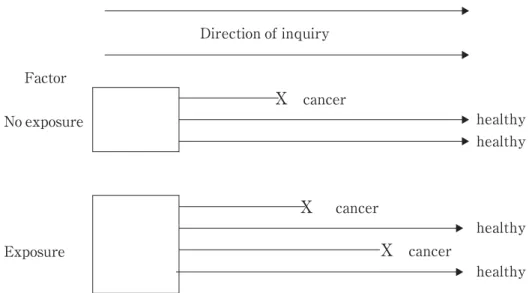
1). As shown in Fig 1, the cohort study is an observational study in which the starting point is the selection of a study population that has no manifestation of the dis- ease of the interest. Information is obtained to
determine which members of this study popula- tion are exposed to the factor of interest. The entire population is followed up over time and the incidence of the disease in the exposed group is compared with the incidence of the un- exposed group. The cohort study provides the best information about the causation of disease and the most direct measurement of the risk of developing disease. However, the cohort study requires long periods of follow-up, and is not suitable for investigating rare diseases.
In our previous cohort study
5), 2,998 hepati- tis B surface antigen (HBsAg) negative subjects and 54 positive subjects in town K were fol- lowed from June 1992 to March 1997. Seventy- nine subjects were lost during the study period because they moved from the town. On the ba- sis of 13,735.0 person-years, 20 subjects were newly diagnosed with hepatocellular carcinoma (HCC) among HBsAg-negative subjects while 2 subjects were among positive subjects on the basis of 248.9 person-years. Thus, our previous study revealed that the risk of developing HCC was significantly higher for subjects who were positive for HBsAg (hazard ratio=5.52, 95% con- fidence interval: 1.29, 23.63, p<0.05). Even after controlling for gender and age, positivity for HBsAg was significantly associated with HCC risk (hazard ratio=7.28, 95% confidence interval:
1.62, 32.61, p<0.01).
Fig. 1 Outline of cohort study
M.WASHIO et al.
42
Time
Direction of inquiry
No exposure
No exposure Exposure Exposure
Observation of past exposure Identification of cases and control
Cases With cancer
Without cancer Study Population
Controls
Case-control study
The case control study is relatively simple and economical to carry out
1). The case-control study is suitable for investigating the cause of a rare disease but not for rare causes. As shown in Fig. 2, the case-control study is an observa- tional study in which the starting point is the identification of cases and controls. Cases are identified because they are known to have the disease of interest while controls are identified because they do not have the investigated dis- ease. The frequencies of past exposures are compared between cases and controls. In the case-control study, the exposure status of the cases is usually determined after the develop- ment of the disease. Questions about past expo- sures are usually answered by the study sub- jects or their relatives. Their answers may be influenced by the disease experiences. Exposure is sometimes determined by biological measure- ments, which may be affected by the disease.
This problem can be avoided in the nested case- control study.
The nested case-control study is a case- control study in which cases and controls are
drawn from the population in the cohort study
2). In the nested case-control study, the exposure data are collected before the development of the disease.
In our previous case-control study
6), 89 cases with ovarian cancer were compared with 323 control subjects without ovarian cancer.
Seven cases (7.9%) had a history of diabetes mel- litus among the 89 cases while 8 controls (2.5%) did so among 323 controls. Thus, our previous study revealed that a history diabetes mellitus was associated with a significantly increased risk of ovarian cancer (odds ratio=2.94, 95% con- fidence interval: 1.02, 8.49, p<0.05). However, when the heaviest non-pregnant weight was si- multaneously included in the model as continu- ous variable, a history of diabetes mellitus failed to remain as a significantly increased risk factor (odds ratio=2.52, 95% confidence interval: 0.86, 7.40).
Cross-sectional study
The cross-sectional study is a study that ex- amines the relationship between diseases and other variables of interest as they exist in a de-
Fig. 2 Outline of case!control study37(2002) Ethical Issues in Cancer Epidemiology 43
Genetic factors Determinant factor
Risk factor 1 Risk factor 2
Risk factor X
Hereditary
Environmental factors Chemical carcinogens Tobacco
Alcohol
Radiation Diet
Virus cancer
Sporadic cancer
fined population at one particular time
2). The fre- quencies of variables of interest are compared between disease-positive subjects and -negative subjects. The prevalence of disease rather than the incidence is normally recorded.
In our previous study
7), 227 males (19.7%) were positive for hepatitis C virus antibody (anti -HCV) among 1151 males in town K. The 227 anti-HCV positive males were compared with 924 negative males. Thirty-nine positive sub- jects (17.3%) had a medical history of blood transfusion as did 62 negative subjects (6.8%).
Thus, our previous study revealed that a his- tory of blood transfusion was a risk factor for anti-HCV positivity (odds ratio=2.65, 95% confi- dence interval: 1.72, 4.10, p<0.001).
Case-only study
The case-only study is a method that ana- lyzes data from a case series, with assumed or theoretical data on prior distribution of expo- sure instead of a control group
2). Epidemiologists use the case-only study design to study the as- sociation between environmental exposure and genotype in genetic epidemiology.
3. Genetic Risk Factors and Environmental Risk Factors
Carriers with a determinant genetic factor of a hereditary cancer show a highly increased risk of developing the hereditary cancer (e.g., fa- milial adenomatous polyposis) while carriers
with a genetic risk factor of a sporadic cancer have a little risk of developing the sporadic can- cer (Fig. 3)
8). Dozens of genetic risk factors are involved in sporadic cancer. With the exposure to an environmental risk factor, carriers of a ge- netic risk factor show a greater risk of develop- ing the sporadic cancer than those without the genetic risk factor. In other words, environ- mental risk factors interact with genetic risk factors (the gene-environment interaction ) , which put one individual at a greater or smaller risk of sporadic cancer than another. Molecular epidemiological studies have suggested complex interactions between the estrogen receptor and the aromatic hydrocarbon receptor pathways in the gender difference in lung cancer susceptibil- ity. It is possible that circulating estrogen may interact with receptors present in the lung and modulate the expression of polycyclic aromatic hydrocarbon (PAH) metabolizing enzymes
9).
Genetically determined susceptibility to smoking-related cancers may depend on the metabolic balance between phase I and phase II enzymes. Benzo(a)pyrene, one of the most typi- cal PAHs, is ultimately metabolized to the car- cinogen BP7,8-diol-9,10-oxide by phase I enzyme CYP1A1. Subsequently, the ultimate carcinogen can be metabolized further to innocuous water soluble metabolites through conjugation with glutathione by phase II enzymes GSTs (Fig. 4).
It is likely that individuals with more reactive phase I enzymes and less efficient phase II en-
*Dozens of risk factors are considered to be involved in sporadic cancer.
Fig. 3 Genetic and environmental factors in carcinogenesis M.WASHIO et al.
44
Benzo(a)pyrene
Phase I reaction
Metabolic activation
Formation of DNA
adduct Cancer
Detoxification
Cytochrome P450s (CYPs)
Glutathione S-transferases (GSTs) + Glutathione
Phase ll reaction Benzo(a)pyrene
7,8,-diol-9,10-epoxide O
H O
O H
O H O H
O H G S
zymes might be at higher risk of cancer than in- dividuals with the opposite combination. Ciga- rette smoking is a strong risk factor of lung can- cer, but genetically determined variations in the metabolism of tobacco-derived carcinogens may affect individual risk. Smoking-related risk of lung cancer may be more accurately estimated when genetic susceptibility is allowed for as re- gards both CYP1A1 and GST genotypes. The findings in Japanese population studies to date have revealed high ORs for lung cancer
10). How- ever, only 10 to 24% of Japanese lung cancer pa- tients display these polymorphism combinations.
For non-Asian populations, the relevance of the CYP1A1 Msp I and GSTM1 polymorphisms to lung cancer is questionable, given their low prevalence in both lung cancer and general populations. Combined CYP1A1 and GSTM1 genotypes are thus a potential predictor of ge- netic susceptibility to smoking-related lung can-
cers in populations where CYP1A1 alleles are common.
4. Ethical Issues
Ethics in epidemiologic practice
Ethics is the branch of philosophy that deals with distinctions between right and wrong, with the moral consequences of human actions
2). Ethical principles govern the conduct of epidemiology, as they do all human activities.
The ethical issues that arise in epidemiologic practice and research include informed consent, confidentiality, respect for human rights, and scientific integrity.
Genetic information and epidemiology
In molecular epidemiology, epidemiologists use genetic information with personal identifiers (e.g., name, social security number, address, tele- phone number), which may lead to discrimina-
Fig. 4 Metabolism of Benzo(a)pyrene37(2002) Ethical Issues in Cancer Epidemiology 45
tion, stigmatization, embarrassment, and ostra- cism
11).
Since genetic information does not change and is shared with siblings and parents, both in- formed consent and confidentiality are very im- portant. Thus, suggestions have been made for the regulation of genetic research (definitely, in- cluding cancer epidemiology) and DNA da- tabanks
12). The suggestions include public disclo- sure of intent to establish the DNA databank, justification for research, prior written authori- zation and approval that sets forth the uses and purpose of research, guaranteed individual ac- cess to the sample and the records, the right to request return or destruction of the sample, the right to correct inaccurate information, strict se- curity measures and protection against un- authorized or third party access, and notifica- tion of new information with potential impacts on health.
"Ethical Principles of Research on the Human Genome and Genetic Analysis" in Japan
In Japan, a Sub-committee on Human Genome Research (Bioethics Committee, Council for Science and Technology) was created in De- cember 1999 to examine the approach to be taken in human genome research, and following the discussion therein, proclaimed the "Funda- mental Principles of Research on the Human Genome" on June 14th, 2000. Following this, three ministries (the Ministry of Health, Labour and Welfare, the Ministry of Economy, Trade and Industry, and Ministry of Education, Cul- ture, Sports, Science and Technology [MEXT]) announced the "Ethical Principles of Research on the Human Genome and Genetic Analysis"
on March 29
th, 2001. ( http://www2.ncc.go.jp/elsi /index.htm) These principles define the ethical framework that should be respected by those who are engaged in human genome research such as scientists and physicians in Japan.
Informed consent for the participants
Participants have the right to make a vol- untary decision either to take part in a study or
to refuse. Epidemiologists should not induce or intimidate participants. Epidemiologists should give participants the necessary information, in- cluding specific characteristics of genetic infor- mation. Epidemiologists should judge each indi- vidual participant's level of understanding, and should use easy words so that participants are able to understand what they are told and to make a reasoned choice.
Informed consent for surrogates
When the potential participants are not competent (e.g. those with cognitive impair- ments and children), epidemiologists may seek consent from surrogates (e.g. a partner, relative, or parent)
13). When children are 15 years old and older, epidemiologists should seek consent not only from their parents but also from the chil- dren themselves. When children do not want to join the study, their opinions should be re- spected whether they are 15 years and older or not.
Informed consent for the general population The general population may misunderstand genetic epidemiology unless they know the dif- ference between genetic risk factors and deter- minant genetic factors. Genetic epidemiology aims to establish the strategy of preventive medicine based on genetic information. Carriers of a genetic risk factor can prevent the develop- ment of a sporadic cancer by avoiding exposure to environmental risk factors. Education for the general population is thus recommended.
Institutional review boards (IRBs) Reform in US Recently, institutional review boards (IRBs) review "too much, too quickly, and with too little expertise," and many IRBs spend "only 1 or 2 minutes of review per study."
14)This inade- quate situation of protection of the rights and welfare of human subjects in medical research is now being intensively discussed in the US.
Annas warned that, with risk of genetic re- search, "racism" could be replaced or supple- mented by "genism."
15)As part of the IRB re- form process, efforts should focus on taking the
M.WASHIO et al.46
entire consent process seriously. The goal of in- formed consent is to provide protection by mak- ing sure that potential research subjects under- stand the research they are being asked to vol- unteer for, its risks, its benefits, and its alterna- tives.
We should not forget that informed consent is a process, and only after that process occurs it is documented with a consent form. Beskow's paper will be helpful in preparing a consent form for population-based research involving ge- netics
16).
Genetic counseling
Genetic counseling should be provided for the participants when epidemiologists intend to inform each participant personal about genetic information
17). Candidates should consult with a genetic counselor in order to decide whether they will get personal genetic information. After getting their own genetic information, follow-up counseling should be provided.
Notification of cancer (truth telling)
In Japan, not all cancer patients are told that they are suffering from cancers, nor do doctors in Japan always notify their patients about the name of the cancer
18). Most doctors do so on a case-by-case basis after consultation with the patient's family. When cancer patients do not know the truth, epidemiologists should not tell the truth. In that case, epidemiologists should ask cancer patients to take part in a study not for cancers but for assumed diseases, which they are notified of.
Confidentiality
Epidemiologists should respect participants' right to privacy. Epidemiologists may correct and store their personal data. If such data are disclosed to a third party, they may be harmful to the participants. Genetic information with personal identifiers may lead to discrimination.
Epidemiologists should make arrangements for protecting the confidentiality of personal data, for example, by omitting personal identifiers,
and limiting access to the data.
Dissemination of findings of public health im- portance
Epidemiologists should inform scientific peers of their study results by publications in the scientific literature or presentations at scien- tific conferences
19). Epidemiologists should dis- seminate findings of public health importance as well.
6. Conclusion
In this paper, we discuss the ethical issues in cancer epidemiology using disease susceptibil- ity genes. Since genetic information does not change and is shared with siblings and parents, both informed consent and confidentiality are very important. The general population may misunderstand genetic epidemiology unless they know the difference between genetic risk fac- tors and determinant genetic factors. Education for the general population is thus recommended.
ACKNOWLEDGEMENT
A part of this paper was presented at the first Congress of the Research Project on Ethi- cal and Legal Guidelines for the Use of Human Bodies and Tissues (chief: Prof. K Shoji, School of Law, Hokkaido University) on July 27
th, 2002.
REFERENCES
1.Ahlbom A, Norell S. Introduction to modern epidemiology. 2nd ed. Chestnut Hill, MA:
Epidemiology Resources Inc; 1990.
2.Last JM. A dictionary of epidemiology. 4th ed.
New York: Oxford University Press; 2001.
3.Farmer R, Miller D, Lawrenson R. Lecture notes on Epidemiology and Public Health Medicine. 4th ed. Cambridge, Mass: Black- well Science; 1996.
4.Silva IS. Cancer epidemiology: principles and methods. Lyon: International Agency for Research on Cancer; 1999.
5.Mori M, Hara M, Wada I, Hara T, Yamamoto K, Honda M, Naramoto J. Pro- spective study of hepatitis B and C viral in-
37(2002) Ethical Issues in Cancer Epidemiology 47
fections, cigarette smoking, alcohol con- sumption, and other factors associated with hepatocellular carcinoma risk in Japan. Am J Epidemol 2001; 151: 131
!139.
6.Mori M, Nishida T, Sugiyama T, Komai K, Yakushiji M, Fukuda K, Tanaka T, Yok- oyama M, Sugimori H. Anthropometric and other risk factors for ovarian cancer in a case-control study. Jpn J Cancer Res 1998;
89: 246
!253.
7.Mori M, Inutsuka H, Wada I, Yamamoto K, Honda M, Naramoto J. Factors associated with hepatitis C virus transmission in the area of high incidence of hepatic cancer in Japan. Hepatol Res 1998; 10: 17
!26.
8.Nakamura Y. Advances in genome medi- cine: Impact of human genome analysis on future medicine. Tokyo: Yodosha Co. Ltd;
2000. ( in Japanese)
9.C Kiyohara, K Yoshimasu, M Washio. Gen- der difference in lung cancer susceptibility;
Tumor Res 2002; 37: 1
!7.
1 0.Kiyohara C, Shirakawa T, Hopkin JM. Ge- netic polymorphism of enzymes involved in xenobiotic metabolism and the risk of lung cancer. Environ Health Prevent Med 2002;
7: 47
!59.
1 1.Coughlin S, Beauchamp T. Ethics and epi- demiology. New York: Oxford University Press; 1996.
1 2.Annas GJ. Privacy rules for DNA da- tabanks: Protecting coded 'future diaries'.
JAMA 1993; 270: 2346
!2350.
1 3.Washio M. Epidemiology and ethics. In: Ja- pan epidemiological association editors. An Introductory Textbook of Epidemiology.
Tokyo: Nankodo; 2002. p. 87
!91. (in Japa- nese)
1 4.Dept of Health and Human Services; Insti- tutional Review Boards. A Time for Re- form. Washington, DC: June 1998.
1 5.Annas GJ. Reforming informed consent to genetic research. JAMA 2001; 286: 2326
!2328.
1 6.Beskow LM, Burke W, Merz JF, Barr PA, Terry S, Penchaszadeh VB, Gostin LO,
Gwinn M, Khoury MJ. Informed consent for population-based research involving genet- ics. JAMA 2001; 286: 2315
!2321.
1 7.Washio M, Hatate T, Ikeda S, Kiyohara C, Mori M. Epidemiology and gene-analysis with special reference to ethical issues. Rin- sho To Kennkyu 2002; 79: 2151
!2154. (in Japanese)
1 8.Ohbayashi K, Hashimoto N. Notification of cancer and informed consent. Nihon-ishikai- zasshi 1996; 115: 1081
!1086. (in Japanese) 1 9.ISPE. Guidelines for good epidemiology
practices for drug, device, and vaccine re- search in the United States. Pharmacoepi- demiol Drug Saf 1996; 5: 333
!338.
(Accepted for publication, Nov. 5, 2002)
M.WASHIO et al.48