• 検索結果がありません。

-INVASIVE METHOD FOR PREDICTING HEPATOCELLULAR CARCINOMA IN PATIENTS WITH CHRONIC HEPATIC DISEASE BY MEASURING THE SHEAR WAVE VELOCITY

N/A
N/A
Protected

Academic year: 2021

シェア "-INVASIVE METHOD FOR PREDICTING HEPATOCELLULAR CARCINOMA IN PATIENTS WITH CHRONIC HEPATIC DISEASE BY MEASURING THE SHEAR WAVE VELOCITY"

Copied!
11
0
0

読み込み中.... (全文を見る)

全文

(1)

NON

-

INVASIVE METHOD FOR PREDICTING HEPATOCELLULAR  CARCINOMA IN PATIENTS WITH CHRONIC HEPATIC DISEASE 

BY MEASURING THE SHEAR WAVE VELOCITY

Junichi Fujiwara, Takashi Goto, Tomomi Shibuya, Mitsuru Chiba, Shigetoshi Ohshima, Kouichi Miura, Wataru Sato, Takahiro Dohmen, Toshitaka Sakai, Yuko Sugimoto,

Shinichiro Minami and Hirohide Ohnishi (received 11 March 2016, accepted 14 April 2016)

Department of Gastroenterology and Hepato

-

Biliary

-

Pancreatology, Akita University Graduate School of Medicine, 1

-

1

-

1 Hondo, Akita 010

-

8543, Japan

Abstract

Aim : To evaluate the usefulness of acoustic radiation force impulse (ARFI) in predicting hepato- cellular carcinoma (HCC) in patients with chronic hepatic disease (CHD).

Methods : A total of 230 patients participated in this study. They were subsequently classified into the “HCC group” and the “non

-

HCC group”. We measured their liver stiffness and calcu- lated the mean shear wave velocity (SWV) using ARFI.

Results : The mean SWV was significantly higher in the HCC group than in the non

-

HCC group. The cut

-

off value for the mean SWV with the best discrimination between the two groups was 1.36 (m/s). The area under the receiver operating characteristic curve (AUROC) was 0.807. The AUROCs of the aspartate

-

aminotransferase

-

to

-

platelet ratio and Fibrosis 4 score were 0.780, 0.728, respectively. The independent risk factors of HCC included the mean SWV and age. A further analysis, based on the individual causes of CHD, found that among the HCV and non

-

HBV and non

-

HCV (nBnC) cases, the mean SWV was significantly higher in the HCC group than in the non

-

HCC group.

Conclusion : Measuring the SWV using ARFI was a reliable method for predicting HCC in CHD patients, especially in HCV and nBnC patients.

Key words : acoustic radiation force impulse, shear wave velocity, receiver operating char- acteristic curves, hepatocellular carcinoma

Corresponding author : Takashi Goto, Associate Profes- sor

Department of Gastroenterology and Hepato

-

Biliary

-

Pancreatology, Akita University Graduate School of Medi- cine,1

-

1

-

1 Hondo, Akita 010

-

8543, Japan

Tel : 81

-

18

-

834

-

1111 Fax : 81

-

18

-

834

-

8619

E

-

mail : [email protected]

-

u.ac.jp

hepatocellular carcinoma (HCC) are very important is- sues. The risk factors for HCC include hepatitis C virus (HCV) infection, hepatitis B virus (HBV) infection, alco- hol consumption, obesity, and other factors ; however, the most important factor is progressive liver fibrosis, particularly the presence of cirrhosis

2)

. When treating progressive liver disease, it is very important to provide appropriate to prevent HCC. Furthermore, it is impor- tant to evaluate the stage of liver fibrosis in order to pre- dict HCC in patients with progressive chronic hepatic disease (CHD). A liver biopsy is considered to be the gold standard for liver fibrosis assessments ; however Introduction

Liver cancer is the second most common cause of

death : it accounted for nearly 746,000 deaths worldwide

in 2012

1)

. Thus, the prevention and early detection of

(2)

this method is invasive and is not suitable for screening examinations. After transient elastography (TE) using a FibroScan examination was applied in the clinical setting as a non

-

invasive assessment of liver stiffness, many studies have reported correlations between TE findings and liver fibrosis

3-6)

. Acoustic radiation force impulse (ARFI) was recently developed as a new method for con- ducting non

-

invasive liver fibrosis assessments. ARFI is a non

-

invasive ultrasonographic technique that can be used to evaluate the degree of liver stiffness by measur- ing the shear wave velocity (SWV)

7)

. Studies that com- pared of TE and ARFI have found ARFI to have a similar predictive value to or to be more accurate than TE in the diagnosis of severe fibrosis

7)-14)

. Furthermore, unlike TE, ARFI is said to not be influenced by the body mass index (BMI) (<27.7 kg/m

2

) or the presence of ascites

15)

and is able to assess liver fibrosis of both the right and left lobes

16)

.

Several studies have reported a correlation between liver fibrosis and stiffness (as measured by ARFI).

However, few reports have evaluated the liver SWV in patients with CHD with respect to predicting HCC. The aim of this study was to compare the degree of liver stiff- ness between patients with and without HCC using ARFI and to evaluate the usefulness of this technique for pre- dicting HCC in patients with CHD.

Materials and Methods

The present study was conducted in accordance with the principles of the Declaration of Helsinki and the study protocol was approved by the ethics committee of Akita University Graduate School of Medicine. We ob- tained informed consent from all patients prior to their entry into the study entry.

Patients

A total of CHD 230 patients who underwent the mea- surement of the SWV in the liver parenchyma at Akita University hospital between September 2009 and January 2014 were included in this study. Patients with HCC were classified into the “HCC group” ; those who had not previously been diagnosed with HCC were classified into the “non

-

HCC group.”

Diagnosis and classification

The diagnosis of HCC was made using contrast

-

en- hanced computed tomography, contrast

-

enhanced mag- netic resonance imaging, contrast

-

enhanced ultrasonog- raphy with Sonazoid

®

and/or a tumor biopsy based on the guidelines proposed by the Japan Society of Hepatolo- gy

17)

. HCC staging was performed according to the TNM classifications provided by the American Joint Committee on Cancer (AJCC)

18)

.

The assessment of liver stiffness

We used a Siemens ACUSON S2000 device (Mochida Siemens Medical Systems Co. Ltd., Tokyo, Japan) to measure the degree of tissue stiffness quantified by shear wave speed expressed in meters/second (m/sec) and cal- culated the SWV within the a 10×5 mm region of inter- est (ROI). In this study, the mean SWV was calculated within the ROI, which located in a segment of the right liver lobe 5, six times via the intercostal approach using a convex probe. The procedures were performed by the same experienced physicians. While performing B

-

mode imaging, we focused on the ROI at a depth of 2

-

5 cm below the liver capsule and selected a location with- out large vessels or bile ducts.

Other indexes of liver fibrosis

The aspartate aminotransferase/alanine aminotransfer- ase ratio (AAR), aspartate

-

aminotransferase

-

to

-

platelet ratio (APRI) and Fibrosis 4 score (FIB

-

4) are existing formulae that are used for predicting the progression of liver fibrosis

19-21)

. These formulae were used to mea- sure liver fibrosis in each of the cases. The formulae are as follows :

AAR = AST (U/L)/ALT (U/L) APRI = (AST [U/L]/

Upper normal limit for AST [U/L])/

Platelet count (10

9

/L)×100 FIB

-

4 = (age [years]×AST [U/L])/

     (Platelet count [10

9

/L]×ALT [U/L]

0.5

).

We compared each of the indexes with the SWV and

examined the usefulness of the SWV.

(3)

Statistical analysis

The values are expressed as the mean ± standard de- viation. The statistical analyses were performed using the non

-

parametric Wilcoxon

-

Mann

-

Whitney U

-

test for continuous data, χ

2

or Fisher’s exact test for qualitative data and the one

-

way analysis of variance for the multi

-

group data. The correlations between the mean SWV and the fibrosis indexes were assessed according to Spearman’s correlation coefficient. Receiver operating characteristic (ROC) curves were used to assess the di- agnostic performance of ARFI, and the area under the ROC curve (AUROC), sensitivity, specificity and cut

-

off values were calculated. ROC curves represent sensitiv- ity versus 1

-

specificity for all possible cut

-

off values for the prediction of HCC. An AUROC value close to 1.0 indicated high diagnostic accuracy. Risk factors for HCC were identified using a multiple logistic regression analy- sis. P

-

values of <0.05 were considered to indicate sta- tistical significance.

Results Patient characteristics

A total of 230 patients were included in the current study (male, n=132 ; female, n=98 ; mean age, 61.6±

13.3 years). In terms of the cause of CHD, 98 patients developed HCV infection (HCV cases), 68 patients devel- oped HBV infection (HBV cases) and 64 patients were found to have a non

-

HBV and non

-

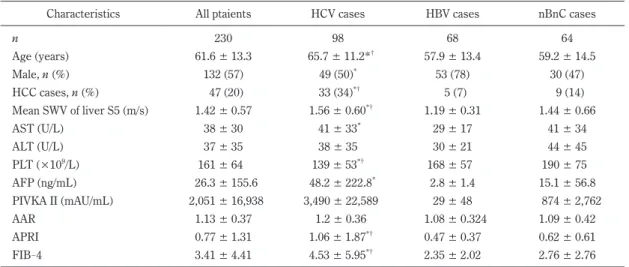
HCV status (nBnC cases). Among the 230 patients, 47 had HCC (HCV, n=33 ; HBV, n=5 ; nBnC, n=9). Table 1 shows all of the patients’ characteristics and a comparison of the HCV cases, HBV cases, and nBnC cases. There were signifi- cant differences in the age, the number of males, the mean SWV, and the APRI and FIB

-

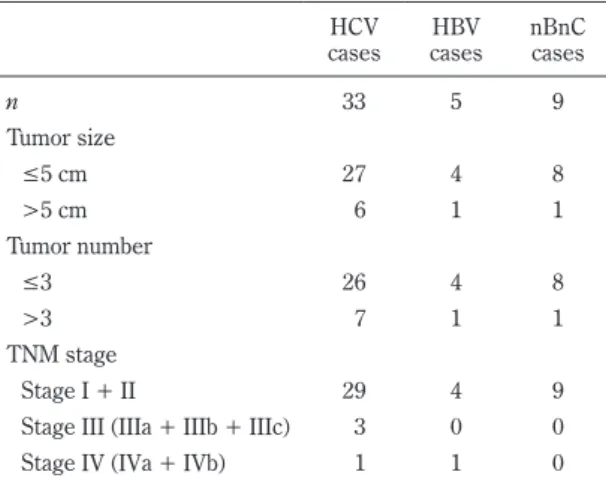
4 values of the HCV cases and the HBV and nBnC cases. Regarding the tu- mor size and the number of tumors in the HCC patients, 27 of the HCV patients had a tumor size of ≤5 cm and 26 had ≤3 tumors. Four of the HBV patients had a tumor size of ≤5 cm and 4 had ≤3 tumors. Eight of the nBnC patients had a tumor size of ≤5 cm and 8 had ≤3 tu- mors. Almost of the HCC patients were classified as stage I or II (Table 2).

Table 1. The patient characteristics (mean±standard deviation)

Characteristics All ptaients HCV cases HBV cases nBnC cases

n 230 98 68 64

Age (years) 61.6 ± 13.3 65.7 ± 11.2*

57.9 ± 13.4 59.2 ± 14.5

Male, n (%) 132 (57) 49 (50)

*

53 (78) 30 (47)

HCC cases, n (%) 47 (20) 33 (34)

*†

5 (7) 9 (14)

Mean SWV of liver S5 (m/s) 1.42 ± 0.57 1.56 ± 0.60

*†

1.19 ± 0.31 1.44 ± 0.66

AST (U/L) 38 ± 30 41 ± 33

*

29 ± 17 41 ± 34

ALT (U/L) 37 ± 35 38 ± 35 30 ± 21 44 ± 45

PLT (×10

9

/L) 161 ± 64 139 ± 53

*†

168 ± 57 190 ± 75

AFP (ng/mL) 26.3 ± 155.6 48.2 ± 222.8

*

2.8 ± 1.4 15.1 ± 56.8

PIVKA II (mAU/mL) 2,051 ± 16,938 3,490 ± 22,589 29 ± 48 874 ± 2,762

AAR 1.13 ± 0.37 1.2 ± 0.36 1.08 ± 0.324 1.09 ± 0.42

APRI 0.77 ± 1.31 1.06 ± 1.87

*†

0.47 ± 0.37 0.62 ± 0.61

FIB

-

4 3.41 ± 4.41 4.53 ± 5.95

*†

2.35 ± 2.02 2.76 ± 2.76

*P<0.05 vs HBV cases,

P<0.05 vs nBnC cases.

AST : Asparate transaminase ; ALT : Alanine transaminase ; AFP : Alpha

-

fetoprotein ; PIVKA

-

II : protein induced

by Vitamin K absence or antagonists

-

II ; AAR : Aspartate aminotransferase/alanine aminotransferase

ratio ; APRI : aspartate

-

aminotransferase

-

to

-

platelet ratio ; FIB

-

4 : Fibrosis 4 score.

(4)

The correlation between the SWV values and the AAR, APRI and FIB

-

4 values

The mean SWV was significantly correlated with the AAR (r=0.293, P<0.0001) (Fig. 1a). Significant correla- tions were found between the mean SWV values and the APRI (r=0.503, P<0.0001) and FIB

-

4 (r=0.522, P<0.0001) values (Fig. 1b, c).

Comparison of the HCC and non

-

HCC groups The mean SWV values in the HCC and non

-

HCC groups were 1.82 ± 0.61 (m/s) and 1.31 ± 0.50 (m/s), re- spectively. The mean SWV was significantly higher in the HCC group than in the non

-

HCC group (Table 3).

Age, the AST, ALT and AFP levels and the APRI and FIB

-

4 values were significantly higher and the platelet count was significantly lower in the HCC group than in the non

-

HCC group (Table 3). The cut

-

off value, sensi- tivity, specificity, positive predictive value (PPV) and the negative predictive value (NPV) which exhibited the best discrimination for the mean SWV were 1.36 (m/s), 0.79, 0.75, 0.45 and 0.93 respectively (Fig. 2a). The AUROC was 0.807. The AUROCs for the APRI and FIB

-

4, were 0.780 and 0.728, respectively (Fig. 2b, 2c). These data indicate that the SWV is a more reliable predictor of HCC than the APRI and FIB

-

4.

Table 2. The clinical characteristics of the 47 hepatocel- lular carcinoma patients.

cases HCV HBV

cases nBnC cases

n 33 5 9

Tumor size

≤5 cm

27 4 8

>5 cm 6 1 1

Tumor number

≤3

26 4 8

>3 7 1 1

TNM stage

Stage I + II 29 4 9

Stage III (IIIa + IIIb + IIIc) 3 0 0

Stage IV (IVa + IVb) 1 1 0

Fig. 1. The correlation between the SWV values and other parameters of fibrosis

(a) The mean SWV was significantly correlated with

the AAR (r=0.293, P<0.0001). (b) The mean SWV

was significantly correlated with the APRI (r=0.503,

P<0.0001). (c) The mean SWV significantly corre-

lated with the FIB

-

4 (r=0.522, P<0.0001).

(5)

A multivariate analysis for discriminating between the HCC and non

-

HCC groups

The discriminative value of the patient characteristics in the HCC and non

-

HCC groups was evaluated using a multivariate logistic regression analysis. Consequently, the mean SWV and age were found to be statistically sig- nificant (Table 4).

The HCV cases in the HCC and non

-

HCC groups The mean SWV values for the HCV cases in the HCC and non

-

HCC groups were 1.87±0.57 (m/s) and 1.41±

0.57 (m/s), respectively. The mean SWV was signifi- cantly higher in the HCC group than in the non

-

HCC group. The AST, ALT and AFP levels and the APRI and FIB

-

4 values were significantly higher and the platelet count was significantly lower in the HCC group than in the non

-

HCC group (Table 5). The cut

-

off value which exhibiting the best discrimination for the mean SWV be- tween the HCC group and the non

-

HCC group was 1.32 (m/s). The AUROC values were 0.778. The mean SWV showed a sensitivity of 0.88, a specificity of 0.65, a

PPV of 0.56, and an NPV of 0.91 for detecting HCC (P<0.0001) (Fig. 3a).

The HBV cases in the HCC and non

-

HCC groups The mean SWV values for the HBV cases in the HCC and non

-

HCC groups were 1.50±0.45 (m/s) and 1.17±

0.28 (m/s), respectively (Table 5). Unfortunately, the difference was not statistically significant. This was at- tributed to the number of HBV cases in the HCC group, which was smaller than the numbers of HCV and nBnC cases. However, the mean SWV cut

-

off value for the HBV cases (1.67 [m/s]) showed the best discrimination between the HCC and non

-

HCC groups. Furthermore, the AUROC value was 0.708, and the mean SWV showed a sensitivity of 0.60, a specificity of 0.95, a PPV of 0.50 and an NPV of 0.97 for detecting HCC (P=0.0007) (Fig.

3b).

The nBnC cases in the HCC and non

-

HCC groups The mean SWV values of the nBnC cases in the HCC and non

-

HCC groups were 1.94±0.80 (m/s) and 1.35±

0.59 (m/s), respectively. The mean SWV value was sig- Table 3. The comparison of all patients in the HCC and non

-

HCC groups (mean±standard

deviation)

HCC non

-

HCC

n 47 183

Age (years) 70.4 ± 9.0* 59.3 ± 13.3

Male, n (%) 26 (55) 106 (58)

HCV cases, n (%) 33 (70)* 65 (36)

HBV cases, n (%) 5 (11)* 63 (34)

Mean SWV of liver S5 (m/s) 1.82 ± 0.61* 1.31 ± 0.50

AST (U/L) 57 ± 43* 33 ± 24

ALT (U/L) 55 ± 42* 33 ± 31

PLT (×10

9

/L) 137 ± 61* 168 ± 59

AFP (ng/mL) 96.1 ± 311.4* 4.7 ± 7.7

PIVKA II (mAU/mL) 5,677 ± 30,053 407 ± 1,253

AAR 1.17 ± 0.41 1.12 ± 0.33

APRI 1.44 ± 1.92* 0.60 ± 1.05

FIB

-

4 5.70 ± 4.64* 2.82 ± 4.17

*P<0.05 vs non

-

HCC groups. AST : Asparate transaminase ; ALT : Alanine trans-

aminase ; AFP : Alpha

-

fetoprotein ; PIVKA

-

II : protein induced by Vitamin K absence or

antagonists

-

II ; AAR : Aspartate aminotransferase/alanine aminotransferase ratio ;

APRI : aspartate

-

aminotransferase

-

to

-

platelet ratio ; FIB

-

4 : Fibrosis 4 score.

(6)

nificantly higher in the HCC group than in the non

-

HCC group. The age and FIB

-

4 values were significantly higher in the HCC group than in the non

-

HCC group (Ta- ble 5). The cut

-

off value exhibiting the best discrimina- tion for the mean SWV between the HCC and non

-

HCC

groups was 1.59 (m/s). The AUROC value was 0.803. The mean SWV showed a sensitivity of 0.67, a specificity of 0.84, a PPV of 0.38, and an NPV of 0.94 for detecting HCC (P=0.0040) (Fig. 3c).

Fig. 2. The ROC curves for the mean SWV (a), APRI (b) and FIB

-

4 (c). The sensitivity, specificity, positive pre-

dictive value (PPV), negative predictive value (NPV), AUROC and the cut

-

off value exhibiting the best discrimina-

tion for each of the data are shown, respectively.

(7)

Discussion

In the present study, we evaluated the efficacy of the mean SWV of the liver in predicting HCC in CHD pa- tients. The APRI and FIB

-

4 values have been shown to be correlated with the degree of liver fibrosis in previous studies

5,20-25)

and were found to be correlated with the mean SWV in this study. In addition, by comparing each of the AUROCs, we found that the ARFI was more useful for predicting HCC than the APRI and FIB

-

4. Based on the results of meta

-

analyses, some studies have reported that the results of ARFI elastography to have a good cor- relation with the extent of liver fibrosis

15,26-31)

, and the ARFI values have been demonstrated to differ between patients with and without a sustained viral response (SVR) after antiviral treatment for chronic hepatitis C (CHC)

32)

. Some researchers have reported that liver

stiffness, as measured by TE using a FibroScan examina- tion, was a predictor of HCC, and have shown high liver stiffness values in HCC patients

3,33,34)

. However, few studies have reported the efficacy of predicting HCC by measuring the SWV using ARFI. Vermehren et al. re- ported that the AUROC for diagnosing HCC was 0.54 for ARFI, but did not present the cut

-

off value in cirrhosis patients

13)

. In the present study, the mean SWV was significantly higher in the HCC group than in the non

-

HCC group (1.82 [m/s] vs. 1.31 [m/s]), and the cut

-

off value was 1.36 (m/s) with a good AUROC (0.807). This result indicates that potential for HCC increased in asso- ciation with advances in liver fibrosis in CHD pa- tients. The age and α

-

fetoprotein (AFP) and transami- nase levels were also significantly higher and the platelet count was significantly lower in the HCC group than in the non

-

HCC group. A decreased platelet count was re- Table 4. A multivariate logistic regression analysis of the risk factors for hepatocellular carcinoma.

Variables OR 95% CI P

-

value

Age 1.113 1.057

-

1.173 <0.0001

Mean SWV of the liver S5 2.411 1.036

-

5.615 0.0412

OR : odd’s ratio ; CI : confidence interval.

Table 5. The HCV, HBV and nBnC cases between in the HCC and non

-

HCC groups. (mean ± standard deviation)

HCV cases HBV cases nBnC cases

HCC non

-

HCC HCC non

-

HCC HCC non

-

HCC

n 33 183 5 63 9 55

Age (years) 70.1 ± 9.6* 63.4 ± 11.4* 66.8 ± 9.0 57.2 ± 13.5 73.3 ± 6.6

56.8 ± 14.1

Male, n (%) 17 (52) 32 (49) 4 (80) 49 (78) 6 (67) 24 (44)

Mean SWV of liver S5

(m/s) 1.87 ± 0.57* 1.41 ± 0.57* 1.50 ± 0.45 1.17 ± 0.28 1.94 ± 0.80

1.35 ± 0.59

AST (U/L) 62 ± 45* 31 ± 20* 37 ± 31 28 ± 15 54 ± 29 38 ± 34

ALT (U/L) 60 ± 45* 27 ± 21* 30 ± 21 25 ± 19 54 ± 18 42 ± 45

Platelets (×10

9

/mL) 115 ± 44* 151 ± 53* 169 ± 53 151 ± 82 188 ± 88 190 ± 64 AFP (ng/mL) 117.5 ± 356.6* 7.9 ± 19.1* 4.0 ± 2.0 2.7 ± 1.3 80.1 ± 137.9 2.1 ± 7.1

PIVKA

-

II (mAU/mL) 6,836 ± 33,571 832 ± 2,290 53 ± 101 25 ± 30 — —

AAR 1.13 ± 0.39 1.23 ± 0.33 1.50 ± 0.2* 1.04 ± 0.28* 1.22 ± 0.46 1.07 ± 0.36 APRI 1.75 ± 2.18* 0.73 ± 1.63* 0.81 ± 0.51 0.44 ± 0.34 0.85 ± 0.67 0.59 ± 0.60 FIB

-

4 6.08 ± 5.15* 3.78 ± 6.20* 5.61 ± 4.86 2.04 ± 1.25 4.39 ± 2.04

2.49 ± 2.77

*P<0.05,

P<0.05. AST : Asparate transaminase ; ALT : Alanine transaminase ; AFP : Alpha

-

fetoprotein ; PIVKA

-

II : protein induced by Vitamin K absence or antagonists

-

II ; AAR : Aspartate aminotransferase/alanine aminotransfer-

ase ratio ; APRI : aspartate

-

aminotransferase

-

to

-

platelet ratio ; FIB

-

4 : Fibrosis 4 score.

(8)

ported to be a predictor of hepatic fibrosis

35)

. We em- ployed a multiple logistic regression analysis to assess the relationships between the presence of HCC and the patient variables. Consequently, age and the mean SWV were found to be independent risk factors for HCC, with odds ratios (95% confidence intervals) of 1.113 (1.057

-

1.173), and 2.411 (1.036

-

5.615), respectively. In previ- ous studies, age

2)

and liver stiffness

33)

were found to be risk factors for HCC. The mean SWV reflected the liver stiffness and we showed that the mean SWV was an inde-

pendent risk factor for HCC. Furthermore, ARFI has an advantage over Fibroscan, in that the SWV can be evalu- ated while scanning the liver with the B mode.

In the present study, the mean SWV of the HCV cases

was significantly higher in the HCC group than in the

non

-

HCC group (1.87 [m/s] vs. 1.41 [m/s]). The cut

-

off

value was 1.32 (m/s) and good AUROC values for detect-

ing HCC were observed (0.778). These data indicate

that HCV

-

positive patients develop HCC via mechanisms

such as chronic hepatitis and cirrhosis. Yoshida et al.

36)

Fig. 3. The ROC curves for the mean SWV of the HCV cases (a), HBV cases (b), and nBnC cases (c). The sen-

sitivity, specificity, positive predictive value (PPV), negative predictive value (NPV), AUROC and the cut

-

off value

exhibiting the best discrimination for the each case are shown, respectively.

(9)

and Inoue et al.

37)

reported similar findings to the present study when they noted that the incidence of HCC in- creased with the degree of liver fibrosis in CHC patients.

In the HBV cases, the mean SWV tended to be higher in the HCC group than in the non

-

HCC group (1.50 [m/s]

vs. 1.17 [m/s]) ; however, the difference did not reach significance due to the small number of HCC cas- es. However, the liver stiffness values determined by ARFI have been shown to be reliable predictors of liver fibrosis in patients with chronic hepatitis B (CHB)

38)

. In addition, Jung et al. examined TE using FibroScan and reported that liver stiffness was a risk factor for HCC in patients with CHB

39)

. Taken together, it seems reason- able to hypothesize that an increased number of HBV pa- tients would allow us to obtain a significant difference in the mean SWV between the HCC and non

-

HCC groups.

In the nBnC cases, the mean SWV was significantly higher in the HCC group than in the non

-

HCC group (1.94 [m/s] vs. 1.35 [m/s]), and good AUROC values for detecting HCC were noted (0.803). Several studies have reported that the liver stiffness values determined by ARFI are reliable predictors of liver fibrosis in patients with autoimmune hepatitis

31)

and nonalcoholic fatty liver disease

28)

. Among the nBnC cases in the present study, the difference in the cut

-

off values between the HCC and non

-

HCC groups were significant. This is a very im- portant finding, as no previous studies have reported the efficacy of ARFI in detecting HCC in nBnC patients.

In a multicenter study performed by Sporea et al., the cut

-

off values for ARFI that were predictive of the vari- ous stages of fibrosis were as follows : 1.19 (m/s) (AU- ROC = 0.779) for F≥1, 1.33 (m/s) (AUROC=0.792) for F≥2, 1.43 (m/s) (AUROC=0.829) for F≥3 and 1.55 (m/s) (AUROC=0.842) for F=4

40)

. In the current study, the cut

-

off values which showed the best discrimination be- tween the HCC and non

-

HCC groups were 1.36 (m/s) (AUROC=0.807), 1.32 (m/s) (AUROC=0.778) and 1.59 (m/s) (AUROC=0.803) for all cases, the HCV cases and the nBnC cases, respectively. Considering the above findings, the cut

-

off values for SWV which were predic- tive of HCC were equivalent to the F2 stage in all cases and the HCV cases and the F4 stage in the nBnC cases.

We hypothesize that the cut

-

off value of the HCV cases in our study was lower than that in the nBnC cases due

to the effects of the different mechanisms promoting HCC in HCV and nBnC as well as the strict follow

-

up that was provided in the HCV cases.

ARFI is a non

-

invasive and simple method for measur- ing the degree of liver stiffness. In the future, ARFI is expected to become more widely used in the clinical set- ting and may become a reliable method for predicting HCC in CHD patients, resulting in the prediction and subsequent treatment of the disease in the early stage. In conclusion, the assessment of the SWV by ARFI may reliably predict HCC in patients with CHD, especially in HCV and nBnC patients.

References

1) Ferly, J., Soerjomataram, I., Ervik, M., Dikshit, R., Eser, S., Mathers, C., Rebelo, M., Parkin, D.M., For- man, D. and Bray, F. (2013) GLOBOCAN 2012 v1.0, Liver Cancer Estimated Cancer Incidence, Mortality and Prevalence World wide : IARC CancerBase No. 11 [Internet]. Lyon, France : International Agency for Research on Cancer. Available from : http://globocan.iarc.fr, Accessed 8/October/2014.

2) Yang, J.D. and Roberts, L.R. (2010) Hepatocellular carcinoma : A global view. Nat. Rev. Gastroenterol.

Hepatol., 7, 448

-

458.

3) Masuzaki, R., Tateishi, R., Yoshida, H., et al. (2012) Assessment of disease progression in patients with transfusion

-

associated chronic hepatitis C using transient elastography. World J. Gastroenterol., 18, 1385

-

1390.

4) Karlas, T., Neuschulz, M., Oltmanns, A., et al. (2012) Non

-

Invasive evaluation of cystic fibrosis related liver disease in adults with ARFI, transient elastog- raphy and different fibrosis scores. PloS one, 7, e42139.

5) Khairy, M., Abdel

-

Rahman, M., El

-

Raziky, M., El

-

Akel, W., Zayed, N., Khatab, H. and Esmat, G. (2012) Non

-

invasive prediction of hepatic fibrosis in patients with chronic HCV based on the routine pre

-

treat- ment workup. Hepat. Mon., 12, e6718.

6) Bota, S., Herkner, H., Sporea, I., Salzl, P., Sirli, R.,

Neghina, A.M., Peck

-

Radosavljevic, M. (2013)

Meta

-

analysis : ARFI elastography versus transient

elastography for the evaluation of liver fibrosis.

(10)

Liver int., 33, 1138

-

1147.

7) Friedrich

-

Rust, M., Wunder, K., Kriener, S., et al.

(2009) Liver Fibrosis in viral Hepatitis : Noninvasive Assessment with Acoustic Radiation Force Impulse Imaging versus Transient Elastography. Radiology,

252, 595-

604.

8) Rizzo, L., Nunnari, G., Berretta, M. and Cacopardo, B.

(2012) Acoustic Radial Force Impulse as an effec- tive tool for a prompt and reliable diagnosis of hepa- tocellular carcinoma

-

preliminary data. Eur. Rev.

Med. Pharmacol. Sci., 16, 1596

-

1598.

9) Rizzo, L., Calvaruso, V., Cacopardo, B., et al. (2011) Comparison of transient elastography and acoustic radiation force impulse for non

-

invasive staging of liver fibrosis in patients with chronic hepatitis C.

Am. J. Gastroenterol., 106, 2112

-

2120.

10) Chen, S.H., Li, Y.F., Lai, H.C., Kao, J.T., Peng, C.Y., Chuang, P.H., Su, W.P. and Chiang, I.P. (2012) Effects of patient factors on noninvasive liver stiff- ness measurement using acoustic radiation force impulse elastography in patients with chronic hepati- tis C. BMC Gastroenterol., 12, 105.

11) Sporea, I., Sirli, R., Bota, S., Popescu, A., Sendroiu, M.

and Jurchis, A. (2012) Comparative study concern- ing the value of acoustic radiation force impulse (ARFI) in comparison with transient elastography (TE) for the assessment of liver fibrosis in patients with hepatitis B and C. Ultrosound Med. Biol., 38, 1310

-

1316.

12) Kircheis, G., Sagir, A., Vogt, C., Vom Dahl, S., Kubitz, R. and Häussinger, D. (2012) Evaluation of acoustic force impulse imaging for determination of liver stiff- ness using transient elastography as a refer- ence. World J. Gastroenterol., 18, 1077

-

1084.

13) Vermehren, J., Polta, A., Zimmermann, O., Her- rmann, E., Poynard, T., Hofmann, W.P., Bojunga, J., Sarrazin, C., Zeuzem, S. and Friedrich

-

Rust, M.

(2012) Comparison of acoustic radiation force impulse imaging with transient elastography for the detection of complications in patients with cirrho- sis. Liver Int., 32, 852

-

858.

14) Sporea, I., Badea, R., Sirli, R., Lupsor, M., Popescu, A., Danila, M., Focsa, M. and Deleanu, A. (2011) How efficient is acoustic radiation force impulse elastography for the evaluation of liver stiffness?

Hepat. Mon., 11, 532

-

538.

15) Bota, S., Sporea, I., Sirli, R., Popescu, A., Danila, M., Jurchis, A. and Gradinaru

-

Tascau, O. (2014) Factors associated with the impossibility to obtain reliable liver stiffness measurements by means of Acoustic Radiation Force Impulse (ARFI) elastography

-

Analy- sis of cohort of 1031 subject. Eur. J. Radiol.,

83,

268

-

272.

16) Toshima, T., Shirabe, K., Takeishi, K., Motomura, T., Mano, Y., Uchiyama, H., Yoshizumi, T., Soejima, Y., Taketomi, A. and Maehara, Y. (2011) New method for assessing liver fibrosis based on acoustic radia- tion force impulse : a special reference to the differ- ence between right and left liver. J. Gastroenterol.,

46, 705-

711.

17) The Japan Society of Hepatology. (2010) Clinical Practice Guidelines for Hepatocellular Carcinoma

-

The Japan Society of Hepatology 2009 update. Hep- atol. Res., 40, 6

-

7.

18) Edge, S.B., Byrd, D.R., Compton, C.C., Fritz, A.G., Greene, F.L. and Trotti, A. (2010) AJCC Cancer Staging Manual. 7th ed. Springer : New York, 191

-

200.

19) Sheth, S.G., Flamm, S.L., Gordon, F.D., Chopra, S.

(1998) AST/ALT ratio predicts cirrhosis in patients with chronic hepatitis C virus infection. Am. J. Gas- troenterol., 93, 44

-

48.

20) Wai, C.T., Greenson, J.K., Fontana, R.J., Kalbfleisch, J.D., Marrero, J.A., Conjeevaram, H.S. and Lok, A.S.

(2003) A simple noninvasive index can predict both significant fibrosis and cirrhosis in patients with chronic hepatitis C. Hepatology, 38, 518

-

526.

21) Sterling, R.K., Lissen, E., Clumeck, N., et al. (2006) APRICOT Clinical Investigators. Development of a simple noninvasive index to predict significant fibro- sis in patients with HIV/HCV coinfection. Hepatol- ogy, 43, 1317

-

1325.

22) Attallah, A., El

-

Far, M., Omran, M.M., Farid, K., Albannan, M.S. and El

-

Dosoky, I. (2013) Noninva- sive diagnosis of liver fibrosis and cirrhosis in chronic hepatitis C patients. J. Clin. Lab. Anal., 27, 121

-

129.

23) Yilmaz, Y., Yonal, O., Kurt, R., Bayrak, M., Aktas, B.

and Ozdogan, O. (2011) Noninvasive assessment of

liver fibrosis with the asparate transaminase to plate-

let ratio index (APRI) : usefulness in patients with

chronic liver disease. Hepat Mon, 11, 103

-

106.

(11)

24) Yamada, R., Hiramatsu, N., Oze, T., et al. (2014) Significance of Liver Stiffness Measurement by Acoustic Radiation Force Impulse (ARFI) Among Hepatitis C patients. J. Med. Virol., 86, 241

-

247.

25) Castéra, L., Vergniol, J., Foucher, J., Le Bail, B., Chanteloup, E., Haaser, M., Darriet, M., Couzigou, P.

and De Lédinghen ,V. (2005) Prospective compari- son of transient elastography, Fibrotest, APRI, and Liver biopsy for the assessment of fibrosis in chronic hepatitis C. Gstroenterology, 128, 343

-

350.

26) Haque, M., Robinson, C., Owen, D., Yoshida, E.M.

and Harris, A. (2010) Comparison of acoustic radia- tion force impulse imaging (ARFI) to liver biopsy histologic scores in the evaluation of chronic liver disease : A pilot study. Ann. Hepatol., 9, 289

-

293.

27) Goertz, R.S., Sturm, J., Zopf, S., Wildner, D., Neur- ath, M.F. and Strobel, D. (2014) Outcome analysis of liver stiffness by ARFI (acoustic radiation force impulse) elastometry in patients with chronic viral hepatitis B and C. Clin. Radiol., 69, 275

-

279.

28) Palmeri, M.L., Wang, M.H., Rouze, N.C., Abdel- malek, M.F., Guy, C.D., Moser, B., Diehl, A.M. and Nightingale, K.R. (2012) Noninvasive Evaluation of Hepatic Fibrosis using Acoustic Radiation Force

-

Based Shear Stiffness in Patients with Nonalcoholic Fatty Liver Disease. J. Hepatol., 55, 666

-

672.

29) Nierhoff, J., Chávez Ortiz, A.A., Herrmann, E., Zeu- zem, S. and Friedrich

-

Rust, M. (2013) The effi- ciency of acoustic radiation force impulse imaging for staging of liver fibrosis : a meta

-

analysis. Eur.

Radiol., 23, 3040

-

3053.

30) Nishikawa, T., Hashimoto, S., Kawabe, N., et al.

(2014) Factors correlating with acoustic radiation force impulse elastography in chronic hepatitis C.

World J. Gastroenterol., 20, 1289

-

1297.

31) Righi, S., Fiorini, E., De Molo, C., Cipriano, V., Cas- sani, F., Muratori, L., Lenzi, M., Morselli Labate, A.M. and Serra, C. (2012) ARFI elastography in patients with chronic autoimmune liver diseases : A preliminary study. J. Ultrasound, 15, 226

-

231.

32) Forestier, N., Gaus, A., Herrmann, E., et al. (2012) Acoustic Radiation Force Impulse imaging for evalu- ation of antiviral treatment response in chronic hepa- titis C. J. Gastrointestin Liver Dis., 21, 367

-

373.

33) Kuo, Y.H., Lu, S.N., Hung, C.H., Kee, K.M., Chen, C.H., Hu, T.H., Lee, C.M., Changchien, C.S. and Wang, J.H. (2010) Liver stiffness measurement in the risk assessment of hepatocellular carcinoma for patients with chronic hepatitis. Hepatol. Int., 4, 700

-

706.

34) Akima, T., Tamano, M., Hiraishi, H. (2011) Liver stiffness measured by transient elastography is a predictor of hepatocellular carcinoma development in viral hepatitis. Hepatol. Res., 41, 965

-

970.

35) Poynard, T. and Bedossa, P. (1997) Age and platelet count : a simple index for predicting the presence of histological lesions in patients with antibodies to hepatitis C virus. J. Viral. Hepat., 4, 199

-

208.

36) Yoshida, H., Shiratori, Y., Moriyama, M., et al. (1999) Interferon therapy reduces the risk for hepatocellu- lar carcinoma : national surveillance program of cir- rhotic and noncirrhotic patients with chronic hepatitis C in Japan. Ann. Intern. Med., 131, 174

-

181.

37) Inoue, A., Tsukuma, H., Oshima, A., Yabuuchi, T., Nakao, M., Matsunaga, T., Kojima, J. and Tanaka, S.

(2000) Effectiveness of interferon therapy for reducing the incidence of hepatocellular carcinoma among patients with type C chronic hepatitis. J.

Epidemiol., 10, 234

-

240.

38) Ye, X., Ran, H.T., Cheng, J., Zhu, Y.F., Zhang, D.Z., Zhang, P. and Zheng, Y.Y. (2012) Liver and Spleen Stiffness Measured by Acoustic Radiation Force Impulse Elastography for Noninvasive Assessment of Liver Fibrosis and Esophageal Varices in Patient With Chronic Hepatitis B. J. Ultrasound Med., 31, 1245

-

1253.

39) Jung, K.S., Kim, S.U., Ahn, S.H., Park, Y.N., Kim do, Y., Park, J.Y., Chon, C.Y., Choi, E.H. and Han, K.H.

(2011) Risk assessment of hepatitis B virus

-

related HCC development using liver stiffness measurement (FibroScan). Hepatology, 53, 885

-

894.

40) Sporea, I., Bota, S., Peck

-

Radosavljevic, M., et al.

(2012) Acoustic Radiation Force Impulse elastogra- phy for fibrosis evaluation in patients with chronic hepatitis C : An international multicenter study.

Eur. J. Radiol., 81, 4112

-

4118.

Table 1.  The patient characteristics (mean±standard deviation)
Fig. 1.  The correlation between the SWV values and  other parameters of fibrosis
Fig. 2.  The ROC curves for the mean SWV (a), APRI (b) and FIB - 4 (c).  The sensitivity, specificity, positive pre- pre-dictive value (PPV), negative prepre-dictive value (NPV), AUROC and the cut - off value exhibiting the best  discrimina-tion for each o
Table 5.  The HCV, HBV and nBnC cases between in the HCC and non - HCC groups.  (mean ± standard deviation)

参照

関連したドキュメント

We present sufficient conditions for the existence of solutions to Neu- mann and periodic boundary-value problems for some class of quasilinear ordinary differential equations.. We

Answering a question of de la Harpe and Bridson in the Kourovka Notebook, we build the explicit embeddings of the additive group of rational numbers Q in a finitely generated group

In Section 13, we discuss flagged Schur polynomials, vexillary and dominant permutations, and give a simple formula for the polynomials D w , for 312-avoiding permutations.. In

Analogs of this theorem were proved by Roitberg for nonregular elliptic boundary- value problems and for general elliptic systems of differential equations, the mod- ified scale of

Then it follows immediately from a suitable version of “Hensel’s Lemma” [cf., e.g., the argument of [4], Lemma 2.1] that S may be obtained, as the notation suggests, as the m A

Definition An embeddable tiled surface is a tiled surface which is actually achieved as the graph of singular leaves of some embedded orientable surface with closed braid

Correspondingly, the limiting sequence of metric spaces has a surpris- ingly simple description as a collection of random real trees (given below) in which certain pairs of

[Mag3] , Painlev´ e-type differential equations for the recurrence coefficients of semi- classical orthogonal polynomials, J. Zaslavsky , Asymptotic expansions of ratios of