Universities as well as the Development of Regional Economy 1
— A Case Study of Wenzhou City Sun Dongshen & Huang Jing
Ⅰ.Introduction
Ⅱ. Higher Education Development and Economic Development in Wenzhou
Ⅲ.Problems of Higher Education Development in Wenzhou
Ⅳ. The Quantitative Analysis of the Relationship between Economic Development and Higher Education in Wenzhou
Ⅴ. Advices on Promoting the Development of Regional Economy by the Reform of Administration-oriented System in Colleges and Universities
I. Introduction
Educators and economists have paid close attention to the relationship between
economic development and higher education. Early in the middle of the twentieth
Century, American economist Schultz (1862) pointed out that in 1957, the contribution
of US education to the rise of the domestic economy was as high as 33% in his book
Education and Economic Growth. The well-known Chinese educationist Zhang Guangdou
(1998) first came up with the idea that the advance of China’s economy must rely on
that of the higher education, so it is necessary to strengthen the cooperation between
them. Having a comprehensive survey of the developed countries, we found that the
academic circles there have already reached a consensus that the win-win effect, mutual
promotion and improvement exist in the higher education and the economy, whereas in
Wenzhou, a city that is quite famous for its rapid economic development and innovative
1 Culture and Scientific Research Project of Wenzhou (Project NO. wyk11096)
capacity, there are few scholars paying much attention to the phenomena of “strong economy” but “weak education” and its causes. Through the investment and analysis of the data, this article tries to explore that whether the coordinated growth between the higher education and the economy exists and how to solve their discordance.
II. Higher Education Development and Economic Development in Wenzhou
2. 1 The Situation of Higher Education Development in Wenzhou
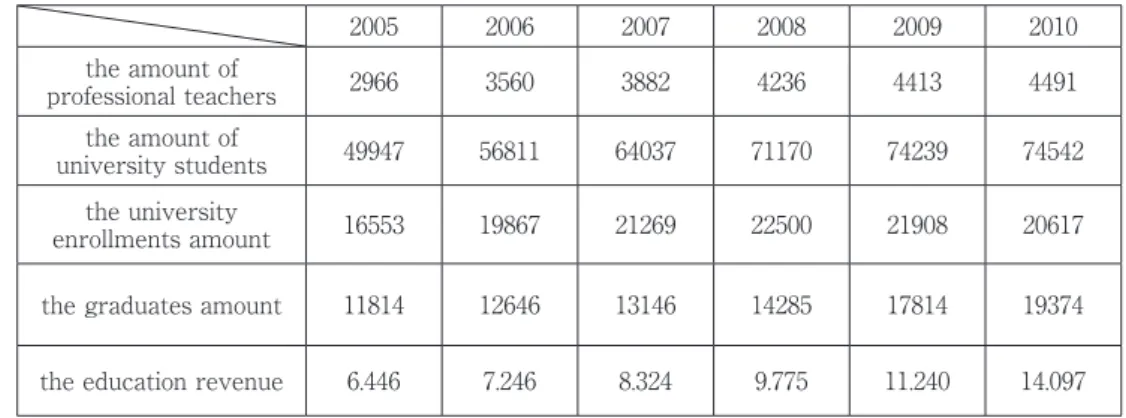
During the thirty years after the practice of reform and open policy, higher education career in Wenzhou has advanced much with the university amount from the initial two extending to seven at present, covering an area of 7399,900 Mu, among which 2266,800 Mu belongs to the university buildings. At the same time, we can get from the following table (Table One) that the amount of university students increases year after year from 21,837 students in 2001 to 74542 students in 2010, in which the increase is 2.4 times, and the rises of the university enrollments amount and the graduates amount also extend that in the past. The amount of professional teachers has increased by 169% from 1,669 in 2001 to 4,491 in 2010 while the amount of education expenditure has risen by 6.43 times, which seems especially obvious, from 2.19 billion Yuan in 2001 to 14.097 billion Yuan in 2010.
Viewing from the university types, the major one in Wenzhou is Junior College while the undergraduate course schools relatively lack enough development. Among the nine ordinary universities which have been listed in Table Two, College of Vocational and Technical has the largest proportion of 44%; the second is other Junior Colleges with
Table One the Basic State of the Development of Higher Education in Wenzhou from 2005 to 2010
2005 2006 2007 2008 2009 2010
the amount of
professional teachers 2966 3560 3882 4236 4413 4491
the amount of
university students 49947 56811 64037 71170 74239 74542
the university
enrollments amount 16553 19867 21269 22500 21908 20617
the graduates amount 11814 12646 13146 14285 17814 19374
the education revenue 6.446 7.246 8.324 9.775 11.240 14.097
Data Source: Wenzhou Statistical Yearbooks over the years; the education revenue unit: billion Yuan
the proportion of 33.3% and only two undergraduate course schools in them. Viewing from the type and amount of enrollments, the proportion of graduate students is rather low, only 3.99% of the total students in 2010, while the proportion of junior college enrollments amount is 40.2% and that of the undergraduates is 55.8%. (Table Two)
2. 2 The Situation of Economic Development in Wenzhou
Since the practice of the reform and open policy, the economy develops rapidly in Wenzhou, with an average rise of 14.8% per year, 5% higher than that of the whole
Table Two the Basic State of Universities in Wenzhou (2010) graduates the
amount
enrollments the amount
students amount
graduate students enrollments
amount
undergraduates enrollments
amount
junior college enrollments
amount Wenzhou Medical
College 2446 3412 12793 2082 10077 637
Wenzhou Medical
College 1508 1470 1706 — 1706 —
Renji School Wenzhou
University 3096 3398 12189 895 11010 284
Wenzhou University
Oujiang College 2365 1736 8406 — 8406 —
Wenzhou Vocational and
Technical College 2691 3211 9764 — — 9764
Wenzhou University
City College 1804 2157 7273 — 4970 2303
Zhejiang Industry and Trade
Vocational College 2530 2821 8334 — — 8334
Zhejiang Dongfang Vocational and
Technical College
1852 759 3793 — — 3793
Wenzhou Vocational College
Science and of Technology
1082 1653 4884 — — 4884
total 19347 20617 74542 2977 41569 29996
nation and 1.7% higher than that of the Zhejiang province. The GDP of Wenzhou in 2008 was 242.429 billion, 8.5% higher than that of last year while the financial revenue is 33.978 billion, ranking NO. Three in the province and the urban per capita disposable income is 26,172 Yuan, increasing by 9.0%.
From Chart One we can get that for ten years, the economic development in Wenzhou has kept well and the increase has continued all the time with the amount of rise around 12%, which make the city maintain the rank of NO. Three in Zhejiang Province in terms of economy, and give it the economic advantage, the amount of rise is much higher than those in other eight locally administrative level cities in the province. However, the rise proportions in 2008 and 2009 were 8.2% and 8.5% with an obvious decline of the per capita GDP. One of the reasons was the influence of the worldwide financial crisis.
The economic distance has been enlarged between Wenzhou and the other two cities, Hangzhou and Ningbo, whereas it becomes shorter between it and some cities like Taizhou and Jiaxing. The traditional industries in Wenzhou such as the shoe and leather, lighter, low-voltage apparatus industries face the challenge of transition and elevation.
The added value of the secondary industries in Wenzhou increased by 6.2% in 2008 but the amount of rise was reduced by 7.8% and ranked the last in the province. What’s worse, some industries with distinguishing features of Wenzhou have had negative growth. In a brief word, there is solid economic strength in Wenzhou but the condition of advantages being weaker and weaker exists, so that a new way needs to be thought of to strengthen the motive force of the economic advance.
Chart One the per capita GDP of Wenzhou from 2001 to 2010 (Unit: Yuan)
Data Source: Wenzhou Statistical Yearbooks; Zhejiang Province Statistical Yearbooks
III. Problems of Higher Education Development in Wenzhou
3. 1 The Higher Education Development Lags behind the Economic Development According to Zhejiang Province Yearbook 2009, the GDP of Wenzhou in 2008 accounted for 11.2% of that of the province while the proportion of university graduate students in Wenzhou was only 7% of the total graduates in Zhejiang Province in the same year; the latter was 4.2% lower than the former. Although the economic force in Wenzhou ranks NO. Three in the province all the time, the higher education falls behind other cities obviously. In recent years, the enlargement of university enrollments and the popular of the higher education in Wenzhou mean that much progress has been made in higher education area. But since it started comparatively late with lower quality and amount of colleges and universities and lower enrollments amount of postgraduates and doctors, the strength of higher education cannot compete with its economic force. From a general viewing, the higher education in Wenzhou is lagging behind the economic development.
3. 2 University Management is Highly Administration-oriented
3. 2. 1 The Analysis of Administration-oriented System in Colleges and Universities The first performance of administration-oriented system in colleges and universities is too many headmasters. In our country, there are often 5 to 8 vice-presidents in the universities or colleges while in the developed countries, there is only one headmaster, though in some large universities there are but few vice-presidents. The second performance is too many administrative staff, which leads to a big difference in terms of the structure of teachers and staff from that in foreign universities. The absolute proportion of teachers is high in countries such as Japan, Belgium, Italy, France and
Table Three A Comparison between the number of Administrative Staff in a Chinese University and that of a Japanese University
students
amount teachers
amount administrative
staff amount headmaster(s) amount
vice- president(s)
amount
administrative departments
amount Zhejiang Dongfang
Vocational and Technical
College
3465 177 125 1 4 10
The University of
Shimane 3277 180 37 1 0 3
P. S. the three administrative departments in the University of Shimane are: Teaching Affairs Office,
Students Affairs Office and Affairs Bureau
Portland while the proportion of non-teaching staff is not low in America. The key enlightenment from the experience of foreign universities is about the working direct of the non-teaching staff—whether the work is promoting and assisting the teaching or not or even blocking the education development.
There exists a host of “administrative jobs” not related to or even against the healthy development of teaching and scientific research in colleges and universities. The
“executive leadership” idea of managing schools makes all the important standards and principles related to teaching transmitted by means of administrative order. This kind of integrity management method superficially brings “standardization” which however, during practice severely ignores particularity between each of schools and subjects.
In 2010, Zhejiang Province Education Working Conference came up with the developing target in the following ten years that was higher education in Zhejiang Province should reach the average level of that of developed countries by 2020, which means that the current situation of higher education in Zhejiang is under the average level of that of developed countries. If the development of higher education in Wenzhou wants to take the lead in reaching the average level of that of developed countries, it must start from the administrative reformation. At the moment, the nine colleges and universities in Wenzhou, no matter whether state-run or civilian-run, exist severe tendency of administration-oriented management.
3. 2. 2 The Shortcomings Produced by Administration-oriented System in Colleges and Universities
i. It Makes Interdependence Phenomenon Serious
The administration-oriented management in colleges and universities makes interdependence phenomenon serious. Phenomenon of paying attention to power and looking down on academic universally exists in colleges and universities. Those having power and connections have no energy to do teaching jobs, and they can find a position in the department as well as the teaching and research section.
Headmasters and vice-presidents do come into being not through university
community but through operating top-down power. Professors should be the main part
of universities who now becomes fully passively governed. That is opposite to the spirit
of modern university, running school by a professor and professors’ running school
through choosing school’s administrators.
ii. It Kills University Professors’ Subjectivity and the University’s Own Subjectivity The administration-oriented management system in colleges and universities makes them become one-level administrative machinery. Essentially universities are knowledge, thought and scholar communities and comfortable residence of academic citizens. The administration-oriented system in colleges and universities damages their subjectivity, causing contraction academic and innovating ability of Chinese universities and their professors on academic independent and freedom of thought. Size of professors’ talking space is in proportion to school’s administrative level and the topic of research project must cater to the administrators’ likes, as a result, professors’ innovation ability and passion are blank.
There are three backbones of modern society: spiritual belief (expressed as churches in western countries), citizen society (emphasizing autonomic spirit of citizens) and universities. In non-religion countries, universities are in fact spiritual forts which express spirit power opposite to secular authority. Once it is brought into the administration system, spiritual power cannot be talked about.
iii. Colleges and Universities’ Professional structure does not Fit the Social Industry Structure
Colleges and universities are important source of human resources of producing.
There exists dynamic adaptation correlation between university discipline structure and production structure. Due to complicated and volatile talent requirements of society and installation of higher education subject existing relative stability, education specialized subject cannot satisfy all the need and change of social profession. The key point of the problem is that: based on realizing no absolute equilibrium between them whether both of the two seek dynamic equilibrium should be paid attention to.
At present, the regional economy in Wenzhou is undergoing an important transformation period. As mentioned before, this area majors in traditional light industry, such as lighter industry, shoe industry, pen-making industry, garment industry, car and motorcycle spare parts industry and so on. The existence and development of the companies there mainly rely on raw material, land and cheap labor force.
Nowadays, besides facing scarcity of peasant workers, companies in Wenzhou are also
facing the rigorous problem of “high-technology talent shortage”. In order to improve
industrial transferring and upgrading in Wenzhou and promote economic development
transformation there, Wenzhou begins three rising industries—bio-pharmaceutical
industry, energy conservation and environmental protection industry and new material
industry. Facing Wenzhou’s particular economic mode, colleges and universities there have made some reformations, especially the Vocational and Technical Colleges where students can design shoe patterns independently in a course named Shoes Design and such kind of course has excellent fusion degree with the local economy. However, the professional setting reform and innovation of colleges and universities in Wenzhou still haven’t had significant change which cannot transfer high-technique talents to society in time. Talents of the three new industries promoted by the government can only be realized through importing talents from other places.
The main reason of the lagging of college professional structure is that administrative management of colleges and universities only pays attention to immediate interest and individual power range and does not consider development of colleges and universities from the perspective of colleges and universities’ undertaking social responsibility.
IV. The Quantitative Analysis of the Relationship between Economic Development and Higher Education in Wenzhou
4. 1 The Selection of the Indices
Using the Spss18.0 statistical software, this article did Pearson correlation analysis and multiple regression analysis respectively for the per capita GDP of Wenzhou as well as the students amount, professional teachers amount, education expenditure in colleges and universities there from 2001 to 2010. All the data were derived from Wenzhou Statistical Yearbooks which were published by Zhejiang Bureau of Statistics over the years.
4. 2 Pearson Correlation Analysis
Firstly, the authors calculated the per capita GDP as well as students amount, professional teachers amount, education expenditure in colleges and universities to investigate higher education’s influence degree to the development of regional economy.
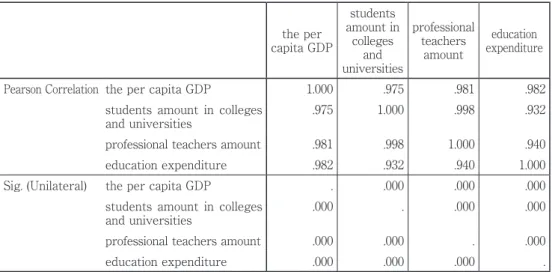
All the data used for calculating were derived from the relevant data during ten years from 2001 to 2010 in Wenzhou. There are four variables in Table Four,among them the per capita GDP is independent variable, and the rest are dependent variables.
Data in the table explains the per capita GDP has outstanding relativity with students
amount, professional teachers amount as well as education expenditure in colleges
and universities, which are all above 0.97, much over 0.01. The significance levels (Sig.)
are 0.000, indicating statistical significance has been reached which means irrelevant
probabilities among them are nearly zero. From the results, significantly positive correlation has been manifested between higher education and regional economy.
From their relative coefficient, GDP and educational expenditure have the highest related coefficient which is 0.982. That explains economic development in Wenzhou has the closest relationship with educational expenditure. Besides, the per capita GDP and students amount in colleges and universities have the lowest relativity (r 2 =0.975).
4. 3. Multiple Linear Regression Analysis
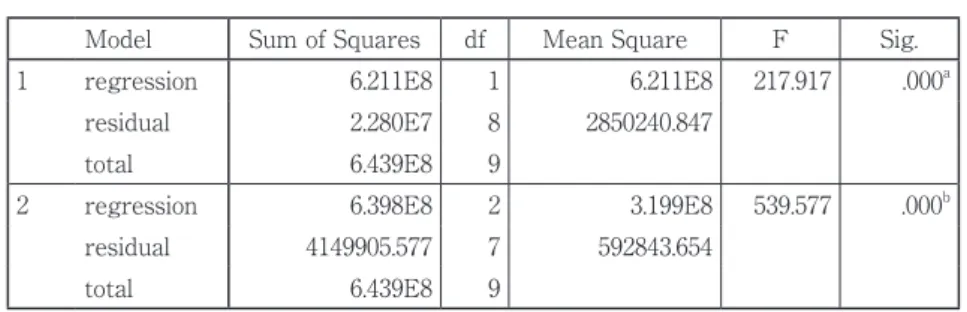
The correlation analysis is used to discuss co-variations among variables, in other words, we want to find the non-causal relationships among variables by such kind of analysis; and the regression analysis is used to distinguish the causation relationships among variables. The higher the degree of correlation is, the more reliable outcome of the analysis we can get. Based on the significance as well as the relativity gained from Table Four, the passage further analyzes whether causal relationship exists between higher education development and regional economy development. By screening variables, two of them entered the regression model, they are education expenditure and
2 r: Pearson’s product-moment correlation coefficient The Pearson formula is:
Table Four Correlation Analysis Pearson Correlation the per
capita GDP
students amount in
colleges universities and
professional teachers
amount
education expenditure
Pearson Correlation the per capita GDP 1.000 .975 .981 .982
students amount in colleges
and universities .975 1.000 .998 .932
professional teachers amount .981 .998 1.000 .940
education expenditure .982 .932 .940 1.000
Sig. (Unilateral) the per capita GDP . .000 .000 .000
students amount in colleges
and universities .000 . .000 .000
professional teachers amount .000 .000 . .000
education expenditure .000 .000 .000 .
(P. S. if the related coefficient level is above 0.01, it would be considered meaningful.)
1
r:Pearson's product-moment correlation coefficient
The Pearson formula is:
n
i i
i=1
n n
2 2
i i
i=1 i=1