Emergency Online Learning: A Survey of Student Anxieties and Experiences
journal or
publication title
Journal of Research and Pedagogy of Otemae University Institute of International
Education
volume 7
page range 43‑53
year 2021‑03‑31
URL http://id.nii.ac.jp/1160/00002020/
Emergency Online Learning: A Survey of Student Anxieties and Experiences
Laura Ashley Kurotobi
Prefectural University of Hiroshima, Mihara Campus
Reference Data:
Kurotobi, L. (2020). Emergency Online Learning: A Survey of Student Anxieties and Experiences. In K. Tanaka, & D.
Tang (Eds.), Reflections on Higher Education and Online Teaching. Otemae University Institute of International Education.
Abstract
This study explores the anxieties and experiences of second-year Japanese university students who experienced emergency online learning due to the effects of the COVID-19 pandemic in 2020. One hundred twenty-six students completed a voluntary questionnaire at the beginning of the semester regarding their impressions of online learning and anxieties related to it. At the end of the semester, eighty-four students completed a secondary voluntary questionnaire evaluating their online learning experience. Based upon the findings of these questionnaires, suggestions are made for preparing institutions and students for possible future emergency online learning situations.
この研究では、2020 年の
COVID-19パンデミックの影響により緊急オンライン学習を経験した日本の大学 2 年生の不安と経験を調査します。126 人の学生が学期の初めに自主的なアンケートに回答しま した。オンライン学習の印象とそれに関連する不安について調べました。学期の終わりに、84 人の 学生がオンライン学習体験を評価する二次自主アンケートに回答しました。これらのアンケートの 結果に基づいて、将来起こりうる緊急のオンライン学習状況に備えて教育機関と学生を準備するた めの提案が行われます。
Background
As a result of the outbreak of the novel coronavirus, COVID-19, at the end of 2019, changes were made worldwide in order to hamper the spread of the disease. In education, this meant many classes were suddenly taken out of institutions and conducted remotely. In Japan, a declaration of a state of emergency on April 7, 2020 prompted many Japanese educational institutions to take measures to deliver lessons online as well. Unfortunately, not all institutions and students were prepared to handle conducting classes in an online environment.
Although the use of technology, including mobile devices students may already be familiar with such as smartphones and tablets, can be successfully used in the classroom environment to enhance learning (Haydon et al., 2012), the potential for these methods is limited to the ability of students and faculty to utilize them. While students in Japan may be known for considerable use of technology for social purposes such as Instagram, Twitter, or other social media platforms (Takahashi, 2011), this doesn’t necessarily prepare them for the digital education environment.
Combined with a low rate of classrooms equipped with computers (MEXT, 2011) and low confidence of instructors regarding using computers in class (Shimizu et al., 2007), students in Japan may not be familiar with using computers or mobile devices for educational purposes. Additionally, many educators in Japan are adverse to using technology such as computers in class as they do not believe their students lack basic computer skills nor do they feel that it is a
sufficient use of their limited classroom time to teach such basics (Castellano et al, 2011; Lockley, 2011). Due to these factors, Japanese students may not have had the familiarity with educational technology necessary to do their best in this sudden change of environment.
A sudden shift from traditional classroom instruction to an isolated online educational environment may add stresses which students can find difficult to overcome as they not only have to process the material, but also learn how to use unfamiliar technology without relying on the aid of people around them. When Lockley (2011) surveyed students about how they learn about new technology and how to use it, the majority of responses included methods which would be difficult to do in isolation such as asking others such as classmates, teachers, and staff about how to use it. Deprived of the immediate support of their social sphere, the task of overcoming an unfamiliar educational model presents additional challenges to students, amplifying the stressors already present in their environment.
Additionally, the abrupt change in classroom format is not the only problem students and faculty face in emergency online learning. In the current situation of COVID-19, students must face uncertainty of the health of themselves and those around them. They also do not have a way to gauge how much longer they must wait until their lives return to a sense of normalcy. This stress not only affects the academic success of students, but also their psychological health (Kafka, 2020). Taking this into account, it is important that educational institutions and their faculty understand the stressors which they can reduce and do so in order for their students to succeed and thrive.
Methods and Participants
The present study investigates the anxieties and experiences of students who experienced emergency remote learning due to the COVID-19 pandemic of 2020 in order to better understand how to prepare students and institutions for future emergency online learning situations. This study was conducted using two questionnaires (Appendix A and Appendix B) developed by the author in both English and Japanese and administered via Google Forms. The items were based upon common anxieties students in previous semesters had expressed to the author regarding traditional classes, with opportunities for students to freely express themselves further in each section of the Post-Semester Questionnaire. The Pre-Semester Questionnaire was made available in the first week of the spring 2020 semester, which began in May of 2020. The Post-Semester Questionnaire was made available in the first week of August 2020, which was the end of the spring 2020 semester. A link was made available at these times in the English Expression III classes that the author held in the spring 2020 semester and students were free to access and respond to the questionnaires on a voluntary basis.
Using the two questionnaires, the study aimed to answer the following research questions:
1: What anxieties and concerns do students have before beginning emergency online instruction?
2: What difficulties do students face in emergency online instruction?
All respondents were second year university students at a public university in Hiroshima Prefecture. 126 students responded to the Pre-Semester Questionnaire and 84 students responded to the Post-Semester Questionnaire. The participants took lessons in various formats such as asynchronous lessons, live video conference lectures, recorded lectures, and independent learning.
Results and Discussion
Of the 126 respondents to the Pre-Semester Questionnaire, 114 (90.5%) reported they had never taken an online course before the spring 2020 semester. A majority of the students (57.1%) reported anxiety about learning online in response to Question 1 of the Pre-Semester Questionnaire, “What is your impression of online learning?” While many simply
wrote “I’m nervous,” others expanded on the reasons for their anxiety. These reasons included such factors as never having done classes online before, being unfamiliar or unskilled with computers, uncertainty about how they will be submitting assignments, and the stability of their internet connections. Other concerns related to social factors, such as one student who wrote “Because I will be taking classes alone, it’s going to be lonely,” and others who expressed sadness that they would not be meeting with their friends or instructors for the term. However, a few students (11.9%) expressed a positive view of online courses, with responses such as “I think online learning is good,” “I’m looking forward to trying something new,” and “Even after Corona, I think online classes would be good.”
The anxieties of the students are important to address as anxiety can be a factor in raising the affective filter, which limits the comprehensible input learners are open to, thus impeding their educational efforts (Krashen, 1982) and may make an already stressful experience for students even more difficult to get through. As students indicated worries such as it being their first time to do an online course, unfamiliarity with the technology, and not knowing how they will access materials and submit assignments, one possible course of action would be to take the recommendation of Lockley (2011) to provide a short course in simple educational technology for incoming freshmen during the early weeks of the first semester. Students may benefit from such a no-credit, introductory course that could explain to the students how to use the technology involved in online learning and how such courses are conducted. This experience can help prepare students so that they are prepared to switch to remote learning in the event of emergency online courses in the future.
After the semester, students appeared to be more split in their attitudes toward online learning. Of the 84 respondents to the Post-Semester Questionnaire, 29 (34.5%) indicated a positive impression of online learning, 18 (21.4%) indicating a neutral impression, and 37 (44%) indicating a negative impression of online learning. The positive responses included reasons such as online classes being the same as in-person once one got used to it and being able to do lessons at their own pace. The negative responses indicated such reasons as having too many assignments to do, difficulty with remembering deadlines, and communication issues due to not being able to meet with their instructors or peers directly. In addition, students indicated that being separated from their peers was lonely and made pair and group work difficult.
Table 1. Perception of Effectiveness of Online Classes (Pre-Semester Questionnaire item 3, Post-Semester Questionnaire item 2)
Do you think online classes can be as effective as in-person classes?
Pre-Semester (N=126) Post-Semester (N=84)
Yes 24 (19.0%) 31 (36.9%)
No 82 (65.1%) 25 (30.0%)
Not sure 20 (15.9%) 28 (33.3%)
In the Pre-Semester Questionnaire, regarding whether or not online classes can be as effective as in-person classes, only 24 (19.0%) said yes, with 82 (65.1%) saying no, and the remaining 20 (15.9%) not sure. However, upon the completion of the semester, confidence in the efficacy of online classes nearly doubled. As a majority of students had not previously taken online courses, it may be assumed that the lack of confidence in the efficacy of online courses before the semester began was largely due to a lack of experience upon which to base their judgement. However, as the amount of “yes” responses nearly doubled, the amount of “not sure” responses doubled as well. The questionnaire did not allow for respondents to expand upon their response, so further research is necessary on this item. The rise in confidence in online learning after completing a semester of courses may indicate evidence that experience in online courses can reduce anxiety regarding them, supporting the idea of implementing an introductory course to familiarize students with online learning.
Table 2. Perception of Difficulty of Online Classes Likert scale 1-5, 1 being “not very difficult,” 5 being “very difficult”
(Pre-Semester Questionnaire item 4, Post-Semester Questionnaire item 3) For you, how difficult do you think
online classes will be? (N=126)
1 2 3 4 5
6 (4.8%) 16 (12.7%) 36 (28.6%) 57 (45.4%) 11 (8.7%) For you, how difficult do you think
online classes are? (N=84)
1 2 3 4 5
1 (1.2%) 23 (27.4%) 16 (19.0%) 35 (41.7%) 9 (10.7%)
While respondents expressed increased confidence in the efficacy of their online courses, their perceived difficulty of the courses remained roughly the same, with only the neutral response of 3 reducing by a third to the 2 responses doubling post-semester. Student responses in later items of the Post-Semester Questionnaire, as explained later in this article, suggest reasons for these difficulties and how they may be addressed.
Table 3. General Anxiety Regarding Online Classes Likert scale 1-5, 1 being “not anxious at all,” 5 being “very anxious”
(Pre-Semester Questionnaire item 13) In general, how anxious are you about online classes?
1 2 3 4 5
1 (0.8%) 14 (11.1%) 12 (9.5%) 62 (49.2%) 32 (25.4%)
As the responses to item 1 of the questionnaire indicated, students were anxious about starting online classes with 25.4% of respondents reporting high levels of anxiety and nearly half of the respondents reporting moderate anxiety.
As anxiety can create a debilitating effect on learners (Brown, 1994) and has a negative correlation with achievement (MacIntyre & Gardner, 1994), it is important that these anxieties are taken into consideration not only during online classes, but before they begin in order to give students the best chance possible for success in their online courses.
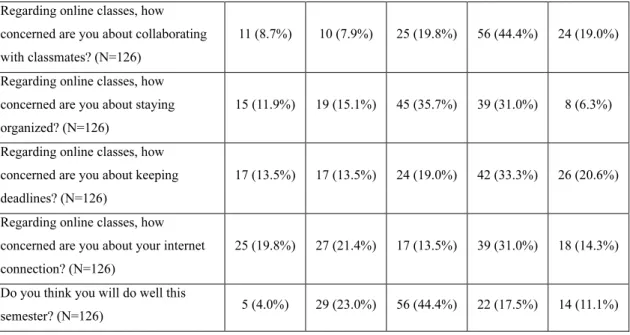
Table 4. Concerns Pre-Semester
Likert scale 1-5, 1 being “very little/none” or “not good at all,” 5 being “very much” or “very good”
(Pre-Semester Questionnaire items 6-12)
1 2 3 4 5
Regarding online classes, how concerned are you about motivation?
(N=126)
13 (10.3%) 26 (20.6%) 27 (21.4%) 49 (38.9%) 11 (8.7%)
Regarding online classes, how concerned are you about understanding the material? (N=126)
8 (6.3%) 14 (11.1%) 22 (17.5%) 55 (43.7%) 27 (21.4%)
Regarding online classes, how concerned are you about communicating with the teacher?
(N=126)
9 (7.1%) 8 (6.3%) 30 (23.8%) 60 (47.6%) 19 (15.1%)
Regarding online classes, how concerned are you about collaborating with classmates? (N=126)
11 (8.7%) 10 (7.9%) 25 (19.8%) 56 (44.4%) 24 (19.0%)
Regarding online classes, how concerned are you about staying organized? (N=126)
15 (11.9%) 19 (15.1%) 45 (35.7%) 39 (31.0%) 8 (6.3%)
Regarding online classes, how concerned are you about keeping deadlines? (N=126)
17 (13.5%) 17 (13.5%) 24 (19.0%) 42 (33.3%) 26 (20.6%)
Regarding online classes, how concerned are you about your internet connection? (N=126)
25 (19.8%) 27 (21.4%) 17 (13.5%) 39 (31.0%) 18 (14.3%)
Do you think you will do well this
semester? (N=126) 5 (4.0%) 29 (23.0%) 56 (44.4%) 22 (17.5%) 14 (11.1%)
The results in Table 3 indicate concern in each of the areas they were questioned about, which is also reflected in the lack of certainty that they would do well in the semester. Over half of the respondents indicated concern about their understanding of the material, communication, collaboration, and keeping deadlines. Nearly half of the students reported concerns about their internet connection and motivation. This correlates with the responses to item 1 of the Pre-Semester Questionnaire, in which students indicated they were concerned about how to use the online modules and that they had no experience upon which to base their expectations. As stated in the previous section, a preparatory course for online learning may be beneficial in this case.
Table 4. Post-Semester Evaluation of Experience
Likert scale 1-5, 1 being “very little/none” or “not good at all,” 5 being “very much” or “very good”
(Post-Semester Questionnaire items 4, 6, 8, 10, 12, 14, 16, 18)
1 2 3 4 5
During spring semester, how was your
motivation? (N=84) 5 (6.0%) 26 (31.0%) 26 (31.0%) 22 (26.2%) 5 (6.0%) During spring semester, how well did
you understand the material? (N=84) 1 (1.2%) 8 (9.5%) 22 (26.2%) 47 (56.0%) 6 (7.1%) How was communication with your
teachers during spring semester?
(N=84)
5 (6.0%) 16 (19.0%) 25 (29.8%) 28 (33.3%) 10 (11.9%)
Were you able to effectively collaborate with classmates in spring semester?
(N=84)
0 (0.0%) 12 (14.3%) 13 (15.5%) 34 (40.4%) 25 (29.8%)
Were you able to stay organized in
spring semester? (N=84) 3 (3.6%) 10 (11.9%) 28 (33.3%) 34 (40.4%) 9 (10.7%) Were you able to keep deadlines in
spring semester? (N=84) 1 (1.2%) 5 (6.0%) 15 (17.9%) 18 (21.4%) 45 (53.6)
How was your internet connection
during spring semester? (N=84) 0 (0.0%) 12 (14.3%) 7 (8.3%) 35 (41.7%) 30 (35.7%) Do you think you did well this
semester? (N=84) 1 (1.2%) 12 (14.3%) 27 (21.4%) 36 (42.9%) 5 (6.0%)
The Post-Semester Questionnaire asked students to evaluate the items from the Pre-Semester Questionnaire based upon their experience and also gave them room to expand upon each item. Overall, students seemed to have the most positive responses regarding understanding the material, collaboration, organization, keeping deadlines, internet connection, and overall success in the semester. Motivation and communication with teachers scored a little lower, with a rather neutral response. Compared to the results of the Pre-Semester Questionnaire, students indicated a better outcome for the semester than they had been anticipating.
Regarding motivation, students who offered additional comments overwhelmingly attributed their positive motivation to getting feedback from their teachers and classmates about their work. Three students indicated that their journal assignments, in which they received comments from classmates, were an enjoyable motivator because of the chance to communicate with their peers.
Regarding understanding of the material, comments were few, but those who gave comments indicated that they were afraid that they misunderstood instructions and would have appreciated a way to check their understanding before proceeding with the assignments. They also indicated that not every teacher used the same way of turning in assignments and it caused confusion.
Regarding communication with teachers, comments were mixed with some positive responses such as “I was glad to be able to chat freely with instructors [using the chat feature],” but mostly neutral or negative responses such as “Depends on a teacher. Some teacher explained how should we do it but some teacher didn’t,” “It was difficult to understand just text,” and “It was inconvenient to have to rely on email.”
Regarding collaboration with classmates, comments were mixed with some positive responses regarding the benefits of getting feedback from their classmates, but negative comments as well indicating difficulty in communicating with others without seeing their face or being unable to collaborate schedules in order to do pair or group work.
There were no comments regarding staying organized.
Regarding deadlines, student comments indicated difficulty keeping track of multiple deadlines and methods of submitting assignments for their classes. Many students also expressed a desire to have a reminder sent to them regarding assignment deadlines, the ability to turn in assignments early, and a minimum of a week in order to complete each assignment.
Regarding internet connection, students indicated that the weather could affect their ability to have a strong enough connection to participate in streaming lectures or activities and that they would have liked for the university to provide them with free Wi-Fi for the use of online lectures.
Item 19 allowed for students to give overall comments to teachers regarding future online classes. Comments varied, but most could be classified into three concerns: too many assignments, each instructor had their own way of submitting assignments and so they would like the system to be unified, and set opportunities to meet with their instructors to have questions and concerns answered directly.
Considering these responses, students seem to appreciate opportunities to be social with their classmates and incorporating activities such as discussion boards and journaling with comments may help facilitate a sense of a social environment. Also, virtual office hours in which students can chat with instructors immediately would help students who wish to have a conversation with their instructors rather than simply email them or hope to be able to talk during
real-time lectures. Students were concerned about the various methods of communication, receiving assignments, and turning assignments in that are implemented by the various instructors, so it would be beneficial for institutions to unify the online environment, rather than allow instructors to set up various methods on their own accord, as much as possible so as to avoid confusion. Additionally, as many students indicated that they had too many assignments, institutions should set up guidelines about how much work each instructor should assign to their classes so as not to overload students with responsibilities for multiple classes. Regarding deadlines, as stated in a previous section, utilizing calendar applications could assist students who are struggling with juggling multiple deadlines and could provide them with automated reminders of due dates. Students should be familiarized with such applications so that they can create and customize calendars of their own tailored to their needs. Finally, as students indicated problems with Wi-Fi and a desire to have the school provide such equipment for them, institutions should consider this issue in order to ensure each student has equal access to course content and participation.
Conclusion
This study investigated the anxieties and concerns of students before beginning an emergency online course and their evaluation of their experience after it. From the responses of those surveyed, four major themes were present:
preparation, unification, too many assignments, and interpersonal communication. Students had anxiety about the concept of online learning and many respondents to the questionnaire indicated that this anxiety was due to it being their first time to undergo an online course. Due to this, they did not know what to expect or what to do, and therefore they could not prepare.
During the course of their online experience, many found that online education was not as hard as they expected, but the lack of unity in communication methods with instructors and assignment submission created problems for the students. They also had difficulty with the amount of assignments and keeping the dates related to them organized.
Finally, with a lack of social contact, students appreciated opportunities for communication with classmates, but expressed a desire for better communication with their instructors.
To combat these problems, the following measures are recommended based upon the feedback from the students:
1. Institutions should ensure unity of the format of online courses. Interfaces to be used, communication methods with the instructors, where to find assignment information, and how to turn in assignments should be streamlined for easy understanding. If possible, a calendar application should be included in the interface of choice so that students and instructors can create their own reminders for deadlines.
2. As suggested by Lockley (2011), institutions should have an introductory course of the technology in the first weeks of instruction. Such a course should familiarize students with how to access lectures, materials, assignment requirements, communication tools, and assignment submission.
3. Institutions should determine the minimum required equipment such as tablets and Wi-Fi units and ensure upon admission that students have access to them whether it be from their personal equipment or loans from the institution.
4. Institutions should develop guidelines for the amount of work each instructor can assign their classes per week so as to ensure students are not overwhelmed with unreasonable workloads. Such limits should take into account the additional difficulties of students working in isolation and the psychological effects they may be experiencing due to the emergency situation in which such emergency online learning is taking place.
5. Institutions should make efforts to create online social events for students in order to create a social atmosphere despite distance.
6. Instructors should have regular online office hours for direct communication with students.
7. Institutions should have a support center students may call for issues that may arise. Such issues should not be
limited to just technology, but also counseling for students who need emotional support.
8. Not only students, but faculty should be trained each year in the technology and procedures for online learning so that they are prepared to transfer their lessons online in case of an emergency.
By implementing such measures, institutions and students can be better prepared in case of a sudden change to online learning, thus reducing anxiety and giving students the best chance possible for success. Online learning can be a great way to continue academic progress despite hurdles such as pandemics and natural disasters, but only if there is adequate preparation beforehand and consideration for the students who must learn under unfamiliar and stressful circumstances.
Bio Data
Laura Ashley Kurotobi is a lecturer at Prefectural University of Hiroshima, Mihara campus, where she teaches English Expression to first and second-year students. Her research interests include bilingual education, adults in higher education, and anxiety in language learners. <[email protected]>
References
Brown, H.D. (1994). Principles of language learning and teaching (3rd ed.). Englewood Cliffs, N.J.: Prentice Hall.
Castellano, J., Mynard, J., & Rubesche, T. (2011). Technology use in a self-access centre. Language Learning and Technology, 15(5), 12-27.
Haydon, T., Hawkins, R., Denune, H., Kimener, L., McCoy, D., & Basham, J. (2012). A comparison of iPads and worksheets on math skills of high school students with emotional disturbance. Behavioral Disorders, 37(4), 232- 243.
Kafka, A.C. (2020, March). Shock, fear, and fatalism: as coronavirus prompts colleges to close, students grapple with uncertainty. The Chronical of Higher Education. https://www.chronicle.com/article/Shock-FearFatalism- As/248240
Krashen, S. (1982). Principles and practice in second language acquisition. Pergamon: Oxford.
Lockley, T. (2011). Japanese students’ experience of ICT and other technology prior to University: A survey. JALT CALL Journal, 2(3), 182-194.
MacIntyre, P.D., & Gardner, R.C. (1994). The subtle effects of language anxiety on cognitive processing in the second language. Language Learning, 44, 283-305.
MEXT (Ministry of Education, Culture, Sports, Science, and Technology in Japan). (2011). Gakkou ni okeru kyouiku jouhouka no jittaitou ni kansuru chosa kekka [Survey on actual situations of computeriazation of school education].
Shimizu, Y., Yamamoto, T., Horita, T., Koizumi, R., & Yoshii, A. (2007). Current situations and future prospects for informatization of school. Japan Society for Educational Technology, 30(4), 365-374.
Takahashi, T. (2011). Japanese Youth and Mobile Media. In M. Thomas (Ed.). Deconstructing digital natives (pp. 67- 82). New York and London: Routledge.
Appendix A
Pre-Semester Questionnaire (126 respondents) 1. What is your impression of online learning?
2. Have you ever taken an online class before?
3. Do you think online classes can be as effective as in-person classes?
4. For you, how difficult do you think online classes will be?
5. Regarding online classes, how concerned are you about motivation?
6. Regarding online classes, how concerned are you about understanding the material?
7. Regarding online classes, how concerned are you about communicating with the teacher?
8. Regarding online classes, how concerned are you about collaborating with classmates?
9. Regarding online classes, how concerned are you about staying organized?
10. Regarding online classes, how concerned are you about keeping deadlines?
11. Regarding online classes, how concerned are you about your internet connection?
12. Do you think you will do well this semester?
13. In general, how anxious are you about online classes?
14. Is there anything that you would want teachers to know or consider before starting online classes?
Appendix B
Post-Semester Questionnaire (84 respondents)
1. What is your impression of online learning from spring semester?
2. Do you think online classes can be as effective as in-person classes?
3. For you, how difficult do you think online classes are?
4. During spring semester, how was your motivation?
5. If you would like to explain further, please use this space.
6. During spring semester, how well did you understand the material?
7. If you would like to explain further, please use this space.
8. How was communication with your teachers during spring semester?
9. If you would like to explain further, please use this space.
10. Were you able to effectively collaborate with classmates in spring semester?
11. If you would like to explain further, please use this space.
12. Were you able to stay organized in spring semester?
13. If you would like to explain further, please use this space.
14. Were you able to keep deadlines in spring semester?
15. If you would like to explain further, please use this space.
16. How was your internet connection during spring semester?
17. If you would like to explain further, please use this space.
18. Do you think you did well this semester?
19. Is there anything that you would want teachers to know or consider before starting online classes from now on?
20. What kinds of support do you think the university should provide to help students who are doing online learning?