社団法人 電子情報通信学会 THE INSTITUTE OF ELECTRONICS,
INFORMATION AND COMMUNICATION ENGINEERS
信学技報
TECHNICAL REPORT OF IEICE.
MSFA を用いた文章の深い意味記述
渋谷 良方
†李 在鎬
†黒田 航
†井佐原 均
†† 独立行政法人 情報通信研究機構 けいはんな情報通信融合研究センター E-mail: † { yshibuya,jhlee,kuroda,isahara } @nict.go.jp
あらまし キーワード
Specifying deeper semantics of a text using MSFA
Yoshikata SHIBUYA
†, Jae-Ho LEE
†, Kow KURODA
†, and Hitoshi ISAHARA
†† National Institute of Information and Communications Technology (NICT) Knowledge Creation Research Center 3-5 Hikaridai, Seika-cho, Souraku-gun, Kyoto, 619–0289 Japan
E-mail: † { yshibuya,jhlee,kuroda,isahara } @nict.go.jp
Abstract
In this article, we introduce the JCASR Project (in progress at NICT), which aims to develop a relatively small Japanese corpus of texts annotated for “semantic frames” and their “frame elements” (aka “semantic roles”), using Multilay-
ered/Multidimensional Semantic Frame Analysis (MSFA) [3]. MSFA is a framework of semantic annotation/analysis compat-ible with the Berkeley FrameNet project [1], [6] that provides a multidimensional description of “contextualized” meanings of words and phrases. After outlining the project, we provide case studies of two sentences (one from a newspaper article and the other of a discourse).
Key words
contextualized meanings of words and phrases, FrameNet, the JCASR project, Multilayered/dimensional Se- mantic Frame Analysis (MSFA), semantic role tagging
1. Introduction
The past 20 years have seen the maturation of surface-true, distri- butionally and statistically based knowledge acquisition techniques.
The development has offered us a parse with a good coverage, free from inconsistencies immanent in manual analysis. It was like a new age of NLP. It turns out, however, that such methods clearly have limitations. One of the critical problems is that these techniques do not always meet our need for processing “deeper” semantics (or
“shallow pragmatics”) in and of the language people use everyday.
What we mean by “deeper semantics” is a class of semantic spec- ifications that goes beyond simple “word senses/meanings” includ- ing the so-called “inferences” (yet applying this term would be no help here, because nobody knows exactly what “inferences” are, af- ter all). This is the classical problem of Knowledge Representation (KR). Suppose that the KR problem is resolved totally after we have finished building all the relevant ontologies and inference engines running over them. Did we get to our ultimate goal at last? We sus- pect the answer is no, because we still need to find out how pieces of knowledge are linked to pieces of language. This is what Kuroda and Isahara (2005) called the problem of Knowledge-Language (K- L) Linking.
If our suspicion is true, we then need to construct a wide-coverage database that specifies what kind of linguistic units are linked to what pieces of world knowledge, or “ontologies” without (too sim- plistically) assuming that words denote “concepts” (i.e., building blocks of ontologies). This assumption is far from true, however:
virtually every word of a given language is ambiguous, and it is far from well-understood how ambiguity comes into play, although there are good theories of word sense disambiguation/creation like Generative Lexicon (Pustejovsky [?]). This reality makes it very in- effective to state that words “denote” concepts. In fact, this situation demands us to build lexical resources dedicated to the identification and specification of “units” of the K-L Linking.
1. 1 The JCASR project
Development of a Japanese Corpus Annotated for Semantic Roles (JCASR) is being attempted as one of the research projects at the National Institute of Information and Communications Technology (NICT), Japan. The project is proceeded with a crucial assumption that “units” of the K-L linking are “idealized/(stereo)typical situ- ations” which can be identified as (semantic) frames in the same sense as the Berkeley FrameNet (BFN) project (Baker et al. [1];
Fillmore et al. [2]). The goal of the JCASR project is to construct a (relatively small) corpus of Japanese texts annotated for (seman-
tic) frames and their frame elements (aka “(situationally-defined) semantic roles”). The goal is to establish a set of (ontological) links from “pieces of world knowledge” to text segments in terms of se- mantic role tagging.
1. 2 What we mean by “semantic role tagging”
In our approach, a strong emphasis is given to the identification and specification of finer-grained, situation-specific roles at con- crete levels (e.g.,hRobbersi,hVictimi,hValuablesi; hereafter,hRirep- resents a role) rather than those of coarse-grained, general-purpose roles at abstract levels (e.g., hAgenti,hPatienti,hThemei). Section 3 is devoted to illustration of this approach. Our approach is the- oretically motivated by the hypothesis we assume that deeper, and
“better,” understandings are achieved at more concrete levels, rather than at more abstract levels. This hypothesis is one of the points that differentiate MSFA from other (usually more “formally oriented”) approaches to semantic annotation/analysis which tend to assume that the deepest semantic analysis is the most abstract semantic anal- ysis. More formally, we posit the following:
Concreteness bias on semantic interpretation:
the more specific and concrete your understanding is, the better it is (as long as it is not obviously wrong).
A lot of phenomena suggest that “deep enough” semantic analy- sis of a text demands effective specifications of what guesses people make, as well as of semantic types of text segments. What is sug- gested is that it does not really matter whether people’s understand- ings are semantically based or pragmatically based as far as our goal is to illustrate people’s text understanding: to specify what people understand is the point at issue, while how they do so is not. The se- mantics/pragmatics distinction would make sense if the issue is how people understand (after we have clarified what they understand).
This reasoning would be both good news and bad news, depending on your perspective. It is good news if you feel that routes to deeper semantics are promised. It can also be considered bad news if you feel that you cannot be so optimistic as to say “Leave it all to prag- matics” any more, because what is at issue now is what pragmatics does and how it works: you need to specify it.
2. Development Scheme
2. 1 Status of the project
The JCASR project officially began two years ago. It is (still) at a preliminary, “exploratory” stage. At the moment, we are trying to find out what kinds of frames/situations are found at what granular- ity levels without assuming a pre-existing, “ready-to-use” database of semantic frames and their frame elements. Some preliminary re- sults have been reported in Kuroda et al. (2006), for instance. We have not started serious development of a semantically tagged cor- pus yet, but annotation samples are available freely or privately at the web sites (contact us for more details). It should probably be noted that we are currently working independently of the Japanese FrameNet (JFN) project (Ohara et al. 2003). But we are also ne- gotiating with the BFN staff to make the MSFA-based annotation scheme shared with BFN.
2. 2 Overview
Currently, we are following the “incremental” development scheme as per the following: (1) select a Japanese text T from a text
database; (2) have each sentence of T segmented into text segments by the staff at NICT (each result of segmentation always needs to be checked manually, because the standard outputs of the so- called “morphological analyzers” like KNP and ChaSen are some- times inappropriate for our purposes; this issue to be mentioned again later below); (3) ask “external” annotators to annotate the seg- mented texts by making reference to databases D1and D2of “sam- ple annotations” hosted at the web sites (available both publicly and privately); (4) collect the annotations conducted by annotators as
“drafts,” and check and edit the results if necessary, which is very often the case (this is conducted by the staff of the project group at NICT); (5) add the edited results to the databases D1and D2, and
“sanitize” the databases when needed.
T is always chosen from Japanese texts which are aligned with English texts. This is because we expect that future comparisons against other annotations (using the BFN database, for example) can be facilitated. So far, all texts have been taken from the following text bases:
D1: Sample annotations for texts from a collection of English- Japanese alignments of copyright-free texts like Aesop’s Fa- bles are hosted at [http://www.kotonoba.net/ mutiyama/cgi- bin/hiki/hiki.cgi?FrontPage]. No access restriction applies.
D2: Samples for texts from Kyoto University Corpus are hosted at [http://www.kotonoba.net/~mutiyama/cgi-bin/hiki2/
hiki.cgi?FrontPage]. Access restriction applies.
The original texts for D1 are provided at [http://www2.nict.
go.jp/x/x161/members/~mutiyama/align/index.html]. Ten- tatively, we separate the procedures to identify (a) frames for event conceptualizations (e.g.,hRobberyi,hPredationi) and (b) frames for social interactions (e.g., speech acts likehClaimingi,hCriticizingi, hDoubtingi, hProtestingi, hWarningi). This is because the second type of frames are more complex, more data selective, and harder to specify. Currently, only Hajime Nozawa is working on the second type (see§3.3). Nozawa’s work has not yet been integrated into the results of the first type worked on by Kuroda, Lee and Shibuya.
3. Case Studies
3. 1 The procedure
In conducting an MSFA, one employs a table T of m+3 rows and n columns: m is the number of text segments (including “null instan- tiations”), and n is the number of frames identified as comprising the
“understood content” of a sentence s. The cell at(i,j)of T specifies the semantic role r of the jth frame f j. The value for f j.r includes
“null,” which means “non-realized role for f .” As illustrated in the following sections, the MSFA’s analytical scheme includes three header lines: “Frame ID” (row 1), “Frame-to-Frame relations” (row 2), and “Frame Name” (row 3). After the completion of the seg- mentation task, one turns to fill in the cells rightward, specifying (or identifying) Frame Names (together with the names of Frame Ele- ments) and Frame-to-Frame relations among these frames. Frame IDs are local variables used to specify Frame-to-Frame Relations, whereas Frame Names and Frame-to-Frame Relations are global variables. Each sentence of a text T is segmented into text segments before one starts annotating them. The sentence segmentation pro- cess is conducted by using morphological analyzers such as ChaSen
Frame ID F1 F2 F3 F11 F8 G1 F4 F5 F6 F7 F9 F10 F12 F13 Frame-to-Frame
Relations elaborates F2 elaborates F3;
realilzes F1 realizes F2 elaborates F8 constitutes F3;
realizes G1
presupposes F5;
constitutes F8
presupposes F4,F5; presumes
F4
constitutes F5 elaborates F5 elaborates F9,F12;
presupposes F5 presupposes F13; realizes F13
Frame name 報道//News 報告//Report 語り//Narration
˜過去性の指定
˜//˜Tense specification[for
event]˜
˜特徴づけ
˜//˜Characteriza tion˜
˜値の指定[役割 の]˜//˜Value specification[ofor
role]˜
挑戦//Challenge 勝負//Match 勝利//Victory 優劣 //Advantages/Dis
advantages 将棋//Shogi (Japanese chess)
将棋[プロ の]//Shogi (Japanese chess)[profession
al]
職(業)をもつ //Occupation
生計立て//Making a living
* 報道者 //News
reporter 報告者 //Reporter 語り手 //Narrator 指定者 //Specifier 特徴づける者 //Characterizant
* 受報者 //News
receiver
受報者 //Report receiver 聞き手 //Listener
* 報道内容//
Content of news 報告内容 //Content of
report
内容 //Content
プロ将棋.EVO: タイ トル//Professional shogi.EVO: title
内容[職業 の]//Content of
occupation
生計を立てる手段 //Means of making
a living
* 場所[勝負の]//
Place for match 昨年//last year
˜過去性の指定[事 態 の]˜.GOV[1,2]//
˜Tense specification[for
対象.Attr //Object.Attr
役 割.Attr//Role.Att
r
時間//Time 時点[勝負 の]//Time of
match
時期//Time
、//, EXT 時
間.EXT//Time.EXT 時点[勝負 の].EXT//Time of
match.EXT 時 期.EXT//Time.EXT 米長//Yonenaga
参与者[事態 の][1]//Event Participant[1]
相手 //Opponent 勝負者[1]
//Player[1] 敗(北)者// Loser 優位者//Person with advantage
棋士[1,2]//Shogi player[1,2]
プロ将棋.EVO: 棋士 [1,2]//Profession al shogi.EVO:
player[1,2]
職(業)をもつ者 [1]//Person in employment[1]
手段により生計を立 てる者[1]//Person using means to make a living[1]
に//to MARKER//NA
挑ん//challenge 事態//Event 挑戦.GOV//
Challenge.GOV 勝負.EVO //Match.EVO
勝利.EVO//
Victory.EVO 優劣.EVO //Advantages/Dis
advantages.EVO だ//˜PAST˜
˜過去性の指定[事 態 の]˜.GOV[2,2]//
˜Tense specification[for
EXT
の//˜N.A.˜ MARKER 役割//Role
が//˜NOM˜
˜特徴づけ
˜.GOV[1,2]//˜C haracterization˜.
GOV[1,2]
MARKER
羽生//Habu
参与者[事態 の][2]//Event Participant[2]
特徴
//Characteristics 値//Value 挑戦者//
Challenger 勝負者[2]
//Player[2] 勝(利)者//Winner 劣位者// Person with disadvantage
棋士[2,2]//Shogi player[2,2]
プロ将棋.EVO: 棋士 [2,2]//Profession al shogi.EVO:
player[2,2]
職(業)をもつ者 [2]//Person in employment[2]
手段により生計を立 てる者[2]//Person using means to make a living[2]
**
˜特徴づけ
˜.GOV[2,2]//˜C haracterization˜.
GOV[2,2]
。//. EXT EXT EXT EXT
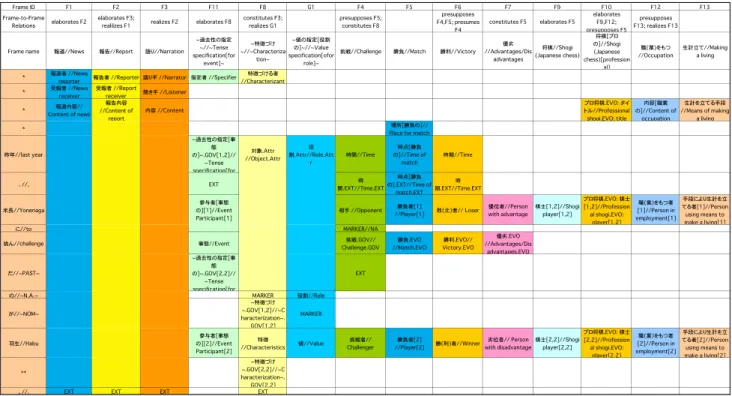
図1 An MSFA of (1)
図2 An SFNA of (1)
(http://chasen.naist.jp/hiki/ChaSen) and KNP (http://
nlp.kuee.kyoto-u.ac.jp/nl-resource/knp.html). It is im- portant to note that the segmentation is also conducted manually by the annotators of the project group. This is because for our purposes it is often the case that the outputs of the morphological analyz- ers leave something to be modified at times (recall§2.1). Another reason is that in an MSFA one tries to specify as many links as possible between knowledge pieces to often discontinuous, multi- word units like idioms and proverbs. In general, MSFA does not assume the principle of compositionality, in that for the phrase p of w1+· · ·+wi+· · ·+wn, the meaning of p is strategically regarded as independent of wi. This is true not only of opaque units like idiom chunks but also of virtually any units which are usually con- sidered to have “regular” semantics. This decision is necessary to avoid the petitio principii in semantic specification, even if it seems redundant.
3. 2 Sample 1: A segment of a newspaper article
Consider the sentence in (1) taken from Kyoto Universtiy Cor- pus (Kurohashi and Nagao [5]). (2) gives the English translation.
Table 1 provides an MSFA of (1):
(1) XXXXXXXXXXXXXXXXXX [S-ID:950101075-033]
(2) Last year, Habu challenged Yonenaga for the title.
In Table 1, the annotations have been converted from Japanese to English (the frame names are given tentatively in English; for the original MSFA in Japanese, seehttp://www.kotonoba.net/
~mutiyama/cgi-bin/hiki2/hiki.cgi?c=view&p=msfa-round2-s33).
All but the first column represent the frames identified, or “discov- ered” in the analysis. As shown in the table, 14 frames were iden- tified in (1) (but note that the number is subject to further modifica- tions; see the later discussion). Each of the frames consists of some semantic roles. ThehMatchiframe (=hXXiin the original Japanese analysis; the URL given above), for example, includes the roles such ashPlayeri(=hXXXXi),hPlace for matchi(=hXX[XXXX]i),hTime of matchi(=hXX[XXXX]i). The colored cells indicate the semantic roles that are considered to be realizing their values in the relevant frames. The uncolored (or “empty”) ones, on the other hand, repre- sent those that do not seem to have any specific roles in the frames.
In conducting an MSFA, it is the semantic roles not the semantic types that are annotated in analyzing a text. Semantic types are roughly equated with natural kinds. In contrast, semantic roles are
“situation-specific concepts” which are considered highly culture- particular and hence are taken to play a more crucially important role than semantic types in one’s understanding of a text (Kuroda et al. [4] [revised]; for a related discussion, see also Kuroda and Isahara [3]). The table contains *-symbol, which represents ele- ments that are not lexically realized in a text. For example, the hNewsiframe (=hXXi) and thehReportiframe (=hXXi) contain some semantic roles in the rows with *-symbol. This is because given these frames such semantic roles must be specified as well. Having outlined the MSFA table for (1), one might address an important question: How deep should one go in describing the meaning of a sentence? In the current MSFA scheme, a sentence is typically given over 20 frames, and each of which comes with some semantic roles as illustrated above. To compare the MSFA scheme to another semantic-annotation framework, the BFN, for example, customar-
ily limits the number of frames to 2 or 3 frames per sentence. It is remarkable that in an MSFA a sentence as short as (1) is identified with a rather large number of frames compared to the BFN scheme (14 frames in the case of 1; recall Table 1). The deep semantic description as illustrated in Table 1 is the result of meeting one of the fundamental theoretical principles of MSFA: the so-called “Be greedy” principle (Kuroda et al. ?? [revised]), which reads as fol- lows: the analysis/annotation needs to be greedy, in that as many frames as you need can be identified and added to the analysis, as long as they are found necessary for providing deep enough seman- tic analysis of a text. From the MSFA perspective, sample semantic annotations provided by the BFN framework today are not taken to be deep enough. It is important to note that we do not claim the MSFA illustrated in the table to be as deep a semantic description as we can provide. Rather, it should be taken as exemplifying a
“tentatively” suggested version of our MSFA of (1). The position that MSFA maintains as to the so-called “granularity” problem is that it must be worked on inductively. The view we hold is that ad- equate levels of granularity need to be “discovered” through induc- tive exploration into real texts. The Frame-to-Frame relations are described in row 2 of Table 1, which is depicted in Figure 1 (called a Semantic Frame Network Analysis [SFNA]). In the figure, each frame identified in the MSFA (Table 1) is represented in a circle and the arrows indicate how these frames are interrelated with one an- other. The diagram is generated automatically byGraphvizbased on the specification given in Table 1 (i.e., the MSFA of (1)). Note that here, as well as in Table 1, all the frame names have been trans- lated from Japanese to English. It should be noted that the Frame- to-Frame relations are not assumed a priori in MSFA. Instead, we hold that the set of such relations too needs to be discovered by inductive processes, rather than in a top-down, theory-driven man- ner. Enlisted in (3) below are the relationships (the specifications partially omitted for lack of space) that are often found. The list is not exhaustive. Most of the Frame-to-Frame relations in the BFN are analogous to those of the MSFA; but for the discrepancies, see Kuroda et al. [4] [revised]:§??).
(3) (a) “Elaboration” relation: A frame F elaborates another frame G; i.e., F inherits from G. (b) “Constitution” relation: F constitutes G; i.e., F is part of G. (c) “Presupposition” relation: G presupposes F. (d) “Presumption” relation: F presumes G. (e) “Re- alization” relation: F realizes G. (f) “Target/Transfer” relation: F targets G.
Having provided a brief illustration of how one analyzes a news- paper article sentence of (1) with MSFA, let us now turn to the prospects of this framework for cross-linguistic semantic annota- tion research. Consider (4), which is the Korean translation of (1) (translation provided by Jae-Ho Lee):
(4) Jagnyeon -e yonenaga -ege dojeonha n salam -i habu.
An MSFA of (4) (here omitted for lack of space) reveals the simi- larities and differences in Japanese and Korean in terms of the avail- ability of the frames (in 1 and 4). Below is the list of the additional frames that were identified with the Korean sentence (4):
(5) (i)h∼Specification[of being Japanese]∼i(=h∼XX[XXXX]∼i) (ii)h∼Specification[of Time]∼i(=h∼XX[XXXX]∼i) (iii)h∼Specification[of difference in ability]∼i(=h∼XX[XXXXXX]∼i) (iv)h∼Transmission[to person]∼i(=h∼XX[XXXX]∼i) (v)h∼Modification∼i(=h∼XX∼i)
(vi)h∼Specification[of the fact that it is an interpersonal event]∼i (=h∼XX[XXXX]∼i)
The involvement of these Korean-specific frames is considered to be due to the syntactic characteristics of the Korean language. It is interesting to see that Korean and Japanese (two typologically close languages) differ in the availability of the frame types in understand- ing an equivalent sentence. The results of an MSFA of (4) suggest an interesting prospect for cross-linguistic (semantic annotation) re- search, because it is suggested that a careful semantic analysis us- ing MSFA would make a contribution to clarifying the universals and particulars of languages with respect to how people understand a sentence.
3. 3 Sample 2: A segment of a prose
Let us briefly discuss how one analyzes a sentence from a dis- course with MSFA. Consider the sentence in (6), taken from Ae- sop’s Fables (The Ass and the Grasshopper):
(6) XXXXXXXXXXXXXXXXXXXXXXXX
(7) They replied, “The dew.” [http://www2.nict.go.jp/
x/x161members/mutiyama/align/htmPages/aesop-0.htm]
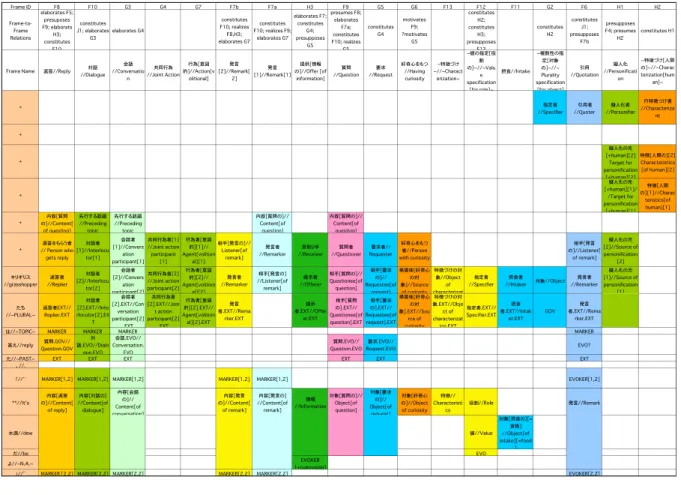
An MSFA of (6) is given in Table 3 and an SFNA in Figure 2.
Similar to Table 1 and Figure 2, all the annotations of Table 3 and Figure 4 have been converted from Japanese to English (for the original analyses, seehttp://www.kotonoba.net/~mutiyama/
cgi-bin/hiki/hiki.cgi?c=view&p=msfa-aesop01-s03-s04).
A total of 25 frames were identified with (6). A remarkable fact with (6) is the involvement of the frames such ashNarrationi(=hXXi), hTelling a storyi (=hXXi), hCreative worki (=hXXi), hAllegory creationi(=hXXXXXi),hImaginationi(=hXXi), which are identified because of the nature of the text (i.e., a discourse-style fable). Of the frames found in the MSFA of (6), thehHaving curiosityiframe (=hXXXXXXXXi) is perhaps among those that significantly dif- ferentiate MSFA from other semantic annotation frameworks for its elaborate semantic specification. In MSFA, one recognizes the hHaving curiosityiframe in a reply sentence like (6), because it is a sentence with which the grasshoppers (specified by they) answer the preceding question that was posed by the ass who was “curi- ous” to find out what type of food the grasshoppers live on so that they could possess such beautiful voices (see the preceding context given below; also notice the description given in Table 2 that says
“G6 motivates F9”):
(8) XXXXXX XXXXXX X X XXX XXX XXXXXXX (9) AN ASS having heard some Grasshoppers chirping, was highly enchanted; and, desiring to possess the same charms of melody, demanded what sort of food they lived on to give them such beautiful voices.
In this section, we have briefly introduced how one analyzes a discourse segment, showing that MSFA provides a framework for describing discourse understanding as well. There is, however, a caveat to note before closing this section. The caveat to bear in mind is that the current version of MSFA scheme has not yet been equipped with a descriptive tool to link a reply to the descrip- tive contents of the preceding sentences effectively (one possible scheme is being developed by H. Nozawa; see his paper in this vol- ume).
4. Conclusion
In this article, we introduced the JCASR Project, which aims to develop a relatively small Japanese corpus of texts annotated for se- mantic frames and their frame elements (aka semantic roles) in the same sense as the Berkeley FrameNet. After outlining the project, including its status, methodological procedures, strategies, and so forth, we provided case studies of two sentences, suggesting that MSFA provides a framework for deep semantic description.
参 照 文 献
[1] C. F. Baker, C. J. Fillmore, and J. B. Lowe. The Berkeley FrameNet project. In COLING-ACL 98, Montreal, Canada, pp. 86–90. Associ- ation for the Computational Linguistics, 1998.
[2] C. J. Fillmore, C. R. Johnson, and M. R. L. Petruck, “Background to FrameNet,” International J. of Lexicography, 16 (3), pp. 235–250, 2003.
[3] K. Kuroda and H. Isahara, “Proposing the Multilayered Seman- tic Frame Analysis of Text,” Proc. of the 3rd International Con- ference on Generative Approaches to the Lexicon, pp. 124–133.
Geneva, Switzerland, 2005. [http://clsl.hi.h.kyoto-u.ac.
jp/~kkuroda/papers/msfa-gal05-rev1.pdf].
[4] K. Kuroda, M. Utiyama, and H. Isahara, “Getting deeper seman- tics than Berkeley FrameNet with MSFA,” Proc. of the LREC-06 (P26-EW), Genova, Italy, 2006. [Available at:http://clsl.hi.h.
kyoto-u.ac.jp/~kkuroda/papers/msfa-lrec06-rev1.pdf]
[5] S. Kurohashi and M. Nagao, “Building a Japanese parsed corpus:
While improving the parsing system,” in TreeBanks, ed. A. Abeill’e, pp. 249–260, Kluwer, Dordrecht, 2003.
[6] J. B. Lowe, C. F. Baker, and C. J. Fillmore, “A frame-semantic ap- proach to semantic annotation,” Proc. of the SIGLEX Workshop on Tagging Text with Lexical Semantics, pp. 18–24, Washington, D.C., 1997.
[7] K. H. Ohara, S. Fujii, H. Sato, S. Ishizaki, T. Ohori, and R. Suzuki,
“The Japanese FrameNet Project: A Preliminary Report,” Proc. of PACLING ’03, pp. 249–254, 2003.
[8] J. Pustejovsky, The Generative Lexicon. MIT Press, Cambridge, MA.
1995.
Frame ID F8 F10 G3 G4 G7 F7b F7a H3 F9 G5 G6 F13 F12 F11 G2 F6 H1 H2
Frame-to- Frame Relations
elaborates F5;
presuposes F9; elaborats H3;
constitutes F10
constitutes J1; elaborates
G3 elaborates G4
constitutes F10; realizes F8,H3;
elaborates G7 constitutes F10; realizes F9;
elaborates G7 elaborates F7;
constitutes G4;
presupposes G5
presumes F8;
elaborates F7a;
constitutes F10; realizes G5
constitutes G4
motivates F9;
?motivates G5
constitutes H2;
constitutes H3;
presupposes F13
constitutes H2
constitutes J1;
presupposes F7b
presupposes F4; presumes H2
constitutes H1
Frame Name 返答//Reply 対話 //Dialogue
会話 //Conversatio
n 共同行為 //Joint Action
行為[意図 的]//Action[v
olitional]
発言 [2]//Remark[
2]
発言 [1]//Remark[1]
提供[情報 の]//Offer [of
information]
質問 //Question
要求 //Request
好奇心をもつ //Having curiosity
˜特徴づけ
˜//˜Charact erization˜
˜値の指定[役 割 の]˜//˜Valu
e specification
[for role]˜
摂食//Intake
˜複数性の指 定[対象 の]˜//˜
Plurality specification
[for object]
引用 //Quotation
擬人化 //Personificati
on
˜特徴づけ[人間 の]˜//˜Charac terization[hum an]˜
* 指定者
//Specifier 引用者 //Quoter
擬人化者 //Personifier
行特徴づけ者 //Characteriza nt
*
*
擬人化の先 [+human][2]
Target for personification
[+human][2]
特徴[人間の][2]
Characteristics [of human][2]
*
擬人化の先 [+human][1]/
/Target for personification
[+human][1]
特徴[人間 の][1]//Charac
teristics[of human][1]
* 内容[質問 の]//Content[
of question]
先行する話題 //Preceding topic
先行する話題 //Preceding topic
内容[質問の]//
Content[of question]
内容[質問の]//
Content[of question]
*
返答をもらう者 // Person who gets reply
対話者 [1]//Interlocu
tor[1]
会話者 [1]//Convers
ation participant[1]
共同行為者[1]
//Joint action participant
[1]
行為者[意図 的][1]//
Agent[volition al][1]
相手[発言の]//
Listener[of remark]
発言者 //Remarker
受取り手 //Receiver
質問者 //Questioner
要求者//
Requester 好奇心をもつ 者//Person with curiosity
相手[発言 の]//Listener[
of remark]
擬人化の元 [2]//Source of personification
[2]
キリギリス //grasshopper
返答者 //Replier
対話者 [2]//Interlocu
tor[2]
会話者 [2]//Convers
ation participant[2]
共同行為者[2]
//Joint action participant[2]
行為者[意図 的][2]//
Agent[volition al][2]
発言者 //Remarker
相手[発言の]
//Listener[of remark]
提示者 //Offerer
相手[質問の]//
Questionee[of question]
相手[要求 の]//
Requestee[of request]
帰属体[好奇心 の対 象]//Source of curiosity
特徴づけの対 象//Object of characterizat
指定者 //Specifier
摂食者
//Intaker 対象//Object 発言者 //Remarker
擬人化の元 [1]//Source of personification
[1]
たち //˜PLURAL˜
返答者EXT//
Replier.EXT 対話者 [2].EXT//Inte rlocutor[2].EX
T 会話者 [2].EXT//Con
versation participant[2]
.EXT 共同行為者 [2].EXT//Join
t action participant[2]
.EXT 行為者[意図 的][2].EXT//
Agent[volition al][2].EXT
発言 者.EXT//Rema
rker.EXT
提示 者.EXT//Offer
er.EXT 相手[質問 の].EXT//
Questionee[of question].EXT
相手[要求 の].EXT//
Requestee[of request].EXT
帰属体[好奇心 の対 象].EXT//Sou
rce of curiosity
特徴づけの対 象.EXT//Obje ct of characterizat
ion.EXT 指定者.EXT//
Specifier.EXT 摂食 者.EXT//Intak
er.EXT GOV
発言 者.EXT//Rema
rker.EXT
は//˜TOPIC˜ MARKER MARKER MARKER MARKER
答え//reply 質問.GOV//
Question.GOV 対 話.EVO//Dialo
gue.EVO 会話.EVO//
Conversation.
EVO
質問.EVO//
Question.EVO 要求.EVO//
Request.EVO EVO?
た//˜PAST˜ EXT EXT EXT EXT EXT EXT
。//.
「//“ MARKER[1,2] MARKER[1,2] MARKER[1,2] MARKER[1,2] MARKER[1,2] EVOKER[1,2]
**//It's 内容[返答 の]//Content[
of reply]
内容[対話の]
//Content[of dialogue]
内容[会話 の]//
Content[of conversation]
内容[発言 の]//Content[
of remark]
内容[発言の]
//Content[of remark]
情報 //Information
対象[質問の]//
Object[of question]
対象[要求 の]//
Object[of request]
対象[好奇心 の]//Object of curiosity
特徴//
Characteristi cs
役割//Role 発言//Remark
水滴//dew 値//Value
対象[摂食の][=
食物]
//Object[of intake][=food
]
だ//be EVO
よ//˜N.A.˜ EVOKER
[+composite]
」//” MARKER [2,2] MARKER[2,2] MARKER[2,2] MARKER[2,2] MARKER[2,2] EVOKER[2,2]
図3 An MSFA of (6)
図4 An SFNA of (6)