A Molecular Dynamics Study
Gia Septiana Wulandari
1,2, Micke Rusmerryani
1,2, Shuhei Kawamoto
1, Hiroaki Saito
1, Kiyoshi Nishikawa
1, Hidemi Nagao
11
Computational Science, Graduate School of Natural Science and Technology, Kanazawa University, Japan
2
Computational Science, Graduate School of Mathematics and Natural Science, Bandung Institute of Technology, Indonesia
E-mail: [email protected]
Abstract. We studied the temperature effect on the dynamics of spherical micelle dimer in wa- ter solvent by using molecular dynamics (MD) simulation. For this purpose, we carried out the MD simulations of 8-8 spherical POPC micelle dimer in 11,326 TIP3P water molecules under the constant NPT condition for 10 ns and continued the MD simulation under the constant NVT condition for 10 ns. We ran the MD simulations of this system at two different temperatures, 340 K and 370 K. The dynamical behavior of the micelle was analyzed by calculating ASIC parameters.
We found that the effects of temperature on stuctures and dynamics of micelle were different for the constant NPT and NVT condition.
Keywords: Molecular Dynamics, lipid, POPC, temperature effects
1 Introduction
Biological phospholipids show self-assembly processes to form certain clusters such as micelle, vesicle, and membrane[1, 6]. Micelle is an aggregate of surfactant molecules in aqueous solutions[9].
The self-assembly is a term used to describe processes in which a disordered system of pre-existing components forms an organized structure or pattern as a consequence of specific local interactions among the components themselves without external direction.
In the computational study of micelle systems, several groups have studied the temperature effects on dynamics of micelle so far. Acep Purqon in his doctoral thesis gave an interesting inspiration to this study. He studied seven issues on bionanocluster fluctuations[1]. One of the issues is to identify solvent effects on the micelle. He analyzed the effects of salty water and temperature on the phospholipids of micelle. In this study, four parameters, aperture A, symmetry S, isotropy I, and compactness C (ASIC) of the micelle system were introduced to investigate the structural character of the micelle in water solvent. From these structural parameter analysis, he found that the symmetry S and aperture A parameters increase as the temperature rises, showing the irregular structure and rapid tail fluctuation of the micelle system. The effects of salt and temperature consequently contribute to shape fluctuations as well. In contrast, the micelle system shows wider fluctuation in pure water.
However, the temperature effects on the self-aggregation of micelle and structural stability of
the lipid of the micelle in water solvent are still not clear. In this study, we therefore analyze the
structures and dynamics of small spherical micelle dimer consisting of phospholipids molecules by
molecular dynamics (MD) simulations. We also study the stability of spherical micelles at two
temperatures and describe the temperature effects on the dynamics of the spherical micelles.
2 Computational Details
In this study, we used 16 palmitoyloleoyl-phosphatidylcholine (POPC) lipids, which is a diacylglyc- erol and phospholipid found in human or animal, for the micelle dimer simulation. To construct the initial condition for the system, we used Packmol program [4]. We divided those lipids into two spherical initial conditions, 8 lipids for each spherical system as in Figure 1(a). Then we put those lipids into the MD box (82 × 158 × 82 ˚ A) filed with 11,326 TIP3P water molecules (Figure 1(b)).
2.1 Molecular Dynamics Simulation
(a) lipids (b) initial condition (c) POPC
Figure 1: POPC. (a) shows 8-8 spherical POPC lipid we used as initial condition for this system. (b) shows initial condition for this system. (c) shows how did we define two vectors to calculate ASIC parameter
We carried out the MD simulations by using NAMD2.7.b3 [7] program with CHARMM36 force field [10, 5] with 12 ˚ A cutoff radii for nonbond interactions. We ran the MD simulations of the system at 340 K and 370 K under the constant pressure condition (NPT ensemble) for 10 ns then continued the simulation under the constant volume condition (NVT ensemble) for 10 ns. By using NPT ensemble, the water and MD box size should be equilibrated in a few ns. The constant NPT simulation was adopted to prevent the effect of the fluctuation of MD box on the dynamics of micelle dimer. We then continued the MD simulation under the constant NVT conditions, without change the volume of MD box. We used the last coordinate of micelle dimer in the constant NPT simulation as the initial condition for the constant NVT simulation. The effects due to the difference of the MD conditions on structural and dynamical behavior of micelle dimer were investigated in this study. We carried out the MD simulations of micelle dimer system at 340 K and 370 K to investigate the effect of temperature difference on this system.
2.2 Analysis Method
After the MD simulations, we analyzed the structural and dynamical behavior of the micelle dimer.
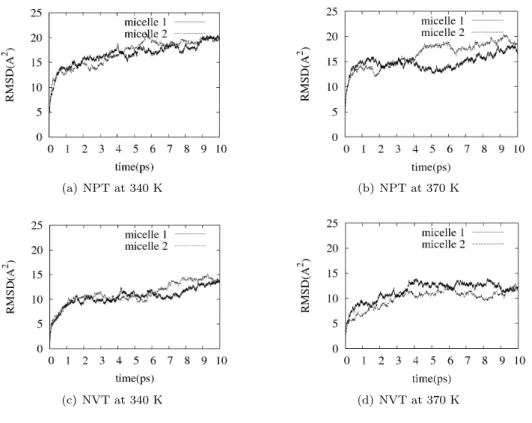
First, we calculated the root mean square displacement (RMSD) to assess the system equilibrium.
The RMSD is frequently used to measure the displacement of the system at time t form the initial
coordinate. The RMSD ise calculated by following equation;
RM SD(t) = v u u t 1 N
N
X
i=1
(R(i, t) − R(i, 0))
2where N is the number of lipid molecule, t is the MD time step, and R(i, t) is the coordintes of lipid molecules pf micelle. We also calculated symmetry parameter S, which is one of four structural parameters given by Acep et al. [1]. Although there are four parameters, aperture A, symmetry S, isotropy I, and compactness C for analysis of micelle system, we only investigate the symmetry parameter S of micelle in this study. To calculate symmetry S, we defined three vectors − →
R
1(t),
− →
R
2(t), and − → r (t) in each POPC lipid as shown in Figure 1(c). These vectors are defined by the two atoms, which are a phosphate atom in the head group and the hydrocarbon atom of lipid chain tail. The vector − →
R
1(t) is applied for the unsaturated acyl chain, the vector − →
R
2(t) is applied for the saturated acyl chain, and the vector − → r (t) is given by averaging the vectors − →
R
1(t) and − →
R
2(t). The symmetry parameter S(t) at each time steps is estimated by following equation;
S (t) = 1 N
N
X
i=1
−
→ r
i(t) .
By this calculation, we can assess a symmetry property of the micelle. The low S value means that the system has high symmetry. From the time series of the calculated symmetry value S(t), we analyze the dynamics of spherical micelle. We also calculated time correlation function (TCF) and direction correlation (DC) to investigate the correlation between micelle dimer in system. The time correlation function is defined as
C(t) = 1 T
T
Z
0
S
1(t
0)S
2(t
0+ t)dt
0,
where S
iis a symmetry value of micelle i. The time correlation between S
1(t) and S
2(t
0+t) should be evaluated by ensemble average of these values. We can also estimate autocorrelation function of symmetry parameter of each micelle when we take S
iof the same micelle in this equation. We compare the calculated TCF between S
1and S
2, and the autocorrelation function of symmetry S
iof each micelle.
We also calculated direction correlation (DC) to see the correlation between micelle dimer in direction. This calculation shows the degree parallel of micelle dimer. We evaluated this correlation by following equation;
D
ijC(t, t
0) =
−
→ S
i(t) − → S
j(t
0)
| − → S
i(t)|| − →
S
j(t
0)| , where − →
S (t) means the average of lipid vector in the micelle, − → S (t) =
N1N
P
i=1
−
→ r
i(t). If the calculated DC value equals to zero, they have anti-parallel direction.
3 Results and Discussion
From each MD simulation, we obtained trajectories of two micelles in water solvent. Here, we
simply call those micelles as the micelle 1 and micelle 2. Figure 2 shows the distance between the
(a) NPT at 340 K (b) NPT at 370 K
(c) NVT at 340 K (d) NVT at 370 K
Figure 2: Distance between the center of micelle 1 and the center of micelle 2. At higher temperature di distance is getting closer.
center of mass of micelle 1 and the center of micelle 2. We found that the micelle 1 and micelle 2 were getting closer at higher temperature (T = 370K) as the MD time step increases in the constant NVT condition. In order to assess the system equilibrium, we calculated RMSD of the micelles.
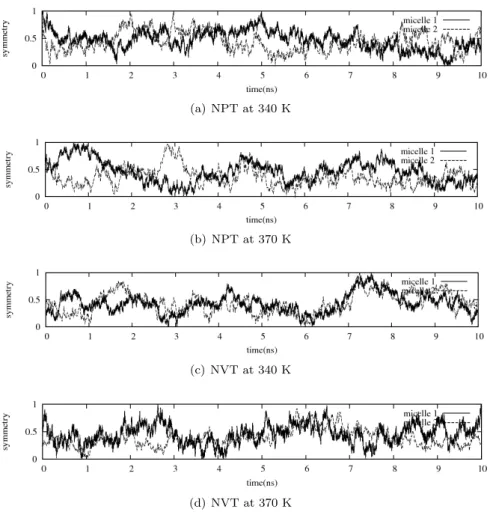
Figure 3 shows the calculated RMSD of each micelle in several conditions. We found that the all RMSD were roughly equilibrated in 10 ns MD time. We then analyzed the fluctuation of symmetry parameter S(t) as a function of time. The results in both constant NVT and NPT simulations at two temperatures are shown in Figure 4. The results show that the system is randomly fluctuate during the simulation time.
Table 1 shows standard deviation of symmetry parameter S. The small standard deviation in- dicates that the data points tend to be very close to the average value, whereas the large standard deviation indicates that the data spread out in wide range. We found that the standard devia- tion obtained from the constant NPT simulation shows a larger value than that in the constant NVT simulation, indicating that the structure of micelle in the NPT simulation should be largely fluctuated.
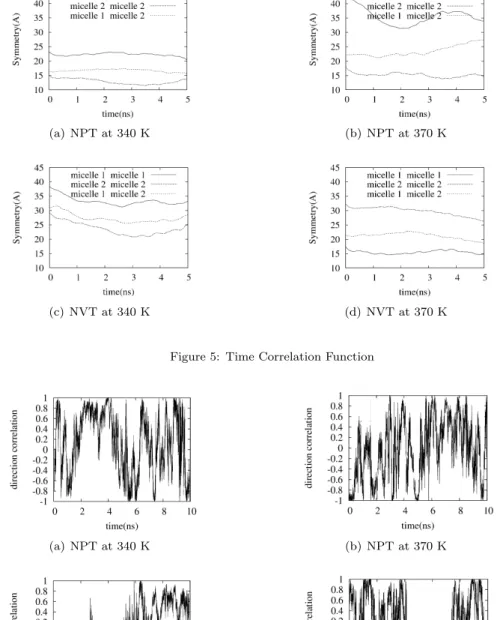
For further analysis, we calculated the TCF of micelle in each MD condition. The calculated
results are shown in Figure 5. The dotted line shows the time correlation function as a function
(a) NPT at 340 K (b) NPT at 370 K
(c) NVT at 340 K (d) NVT at 370 K
Figure 3: RMSD calculation. At lower temperature, system seems more equilibrium than at higher temperature.
Ensemble T Micelle SD Symmetry
NPT
340 K 1 2.62
2 1.99
370 K 1 6.48
2 3.13
NVT
340 K 1 4.58
2 4.37
370 K 1 2.16
2 4.32
Table 1: Standard Deviation of Symmetry
of time steps between the micelle 1 and micelle 2. We did not see the usual relaxation between
the symmetry of micelle dimer in this time range. This imply the there is no correlation between
micelle 1 and 2. The larger correlation time or sufficient statistic average should be used for the
observation of relaxation of the TCF. The other lines, which indicate the autocorrelation function
of each micelle, show different result with the dotted line. The observed TCF monotonically
decrease value, implying the relaxation of TCF of each micelle in this time. However, further
statistic average should be taken for the clear this relaxation property.
(a) NPT at 340 K
(b) NPT at 370 K
(c) NVT at 340 K
(d) NVT at 370 K
Figure 4: Symmetry. It shows that system are fluctuative.
Besides analyzing correlation in time, we investigate the correlation of micelles in direction. As shown in Figure 6, the direction of micelle 1 and micelle 2 were shown to be randomly changed during the MD time steps in all simulation conditions. Figure 7 shows that, the micelle 1 and micelle 2 are more anti-parallel under the constant NPT condition at higher temperature (T = 370K), while they are more parallel under constant NVT condition at the same temperature.
4 Conclusion
We have carried out the molecular dynamics simulations of spherical micelle dimer in water solvent
at two different temperatures under the constant NPT and NVT condition to investigate the
temperature effects on this system. We evaluated the symmetry parameter S of the micelle dimer
system at each MD time steps and showed that the micelle largely uctuates at higher temperature
under the constant NPT condition, while the large fluctuation was shown at lower temperature
in the constant NVT condition. In the calculation of the time correlation function of micelle
(a) NPT at 340 K (b) NPT at 370 K
(c) NVT at 340 K (d) NVT at 370 K
Figure 5: Time Correlation Function
(a) NPT at 340 K (b) NPT at 370 K
(c) NVT at 340 K (d) NVT at 370 K
Figure 6: Direction Correlation
(a) NPT at 340 K (b) NPT at 370 K
(c) NVT at 340 K (d) NVT at 370 K
Figure 7: Distribution of Direction Correlation