Tolerance to Different Behavior of Others in Kindergarten Children
Toshimoto Shuto
Faculty of Education, Saitama University
Xuanhua Yu
Graduate School of Education, Saitama University
Junko Taniwaki
Hikari Kindergarten, Soka, Saitama Kokusai Gakuin Saitama College
Abstract
Accepting others as peers who have preferences and behavioral tendencies that are different from one’s own, instead of rejecting them, can be labeled as tolerance. Focusing on socio-moral deviant behavior and idiosyncratic preference as different behavior of others, the present study examined the effect of types of difference on children’s moral and peer acceptance judgments and effect of nature of acceptance settings (public, private), and analyzed the characteristics of toler- ance in early childhood. A total of 80 children (M.age = 5 years 9 months) who were enrolled in Japanese kindergartens were presented with a story of a protagonist with socio-moral deviant be- havior and a story of a protagonist with idiosyncratic preference. They were then asked to make four types of moral and acceptance judgments, such as whether they would accept the protagonist as a peer in a public or private setting. Results showed that children judged socio-moral deviant behavior to be relatively worse and the agent of the behavior relatively more unlikeable, and that they did not recognize self-determination in the behavior. Children accepted the protagonist who exhibited socio-moral deviancy in kindergarten and private settings at similar levels. On the other, children tended to reject protagonists with idiosyncratic preference in the private setting, where teacher intervention was not in place. Based on these results, characteristics of children’s tolerance were discussed from the perspectives of social cognition and socio-moral developments.
Key Words: Tolerance, Moral Judgment, Social Domain Theory, Early Education
1. Background and Purpose
In the field of early childhood education in Japan where globalization is in progress in the recent years, there are a growing number of elements of multiculturalism (Watanabe, Crystal, &
Killen, 2001). Children are expected to acquire from early stages in childhood abilities to get along with others who have characteristics that are different from theirs. Accepting others as peers who have preferences and behavioral tendencies that are different from one’s own, instead of rejecting
J. Saitama Univ. Fac. Educ., 63 (1) : 75-84 (2014)
cultural education.
One element of multiculturalism is diversity in ways of thinking and opinions. This topic has been studied in developmental psychology concerning acquisition of the value of freedom of speech (Killen, Lee-Kin, McGothlin, Stangor, & Helwig, 2002; Wainryb, Shaw, Langley, Cottam,
& Lewis, 2004). For example, Wainryb and her colleagues (2004) demonstrated that 5-year-olds did not show tolerance to those who did not see violence as socio-moral deviance while they did show tolerance to those whose preferences were different from theirs. Results indicate that 5-year- olds’ acceptance judgments depend on the content of opinion.
Another element of multiculturalism is diversity in behavior. In early childhood, immature behavior is often observed due to individual characteristics, such as willfulness, roughness, and hyperactivity, as well as environmental influence. Individual preferences in eating and playing greatly vary. Do young children accept as peers those who harm others and disturb social order, and those whose preferences are different from theirs, or reject both types similarly? According to the theory of social domains (Turiel, 2002; Wainryb, 2006), when individuals make moral judg- ments, they carry out multidimensional thinking, not only focusing on the behavior but also taking characteristics of the setting into consideration. Moreover, it has been shown that even children hold multidimensional domain concepts. It is possible that tolerance in children is affected by dif- ference in setting. Based on the research findings in freedom of speech, it can be predicted that judgment of young children on socio-moral deviant behavior is less tolerant compared to individu- als whose preferences are different from theirs.
Focusing on socio-moral deviant behavior and idiosyncratic preference as different behavior of other individuals, the present study was designed to examine the effect of types of difference on children’s moral and peer acceptance judgments and the effect of nature of acceptance settings (public, private), and analyze the characteristics of tolerance in childhood. In addition, whether children viewed the opinion, that someone would play with another if the other changed his/her behavior or preference that was different, fair or not was studied to examine the development of tolerance in childhood from the perspective of moral development.
2. Method
2. 1 Participants
Participants were 43 5-year-olds who were enrolled in Kindergarten A (private) and 37 5-year-olds who were enrolled in Kindergarten B (N = 80, M.age = 5 years 9 months) in Saitama prefecture.
2. 2 Experimental Design
A 2 (sex) x 2 (difference: socio-moral deviance, idiosyncratic preference) factorial design was applied. Age was a between-subject factor, whereas nature of difference was a within-subject fac- tor.
2. 3 Materials
Three stories were developed describing socio-moral deviance (meanness, messiness, risky behavior) and idiosyncratic preference (having a lizard as a pet, liking vegetables, liking golf) each. Five pictures in color (size A4) were prepared for each story (Figure 1).
Pictures can be described as follows: introductory scene according to the theme (picture 1), introduction of the protagonist whose behavior or preference is different from the participant’s (picture 2), a teacher directing to play with the protagonist in kindergarten (picture 3), a child in- viting a favorite friend in his/her home (picture 4), and a child telling the protagonist to change his/her behavior or preference (picture 5). Contents of the stories are summarized in the Table 1.
Additionally, for the use in responding about moral and acceptance judgments, pictures depicting changes in facial expressions of a child (e.g., strongly angry, mildly angry, neutral, pleased a little, pleased greatly) were prepared.
Table 1. Contents of Stories Story of Socio-Moral Deviant Behavior
Meanness
Kenta and Yuta are playing in a sandbox in kindergarten, when Kenta suddenly became angry with Yuta, and said in a very loud voice, “Go away!” He is saying, “I’m not going to play with Yuta ever again!” Yuta is leaving from the sandbox, looking sad.
Does not clean up
It is about the time to go home. Everyone is getting ready to go. They put their hats on, put their backpacks on, gather around the teacher’s desk, and sing the song of good-bye with the teacher before going home. Haru still has her crayons out on the table that she used for drawing. She hasn’t put away the books either.
Risky behavior
Children are riding scooters in the kindergarten playground. Kai too is playing, riding a scooter.
Kai is going around fast like the wind. He is going so fast that he sometimes crashes a playground equipment and falls down. Other times, he bumps into another child. He does not care if falls. He is still riding the scooter around fast like the wind.
Story of Preference
Having a lizard as a pet
Everyone is talking about their favorite animals. She likes dogs, he likes cats, and she likes rab- bits. Kota’s favorite is lizards! Kota has a lizard in his home. Kota shows pictures of his lizard to ev- eryone, and talks happily. Another child doesn’t like lizards. He is afraid of lizards.
Liking vegetables
It is lunch time. Everyone is enjoying lunch that Mother made: fried chicken, hamburger, sau-
them.
Golf is the favorite sport
Everyone is looking at a sports book with the teacher. Taka said, “I like golf! Let’s play golf to- gether.” No one, teacher or children, knows about golf. Taka is pretending to play golf.
Figure 1. Sample of pictures “Golf is the favorite sport”
2. 4 Procedures
Experiment was conducted individually in private rooms in the kindergartens in July 2012.
Participants were presented with one of the nine combinations of one out of three stories of socio- moral deviance and idiosyncratic preference each. In other words, each participant was presented with a total of two stories, one of socio-moral deviance and one of preference. Eight to nine par- ticipants were assigned to each of the nine combinations. There were about the same numbers of boys and girls.
Presentation orders of two stories were counterbalanced. Participants heard stories as they looked at the pictures. They were provided with explanations about characteristics of protagonists while being presented with picture 1 and 2. During this time, the investigator made sure that the participants understood the behavior or preference of the protagonists was different from theirs.
Participants responded about judgments about wrongness and likable-unlikableness on 5-point scales. Additionally, for the judgments on wrongness, they were asked for the reasons.
Next, participants responded about self-determination on a 2-point scale. For example, for the story of meanness, questions were asked as follows: “If you think, ‘I don’t like that kid,’ is it OK to say on your own freely, ‘I’m not going to play with you again,’ or ‘Go away?’ Instead, is it better to consult your teacher when you think, ‘I don’t like that kid?’” Responses were made by choosing either “You can decide on your own,” or “It is better to consult your teacher.”
Subsequently, participants were presented with picture 3, responded about acceptance judg- ment in a public (kindergarten) setting on a 4-point scale, and explained the reason. Next, picture 4 was shown, and the participants responded about acceptance judgment in a private (park) set- ting similarly. For example, for the meanness, participants were asked questions as follows. For the public setting, “Yuta was told to go away by Kenta. However, the teacher told Yuta to play with Kenta in the sandbox. Do you think Yuta will play with Kenta in the sandbox, or he will not?”
Whichever the response, participants were then asked to indicate the degree of judgment, “Does he think he can play a little, or does he think they will play for a long time?” Alternatively, they were asked, “Does he not want to a little, or does he absolutely not want to?” For the private setting, participants were asked, “Yuta wanted to play with friends in the sandbox in the park after kinder- garten. He said to Taro, ‘Let’s play together in the park after we get home.’ Then Kenta said, ‘I want to play with the sand in the park, too!’ Does Yuta ask Kenta to play together, or does he not?”
Whichever the response, participants indicated the degree by choosing “a little” or “very much.”
Finally, participants were presented with picture 5, responded about fairness of the opinion asking to change behavior or preference using a 4-point scale, and stated the rationale. For exam- ple, for meanness, participants were asked, “Friend Taro said, ‘I am not going play with Kenta. I don’t like him because he says, ‘Go away,’ and other rough things. If Kenta promises he will never say mean things, I don’t mind playing with him.’ Do you think what Taro said was wrong or not wrong?” Whichever the response, participants were asked to indicate the degree by choosing “a little” or “very much.”
3. Results
3. 1 Wrongness and Likable-Unlikableness Judgments
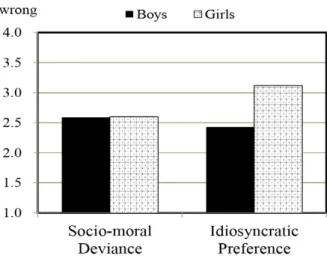
Responses were scored so that higher scores indicated stronger inclination toward wrongness and unlikableness, and analyzed for ANOVAs with a 2 (sex) x 2 (type of difference: socio-moral deviance, idiosyncratic preference) design. Results indicated that only the main effect of difference was significant (F (1, 78) = 102.74, p < .01; F (1, 78) = 40.57, p < .01) in all analyses. Thus, it was shown that young children tend to judge morally deviant behavior with higher degrees of wrong- ness and unlikableness (Figure 2).
3. 2 Self-Determination Judgment
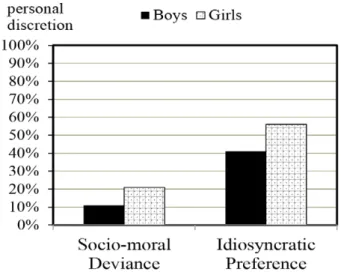
For socio-moral deviancy, 84% of the participants responded that it could not be done freely and that it would do better to consult. For idiosyncratic preference, 49% responded that it could be done freely. Results of ANOVA showed only the main effect of difference to be significant (F (1, 73)
= 28.59, p < .01). It was demonstrated that young children do not acknowledge self-determination in socio-moral deviance, while recognizing preference as a personal issue to some extent (Figure 3).
3. 3 Acceptance Judgment
Generally, children showed a high inclination toward acceptance. A 2 (sex) x 2 (difference) x 2 (acceptance setting: public, private) ANOVA found only the interaction effect of difference x ac- ceptance setting to be significant (F (1, 77) = 4.28, p < .05). Degree of acceptance of protagonist who exhibited socio-moral deviance was similar in the kindergarten and private settings. On the other
Figure 2. Children’s judgments of wrongness and likable-unlikableness
hand, children accepted protagonist who exhibited idiosyncratic preference more readily in the kindergarten setting than in the private setting. They considered that in the private setting, where there was no intervention by the teacher, protagonist with idiosyncratic preference was less accept- able than protagonist with socio-moral deviance. (Figure 4)
3. 4 Fairness Judgment on Request to Change
Generally, participants tended to judge requests for change of both behaviors to be fair. Re- sults of ANOVA showed a significant interaction effect of difference and sex (F (1, 75) = 6.28, p <
.05). In other words, girls, when compared to boys, were more likely to judge opinions to request Figure 3. Children’s Self-Determination Judgment
Figure 4. Children’s acceptance judgments
4. Discussion
Results on wrongness and self-determination judgments demonstrated that the children who participated in the present study held differing recognition of socio-moral deviant behavior and idiosyncratic preference. These results were in keeping with finding in the previous research (e.g., Shuto, 2006; Shuto & Ninomiya, 2003). To summarize, by 5 years of age, specialization of social cognition has begun, and social domains that constitute cognitive frameworks for moral, conven- tional, and personal judgments have developed. Children by this age are able to make social judg- ment based on an understanding of the context of deviant behavior.
It has been shown that 4-year-olds have specialized domain concepts, and apply the knowl- edge to moral judgment. Killen, Pisacane, Lee-Kim, and Ardila-Rey (2001) found that 4-year-olds regarded excluding boys from doll plays as moral deviance, prioritizing fairness over stereotypical sex role behavior. These findings indicate that young children are developing moralists.
Children did not reject the agents of socio-moral deviant behavior as much as they judged the behavior to be wrong and unlikable. Both in public (kindergarten) and private (home) settings, they were tolerant toward protagonists with deviant behavior or idiosyncratic preference. Analysis of reasons revealed that those who demonstrated tolerance referred to friendship and compassion (“I feel sorry if he is left out”). The deviant behavior and idiosyncrasy of preference that were ex- amined in the present study may not be significantly different in the social life of young children.
It is possible that situations such as playing alone and being left out may trigger morality and toler- ance in children more strongly to drive them to take some action.
Girls showed a strong tendency to oppose the opinion to ask to change preference. This indi- cates that girls show more advanced moral development than in boys. Typically, girls show higher sympathy when measured with questionnaire (e.g., Eisenberg, 2005). Therefore, it is conceivable that girls develop morality which is based on sympathy earlier. However, the questions used in the present research about fairness of request to change difference relates to values such as freedom of speech and fairness. The fact that girls showed a stronger tendency than did boys toward judging
Figure 5. Children’s Fairness Judgment on Request to Change
the opinion that the character in the story would play with the other character if he/she changed his/her favorite pets to be wrong may be indicative of earlier maturation of girls in the area of mo- rality of fairness.
The present research indicates that in young children, judgments on wrongness of difference, likable-unlikableness, and morality of requesting to change preference do not directly correlate with acceptance judgment. On the other, research showed that behavior related to exclusion and bullying was differently judged developmentally, correlating with moral judgment. Shaw & Wain- ryb (2006) found that while 5-year-olds judged victims of bullying (e.g., a child who was told to clean the locker of another child) being obedient positively and being resistant negatively, children between ages of 7 and 16 judged victims being resistant positively. Future research should exam- ine the process of social cognition that is in the background of tolerance judgment and behavior, and address the relationship between tolerance and social cognition from the developmental per- spective.
References
Eisenberg, N. (2005). The Development of Empathy-Related Responding. In R. A. Dienstbier, G. Carlo, and C. P. Edwards (Eds.), Moral Motivation through the Life Span Vol. 51 of the Nebraska Sympo- sium on Motivation. Lincoln: University of Nebraska Press, 73-117.
Killen, M., Lee-Kin, J., McGothlin, H., Stangor, C., & Helwig, C. C. (2002). How children and adoles- cents evaluate gender and racial exclusion. Monographs of the society for research in child develop- ment Serial No.271, 67 (4). Boston, MA: Blackwell.
Killen, M., Pisacane, K., Lee-Kim, J., and Ardila-Rey, A. (2001). Fairness or stereotypes? Young chil- dren’s priorities when evaluating group exclusion and inclusion. Developmental Psychology 37, 587- 596.
Leary, M. R. (2001). Interpersonal Rejection. New York: Oxford University Press.
Shaw, L. A. and Wainryb, C. (2006). When victims don’t cry: Children’s understandings of victimization, compliance, and subversion. Child Development 77, 1050-1062.
Shuto, T. (2006). Young children’s socio-moral judgments about conflict situations between moral and conventional rules. Japanese Journal of Morality Psychology 20, 1-6. (Japanese)
Shuto, T. and Ninomiya, K. (2003). Kodomono Doutokuteki Jiritsu No Hattatsu. (Development of Chil- dren’s Moral Autonomy). Tokyo: Kazama Shobou (Japanese)
Turiel, E. (2002). The culture of morality: Social development, context, and conflict. Cambridge, England:
Cambridge university press.
Wainryb, C. (2006). Moral development in culture: Diversity, tolerance, and justice. In M. Killen & J. G.
Smetana (Eds.), Handbook of moral development. Mashwah, NJ: Erlbaum, pp. 211-240.
Wainryb, C., Shaw, L. A., Langley, M., Cottam, K. and Lewis, R. (2004). Children’s thinking about diver- sity of belief in the early school years: Judgments of relativism, tolerance, and disagreeing persons.
Child Development 75, 687-703.
Watanabe, H., Crystal, D., and Killen, M. (2001). Tolerance for human diversity: Children’s and adoles- cents’ evaluations of peer group inclusion and exclusion in Japan and the United States. Bulletin of the faculty of education, Ehime university 47 (2), 39-58.
(Received October 11, 2013) (Accepted November 21, 2013)
Correspondence concerning this article should be sent to:
SHUTO, Toshimoto
Department of Early Childhood Education and Care Faculty of Education, Saitama University
255 Shimo-Ohkubo, Sakura-ku, Saitama 338-8570, Japan E-mail: [email protected]