• 検索結果がありません。

神田外語大学学術情報リポジトリ asKUIS

N/A
N/A
Protected

Academic year: 2021

シェア "神田外語大学学術情報リポジトリ asKUIS"

Copied!
23
0
0

読み込み中.... (全文を見る)

全文

(1)

An Analysis of Linguistic Politeness in

Japanese: A Case Study on the Management of Polite Form among Young Japanese People in Australia

journal or

publication title

 Global communication studies = グローバル・コ ミュニケーション研究

number 8

page range 137‑158

year 2019‑03

URL http://id.nii.ac.jp/1092/00001613/

asKUIS 著作権ポリシーを参照のこと 

(2)

An Analysis of Linguistic Politeness in Japanese: A Case Study on the

Management of Polite Form among Young Japanese People in Australia

Koichiro K ITAMURA

The present paper makes an analysis of linguistic politeness by focusing on the style choice between a formal and plain forms, or

“mas-form” and “ø-form” in Japanese discourse. Style shifting from one form to the other is observed in ongoing social interactions taking place in a particular speech community: a group of Japanese Working Holiday Makers in Australia. The author argues, despite an unfavorable view that the group of young Japanese people overseas is not sophisticated in maintaining their speech level in a proper manner, that style-shifting is a meaningful linguistic practice through which they relativize their social relationships with each other in the course of linguistic socialization in a culturally characterized context. As a part of comprehensive research on a correlation of linguistic manipulation with social practices, the primary purpose of this paper is to characterize the distribution of polite forms through questionnaire surveys and discourse analysis by which the author will further investigate into social and psychological source behind the linguistic manipulation shared among members of a Japanese speech community abroad.

Keywords: Linguistic politeness, style-shifting in Japanese, Discourse Analysis, Japanese Working Holiday Makers

1. Introduction

It is recognized that a number of researchers have attempted to characterize the use of mas-form

1)

in pragmatically cohesive rules.

As discussed in Kitamura (2016), the previous studies suggest that

a dimension of solidarity as well as formality is operative in the

(3)

style choice between mas-form and ø-form. However, in order to seek a correlation of the social and psychological forces with the linguistic manipulation, the notion of solidarity needs to be elaborated on particularly in Japanese terms. Crucial to Japanese linguistic politeness is that style choice is codetermined by a range of cultural values, or the two contrasting but shifting parameters of in-group and out-group or uchi and soto. And equally important is the fact that, due to its fl uid nature of the parameters, the frame of social relationships and contexts is not fi xed but consistently negotiated in ongoing social interactions. The motivation for style- shifting from one form to the other is therefore to be discussed by examining how people extensively relativize a boundary of uchi and soto relationships with each other in their social encounters.

In studying linguistic politeness in Japanese, four issues are taken up in Kitamura as research questions to be investigated: (1) what brings about a sense of uchi or soto among a group of people in their social encounters; (2) how it is realized in their style choice; (3) how the meaning of the linguistic manipulation is exchanged among the members, and; (4) what effects linguistic practices may be imposed on the group (Kitamura 2016:212). In order to answer these research questions, this paper will deal with the investigation of style-shifting as a means to characterizing social and psychological source behind the linguistic management through questionnaire surveys and discourse analysis on the distribution of mas-form and ø-form.

By conducting questionnaire surveys to a group of Japanese

Working Holiday Makers in Australia, I will pursue their

motivations for the linguistic manipulation in terms of the cognitive

process of relativizing social and psychological distance in their

minds. The main goal of this paper is to demonstrate the

distribution of mas-form and ø-form marking in both written and

spoken discourse, which will lead to a further inquiry into how the

(4)

meaning of style-shifting is perceived, negotiated and shared by members of the speech community.

2. Literary Review

The previous studies have shed lights upon the two concepts being operative in Japanese linguistic politeness: the social distance between senior and junior members, and moreover the psychological distance relativized with regard to a distinction between in-group and out-group members. The style choice between mas-form and ø-form can be characterized as an accommodating or distancing speech acts to maintain interpersonal relationships between individuals. As pointed out in Kitamura (2016), if the manipulation of the two linguistic forms functions as to controlling the access to solidarity, the avoidance of using mas-form can be regarded as a sign of being in in-group or uchi relationships where psychological territories are open to each other.

Taking a dimension of solidarity into consideration, style-shifting between two forms is treated no longer as a violation of consistency prescribed in conventions but as an implication of social distance variably relativized by the participants in the discourse. Relatively recent studies on style-shifting or more commonly referred to as

“speech-level shift” (Mimaki,2013:85) have provided more comprehensive views of the linguistic manipulation by categorizing the occurrence condition for mas-form marking and its pragmatic functions. For example, Maynard (1991, 1997) defi nes style-shifting as “a manipulative device to express some aspects of discourse modality” (Maynard, 1991:580). The condition for ø-form marking is summarized as follows:

The da style is selected (1) when the speaker takes a perspective

internal to the narrative setting and immediately responds

within that framework, (2) when the speaker presents

(5)

backgrounded information semantically subordinate within the discourse structure and (3) when the speaker fi nds the addressee close enough and the speaker uses a style similar to the style in which he or she self-addresses. (Maynard, 1991:551)

Usami further points out the possibility of mas-form and ø-form functioning as indicators of “the social and psychological relationships between the speaker and hearer” (Usami, 2002:138) by demonstrating the correlation between the frequency of occurrence of style-shifting and “the power (age, social status) and / or gender of the interlocutor” (ibid. 3) in discourse level.

The previous studies suggest a dimension of solidarity as well as formality is operative in the style choice between mas-form and ø-form. However, it is not likely that they would fully provide the pragmatics of mas-form with the social and cognitive process in which the speech participants work out with their interpersonal relationships. In fact, it is not completely clear how the sporadic use of mas-form in ø-form-dominant discourse is interpreted as a sign of expressing a sense of distance, not of lacking the ability to maintain the consistency in style. Nor is it clear in what situation the sporadic use of ø-form in mas-form-dominant discourse is interpreted as a sign of expressing a sense of solidarity, not of neglecting sets of linguistic etiquette.

Defi ning the social and psychological relationships in Japanese

terms, this study attempts to characterize style shifting as an index

to defi ne and redefi ne interpersonal relationships in terms of a sense

of uchi or soto. The motivations for the linguistic manipulation are

to be investigated in a case study by conducting questionnaire

surveys and analysis on the distribution of mas-form and ø-form in

written discourse through a fi eld work in a Japanese speech

community abroad.

(6)

3. Data and Methods

The investigation of style shifting between mas-form and ø-form was made within a specifi cally targeted speech community a group of Japanese Working Holiday Makers in Australia. A total of eight informants cooperated in providing information for questionnaire survey as well as written text and spoken discourse for analysis. All informants were Japanese Working Holiday Makers staying in Sydney for less than half a year. There were 4 male and female speakers of similar age, between 18 and 24, who came from various parts of Japan. They will be termed as male Speaker (a), (b), (c), (d) and female Speaker (E), (F), (G), (H) for convenience. The contrast between small and capital letters represents their differences in gender. Not all of them knew each other before the collection of conversational data.

For the analysis of style shifting practiced by Working Holiday Makers in ongoing social interactions, the eight informants were invited separately to take part in conversations. Each conversation was performed by two speakers totaling 8 pairs. The pairs consisted of the speakers both familiar and unfamiliar to each other by 50%.

There were 4 pairs between friends and also 4 pairs between strangers.

The rationale behind the selection of 8 pairs is that there needs to be an analysis made to characterize how one speaker may treat his / her style differently depending on conversational partners.

Some speakers were therefore invited to participate more than twice, in their usual conversation between friends as well as in their fi rst meeting with strangers.

All conversations were audio-recorded in a controlled situation with

no outsider present, with minimal guidance to the informants. Only

3-minute segments were selected within 10-minute conversations as

data relevant to the analysis of the style choice between mas-form

and ø-form. Besides the initial 2-minute segments, the last 1-minute

(7)

segments were extracted in order to examine some changes in the way the informants treat the linguistic signs during their conversations. Statistical information discussed in this work will be based on the total of 24 minutes of spoken discourse (i.e. 3 minutes each from 8 conversations).

In order to seek social and psychological source for their group consciousness, questionnaire survey was conducted to characterize their view of self in relation to other Working Holiday Makers. A total of eight copies were collected from the informants. The questionnaire was organized for the purpose of understanding the notion of the Working Holiday scheme agreed on by the informants.

It was made up of three parts that asked them about their (1) profi les (i.e. age, gender, and current occupational status), (2) images of a typical Working Holiday Maker, and (3) experiences as one of Working Holiday Makers themselves in Australia.

The last part of the questionnaire, Part (3), provided the written discourse to be analyzed to seek motivations for style choice practiced by the Working Holiday Makers. The informants had two pages to write about their own experiences as to the Working Holiday scheme. They were requested to present the same story to the two different types of readers in mind: the fi rst page to Working Holiday Makers and the second page to Japanese university students in Australia. A crucial point in this task was to test if the style choice would be made differently depending on the two types of addressees. It was posited, if a sense of uchi or soto was being operative, that the informants would use mas-form less in writing to the group of Working Holiday Makers as in-group members than to that of university students.

As well as the written and spoken discourse obtained directly

from the informants of Working Holiday Makers, data collection

was made for text analysis in Australia. There were more than ten

Japanese newspapers and magazines, and many of them were

(8)

available for free in Japanese restaurants, grocery stores, book shops, travel agencies, and student information centers in Sydney.

In addition to news articles, columns, and essays, those free publications would contain a variety of information or advertisements on services available in Japanese such as auto repairs, haircuts, internet providers, medical checks, academic consultations, and visa support. Some articles were extracted from news magazines as the data relevant to the issue of motivations for the management of style discussed in this study.

It should be noted here that, as the main purpose of this study is to demonstrate how style shifting is correlated with social and psychological source that would give rise to a sense of uchi or soto, the target of analysis on the distribution of mas-form and ø-form is the interactional aspect of linguistic practices. Although style- shifting derived from self-addressed speech or as a result of presenting backgrounded information as described earlier in Maynard (1991) may also be counted as the co-occurrence of mas- form and ø-form, it is not discussed in detail in this paper.

On the assumption that a linguistic choice of one form over the other would manifest the speaker’s recognition of a relative social position to the other speech participants, style-shifting can be regarded as an act of identity. In analyzing the distribution of mas- form and ø-form, the co-occurrence of the two forms is to be interpreted as a manifestation of multiple social identities. Two theories relevant to the analysis of the multiplicity are the concept of “voice” advocated by Bakhtin (1981) and the framework of

“footing” by Goffman (1981).

In accordance with Bakhtin’s view of an utterance as “fi lled with

dialogic overtones” (Bakhtin, 1986:102), the speaker’s representing

voices are treated as a clue to analyzing style mixing discourse. In

identifying social and cognitive source for the linguistic choice,

discourse analysis is made to characterize multiple social roles and

(9)

moreover the dialogic nature inherent in the speakers’ speeches that are what Holquist and Emerson (1981) may call “the speaking personality” or “speaking consciousness.”

Furthermore, in order to explain style-shifting performed by a single speaker to the same conversational partner, a change in the speaker’s understanding of his / her interpersonal relationship is elaborated on in terms of Goffman’s framework. According to Goffman, such a change may imply “a change in the alignment we take up to ourselves and the others present as expressed in the way we manage the production or reception of an utterance” (Goffman, 1981:128). The speaker’s motivations for style-shifting between mas-form and ø-form can be interpreted as a result of the change in understanding his / her conversational role, be it as an in-group or out-group member, in relation to other participants. The investigation of style-shifting practiced by the eight Japanese Working Holiday Makers is therefore made by inquiring into how they refl ectively use mas-form and ø-form in categorizing their social relationships with each other.

4. Results

4.1. Conversations

The description of the eight conversational partners is made in

Table 1, with their age and use of mas-form, followed by the

numbers and percentages of mas-form marking observed in each

conversation.

(10)

In Table 1, it is realized that the use of mas-form is not simply observed by particular informants. The same speakers in fact present a varying degree of mas-form marking depending on their conversational partners. Speaker (b) for example, uses mas-form differently in conversation with his friends, Speaker (F) and (c). He frequently speaks in mas-form to Speaker (F) in Conversation 2, while he never does to Speaker (c) in Conversation 7.

Moreover, it is noticeable that many of the informants often shift their style even in speaking to the same partners in the course of 10-minute conversations. The increasing number of mas-form observed in Speaker (a)’s utterances in Conversation 6 indeed illustrates how variably one may manipulate the linguistic forms. In order to pursue the process of style-shifting, I will attempt to describe which style is used by whom in what situations in the eight conversations.

Pair Speaker Age Use Total 3 minutes

First 2 minutes

Last 1 minute

Style Shifting 1 Friends (a)

(H) 23 24

No No

0 (0%) 0 (0%)

0 (0%) 0 (0%)

0 (0%) 0 (0%)

― 2 Friends (b)

(F) 24 24

Yes Yes

18 (29.5%) 10 (16.4%)

12 (29.3%) 6 (14.6%)

6 (30.0%) 4 (20.0%)

0.7% up 5.4% up 3 Strangers (b)

(G) 24 23

Yes Yes

2 (3.7%) 2 (3.7%)

2 (5.9%) 2 (5.9%)

0 (0%) 0 (0%)

5.9% down 5.9% down 4 Strangers (F)

(G) 24 23

Yes Yes

6 (10.5%) 4 (7.0%)

6 (15.8%) 4 (10.5%)

0 (0%) 0 (0%)

15.8% down 10.5% down 5 Strangers (a)

(E) 23 24

No Yes

0 (0%) 6 (8.6%)

0 (0%) 6 (12.2%)

0 (0%) 0 (0%)

Ð―

12.2% down 6 Strangers (a)

(b) 23 24

Yes Yes

12 (30.8%) 20 (51.3%)

4 (16.0%) 15 (60.0%)

8 (57.1%) 5 (35.7%)

41.1% up 24.3% down 7 Friends (b)

(c) 24 24

No No

0 (0%) 0 (0%)

0 (0%) 0 (0%)

0 (0%) 0 (0%)

― 8 Friends (a)

(d) 23 18

No No

0 (0%) 0 (0%)

0 (0%) 0 (0%)

0 (0%) 0 (0%)

Table 1: The distribution of mas-form marking in the 8 pairs

(11)

4.1.1. Conversations between Friends

It is widely recognized that the use of mas-form is often disregarded in casual conversations between friends. The absence of mas-form in Conversation 1, 7 and 8 seems to agree to the general tendency. No single utterance is given in mas-form in the three conversations between friends, i.e. Speaker (a) and (H), Speaker (b) and (c), and Speaker (a) and (d).

However, it should be noted that there are cases in which people employ mas-form regardless of the familiarity. Indeed, in Conversation 2, both Speaker (b) and (F) employ mas-form to a signifi cant degree (i.e. 29.5% and 16.4% respectively) even though they have been friends for nearly three months in Australia. The mas-form marking presented by Speaker (b) and (F) in Conversation 2 suggests that the style choice between mas-form and ø-form is not solely dependent on the familiarity between speech participants.

The distribution of mas-form presented by Speaker (b), (F), and (G) further poses a question on the consistency in style prescribed in the conventions. Firstly, Speaker (b) is apparently the most frequent user of mas-form. The high degree of mas-form marking is in fact observed not only in Conversation 2 (i.e. 29.5%) but also in Conversation 6 (i.e. 51.3%). Judging from the distribution of mas-form in the two conversations, mas-form can be taken as the neutral style for Speaker (b) in speaking to his friends as well as strangers. However, evidenced in the lack of mas-form in Conversation 7, Speaker (b) also seems to follow the general tendency to disregard mas-form when he talks with his friend, Speaker (c). Moreover, the relatively small number of mas-form marking in Conversation 3 (i.e. 3.7%) indicates that Speaker (b) may feel free to go without mas-form even to Speaker (G) whom he meets for the fi rst time.

Such an inconsistency in the style choice is further observed with

Speaker (F). Speaker (F) is also likely to be an informant who

(12)

frequently uses mas-form. As well as in Conversation 2 (i.e. 16.4%), she shows a comparatively high degree of mas-form marking in Conversation 4 (i.e. 15.8%). However, apart from the similar rate of mas-form marking, there seems to be a crucial difference in Speaker (F)’s management of mas-form in the two conversations. The difference becomes apparent in focusing on the distribution of mas- form in a sequence of conversations. On the one hand, in Conversation 2, there seems to be a little difference in the distribution of mas-form in the fi rst 2-minute and the last 1-minute segments (i.e. 14.6% and 20.0%). Regardless of the familiarity for Speaker (b), Speaker (F) maintains or slightly increases the degree of mas-form marking in the latter part of the conversation. On the other hand, in comparing the distribution of mas-form in the two segments in Conversation 4, it is noticeable that the percentages of mas-form marking falls into zero in the course of a new social encounter with Speaker (G) (i.e. from 15.8% to 0%). No single sign of mas-form in the last 1-minute segment indicates that Speaker (F) may have gone through some kind of negotiation on the notion of mas-form or ø-form with Speaker (G).

In the same manner, Speaker (G) shows a tendency not to use

mas-form in the course of a new social encounter with Speaker (F)

in Conversation 4. As well as Speaker (F), Speaker (G) frequently

uses mas-form in the fi rst 2-minute segment (i.e. 10.5%) but no

longer in the last 1-minute segment (i.e. 0%). As Speaker (F) and

(G) get to know each other, they start to disregard mas-form. The

corresponding style-shifting observed in their utterances may

suggest that they seem to have a mutual agreement to go without

mas-form in their ongoing social interactions. Noteworthy to the

linguistic manipulation practiced by Speaker (G) is that such

coordination seems to be made in conversation with Speaker (b) as

well. The distribution of mas-form in Conversation 3 turns out to

be similar to that in Conversation 4 in the point that both

(13)

participants start not to use mas-form to each other in the course of their new social encounter. In fact, Speaker (b) does not use mas- form at all in speaking to the unfamiliar conversational partner, Speaker (G), in the later stage of Conversation 3, even though he consistently uses it in speaking to his friend, Speaker (F), in Conversation 2.

4.1.2. Conversations between Strangers

It is widely recognized that the use of mas-form tends to be preferred in conversations between strangers. According to the numbers and percentages of mas-form illustrated in Table 1, the occurrence of mas-form observed in the initial parts of Conversation 3, 4, 5 and 6 largely supports the general view. Not knowing each other well, the participants may fi nd it diffi cult to make their style choice between mas-form and ø-form. However, evidenced in the absence of mas-form presented by Speaker (a) in Conversation 5, there are occasions where people start their conversation without mas-form in spite of the uncertainty in relativizing their social relationships. For example, Speaker (a) is seemingly an informant who prefers to use ø-form in speaking to most of his conversational partners: not only to his friends, Speaker (H) and (d) in Conversation 1 and 8, but also to unfamiliar conversational partners, Speaker (E) and (b), in Conversation 5 and initially in Conversation 6.

Speaker (a) remarkably shows a tendency to disregard the use of

mas-form in speaking to his conversational partners. However, it

should be noted that such a tendency is not particularly observed

by Speaker (a) but rather commonly observed by the other

informants. In fact, although Speaker (G), (F), (E), and (b) often

employ mas-form to their unfamiliar partners at the very beginning,

they show the tendency to use ø-form at the early stage of their new

social encounters (i.e. within 10 minutes of their conversations).

(14)

The tendency demonstrated by the pairs of strangers suggests that the use of ø-form is not solely determined by the familiarity between speech participants.

Furthermore, the stylistic coherence prescribed in the conventions is not tenable in the use of ø-form presented by Speaker (E), (F), and (G). Speaker (E) is one of the informants who follow the general tendency to start using ø-form in the course of 10-minute conversations. The process of her style-shifting from mas-form to ø-form is observable in comparing the distributions of the two forms in the fi rst 2-minute and the last 1-minute segments of conversations illustrated in Table 1. In Conversation 5, Speaker (E) uses mas-form in speaking to the unfamiliar conversational partner, i.e. Speaker (a), at the rate of 12.2% in the fi rst segment. However, she seems to disregard her initial style in the latter part of the conversation. In fact, in Table 1, the degree of her mas-form marking indicates 0% in the last 1-minute segment.

As mentioned above, those pairs of Speaker (b) and (G), and of Speaker (F) and (G) also show the same tendency. It is notable in Table 1 that the degree of mas-form marking remarkably decreases in Conversation 3. Only ø-form marking is observed in the utterances given by Speaker (b) and (G) in the last 1-minute segment, while mas-form marking is observed to a certain degree, i.e. 5.9%, in the fi rst 2-minute segment of their conversation. The tendency of style- shifting from mas-form to ø-form is more notably realized in Conversation 4. Both Speaker (F) and (G) show no single sign of mas- form in the last 1-minute segment, though they employ mas-form in the fi rst 2-minute segment at the rate of 15.8%

and 10.5% respectively.

The above data show a strong tendency for many of the young

Japanese Working Holiday Makers to prefer to go with ø-form in

associating with each other or exclusively use ø-form in the latter

part of their conversations even in their fi rst meeting. However, at

(15)

the same time, it is noticeable that such a tendency is not always applied to all the pairs. The opposite direction of style shifting observed in Conversation 6 indicates the necessity for further inquiry into their linguistic management diagnostic of the group.

It is notable in Conversation 6 that Speaker (a), the most frequent user of ø-form, cannot always be so determined with his style choice. Speaker (a) is actually observed to use a relatively large degree of mas-form marking (i.e. no less than 30.8%) in conversation with Speaker (b). As illustrated in the number and percentages of mas-form marking in Table 1, Speaker (a) for the fi rst time shows mas-form marking at the rate of 16% in the fi rst 2-minute segment.

Moreover, he even increases the rate up until 57.1% in the last 1-minute segment.

A crucial point to note as to the conversations between the unfamiliar group is that the way a speaker chooses one style over the other is not always fi xed but rather refl ectively negotiated with the other participant in ongoing social interactions. In order to elaborate on the variable motivations for the style-shifting between mas-form and ø-form, further analysis is necessary to explain how the notion of the linguistic forms being exchanged between the participants.

4.1.3. Conversation Category

Based on the description of the eight pairs and their management of mas-form and ø-form, the eight conversations can be categorized into four types. The categorization is made in terms of three points:

the familiarity of the participants, the percentages of mas-form in

their utterances, and the shifting degree of mas-form marking in the

course of conversations as in the following table.

(16)

The stability in the degree of mas-form marking in Type 1 and 3 indicates that one cannot simply label mas-form or ø-form as a neutral form in conversations. Indeed, as is demonstrated by Speaker (b) in Conversation 2 and 7, even the same informant treats mas-form differently depending on his conversational partners. The factors that call for the different style choice seem to lie in the process of relativizing social relationships between the participants.

Since the use of the two linguistic forms is deictic to the addressees, the pairs of friends are categorized into sub-groups that use and do not use mas-form to each other.

In investigating into the meaning of style-shifting, the category shows the necessity for discourse analysis on such conversations in Type 2 and 4 where the informants refl ectively manipulate the linguistic signs in ongoing social interactions. The characterization of their social relationships is to be elaborated on by a range of Japanese cultural values, uchi and soto. The meaning of disregarding or rather emphasizing mas-form will be discussed in the future analysis on Conversation 3, 4, 5 and 6 by focusing on the process of enacting a sense of uchi and soto based relationships, or in-group and out-group memberships among the eight Japanese Working Holiday Makers in Australia.

Type Conversation Pair mas-form marking Result

1 1 ・ 7 ・ 8 Friends 0% Stable

2 3 ・ 4 ・ 5 Strangers 0% 〜 15% Decreasing

3 2 Friends 15% 〜 30% Stable

4 6 Strangers 30% 〜 Increasing

Table 2: The category of the 8 conversations

(17)

4.2. Questionnaire on the Working Holiday Scheme

The answers to the questionnaire give insights into the notion of the Working Holiday scheme for the eight informants. The information gained through each part of the questionnaire is summarized prior to the discourse analysis.

4.2.1. Personal profi les

Part (1) is brief since personal information relevant to this study is only their age, gender, and current occupational status. Their age and gender are illustrated in Table 1. Their answers on social status are simply described as follows:

It is interesting enough to point out that all the eight informants claim their social or occupational status as a Working Holiday Maker no matter what jobs or activities they are currently engaged in since they came to Australia. It is notable that all of them except Speaker (b) are or were a student of language schools to learn English for one or two months. It seems typical of Japanese Working Holiday Makers to enroll in a language course for the fi rst few months. As they become accustomed to a life in Australia, they try to participate in other activities such as traveling around Australia, working in part-time, or improving skills related to their former jobs. Among the eight Working Holiday Makers, Speaker (b) is rather an exceptional informant who does not study in a language school, but instead works almost every day in a Japanese restaurant in Sydney. However, the difference in their activities is not refl ected in their answers in Part (1). A term “Working Holiday Maker” is applied not only to a visa holder, but moreover to a

The number Social status

8 (100%) a Working Holiday Maker

Table 3: Self-categorization

(18)

distinctive social status beyond such categories as a student of a language school, a waiter of a restaurant, and so forth.

4.2.2. The Notion of the Working Holiday scheme

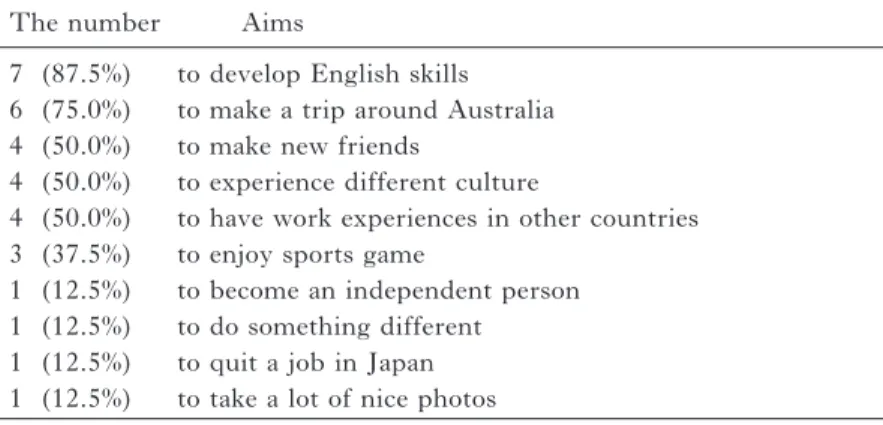
In Part (2), several questions are asked of the eight informants to describe their notions of the Working Holiday Scheme or images typical of a Working Holiday Maker. The questions begin with asking their motivations for participating in the scheme. All of the eight informants state their goals in Australia by describing the opportunities or advantages they can have with the visa. Their answers are listed below:

It should be noted that the aim of the Working Holiday Scheme is stated in general terms and does not describe specifi c activities to its visa holders in offi cial documents. In the case of the features described by the Department of Home Affairs

2)

in Australia, it is released that “the Working Holiday visa is a temporary visa for young people who want to holiday and work in Australia for up to a year. It is a temporary visa that encourages cultural exchange and closer ties between Australia and eligible countries” (Working

The number Aims

7 (87.5%) to develop English skills 6 (75.0%) to make a trip around Australia 4 (50.0%) to make new friends

4 (50.0%) to experience different culture

4 (50.0%) to have work experiences in other countries 3 (37.5%) to enjoy sports game

1 (12.5%) to become an independent person 1 (12.5%) to do something different 1 (12.5%) to quit a job in Japan 1 (12.5%) to take a lot of nice photos

Table 4: Goals in the Working Holiday Scheme

(19)

Holiday visa: subclass 417).

The goals of the eight informants illustrated above go more or less beyond the original scheme. Most of the informants seem to be more concerned about making a trip around Australia, or what they preferably call “round.” The term “round” is synonymous with

‘sightseeing,’ yet more likely to indicate a long term trip through campsites or cheap accommodations such as ‘backpackers’ and

‘youth hostels’ with small funds. With permission to engage themselves in a full-time study (within three months) and work to supplement their funds (through incidental employment), the Working Holiday visa is obviously the most attractive option for them to achieve their various goals listed above.

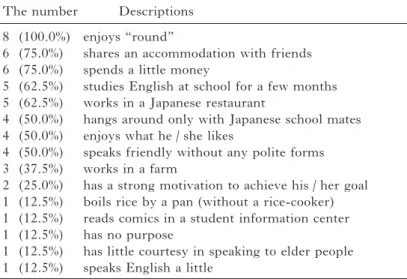
The description of what a typical Working Holiday Maker would be in the next question results in confi rming the popularity of

“round” among the group of young Japanese people. Their images of a Working Holiday Maker are described in the following table:

The number Descriptions 8 (100.0%) enjoys “round”

6 (75.0%) shares an accommodation with friends 6 (75.0%) spends a little money

5 (62.5%) studies English at school for a few months 5 (62.5%) works in a Japanese restaurant

4 (50.0%) hangs around only with Japanese school mates 4 (50.0%) enjoys what he / she likes

4 (50.0%) speaks friendly without any polite forms 3 (37.5%) works in a farm

2 (25.0%) has a strong motivation to achieve his / her goal 1 (12.5%) boils rice by a pan (without a rice-cooker) 1 (12.5%) reads comics in a student information center 1 (12.5%) has no purpose

1 (12.5%) has little courtesy in speaking to elder people 1 (12.5%) speaks English a little

Table 5: Descriptions of a typical Working Holiday Maker

(20)

It is remarkable that all of the eight informants mention “round”

as an activity that a typical Working Holiday Maker does. The full remark on “round” refl ects a strong tendency for Japanese Working Holiday Makers to be engaged in traveling as though it were the main purpose of the scheme. The consensus on the image of a Working Holiday Maker among the eight informants does not seem to be accidental when we are provided a full of information about

“round” by a key word “Working Holiday” on web sites. Such a stereotypical view of a Working Holiday Maker as an enthusiastic traveler or “round maker” can be found in many publications that feature the Working Holiday Scheme.

4.2.3. Essay Writing

Writing task is required in Part (3), targeting at two different groups of readers in mind: Working Holiday Makers and Japanese university students in Australia. The number of mas-form marking in their essays is counted and analyzed in relation to that of ø-form marking. The distribution is illustrated below:

It is notable that six informants show a consistency in style in both the fi rst and the second essays. In fact, there is no style

The number of mas-form marking

to Working Holiday Makers to University Students Speaker ( a )

Speaker ( b ) Speaker ( c ) Speaker ( d ) Speaker ( E ) Speaker ( F ) Speaker ( G ) Speaker ( H )

0 (0%) 8 (81.8%) 0 (0%) 0 (0%) 4 (57.1%) 0 (0%) 0 (0%) 0 (0%)

8 (100%)

11 (100%)

0 (0%)

0 (0%)

10 (83.3%)

0 (0%)

0 (0%)

11 (100%)

Table 6: Mas-form marking in written discourse

(21)

mixture observed in the two contrasting essays presented by Speaker (b), (c), (d), (E), (F), and (G). Two informants, Speaker (b) and (E), employ mas-form while the rest of the four informants, Speaker (c), (d), (F), and (G), use ø-form in presenting their essays.

Important to note in analyzing style choice is the complementary distribution of mas-form and ø-form observed in by Speaker (a) and (H). One the one hand, when they are asked to write to Working Holiday Makers, Speaker (a) and (H) completely disregard mas- form. To university students, on the other hand, both speakers employ mas-form in every sentence they write. The consistency in the selective use of style observed in the two speakers’ essays may indicate the possibility that a sense of solidarity is being operative to those who are also categorized as Working Holiday Makers. The dichotomy of uchi or soto relationship can be interpreted to be a key to elaborating on their motivations behind the linguistic choice.

5. Concluding Remarks and Future Direction for Research Through the fi eld work in a speech community of Japanese Working Holiday Makers in Australia, both written and spoken discourse was collected from the members who had been engaged in the Working Holiday Scheme. Based on the distribution of mas- form and ø-form and description of those who categorize themselves to be Working Holiday Makers, their management of the polite form has been partly characterized in this study.

The fl uid nature of linguistic politeness in Japanese was most apparently observed in style-shifting from mas-form to ø-form and reversely from ø-form to mas-form in some conversations. In order to seek the speakers’ motivations for the linguistic manipulation, there needs to be a further investigation in terms of their recognition of self in relation to the other in their ongoing social encounters.

The social and psychological source behind their style choice is to

be pursued in specifying their shared interests that nurture the

(22)

sense of solidarity.

Further research on the management of polite form will be made by discourse analysis on the essays provided by the Working Holiday Makers along with the survey on the goals and images about the Working Holiday Scheme, which is believed to be a clue to explaining the dimension of solidarity (i.e. how one may or may not locate him / herself in an in-group relationship with the other).

Moreover, through discourse analysis on their conversations, the research will be developed to investigate on the process of style- shifting (i.e. how the meaning of mas-form and ø-form is actually exchanged, negotiated and shared or not shared) in ongoing social interactions. The future research is to shed light on a correlation between an act of social identity and style-shifting by demonstrating how extensively the uchi or soto dichotomy is interrelated with the linguistic politeness in Japanese.

Acknowledgements

This research was partially supported by Global Communication Institute.

Funding from Kanda University of International Studies is gratefully acknowledged.

Notes

1) As to the treatment of polite and plain forms, this article describes the forms in verb morphology masu / desu endings as mas-form and da endings as ø-form. The rationale for the description is that both masu / desu-ending and da-ending forms or styles do not necessarily determine the level of politeness in the same ways as honorifi c and humble forms do. Style-shifting between the two forms is therefore not interpreted as an indication of being ‘more polite’ or ‘less polite’. In terms of the neutrality, the absence of mas-form is described as ø-form.

2) Working Holiday visa (subclass 417). (2018). Australian Government:

Department of Home Affairs. Retrieved from https://www.homeaffairs.

gov.au/trav/visa-1/417 on October 29, 2018

(23)

References

Bakhtin, M. (1981) The Dialogic Imagination: Four Essays. Austin:

University of Texas

Bakhtin, M. (1986) Speech Genre and other Late Essays. Austin: University of Texas

Goffman, E. (1981) Forms of Talk. Philadelphia: University of Pennsylvania Press.

Holquist, M. and C. Emerson (1981) Glossary for The dialogic imagination:

Four essays by M. M. Bakhtin. Austin: University of Texas Press.

Kitamura, K. (2016) Some Theoretical Considerations for Studying Linguistic Polite ness in Japanese. Global Communication Studies, 4, Special Issue, pp. 197–215. Chiba: Global Communication Institute.

Kanda University of International Studies.

Maynard, S. (1991) Pragmatics of discourse modality: A case of da and desu / masu forms in Japanese. Journal of Pragmatics, 15, pp. 551–82.

North-Holland.

Maynard, S. (1997) Japanese Communication: Language and Thought in Context. Honolulu: University of Hawai’i Press.

Mimaki, Y. (2013) Poraitonesu no danwa-bunseki: Shotaimen komunikeeshon no sugata to shikumi (Discourse Analysis in terms of Politeness: Aspects and Mechanism of Communication in the First Meeting). Tokyo: Kuroshio Shuppan.

Usami, M. (2002) Discourse Politeness in Japanese Conversation. Some

Implications for a Universal Theory of Politeness. Tokyo: Hitsuji Shobo.

Table 2: The category of the 8 conversations
Table 4: Goals in the Working Holiday Scheme
Table 5: Descriptions of a typical Working Holiday Maker

参照

関連したドキュメント

The solution is represented in explicit form in terms of the Floquet solution of the particular instance (arising in case of the vanishing of one of the four free constant

On the other hand, from physical arguments, it is expected that asymptotically in time the concentration approach certain values of the minimizers of the function f appearing in

Here we consider the problem of whether the hyperbolicity of a dynamics in upper trian- gular form, and more generally in block upper triangular form, can be deduced from the

In particular we show, using one of the Crum-type transformations, that it is possible to go up and down a hierarchy of boundary value problems keeping the form of the second-

Here we continue this line of research and study a quasistatic frictionless contact problem for an electro-viscoelastic material, in the framework of the MTCM, when the foundation

Subsolutions of Elliptic Operators in Divergence Form and Application to Two-Phase Free Boundary Problems.. Fausto Ferrari and

The idea of applying (implicit) Runge-Kutta methods to a reformulated form instead of DAEs of standard form was first proposed in [11, 12], and it is shown that the

In the standard setting of smooth maps between open subsets of Cartesian spaces, one way to define a differential form is as a multilinear alternating map.. However, since