[研究ノート]
Structured Self-Help for Struggling Learners:
A Study Support Class for the Tama University English Shower Program
Yumiko Sano
Key words: remedial instruction, programmed instruction, student needs, autonomy
(原稿受領日 2004. 10. 12)
I. Background
In Spring 2004, Tama University offered a new, non-credit elective course called “Study Support Class” for students who were struggling to keep up with the compulsory, four-day-a-week, English-only classes in our English Shower (ES) program.
Notwithstanding the recent recognition the ES program has garnered for its success, some students have been falling behind every year despite their best efforts and initial enthusiasm. Some of these students are hindered by a lack of basic knowledge of English.
Others are unable to keep up with the pace of the study routine required for success in university-level English classes. In most cases, both of these problems play a role. Students who fall behind generally lose interest in English, lose confidence in their abilities as English- learners, and end up failing or barely passing their ES courses.
Unlike many American universities, where resources and support for remedial students are often available, Japanese universities still tend to provide little support for students at risk of failing. The Study
Support Class was established to address the needs of such students in the ES program, offering them the means to improve their performance in their university-level English classes.
II. Class Design and Approach
The design of the Study Support Class is based on two major premises: 1) that struggling students in the ES program lack basic knowledge of English that they were supposed to have mastered before university matriculation; and 2) that struggling students lack the study habits required to keep up with university-level English classes. These premises inform the three instructional objectives that were set for the Study Support Class: 1) to impart basic knowledge of English grammar required for students both to participate successfully in ES classes and to diminish their anxiety about confronting English-language challenges; 2) to provide practice in applying new knowledge of English grammar towards its successful use in ES classes; and 3) to impart methods of independent study and other study skills that empower students to become
autonomous learners.
It was decided that enrollment in Study Support Class would be voluntary and strictly on an elective basis. To foster student awareness of the Study Support Class, the Class was described to all first year students during pre-ES orientation classes held soon after matriculation, and a leaflet about the course was distributed in all ES classes. A Study Support Class orientation session was then held, in which a detailed course description was given, along with a pre-test.
The pre-test was used to determine the appropriate level and content for the Study Support Class. The pre-test evaluated basic grammatical knowledge in areas where students frequently make errors, such as subject-verb agreement and use of tenses and pronouns. Students who did not do well on the pre- test were encouraged to register for the Study Support Class with the suggestion that their participation might improve their performance in ES classes. Students were also allowed to audit the first meeting of the Study Support Class before deciding to register. After ES mid-term exams, furthermore, additional announcements inviting students to join the Study Support Class were posted; students who found themselves falling behind in ES classes were thus afforded the opportunity to join the Study Support Class even after mid-term.
To minimize conflicts with other courses, two Study Support Class courses were scheduled late in the day, one meeting on Wednesdays primarily for pre-intermediate-level students and the other on Thursdays primarily for beginner-level students.
Students registered for one or the other of these courses according to their schedule and level.
Once registered, students were asked to attend class every week; this was felt to be important to the development of effective study habits.
In each weekly class session, a different rule of grammar or study skill was taught for curriculum, see Table 1. To supplement the class sessions, self study materials prepared by their Study Support Class teacher were provided to students. Students were also asked to maintain an “inquiry sheet” — a record in which they recorded things they did not understand in their ES classes, their textbooks, or in the course of their self study in regard to which they wanted help.
Each of the Study Support Class courses was taught by a Japanese English teacher (I was one of the two instructors) rather than native-English speaking teachers. Japanese teachers were assigned to teach the courses for two reasons: 1) Japanese teachers are more familiar with students’ prior study of English in Japanese junior and senior high schools; and 2) Japanese teachers can offer students instruction in their native language, Japanese, the most effective language of instruction for the remedial purposes of the Study Support Class. Both of the Study Support Class teachers also taught regular English Shower classes simultaneously, enhancing our working understanding
Table 1
of student needs in both classes. Informal exchanges of views and experiences were also conducted regularly between the two Study Support Class teachers.
III. Class Launch and Ongoing Development
Thirty-eight students in total attended the first meeting of the Study Support Class, most after attending the orientation session. Ten students decided not to register after attending the first meeting. (Their reasons for not registering are shown in Figure 8.) The Study Support Class then officially commenced, with 28 students spread between the Wednesday and Thursday class meeting times. Two of the 28 students decided to attend on both days. Nine students withdrew during the term. Two new students joined mid-term.
Twenty-one students thus completed the semester, at the end of which a small celebration ceremony was held and participants were awarded a Certificate of Completion. Although the Certificate of Completion was handmade and did not confer any official status, two of the students remarked happily that it amounted to the first recognition of achievement that they had received in their lives.
The Study Support Class was intended to be student-centered and interactive, and both teaching content and style were frequently reviewed and adjusted to further these aims. As the semester developed, the desire students expressed to study ES class content in the Study Support Class was increasingly addressed. Although review of key points of grammar remained an important focus, more words and expressions drawn directly from ES classes were incorporated. Students also expressed strong wishes for conversational practice; in response, an increasing amount of time was devoted to oral practice with the
grammatical material studied on a given day.
IV. Study Support Class Student Evaluations
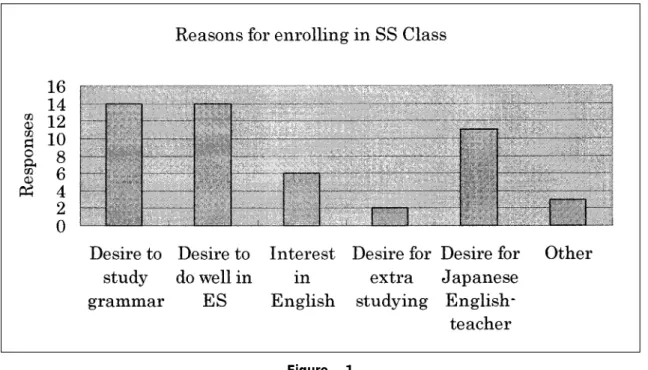
To evaluate course design and content, questionnaires were distributed to all Study Support Class participants during the last class meeting of the spring semester. Figure 1 shows the reasons participants reported for having enrolled in the Study Support Class. (Multiple answers were allowed).
Since students were free to withdraw from the Study Support class at any time, it was unsurprising that students who remained in the course until the end of the semester reported a high level of satisfaction with the Study Support Class (see Figure 2).
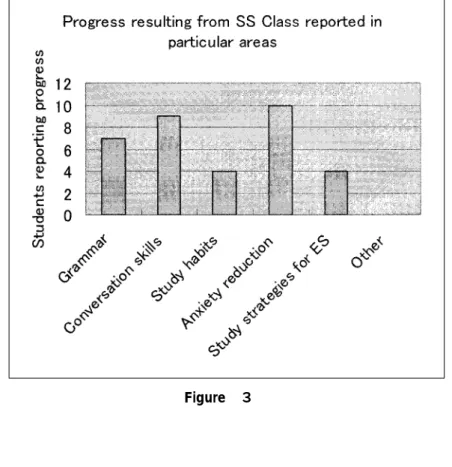
Figure 3 shows the number of students reporting progress in particular areas as a result of participating in the Study Support Class. With regard to progress in “anxiety reduction,” students reported that Study Support Class provided relief by offering “informal interaction with teacher,” and “Japanese support”; one student noted that “confidence came with mastering grammar rules that I never understood before” (student responses on open-ended comment section of questionnaire; my translation). Only a few students reported progress in developing better study habits;
the course either fostered insufficient gains in this area, or students did not recognize their progress. Nine students reported improvement in their English conversation skills, which were supported not only by the course but also by opportunities to apply knowledge gained through the course in ES classes.
Finally, as we hoped students in the Spring 2004 Study Support Class would enroll in the course again in the following semester, the questionnaire asked participants about areas in which they would want support if they were to continue studying in the course.
Figure 2 Figure 1
Figure 4 Figure 3
It can safely be concluded from their responses (shown in Figure 4) that students want the contents of the Study Support Class to relate closely to their ES classes so that the knowledge they gain contributes to their academic success in ES.
V. Evaluations of Study Support Class
Another set of questionnaires was distributed to all ES students after ES-course final examinations.
This group of students included both participants and non-participants in the Study Support Class. Most ES students were aware of the Study Support Class (see Figure 5). Eleven percent of all ES students participated in the Study Support Class, including those who withdrew (see Figure 6). An additional 15
% of all ES students were interested in the Study Support Class but decided not to register.
Figure 7 shows the reasons students who decided
not to participate gave for their decision. Notably, 50%
decided not to join because of the early evening class meeting time; student responses on the open-ended comment section of the questionnaire included “no school buses,” “dark and dangerous,” and “conflict with part-time job schedule” (my translation).
Furthermore, most first-year students did not have afternoon classes on Wednesdays during the spring semester; this gave rise to the response, “did not want to wait around on campus just for the Support Class”
(my translation). Nineteen percent of students decided not to enroll after performing well on the pre-test given during the Study Support Class orientation session;
one student noted feeling “relieved” after doing well on the pretest (student response on open-ended comment section on questionnaire; my translation).
In addition to the nine students who withdrew from the Study Support Class after registering, ten attended the first meeting but decided not to register. Figure 8
Figure 5
shows the reasons both of these groups gave for deciding not to continue. Twenty-one percent reported that they had to withdraw because they had too much work to do for other courses. Forty-two percent found the class too easy (everyone who decided not to register after attending the first session gave this
reason). Sixteen percent found the class meeting time to be too late.
The questionnaire also asked students whether or not they intended to enroll in Study Support Class the following semester; the results are shown in Figure 9.
Notably, a total of 45 % of students either intended or Figure 7
Figure 6
were considering but had not decided to enroll in the Study Support Class in Fall, 2004. Figure 10 shows the reasons students reported for responding
“considering but not sure” to this question. It is noteworthy that nearly 40% of these students hesitated because of the late class meeting time; since Study
Support Class will again be scheduled for the same early evening time period during the Fall 2004 semester, it seems unlikely that these students will enroll in the Study Support Class.
Finally, Figure 11 shows what ES students want Study Support Class to provide. The most common Figure 9
Figure 8
Figure 10
Figure 11
著者プロフィール 佐野裕美子
獨協大学外国語学部英語学科卒
カリフォルニア州立大学ソノマ校大学院修士課程修 了(MA in Education )
株式会社理究、株式会社ジオス勤務を経て、現在、
多摩大学経営情報学部助教授 responses, “flexible schedule” and “individual help,”
are noteworthy, reflecting the desires of students who wanted “to join only when I have questions,” “to receive one-on-one help,” and “to get the right help for my level” (student responses on open-ended comment section; my translation).
VI. Future Directions
Several problems emerged during the first semester that need to be addressed in future efforts to improve the Study Support Class. First, since the Study Support Class was designed for students lacking the most basic knowledge, it failed to fully support the large number of students whose knowledge was only somewhat limited but still lacked sufficient confidence for success in ES, yet felt the course content was too elementary. The question of how best to deal with students of different levels of academic ability in the Study Support Class thus remains, insofar as the amount of help, time, and effort that one teacher can provide to the many students who are seeking customized support is limited.
Furthermore, many students found the early evening class meeting time to be an obstacle to participating. This raises a number of questions: Might it not be possible to schedule the Study Support Class earlier in the day, and would this attract more participants? Might it be possible to arrange school bus service for the early evening meeting time?
Yet increasing enrollment in the Study Support Class in itself would raise further questions. Could a single teacher provide effective support to larger numbers of students? Could an e-learning system developed in conjunction with the Study Support Class better support larger numbers? Ultimately, would ES student needs best be addressed by a dedicated tutorial
center which students could visit whenever they wanted help? Might student mentors play a role in providing support?
Providing support for students who need extra help is an important responsibility for universities. Our efforts to fulfill this responsibility in the ES program at Tama University have begun with targeted help for failing students, but hopefully will grow into a center providing support for all students who want to improve their classroom performance. Such a center will be especially invaluable as a resource that fosters autonomous learners.