Studies on interaction between a dislocation and impurities in KCl single crystals
著者 Kohzuki Yohichi
year 1994‑03‑25
URL http://hdl.handle.net/2297/30615
,t )
.
V.1
.' of. "Y 'tS x
' "f
-`' ./.eJ :-L),,. •"f ;t
t '-
t 1-
J,';'Y:i"r,
Pe l! rf, .
'tA}`l,>vl'f•l:l.."
'i St4 -t
,-
' i (rK tt
't l .
N" '1/t `;r']i'"'.- -'K xt'
i'F t
1-
se t iv' . '" "kPJ;(
X"";2.`:.e -''
' "' ,Y•.•cl"/' ,;', ...t z, - .•
t"-4V.r r
: L tsAtr
szM'//l"'t/?y}..--'t ''
l.ff e.' -
t
..,.,e
af S-i- i
--
i.. e.,
;. "' f:JF)' !:Sy 1'
. ]-
''N `.
tt":kr"
;i; tGgt/;V.i"
,
{l,lil, t, ud
# t'S' v' tt v, .s
t 1'-
N-Elrtl .tT
t?ZfT,,g-
-rJ v
'1 ,e. "t
r si"tLh'i•,VI ]>'•V•C... .
,)iS.l//,Ii"SJ
. ':Vfi aF
l-
l"
-t- t -'. tst "V
-D, 1
,11 },,i.l• l;N•-J t",}[s• s}1. 1"{ 'kc , h
"J "
'n,•
: J' S,i,,L"' ;ttt"
1 st 1- l fL.tt
+ .-y '
N•
.kltj t
"'lt, \ " ,tgt
1t-
t--
v" J
)•
e
;
:f
v'
'
'
jtF 1L •S'
.. sp .lt ': '
t\ ''s'
"
"-:
t'-i
)- .v+
. . I-
"'H
"-•
v,
F'
te
JJ
lt 7-t",eA eJ`"te t -" (
r- ""
+ - )--
--e ;
leS,t r lh•i Y )t "-?l
'pt ' re
."
J-
l'f -
-1 -t JS
-itv
.-p
' 'I i,,J"
."
} .J F
' 7t -cy
'- '.s ' t, ,- is
't 6v -
-i.•s t.-. " .Cer.
-J -} X -'r .t J'- tt
L:
rl 'u ezav'
t;- b , -v.F:, .
S- t 'gt -t.LrO -L -V J J tt
-t w)
-" '-tt " -
r ]. "t -t
' tt N.l
= lt vi -.
on- '
-+
tr-
--.
Ltt e s
s
N :;:tH , JIt>"
iy
:I.
-- -
it
•-l t, J"
' r-.-! y
"f Jf k
li. {
--t -I
ts
- lt t-J vtK ') ,Xc rl
ite 'T '}•;ri 'i
--" t "
t- b -..
"S'}' ?l.;;;
2S•'>ll,!1,ft,i,tll•iil/lxt`
"X '/1,, `t:'`} irI
",Is 11tll'ÅíN2il:•'I
-T X' 'i S< .\"` -'
r rtV ..
g."`" ' : Sril3 "
.V .Jc x{ ::-•'.-t.".
'i t
lKJ• "'-
iN. " '; ':l ",.t t
`
:iS.[rl/'i`-r'i.`l"
T`k,N' "lx i h- .ct
t`eF
l
t
t
:t -tt
k
iJl
+ :. lii-t;}'fP i "
tti e..."
t"
Vh- -
-"'SL>,J . "'t X.t-er
Vs
""f '-
sl i
,T tLpt -# " s-rkr
t Jt lk- It dl)
"" sf
:;
-, ,R
v .t" ;
ao, .
' ..i;t"."-"".S
s .pnt- rx" "f'- , )s l
"; -' lie iy,,, y {. -k",t
'
rf
-er:
rt
ill
v
IJ -i
lt v
--.`
N
x•
iS T
7e't' "
tIs
('
t:
tl
:/ vt
--lVb
"i'v
1
l )Y
* ((
,?,
i
t) tc .--
, tt r
rk
te' -l"2 "
:
: "f'
t- t's' f'``
1 Itte
t
'
L
i
N•
? ,.!
i'
r N. L.. t
ts} - +i' i t' )v -. -" "Ur
.
t. " qL "
Lv ".
t H,. .
4S
,
t-t ' ,;.i4 i"t' i"'"`,S $,z v}
l'rt t
"ti,. i ' :x]A;r .)l,:I`r, vi, r.
T' t+r
ed t'iE:T', 5rt,.. JF.
-+
"f
it
l c
;; 't
--
,
t .t ".( Jt
'1 L- K' •.
.
l;./
;d ft}
xs,k/kN,i}
.N•
dLS Vb NS`
v -."
-. fi
Y
-- - '
J-j
" e4 I ; i." -v
mteraetib`'n, 3, bbtWeeit a.- di ,igt(lig`"ttCIeingle'ery
";
.•,, ,•, r/r, it l,
'
-) ; :lt' ..
tt L{
- 'h{,fagt,1' t
, S .. Ib
r, :. 1" -i' ";Ys:r '..{•.s"x,
'l e- -
ti ""
;.'t ' 17 '?,v.sttit.Slit,'fK<,.}..l
"- '. Ih' ..
ft
itS. : -',Slb
"-'
7} tt d
i y4
.(c -
!
.1 v.-f ';.Ag', .N., r-
--t
.sa
sc:l . I+ .- ..:. ,} ," tfe
'
LN I, T.
'•'
"•s :g,."
tptst l /Si ti,IL i
.L s iL-
""-g, y 1 ,.
.. :.s W,,
-1-t Nv
-.)bL Vit 'C tn L. V"
a `t-f
r
T-L
-"
t .A
,
N"s +L
y x. -' ? U, ';', `t,'t r
S -' L-
Ir. i.n ti v
+. •t•-A e,
;b-sc
- tk -s •.
v
,
- L --
N
' issU" g.•.-,
t' t 'i
".vJ y ai,t
e:,. T -' ";"i
1. h- .t
t-. t " }.. -b
) '
Al '
SL,tt/l.IS"" :"iX .1{
.r i1 h- -
tt- ., ;ltc`-3f.
' e. ') '.
";
sXi
l k-S f" NV t
N }.. ,
., n,s• ' 'N.. V'-:vr
"t ,ls..p ,
{g,tsr2ts
rl :lvA. t S" .)i A.ti,
Lt
t-" t .ltv s
- - l"t
h lhx
Js-
il
:.gslx
'• X $. stl fgNK $ L.t
/1[ S,.i/lil l;f !-ill, siykNi,,.
h:,,.i' iN';kiÅí.;;txh..!itt"/'l;.s`.lii/:.1.ti,,I,LI "
s ,l., t• -,l.,.i t,)/ 1. ,f - ,r
, l' t,.y' • i< ",' ,g- - tl Iy t. t vJ-): t". "
, .; hi 11. '-J . ?.", ',t
l .r
l1""Lt.` -
v"t
. !P '" t ,r 'rtl a
"e . "r.
F
i. .s kS/!+,ilg '`,.,' i
tt' ,lt: -
i li' }J
, . "t .? ,
k
t
,
it
s-l
t'
. ;L StLN"
-N
t t4
:.:t{ r" -' -
-t i-L)r .`2r. f i;' r-" t-t T
!.'.". s"e-ii4,' -`t ';ev
as hS.
--i 'Nti, '
k" "' ' "'Aet'kL.r)e.
•< , ,-, N =4S ., L'. r ,t S. vr . .V ' L'•
. +, 7 lt.
-r. .x it
k: :"' "
.
-t
{.
Ly>.:?
-st - 11 Jd sJ -L it
.: :.r 't t?er lii.gMl f'
, xrr i
), .L r- -"I ,•,! .,"
V, i .v•.
•`t "`?. s:', -- 1.:
t..".,ll
) i!, -' 'a -+
f'(ij ;:.:ive r-'::.i<nf ,
ed
'• V-?: te",: - K PI Å}y... tLt A
ttNgll-,r'IC',.i;;kti.S . .tir.L..
S\• tllti:g>l..<i. `-u.
ti
- " 'tl
--' `iihin- tPJt -i
. -"-
-t
.:.1 :. ,, J. S.,Ft:I,<•
m,. '
rt 4
7t 't.n tk,.llij'. ,;..•s-"M;;"`•ti.;,.'3
f" '1i': itl;5..i."'INr' .L 1' "Xi
$'-"ta'xgif1:}..g,G,k5
:. ,y ,' .. ` " 'K 'JY, ii -t "'
tN- .t i=
.-
t Sr-' ,'kS , ' '""'S ;
f ': :.i "..t
ii.g S, ,, ,},;'•iiv•xx'
t t -.t -S . vt
Tt -4
s'locli
v{
'
)1i
sta
"V.g-:sri:L.;."'VL
s
'.' -M.--
"- 1.-tn .
i"s ,; s,K.r ' 't{):"nt;` ".". '. .c"iptt> .
.K $,. 7N -?tysli3i,Y', -l
t V- , .r." "t
- Y-g:,.r.
ikt3(');i'if-tifi'd"""-•
, M• s, J:
l,"//--•,g"Ji,}:.t};;ILttLiiFiik-iit",
,.:,xt .}. tk. . SF tl..
• Z's ,i'. L'"fl,,
f'"
1 Nt-
Y
rt•
tt 't ,, 'y ":g .r-\i
ii.,,)`gif,l>E,`(g
Mi. t
'
"- v4a: i
t
L
.i =.
IMP"
r, X,
>
t
,
c
1t.)x
:NA-
L t.eK i
iL
1
t -Vl." )v-y,h
"J
T
•K,-•, '
'
L"
tr
.st
"
iS. , i,fj't": . r;vvN'}N ,t ) ->,21i,ll)t/lsii}S
't ) '-ST-. A-' v
SL t x .-t . `Ts t".,
N,tt-
:1 -,
??ptxxlf .
t-
r
' }
f'
t 'F/
' .s
,
-t
)' Hs rla 'L
d)
,L. .s x. 1-u.
t
A, "
v+ irf";eS,.' i-
t
--" 1
'` -t;;s,.),..,• ri;,:,
t' .
-tt 'Lt r- ti (l"l"
" k-.
,•N..r• - V'v
4-
?t "' ''
t eLt : tL- .
",Fi;
`i '
-P
YPHICHI 'KOmpng, ]!!5ix SYIarch te94
'>"f•ii' 1.`Iik;1";.
"F .t- .
- t.r
-'l
+
r
,• "' "';. ti
"slt" -
,
-
i1 lt ,.
L!" ,
:". ]Wi'xl
JS
-rl' t:
i
k• l `.
IJ
" -' ?i
' t--
N ;.
• 5"J
.
Lev l tL
t
. tr.
t
ti j"
-i 'K ,
. 'J!: rv,V)
Ei"ikrrI..,IIf/lt2tt"'rL
s.
t-
" -i L'
- -.L-
t". J..' 'N t. '` z. .Ar: ,. - e. ;- "l;;r;"`f:1,1:..1'ix'lrj'i:l .tl•,k .e.tr,r1':ic,lt' ;1'` ",.r,L.1 IS'Il`1,'"1`sy ''.': '<lj, G'l,
,- ;- st lf::s4"
g v '
"-3
' -4
-f
tr
Hr.
t- tLk t. 1
f
,
e v - I , '.-
: rlt- t ;. -' '
- .rt
' " l'.
vrx kt" /':}
iV
- r---
L tl., . t -i t '-
IL:,Rvlr t' .s.f.;! ,
. rl
--
, P'` ' , f. 1.
"SL
-(l F'
`"
."
;t"F',/i/`/t;'/i-{:'/i's'':
.. Lg.pt .'V , , '1"f•!,7,' t...'
"v'
, , e..,.
i
. .l"lt t S4"..1
'
Lr
g :
f,I.1,"fl'fg,k,,i{l
N } e' ; t.. s"
S-'- ,
' .,t. . a ..tH -' ), Si; "., : .r. [
' S't-+-Aag;-:J't",47Ni.!r )
:L t) 5 "t
"aJ {'f I...tlt ,!$-"tt';l
t-
1. sL
le t
iCk4,x,,.11v`{litli;T
''{ :':eii -r Yl';; ;;gll.'
-.- i
"
' s'. .•t icr "' "v '"n'T'' '
. .tl'i. 2 "' .1 i `i i ." r
. LC` 'S, S
! ; jlr', t. ,`.,i, X"'"'i 't' i'tT'•."t'i,Ktis ";
vt rL '- }" tS 'Y-s i'
sl- v.
,3 ?'X .'
lh t "i
--) ' . . '
f LNIL. t' . ,s z,. .i '. "' :
IL tttN..
I.sr
Li "
;-
u r,s .ed
:';rsts tgi '
1
-S..v ". .7
sL :i
Nli'iv-. t r. x. ': '.: tpt ..g.,?..,'
t r"'x; "., . ' i?IStx: ,"{::/1'I"4 :ll'L::t: -'"'
' S h Ck g;illli 3" ,eili" 2'.
.
t`v
.v.v r.fi>. '' Q,,'• ,lr/5f
lt ; I 4"
.-
",kji,l'[,•
t+ (-
t eg, k- s(t
rJ
t
;
1.
't-T
ai
,s--
4-p Lt"
. --. -r-sJ
]--
"-
,2 •,
,"rk je.F` 2-
r .t I
,
xl e '
fl •'T ,
'` 'ix'r .fy. ,
atr t- t
jil
.N -
.- v!tsz•.,SiF: l i t
ltt
- "J - M' i.-
.•' ! 7
y, l-
iL "-
;Er iit\irii pl:." !i
r- t"
"
tv "r '"i t ivt ,l "1. iT.tV ,
-sf -t-
, .,i Y.
x;
W , ,k• `t, . -y s!x} 'ts
'fi ' i ; T !1 ,
.e - -.
11-
-f
X Y." t
: . - ' -v.. X" .f+- "1 -
-; 1 .'L .,•cth
p-
' ' lr"A
r `Y'S
--t .
Studies on interaction between
in KCI singl
a dislocation and impurities e crystals
YOHICHI KOHZUKI
March 1994
Contents
Chapter 1. General introduction
Chapter 2. Interaction between a diSlocation and impurities in KCI single crystals
2.1 Introduction
2.2 Experimental procedure 2.2.1 Specimen preparation 2.2.2 Experimental apparatus 2.2.3 Strain-rate cyclmg test
during the Blaha effect measurement 2.3 Results
2.3.1 State of the specimen for Kcl:sr2+
2.3.2 Relation between the strain-rate sensitivity and the stress decrement for Kcl:sr2+, Kcl, and KCI doped with various impurities 2.3.3 Dependence of Tpl and Tp2 on the yield stress for Kcl:sr2+
2.4 Discussion
2.4.1 Relation between the strain--rate sensitivity and the stress decrement for Kcl:sr2+
2.4.2 Dependence of Tpl and Tp2 on the temperature for Kcl:sr2+
2.5 Conclusion
Chapter 3. Interaction between a diSlocation and various divalent impurtties
in KCI single crystals
1
6 6 6
9
22
30
32
Chapter
3.1 Introduction
3.2 Results and discussion
3.2.1 Relation between the straiLn-rate sensitivity and the stress decrement for KCI doped Mg2+, ca2+, sr2+ or Ba2+
3.2.2 Determination of the critical temperature 3.2.3 Activation energy for the interaction between a dislocation and the divalent lm punties
3.2.4 Dependence of the strain-rate sensitivity on temperature
3.3 Conclusion
4. Influence of the state of impurities
on the interaction between a djslocation and impurities in KCI single crysta]s
4.1 Introduction
4.2 Experimental procedure 4.2.1 Specimen preparation 4.2.2 Dielectric loss measurement 4.3 Results and discussion
4.3.1 Relation between the stratri--rate sensitivity and the stress decrement
for the stored Kcl:sr2+
4.3.2 Dependence of the state of impurities
with
32 32
60
66 66 67
68
Tpl and Tp2 for Kcl:sr2+
4.3.4 Influence of the state of impurities on the interaction between a diSlocation and impurities
4.4 Conclusion Chapter 5. Summary
Ackno wle dge m ents R efe re nces
Publication list
83
84
86
87
91
Chapter 1. General Introduction
There are various types of obstacles to dislocation motion, for example, forest dislocations, solute atoms, precipitates, isolated and clustered point defects, etc. In many cases the obstacle has a short range interaction with a moving dislocation.
And the interaction between a dislocation and obstacles has been so far investigated by yield stress[1-5], direct observation of
the dislocation[6-9], internal friction[10-l5], or stress relaxation[16,17]. It is difficult to investigate the
interaction between a dislocation and obstacles during plastic deformation from yie!d stress, because yield stress depends on dislocation velocity, dislocation density, and multiplication of
dislocations[18]. As for direct observation, the electron microscopy provides the inforrnation on the interaction for a thin specimen but not for bulk ,and also the light scattering
method is useful only for the transparent specimen. Internal friction measurement cannot also provide the information on the
motion of a dislocation which moves by overcoming the forest dislocations and the weak obstacles such as impurities during plastic deformation, because the measurement concerns the 'motion
of a dislocation which breaks away from the weak obstacles
between two forest dislocations by vibration. Stress relaxation
test has been proposed as a method since the strain rate is
stress are constant. Recently, it is reported that the strai-n- rate cycling test during the Blaha effect measurement can provide the information on the interaction between a dislocation and
monovalent impurities for KCI doped with Br" or I- [19]. Details
of the Blaha effect are as follows.
When the ultrasonic oscillatory stress of 800kHz was
superimposed during plastic deformation of Zn single crystals, Blaha and Langenecker found that the static flow stress was decreased markedly. Fig.1-1 shows the variation of the stress- strain curve by superimposed ultrasonic vibrations as an example of their experimental results[20]. The curve represents the intermittent addition of ultrasonic vibrations in a solid line
and the continued addition in a broken line. This phenomenon is so called the Blaha effect. The same sort of investigations have
been confirmed in many metals[21-23]. And this phenomenon has been widely made to apply to the plastic working technique for
industrial purpose such as wire drawing, deep drawing, rolling and another metal forming techniques, since this phenomenon has
an industnal significance[24-33].
The Blaha effect has been explained by the oscillatory stress
superposition mechanism so far[34]. However, Ohgaku and Takeuchi have reported that there are phenomena[35] which
cannot be explained by the stress superposition mechanism and the phenomena are considered to be attributed to the increasing average length of dislocation segments under superposition of oscillation. They have also reported that combination of strain- rate cycling test and the Blaha effect measurement provides the
-2-
400
300
ft E
Å~ E
V200 o P
1OO
1
/ !
on
off
----. ---- --- -
.
/ / M
---i- ---d --- - i--- - - " -- --- - continued
intermittent addition ackl ition
o 1 2
Åí (o!o)
3 4
F
i- g.Zn vi
1-1 Variation of single crystals brations.
the by
stress-strain curve for
superimposed ultrasonic
information for the mobile dislocation.
In this studies, the strain-rate cycling tests during the
Blaha effect measurement,.which was proposed by Ohga}<u and Takeuchi as mentioned above, are carried out mainly for KCI doped with a divalent cation impurity. And it is investigated
that the interaction between a dislocation and divalent impurities can be approximated to Fleischer's model[36].
Fleischer's model has been used widely with much success[36].
Many investigators concluded from the linear plots of the
relation between stress to the one--half power and temperature to the one-half power that Fleischer's model is valid, and that the obstacles have tetragonal distortion. Another several models for the force-distance profile•and relation between temperature and effective stress due to the obstacle have been proposed [37,38].
For example, the relation between the temperature, T, and the
shear stress, T, is as follows.
( T / To)2/3-1-<T/Tc)P/(P'1)
where To is the stress at OK, Tc the temperature at which the effective stress becomes OMPa and a dislocation breaks away from the impurities only with the help of thermal activation, and p a
parameter. Force-distance curve is triangular when p is one[39], parabolic when p is two, and square when p is infinite[38]. The model in which the force-distance profile is a triangle is applied to the interaction between a dislocation and aggregates
for KCI doped with Sr2+ in chapter 4. This thesis is
constructed by three contents as follows.
In chapter 2, the temperature and impurity concentration
'
dependence of the relation between strain-rate sensitivity and stress decrement will be investigated for KCI:Sr2+. And the temperature and impurity concentration dependence of the
effective stress, Tpl, due to only one type of impurity lying on
the diSlocation with the largest separation wil1 be discussed.
In chapter 3, the critical temperature, Tc, and the activation energy for the interaction between a dislocation and divalent ion-vacancy(I-V) dipole will be obtained from the temperature dependence of Tpl for KCI doped with Mg2+, ca2+, sr2+ or Ba2+
as a weak obstacle.
In chapter 4, it will be invesigated whether the force-
distance profile can be approximated to Fleischer's model when I- V dipoles turn into the aggregates for KCI:Sr2+ used in chapter 2. Furthermore, the change of Tc and the activation energy for
the interaction wil1 be obtained.
Chapter 2. Interaction between a djslocation and impurities iJi KCI sjngle crysta]s
2.1 Introduction
Recently, Ohgaku and Takeuchi have reported that the strain-rate cycling test during the Blaha effect measurement can separate the effective stress due to a weak obstacle such as an impurity, from that due to dislocation cutting at room temperature[40,41].
After that, they have discussed the temperature dependence of the effective stress due to monovalent impurities in KCI single crystals doped with Br- and I- at temperatures from 77-420K, and have reported that the measurement of strain-rate sensitivity under application of ultrasonic oscillatory stress during plastic
deformation provides useful information on the interaction
between a mobi.le diSlocation and impurities[19].
The strain-rate sens.itivity and the stress decrement due to oscillation are measured for three kinds of KCI single crystals
at low temperature. The purpose of this chapter is to investigate the temperature and impurity dependence of the relation between the strain-rate sensitivity and the stress
decrement. Furthermore, the temperature dependence of the effective stress due to only one type of weak obstacle is
discussed.
i
2.2 Experimental procedure 2.2.1 Specimen preparation
Three kinds of single crystal used in this work, KCI, KCI doped
with Sr2+(O.03 5, O.050, O.0 65 m ol Y. in the m elt), and K CI do ped
with various impurities sodium, calcium, manganese, nicl<el,
stron ti.um, s:i -l ver, caesiu m, ba riu m, thalliu m and lead(O. 050 m ol Y. ,
respectively, in the melt), were grown from the melt of a superfine reagent of powders by the Kyropoulos method in air.
The specimens, which were obtained from the ingots by cleaving to the size 5x5x15mm3, were annealed at 973K for 24h in order to reduce dislocation density as far as possible, followed by cooling to room temperature at the rate of 40Kh-1. Furthermore, the specimens were held at 673K for 30min, followed by quenchj-ng to room temperature immediately before the test, in order to
disperse the impurities into them.
2.2.2 Experimental apparatus
A schematic illustration of the apparatus is shown in Fig.2--1. A resonator composed of a vibrator and a horn with the resonant frequency of 20kHz was attached to the testing machine, Shimadzu
DSS-500. The specimen, of which the upper and bottom sides are applied with an adhesive agent at room temperature to prevent
frorn slj.pping dur.i-ng the test, was lightly fj.xed on a
piezoelectric transducer and then cooled down to a'test
temperature. The specimens were deformed by compression along the <100> axis and the ultrasonic oscillatory stress was applied
by the resonator in the same direction as the compression. The
CrossHead
Load /
Cell
Di
:
ibrator
-
<.--
Horn BrassTube
Liq.N2
Specimen
ezoeiectric ransducer
'-
F"
'=IF1•I:•::
-
:l::.
1.:: :l::III::•:::1•---
Heat
--Insu(ator
i.;llllx}sg{T.a..bJ.e..Å~>ss
DispIacement
Fj.g.2-1 Schematic
,
illustration of the apparatus.
length of the specimen, the strain of the specimen is considered
to be homogeneous.
2,2.3 Strain-rate cycling test during the Blaha effect
m easure m ent
The strain-rate cycling test during the Blaha effect measurement is illustrated in Fig.2-2. Superposition of oscillatory stress,
Tv, during plastic deformation causes a stress drop AT. Keeping the stress amplitude, Tv, constant, strain-rate cycling between
ee the strain rates of el and e2 is carried out. Then, the stress change due to the strain-rate cycling is AT'. The strain-rate
cycling tests made between the cross head speeds of 20 and 100 llm • -1
were performed at temperatures from 77-220K. For the tests mm
at 77K, the specimen was 'jmmersed in the liquid nitrogen. The
other temperature measurements were made by thermocouples of
ni.ckel-55Y. copper a.11oy vs. copper. The stability of temperature during a compression test was kept within 2K. The strain-rate
se nsii.t i- vity, AT '/ A ln e , is giv en by AT '/1.609.
Fig.2-3 shows the variation of the strajJn-rate sensitivity and
the stress decrement with the shear strain for
KCI:Sr2+(O.050mo19.) at 200K. The relation between the strain- rate sensitivity and the stress decrement at a given strain,
which is shown in Fig.2-6, is obtaj-ned from Fig.2-3.
h
,
rv
e2
.Ta
ti
ei'Ar
eC2
at
'
Åíi
Fig.2-2Variation cycling between superposition of
of applied the strain ultrasonic
shear stress .
rate, el and oscillatory
, Ta, when the e2, is carried
.shear stress,
straln-rate
out 'under
Tv'
O.1O
A a
cjv 2
.co
wc
NO.O5
-Å~
P N
o
1.5
A 8
g 1.o
P N
O,5
---- H []---
.-svzv---xP '--
-i.---eiF--'---x-ei.."
o 5 10 15 E (O/o) 20 25
, d
Fig.2-3 Variation of the strain-rate sensitivity,
djslocations. Acorrosive liquid was a saturated solution of pbC12+ ethyl alcohol added two drops of water. The etching was carrjed out at room temperature for 30 min. Fig.2-4 is the
optic al m ic ro gra ph of the etch pi ts for K CI: Sr 2+(O .OsO m o1 9. )
annealed at 973K for 24h. The position of the dislocation after the annealed treatment is marked by a pyramidal pit, and the position where a dislocation slipped out of the crystal after the treatment is marked by a flat-bottom pit. The dislocation density on a (100) plane is found to be 1.27xl04cm-2 for the annealed
specl m en.
Fig.2-5 shows the dependence of dislocation density, tan6 , and yield stress on the temperature from which a specimen,
K C I:Sr2+(O.50 m o1 9. ), w as quenched. T his in dic ates th at the dip ole
concentration affect the yield stress, as reported[1,42-48].
Therefore, specimens are quenched from 673K to room temperature
immediately before the test.
2.3.2 Relation between the strain-rate sensitivity and the stress decre m ent for K C I:Sr2 +, K C I, and K CI doped with va rious
Im puntues
The relation between the strain-rate sensitivity and the stress
decrement obtained by the method mentioned above is shown in
Fig s.2-6 and 7 for K C I:Sr2+(O.0 50 m ol Y. ). Fig.2-6 corresponds to
the case of one specimen at several strains. Fig.2-7 concerns
several temperatures. As can be seen from Figs.2-6 and 7, there
are two bending points on each curve, and there are two plateau
regions: the first plateau region ranges below the first bending
-i,igw,,,,.1\,itiYiil'ke
Fi'
g.2-4
on a mol%)
The optical (100) plane
before the
micrograph of the dislocations
for the annealed KCI:Sr2+(o.oso
tests.
40 a'3O
iENr
8 20
v qlo
CA-SJ
b v (o
c
(•
U
••-•",
o
1.0
O,5
o
B a20 v E
>
P
10 o
o 400 6OO
T (K)
800
Fi'
g.2-5 Dependence and y-i-eld stress
of Ty
d j- sloc a.t ion ' density p, tan6 ,
on the annealing temperature.
A 8
.IIIII
'Yc
>N<
%
O.1O
KCI:O.osomoto/
Temp. 200K
o
oSr,
E=18O!o
O,O5 E
o E=1 40/o
o
E=1 O o/,
o O.5
bZ (MPa)
1.0
1.5Fj.g.2-6 Relation decrement for
( O)189. .
between the strain-rate sensitivj]ty and
KCI: S r 2+ ( O. 05 0m o 1 9. ) a t 20 0K . e : ( O ) 1 0 9o
the stress
, (A')149o,
O.2 vA .8
,w.
"X
PO,1
'{ q
KC ( : 0. 050 mol O/. Sr
Temp
o
.103K o 133K A
200K m
E=9O!o
E=8Olo
E=1o ol.
o 1
AZ
2 (MPa)
3
Fig.2-7 Relation between the strai-n-rate sensitivity and the clecremept for Kcl:Sr2+(O.OsOmo19.) at various temperatures:
I03K , E-9 9. ( A)] 33K, E-8 Y. ( O) 200K , e- I OO/. .
stress
(o)
,
.
point, Tpl, at low stress decrement and the second one extends from the second bending point, Tp2, at high stress decrement.
The second plateau region is considered to correspond to the plateau region reported by Ohgaku and Takeuchi[41]. The strain- rate sensitivity decreases wlth the stress decrement between two bending points. Furthermore, Fig.2-6 shows the influence of the shear strain on the relation between the strain-rate sensitivity
and the stress decrement. The curve shifts upwards with
increasing shear strain. This phenomenon is caused by that part of the strain-rate sensitivity which depends on dislocation cuttings. Because the dislocation cuttings increase with increasing strain, the strain-rate sensitivity increases[41].
Fig.2-7 shows the influence of temperature on the relation between the strain-rate sensitivity and the stress decrement.
As the temperature is lower, Tpl is larger.
Fig.2-8 shows the relation between the strain-rate sensitivity and the stress decrement for nominally pure KCI. In contrast to KCI:Sr2+, there is only one bending point on each curve which is considered to correspond to Tp2. The bending point shifts in the direction of higher stress decrement with decreasing temperature.
Fig.2-9 shows the influence of the shear strain on the relation between the strain-rate sensitivity and the stress decrement.
The curve shifts upward with increasins shear strain. This
phenomenon is caused b' y the part of the strain-rate sensitivj-ty
O.15
A U
a El
•w v
=
iE55Å~
:
O.1 O
O.O5
o•
.
168K 94K
77K
o O.5
Aec
1.0
(MPa)
1.5
Fig.2-8 Relation between the stress decrement for KCI at (A)94K, (O)168K.
straln-rate sensltlvlty varlous temperatures:
and the
(O)77K,
O.O6
A U
a E
v
•CJ
c
iiii5Å~
'P`
wo
O.04
O.O2
o
`!tsl
A
o
a e=1 5o/,
o e=12ol,
e=1 oo/,
o
o O.5
AT (MPa)
1.0
Fj.g.2-9 Relatiton between the strain-rate sensi.tiviLty
,
and the stress decrement for KCI at (A)129., (O)15Y..
168K. e (O )10 9.,
A U
a
:!El
v
•w c
N-
<[iiÅ~
"P
N
O.1O
O.05
u .•
o
A A
o
.
A 159K
o 151 K
195K
o O.5
AeU
1.0
(MPa)
1.5
2.0
'
Fig.2-10 Relation between the strain-rate sensitivity and stress decrement for KCI doped with various impurities various temperatures: (O)151K, (A)159K, (O)195K.
the
at
O.1O
o o
A U
a
:IEI
v
•o c
iiiiÅ~
P N
O.05
A
m
m
o
A
a
e=8o!,
S=1 2 O/o
e=1 o o/,
o O.5
A rU
1.0
(M Pa)
1.5
2.0
Fig .2-11 stress 159K.
Relation between the strain-rate sensitivi'ty and decrement for KCI dopecl wi"th
E: (O)8%, (A)109., (O)12Y..
,
various impurities
the
at
sensitivity only decreases wi.th iuncreasing stress decrement.
2+ 2.3.3 Dependence of Tpl and Tp2 on the yield stress for KCI:Sr
It is clear from Figs.2-6`vll that the curve of the strain-rate
sensitivity and the stress decrement has two bending points and two plateau regions only for KCI:Sr2+, which is considered to have only one type of impurity. Thus, Tpl and Tp2 may depend on impurity concentration. Fig.2-12 shows the dependence of Tpl 2+ and Tp2 on the yield stress for KCI:Sr
at 150K. The plots
correspond to the case when the Sr2+ concentration is o.o3s, O.05 0, and O.065 m o1 9o fro m botto m. It can be se en from this figure that both Tpl and Tp2 are approximately proportional to
the yield stress. This means that Tpl and Tp2 increase,
depending on the impurity concentration, because the yield stress
generally increases with increasing impurity concentration [1-5].
2.4 Discussj]on
2.4.1 Relation between the strain--rate sensitivity and the stress 2+
clecrement for KCI:Sr
The above experimental facts that the curve of the strain-rate sensitivity and stress decrement curve for only KCI:sr2+ has two bending points and two plateau regions, and both Tpl and Tp2 depend on sr2+ concentration, suggest that the phenomena shown in Figs.2-6 and 7 are attributable to the interaction between a
dis-location and only one type of obstacle.' The reason for this
is discussed below.
The strain--rate sensitivity relates to the activation volume,
A U
a
:IEI
v a
P :
a.
P
1.2
O.8
O.4
.
A
o
A
o 1 2
Ty 3
(M Pa)
4 5
Fig.2-12 Dependence of 2+
T for KCI:Sr at
y'
sr2+ =o.o3s, o.oso,
Tpl and Tp2 on
150K. (O,A)
O.065molY. from
the yield stress, Concentration of the left.
.
i.e. the average length of dislocation segment. In addition, i-t is reported that the length of the dislocatjJon segment increases and the strain-rate sensitivity decreases when the ultrasonic oscillatory stress is applied at room temperature during plastic deformation and that the plateau region is due to the dislocation cuttings when oscillations cause the dislocation to break away from all weak obstacles[41]. Therefore, the first plateau region, as well as the second one, indicates that the average length of the dislocation segment remains constant there. Thus, application of oscillations with low stress amplitude cannot influence the average length of dislocation segment at low temperature, but i.t can do so at high temperature, such as room temperature. Therefore, •the plateau region appears at low stress decrement in Figs.2-6 and 7. Now we imagine a dislocation pinned by many weak obstacles and bowing by applied stress between a few strong obstacles during stationary plastic deformation. When the stress amplitude increases, the dislocation begins to break away from weak obstacles by oscillation between the strong ones and the average length of the dislocation begins to increase. The strain--rate sensitivity starts to decrease at the stress
decrement of Tpl. This Tpl should depend on temperature, and on type and density of the obstacle. Consequently, the phenomena shown in Fj-gs.2-6 `vll reflect the inf].uence of ultrasonic
oscillation on thd dislocation motion on the slip plane
'
.
COntaining many weak obstacles and a few strong ones, during Plastic deformation. Furthermore T
, pl is considered to represent
the effective stress due to the weak obstacles which lie on the
dislocation with the largest separati.on between two strong obstacles, because the dislocation begins to break away from these weal< obstacles with the help of oscillation. The stress decrement at which the ultrasonic oscillatory stress helps the dislocation break away from all weak obstacles is Tp2, as
reported by Ohgaku and Takeuchi[41]. At a stress decrement more than Tp2 the obstacles to the dislocation motion are only strong
ones such as dislocation cuttings.
The curve of the strain-rate sensitivity and the stress
decrement for the specimen containing many types of obstacle should be obtained by superimposition of various curves for each obstacle. Therefore, the bending points and plateaus should not be c-lear. The curve shown in Fig.2-10 and 11 corresponds to this
case. KCI crystal may contain a small amount of various
impurities, although none were added. Because the yield stress for KCI increases slightly with decreasing temperature as well as jt for KCI:Sr2+ as shown in Fig.2-13. As a result, the first
bend.ing point does not appear. The second bending point,
however, appears because the amount of impurities is small.
2•4•2 Dependence of Tpl and Tp2 on the temperature for KCI:Sr2+
If Tpl is the effective stress due to the weak obstacles with the Iargest separation, it should depend on temperature and impurity
concentration. Fig.2-14a-c show the dependence of Tpl and T p2
9
6
3
o
6
-3 U
a 2
vo >
P
6
3
o
6
3
o 60
o o
o KC[:O.065mo(Ol.Sr
o
o o
o
(!p
op O.05Omo(O/,Sr
o
.o
o oo g o o oo
o o
O.O35molO/,Sr
o
co o
o o
KCl pure
o o
o o
t
80 1oo 120 140' 160 T(K)
180 2oo 220
Fig.2-13 Dependence of for Kcl:Sr2+ and KCI
the yield stress, T y, on temperature
A a U
[llil
v a
P
-:P a 3
2
1
o
2
1
o
2
1
o
o
o
(a)
oo
(b)
o 80
(c)
1OO 120 140 160 T (K) -
180 200
,
220 240
Both Tpl and Tp2 increase with increasing concentration of sr2+
at a given temperature. The critical temperature, Tc, at which the curves intersect the abscissa and Tpl jTs zero, may be determined from these figures. Then, Tc appears to be constant independently of the Sr2+ concentration. It is clear from these
phenomena that Tpl corresponds to the effective stress due to the weak obstacles which lie on the dislocation with the largest separation when the dislocation moves forward. Observation of Tpl, therefore, provides information on the interaction between a
dislocation and weak obstacles. That is, the temperature dependence of Tpl reveals the force-distance profi+le which expresses the interaction between a dislocation and weak
obstacles. •
The tetragonal distortion resulting from the introduction of the divalent cations into alkali- halides is generally formed in the lattice, and it is weli known that the Fleischer's model, which is the most successful one for the dramatic hardening of divalent cations, is suitable for the interaction between a dislocation and obstacles [36]. Then , the relation between the effective stress and the temperature can be approximated as
(Tpl/Tpo)1/2 =1-(T/Tc)1/2 (2-1)
where Tpo is the effective stress due to the weak obstacles without thermal activation. Fig.2-15 shows that the relation
between Tpl and temA perature for KCI:Sr2+ agree with the above
equa tio n.
It is possible to determine the critical temperature from the
figure. The value of the critical temperature, Tc ,is about 227K
O.5
O.4
'>f
8 A
P O.3
Å~
Eil
e o.2
O.1
o
m rp
ige
A
mo iR 4 o4
o OnAm l3N
D o
8 10 12
Ti/2 (Ki/2)
14 16
Fig.2-15
[(A)O
Linear plots of
.035mo1 9. , ( O )O.
(Tpl/Tpo)1/2 and Tl/2 for Kcl:sr2+
050mol Y. , and ( U )O.065mo1 9. ] .
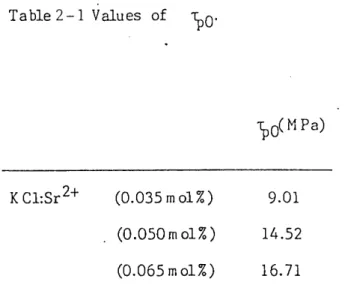
for KCI:Sr2+, and Tpo, which is obtained by extraporating the curve to oK, increase with sr2+ concentration. The values of TpO
are given jn Table2-1.
2.5 Concluston
When the strain-rate cycling test during the Blaha effect measurement is carried out, the dependence of the strain--rate sensitivity on the stress decrement provides information on the interaction between a dislocation and weak obstacles. The plots of the strain-rate sensitivity and stress decrement for Kcl:sr2+
have two bending points and two plateau regions, as shown in F.i.gs.2-6 and 7. The first bending point , '[pl, corresponds to
the effective stress due to weak obstacles which have the ilargest separation on the mobile dislocation. The temperature
dependence of Tpl reveals the force--distance profile between a
dlslocation and obstacles, and Tc is 227K for KCI:Sr2+.
Table 2-1 Values of foO'
'i) o( M Pa)
K ci:sr 2+ (O.035 m ol 7o ) . (O.050 m o1 7. )
(O.065 m ol Y. )
9.01
14.S2
16.71
chapter 3. Interaction between a dislocation and various divalent
impurities in KCI sjngle crysta]s
3.1 Introduction
It i.s well known that aliova]-ent cation impurities are a much more potent source of solution strengthening in ionic crystals than are isovalent cations. The phenomenon has been known for many years in alkali halides[49-51]. In order to study if the
divalent ionic size is an important factor in solution hardening, the interaction between a dislocation and various divalent impunties is investigated for KCI single crystals doped wj.th
Mg2+, ca2+, sr2+ or Ba2+. And the aim of this chapter is to investigate the effect of various divalent impurities on the critical temperature, Tc, at which the effective stress due to
weak obstacle lying on the dislocation with the largest
separacton lls zero.
The single crystals used in this study were KCI doped with
Mg2+(O.035 m o1 9. in the m elt), Ca2+(O.035 and O.0 65 m o1 9o in the
m elt), Sr2+(O.035, O.050, and O.0 65 m ol Yo in the m elt) or
Ba2+(O. 050 and O. 065 m o1 9. in the m elt) as div ale nt im pu ri ties, all
of which were grown by the Kyropoulos method in air. The details of the tests during the plastic deformation were descrived in the
section 2.2.2 and 2.2.3.
3•2 Results and discussion
3•2•1 Relation between the strain-rate sensitivity and the stress
decrement for Kcl doped with Mg2+, ca2+, sr2+ or Ba2+
Fig.3-1 shows the inEluence of temperature on the relation between the strain-rate sensitivity, AT'/ Alne, and the stress decrement, AT, for KCI single crystals doped with Sr2+ as weak
obstacles. As the temperature is high, the first bending point Tpl shifts in the direction of low stress decrement and is not appeared at 225K. The first plateau region indicates that the average length of dislocation segment keeps constant there[19].
This means that application of oscillation with low stress amplitude cannot influence the average length of dislocation segment at low temperature, but even low stress amplitude can do so at the temperature of 225K. Such a phenomenon as Fig.3-1 was also observed for the other kinds of specimens, KCI doped with
Mg2+, ca2+ or Ba2+. Generalization of the above phenomena gives
Fig.3-2. The phenomenon shown in the figure reflects the
influence of ultrasonic osci.11ation on the dislocation motion on the sli.p plane contaii.n'ing many weak obstacles and a few strong ones during plastic deformation. And the relation between the strain-rate sensitivity and .the stress decrement provides information on the interaction between a dislocation and an impunty as mentioned so far. And ( AT'/ Alne )p due to weak obstacles is defined in Fig.3-2. The reason will be described in
section3.2.3.
3.2.2 Determination of the critical temperature
O.2
A a U v E
•o c
iii5-Å~
P N
O.1
o
A1 (MPa)
Fig.3-1 Relation between the strain-rate and the stress decrement at the shear 107. for KCI:Sr2+(O.050mo19.) at various
(O)103K, (A)133K, (O)200K, (O)225K
3
sensltlvlty strain of
temperatures:
.
.
2
'N' O""'-Å~
P N
' 1 } l l l l l I l l
,
(A "u7A [ne)p
i
Tpl Tp2
6T
F
i- g. 3-2 I ]- lustra tion
sensitivity and the
of relation between stress decrement at
the a
straln-rate glven straln.
,
d
ca2+, ,sr2+ or Ba2+ as a weak obstacle is ]'tnvestisated ]ln this
section. The relation for all specimens js described as fo]lows.
As shown in Fig.3-3 'V 6, the three kinds of stress decrease w.i.th j-ncreasing temperature and the curve of Ty seems to
approach a constant stress at high temperature. Each stress i.ncreases with the concentration of divalent impurities at given
temperature. The slope of Tpl increases with increasing impurity concentration and Tpo which is obtained by
extraporating the curve of Tpl to OK also increases. The curve
of Tp2 is seen to gradually approach the Tpl curve with
decreasing temperature. This may reveal the narrow distribution of the separation between the weak obstacles on the mobile dislocation at a given temperature. That is, the separation between the weak obstacles on the mobile dislocation is seemed to be nearly equal to the average separation of the weak obstacles on the slip plane because the dislocation segment begins to bow
out under h-igh shear stress[52].
Since Tpl suggests the effective stress due to the weak
obstacles with the largest separation when the dislocation moves, the relation between the temperature and Tpl was noticed for each specimen. Fig.3-7 shows the dependence of Tpl on the temperature for KCI doped with Mg2+(O.035mo19. in the melt),
Ca2+(o.o 6s m o1 9. in the m elt ), Sr2 +(O.0 50 m o1 9o in the m elt) or
Ba2+(O.065mo19. in the melt). Tpl decreases with increasing
temperature for four kinds of specimens. The critical
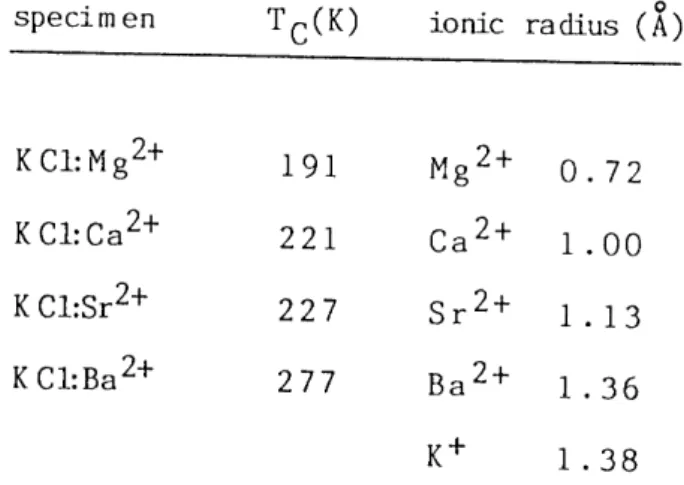
temperature, Tc, is around 180K, 220K, 230K, 260K for KCI:Mg2+,
Kcl:ca2+, Kcl:sr2+, and Kcl:Ba2+, respectively. When alkali
3 B a
g2
p
ov-
bi
aX
po
o
go
<ch
g
A o
o
o
A o
A
60 1oo 140 T (K) 80
Fig.3-3
(O)T
yDependence of (O)Tpl, (A)Tp2, on temperature for Kcl:Mg2+(o.
and
035mo1 9. ) .
,
d
3
2
A aU l
GIII
bo
rv a"3
P 2
1
o
o
0
O
o
•--•-- Ip
8 o
o(EG)
pt A
(a)
o
o ff oo o ta-) as
an o o
o
..IF--;
o
(b)
60 1OO 140 180 T (K) 220
6
4
2B g
v o.
6P
4
2
o
Fi g8,F,g.?.2.psgd?gc.e,gi,,8.9+)Ipi6.S+A.)g.pg.'.2?g,5•..D.):,g
on (a) O.065, (b) O.050molY..
t
.
4 3
2
1
o -4 o
a
EE]V3 a
p2
1
o 3 2
1 o 60
o (a)
a a
o
••--•-•- )).o
o a
o g
O.i-ilb-•--'`
AO
@o o o
,
o
di]
(b)
o%
o o
(sl;i)
o A D o o
..ili---`
o
o
..IF-d=[IXSilA
A:
o e
(c)
o
.
d()X
A
o
())kiSts
o
•.ql-•-•-;
g
S
1oo 140 180 T (K) 220
8 6 4 2 o
8A 8 E 6V >
P
4
2 o 6
4
2
o 260
5 4
3
A 82
.lllll,
Pl
Eil'
p-o
s 3
2
1 o
o
8 o
[]
o
o o
o
A o 8)
g o
o o o
o
2. o o o o
(ill)
(a)
a
g o o
o
AA o g.
o A
iliiio o
o
o%
fige,
A A
oo
o o
(b)
eo 1oo 140 180 220 260
T (K)
Fig.3-6Dependence temperature for (b) O.050mo19..
,gi,i.9 +' Ipig.g+A• liR.26.2;g,i• .O. )lg
on
(a) O.065,
2
1
o
2
Al aU
Eo
Pa'2
1
o
1
o
(a)
8 o
i
.(b)
o
.,
o
.
o(si5
o o
(c)
(sÅí)
o o
o o
o
(d) o
o o
o oo
60 1OO 140
T(K)
180 220 260
.
haljde crystals are doped with divalent ions, the divalent cation impurity jtnduces a positive ion vacancy which conserves the electrica-1 neutrality. They are often at the nearest neighbor sites forming an impurity-vacancy(I--V) dipole, which attract them strongly[53], for crystals quenched from a high temperature. And a dislocation moves on a single slip plane and interacts strongly only with these defects lying within one atom spacing of the glide plane. Then, the relation between the effective stress and the temperature can be approximated as an Equation(2-1) on page 28. The temperature dependence of Tpl reveals the force-distance
profile which expresses the interaction between a dislocation and weak obstacles. Fig.2-15 and 3-8 'VIO shows that the relati-on between Tpl and temperature agree with Equation(2-1) for four kinds of specimens. And then, the values of Tpo are given in Table 3-1. Furthermore, the critical temperatures, Tc, were determ.i.ned from the intersection with the abscissa for each specimen as shown in Table 3-2. When the divalent ionic size is
close to the K+'s one, Tc tends to iincrease.
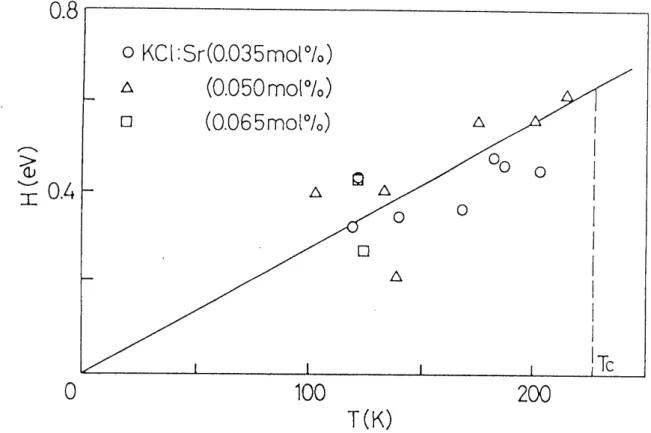
Determination of Tc is attempted from the temperature dependence of yield stress. Then, the effective stress was defined by subtraction of the yield stress at room temperature from the yield stress at a given temperature. That is, the yield stress at room temperature is taken as the internal stress. The internal stress is 2.2, 3.2, and 3.7rvlPa for KCI:Sr2+(O.035mol%), Sr2+(o.oso m o19.), and Sr2+(O.065 m o19.), respectively. Fig.3-11 shows the relation between ( Teff. / Teff.o)1/2 and Tl/2 for
KCI:Sr2+. Teff. shows the effective stress due to weak obstacle
Å~--
r8
g.- E
b
1.0
O.5
o
1
Q l
o
l
Åéo
8 10 12
Ti/2 (Ki/2)
14
Fig.3-8
[(o)o
Linear plots of .035mol%].
Tpll/2 and Tl/2 for KCI:Mg2+
,
t
r>Sl
"'111)
p
Å~
zil