The Craft of One Little Finger: Analysis of A Conversation with Henri Cartier-Bresson
Mark Hammond
1. Introduction
Discourse analysis provides a vehicle to explore written or spoken texts “beyond the sentence” (Thornbury, 2005), allowing for a deeper discovery of the meaning of the text and the context in which it is used. Models of categorical frameworks to organize the structure of discourse play a crucial role in a systematic approach to analysis. One particular model, the Francis & Hunston framework, facilitates rich analysis of data extracted from the spoken text of interactional conversation, which includes the genre of journalistic interview. For this paper, the framework was employed to produce an analysis of a televised interview with renowned photographer Henri Cartier-Bresson, in order to determine if categorization based on the micro-structure of the text could provide a clearer view of the wider themes that are present in the discourse. The first section of the paper offers a review of the development of the framework, followed by a description of the specific data from each level in the model’s hierarchy. In the final section, the patterns and characteristics of the discourse will be examined in relation to Cartier-Bresson’s own letters and memoirs, in order to further illuminate meaning beyond the photographer’s acts of speech.
2. The Francis & Hunston Framework
Francis & Hunston’s systematic framework was developed for use in an undergraduate course in discourse analysis at the National University of Singapore in 1992. The model attempts to provide a “flexible and adaptable” system that allows students to analyze the spoken discourse of numerous different situations, such as casual conversations between friends, child-adult talk, commercial transactions, professional interviews, and others (Francis & Hunston, 1992, p. 123).
The framework represents an effort “to interpret, integrate, and systemize various adaptations of refinement” of the efforts of researchers primarily from the University of Birmingham (Francis & Hunston, 1992, p. 123). The 1975 model developed by Sinclair & Coulthard focused on the spoken texts of language classrooms, and established a rank scale that could be used to organize discourse, starting with the lowest rank of act, which is realized at the level of grammar or lexis, and describes the basic functions of language. For example elicitation is a broadly defined act of “requesting a linguistic response” (Coulthard, 1977, p. 126).
Twenty-two acts were proposed and organized into the three categories of meta- interactive, interactive, and turn taking.
A completed act realizes a move which in turn forms an exchange. A common three-move exchange pattern of structure, Initiation-Response-Follow-up (IRF), was identified as a common occurrence in classroom discourse (Sinclair & Coulthard, 1992, p. 3). In an IRF exchange, the teacher initiates, the student responds, and the teacher offers feedback, corresponding with a one-to-one relationship between the structure of discourse and the move, as illustrated in this fabricated exchange:
Example 1 - IRF Exchange
Speaker Structure Dialogue Move
Teacher I (initiates) What sport doesn’t use a ball? Opening
Student R (responds) Skiing. Answering
Teacher F (follows up) That’s right. Good. Follow-up
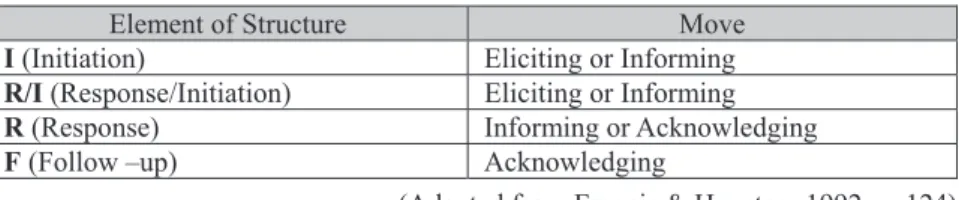
Addressing more complex exchanges, the 1981 Coulthard & Montgomery model reformulated the earlier framework, removing the one-to-one relationship, by classifying moves as eliciting, informing, and acknowledging (Francis & Hunston, 1992, p. 124). The I move could be either eliciting or informing, the R move either informing or acknowledging, the F move was always acknowledging. Additionally, an R/I element of structure was introduced to recognize moves that simultaneously respond and initiate. I and R are required to complete an exchange, while R/I and F are possible but not always present. The model also recognizes that F may occur more than once (noted by F1, F2, etc.).
Table 1 - Relation of Structure and Move in Coulthard & Montgomery Model
Element of Structure Move
I (Initiation) Eliciting or Informing R/I (Response/Initiation) Eliciting or Informing R (Response) Informing or Acknowledging F (Follow –up) Acknowledging
(Adapted from Francis & Hunston, 1992, p. 124)
Francis & Hunston built upon the theoretical foundations of the Birmingham models and made several adaptations of their own, including a division of exchanges into three categories: organizational, conversational, and bound-elicit. A bound-elicit exchange seeks clarification, repetition, or re-initiation of a preceding exchange, and is designated by Ib and separated from other exchanges by a broken line. Additionally, an expansion of the classification of acts was made, from the original twenty-two to thirty-two (Francis &
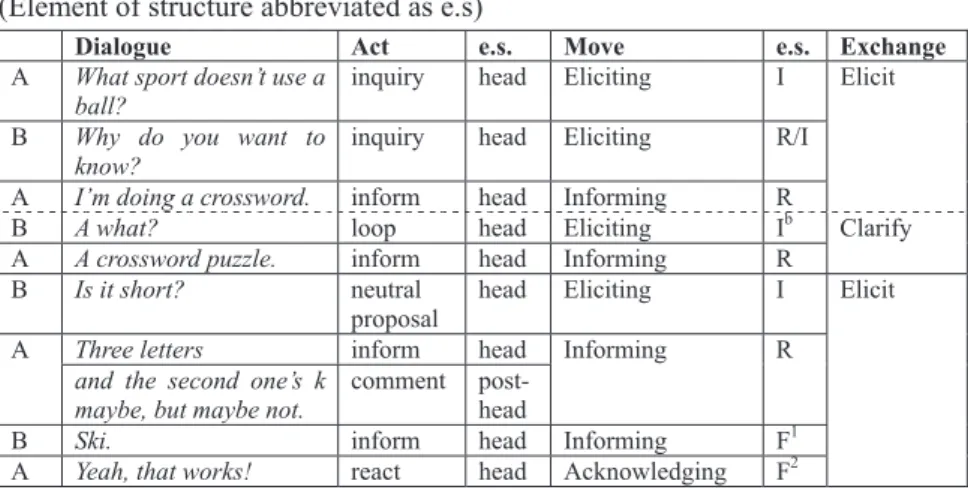
Hunston, 1992, p. 134), providing more depth of analysis. For example, the act of eliciting in earlier models was subdivided into six separate acts: inquire, marked proposal, neutral proposal, loop, return, prompt. The framework acknowledges not only the structure of the exchange, but also the structure of moves, by allowing acts to be classified as pre-head, head, or post-head, which permits a richer analysis compared to earlier models, as illustrated in the following fabricated exchange:
2. The Francis & Hunston Framework
Francis & Hunston’s systematic framework was developed for use in an undergraduate course in discourse analysis at the National University of Singapore in 1992. The model attempts to provide a “flexible and adaptable” system that allows students to analyze the spoken discourse of numerous different situations, such as casual conversations between friends, child-adult talk, commercial transactions, professional interviews, and others (Francis & Hunston, 1992, p. 123).
The framework represents an effort “to interpret, integrate, and systemize various adaptations of refinement” of the efforts of researchers primarily from the University of Birmingham (Francis & Hunston, 1992, p. 123). The 1975 model developed by Sinclair & Coulthard focused on the spoken texts of language classrooms, and established a rank scale that could be used to organize discourse, starting with the lowest rank of act, which is realized at the level of grammar or lexis, and describes the basic functions of language. For example elicitation is a broadly defined act of “requesting a linguistic response” (Coulthard, 1977, p. 126).
Twenty-two acts were proposed and organized into the three categories of meta- interactive, interactive, and turn taking.
A completed act realizes a move which in turn forms an exchange. A common three-move exchange pattern of structure, Initiation-Response-Follow-up (IRF), was identified as a common occurrence in classroom discourse (Sinclair & Coulthard, 1992, p. 3). In an IRF exchange, the teacher initiates, the student responds, and the teacher offers feedback, corresponding with a one-to-one relationship between the structure of discourse and the move, as illustrated in this fabricated exchange:
Example 1 - IRF Exchange
Speaker Structure Dialogue Move
Teacher I (initiates) What sport doesn’t use a ball? Opening
Student R (responds) Skiing. Answering
Teacher F (follows up) That’s right. Good. Follow-up
Addressing more complex exchanges, the 1981 Coulthard & Montgomery model reformulated the earlier framework, removing the one-to-one relationship, by classifying moves as eliciting, informing, and acknowledging (Francis & Hunston, 1992, p. 124). The I move could be either eliciting or informing, the R move either informing or acknowledging, the F move was always acknowledging. Additionally, an R/I element of structure was introduced to recognize moves that simultaneously respond and initiate. I and R are required to complete an exchange, while R/I and F are possible but not always present. The model also recognizes that F may occur more than once (noted by F1, F2, etc.).
Table 1 - Relation of Structure and Move in Coulthard & Montgomery Model
Element of Structure Move
I (Initiation) Eliciting or Informing R/I (Response/Initiation) Eliciting or Informing R (Response) Informing or Acknowledging F (Follow –up) Acknowledging
(Adapted from Francis & Hunston, 1992, p. 124)
Francis & Hunston built upon the theoretical foundations of the Birmingham models and made several adaptations of their own, including a division of exchanges into three categories: organizational, conversational, and bound-elicit. A bound-elicit exchange seeks clarification, repetition, or re-initiation of a preceding exchange, and is designated by Ib and separated from other exchanges by a broken line. Additionally, an expansion of the classification of acts was made, from the original twenty-two to thirty-two (Francis &
Hunston, 1992, p. 134), providing more depth of analysis. For example, the act of eliciting in earlier models was subdivided into six separate acts: inquire, marked proposal, neutral proposal, loop, return, prompt. The framework acknowledges not only the structure of the exchange, but also the structure of moves, by allowing acts to be classified as pre-head, head, or post-head, which permits a richer analysis compared to earlier models, as illustrated in the following fabricated exchange:
Example 2 – Exchanges using the Francis & Hunston Framework (Element of structure abbreviated as e.s)
Dialogue Act e.s. Move e.s. Exchange
A What sport doesn’t use a
ball? inquiry head Eliciting I Elicit
B Why do you want to
know? inquiry head Eliciting R/I
A I’m doing a crossword. inform head Informing R
B A what? loop head Eliciting Ib Clarify
A A crossword puzzle. inform head Informing R
B Is it short? neutral
proposal head Eliciting I Elicit
A Three letters inform head Informing R
and the second one’s k
maybe, but maybe not. comment post-
B Ski. inform headhead Informing F1
A Yeah, that works! react head Acknowledging F2
The framework also includes two higher ranks: transactions and interactions.
Transactions represent the structure of topics within the discourse, as recognized by linguistic signals such as organizational moves (framing, opening) or by high-key intonation or proclaiming tone. Francis & Hunston (1992) note that defining a topic is a “thorny question”, making the rank of transaction “a less satisfactory unit altogether than those lower down the rank scale” (p.140). The same can be said for the rank of interactions, which the authors admit lacks any evidence of internal structure and has “not yet been, and perhaps cannot be, characterized in linguistic terms” (Francis & Hunston, 1992, p. 140).
The rank levels and elements of structure required for the framework can be accommodated in the form of a table, which facilities classifying elements of discourse during analysis. An example of such an analysis is presented in the following section.
3. Analysis of Transcribed Data
For this paper, an analysis was made of a text of approximately 2000 words of
transcribed dialogue, categorized in a table (appendix) containing over 700 individual classifications. The text used in the analysis was obtained from a video recording of a television interview of photographer Henri Cartier-Bresson and Charlie Rose, a veteran broadcast journalist. Recorded on July 6th, 2000 for the PBS television program, Charlie Rose, under the title of A Conversation with Henri Cartier-Bresson, the total length of the interview is 50 minutes; only the first 13 minutes were transcribed for this analysis. A summary of the significant findings from the data will follow, subdivided into each specific level of the rank scale.
3.1 Interactions and Transactions
The two participants engage in a single interaction, of 11 separate transactions, indicated by twin horizontal lines on the table. Of the 11 transactions, 10 start with eliciting moves by Rose, who clearly controls the direction of the discourse. Only one transaction can be attributed to initiation by Cartier-Bresson (appendix, line 146), when he brings up the experience of photographing Mahatma Gandhi.
3.2 Exchanges
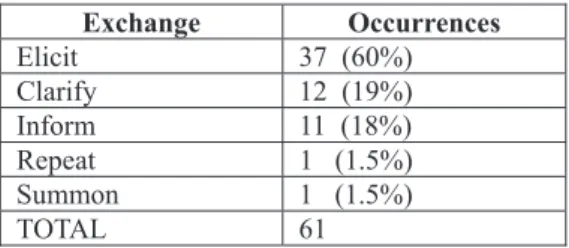
There were a total of 61 exchanges in the transcript. The three most frequently occurring types (elicit, clarify, and inform) accounted for 97% of all exchanges.
Table 2 - Frequency of Exchanges
Exchange Occurrences
Elicit 37 (60%)
Clarify 12 (19%)
Inform 11 (18%)
Repeat 1 (1.5%)
Summon 1 (1.5%)
TOTAL 61
Only ten of the 61 exchanges begin with an utterance from Cartier-Bresson,
Example 2 – Exchanges using the Francis & Hunston Framework (Element of structure abbreviated as e.s)
Dialogue Act e.s. Move e.s. Exchange
A What sport doesn’t use a
ball? inquiry head Eliciting I Elicit
B Why do you want to
know? inquiry head Eliciting R/I
A I’m doing a crossword. inform head Informing R
B A what? loop head Eliciting Ib Clarify
A A crossword puzzle. inform head Informing R
B Is it short? neutral
proposal head Eliciting I Elicit
A Three letters inform head Informing R
and the second one’s k
maybe, but maybe not. comment post-
B Ski. inform headhead Informing F1
A Yeah, that works! react head Acknowledging F2
The framework also includes two higher ranks: transactions and interactions.
Transactions represent the structure of topics within the discourse, as recognized by linguistic signals such as organizational moves (framing, opening) or by high-key intonation or proclaiming tone. Francis & Hunston (1992) note that defining a topic is a “thorny question”, making the rank of transaction “a less satisfactory unit altogether than those lower down the rank scale” (p.140). The same can be said for the rank of interactions, which the authors admit lacks any evidence of internal structure and has “not yet been, and perhaps cannot be, characterized in linguistic terms” (Francis & Hunston, 1992, p. 140).
The rank levels and elements of structure required for the framework can be accommodated in the form of a table, which facilities classifying elements of discourse during analysis. An example of such an analysis is presented in the following section.
3. Analysis of Transcribed Data
For this paper, an analysis was made of a text of approximately 2000 words of
transcribed dialogue, categorized in a table (appendix) containing over 700 individual classifications. The text used in the analysis was obtained from a video recording of a television interview of photographer Henri Cartier-Bresson and Charlie Rose, a veteran broadcast journalist. Recorded on July 6th, 2000 for the PBS television program, Charlie Rose, under the title of A Conversation with Henri Cartier-Bresson, the total length of the interview is 50 minutes; only the first 13 minutes were transcribed for this analysis. A summary of the significant findings from the data will follow, subdivided into each specific level of the rank scale.
3.1 Interactions and Transactions
The two participants engage in a single interaction, of 11 separate transactions, indicated by twin horizontal lines on the table. Of the 11 transactions, 10 start with eliciting moves by Rose, who clearly controls the direction of the discourse. Only one transaction can be attributed to initiation by Cartier-Bresson (appendix, line 146), when he brings up the experience of photographing Mahatma Gandhi.
3.2 Exchanges
There were a total of 61 exchanges in the transcript. The three most frequently occurring types (elicit, clarify, and inform) accounted for 97% of all exchanges.
Table 2 - Frequency of Exchanges
Exchange Occurrences
Elicit 37 (60%)
Clarify 12 (19%)
Inform 11 (18%)
Repeat 1 (1.5%)
Summon 1 (1.5%)
TOTAL 61
Only ten of the 61 exchanges begin with an utterance from Cartier-Bresson,
eight of which are informing, and two eliciting. Rose is responsible for initiating the remaining 51 exchanges, including 96% of eliciting and 100% of clarifying.
Structurally, the I-R pattern was by far the most prevalent, occurring in 40% of all exchanges. Many of the I-R exchanges occur early in the interview and end in short utterances, which could be a reflection of Cartier-Bresson’s reluctance to participate, although as the interview progresses, the structure of exchanges becomes slightly more dynamic.
3.3 Moves
The frequency of moves is distributed evenly between the two participants.
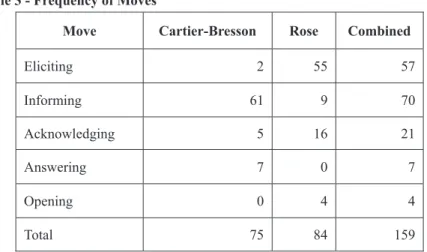
Cartier-Bresson made 75 moves (47%) while Rose made 84 (53%). Considering the genre of television interview, it is not surprising that 85% of Rose’s moves were either eliciting or acknowledging, and 89% of Cartier-Bresson’s moves were either informing or answering.
Table 3 - Frequency of Moves
Move Cartier-Bresson Rose Combined
Eliciting 2 55 57
Informing 61 9 70
Acknowledging 5 16 21
Answering 7 0 7
Opening 0 4 4
Total 75 84 159
The structure of 86% of all moves consists of a single act, while multi-act moves (containing pre or post-headed acts) account for the remaining 14%. Rose’s multi-
act moves generally serve to set up a question and guide the direction of the discourse.
3.4 Acts
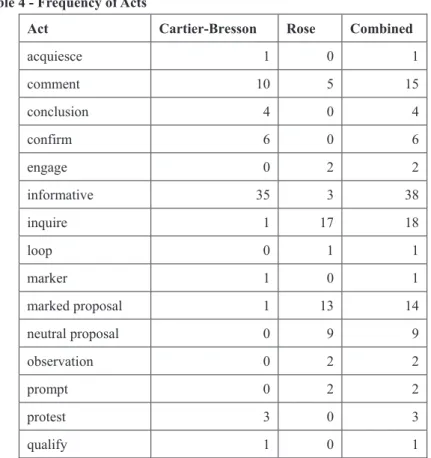
The 173 total acts are evenly distributed between the participants, with Rose responsible for only 5% more than Cartier-Bresson. Despite the 22 varieties of acts, Rose’s questions (inquire, marked and neutral proposals) make up 41% of his acts, while Cartier-Bresson’s are 45% informative.
Table 4 - Frequency of Acts
Act Cartier-Bresson Rose Combined
acquiesce 1 0 1
comment 10 5 15
conclusion 4 0 4
confirm 6 0 6
engage 0 2 2
informative 35 3 38
inquire 1 17 18
loop 0 1 1
marker 1 0 1
marked proposal 1 13 14
neutral proposal 0 9 9
observation 0 2 2
prompt 0 2 2
protest 3 0 3
qualify 1 0 1
eight of which are informing, and two eliciting. Rose is responsible for initiating the remaining 51 exchanges, including 96% of eliciting and 100% of clarifying.
Structurally, the I-R pattern was by far the most prevalent, occurring in 40% of all exchanges. Many of the I-R exchanges occur early in the interview and end in short utterances, which could be a reflection of Cartier-Bresson’s reluctance to participate, although as the interview progresses, the structure of exchanges becomes slightly more dynamic.
3.3 Moves
The frequency of moves is distributed evenly between the two participants.
Cartier-Bresson made 75 moves (47%) while Rose made 84 (53%). Considering the genre of television interview, it is not surprising that 85% of Rose’s moves were either eliciting or acknowledging, and 89% of Cartier-Bresson’s moves were either informing or answering.
Table 3 - Frequency of Moves
Move Cartier-Bresson Rose Combined
Eliciting 2 55 57
Informing 61 9 70
Acknowledging 5 16 21
Answering 7 0 7
Opening 0 4 4
Total 75 84 159
The structure of 86% of all moves consists of a single act, while multi-act moves (containing pre or post-headed acts) account for the remaining 14%. Rose’s multi-
act moves generally serve to set up a question and guide the direction of the discourse.
3.4 Acts
The 173 total acts are evenly distributed between the participants, with Rose responsible for only 5% more than Cartier-Bresson. Despite the 22 varieties of acts, Rose’s questions (inquire, marked and neutral proposals) make up 41% of his acts, while Cartier-Bresson’s are 45% informative.
Table 4 - Frequency of Acts
Act Cartier-Bresson Rose Combined
acquiesce 1 0 1
comment 10 5 15
conclusion 4 0 4
confirm 6 0 6
engage 0 2 2
informative 35 3 38
inquire 1 17 18
loop 0 1 1
marker 1 0 1
marked proposal 1 13 14
neutral proposal 0 9 9
observation 0 2 2
prompt 0 2 2
protest 3 0 3
qualify 1 0 1
react 0 10 10
receive 0 2 2
reformulate 0 6 6
reject 15 0 15
return 0 12 12
starter 0 7 7
summon 0 1 1
undetermined (X) 0 3 3
Total 78 95 173
Cartier-Bresson’s second and third most frequent acts, reject and protest, both of which require disagreement with one’s interlocutor, show that 23% of his utterances are, to some degree, in opposition to Rose. Francis & Hunston (1992) describe an act of protest as acknowledging and objecting to the previous utterance, “while disputing its correctness, relevance, appropriateness, the participants right to have uttered it, or anything else” (p. 134). Included in the description of reject is the refusal to accept the underlying presuppositions of an eliciting act (Francis &
Hunston, 1992, p. 134). Certainly the same reasons listed for protest could be justification for reject as well. Regardless, both acts imply a sentiment of objection, and it is useful to consider them collectively to understand the photographer’s reactions towards the interviewer’s presuppositions, which will be addressed in the next section.
4. Cartier-Bresson’s Objection to Labels
In the interview, Cartier-Bresson’s protest and reject acts offer insight to the structure of the discourse, and provide a starting point to examine the photographer’s
attitude towards being labeled or categorized by any artistic or creative terms. After surveying the context of acts of protest or rejection, a pattern emerged, as illustrated in the following exchange taken from lines 16 to 18 of the transcript (appendix):
16 17 18
On the other hand,
There are things that you would expect of craftsmen.
<H>You’re teaching how to use your little finger, that’s all.
s i prot
pre h h
inform acknow
I R
The label of ‘craftsman’ triggers Cartier-Bresson’s protest, but this is not an isolated case; in other exchanges in the transcript (appendix) the labels of
‘photojournalist’ (line 47), ‘surrealist associate’ (line 54), ‘artist’ (line 77), and even
‘photographer’ (line 75) are all rejected or protested. Moreover, the only instance of a transaction (line 146, appendix) being directed by Cartier-Bresson seems to be an attempt to avoid further discussion about Rose’s proclamation that he is one of the greatest artist of the century.
Within the text, Cartier-Bresson offers three alternative labels for his own identity. He states he is an ‘anarchist’ (line 59) when the suggestion is made that he belongs to the surrealist movement. When asked if he considers himself just to be an artist, he proclaims to be just a ‘human being’(line 78). After Cartier-Bresson, in line 172, tags labels on fellow photographers David Seymour (a thinker) and Robert Capa (an adventure) in the final transaction, Rose appears to have the photographer trapped and asks, “And you were?” This allows Cartier-Bresson to make his third self-assessment of “Un inttello”, the French term for “egghead” or a nerdy intellectual.
Uncovering this pattern in the 13 minutes of the analyzed text is significant, as it guides navigation of the remaining 37 minutes of the interview, in search of similar examples. Without making a time-consuming formal analysis, further examples of the pattern surfaced. Rose’s labeling attempts (“friend of the artist Henri Matisse”,
“a born photographer”, “a giant [in the art world]”, “art critic”), were all rejected or
react 0 10 10
receive 0 2 2
reformulate 0 6 6
reject 15 0 15
return 0 12 12
starter 0 7 7
summon 0 1 1
undetermined (X) 0 3 3
Total 78 95 173
Cartier-Bresson’s second and third most frequent acts, reject and protest, both of which require disagreement with one’s interlocutor, show that 23% of his utterances are, to some degree, in opposition to Rose. Francis & Hunston (1992) describe an act of protest as acknowledging and objecting to the previous utterance, “while disputing its correctness, relevance, appropriateness, the participants right to have uttered it, or anything else” (p. 134). Included in the description of reject is the refusal to accept the underlying presuppositions of an eliciting act (Francis &
Hunston, 1992, p. 134). Certainly the same reasons listed for protest could be justification for reject as well. Regardless, both acts imply a sentiment of objection, and it is useful to consider them collectively to understand the photographer’s reactions towards the interviewer’s presuppositions, which will be addressed in the next section.
4. Cartier-Bresson’s Objection to Labels
In the interview, Cartier-Bresson’s protest and reject acts offer insight to the structure of the discourse, and provide a starting point to examine the photographer’s
attitude towards being labeled or categorized by any artistic or creative terms. After surveying the context of acts of protest or rejection, a pattern emerged, as illustrated in the following exchange taken from lines 16 to 18 of the transcript (appendix):
16 17 18
On the other hand,
There are things that you would expect of craftsmen.
<H>You’re teaching how to use your little finger, that’s all.
s i prot
pre h h
inform acknow
I R
The label of ‘craftsman’ triggers Cartier-Bresson’s protest, but this is not an isolated case; in other exchanges in the transcript (appendix) the labels of
‘photojournalist’ (line 47), ‘surrealist associate’ (line 54), ‘artist’ (line 77), and even
‘photographer’ (line 75) are all rejected or protested. Moreover, the only instance of a transaction (line 146, appendix) being directed by Cartier-Bresson seems to be an attempt to avoid further discussion about Rose’s proclamation that he is one of the greatest artist of the century.
Within the text, Cartier-Bresson offers three alternative labels for his own identity. He states he is an ‘anarchist’ (line 59) when the suggestion is made that he belongs to the surrealist movement. When asked if he considers himself just to be an artist, he proclaims to be just a ‘human being’(line 78). After Cartier-Bresson, in line 172, tags labels on fellow photographers David Seymour (a thinker) and Robert Capa (an adventure) in the final transaction, Rose appears to have the photographer trapped and asks, “And you were?” This allows Cartier-Bresson to make his third self-assessment of “Un inttello”, the French term for “egghead” or a nerdy intellectual.
Uncovering this pattern in the 13 minutes of the analyzed text is significant, as it guides navigation of the remaining 37 minutes of the interview, in search of similar examples. Without making a time-consuming formal analysis, further examples of the pattern surfaced. Rose’s labeling attempts (“friend of the artist Henri Matisse”,
“a born photographer”, “a giant [in the art world]”, “art critic”), were all rejected or
protested. A particularly blunt rejection comes towards the end of the interview when, in the context of Rose’s attempt at drawing a parallel to Pablo Picasso, an irritated Cartier-Bresson shouts, “Who cares? Who cares?”
To further analyze this pattern, additional contextual background is required about the two participants. Cartier-Bresson, 92-years old at the time of the interview, had spent his life rejecting notoriety, preferring “to be unknown, to disappear, and to be able to observe” (Riding, 2001). At the urging of his wife Martine Frank, who was in the process of establishing a foundation to preserve the legacy of his work, the photographer was convinced to grant a televised interview, something that he had always been reluctant to do (Rose, 2010). The veteran journalist, Rose, has stated that he considered interacting with the photographer to be one of the greatest honors of his career, which may explain some anxiety and nervousness. Ten years after the interview, Rose suggested that insobriety may have been a factor, as he admitted that once the cameras started to roll for the interview, “we had had a bottle of wine by then” (Rose, 2010). There seems to be an awkwardness between the two men during the interview, and “Rose never puts his subject at ease, and Cartier- Bresson never warms to him” (Johnston, 2007).
However, Cartier-Bresson’s attitude and objection go deeper than the discourse directed by Rose. Protesting the label of ‘craftsman’ can be traced back to when the photographer was a young man. Andre Pieyre de Mandiargues, poet and friend from the photographer’s youth, recalls that the word ‘craft’ in association with career turned Cartier-Bresson’s stomach (Galassi, 1987). As far back as 1952, as recounted in his memoir The Mind’s Eye, Cartier-Bresson (1999) wrote that “people think far too much about technique and not enough about seeing” (p. 38), and dismisses photographers who belong to “a whole group of fetishes which have developed on the subject of technique” (p. 38).
Objection to the label of ‘artist’ is seen in the exchange at line 77 to 79. Cartier- Bresson raises his voice and appears particularly irritated at Rose’s presupposition that he accepts validity of the term, as evident by his comment act “What is all this?”
77 78 79
<C>So you see yourself simply as an artist?
<H>I am just a human being! Anybody who is sensitive is an artist!
What is all this?
ret prot com
h h post
elicit acknow answer
Ib R
This is not the first time Cartier-Bresson has protested such characterization of his identity in relationship to art or an art movement. Thirteen years earlier, in a 1987 letter, he recalled that his association with French intellectuals led to his convictions that every human being is potentially an artist, and implied that professional artists give up freedom when they sell out to “enter into the law of the jungle” (as quoted in Galassi, 1987, p. 17). The same can be said for rejection of the label of ‘surrealist’; as early as 1947 his fellow Magnum co-founder Robert Capa warned him of the dangers of being known as “the little Surrealist photographer” after holding an exhibition at the Museum of Modern Art in New York (as quoted in Galassi, 1987, p. 26).
Perhaps the most surprising rejection is to the label of ‘photographer’, found in the following exchange at lines 75 and 76 (appendix):
75 76
<C>…Something must have made you want to be a photographer?
<H>I don’t consider myself a photographer. I am using a camera, but everybody, there’s millions of photographers. It is what you see, it is a way for me.
m.pr rej
h h
elicit inform
I R
In this exchange, it is hard to fault Rose’s underlying assumption. Not only is the subject of his interview a renowned and celebrated photographer, but is arguably the most influential photographer of the 20th century. Cartier-Bresson is not rejecting the fact that he takes photographs, he is rejecting the notion that his sense of self- identity can be summed up by the term. Even with all his accomplishments and accolades, he still only admits to being an “amateur…no longer a dilettante”
(Cartier-Bresson, 1999, p. 23). His attitudes, even at the age of 92, remain true to the spirit of his definition of photography as a way “of freeing oneself, not of proving or asserting one’s originality” (Cartier-Bresson, 1999, p. 16).
protested. A particularly blunt rejection comes towards the end of the interview when, in the context of Rose’s attempt at drawing a parallel to Pablo Picasso, an irritated Cartier-Bresson shouts, “Who cares? Who cares?”
To further analyze this pattern, additional contextual background is required about the two participants. Cartier-Bresson, 92-years old at the time of the interview, had spent his life rejecting notoriety, preferring “to be unknown, to disappear, and to be able to observe” (Riding, 2001). At the urging of his wife Martine Frank, who was in the process of establishing a foundation to preserve the legacy of his work, the photographer was convinced to grant a televised interview, something that he had always been reluctant to do (Rose, 2010). The veteran journalist, Rose, has stated that he considered interacting with the photographer to be one of the greatest honors of his career, which may explain some anxiety and nervousness. Ten years after the interview, Rose suggested that insobriety may have been a factor, as he admitted that once the cameras started to roll for the interview, “we had had a bottle of wine by then” (Rose, 2010). There seems to be an awkwardness between the two men during the interview, and “Rose never puts his subject at ease, and Cartier- Bresson never warms to him” (Johnston, 2007).
However, Cartier-Bresson’s attitude and objection go deeper than the discourse directed by Rose. Protesting the label of ‘craftsman’ can be traced back to when the photographer was a young man. Andre Pieyre de Mandiargues, poet and friend from the photographer’s youth, recalls that the word ‘craft’ in association with career turned Cartier-Bresson’s stomach (Galassi, 1987). As far back as 1952, as recounted in his memoir The Mind’s Eye, Cartier-Bresson (1999) wrote that “people think far too much about technique and not enough about seeing” (p. 38), and dismisses photographers who belong to “a whole group of fetishes which have developed on the subject of technique” (p. 38).
Objection to the label of ‘artist’ is seen in the exchange at line 77 to 79. Cartier- Bresson raises his voice and appears particularly irritated at Rose’s presupposition that he accepts validity of the term, as evident by his comment act “What is all this?”
77 78 79
<C>So you see yourself simply as an artist?
<H>I am just a human being! Anybody who is sensitive is an artist!
What is all this?
retprot com
hh post
elicit acknow answer
Ib R
This is not the first time Cartier-Bresson has protested such characterization of his identity in relationship to art or an art movement. Thirteen years earlier, in a 1987 letter, he recalled that his association with French intellectuals led to his convictions that every human being is potentially an artist, and implied that professional artists give up freedom when they sell out to “enter into the law of the jungle” (as quoted in Galassi, 1987, p. 17). The same can be said for rejection of the label of ‘surrealist’; as early as 1947 his fellow Magnum co-founder Robert Capa warned him of the dangers of being known as “the little Surrealist photographer” after holding an exhibition at the Museum of Modern Art in New York (as quoted in Galassi, 1987, p. 26).
Perhaps the most surprising rejection is to the label of ‘photographer’, found in the following exchange at lines 75 and 76 (appendix):
75 76
<C>…Something must have made you want to be a photographer?
<H>I don’t consider myself a photographer. I am using a camera, but everybody, there’s millions of photographers. It is what you see, it is a way for me.
m.pr rej
h h
elicit inform
I R
In this exchange, it is hard to fault Rose’s underlying assumption. Not only is the subject of his interview a renowned and celebrated photographer, but is arguably the most influential photographer of the 20th century. Cartier-Bresson is not rejecting the fact that he takes photographs, he is rejecting the notion that his sense of self- identity can be summed up by the term. Even with all his accomplishments and accolades, he still only admits to being an “amateur…no longer a dilettante”
(Cartier-Bresson, 1999, p. 23). His attitudes, even at the age of 92, remain true to the spirit of his definition of photography as a way “of freeing oneself, not of proving or asserting one’s originality” (Cartier-Bresson, 1999, p. 16).
5. Conclusion
The Francis-Hunston framework was an effective tool for extracting meaning from spoken discourse of the interview, especially at the rank level of act. The completed table of data was instrumental in uncovering the pattern of objection to Rose’s use of labels, and illuminated similar examples from the non-analyzed text of the interview. The pattern of protesting and rejection found in the analysis of the text of the interview is consistent with the attitudes and ethics expressed throughout the photographer’s life. Starting at the point of dissecting individual utterances, the analysis permits a larger view and guides further investigation aimed at a deeper understanding a self-described un inttello.
References:
Cartier-Bresson, H. (1999). The Mind’s Eye. New York: Aperture Press.
Coulthard, M. (1977). An Introduction to Discourse Analysis. Essex, UK: Longman.
Francis, G. & Hunston, S. (1992). Analysing everyday conversation. In Coulthard, M. (Ed.) Advances in Spoken Discourse Analysis (123-161). London: Routledge.
Galassi, P. (1987). Henri Cartier-Bresson – The Early Work. New York, Museum of Modern Art.
Johnston, M. (2007, February 23). The Charlie Rose-Cartier-Bresson Interview.
Retrieved from:
http://theonlinephotographer.blogspot.jp/2007/02/charlie-rose-cartier-bresson- interview.html
Riding, A. (2001). A Camera-Shy Legend, Exposed and Indignant; Cartier-Bresson Chafes Over Book Of Photographs of His Well-Guarded Face. New York Times.
Retrieved from:
http://www.nytimes.com/2001/02/08/books/arts-abroad-camera-shy-legend- exposed-indignant-cartier-bresson-chafes-over-book.html?pagewanted=all Rose, C. (Producer and Director). (2010, April 15). Henri Cartier-Bresson: The
Modern Century. [Television series episode]. New York. PBS Television.
Sinclair, J. & Coulthard, M. (1992). Towards an analysis of discourse. In Coulthard, M.
(Ed.) Advances in Spoken Discourse Analysis (1-34). London: Routledge.
Thornbury, S. (2005). Beyond the Sentence, Introducing Discourse Analysis.
Oxford: Macmillan Education.
Appendix
A Conversation with Henri Cartier-Bresson
Recorded on July 6th, 2000 in Paris, France for the PBS television program, Charlie Rose. Transcription of the first 13 minutes of the program is used for this analysis.
Abbreviations:
A# Act number
<C> Charlie Rose, Interviewer
<H> Henri Cartier-Bresson, Interviewee
e.s. Element of structure
(for the preceding act or move)
Exch. The type of exchange, and sequential number
(X) Undeterminable or incomplete
& Overlapped speech
Double bold line Transaction boundary Single solid line Exchange boundary
Dashed line Bound-elicit exchange boundary
Italics French language
*** Pause longer than 4 seconds
… Pause less than 4 seconds
A# Dialogue Act e.s. Move e.s. Exch.
1 2
<C>You once said, “I don’t take the photograph, the photograph takes me”.
<H>Yes that’s true.
m.pr conc
h h
elicit inform
I R
Elicit
#1 3
4 <C>What did you mean?
<H>Sensitivity, it’s an impression and sensitivity. You mustn’t want, you must be &
inq i h
h elicit inform Ib
R Clarify
#2 5 6 <C>&Feel?
<H>And receptive. m.pr
qu h
h elicit inform R/I
R Elicit
#3 7
8 9
<C>Composition for you?
<H>Geometry
<C>Geometry?
inq i rea
h h h
elicit inform acknow
I R F
Elicit
#4 10
11 <C>…Are you born with that sense of geometry?
<H>Has to be cultivated. n.pr
i h
h elicit inform I
R Elicit
#5
5. Conclusion
The Francis-Hunston framework was an effective tool for extracting meaning from spoken discourse of the interview, especially at the rank level of act. The completed table of data was instrumental in uncovering the pattern of objection to Rose’s use of labels, and illuminated similar examples from the non-analyzed text of the interview. The pattern of protesting and rejection found in the analysis of the text of the interview is consistent with the attitudes and ethics expressed throughout the photographer’s life. Starting at the point of dissecting individual utterances, the analysis permits a larger view and guides further investigation aimed at a deeper understanding a self-described un inttello.
References:
Cartier-Bresson, H. (1999). The Mind’s Eye. New York: Aperture Press.
Coulthard, M. (1977). An Introduction to Discourse Analysis. Essex, UK: Longman.
Francis, G. & Hunston, S. (1992). Analysing everyday conversation. In Coulthard, M. (Ed.) Advances in Spoken Discourse Analysis (123-161). London: Routledge.
Galassi, P. (1987). Henri Cartier-Bresson – The Early Work. New York, Museum of Modern Art.
Johnston, M. (2007, February 23). The Charlie Rose-Cartier-Bresson Interview.
Retrieved from:
http://theonlinephotographer.blogspot.jp/2007/02/charlie-rose-cartier-bresson- interview.html
Riding, A. (2001). A Camera-Shy Legend, Exposed and Indignant; Cartier-Bresson Chafes Over Book Of Photographs of His Well-Guarded Face. New York Times.
Retrieved from:
http://www.nytimes.com/2001/02/08/books/arts-abroad-camera-shy-legend- exposed-indignant-cartier-bresson-chafes-over-book.html?pagewanted=all Rose, C. (Producer and Director). (2010, April 15). Henri Cartier-Bresson: The
Modern Century. [Television series episode]. New York. PBS Television.
Sinclair, J. & Coulthard, M. (1992). Towards an analysis of discourse. In Coulthard, M.
(Ed.) Advances in Spoken Discourse Analysis (1-34). London: Routledge.
Thornbury, S. (2005). Beyond the Sentence, Introducing Discourse Analysis.
Oxford: Macmillan Education.
Appendix
A Conversation with Henri Cartier-Bresson
Recorded on July 6th, 2000 in Paris, France for the PBS television program, Charlie Rose. Transcription of the first 13 minutes of the program is used for this analysis.
Abbreviations:
A# Act number
<C> Charlie Rose, Interviewer
<H> Henri Cartier-Bresson, Interviewee
e.s. Element of structure
(for the preceding act or move)
Exch. The type of exchange, and sequential number
(X) Undeterminable or incomplete
& Overlapped speech
Double bold line Transaction boundary Single solid line Exchange boundary
Dashed line Bound-elicit exchange boundary
Italics French language
*** Pause longer than 4 seconds
… Pause less than 4 seconds
A# Dialogue Act e.s. Move e.s. Exch.
1 2
<C>You once said, “I don’t take the photograph, the photograph takes me”.
<H>Yes that’s true.
m.pr conc
h h
elicit inform
I R
Elicit
#1 3
4 <C>What did you mean?
<H>Sensitivity, it’s an impression and sensitivity. You mustn’t want, you must be &
inq i h h elicit
inform Ib
R Clarify
#2 5 6 <C>&Feel?
<H>And receptive. m.pr
qu h
h elicit inform R/I
R Elicit
#3 7
8 9
<C>Composition for you?
<H>Geometry
<C>Geometry?
inq i rea
h h h
elicit inform acknow
I R F
Elicit
#4 10
11 <C>…Are you born with that sense of geometry?
<H>Has to be cultivated. n.pr
i h
h elicit inform I
R Elicit
#5
12 13
<C>But, you once said about photography
…nothing…worth knowing…can be taught.
<H>Yes…
ret conc
h h
elicit inform
I R
Elicit
#6 14
15 <H>What is your opinion?
<C>I think that’s probably true. inq
i h
h elicit inform I
R Elicit
#7 16
17 18
On the other hand,
There are things that you would expect of craftsmen.
<H>You’re teaching how to use your little finger, that’s all.
s i prot
pre h h
inform acknow
I R
Inform
#8
19 20 21
<C>Just the finger?&
<H>&No, we have other fingers too, but we are
…I don’t know &
ret i ter
h h h
elicit inform Ib
R Clarify
#9 22
23
<C> & Was your photography … influenced .. by your early interest ….in art?
<H> My photography is just an instant drawing .. just to guess and click-click , the advantages of photography, but you need one [holds up finger] and with drawing you need three fingers. It’s a meditation, drawing. Photography is just shooting. Bang!
n.pr rej
h h
elicit inform
I R
Elicit
#10
24
25 26
<C>I look around this room, there are all these photographs of yours. They are magnificent and the most admired, not in my opinion, in everybody’s opinion.
You never hang your own photographs… on your walls…at your home?
<H> No..no
s
m.pr i
pre
h h
inform
elicit inform
I
R Elicit
#11
27 28 29
<C>Never printed your own photographs, you would just send them away.
<H> Yes, a friend of mine prints.
I don’t know how to print. Takes time. I like shooting.
That’s all.
m.pr i com
h h post
elicit inform inform
I R
Elicit
#12
30 31 <C>Just shooting?
<H>Yes. rea
conf h
h acknow I
R Elicit
#13 32
33 34
<C>What is it that you like about it?
<H>I don’t think of photography …I think of what I see and geometry. That means everything is to be composed properly***
<C> Today &
inq rej (X)
h h (X)
elicit inform (X)
I
R Elicit
#14
35 36 37
<H> & That’s because I started with drawing.
<C> And you returned to drawing.
<H>I never quit drawing. The camera is a way of drawing.
com obs rej
post h h
inform inform inform
I R F
Inform
#15
38 39
<C>When you take the photograph, is there a moment for you when you know when to… snap?
<H>When the subject takes me.
n.pr i
h h
elicit inform
I R
Elicit
#16 40
41 42
<C>When the subject takes you.
<H>Then I am receptive and I shoot.
It is just to concentrate, concentrate. Inner silence and you mustn’t want. Must be receptive.
Don’t think even. The brain is a bit dangerous. It is the sensitivity of it. The flavor. [sniffing sound]
ret i com
h h post
acknow inform inform
Ib
R Clarify
#17
43 44 45 46
<C>Is it true of drawing as well?
<H>Life in general.
<C>In general! Yes! It’s very good [laughs]
It’s philosophy of life. It’s to let it…soak it up … let it overwhelm.
n.pr i rea com
h h h post
elicit inform acknow inform
I R F
Elicit
#18
47
48
<C>Before the war, were, were your intentions, were the way you photographed different than it was after the war when you became… created Magnum … and became a photojournalist?
<H>All of those are labels.
inq
rej h
h
elicit
answer I
R Elicit
#19
49 50 51
<C>Doesn’t mean anything?
<H>Doesn’t mean anything.
It’s a relation to reality, to be present, to be sensitive and participate. Receptive and participate.
ret conf com
h h post
elicit inform Ib
R Clarify
#20
52 53 <C>Did surrealism effect you and your photography?
<H> I have no idea. I never thought of it. inq
rej h
h elicit inform I
R Elicit
#21 54
55
<C>What did it mean to you when you were a young man, and you were associating with the movement and young surrealists?
<H>I don’t know.
inq prot
h h
elicit acknow
I R
Elicit
#22
56
57 <C>You were very young. [laughs]
<H>I don’t know what young means. You are alive or you are not. Wrinkles have nothing to do with it.
p
rej h
h elicit inform I
R Elicit
#23 58
59 <C>But if the brain is young, the heart is young.
<H>I am an anarchist! p
rej h
h elicit inform I
R Elicit
#24 60
61 <C>An anarchist!?
<H>Yes. ret
i h
h elicit inform Ib
R Clarify
#25 62 63 <C>In what way?
<H>Non-violent. inq
i h
h elicit inform I
R Elicit
#26 64
65 66 67 68
<C>But an anarchist in what way? What is it to you want to *** If you took a look at&
<H>&I’d answer only in front of a police.
<C> [laughs]
ret ref (X) rej rea
h post (X) h h
elicit elicit (X) inform acknow
Ib
R F
Clarify
#27
69 70
<C> This life that you have lived, it’s not the life of an anarchist, is it?
<H>Anarchism is an ethic. It is a way of behaving.
m.pr rej
h h
elicit inform
I R
Elicit
#28 71
72 73 74
<C>And so..
how have you behaved?
<H>I’d answer in front of the police only.
<C>[laughs]
s inq rej rea
pre h h h
elicit answer acknow
I R F
Elicit
#29
75 76
<C>…Something must have made you want to be a photographer?
<H>I don’t consider myself a photographer. I am using a camera, but everybody, there’s millions of photographers. It is what you see, it is a way for me.
m.pr rej
h h
elicit inform
I R
Elicit
#30
77 78 79
<C>So you see yourself simply as an artist?
<H>I am just a human being! Anybody who is sensitive is an artist!
What is all this?
ret prot com
h h post
elicit acknow answer
Ib
R Clarify
#31