Inheritance, Ecotourism, and Industrial Development.: Strategies, Mechanisms and
Spatial Practice of The Amis Dietary Culture Transformed into Creativity Living Industry.
著者 Yi‑Su Chen, Li‑Wei Liu
journal or
publication title
International Review for Spatial Planning and Sustainable Development
volume 5
number 3
page range 66‑78
year 2017‑07‑15
URL http://hdl.handle.net/2297/48394
doi: 10.14246/irspsd.5.3_66
66
DOI: http://dx.doi.org/10.14246/irspsd.5.3_66
Copyright@SPSD Press from 2010, SPSD Press, Kanazawa
Interaction and Integration of Cultural Inheritance, Ecotourism, and Industrial Development.
Strategies, Mechanisms and Spatial Practice of The Amis Dietary Culture Transformed into Creativity Living Industry.
Yi-Su Chen
1*and Li-Wei Liu
21 Ph.D Program in Civil and Hydraulic Engineering, Feng Chia University.
2 Department of Urban Planning and Spatial Information, Feng Chia University.
* Corresponding Author, Email: [email protected]
Key words: Creativity Living Industry, Ecotourism, Dietary Culture, Amis, Social Network Analysis (SNA).
Abstract: Diet is the important foundation in constructing traditional culture in aboriginal tribes. Because food is usually regarded as the fundamental element of cultural and social interaction, diet carries symbolic information of cultural tradition in the society. In the face of severe challenge in the globalization era, how to conserve aboriginal culture as well as build aboriginal competitiveness in the free market becomes an important issue in enriching plural ethnic culture. Existing research indicates that the traditional economic structure and cultural context of aboriginal tribes may develop a new cultural pattern after tourism development is drawn into aboriginal living territory. Especially the introduction of ecotourism and tourist experience activities can positively support the conservation of local characteristics and contribute to ecological conservation. Moreover, ecotourism also benefits the promotion of local employment and brings natural resources into aboriginal daily life to preserve local characteristics. On the other hand, Creativity Living Industry is the unique type of Cultural and Creative Industries in Taiwan, and it is full of experimental vitality. However, how to develop Amis tribe’s dietary culture into promising Creativity Living Industry is still rare in the field of academic research.
This research is intended to fill in these academic blanks. Therefore, this project will conduct a field survey and interview with local persons and professionals in Hualien to collect basic data and information. Social network analysis (SNA) is applied to analyze the mechanism which can effectively transform Amis dietary culture into Creativity Living Industry. Finally, some suggestions regarding spatial planning and improvement are also proposed.
1. INTRODUCTION
In recent years, the impact of globalization on local culture has raised
public awareness on the importance of localization. Exploring and
maintaining local characteristics and creating regional differentiation are the
core strategies employed in manifesting the subjectivity of local regions. The
government of Taiwan has actively utilized local resources to develop local
cultural industries, implying that developing local characteristics has become
a key trend for local economic development. Cultural and creative industries
are emerging industries that the government of Taiwan has endeavored to
develop in recent years. In particular, the creativity living industry is a unique
industry in Taiwan. In 2003, a promotion panel organized by the Ministry of Economic Affairs in Taiwan described the categories of cultural and creative industries, defining the creativity living industry as creative or culture-based industry, in which commodities or services for daily life (e.g., food, clothing, accommodation, travel, education, and entertainment) are innovatively managed through composite, creative, regenerative business models, thus offering learning activities to customers. When the creativity living industry was an emerging industry, case studies and academic research have shown that companies operating in the creativity living industry feature the following three elements: core knowledge, quality aesthetics, and in-depth experience;
therefore, the creativity living industry was redefined as an industry
“providing economy of in-depth experience and quality aesthetics based on the core knowledge of integration of creativity and living aesthetics (e.g., in dietary culture, daily living education, natural ecosystems, fashion, artifacts, and crafts).” (Chang, W. H., 2010).
Since the 1980s, with the deterritorialization and time-space compression that comes with advanced modernization, the social, political and aesthetic properties potentially associated with cuisine have come to be immensely significant in modem societies. Against this backdrop, food has gradually become a central focus of socio-cultural forces and gained a key position that reflects socio-cultural power relations (Lai, 2006). In the context of modern development, diet carries the connotation of a cultural code. Food is the clue to memory, a specific food is associated with the memory and the growth experience of an individual which is capable to awake the collective memory of a group. Food sources and cooking methods imply social and cultural identity (including diet heritage and cultural mosaic) (Lin, H. C., 2009). Mak, Lumbers, and Eves (2012) contend that globalization poses a threat to local gastronomic identity and image, there is preliminary evidence suggesting that it can provide an impetus for reinventing local gastronomic products and identity. Beside, a diet of over-refined foods can cause numerous diseases.
Because people currently exhibit strong intentions of living a natural primitive lifestyle, natural foods for lifestyles of health and sustainability (LOHAS) have become a popular trend. Incorporating traditional cooking methods and fresh seasonal and local ingredients into dietary habits is generally conducive to good physical health.
Because of globalization, minor traditions have gradually received increasingly more attention and have thus been recreated, reused, redefined, and redeveloped. Herbs and medicinal foods are also used in the creation of a diverse range of delicacies (Liao, 2004). Given the numerous cultures in Taiwan, diets of indigenous peoples have a profound relationship with the natural ecosystem. Indigenous diets not only interact with nature, but also reflect the wisdom of indigenous tribes and the abundance of culture in the mountainous areas of Taiwan (Ju, H. L., 1997). Traditionally, indigenous peoples pick edible wild vegetables, which have been a crucial food source for them since ancient times. The Amis people live in the eastern area of Taiwan where natural resources are abundant, and they thus have access to abundant food sources in the rivers, forests, mountains, and the sea (including vegetables, fruits, peat moss, laver, and kelp) (Tian, 2001; Chang, Y. S. &
Yang, 2004; Wu, S. Y., 2006). In the current society where localization is embraced and people advocate natural health, indigenous dietary culture in which local and natural foods with simple seasoning are served and simple cooking methods are used have started to receive increasingly more attention.
In the present study, the tribe in the Matai’an Wetland (hereafter, Matai’an
tribe in Guangfu township, Hualien County, Taiwan served as a research base.
Social network analysis (SNA) was adopted to holistically investigate and comprehensively analyze Amis dietary culture of the Matai’an tribe. This study has two main purposes: (1) to explore the development of Amis dietary culture in the Matai’an tribe and the relationship between Amis dietary culture and the Matai’an tribe; and (2) to construct and analyze the interactive network in which the Matai’an Tribe transformed Amis dietary culture into the creativity living industry.
2. LITERATURE REVIEW 2.1 Creativity Living Industry
In 2002, the Taiwanese government proposed the “Challenge 2008 - National Development Plan,” and admitted the creativity living industry into the “Cultural and Creative Industries Development Plan” as one of the categories for the cultural and creative industries. The creativity living industry is a category uniquely created based on the economic situation in Taiwan and practices used in other countries. Unlike other industries that target artists, designers, and cultural workers, the creativity living industry primarily targets traditional industries and is a part of the creative industries (Lin, F. J. & Lin, 2012).
Business operations in the creativity living industry are focused on developing effective business strategies and interactive commodities along the dimensions of product, promotion, space, and service. These four major items must be interconnected to form a niche for and key characteristics of business management (Chang, W. H., 2010). Currently, which types of businesses are entailed in the creativity living industry is not clearly defined; all businesses related to daily life activities and in possession of unique core knowledge, experiences, and aesthetic designs can be included in the creativity living industry (Lin, F. J. & Lin, 2012).
Food is a type of product that depicts local and cultural characteristics and local identification. It provides a special dietary experience for tourists.
(Sánchez-Cañizares & López-Guzmán, 2012) argue that typical local cuisine, as perceived in the restaurant sector, is an important tourist product that revalorizes the culture of a given location. This study explored the concept of diet and investigated how dietary culture can be transformed into the creativity living industry.
2.2 Dietary Culture
Dietary culture represents a lifestyle of a group of people, and it includes previous and current cultural heritage and integrates physical and spiritual concepts (Teng, 2009). Some dietary customs are deemed fundamental, and are incorporated into the cultural practice of an ethnic group; they are endowed with distinctive ethnic cultural connotations, and become symbolic marks that are transmitted and passed down and consolidate group membership internally and serve to fix boundaries externally (Wang, 2007). A food system integrates and connects various social groups based on characteristics commonly perceived and demonstrated in a region. Such system can be used to differentiate the explicit or implicit differences between societies (Lai, 2006).
Although eating is a natural human behavior, there are specific reasons for
eating certain foods, and some foods have specific cultural meanings. Dietary
culture is integral to a culture on an overall level. Diet can reflect the local characteristics of an area and help people understand certain social and cultural implications. During the modernization of society, food has become an element of social and cultural functioning, reflecting specific social and cultural meanings. The dietary cultures of various countries effectively characterize the national cultures of countries (Lin, H. C., 2009).
Local dietary resources are used to satisfy the dietary needs of local people and to develop local dietary cultures. Additionally, local dietary resources have other values and functions such as serving as a carrier of local dietary cultural heritage to embody local traditional culture, and as an option to develop local tourism resources and the local economy (Ju, M. K., 2010). A growing demand for distinctive, local produce has encouraged the renewal of traditional festivals, inspired the emergence of educational visitor attractions, reconnected consumers with the countryside, inspired the retention and development of culinary and agricultural skills, and offered dying traditional industries and small businesses a lifeline (Everett & Aitchison, 2008). Thus, tourism destinations can create a strong tourism image by exploiting unique culinary features and cultural assets.
Food is one of the essential elements of the tourist. Food tourism is an emerging theme in the international tourism and hospitality business; a significantly growing number of tourists travel to destinations to taste unique and authentic culinary products (Smith & Costello, 2009). Food tourism is clearly able to contribute to the “triple bottom line” of environmental, economic and social sustainability (Everett & Aitchison, 2008). While ecotourism is to promote sustainable development of local communities in the best way, so that community residents with ecological knowledge and awareness of the ecological environment, promoting community consensus through the autonomous communities in the ability to improve the community natural ecological environment, the economy and the preservation of community culture (Sirakaya, Sasidharan, & Sönmez, 1999; Vincent &
Thompson, 2002). The present study focused on exploring the feasibility of using dietary culture to develop tribal ecotourism by examining the relationship between dietary culture and ecotourism.
2.3 Ecotourism
Hetzer was one of the first scholars to propose the term ecological tourism.
He proposed four criteria for ecological tourism: (a) minimizing the impact of the local culture and environment, (b) using local resources or cultures to produce the greatest economic benefit, (c) minimizing the effect of local tourist destinations on the ecosystem, and (d) achieving complete satisfaction of visitors (Hung, Tsaur, & Lu, 2008; Lu, 2006; Wu, T. C., 2007; Yang, 2014).
In 1991, the International Ecotourism Society (TIES) defined ecotourism as
“responsible travel to natural areas that conserves the environment and improves the well-being of local people” (Wu, T. C., 2007).
Regarding the development of ecotourism of Taiwan, to promote
ecological education, the United Nations declared 2002 to be the International
Year of Ecotourism. The tourism policy-promotion panel at the Executive
Yuan requested the Tourism Bureau to publish an ecotourism white paper,
develop related promotion policies in recognition of 2002 being designated as
the International Year of Ecotourism, thus establishing the Taiwan
Ecotourism Association (TEA). In 2005, the Tourism Bureau published the
Ecotourism White Paper, defining ecotourism as tourism in natural areas
where ecological conservation and sustainable development are valued.
Additionally, the Tourism Bureau proposed specific assessment criteria that tourism activities must meet to be classified as a form of ecotourism. For ecotourism, only camping and leisure activities that have a low impact on the environmental can be allowed, the number of tourists must be limited (including group size or the number of tourist groups), conservation of local natural resources and cultures must be advocated, services and carriers provided by local people must be used, tourism must focus on a “natural experience,” tour guides must possess an understanding of local natural culture, wild animals and plants must not be disturbed, the environment must not be damaged, and traditional culture and the privacy of local people must be respected.
The meaning of ecotourism can be expressed as a form of tourism in natural areas, emphasizing the concept of ecological conservation and sustainable development as the ultimate goal (Yang, 2014). Thus, ecotourism is based on the sustained conservation of resources in a non-consumptive manner involving nonintrusive exploitation of natural resources through the controlled use and management of cultural and environmental resources for the future (Sirakaya, Sasidharan, & Sönmez, 1999).To fulfill the spirit of ecotourism, the following five dimensions must be integrated:
(1) Natural experience: Travel plans and services are developed according to natural resources, ecological characteristics, and features exhibiting educational values (e.g., local fauna, nature, and culture) to provide tourists with an in-depth experience.
(2) Environmental education and interpretation: Tourists are guided to experience, understand, appreciate, and enjoy nature. Professional and in- depth explanations and accurate information about natural areas and cultural assets are provided to tourists as they interact with the environment. Tour guides are employed to guide and provide tourists with correct information before and during the tour. In addition, educational environmental activities are held so that tourists could learn various levels of knowledge, and perceive, appreciate, and experience nature.
(3) Sustainable development: Regarding the development and implementation of business operation methods in ecotourism areas, the sustainability of natural resources and conservation of local fauna, diverse resources, and natural habitats must be fulfilled. The impact of human activity on the environment must be reduced as much as possible. Revenues generated through tourism activities must be channeled into protecting and conserving local natural environments and cultural assets.
(4) Environmental awareness: A sense of mission toward the natural environment should be integrated with a sense of responsibility toward social morality. These ideas should be promulgated among tourists to gain their recognition. Through interpretive services and environmental education, tourists can be enlightened and encouraged to respect local traditional cultures and lifestyles, establish environmental ethics, and raise awareness on environmental issues.
(5) Benefits and feedback: An ecotourism strategy involves using earnings obtained from tourism activities as conservation funds for local areas. In other words, community residents are encouraged to participate in raising environmental conservation, research, and education funds through various mechanisms to help protect and conserve local ecological and cultural resources while developing tourism.
Ecotourism is considered to be a responsible approach of tourist
development. It aims to keep the balance between the economic growth and
environmental concerns and furthermore, to enhance the cultural integrity of
the local residents in order to achieve sustainable living (Huang, C. T. & Lo, 2013; Lu, 2006). The sustainable development of ecology emphasizes the balance between the use of the natural environment and development to maintain the integrity of the ecosystem and the ability to regenerate (Yang, 2014). In summary, ecotourism is a small-scale tourism model that integrates leisure activities, in-depth experience, and intellectual education. The objectives of ecotourism are to protect and conserve ecosystems and to enhance the well-being of local people through tourism activities.
3. METHODOLOGY 3.1 Research Methods
(1) Literature Review: On the basis of related studies and information, historical data were collected from relevant books, research reports, statistical data, and newspapers to explore the origins of Amis dietary culture (including natural and geographic conditions, production and living conditions, and social and cultural factors).
(2) Field Study and In-depth Interviews: Field study and in-depth interviews with tribal elders, restaurant owners, and people who have hosted dietary cultural activities were conducted to elucidate the development of Amis dietary culture, thereby bridging the research gaps in previous studies.
(3) Observational: Naturalistic observation was undertaken, in which research targets were observed in natural conditions without disturbing their behavior and observations were recorded in writing. Amis dietary culture was observed in dimensions of ecology, culture, and industry.
(4) Social Network Analysis (SNA): Social network refers to a specific tie and relationship established among individual nodes of a group in a certain manner. Function and authority is distributed across the nodes and linkages, such that decision-making and implementation are conducted through informal and temporary coalitions of actors and resources (Gilchrist, 2004).
SNA is a tool for examining network relationships. After identifying which actors are nodes, network data are collected through questionnaires, interviews, and observations and then input into an analysis software package to calculate various network indicators and depict network graphs representing various types of relationship. Actors are connected to one another through a line, and a social network graph is presented by using dots and lines.
The structure of the social network graph is identified, and graph theory, theoretical modeling, and cognitive analysis are employed to understand the social network and interpersonal relationships of the actors in that social network; to examine their influence on people or organizations; and to explain the social behavior of group members (Chen, M. H. & Lee, 2008; Huang, C.
Y. et al., 2011). Chen, C. S. and Tai (2007) indicated that social networks possess the following six crucial features:
Size: The size of a network refers to the number of network members.
Larger networks produce a greater amount of useful information, and network members are more likely to obtain information.
Density: Density refers to the level of intimacy or connection strength between network members, and it can be assessed on the basis of interaction frequency and the amount of time spent on building a network.
Content: Content refers to the relationship between network members.
Diversity: The diversity of network members refers to the various background and experiences of network members.
Purpose: The purposes of building networks may vary. If building a network is to satisfy a certain purpose, the network will not last long and will provide limited information and interests. If network members have been acquainted with one another for long, they will build a profound affective connection with one another, gain support from one another, and share information with one another.
Social norms: Considering how network members govern, maintain, and use networks for an extended period, trust and interaction between network members and written and unwritten norms are crucial for governing networks.
The connection framework and interaction model among network members can be verified through SNA. Therefore, group phenomena can be explained using the concept of social networking (Huang, C. Y. et al., 2011).
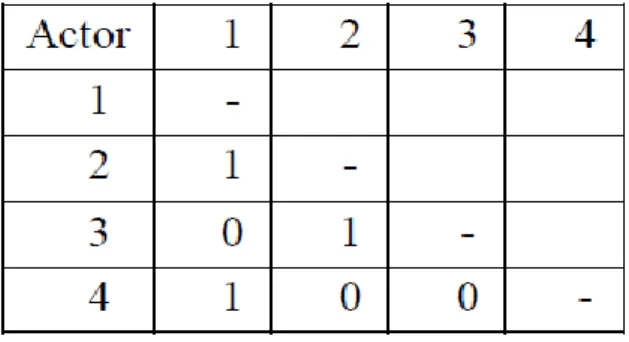
Before performing an SNA, a relation matrix must be established. The main networks are interlinked if the themes are related to one another. According to the relation between actors, an n × n actor-by-actor matrix is formulated.
Table 1 shows an example of such a matrix; under a theme in one dimension, four main networks exist, and the links between the networks represent the interaction between nodes. A value of “1” indicates that a response relationship exists between nodes, whereas a value of “0” indicates that no response relationship exists. The response relationship is represented by a social-network-relationship matrix.
Figure 1. A social-network-relationship matrix
A social network graph can be constructed as a relationship matrix according to the response relationship between actors. A node represents an actor and a link represents a response of an actor to another actor. Using Node 1 as an example, Node 1 has a response relationship with Nodes 2 and 4, but not with Node 3.
Figure 2. A social network graph
A primary function of networks is to facilitate boundary-spanning co- operation, co-ordination and communication. In a network-type organization, members are generally loosely connected through a variety of formal and informal linkages that enable them to share information or to trade with one another (Gilchrist, 2004). In this study, University of California of Irvine Network (UCINET) 6.0 was used to explore individual actions within an overall structure. According to social network theory and an analysis of network centrality, critical actions in the network were identified to understand the role of various action factors in building an interactive network of transforming the Amis dietary culture into the creativity living industry.
3.2 Research Design
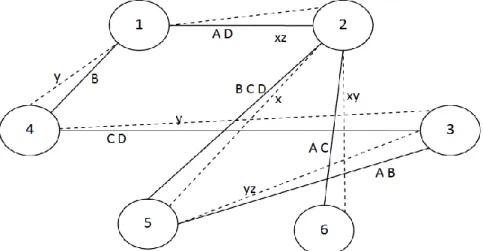
The actions of interviewees who transformed Amis dietary culture into the creativity living industry served as nodes; in addition, the social network formed by various actions during the development of the creativity living industry was illustrated. Four main elements that formed the creativity living industry were denoted as A, B, C, and D, and the reasons for the interaction between cooperating bodies were denoted as Reasons x, y, and z. Actions were related to one another on the basis of the aforementioned elements and reasons. Using Node 1 as an example, Node 1 is connected to Node 2 because of Elements A and D and Reasons x, y, and z.
Figure 3. The schematic diagram of a social network graph
4. RESULTS
On the basis of the four constituent parts of the creativity living industry, this study adopted interactions between partners involved in ecological conservation, cultural heritage, and industry development as research dimensions, interviewed local tourism businesses, and treated the interviewees’ actions as the foundation of a network for analysis. Degree centrality was used to measure the importance of each action in the interactions
4.1 Coding and Analysis of the Interview Data
The actions collected through interviews were divided into five categories:
(1) Industrial operations:
A (providing traditional meals): The primitive cooking methods of the Amis people were adopted for tourists to experience tasting traditional cuisine (e.g., salted and grilled fish and stone hotpot).
B (developing creative dishes): Creative cooking methods were employed to prepare and promote exotic local foods that tourists would not normally accept (e.g., solanum coagulans, kakorot, okra, pigeon peas, and snails).
C (researching and developing special agricultural products): Through cooperation with the Industrial Development Bureau of the Ministry of Economic Affairs, local crops (e.g., purple rice, pigeon pea, kakorot, roselle, and rice) were incorporated into the design of souvenirs.
(2) Promotion and education:
D (providing introductions and tours): Through ecological tours and bicycle tours, tourists can learn about the natural ecology and cultural history of the Matai’an Wetland.
E (engaging visitors in actual operations): The traditional fishing method (Palakau) and cutlery-making method (e.g., betel leaf tableware, stone-hotpot cooking method, and mochi pounding) of the Amis people were demonstrated.
F (offering performances and demonstrations by local residents): Local residents demonstrated the traditional fishing (fish and shrimps) and cooking methods of the Amis people.
(3) Raising animals and cultivating plants:
G (contract farming and purchasing and cultivating plants and raising animals for personal consumption): Business operators purchased foods from or entered contracts with specific farmers to ensure the origin of food ingredients (organic).
H (purchasing): Business operators purchased foods from markets or farms, and occasionally obtained free food from relatives or friends.
I (cultivating plants and raising animals for personal consumption): The ingredients for preparing indigenous dishes (Amis dishes) were cultivated in fields or yards. Accordingly, the freshness of foods can be ensured, and rare wild vegetables could be reproduced to ensure abundance of local specialty foods (water sprite).
(4) Social interactions:
J (providing mutual support among local residents): Local residents were employed to work part-time or full-time in restaurants and parks or to work as tour guides or performers.
K (attracting tourists from outside the community): Travel agents, government departments, and schools were consulted about itineraries to attract more tourists, generate additional income sources, and promote cultural and ecological education.
(5) Spatial development:
L (preserving the original features of Matai’an): The appearance of the local ecological environment was preserved as much as possible. For example, fences, boardwalks, and signs were used to minimize anthropogenic influences on the environment.
M (promoting indigenous Amis cultural styles): Culture and history workshops decorated with tools, clothing, totems, and craft works were established to recreate the atmosphere of the Amis tribe
4.2 Social Network Analysis
With Social Network Analysis (SNA), it analyzes the centrality intensity
of all actions in dimensions like Ecological conservation, Cultural inheritance,
Industry development when dietary culture is transferred into product,
promotion, service and space. The higher intensity shows higher importance.
The analytical results, as shown in the table (i.e., data analysis of action relations) and figure (i.e., social network based on action relations), illustrate the social network formed by actions performed in developing a creative living industry.
4.2.1 Ecological conservation:
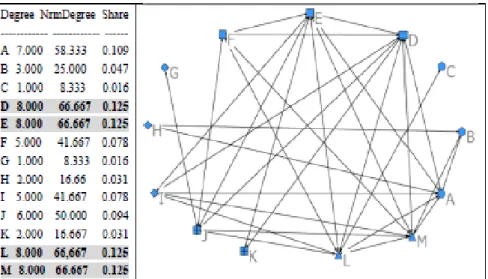
Element L (preserving the original features of Matai’an) was the most crucial, followed by Elements E (engaging visitors in actual operations) and I (cultivating plants and raising animals for personal consumption). These elements interacted independently with seven other actions.
Figure 4. The social network graph of ecological conservation dimensions
4.2.2 Cultural inheritance:
Elements D (providing introductions and tours), E (engaging visitors in actual operations), L (preserving the original features of Matai’an), and M (promoting indigenous Amis cultural styles) were independently related to eight other actions. The link degree was approximately 67%. Elements D, E, L, and M were equally crucial for cultural inheritance.
Figure 5. The social network graph of cultural inheritance dimensions
4.2.3 Industry development:
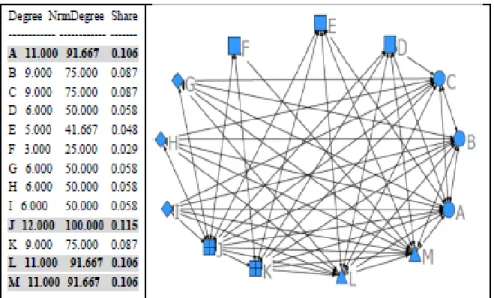
Element J (providing mutual support among local residents) was connected with the most number of actions (12 nodes); the link degree reached 100%. Elements A (providing traditional meals), L (preserving the original features of Matai’an), and M (promoting indigenous Amis cultural styles), which were equally crucial, were connected with the second-most number of actions (11 nodes); the link degree reached approximately 92%.
Figure 6. The social network graph of Industry development dimensions
5. CONCLUSION
This research found that local dietary resources are used to satisfy the dietary needs of local people and to develop local dietary cultures. Local dietary culture offers an alternative means of local and regional development, with the potential to strengthen identity, enhance appreciation of the environment, encourage the regeneration of local heritage and the economy.
According to the social network analysis, the Matai’an tribe presented Amis dietary culture in various forms and practiced it in various ways. In the product dimension, local or innovative dietary experiences were provided. The space dimension involving the creation of a dining environment, comprised more links compared to other actions; in other words, creating a dining environment was crucial because it was connected with numerous nodes. Therefore, the Matai’an tribe used space as a medium for promoting traditional culture, which then became the basis for the creativity living industry, as well as for marketing local delicacies, craft works, agricultural products, cultural landscape, and in-depth tourism. Tourist consumption of local foods creates a market opportunity that can encourage the development of sustainable agriculture, help conserve traditional farming landscapes and assist the local economy.
Production and consumption processes in the creativity living industry
increased job opportunities and local incomes. In particular, when local
indigenous peoples are employed and trained as tour guides, they gain insight
into the precious experiences of tribal elders and the values of traditional
culture and ecological wisdom, and subsequently identify with and exhibit a
sense of belonging to their culture. Consequently, cultural education and
heritages are promoted, thus facilitating the preservation of Amis culture and
ecological conservation of the Matai’an Wetland. Moreover, Amis dietary culture attracts tourists and stimulates local economic growth. The local economy and industries can be diversified to achieve the prosperity of an ecological environment, social and cultural lifestyles, and a production-based economy. Through managing traditional Amis cuisines, providing ingredients required for creative Amis delicacies, and constructing a catering environment, the geographical landscape of Matai’an Wetland and biological habitats are preserved and unique edible plants are reproduced to protect the ecology and ensure biological diversity.
With the increased life quality of Taiwanese, the recreational industry leads to green tourism. To promote indigenous cultural industry, the characteristics of indigenous culture must be considered, rather than merely pursue mass production and economic benefits. The creativity must be fulfilled in the life and each industrial level. Exotic tribal characteristics of buildings and human resources should be highlighted in the planning of an indigenous the creativity living industry involving gourmet feasts, ecotourism, cultural-workshop visits, and daily living experiences to develop the creativity living industry that embodies the characteristics of tribal people, landscapes, and production activities. Ecological knowledge about means for coexisting with nature is the result of the long-term interaction between the aborigines of Taiwan and the natural environment, and it is an ecological value that should be promoted. Overall, the sustainable development of an indigenous tribal industry can be achieved by focusing on nature-based ecotourism, the creativity living industry based concepts, unique tribal cultural resources and natural landscapes, leisure activities aimed at conserving nature and achieving sustainable development, conventional industrial technologies, the creation of a knowledge economy, and integration of tradition and innovation.
REFERENCES
Chang, W. H. (2010). "The Designed Concepts of Creativity Living Industry". Science Development, 453, 20-29.
Chang, Y. S., & Yang, S. P. (2004). Introdction to Dietary Culturue. Taipei: Yang-Chih Book.
Chen, C. S., & Tai, S. H. (2007). "A Qualitative Research of Entrepreneur's Social Networking Behaviors". Journal of Entrepreneurship Research, 2(4), 1-24.
Chen, M. H., & Lee, L. H. (2008). "Applying Social Network Analysis for Community Ecotourism-a Case Study of Shirding Community". Quarterly Journal of Chinese Forestry, 41(2), 221-236.
Everett, S., & Aitchison, C. (2008). "The Role of Food Tourism in Sustaining Regional Identity:
A Case Study of Cornwall, South West England". Journal of Sustainable Tourism, 16(2), 150-167.
Gilchrist, A. (2004). The Well-Connected Community: A Networking Approach to Community Development. Bristol: Policy Press.
Huang, C. T., & Lo, S. L. (2013). "A Study of Operation Model on Community Participation for Forest Ecotourism". Quarterly Journal of Forest Research, 35(1), 59-70.
Huang, C. Y., Chang, W. L., Lee, H. L., & Lai, M. H. (2011). "Exploring the Industry Innovation Diffusion through Social Network Analysis in Local Rice Industry". Soochow Journal of Economics and Business, 73, 67-108.
Hung, W. L., Tsaur, S. H., & Lu, J. C. (2008). "A Study of the Framework and Strategies of Community-Based Environmental Auditing in an Ecotourism Site". Leisure and Recreation Research, 2(1), 71-101.
Ju, H. L. (1997). The Reward of Nature: Taiwan's Aboriginal Dietary World. Taipei: SMC Publishing.
Ju, M. K. (2010). "Local Cuisine Culture Resource and Its Development Research". Culinary Science Journal of Yangzhou University, 27(4).
Lai, S. C. (2006). "The Reconstruction of Ethnic Food Culture under the Dynamics of Modern Consumer Culture: A Case Study of the Transformation of Taiwan "Hakka Cuisine" into a Form of Leisure Consumption". Journal of State and Society, 1, 167-212.
Liao, B. H. (2004). Postmodernism of Eat. Taipei: 2-Fishes.
Lin, F. J., & Lin, Y. L. (2012). "The Study of Leisure Farm Competitiveness in Yilan Area under the Creative Life Industries". Sun Yat-Sen Management Review, 2(4), 1143-1176.
Lin, H. C. (2009). "The Dietary Culture Restructuring of Lanyu Tao People - a Study of Cultural Ecology". Journal of Hospitality and Home Economics, 6(1), 1-12.
Lu, H. H. (2006). "A Preliminary Study on the Development of Ecotourism at the Bukiu (Wang- Hsiang) Tribe". The Journal of Social Studies Education Research, 11, 177-212.
Mak, A. H., Lumbers, M., & Eves, A. (2012). "Globalisation and Food Consumption in Tourism". Annals of Tourism research, 39(1), 171-196.
Sánchez-Cañizares, S. M., & López-Guzmán, T. (2012). "Gastronomy as a Tourism Resource:
Profile of the Culinary Tourist". Current Issues in Tourism, 15(3), 229-245.
Sirakaya, E., Sasidharan, V., & Sönmez, S. (1999). "Redefining Ecotourism: The Need for a Supply-Side View". Journal of Travel Research, 38(2), 168-172.
Smith, S., & Costello, C. (2009). "Culinary Tourism: Satisfaction with a Culinary Event Utilizing Importance-Performance Grid Analysis". Journal of Vacation Marketing, 15(2), 99-110.
Teng, C. C. (2009). "The Transformation of the Hakka Dietary Culture in Hsinchu". Journal of Hospitality and Home Economics, 6(4), 353-377.
Tian, Z. Y. (2001). Aborigines of Taiwan: Amis. Taipei: Taiwan Publishing.
Vincent, V. C., & Thompson, W. (2002). "Assessing Community Support and Sustainability for Ecotourism Development". Journal of Travel Research, 41(2), 153-160.
Wang, X. (2007). "Dietary Customs and the Boundaries of Ethnic Groups: The Case of Dietary Culture in Xinjiang". Journal of Chinese Dietary Culture, 3(2), 1-21.
Wu, S. Y. (2006). Edible Wild Plant of Taiwan. Taipei: Commonwealth.
Wu, T. C. (2007). "Accessing Ecotourism Development Model for Rural Communities".
Journal of Rural Tourism Research, 1(1), 29-57.
Yang, H. C. (2014). "Wetland Environment Preservation from the Perspective of Visitors to Chong-Du Wetland". Journal of Chinese Agricultural Engineering, 60(4), 8-19.