• 検索結果がありません。

Challenges and Tasks of Ecobridges in Seoul Based on the Ecobridge-use Behavior Survey

N/A
N/A
Protected

Academic year: 2021

シェア "Challenges and Tasks of Ecobridges in Seoul Based on the Ecobridge-use Behavior Survey"

Copied!
18
0
0

読み込み中.... (全文を見る)

全文

(1)

39

International review for spatial planning and sustainable development, Vol.3 No.1 (2015), 39-55 ISSN: 2187-3666 (online)

DOI: http://dx.doi.org/10.14246/irspsd.3.1_39

Copyright@SPSD Press from 2010, SPSD Press, Kanazawa

Challenges and Tasks of Ecobridges in Seoul Based on the Ecobridge-use Behavior Survey

In the Case of Ecobridges in Dongjak-gu and Gwanak-gu

Yoon-seo Huh¹, Yoon-ah Hur¹, Sun-young Yoon¹, Emila Widawati² and Yong- hoon Son³*

1 Department of Landscape Architecture, Graduate School of Environmental Studies, Seoul National University

2 Dept. of Forest Sciences, College of Agriculture and Life Sciences, Seoul National University 3 Graduate School of Environmental Studies, Seoul National University

* Corresponding Author, Email: [email protected] Received 20 January, 2014; Accepted 5 July, 2014

Key words: Eco-bridge, Using state survey, Ecological axis, Greenway, Urban ecology Abstract: During the past 50 years, there have been strong demands for establishing the

North and South Green Network and its eco-corridors to resolve problems of urbanization in Seoul. Following this, from 1994, the Seoul City Government began building ecological paths to re-establish ecological networks. 25 eco- corridors were created between 1994 and 2013 in Seoul, however, the designed eco-corridors presented some problems with biased functions, losing a major objective of eco-corridors which are required to perform as both a citizens’ moving route as well as wildlife passage. In addition, eco-corridors in Seoul, a heavily populated city, are not likely to serve the originally intended functions as well as those in natural areas. Accordingly, to appropriately perform its own function as a moving route for humans and wildlife, eco- corridors in urban areas are required to be comprehensively analysed with consideration of both ecological and pedestrian aspects. Study sites have been selected from the green zone of the Gangnam area. Specifically, it includes Seodal-ro, Sadang-ro, Solbat-ro, and Nambusoonhwan-ro, which form a linking footpath between Seodal mountain neighborhood park, Gachi mountain and Gwanak mountain. This study is to examine some issues of the selected urban eco-corridors, which are supposed to act as moving routes for both humans and animals through analysis of the current situation and use- behavior survey of eco-bridges in Seoul, and to interpret the meaning of eco- corridors in urban areas. Through the results of user behavior analysis of four eco-bridges, on one hand, it is found that the appearance frequency of wild animals is very low and species diversity is quite limited. On the other hand, the frequency of human utilization is very high and the purposes of utilization are varied. As known from these results, eco-bridges in Seoul could have more functions and meanings, not only concentrating on the function as a wildlife passage. This study offers the insight that eco-bridges in Seoul could be considered in a broader sense, focusing on human use rather than focusing on their ecological function in a narrow sense.

1. INTRODUCTION

1.1 Background and Purpose

The Seoul City Government has declared the “Ecological Green Corridor

Link Project” to connect 24 segmented green axes in the city by building

(2)

eco-bridges on a budget of 300 billion won. This project leads to the question of whether eco-bridges in Seoul are functioning properly.

Eco-bridges generally function as corridors of the ecological system.

Forman and Gordon (1986) mentioned that corridors function as a habitat for species, a conduit for movement, a filter separating areas, and an environmental source for the surrounding matrix. Eco-corridors built over expressways have some visible effects, for example, decreasing road-kill. On the other hand, the effectiveness of eco-bridges in Seoul is controversial.

Fleury and Brown (1997) suggested a framework for the design of wildlife corridors, involving the definition of critical corridor attributes, identification of target species, the determination of biophysical inventory, and evaluation of corridor designs.

In comparison, most eco-bridges in Seoul are designed and constructed without any regard for target species or ecological conditions. Moreover, they have been criticized for wasting the taxpayer budget. Consequently, contrary to the expectations (that wild animals would use them to migrate), they have mostly been used as walking trails for humans. In fact, wild animals can hardly survive in urban areas due to the lack of green space and vegetation, and the preservation of the urban ecological system by excluding human activity is impractical, because cities are heavily populated areas.

That is to say, eco-corridors in heavily populated cities are not likely to serve the same functions as those in non-urban areas. New possibilities for eco- bridges in cities are necessary.

In this context, the purpose of this study is to find the genuine meaning of eco-bridges in Seoul through an analysis of the current situation. In South Korea, studies about eco-corridors have been ongoing since the Ministry of Environment constructed wildlife passages on Jiri Mountain and Odae Mountain as a pilot project in 1998 (Ministry of Environment, 2003).

Since the pilot project, over 200 eco-corridors have already been constructed in the country, 23 of which have been constructed in Seoul, the capital of South Korea. Most research studies in the country have investigated the cases of eco-corridors in non-urban areas, whose main purposes and functions are the migration of wild animals, however eco- bridges constructed in Seoul, although used as wildlife passageways, have been actively used by citizens.

1.2 Research Methods

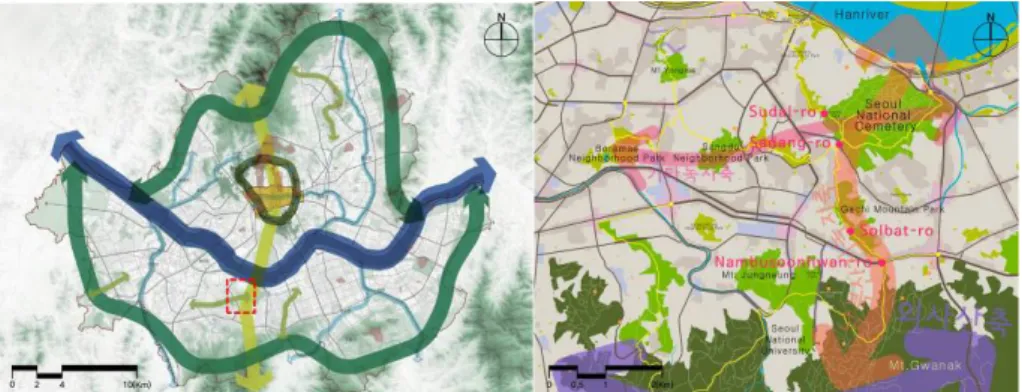
Figure 1. Ecological axis of Seoul (Landscape Master Plan of Seoul, 2010)

Linking Seoul National Cemetery, Gachi Mountain Neighborhood Park,

and Gwanak Mountain, all of which belong to the major stronghold green

(3)

zone of Seoul, the North and South Green Network plays a major role as an important habitat for the city ecosystem.

Along the ecological axis in Seoul, the Han River flows through the east and west, the south-north green axis is formed by mountains. Gwanak-gu and Dongjak-gu include stronghold green zones, such as Seoul National Cemetery, Gachi Mountain Park, and the south-north green axis of Seoul.

In Seoul, 25 eco-corridors were created between 1994 and 2013. Among these 25 eco-corridors, four eco-corridors in the southern area of Seoul were built to re-establish the disconnected North and South Green Network, which are selected as being study sites. Specifically, it includes Seodal-ro, Sadang- ro, Solbat-ro, and Nambusoonhwan-ro, which form a linking footpath between Seodal Mountain, Gachi Mountain and Gwanak Mountain. Four eco-corridors sequentially link the disconnected north and south ecological axis. By using GIS maps offered by the National Geographic Information System, we conducted a regional analysis using biotope evaluation, land use, biotope type, and vegetation maps. In addition, we determined the current situation, spatial layout, and usage state of eco-bridges through field investigation. The questionnaire items were presented in Table 1.

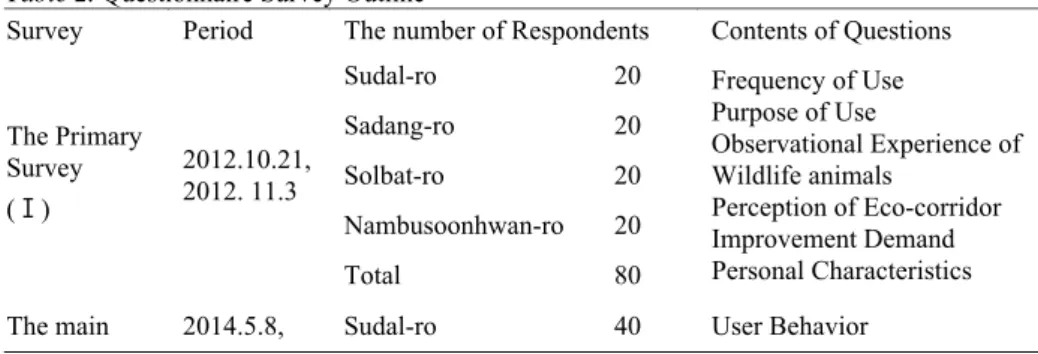
We conducted a questionnaire twice with target users passing through the four eco-bridges. The questions were as follows (Table 2):

Table 1. Questionnaire items

1. Individual Characteristics Sex, Age, Residence 2. User behavior Objective and Frequency

Day of Week and Hours of Use 3. Wild Animal Observational

Experience and Observed Species

Wild Animal Observational Experience Observed Wild Animal Species 4. Perception about Urban Eco-

corridors

Necessity of Urban Eco-corridor

Perception about Animal Passage of Urban Eco- corridors

Perception about the Objectives of Urban Eco- corridors (People’s movement)

Perception about Limited Usage of Urban Eco- corridors

5. Users’ satisfaction with Urban

Eco-corridors Advantage of Urban Eco-corridors for Leisure Nature Friendliness of Pavement of Urban Eco- corridors

Diversity and Beauty of Planting of Urban Eco- corridors

6. Satisfaction with Management and Operation

of Urban Eco-corridors

Satisfaction with Plant Management of Urban Eco-corridors

Satisfaction with Management of Facility of Urban Eco-corridors

Table 2. Questionnaire Survey Outline

Survey Period The number of Respondents Contents of Questions

The Primary Survey (Ⅰ)

2012.10.21, 2012. 11.3

Sudal-ro 20 Frequency of Use

Purpose of Use

Observational Experience of Wildlife animals

Perception of Eco-corridor Improvement Demand Personal Characteristics

Sadang-ro 20

Solbat-ro 20

Nambusoonhwan-ro 20

Total 80

The main 2014.5.8, Sudal-ro 40 User Behavior

(4)

Survey (Ⅱ)

2014.5.11 Sadang-ro 40 Observational Experience of Wildlife animals

Perception of Eco-corridor Satisfaction of Pedestrian Environment

Satisfaction with Management

Personal Characteristics

Solbat-ro 40

Nambusoonhwan-ro 40

Total 160

2. TYPES OF ECO-CORRIDORS IN KOREA

Eco-corridors are artificial structures that connect ecosystems fragmented by roads and railways to allow wild animals to migrate. They are constructed to allow wild animals to cross over the road safely, and they are generally classified as either overpasses or underpasses (Ministry of Environment, 2010). According to the Natural Environment Conservation Act Article 2 in Korea, eco-corridors are meant to prevent the destruction and damage of wild animals’ habitats by roads, dams, sluice gates, and estuary dams. They are artificial structures and ecological spaces aimed at maintaining the continuity of the ecosystem, including the migration of wild animals. There are similar Terms such as “ecological network,” “ecological axis,” and

“greenway”. The types of eco-corridors defined by Korean Ministry of Environment are shown in Table 3.

Table 3. Types of eco-corridors (Ministry of Environment, 2003)

Types Features

Usage type

Trail Type Used for exercise and passage Animal Corridor

Type

Used for animal migration and as a habitat for animals and plants

Trail – Animal Corridor Type

The trail and animal corridor are separated by a hedge or fence in an eco-corridor

Form type

Overpass (Bridge Type)

A structure built over a road

(Difficult to build a passage for animals because of fragmented areas and obstacles)

Underpass (Tunnel Type)

A passage made under the ground

(Usually on a road where there is heavy traffic, or no connecting area to build a land passage)

Linear Type A structure built along a road, railway, or river

In Seoul, most eco-corridors are trail-animal corridors and bridge type

corridors. In the case of the trail-animal type, the width of the trail should be

under three meters without any pavement, and the width of the animal

corridor should be over 30 meters. Furthermore, the two different spaces

should be spatially separated by filled-up ground or vegetation. The entrance

space should be wider than the inner space and encourage wild animals to

migrate. In the case of the overpass type, the minimum width should be over

seven meters and over 30 meters if the overpass type eco-corridor is located

on a main ecological axis (Ministry of Environment, 2010).

(5)

3. CURRENT SITUATION

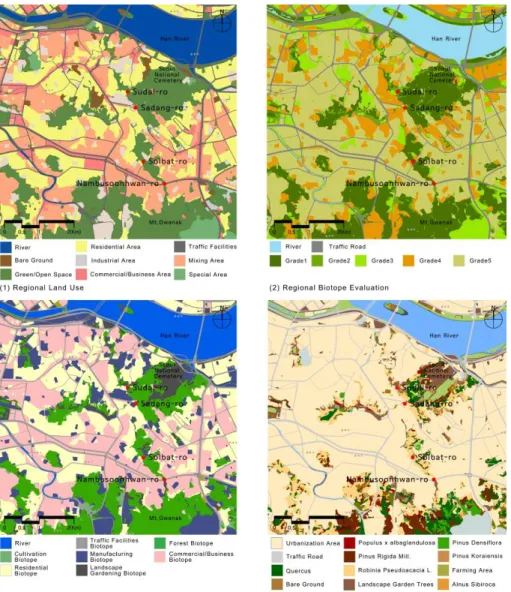
The regional analysis (land use, biotope evaluation, biotope type, and vegetation maps) was conducted (Figure 2). Most of the areas in Gwanak-gu and Dongjak-gu are commercial, business, and residential areas. Some green and open spaces exist. Sudal Mountain, Gwanak Mountain (Biotope Grade 1), and Seoul National Cemetery are significant strongholds of green areas.

Gachi Mountain is a natural corridor that connects them. The green zones of Gwanak-gu and Dongjak-gu mainly consist of forest biotope and landscape gardening biotope. In addition, most of these areas have become urbanization areas. These areas do not have enough buffer zone to surround the core green zone. Sudal Mountain and Gwanak Mountain, which are core green zones, consist of pinus rigida (Pinus rigida Mill.) and acacia (Robinia pseudoacacia L.) forest as well as pine and oak forest in good condition.

Figure 2. Regional analysis (National Geographic Information System)

3.1 Sudal-ro

The boardwalk for humans and the animal corridor are separated by a

(6)

fence. We found many people taking walks and doing exercise on it. Many trees looked young, likely because this eco-bridge was recently renovated.

Considering the ecological side, Sudal Mountain (Biotope Grade 1), Arboretum, and the Nut Pine Forest (Biotope Grade 1 or 2) form an

“ecological axis.” However, there are oak and nut pine forests in good condition in Seoul National Cemetery, and on the other side of the eco- bridge, acacia forests and gardening tree forests are distributed. That is, the different types of vegetation on either side make it difficult for it to function as an animal habitat. Sudal-ro includes the walking trail 'the first route of Dongjak Cheunghyo-gil'. It is mainly used by residents who live in nearby apartments and wish to have a rest or take a walk. According to the survey results, mostly middle-aged residents use the passage for working out.

Figure 3. Analysis of Sudal-ro (National Geographic Information System)

3.2 Sadang-ro

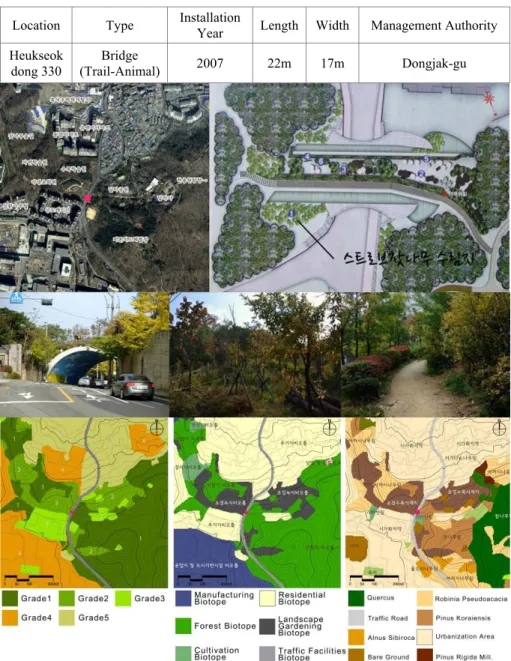
Of the four eco-corridors, Sadang-ro is the newest one. The boardwalk and animal corridor were built separately, and there was a log cabin for small wild animals, such as squirrels. Only a few people passed by or used this

Location Type Installation

Year Length Width Management Authority Heukseok

dong 330

Bridge

(Trail-Animal) 2007 22m 17m Dongjak-gu

(7)

eco-corridor. Considering the ecological side, Sadang-ro is connected with Sudal Mountain (Biotope Grade 1) and a residential area (Biotope Grade 4).

In addition, most vegetation around Sadang-ro is acacia forest, which does not function well as an animal habitat. Therefore, it is not expected to play the role of an animal habitat. Vegetation distribution is also unbalanced.

Sadang-ro is mostly used to access Seoul National Cemetery or as a shortcut from one place to another by residents who live nearby. Safety is a concern, because one side of the eco-bridge borders a road.

Location Type Installation

Year Length Width Management

Authority Sadang-dong

San 31-1

Bridge

(Trail-Animal) 2008 20m 16m Dongjak-gu

Figure 4. Analysis of Sadang-ro (National Geographic Information System)

3.3 Solbat-ro

The boardwalk is set up along the path, and the two areas (a trail and an

animal corridor) are separated by thick bushes. Solbat-ro is an eco-bridge

that connects the fragmented Kachi Mountain Park (Biotope Grade 1). The

vegetation on both sides is the same as that found in an acacia forest. Despite

the fact that there is no buffer zone between the urban infrastructure biotope

and Kachi Mountain, diverse vegetation is distributed. Therefore, this space

(8)

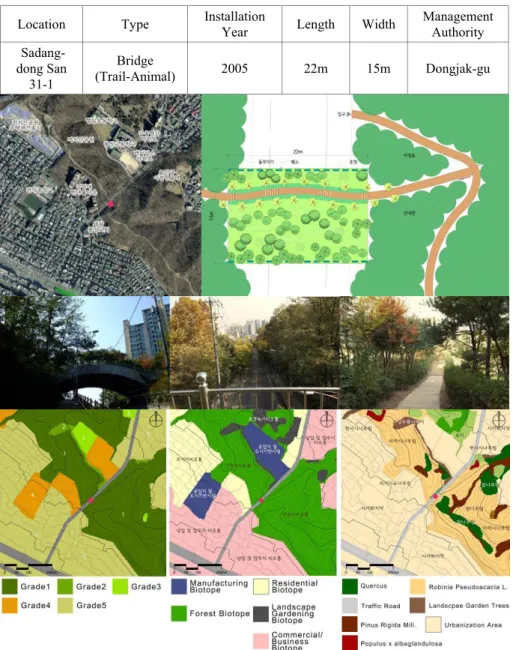
can function as an animal habitat. Solbat-ro includes a walking route, “the se venth route of Dongjak Chunghyo-gil”. According to the survey results, 100 percent of users (middle-aged residents living nearby) used the passage “to work out.”

Location Type Installation

Year Length Width Management

Authority Sadang-

dong San 31-1

Bridge

(Trail-Animal) 2005 22m 15m Dongjak-gu

Figure 5. Analysis of Solbat-ro (National geographic information system)

3.4 Nambusoonhwan-ro

Nambusoonhwan-ro is the only eco-bridge of the four that remains a soil path. The vegetation on this eco-bridge is quite dense and the path is narrow.

Nambusoonhwan-ro connects the acacia forest biotope (Biotope Grade 1 or 2) and the gardening tree forest biotope. This eco-bridge is surrounded by commercial and official areas, and a broad road passes through it. Oak forest and pine tree forest are distributed through parts of it. Nambusoonhwan-ro belongs to Gwanak Mountain “Dulle-Gil” that is a walkable route for viewing Seoul. Middle-aged individuals wanting to climb Gwanak Mountain or Gachi Mountain primarily used this passage.

Key Map Location Type Installation Length Width Management

(9)

Year Authority Namhyun-

dong, Sadang-

dong San 55-2

Bridge (Trail- Animal)

2006 80m 15m Gwanak-gu

Figure 6. Analysis of Nambusoonhwan-ro (National Geographic Information System)

4. RESULTS

4.1 Individual Characteristics

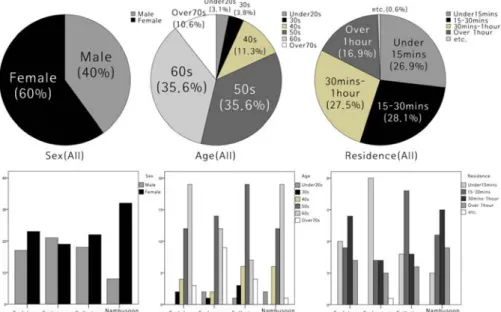
Individual characteristics of the urban eco-corridors from the respondents of the satisfaction survey are as follows in Figure 7. The number of female, 96 (60%), is larger than that of male, 64 (40%) users. Each of the age groups, “20s”, “30s”, “40s”, “50s”, “60s”, and “70s”, account for 5(3.1%), 6(3.8%), 18(11.3%), 57(35.6%), 57(35.6%), and 17(10.6%) respecticely.

The age groups over 40s account for 93.15%. Among these, the 50s and 60s

contain most of the respondents (71.2%).

(10)

Figure 7. Individual characteristics of urban eco-corridor users

4.2 User behavior

Objectives of usage from the users of the urban eco-corridors are as follows in Figure 8. Utilization purposes in the four target sites have similar results. Overall, the majority of people are distributed in “Strolling” (55.0%) and “(Mountain) Climbing” (40.0%). “Travel” and “Natural environment education” were only 4% and 2% respectively.

Frequency of usage from the users of the urban eco-corridors is as follows in Figure 9. In the usage frequency of urban eco-corridors, “Three to six times a week” (36.9%), “Everyday” (28.8%), “Once or twice a week”

(20.6%) were the usage rates of most respondents. Comparing the four target sites, Solbat-ro and Seodal-ro are frequently used in a week, but Nambusoonhwan-ro has a low frequency in the usage of the respondents.

This is because there are many residents using Solbat-ro and Seodal-ro, but Nambusoonhwan-ro is mostly used for mid-passage of mountain climbers.

Figure 8. Objectives of the urban eco-corridor users

(11)

Figure 9. Frequency of the urban eco-corridor users

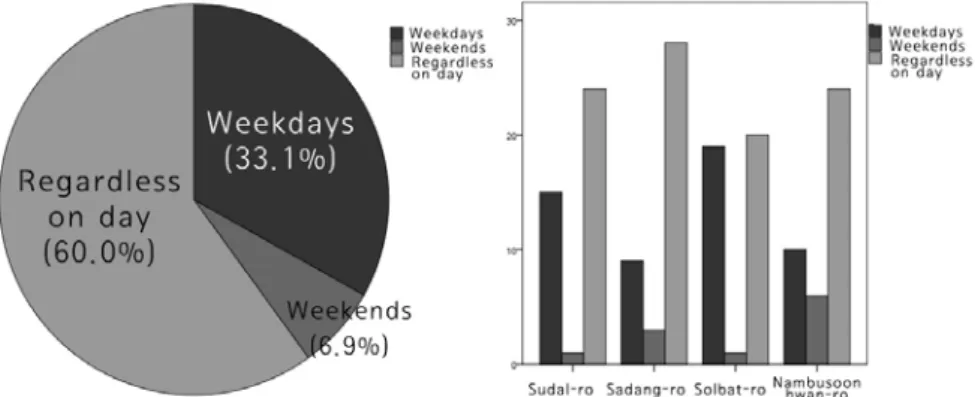
Usage days of the urban eco-corridor is as follows in Figure 10. Most users responded “Regardless of day” (60%), but only a few respondents (11.0%) use the corridors on “Weekends”. “Weekdays” (33.1%) respondents are mostly residents of near-by areas. In particular, regarding their high percentage of “Weekdays” usage, Solbat-ro and Seodal-ro are frequently used by their residents.

Figure 10. Day of week of the urban eco-corridor users

Hourly usage of the urban eco-corridor users are as follows (Figure 11).

Most respondents use the paths between 9 AM and 12 PM (55.0%). Each of

the “6am - 9am” and “12pm – 6pm” timeframes accounts for 29.4% and

15% respectively. However, there is low usage after 6pm (0.6%). By target

site, the highest usage from “6am - 9am” is in Seodal-ro and Solbat-ro. But

Sadang-ro and Nambusoonhwan-ro have the most users from “9am - 12pm”.

(12)

Figure 11. Hourly usage of the urban eco-corridor users

4.3 Wild Animal Observational Experience and Observed Species

56.3% of the respondents have had wild animal observational experience.

However, the four target sites show a huge difference in the number of observational experiences: Seodal-ro, 77.5%; Sadang-ro, 62.5%; Solbat-ro, 52.5%; and Nambusoonhwan-ro,32.5%. This order of the four target sites corresponds to the order of the location of the urban eco-corridor connecting Seodal-san, Gachi-san, and Gwanak-san. This supposes that, even though Gwanak-san has a favorable natural environment for wild animals, the narrower connecting path results in a low percentage of movement of wild animals.

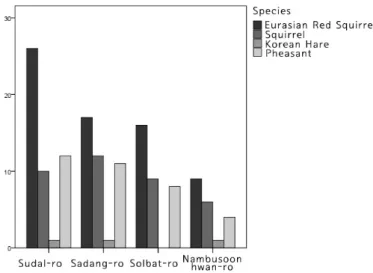
Observed wild animal species by the urban eco-corridor users are as follows (Figure 12). The survey allows duplicable options. The main animals that the respondents observed were Eurasian red squirrel, squirrel, Korean hare, and pheasant. Dog, cat, pigeon, and magpie are excluded from the result because of their irrelevance with habitat connection. The four target sites have similar distributions of the wild animals. Observation frequency follows the order: Eurasian red squirrel, squirrel, pheasant, and Korean hare.

Figure 12. Observed wild animal species near urban eco-corridors

4.4 Perception about Urban Eco-corridors

Necessity of urban eco-corridor is as follows (Figure 13). The majority

of the responding people (91.8%) replied positively regarding the necessity

of urban eco-corridors. In particular, the respondents from Solbat-ro and

Nambusoonhwan-ro, who have less observational experiences with wild

animals, respond as “Highly positive” (57.5%), more than Seodal-ro and

Sadang-ro.

(13)

Figure 13. Necessity of urban eco-corridor

The result of the survey about the perception of the animal path of urban eco-corridors from the respondents is as follows (Figure 14). Only 28.8% of the respondents perceive the paths as animal paths, but 46.3% of the respondents do not perceive them as animal passages. In the case of Sadang- ro, even though there is little animal habitat, many people recognize it as an animal path because of a sign that reads “animal path”. However, other target sites have no sign. The sign “animal path” itself seems to affect respondents’ perception about animal paths as urban eco-corridors.

Figure 14. Perception about animal passage of urban eco-corridors

The result of the survey about the respondents’ perception of the

objective of urban ecological paths for human usage is as follows (Figure

15). Only 12.5% of the respondents have negative ideas about the objective

of urban ecological paths for people; 70.6% of the respondents have positive

ideas about it. In particular, in the case of Solbat-ro and Nambusoonhwan-ro,

more people recognize the objective for pedestrians, but more respondents at

Seodal-ro responded negatively than those at other target sites.

(14)

Figure 15. Perception about the objectives of urban eco-corridors (People’s movement)

The result from surveys about the respondents’ perceptions about limited usage of urban eco-corridors is as follows (Figure 16). 35.7% of the respondents answered positively regarding the animal’s usage, but negative answers were more common at 45.7%. Considering the high percentage (81.3%) of positive answers about the coexistence of people and animals in urban eco-corridors, people seem not to perceive any inconvenience from the limited usage of urban eco-corridors.

Figure 16. Perception about limited usage of urban eco-corridors

4.5 Users’ satisfaction with Urban Eco-corridors

The result of the survey about the advantage of urban eco-corridors for

leisure is as follows (Figure 17). Positive responses account for 95%, which

means that the path gives users not only a path to walk through, but also is a

source of their leisure. In particular, Solbat-ro and Nambusoonhwan-ro have

more positive responses than the other two.

(15)

Figure 17. Advantage of urban eco-corridors for leisure

The result of the survey about how eco-friendly the pavements of urban eco-corridors are is as follows (Figure 18). In total, of the four target sites, the respondents mostly have “Strongly positive” (21.3%) and “Positive”

(46.9%) perceptions of the nature friendliness of the pavements. “Strongly negative” and “Negative” responses were 12.5% in total. Nambusoonhwan- ro which is the only path paved with dirt among the four target sites resulted in 90% positive answers for its natural friendliness. According to this, people regard dirt-paved paths as more nature friendly than wooden boardwalks.

Figure 18. Nature friendliness of pavement of urban eco-corridors

The result of the survey about diversity and beauty of tree planting along the urban eco-corridors is as follows (Figure 19). Only 9.4% of the respondents have negative ideas about the diversity and beauty of tree planting along urban eco-corridors in addition, 18.1% of the respondents feel

“Strongly positive”, and 43.8% of the respondents feel “Positive”. In

particular, among the four target sites, Nambusoonhwan-ro has highly

positive answers from the respondents (25.0% “Strongly positive” and

55.0% “Positive”) because of its dense forest which mostly covers the

traveling paths of humans and animals.

(16)

Figure 19. Diversity and beauty of tree planting of urban eco-corridors

The result of the survey about satisfaction with plant management of urban eco-corridors is as follows (Figure 20). Less than half of the respondents think positively (8.8% “Strongly positive” and 40.6%

“Positive”), but 39.4% of the people think the plant management of the sites is “Average”. This result suggests that many people are not satisfied with the plant management of the sites. Among those, Seodal-ro users show the strongest positive response, but Sadang-ro users are satisfied the least with its plant management.

Figure 20. Satisfaction with plant management of urban eco-corridors

The result of the survey about satisfaction with management of the facility of urban eco-corridors is as follows (Figure 21). 56.9% of the respondents show positive answers to the question (9.4% “Strongly positive”

and 47.5% “Positive”), and 35.6% of the peoples’ responses are “Average”.

As for the plant management, many people are not satisfied with the

management of the facility and the surrounding environment of the eco-

corridors. Among the four sites, Seodal-ro users give the most positive

responses to the issue.

(17)

Figure 21. Satisfaction with management of facility of urban eco-corridors

5. DISCUSSTION

According to the result of the survey, firstly, both humans and animals demand the urban eco-corridors as a green space in the city. The objective of the respondents for using the urban eco-corridors is concluded not as a simple path for their movement, but as for leisure walking, sight-seeing and hiking. Secondly, there is an understanding that the urban eco-corridors are areas of coexistence with wildlife. Half of the respondents answer positively on the movement of wild animals through the path. Many of them want the path to be shared with wild animals.

Urban eco-corridors could have functions and meanings not only concentrating on the function as a wildlife passage. Eco-corridors would be a space where nature and humans make contact and coexist.

The terms eco-corridor, ecological axis, and greenway, are similar in urban environments. Eco-bridges in Seoul could be redefined in a broad sense, rather than focusing on their ecological function in a narrow sense.

Eco-bridges in Seoul link the ecological network to sustain the ecosystem and reconnect fragmented habitat sites. They are also used as trails or as a kind of green road to promote public health. Urban eco-bridges are an example of precious green open space where people can commune with nature.

The utilization rate of eco-bridges in Seoul is increasing, but the appearance rate of wild animals is gradually decreasing. Even though the geographical locations of the eco-bridges in Seoul are generally appropriate, there are many challenges in terms of designing and managing processes in each field. User’s opinions would have to be collected periodically. In addition, the actual growth of vegetation and the rate of animal appearances should be monitored and assessed periodically.

REFERENCES

Fleury, A. M., and Brown, R. D. (1997). "A framework for the design of wildlife conservation corridors with specific application to southwestern Ontario", Landscape and urban planning, 37(3), 163-186.

Forman, R. T., & Godron, M. (1986). Landscape ecology, Wiley and sons, New York.

Ministry of Environment (2003). Guidelines for Creation and Management of Eco-Corridors for Fragmented Ecosystem Conservation, Ministry of Environment.

Ministry of Environment (2010). Guidelines for Design and Management of Wildlife

Crossing Structures in Korea, Ministry of Environment.

(18)

Seoul Development Institute (2010). Seoul landscape master plan.

Figure 1. Ecological axis of Seoul (Landscape Master Plan of Seoul, 2010)
Table 2. Questionnaire Survey Outline
Figure 2. Regional analysis (National Geographic Information System)
Figure 3. Analysis of Sudal-ro (National Geographic Information System)
+7

参照

関連したドキュメント

The inclusion of the cell shedding mechanism leads to modification of the boundary conditions employed in the model of Ward and King (199910) and it will be

She reviews the status of a number of interrelated problems on diameters of graphs, including: (i) degree/diameter problem, (ii) order/degree problem, (iii) given n, D, D 0 ,

[11] Karsai J., On the asymptotic behaviour of solution of second order linear differential equations with small damping, Acta Math. 61

We show that a discrete fixed point theorem of Eilenberg is equivalent to the restriction of the contraction principle to the class of non-Archimedean bounded metric spaces.. We

[3] Chen Guowang and L¨ u Shengguan, Initial boundary value problem for three dimensional Ginzburg-Landau model equation in population problems, (Chi- nese) Acta Mathematicae

Kilbas; Conditions of the existence of a classical solution of a Cauchy type problem for the diffusion equation with the Riemann-Liouville partial derivative, Differential Equations,

Answering a question of de la Harpe and Bridson in the Kourovka Notebook, we build the explicit embeddings of the additive group of rational numbers Q in a finitely generated group

Then it follows immediately from a suitable version of “Hensel’s Lemma” [cf., e.g., the argument of [4], Lemma 2.1] that S may be obtained, as the notation suggests, as the m A