Chain structure and electronic states of liquid Rb-Se mixtures by ab initio molecular-dynamics simulations
Fuyuki Shimojo
Department of Physics, Kumamoto University, Kumamoto 860-8555, Japan
Kozo Hoshino
Graduate School of Integrated Arts and Sciences, Hiroshima University, Higashi-Hiroshima 739-8521, Japan 共Received 9 June 2006; published 18 September 2006
兲
The effects of excess electronic charges transferred from alkali metals to Se atoms on the chain structure in liquid RbxSe1−xforx艋0.5 are investigated by means ofab initiomolecular-dynamics simulations. It is found that the interaction between Se chains is enhanced by the transferred electrons, and that the average length of Se chains becomes shorter with increasing alkali-metal concentration. The shortening of Se chains is respon- sible for an increase of electronic states at the Fermi level, which explains the observed increase of the electrical conductivity on the addition of alkali metals. At the equiatomic concentration, there are almost no electronic states at the Fermi level due to the formation of Se22− dimers. The alkali-metal-concentration dependence of the bonding properties between Se atoms is discussed in comparison with liquid alkali-metal tellurides based on a population analysis.
DOI:10.1103/PhysRevB.74.104202 PACS number共s兲: 61.20.Ja, 71.22.⫹i, 71.15.Pd
I. INTRODUCTION
Liquid Se has a chain structure of covalently bonded at- oms in twofold coordination.1Each chain molecule includes 105 atoms on the average near the triple point.2,3 In a wide range of pressure and temperature, liquid Se exhibits semi- conducting behavior similar to that of the crystalline phase.
It is known, however, that the electronic properties become metallic, accompanied by a shortening of Se chains under high pressures and high temperatures near the critical point.4,5In the metallization process, bond breaking induced by interchain interaction plays an important role, together with the electronic states that have large amplitudes of wave functions near the ends of chains.6
In contrast to liquid Se, liquid Te exhibits semimetallic properties on melting, while the crystalline phase is a typical semiconductor. Although the chain structure is loosely pre- served in the liquid phase, there exist many threefold- coordinated Te atoms.7–9It has been considered that the me- tallic properties of liquid Te arise from these coordination defects.
The effects of the addition of alkali metals on the elec- tronic and structural properties of liquid Te have been exten- sively studied by both experimental10–15 and theoretical16–18 methods so far. With increasing alkali-metal concentration, the electrical conductivity decreases monotonically,10–12 i.e., the electrical conductivity of pure liquid Te is about 2000
⍀
−1cm−1, and it is only about 1⍀
−1cm−1 at an alkali- metal concentration of 50%. It has been suggested that the disappearance of the metallic properties in liquid alkali-metal tellurides is closely related to the stabilization of the chain structure due to excess electronic charges transferred from alkali metals to Te atoms.16,17It is experimentally known that the electrical conductivity increases on the addition of alkali metals in liquid Se,19,20as opposed to the behavior of liquid Te. If the chain structure of liquid Se was stabilized by the transferred electrons, the elec-
trical conductivity would decrease in the same way as in the liquid alkali-metal–Te mixtures. It is interesting to consider such contradicting alkali-metal-concentration dependence of the electronic properties in relation to the chain structure of the liquid alkali-metal–chalcogen mixtures. Recently, the structure of liquid Rb-Se mixtures has been investigated by extended x-ray absorption fine structure and neutron diffrac- tion experiments.21,22 It was found that the structure factor S共k兲 has a small prepeak at about k= 1.3 Å−1. The spatial correlation between Se chains and Rb atoms was discussed based on the experimental results together with reverse Monte Carlo simulations. It was concluded that the prepeak is associated with an interchain correlation. However, the microscopic origin of the increase of the electrical conduc- tivity due to the addition of alkali metals is still unknown.
In this study, we investigate the structure and electronic states of liquid Rb-Se mixtures by ab initio molecular- dynamics simulations. The purposes of our simulations are to clarify the effects of excess electronic charges transferred from alkali metals to Se atoms on the chain structure, and to discuss the bonding properties between Se atoms in liquid alkali-metal selenides in comparison with those between Te atoms in liquid alkali-metal tellurides.16,17
II. METHOD OF CALCULATION
The electronic structure calculations were performed within the framework of the density functional theory, in which the generalized gradient approximation23was used for the exchange-correlation energy. The electronic wave func- tions and the electron density were expanded in plane-wave basis sets with cutoff energies of 11 and 65 Ry, respectively.
The energy functional was minimized using an iterative scheme based on the preconditioned conjugate-gradient method.24,25 Ultrasoft pseudopotentials26 were utilized for the interactions between valence electrons and ions. The molecular-dynamics simulations were carried out at three Rb PHYSICAL REVIEW B74, 104202共2006兲
1098-0121/2006/74共10兲/104202共6兲 104202-1 ©2006 The American Physical Society
concentrations: RbxSe1−xwithx= 0.0, 0.2, and 0.5. For each Rb concentration, we used an 80-atom system in a cubic supercell with periodic boundary conditions. The tempera- tures and number densities are
共
560 K, 0.0294 Å−3兲
,共
560 K, 0.0262 Å−3兲, and 共800 K, 0.0223 Å
−3兲
for x= 0.0, 0.2, and 0.5, respectively. The densities were determined from the zero-pressure condition. Using the Nosé-Hoover thermostat technique,27the equations of motion were solved via explicit reversible integrators28 with a time step of⌬
t= 3.6 fs. The quantities of interest were obtained by averaging over about 30 ps after an initial equilibration taking about 10 ps.III. RESULTS A. Structure factors
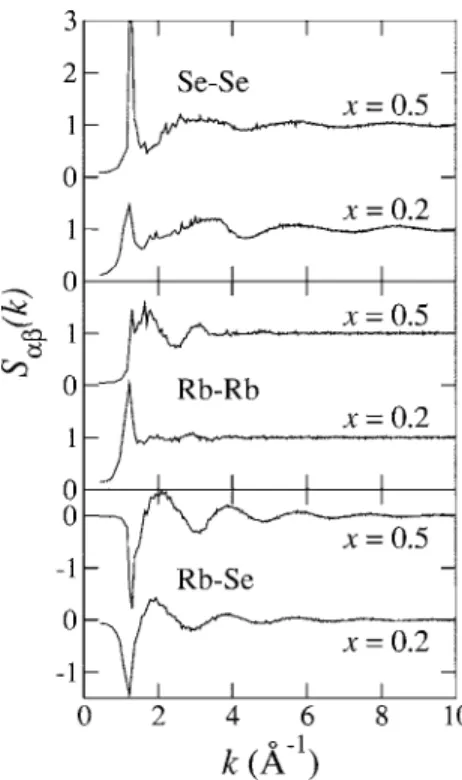
Figure 1 shows the structure factors S共k兲 of liquid RbxSe1−x. For x= 0.2 and 0.5, S共k兲 were obtained from the partial structure factors S␣
共
k兲
, shown in Fig. 2, with the neutron scattering lengths. In Fig. 1, the calculated results共solid
lines兲 are compared with the experimental results22,29,30共open and solid circles兲. We are unaware of
experiments for the 50% Rb concentration. It is confirmed from this figure that the calculated results are in reasonably good agreement with experiments forx艋
0.2. In particular, the prepeak at about 1.3 Å−1is reproduced very well by our calculations forx= 0.2, which means that the system size is large enough to simulate intermediate structures indicated by the prepeak. It is seen that the prepeak grows to a clear peak at the equiatomic concentration. Such a first sharp diffraction peak has also been observed in liquid K0.5Te0.5 by neutron diffraction measurements.13The Ashcroft-Langreth partial structure factorsS␣
共k兲
are shown in Fig.2. BothSSeSe共k兲
andSRbRb共k兲
have peaks at thewave vector 1.3 Å−1 at which the prepeak appears in S
共
k兲
. These peaks become higher and lower in SSeSe共k兲
and SRbRb共k兲, respectively, when
xis increased from 0.2 to 0.5. In SRbSe共k兲, there exists a dip at the same wave vector. It is
FIG. 1. Structure factorsS共k兲of liquid RbxSe1−x. The calculatedresults共solid lines兲 are compared with the experimentalS共k兲’s ob- tained by x-ray diffraction measurements at 300 ° C and 12 bar of Tamura and Hosokawa 共Ref.29兲 共open circles兲 for x= 0.0, x-ray diffraction measurements at 300 ° C and 9.8 bar of Tamura and Inui 共Ref.30兲 共solid circles兲forx= 0.0, and neutron diffraction measure- ments at 280 ° C and 1 bar of Maruyama et al. 共Ref. 22兲 共open
circles兲forx= 0.2. FIG. 2. Ashcroft-Langreth partial structure factorsS␣共k兲of liq- uid RbxSe1−x.
FIG. 3. Partial pair distribution functions g␣共r兲 of liquid RbxSe1−x. The solid, dashed, and dotted lines show gSeSe共r兲, gRbSe共r兲, andgRbRb共r兲, respectively.
obvious that the peaks and dips at 1.3 Å−1arise from charge ordering in the liquid alkali-metal–Se mixtures as in the liq- uid alkali-metal–Te mixtures.16,17
B. Pair distribution functions
Figure 3 shows the partial pair distribution functions g␣
共r兲
of liquid RbxSe1−x. In pure liquid Se, the first peak of gSeSe共r兲
at about 2.3 Å corresponds to the correlation be- tween the nearest neighbors within a chain, while the second peak at about 3.8 Å is mainly contributed by the next-nearest neighbors within a chain. Atomic correlations between dis- tinct chains have also some contribution to gSeSe共r兲
beyond 3 Å.The clear minimum at about 2.8 Å indicates that Se chains do not frequently interact with each other. IngSeSe共r兲
of liquid Rb0.2Se0.8, the minimum becomes shallower, and the second peak shifts slightly toward largerrcompared with that in pure liquid Se, while the position of the first peak remains the same. These changes suggest an increase of in- terchain interaction by the addition of Rb atoms.gRbSe共r兲
has a clear first peak at about 3.5 Å followed by a broad profile with a very shallow minimum at about 6 Å. In gRbRb共r兲,
there are no clear peaks because of the low Rb concentration.When the concentration is increased tox= 0.5, the profile of gSeSe
共r兲
becomes very different from those atx= 0.0 and 0.2, i.e., there exists a wide deep valley between the sharp first peak and the wide-ranging second peak at about 6 Å. The first peak ingRbSe共r兲
becomes sharper, while its position is unchanged. There appears a broad first peak at about 4.5 Å ingRbRb共r兲.
C. Electronic densities of states
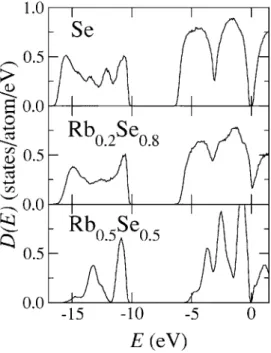
Figure4 shows the electronic densities of statesD共E兲of liquid RbxSe1−x. The origin of energy is taken to be the Fermi
level. At x= 0.0, D共E兲 has a deep dip at the Fermi level corresponding to the semiconducting properties of liquid Se.
With increasing alkali-metal concentration tox= 0.2, the dip at the Fermi level becomes shallower, which means that the liquid has semimetallic properties, consistent with the ob- served concentration dependence of the electrical conductivity.19,20 When the alkali-metal concentration is in- creased further
共
x= 0.5兲
, the dip at the Fermi level becomes deeper again. In this way, the electronic properties of the liquid alkali-metal–Se mixtures change with alkali-metal concentration: semiconducting, semimetallic, and semicon- ducting atx= 0.0, 0.2, and 0.5, respectively.D. Spatial configurations of atoms
The spatial configurations of atoms in liquid RbxSe1−xare shown in Fig.5. The white and gray balls show the positions of Se and Rb atoms, respectively. It is clearly displayed that pure liquid Se consists of chain molecules. We see that the chain structure is retained at the Rb concentration of 0.2.
From the time evolution of the atomic configuration, it is recognized that bond-breaking and bond-switching reactions happen more frequently on the addition of Rb atoms, which is consistent with the observations in gSeSe
共
r兲
. At 50% Rb concentration, it is found that most Se atoms form Se2 dimers.E. Coordination-number distributions
To investigate the atomic coordination around Se atoms in more detail, we obtained the ratioP
共
n兲
of the number of Se FIG. 4. Electronic densities of statesD共E兲 of liquid RbxSe1−x.The origin of energy is taken to be the Fermi level共EF= 0兲.
FIG. 5. Spatial configurations of atoms in liquid RbxSe1−x for x=共a兲0.0,共b兲0.2, and共c兲0.5. The white and gray balls show the positions of Se and Rb atoms, respectively, in the supercell. The bonds connect two Se atoms with atomic distances less than 2.8 Å.
FIG. 6. Se-Se coordination-number distributionsP共n兲 of liquid RbxSe1−x. The solid circles, open circles, and open triangles show P共n兲 forx= 0.0, 0.2, and 0.5, respectively.
CHAIN STRUCTURE AND ELECTRONIC STATES OF¼ PHYSICAL REVIEW B74, 104202共2006兲
atoms coordinated withnSe atoms to the total number of Se atoms by counting the number of atoms inside the sphere of a radiusRcentered at each atom. We used the first minimum position, 2.8 Å, of gSeSe
共r兲
as the radius R. The Rb- concentration dependence of P共n兲 is shown in Fig.6. It is seen that almost all Se atoms have twofold coordination in pure liquid Se. With increasing Rb concentration, twofold- coordinated Se atoms decrease, and onefold-coordinated Se atoms increase. This concentration dependence clearly shows that Se chains are shortened by the addition of alkali metals.At the Rb concentration of 50%, P共n兲 has a large peak at n= 1, which is consistent with the formation of Se2dimers.
F. Bond-overlap populations
To clarify the change in the bonding properties between Se atoms due to the addition of alkali metals, we used popu- lation analysis31,32 by expanding the electronic wave func- tions in an atomic-orbital basis set.33,34Based on the formu- lation for the ultrasoft pseudopotentials,35 we calculated the overlap populationOijbetween theith andjth atoms and the gross chargeQi for theith atom.31 It should be noted that, since the atomic-orbital basis used in the expansion of the wave functions is not unique, a different set of atomic-orbital bases would give different values forOijandQi.34However, their relative magnitudes can be discussed meaningfully, be- cause the trends are the same for any choice of atomic-orbital basis sets. For the basis used in our calculations, the charge
spillage33 defining the error in the expansion is less than 0.3%.
Figure 7 shows the time-averaged distributions pSeSe
共
O¯兲
of the overlap populationsOi苸Se,j苸Sewhich give a semiquan- titative estimate of the strength of covalentlike bonding be- tween Se atoms. Note that the integration of pSeSe共O
¯兲, 兰
O⬁minpSeSe共O
¯兲dO
¯, gives the average number of Se atoms that have overlap populations greater than Omin around one Se atom. For the Rb concentrations forx艋
0.2,pSeSe共O
¯兲
consists mainly of three peaks at about O¯= 0.7, 0.1, and −0.2 as shown by the solid lines for liquid Se and liquid Rb0.2Se0.8in Fig.7. Note that there is a large peak atO¯= 0.0, because we calculatedOijfor pairs of Se atoms with a large cutoff dis- tance共⬃7 Å兲
so as to take into account all pairs of Se atoms chemically interacting with each other. Finite values of Oijare obtained for Se pairs with atomic distances up to about 5 Å.Oijobtained for pairs with further atomic distances are nearly zero, and give the peak atO¯= 0.0.
To examinepSeSe
共O
¯兲
in connection with the chain struc- ture of Se atoms, we identified Se chains in the liquid mix- tures by connecting up Se atoms with atomic distances less than 2.8 Å, the minimum position ofgSeSe共r兲. Since each Se
atom is assigned to one of the chains, we can specify the spatial relation between two Se atoms selected arbitrarily with respect to the chain structure. The solid circles in Fig.7 show the time-averaged distributions of the overlap popula- tions for pairs of Se atoms that are nearest neighbors to each other within a chain. Each Se atom is connected to its nearest neighbors by a-type bond, and the distributions have peaks at the largerO¯⬃
0.7. Pairs of Se atoms that are next-nearest neighbors to each other within a chain give the time- FIG. 7. DistributionspSeSe共O¯兲of overlap populationsOi苸Se,j苸Se.The bold solid lines showpSeSe共O¯兲. The solid and open circles show the contributions topSeSe共O¯兲from the nearest-neighbor共n.n.兲atoms and the next-nearest-neighbor共n.n.n.兲atoms, respectively, within a chain, while the open diamonds show the interchain contribution to pSeSe共O¯兲.
FIG. 8. Distributionsf␣共Q兲of gross chargesQi苸␣. The solid and dashed lines showfSe共Q兲and fRb共Q兲, respectively.
averaged distributions displayed by the open circles in Fig.7.
Because of the antibonding interaction between the lone-pair states, the distributions have peaks at the negativeO¯
⬃
−0.2.The distributions shown by the diamonds in Fig.7are given by pairs of Se atoms belonging to different chains. Since the interchain interaction is weak, the peaks exist at the smaller O¯
⬃
0.1.It is seen in pure liquid Se that the distributions shown by the solid circles and the diamonds are well separated by a clear minimum at about O¯= 0.2, and that the next-nearest- neighbor Se atoms give a large peak at aboutO¯= −0.2
共open
circles兲
. These features reflect the existence of Se molecules that have a clear chain structure. At the Rb concentration of 0.2, the distribution by the interchain interaction共diamonds兲
spreads over larger overlap populations, and the minimum at about O¯= 0.2 becomes shallower, which indicates that Se chains interact more frequently with each other due to the excess electronic charges transferred from Rb atoms. Also the height of the peak atO¯= −0.2 becomes lower. These facts are consistent with the shortening of chains. At the equi- atomic concentration, pSeSe共
O¯兲
has a qualitatively different distribution from those at the lower Rb concentrations, re- flecting the formation of dimers. The distribution shown by the solid circles shifts to larger overlap populations, and has a peak at about O¯= 1.0, which shows a stronger chemical bonding in dimers. The distribution by the interchain inter- action共
diamonds兲
has a profile spreading over a wide range of O¯ with a very low peak, which indicates that the dimer- dimer interaction occurs infrequently.G. Mulliken charges
Figure8 shows the time-averaged distributions f␣
共Q兲
of Qi苸␣ for ␣-type atoms. Note that f␣共
Q兲
is normalized as兰
f␣共
Q兲
dQ= 1. In pure liquid Se,fSe共
Q兲
naturally has a sym- metric distribution around Q= 0.0. In liquid RbxSe1−x for x= 0.2 and 0.5, fRb
共Q兲
has peaks near Q= 1.0, which reflects the fact that almost all 5s electrons of Rb atoms are trans- ferred to Se atoms. Atx= 0.2,fSe共Q兲
has an asymmetric dis- tribution with the peak at about Q= −0.2. The asymmetry comes from the coordination dependence of the gross charges, i.e., onefold-coordinated Se atoms have more elec- trons than twofold-coordinated Se atoms. At x= 0.5, fSe共Q兲
has two peaks; the high peak at aboutQ= −0.8 is given by Se atoms in stable dimers, while the small peak at about Q= −0.6 arises from rearrangements of dimers. When two dimers interact with each other, a short chain is formed tran- siently, and Se atoms have fewer electrons
IV. DISCUSSION
Here, we discuss the effects of alkali metals on the elec- tronic and structural properties of the liquid alkali-metals–Se mixtures in comparison with the liquid alkali-metals–Te mix- tures. As seen in the spatial configurations of atoms
共Fig.
5兲 and the coordination-number distributions共Fig.
6兲, Se chains are shortened by the addition of Rb atoms in liquid RbxSe1−x.The electronic densities of states
共Fig.
4兲show that the elec- tronic properties of liquid Rb0.2Se0.8are semimetallic, while pure liquid Se has semiconducting properties. The distribu- tions of the overlap populations共Fig.
7兲 and the gross charges共Fig.
8兲clearly show that 5selectrons of Rb atoms are transferred almost completely to Se atoms, and that the transferred electrons enhance the interchain interaction at x= 0.2.
On the other hand, in pure liquid Te, there exist many threefold-coordinated Te atoms.7–9 The Te-Te coordination distribution16shows that twofold- and threefold-coordinated Te atoms exist in almost the same percentage. By adding alkali metals, threefold-coordinated Te atoms decrease, and twofold-coordinated Te atoms increase, which means that the chain structure is stabilized, in contrast to the liquid alkali- metals–Se mixtures. The calculated electronic densities of states16,17have revealed that liquid Te has semimetallic prop- erties, and that the electronic properties become semicon- ducting with increasing alkali-metal concentration reflecting the stabilization of Te chains.
The distribution of overlap populationspTeTe
共O
¯兲
for pure liquid Te has a broad profile, and has no clear peak共except
forO¯= 0.0兲
,35which is consistent with the existence of many threefold-coordination defects. This indicates that bond breaking and bond exchange occur much more frequently compared with those in pure liquid Se, and that the -type bonding between Te atoms is weaker than that between Se atoms. By the addition of alkali metals, the transferred elec- trons function to make the Te-Te bonding stronger, and sta- bilize the chain structure.From these observations, we see that the role of the trans- ferred electrons in liquid alkali-metal chalcogenides depends on the spatial localization of electrons in pure liquid chalco- gens. Liquid Se has a well-localized electron distribution in the chain structure, i.e., four p electrons of each Se atom occupy the-type bonding and lone-pair nonbonding states around the Se atom. Since the*-type antibonding states are well separated energetically from these occupied states, the bond breaking and bond exchange scarcely take place in liq- uid Se. When alkali metals are added, the transferred elec- trons probably occupy the *-type antibonding states, be- cause the bonding and nonbonding states are already occupied. Due to the antibonding character of the electronic states occupied by the transferred electrons, Se-Se bonds be- come weaker, and the interaction between Se chains is en- hanced. In contrast, the valence electrons are distributed over the chains in pure liquid Te as it has metallic properties.
Considering the fact that bond breaking and bond exchange occur frequently, the electronic states in liquid Te have anti- bonding character as well as bonding and nonbonding char- acters. In other words, the bonding and nonbonding states around Te chains are partially occupied. If extra electrons are given by the addition of alkali metals, those bonding and nonbonding electronic states are preferentially occupied by the electrons so as to make the chain structure stable. It is noted that, at the equiatomic concentration, almost all chal- cogen atoms form divalent anion dimers in both the liquid alkali-metal–Te and alkali-metal–Se mixtures.
CHAIN STRUCTURE AND ELECTRONIC STATES OF¼ PHYSICAL REVIEW B74, 104202共2006兲
V. SUMMARY
We have investigated the structure and electronic states of liquid RbxSe1−x by means of ab initio molecular-dynamics simulations. It has been shown that the calculated structure factors are in reasonable agreement with experiments. We have confirmed from the calculated electronic densities of states that the electronic properties of the liquid alkali- metal–Se mixtures change from semiconducting to semime- tallic with increasing alkali-metal concentration fromx= 0.0 to 0.2. The shortening of Se chains occurs due to the trans- ferred electrons, and is responsible for the metallic proper- ties. Based on the population analysis, we have discussed the effects of the transferred electrons on the chain structure in
connection with the bonding properties in liquid Se and liq- uid Te.
ACKNOWLEDGMENTS
The authors acknowledge K. Maruyama, H. Hoshino, and H. Endo for providing us with their experimental data. They are grateful to M. Aniya for useful discussions. The present work was supported in part by a Grant-in-Aid for Scientific Research on Priority Area “Nanoionics
共439兲,” and a Grant-
in-Aid for Scientific Research共
C兲
by the Ministry of Educa- tion, Culture, Sports, Science and Technology of Japan. The authors thank the Supercomputer Center, Institute for Solid State Physics, University of Tokyo for the use of the facili- ties.1The Physics of Selenium and Tellurium, Proceedings of the Inter- national Conference on the Physics of Selenium and Tellurium, Königstein, Germany, 1979, edited by E. Gerlach and P. Grosse 共Springer, Berlin, 1979兲.
2J. C. Perron, J. Rabit, and J. F. Rialland, Philos. Mag. B 46, 321 共1982兲.
3W. Freyland and M. Cutler, J. Chem. Soc., Faraday Trans. 2 176, 756共1980兲.
4H. Hoshino, R. W. Schmutzler, and F. Hensel, Ber. Bunsenges.
Phys. Chem. 80, 27共1976兲.
5H. Hoshino, R. W. Schmutzler, W. W. Warren, Jr., and F. Hensel, Philos. Mag. 33, 255共1976兲.
6F. Shimojo, K. Hoshino, M. Watabe, and Y. Zempo, J. Phys.:
Condens. Matter 10, 1199共1998兲.
7S. Takeda, S. Tamaki, and Y. Waseda, J. Phys. Soc. Jpn. 53, 3830 共1984兲.
8A. Munelle, R. Bellissent, and A. M. Frank, Physica B 156, 174 共1989兲.
9T. Tsuzuki, M. Yao, and H. Endo, J. Phys. Soc. Jpn. 64, 485 共1995兲.
10C. A. Kraus and S. W. Glass, J. Phys. Chem. 33, 984共1929兲.
11M.-L. Saboungi, J. Fortner, J. W. Richardson, A. Petric, M.
Doyle, and J. E. Enderby, J. Non-Cryst. Solids 156-158, 356 共1993兲.
12Y. Kawakita, M. Yao, H. Endo, and J. Dong, J. Non-Cryst. Solids 205-207, 447共1996兲.
13J. Fortner, M. -L. Saboungi, and J. E. Enderby, Phys. Rev. Lett.
69, 1415共1992兲.
14Y. Kawakita, J. Dong, T. Tsuzuki, Y. Ohmasa, M. Yao, H. Endo, H. Hoshino, and M. Inui, J. Non-Cryst. Solids 156-158, 756 共1993兲.
15Y. Kawakita, M. Yao, and H. Endo, J. Phys. Soc. Jpn. 66, 1339 共1997兲.
16F. Shimojo, K. Hoshino, and Y. Zempo, Phys. Rev. B 59, 3514 共1999兲.
17F. Shimojo, K. Hoshino, and Y. Zempo, Phys. Rev. B 63, 094206 共2001兲.
18J. Hafner, K. Seifert-Lorentz, and O. Genser, J. Non-Cryst. Solids 250-252, 225共1999兲.
19S. Hosokawa, M. Yao, T. Yoshimura, and H. Endo, J. Phys. Soc.
Jpn. 54, 4717共1985兲.
20H. Hoshino and H. Endo, J. Non-Cryst. Solids 117-118, 525 共1990兲.
21K. Maruyama, H. Hoshino, H. Endo, M. Yamazaki, and T Miy- anaga, J. Phys.: Condens. Matter 17, S3317共2005兲.
22K. Maruyama, H. Endo, and H. Hoshino, J. Phys. Soc. Jpn. 74, 3213共2005兲.
23J. P. Perdew, K. Burke, and M. Ernzerhof, Phys. Rev. Lett. 77, 3865共1996兲.
24G. Kresse and J. Hafner, Phys. Rev. B 49, 14251共1994兲.
25F. Shimojo, R. K. Kalia, A. Nakano, and P. Vashishta, Comput.
Phys. Commun. 140, 303共2001兲.
26D. Vanderbilt, Phys. Rev. B 41, 7892共1990兲.
27S. Nosé, Mol. Phys. 52, 255共1984兲; W. G. Hoover, Phys. Rev. A 31, 1695共1985兲.
28M. Tuckerman, B. J. Berne, and G. J. Martyna, J. Chem. Phys.
97, 1990共1992兲.
29K. Tamura and S. Hosokawa, Ber. Bunsenges. Phys. Chem. 96, 681共1992兲.
30K. Tamura and M. Inui, J. Phys.: Condens. Matter 13, R337 共2001兲.
31R. S. Mulliken, J. Chem. Phys. 23, 1833共1955兲.
32R. S. Mulliken, J. Chem. Phys. 23, 1841共1955兲.
33D. Sánchez-Portal, E. Artacho, and J. M. Soler, J. Phys.: Condens.
Matter 8, 3859共1996兲.
34M. D. Segall, R. Shah, C. J. Pickard, and M. C. Payne, Phys. Rev.
B 54, 16317共1996兲.
35F. Shimojo, K. Hoshino, and Y. Zempo, J. Phys. Soc. Jpn. 72, 2822共2003兲.