Baculovirus ‑ inducing fast ‑ acting innate immunity kills Plasmodium liver stages
著者 タルハ ビン エムラン
著者別表示 Talha Bin Emran journal or
publication title
博士論文要旨Abstract 学位授与番号 13301甲第4793号
学位名 博士(学術)
学位授与年月日 2018‑09‑26
URL http://hdl.handle.net/2297/00053152
doi: 10.4049/jimmunol.1800908
Creative Commons : 表示 ‑ 非営利 ‑ 改変禁止 http://creativecommons.org/licenses/by‑nc‑nd/3.0/deed.ja
氏 名 学 位 の 種 類 学 位 記 番 号 学 位 授 与 の 日 付 学 位 授 与 の 要 件 学 位 授 与 の 題 目
論 文 審 査 委 員
タルハ E 博士(学術)
医薬保博甲215号 平成30年9月26日
課程博士(学位規則第4条第1項)
Baculovirus-inducing fast-acting innate immunity kills Plasmodium liver stages
(バキュロウイルスが誘導する即効性自然免疫応答による肝臓期 マラリア原虫の殺傷効果)
主査 吉田 栄人 副査 鈴木 亮 副査 猪部 学 副査 倉石 貴透 副査 伊従 光洋
学位論文要旨
Summary (167)
Baculovirus (BV), an enveloped insect virus with a circular double-stranded DNA genome, possesses unique characteristics that induce strong innate immune responses in mammalian cells. I show that BV administration in BALB/c mice not only provides sterile protection against a subsequent Plasmodium berghei sporozoite infection for up to seven days after the injection but also eliminates existing liver-stage parasites completely. The elimination of sporozoites by BV was superior to that by primaquine, and this effect occurred in a TLR9-independent manner. At 6 h post-BV administration, IFN-α and IFN-γ were robustly produced in the serum, and RNA transcripts of IFN-stimulated genes were markedly upregulated in the liver compared with control mice. The in vivo passive transfer of post-BV-administration serum effectively eliminated liver-stage parasites, and IFN-α neutralization abolished this effect, indicating that the BV liver-stage parasite-killing mechanism is downstream of the type I IFN signalling pathway. These findings provide evidence that BV-induced fast-acting innate immunity completely kills liver-stage parasites and, thus, may lead to new malaria drug and vaccine strategies.
Extended Abstract (1234)
Introduction: Malaria is a life-threatening disease cause 216 million cases worldwide and
almost 445,000 deaths every year. Malaria infection is initiated following injection of Plasmodium
sporozoites injected into the skin during the taking of a blood meal by Anopheles mosquitoes. The
sporozoites then migrate to the liver and invade hepatocytes. Before clinical symptoms of malaria
occur during the blood stage of infection, Plasmodium falciparum in the liver develops into
exoerythrocytic schizonts for 5 to 6 days. Plasmodium vivax and Plasmodium ovale can develop
dormant liver-stage forms, known as hypnozoites, which cause relapsing blood-stage infections
months or years after the primary infection. Moreover, the liver-stage development compensates for
the low numbers of transmitted sporozoites, a major bottleneck of the Plasmodium life cycle. The
pre-erythrocytic stages are deal targets for both the vaccine interventions and prophylactic drug
discovery. Therefore, an effective innate immune response raised before or during the liver-stage
infection could prevent the onset of disease.
Autographa californica nucleopolyhedrosis virus (AcNPV), a type of Baculovirus (BV), is an enveloped insect virus with a circular double-stranded DNA genome, possesses unique characteristics to induce strong innate immune responses in various mammalian cells and in mice.
BV is also widely used in the pharmaceutical industry for the production of recombinant proteins as well as for human gene therapy applications. With the outstanding adjuvant properties on maturation of DC and activation of NK cells, BV has recently emerged as a new vaccine vector. Our lab (Laboratory of Vaccinology and applied Immunology) has developed BV-based malaria vaccines effective for all three-parasite stages: pre-erythrocytic stage, asexual blood stage, and sexual stage.
Objective: The overall aim of this thesis was to examine the characteristics features of BV with activation of innate immunity. In the long run, I was chasing against the malaria pre-erythrocytic stage by exploiting the adjuvant properties of baculoviral vector. I sought to assess whether BV possessed more prophylactic and therapeutic effectiveness than CpG and primaquine, respectively.
For all experiments in which comparisons were made between control and treated mice, all control mice developed blood-stage infection within 6 days following the intravenous injection of 1,000 sporozoites. Once parasites appeared in the blood of a mouse, the animal subsequently died from the infection. All mice that survived sporozoite injection successfully prevented blood-stage parasite development.
Method: The experiments of my study were designed to assess whether BV-mediated innate
immunity could protect animals against malaria challenge infection and whether this immunity could
eliminate existing liver-stage parasites. Group of mice were intramuscularly administered with BV
and challenged with Plasmodium berghei sporozoites or vice versa. To check the interferon (IFN)
dependent killing mechanism, serum levels of type-I and II IFN were measured from mice that were
intramuscularly administered with BV at 6h. I also investigated whether TLR9 plays an important
role in BV-mediated parasite killing in the liver. To determine whether the serum cytokines act as
effectors against liver-stage parasites, a serum transfer assay was performed. Next I examined
whether neutralization of IFN-α or IFN-γ in the sera altered the effect of the sera on liver-stage
parasites. To assess the effects of exogenous IFN-α and IFN-γ on the elimination of liver-stage
parasites, direct administration of recombinant IFN-α or recombinant IFN-γ assay was also
performed. Finally to confirm the involvement of interferon stimulated genes (ISGs), the gene
expression levels in the livers of mice that had been intramuscularly injected with BES-GL3 were
measured by quantitative RT-PCR (qRT-PCR). Protective efficacy of heterologous human adenovirus
serotype 5 (AdHu5)-prime/BV dual expression system (BDES)-boost immunization against
sporozoite challenge was also tested.
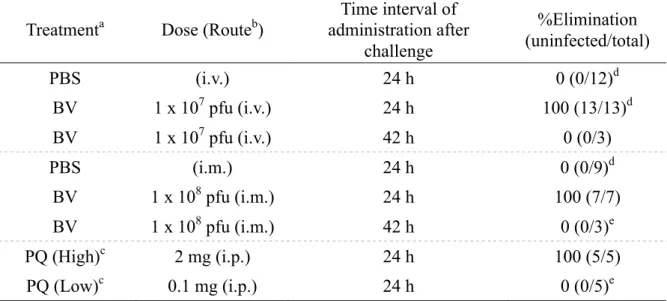
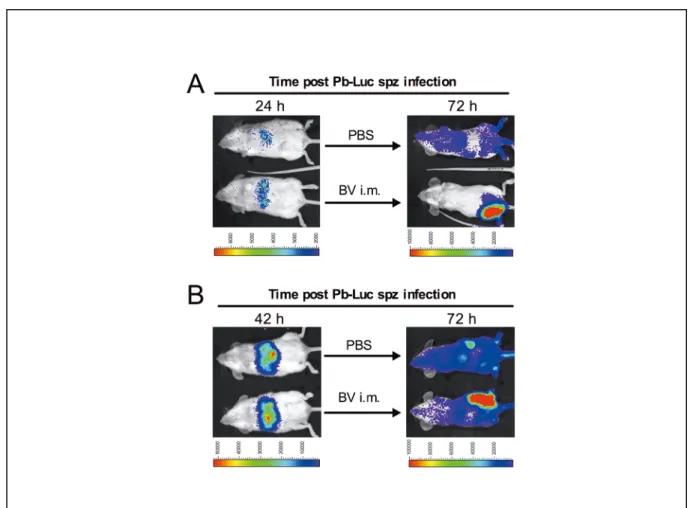
Results: Here I show that the innate immune responses induced by BV not only eliminate Plasmodium liver-stage parasites but also elicit sterile protection against Plasmodium sporozoite infection through type I interferon (IFN) signaling pathway. Mice had infected with liver-stage parasites before 24 h completely prevented blood-stage parasites following single dose of BV intramuscular administration, which was much superior to primaquine (PQ), the only drug approved to eradicate liver-stage parasites indicating an excellent therapeutic effect as well as the short-term prophylactic effect (table 1 and fig.1).
Table 1. Elimination of liver-stage parasites by BV administration
aTreatment
aDose (Route
b)
Time interval of administration after
challenge
%Elimination (uninfected/total)
PBS (i.v.) 24 h 0 (0/12)
dBV 1 x 10
7pfu (i.v.) 24 h 100 (13/13)
dBV 1 x 10
7pfu (i.v.) 42 h 0 (0/3)
PBS (i.m.) 24 h 0 (0/9)
dBV 1 x 10
8pfu (i.m.) 24 h 100 (7/7)
BV 1 x 10
8pfu (i.m.) 42 h 0 (0/3)
ePQ (High)
c2 mg (i.p.) 24 h 100 (5/5)
PQ (Low)
c0.1 mg (i.p.) 24 h 0 (0/5)
ea
BALB/c mice were intravenously injected with 1,000 Pb–conGFP sporozoites. After the indicated interval, mice were administrated either with BES-GL3 (described as BV) or PQ. Parasitemia was monitored on days 5-8, 11, and 14 after sporozoite injection. Once parasites appeared in the blood, all mice died.
b
i.v., intravenous; i.m., intramuscular; i.p., intraperitoneal.
c
The two different doses of PQ were administrated to eliminate liver-stage parasites. The two different doses of PQ as High (2 mg/100
µl) and Low (0.1 mg/100 µl) were administrated to eliminateliver-stage parasites.
d
Cumulative data from three experiments.
e
Significant delay of parasitemia was observed in infected mice, compared with the PBS group.
Figure 1: Effect of BV intramuscular administration on liver-stage parasites (A, B).
Mice were challenged by infection with Pb-Luc sporozoites at 0 h, followed by intramuscular administration of BES-GL3 (10
8pfu; described as BV) at the indicated timepoints. Luminescence in the liver indicates parasite growth, whereas that in the thigh shows the transgene expression by intramuscular BV injection. The heatmap visible in each mouse image represents the total flux of photons (p/s/cm
2) in that area.
Rainbow scales are expressed in radiance (p/s/cm
2/sr).
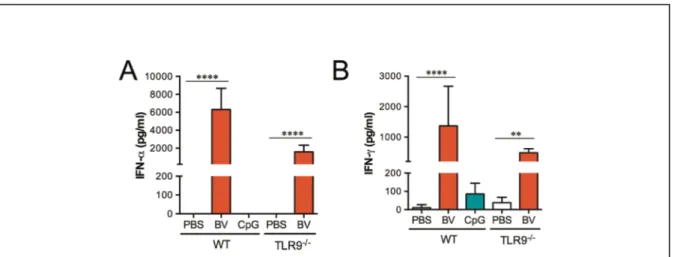
At 6 h post-BV administration, IFN-α and IFN-γ were robustly produced in the sera, and RNA transcripts of interferon-stimulated genes were drastically upregulated in the liver compared with control mice (fig. 2).
BV possesses unique characteristics that activate DC-mediated innate immunity through MyD88/TLR9-dependent and -independent pathways. Therefore, next I investigated whether TLR9 plays an important role in BV-mediated parasite killing in the liver. A single dose of intramuscularly administered BES-GL3 completely prevented blood-stage parasites in all TLR9
-/-mice that had been previously infected with liver-stage parasites. In contrast, no elimination effect or parasitemia delay was observed in TLR9
-/-mice following intramuscular administration of CpG (50 µg) (table 2).
Fig. 2: BV intramuscular administration BV administration rapidly induces type I and II IFNs in sera. (A-B) Levels of IFN-α (A) and IFN-γ (B) in sera from WT or TLR9
-/-mice at 6 h after intramuscular administration of BES-GL3 (described as BV) (10
8pfu), CpG, or PBS (n = 9-10). Bars show means ± SD. The difference from the PBS group was assessed by a Kruskal-Wallis test with Dunn’s correction. **p < 0.01, ****p
< 0.0001.
Table 2. Elimination of liver-stage parasites by BV injection in TLR9
-/-mice
aTreatment
aMouse
strain Dose
Time interval of administration after
challenge
%Elimination (uninfected/total)
PBS TLR9
-/-- 24 h 0 (0/7)
BV TLR9
-/-1 x 10
8pfu 24 h 100 (7/7)
BV WT 1 x 10
8pfu 24 h 100 (5/5)
CpG WT 50 µg 6 h 100 (5/5)
CpG WT 50 µg 24 h 0 (0/4)
bCpG TLR9
-/-50 µg 24 h 0 (0/5)
a
TLR9
-/-(BALB/c background) or WT mice were intravenously injected with 1,000 Pb-conGFP sporozoites. After 24 h, mice were intramuscularly administrated either with BES-GL3 (described as BV) or CpG ODN 1826 (described as CpG). Parasitemia was monitored on days 5-8, 11, and 14 after sporozoite injection. Once parasites appeared in the blood, all mice died.
b
Significant delay of parasitemia was observed in infected mice, compared with the PBS.
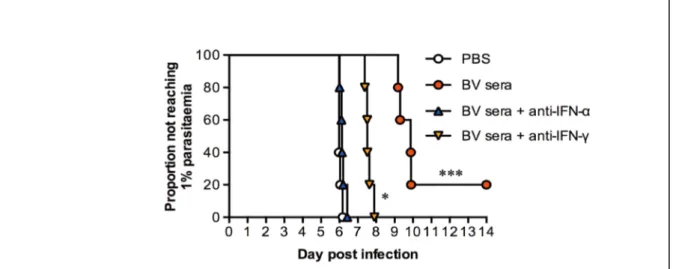
The in vivo passive transfer with sera from mice intramuscularly administered with BV
effectively eliminated liver-stage parasites and this effect was canceled by neutralization of IFN-α
but not IFN-γ in the sera, indicating a killing mechanism downstream of type I IFN signaling
pathway (fig. 3).
Conclusion: Collectively these results demonstrate that BV administration has both therapeutic and prophylactic immunostimulatory effects. Thus, this study provides great potentials of BV for development of a new IFN-inducing non-haemolytic single-dose alternative to PQ. We propose that these findings serve to inform us a new insight into the development of an effective vaccine platform for not only malaria but also for other serious infectious diseases such as viral hepatitis and liver cancers.
Fig. 3: IFN-α induced by BV intramuscular administration contributes to
elimination of liver-stage parasites. Results of a serum transfer assay to determine the
role of IFN-α and IFN-γ in the elimination of liver-stage parasites. Sera collected from
mice at 6 h after BV administration was neutralized by either anti-IFN-α or anti-IFN-γ
antibody. Passive transfer of antibody-treated sera, non-treated sera, or PBS was
conducted at 24 h after sporozoite infection (n = 5). The difference from the PBS group
was assessed by a Kruskal-Wallis test with Dunn’s correction. *p < 0.05, ***p < 0.001.
審査結果の要旨
三日熱マラリア原虫は、急性期(赤内期)にアルテミシニンによる治療で症状が改善するが、
肝細胞中に原虫の休眠体(ヒプノゾイト)が残存し、数カ月~数カ年の期間を経て80%が 再発する。このマラリア再発は、マラリアの撲滅にとっての大きな障害となっている。ヒプ ノゾイトを排除できる唯一の薬剤であるプリマキンは、(i) G6PD欠損の人に投薬すると溶 血性貧血を引き起こし死に至る場合がある。(ii)プリマキンによる根治療法(14日間)を行っ ても時に再発が見られ、プリマキン低感受性原虫の存在が懸念されている。このような禁忌、
副作用、耐性原虫出現等々の問題点があり使用が制限されている。プリマキンに替わる薬剤 の探索が長年続けられてきているが開発には至っていない。本論文はバキュロウイルス(BV) が誘導するユニークな自然免疫応答に着目し、ネズミマラリア原虫をモデルとして「BVを 大腿部に筋注すると遠距離にある肝臓内のマラリア原虫に対して100%の強力な殺傷効果 を発揮する」ことを見出した。BV接種により誘導されたIFN-a, -gが肝臓に作用し、その結
果各種IFN-stimulated gene群が活性化して肝臓内マラリア原虫を殺傷することを明らかに
した。全く新規の「自然免疫賦活化薬」という新しいコンセプトでプリマキンを凌駕する抗 マラリア新薬の開発を提案している。本審査委員会は、研究成果の新規性および口頭発表会 における学位申請者の発表と討論の能力を考慮して、当該学位論文は博士(学術)に値する と判定した。