Formation and Custody of the Ottoman Archives During the Pre-Tanzimat Period
TAKAMATSU Yoichi
1. Characteristics of the Ottoman Archives
There is probably no larger body of source materials in the non-west- ern language world than the extant archives related to the history of the Ottoman Empire. The largest collection within this body is the Prime Ministry’s Ottoman Archives (Babakanlık Osmanlı Arivi: BOA) in Istanbul, which contains over 150 million titles.
1)The second largest col- lection in Turkey is the Archives of the Topkapı Palace Museum (Topkapı Sarayı Müzesi Arivi: TSMA), also in Istanbul, which contains about 153,000 records. TSMA had divided its materials into two cate- gories: Evrak (individual documents) and Defter (registers), indicated by last call numbers of 12476 and 10775, respectively.
2)The reason why the Ottoman archives is so large is not only because of the Ottoman State’s long duration from the 14th to the 20th century and the fact that Istanbul was never destroyed by war after the conquest, but also, most importantly, because the Ottoman bureaucracy almost never discarded any of its existing documentation, like drafts of imperial decrees, even after they were no longer needed in the clerical process.
This aversion to discarding documents also means that their blank spaces were not reused as stationery, resulting in only rare cases of totally unre- lated documents appearing on the backs of older ones. The reason why documents were not reused can be attributed to the way in which they were processed. That is, related documents were frequently composed in the margins and the backs of original documents. So some related docu- ments often coexist on one single sheet of paper, presenting difficulty for historiographers in determining a given document’s style and type.
3)Another characteristic of the Ottoman archives is that most of them
contain documents of a public nature; that is, issued or received by the
powers that were. Since the sources in both BOA and TSMA originated
from either the bureaucratic organizations or the Sultan’s court, it is no
wonder that they suffer from a scarcity of private records. Consequently, it is often quite difficult to study the private affairs of a certain family or person.
Although almost nothing was ever thrown away intentionally, a great part of the Ottoman archives was lost by fire and poor maintenance. The major part of what exists today comes from the mid-nineteenth and thereafter, a time when a series of westernization reforms were being im- plemented. Due to the establishment of ministries and standardization of documents, the amount of documentation soared in explosive propor- tions.
4)On the other hand, due to the relative scarcity of records from the time prior to the 17th century, it is difficult to investigate particulars regarding the formation and preservation of the archives in that period.
The source materials dealt with in the present article come mainly from the 18th and early 19th centuries, before the beginning of the Ottoman institutional reforms called Tanzimat (1839–1876).
2. Approaches to the Study of the Ottoman Archives
The modern study of Ottoman diplomatics was begun by Central and Eastern European scholars, as an auxiliary science to the histori- ographical study of the documents related to their respective countries.
Consequently, their concerns did not extend to utilizing the huge archives in Istanbul, the capital of the Ottoman Empire. An exception was Lajos Fekete, Hungarian scholar, who had a great influence on early studies of Ottoman diplomatics in Turkey. The comprehensive study of the Ottoman archives as a whole in Turkey has not been attempted, until recently.
5)The research done to date has focused mainly on the form and style of documents rather than their function and custodial history.
Moreover, in the field of archival science, there is little theoretical work, in spite of the richness of available materials. The work to date may be found in guidebooks to BOA and publications by the general di- rectorate of state archives.
6)It is noteworthy that among the two modern archival principles, only the principle of provenance (Provinienzprinzip) has been advocated, with no reference being made to the principle of original order (Registraturprinzip);
7)and almost no attention had been paid to the circumstances under which the materials made their way into the Archives. These problems are closely related to a lack of interest in the custodial history of the documents. Despite the fact that the study of the formation and custody of the Ottoman archives is inseparable from the
The Memoirs of the Toyo Bunko, 64, 2006 126
Formation and Custody of the Ottoman Archives During the Pre-Tanzimat Period 127
B A C
D
E 1 F
2
Map of Istanbul 1. Babakanlık Osmanlı Arivi (BOA)
2. Topkapı Sarayı Müzesi Arivi (TSMA) A. Seferli Kog .
uu (in the Inner Court of the Topkapı Palace) B . K az∏ne-i Hüm∑yπn (in the Outer Court of the Topkapı Palace) C.
t.omru
k.d∑’iresi (in the Sublime Porte)
D. K az∏ne-i Evr∑
k.E .
Qbrahim Paa Palace
F . the Mosque of Aya
s.ofya
historical study of the Ottoman bureaucracy, since the archives are domi- nated by official records, we find only brief references to how the archives were dealt with by Ottoman bureaucratic agencies in the institu- tional and administrative research to date.
8)3. The Formation of the Ottoman Archives
The Ottoman archives consist of individual documents (evr∑ k. ) and registers (defter), which are closely correlated by virtue of document texts being recorded in registers, and the contents of registers being copied onto documents. The centers of Ottoman document administration were the two major bureaucratic organizations in Istanbul, the Sublime Porte (B∑b-ı ≠ s. af∏) headed by the Grand Vizier ( s. adr-ı a‘ z. am) and the Treasury (B∑b-ı Defter∏) headed by the chief treasurer (ba-defterd∑r). The Sublime Porte was in charge of domestic and foreign affairs in general, while the Treasury was in charge of fiscal affairs, specifically cash revenue and ex- penditure from the public purse. One exception was the fiscal manage- ment of the t∏m∑r system, which was completely outside of the Treasury’s jurisdiction, being handled by the Sublime Porte. Both the Sublime Porte and Treasury were divided into offices called k. alem, their docu- ment managing units.
9)Each k. alem kept its own registers of its duties and issued/received various types of documents. In principal, all k. alems exist- ed on equal terms organizationally, though the size of their staffs and im- portance of their respective duties differed.
Besides these bureaucratic organizations, the court of the Sultan (p∑di∑h) also accumulated records and formed its own archives regard- ing the sovereign of the Empire. The Grand Vizier, the head of the bu- reaucracy acting as the absolute proxy of the Sultan, always required Sultanic approval, be it only a formality, and thus submitted to the sover- eign reports on the course of the decisions that were being made in his name. These reports were usually returned to the Sublime Porte, but some the Sultans preferred to retain.
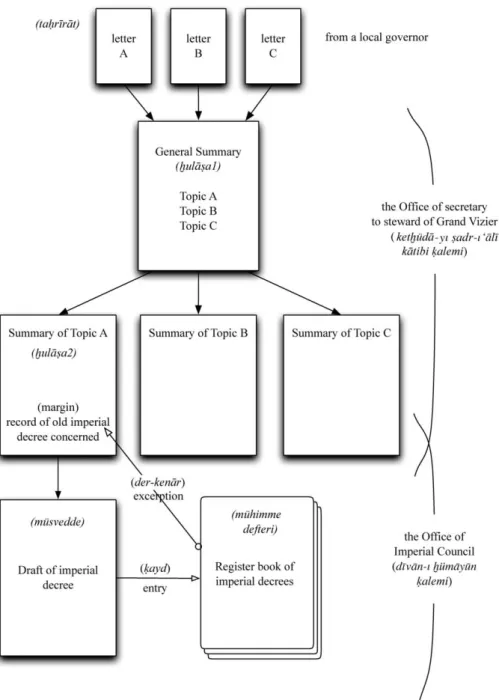
10)To summarize document-processing within the latter 18th century Ottoman bureaucracy, the decision-making was generally a bottom-up process. Correspondence (ta h. r∏r∑t) received by the Sublime Porte from a local governor, for example, would be submitted by the Grand Vizier to the Sultan, along with his own report (telj ∏ s. 1) and a summary of the con- tent ( j ul∑ s. a 1) to be examined. Upon examination, the Sultan returned the documents to the Grand Vizier, with a directive in his own writing
The Memoirs of the Toyo Bunko, 64, 2006 128
( j a t.t. -ı hüm∑yπn) in the margin of the Vizier’s report. Upon receipt the Grand Vizier would order the chief treasurer to tend to the matter, if it pertained to fiscal matters, and the treasurer would then order one of his k. alem to research precedents in its own register books and report the re- sults back to the Grand Vizier. Based on the chief treasurer’s report (telj ∏ s.
2), the Grand Vizier would order one of Sublime Porte’s k. alems to draft an imperial decree (emr-i er∏f ), which would be sent to the local governor in question. During this process, archives were formed in each agency concerned. (Fig. 1)
Figure 2 is a diagram of the most simple example of document-proc- essing within the Sublime Porte. In Reb∏‘ü'l-evvel 1211/October 1796 Ebπ-bekir Paa, the governor of Egypt sent two letters (mektπb) and five k. ∑’imes (notes) concerning several different matters to the Sublime Porte (Document 1). A scribe in the Office of the Secretary to Steward of the Grand Vizier (ketj üd∑-yı s. adr-ı ‘∑l∏ k∑tibi k. alemi) drew up a general summa- ry of the correspondence in several paragraphs ( j ul∑ s. a 1), using one sheet of paper (Document 2) and devoting one or two paragraphs to each letter and k. ∑’ime. The general summary was submitted to the Sultan.
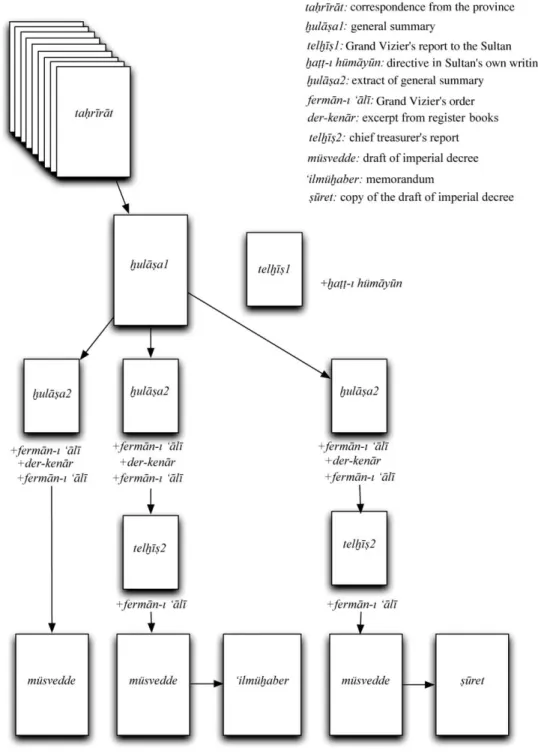
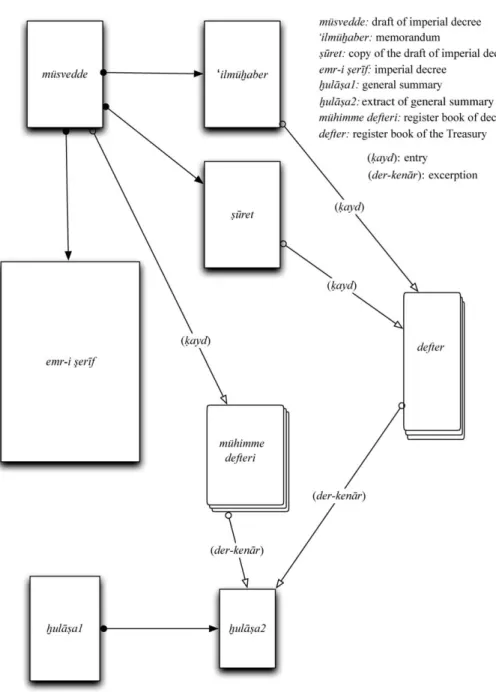
Then, another scribe in the Office of the Secretary extracted each paragraph of the general summary and copied it onto another sheet of paper (Document 3). One of the extracts ( j ul∑ s. a 2) was sent to the Office of the Imperial Council (d∏v∑n-ı hüm∑yπn k. alemi), where a scribe searched the register book of previous imperial decrees to see if there were any similar cases. He did not find any precedent in the register and noted that fact on the margin of the extract, meaning that a new decree would have to be drafted, which was done by another scribe (Document 4). The actual imperial decree, which mentions the content of the original letter, was dispatched to the governor of Egypt, and it was also copied into the register of imperial decrees in the Office of the Imperial Council (Document 5). Due to this characteristic feature of Ottoman document handling, the actual document-processing of any transaction within the Ottoman bureaucracy can be completely reconstructed. Beginning from the report of a local administrator, a series of specific document types were composed until an imperial decree was issued as the final feedback (See Fig. 3). They made their way from k. alem to k. alem in the form of gen- eral summaries ( j ul∑ s. a 1) and extracted portions of them ( j ul∑ s. a 2),
11)and of course were recorded for future reference to be inserted possibly into the text of another document. (See Fig. 4)
In short, Ottoman document-processing mainly involved the forma-
Formation and Custody of the Ottoman Archives During the Pre-Tanzimat Period 129
The Memoirs of the Toyo Bunko, 64, 2006 130
Fig. 1: Ottoman transaction of a matter in the 18th century
Formation and Custody of the Ottoman Archives During the Pre-Tanzimat Period 131
Fig. 2: Simplified document-processing in the Sublime Porte
The Memoirs of the Toyo Bunko, 64, 2006 132
Document 1: BOA, Hatt-~~ Hümayun 5318-F
Letter (mektπb) from Ebπ-bekir Paa, the governor of Egypt, to the Sublime
Porte. In general mektπbs were not dated, but we can surmise that it was written
in 11 Reb∏‘ü'l-evvel 1211 (14 October 1796) from the date of the other docu-
ments attached to it.
Formation and Custody of the Ottoman Archives During the Pre-Tanzimat Period 133
Document 2: BOA, Hatt-~~ Hümayun 5318
General Summary (
jul∑
s.a 1) dated 21 Cum∑de'l-πl∑ 1211 (22 November 1796).
Two letters and five
k.∑’imes sent from Ebπ-bekir Paa, the governor of Egypt, and a letter and a u
k.k.a sent from Yπsuf Paa, the governor of Jidda and Abyssinia, are summarized in 13 paragraphs. The fourth and fifth paragraphs make up a summary of the topics in the Document 1 (Hatt-ı Hümayun 5318-F).
Red ink notes appear on the upper-margin of each paragraph.
The Memoirs of the Toyo Bunko, 64, 2006 134
Document 3: BOA, Cevdet Dahiliye 5009
Topic summary (
jul∑
s.a 2) dated 21 Cum∑de'l-πl∑ 1211 (22 November 1796) con-
taining excerpts from Document 2 (paragraphs 4 and 5). A note on the lower-
margin of excerpts commands the Office of the Imperial Council to investigate
decrees issued toward the similar cases of the matter, and another dated 13
Cum∑de'l-∑
uire (14 December 1796) from the Office of the Imperial Council
replies that no precedent of the decree concerning the matter exists.
Formation and Custody of the Ottoman Archives During the Pre-Tanzimat Period 135
Document 4: BOA, Cevdet Dahiliye 5009
The draft of the imperial decree dated the middle ten days of Cum∑de'l-∑
uire 1211 (12–21 December 1796) to Ebπ-bekir Paa, the governor of Egypt and
ey
uü'l-beled
Qbr∑h∏m Beg, Mur∑d Beg and other em∏rs. The addressees and
portions of the text have been corrected.
The Memoirs of the Toyo Bunko, 64, 2006 136
Document 5: BOA, Mühimme-i Mısır vol. 10, p. 256 (No. 574)
Record of the Document 4 dated the middle ten days of Cum∑de'l-∑
uire 1211
(12–21 December 1796) to Ebπ-bekir Paa, the governor of Egypt and others
from a register book. The text has been written obliquely.
Formation and Custody of the Ottoman Archives During the Pre-Tanzimat Period 137
Fig. 3: Detailed document-precessing system in the 18th century 1
The Memoirs of the Toyo Bunko, 64, 2006 138
Fig. 4: Detailed document-precessing system in the 18th century 2
tion, accumulation and utilization of the texts of imperial decrees.
12)The same text could be transformed into various types of documents, circulat- ed between the k. alems, and stored there, resulting in the enormous size of the Ottoman archives. Therefore many documents are found with identi- cal contents, but in very different forms.
4. The Aspect of Custody in pre-Tanzimat Times
According to the information available from the late 18th century, we know that at least during that century the archives were treated in dif- ferent ways, depending on the type of record (document or register), the date of issue and provenance (the Sublime Porte or the Treasury).
13)Registers in current use were preserved in each k. alem and were repeated- ly referred and added to by both the Sublime Porte and the Treasury.
14)The documents and registers unnecessary for present operations were packed in monthly bags, which were put in yearly chests.
15)At the Sublime Porte, newer archives that were put to be referred to most fre- quently were kept in depots (maj zen) near the k. alems located in the t. omru k.
d∑’iresi, which was a building complex inside the Sublime Porte.
16)On the other hand, older archives were stored in the j az∏ne-i hüm∑yπn (Imperial Treasury), located in the outer court of Topkapı Palace.
17)Even as early as the late 17th century, the Sublime Porte was separated completely from the Palace both institutionally and locationally.
However, in the 16th century, when the functions of state were centered around the imperial council (d∏v∑n-ı hüm∑yπn), the archives were stored in the room attached to the Salon under the Dome ( k. ubbe altı) located in Topkapı Palace, where the imperial council convened. It is plausible to assume that the older archives of the Sublime Porte were stored in the j az∏ne-i hüm∑yπn, adjacent to the Salon under the Dome, even after its separation, as a vestige of the classical period.
On the other hand, we know for certain that the archives of the Treasury were stored near the Hippodrome (Atmeyd∑nı) of Istanbul in what were referred to as “old depots” (maj zen-i ‘at∏ k. ) or “barracks of the tent corps” (mehter∑n-ı j ayme k. ılası).
18)Both indicate a building on the site of the former Q brahim Paa Palace located on the west side of the Hippodrome, whose buildings were utilized for various purposes at the time.
19)In fact, a considerable amount of the archives was found in rela- tively good condition in the former Q brahim Paa Palace during the 1930s.
20)Formation and Custody of the Ottoman Archives During the Pre-Tanzimat Period 139
5. Custody of the Ottoman archives after the Tanzimat
There is no doubt that the K az∏ne-i evr∑ k. (Treasury of Documents), which was established in 1846 and completed in 1848, played an impor- tant role in preserving the Ottoman archives for future generations. It was the first modern archives of the Ottoman Empire modeled after the West and was the antecedent of the BOA.
21)However, K az∏ne-i evr∑ k. did not contribute much to the destiny of records before the Tanzimat peri- od, since it did not store older records. Consequently, the storage before the Tanzimat period was not stable, since some records were moved from depot to depot within Istanbul, which ultimately led to a worsening of the situation. When Topkapı Palace lost its function as the imperial palace and was completely abandoned for Dolmabahçe Palace, the European-style palace resembling Versailles, in 1853, records in the Topkapı depots were also abandoned and left to deteriorate. Some records that had been kept on the ground floor of the Ayasofya were moved up to the gallery on the second floor on the occasion of the visit of Wilhelm II (1898).
22)It is thought that the records of the Sublime Porte and those of the Treasury were mixed together in the process of moving the old archives repeatedly from one place to another.
23)Poorly preserved old Ottoman archives once more saw the light of day after the Young Turk Revolution (1908) brought the despotic regime of ‘Abdül [ am∏d II to an end. In 1909 ‘Abdurra [ m∑n x eref, the chairman of the T∑r∏j -i ‘O s- m∑n∏ Encümeni (la Société d’Histoire Ottomane) and the last va k. ∑yi‘-nüv∏s (state chronicler), found the archives hiding in the depots of Topkapı Palace, moved them to the Cev∑d Paa Library (Cev∑d Paa Kütübj ∑nesi)
24)in the courtyard of the Sublime Porte and reported
25)how the water-damaged records were carried to the Library in 518 wagonloads, indicating the enormity of the old archives. Then
‘Abdurra [ m∑n x eref himself took on the task of arranging them.
However, it was only a decade later, in 1918, that the work began in earnest. The cataloging committee was headed at that time by ‘Al∏ Em∏r∏, who was the leading scholar of Islamic manuscripts,
26)but not a profes- sional archivist, resulting in the standards he adopted based on the reigns of the Sultans becoming unsuitable to the modern principles of archive management. In the end, he was forced to resign in 1921 due to ill health, leaving most of the archives uncatalogued.
When Q bnülem∏n Ma [ mπd Kem∑l [ Q nal], a prominent biographer, took over to the committee’s chair,
27)‘Al∏ Em∏r∏’s chronological system
The Memoirs of the Toyo Bunko, 64, 2006 140
was abandoned in favor of a subject catalogue. This scheme also proved inadequate, in fact more regressive than the ‘Al∏ Em∏r∏’s system, since the determination of a document’s attributes was too subjective. The work was suspended with the fall of the Ottoman Empire, after which little at- tention was paid to the archives in the course of the Turkish Revolution and establishment of the Republic (1923). However, this situation changed suddenly in 1931, when a part of the archives (some decade tons) preserved in Istanbul prison under the control of the Q stanbul def- terdarlıg
˘ı (Department of Revenues) was sold as waste paper to a Swiss- owned paper-mill in Bulgaria.
28)Fortunately, an urgent plea from the Turkish government avoided the materials from being dissolved into pulp, but a large part of the documents was not returned to Turkey de- spite repeated Turkish government demands. The greater part of the archives which were sold to Bulgaria are now preserved in the National Library of Sofia (ç‡Ó‰Ì‡ ÅË·ÎËÓÚÂ͇ “ë‚. ë‚. äËËÎ Ë åÂÚÓ‰ËÈ”), composing the second largest collection of the Ottoman archival materi- als in the world.
In light of this transaction and loss of a part of the Ottoman archives, the issue of their preservation and cataloguing drew the attention of Turkey’s media, which led to the reorganization of the cataloguing com- mittee in 1932 under the leadership of Muallim Cevdet [ Q nançalp], who, incidentally, was suspected of engineering the sale of the archives to Bulgaria and orchestrating the media campaign about it. The work was reopened at the Cev∑d Paa Library
29)more or less under the Q bnülemin system, with the subject categories being expanded, but chosen in the same arbitrary manner as before, resulting in, for example, petitions from the same person with the same content, but different dates, winding up in different subject categories.
30)While Muallim Cevdet’s committee continued its work at the Cev∑d Paa Library, other parts of the archives scattered around Istanbul were gradually recollected, and the docu- ments preserved in the Ayasofya were moved to the Cev∑d Paa Library in 1936.
31)It was during the following year that a turning point was reached in the cataloguing project with the invitation extended to Lajos Fekete, a Hungarian orientalist specializing in Ottoman diplomatics,
32)to investi- gate and report on the conditions the archives scattering around Istanbul, resulting in his proposal to introduce the principle of prove- nance at BOA in 1937. BOA accepted the proposal as well as Fekete’s ad- vice to give precedence to defters over individual documents, since the
Formation and Custody of the Ottoman Archives During the Pre-Tanzimat Period 141
former were easier to identify under that principle. Based on this advice, Kamil Kepeci began cataloguing defters, which are known today as the fonds of Kamil Kepeci, a collection arranged according to k. alems.
33)Since then, almost all pre-19th century documents were catalogued into fonds ti- tled according to k. alem.
While Lajos Fekete helped to institute the principle of provenance at the BOA, curiously enough, he seems not to have introduced the princi- ple of original order, another major principle of modern archival man- agement. Indeed, many BOA publications today continue to advocates the provenance system, but the principal of original order never receives mention.
6. BOA’s Fonds and Document Collection by TSMA
The BOA fonds
34)containing pre-Tanzimat documents are classified into three groups. The first is the group to which the principle of prove- nance was not adopted and whose original order was completely lost.
These are the fonds of Ali Emirî, Q bnülemin and Cevdet. They were cata- logued according to principles adopted before Fekete’s investigation in 1936–37 and consist of the archives moved from Topkapı Palace to the Cev∑d Paa Library in 1909. It is obvious that the archives of the Treasury had become mingled with them, though the depots of the Topkapı Palace were stored in the old archives of the Sublime Porte, since the documents discovered after the abandonment of the Palace ap- pear in the fonds of Cevdet and seem to have been mingled with the old archives of the Sublime Porte at either Topkapı Palace or the Cev∑d Paa Library.
The second is the group to which the principle of provenance was adopted, but whose original order was lost. These are classified by k. alem of provenance and coded as A.DVN (Bab-ı Asafi Divan-ı Hümayun, the office of the Imperial Council) and D.B x M (Bab-ı Defteri Bamuhasebe Kalemi, the Office of the Chief Accountant of the Treasury), etc. They had to be examined one by one to confirm their provenance because of the archives being mixed together while being moved repeatedly from one place to another. Thus, their original order was lost along with their custodial history. It should be noted that some documents have been arranged into fonds incorrectly, since their provenance had to be deter- mined by educated guessing. For example, A.RST (Bab-ı Asafi Reisülküttaplık Kalemi, the Office of re’∏sü′l-kütt∑b, chief scribe of the
The Memoirs of the Toyo Bunko, 64, 2006 142
chancery) contains not only letters and orders addressed to the chief scribe, but also letters with signed by him, which should have been sent to another office. In addition, the chief scribe did not have his own k. alem in the actual Ottoman bureaucratic organization. This second group seems to consist of the documents brought from Topkapı Palace to the Cev∑d Paa Library not catalogued by Ali Emirî, Q bnülemin or Cevdet and the archives brought from Ayasofya and the depots of former Q brahim Paa Palace, etc.
The third group, whose provenance is obvious and whose original order has been maintained, consist only of the fonds of Hatt-ı Hümayun, making this an exceptional case for the period. They were packed into bags at the beginning of the 19th century, moved to Topkapı Palace then moved into K az∏ne-i evr∑ k. . The Hatt-ı Hümayun fonds are thought to be the provenance of ∑med∏ k. alemi at the Sublime Porte, which drafted the Grand Vizier’s reports to the Sultan and received the Sultan’s replies.
However, a portion of the documents were added later, leaving some unclarity as to their provenance and transmission.
The entire TSMA document collection, on the other hand, has been catalogued as a single fond, designated E. for Evrak with serial numbers.
According to Fekete, they comprise the archives stored in 1937 at the Seferli Kog . uu (barracks of pages managing expedition items) located in the Inner Court of Topkapı Palace
35)and exist apart from the old archives of the Sublime Porte stored in the depot of the Outer Court.
The TSMA collection therefore contains documents concerning the Palace or submitted to the Sultan. Another TSMA characteristic is the presence of a series of documents addressed to a certain person. For ex- ample, all the documents classified as E.37 were addressed to R∑’if Q sm∑‘∏l Paa, who was executed in 1785.
36)It is thought that they were confiscated and brought to the Privy Treasury of the Inner Court after his execution and their original order was maintained in the process of confiscation. TSMA has thus preserved such documents as fair copies of the imperial decrees and letters sent by the Grand Vizier to certains per- sons, and petitions submitted to them from the population of the provinces they governed. Since such documents are not found in BOA, TSMA has great value in spite of its much smaller size.
Formation and Custody of the Ottoman Archives During the Pre-Tanzimat Period 143
7. Conclusion
As mentioned above, a part of the Ottoman archives was destroyed during the last decades of the Ottoman Empire and the early years of the Turkish Republic. We should not forget the fact that despite the enormi- ty of the archives, the majority of pre-Tanzimat documents have been lost. It is also unwise to focus one’s study on specific fonds, since the origi- nal order of the archives had been lost, and the cataloguing process dur- ing the late Ottoman and early Republican periods was so arbitrary that any distinction made among various fonds has almost no significance, es- pecially among those of Ali Emirî, Q bnülemin and Cevdet.
37)Therefore, when utilizing the Ottoman archives, the researchers should reconstruct their original order for themselves, paying enough attention to custodial history of the documents and document-processing within the Ottoman bureaucracy.
* This article is the revised translation of “Formation and Preservation of the 18th and 19th Centuries Ottoman Archives”, Journal of the Centre for Documentation & Area-Transcultural Studies (Tokyo University of Foreign Studies), No. 4, September, 2004, 106–126.
Notes
01) T.C. Babakanlık. 2000b: xxxv.
02) Uzunçarılı, Baybura & Altundag˘
. 1985: viii, x. There are cases in which multiple documents are classified under one call number.
03) The very complex terminology regarding Ottoman documentation makes
it difficult to know the real meaning of appellations. There are many-to- many correspondences between the style and appellation of the docu- ments. For example, the appellation, tel
j∏
s., is used for both reports from Grand Vizier to the Sultan and the chief treasurer’s reports of an inquiry made by the Grand Vizier, while the latter are sometimes called i‘l∑m. Q ‘l∑m is also used both for
k.∑
d.∏’s reports to the central government and his judg- ments. In order to understand the Ottoman archives, most of which consist of official records, it is necessary to understand the terminology current in the bureaucracy at the time in question.
04) Concerning reforms of the Ottoman document system after 1839, see
Akyıldız. 1995a.
05) Concerning the development of Ottoman diplomatics in Central and
Eastern Europe, see Stojanow. 1983. The latest and the most comprehen- sive study of the subject in Turkey is Kütükog
˘lu. 1994. For a review, see Takamatsu. 1997.
The Memoirs of the Toyo Bunko, 64, 2006 144
06) Sertog˘
lu. 1955, Çetin. 1979, T.C. Babakanlık. 1992, T.C. Babakanlık.
1995, T.C. Babakanlık. 2000b.
07) Concerning the principles of provenance and original order, see
Schellenberg. 1965: 90–105.
08) Concerning Ottoman bureaucratic structure, see Uzunçarılı. 1948 and
Ahsıkalı. 2001.
09) Concerning the k.
alem, see Uzunçarılı. 1948, Findley. 1980, Dog
˘an. 1999 and Takamatsu. 2004b.
10) Concerning the p∑di∑hs and their courts, see Uzunçarılı. 1945.
11) Concerning further details of
jul∑
s.a and document-processing by the Ottoman bureaucracy, see Takamatsu. 1999.
12) Takamatsu. 2004a.
13) According to Uzunçarılı [1948: 76–78], less attention was paid to the con- dition of the Ottoman archives beginning in the 18th century; but this argu- ment seems to have no logic, because the construction of a stone building was ordered in 1785 for storage of the archives at the Sublime Porte. See Türkay. 1968: 46–47, Akta. 1985: 67 and T.C. Babakanlık. 2000a: I, 104, II, 22.
14) The principal registers of the department of the chief treasurer form inde- pendent fonds of Maliyeden Müdevver Defterler (Registers transferred from the Ministry of Finance). Many registers of the
k.alems under the department of the chief treasurer are thought to have been preserved in the Ministry of Finance, after the transformation of the Treasury into the Ministry.
15) Uzunçarılı. 1948: 77.
16) Elker. 1952: 183, Türkay. 1968: 44.
17) Uzunçarılı. 1948: 76, Türkay. 1968: 44–45.
18) Elker. 1952: 183, Türkay. 1968: 44–45.
19) Regarding
Qbrahim Paa Palace, presently Türk ve
Qslam Eserleri Müzesi (the Museum of Turkish and Islamic Art), see Çetinkaya. 1939, Konyalı.
1942 and Atasoy. 1972.
20) Fekete. 1937: 28–29.
21) Regarding K az∏ne-i evr∑
k., see Elker. 1952, Akyıldız. 1995b and T.C.
Babakanlık. 2000a. After the establishment of the Republic of Turkey, the name of K az∏ne-i evr∑
k.was changed several times, ending up as BOA in 1981 (Akta. 1993: 82–83).
22) Türkay. 1968: 45–46.
23) Elker. 1952: 183; Türkay. 1968: 45.
24) Cev∑d Paa, the statesman and military-historian, held the post of Grand Vizier from 1891 to 1895. He built the Cev∑d Paa Library on the site of the Sublime Porte for its staff members, but it was not used as a library up- on persuading ‘Abdül
[am∏d II. (
Qnal. 1940–1953: 1531–1532).
25) ‘Abdurra
[m∑n
xeref. 1911: 16–19.
26) Regarding ‘Al∏ Em∏r∏ and his catalogs, see T.C. Babakanlık. 1992:
393–394, idem. 1995: 3–7, Kahraman. 1998: 422–423, T.C. Babakanlık.
2000a: I, 384–389, II, 304–311 and idem. 2000b: 408–409.
Formation and Custody of the Ottoman Archives During the Pre-Tanzimat Period 145
27) T.C. Babakanlık. 1992: 394–396, 1995: 144–148.
28) For more details about this question, see T.C. Babakanlık. 1993b, 1994a. It seems that the sale of the central archives resulted in a unique development of Ottoman diplomatics in Bulgaria, which leads other countries in the field. See for example ç‰ÍÓ‚. 1966–1972, Velkov. 1979 and ÇÂÎÍÓ‚.
1986.
29) For more details about Cevdet’s preservation and cataloging activities, see Ergin. 1937: 106–209.
30) For example, petitions about monthly pension for ‘O
jm∑n Beg, the former Commander of the Egyptian Pilgrimage (em∏rü′l-
h.∑cc-ı Mı
s.ır), are found in three subject categories of the fonds of Cevdet (Dahiliye 4726, 9442, 14951;
Evkaf 11462; Maliye 1714, 7316, 28234) and also in the fonds of Ali Emirî (III. Mustafa 15349, 27740).
31) Fekete. 1937: 27.
32) Fekete. 1937. Regarding Fekete’s contribution to BOA, see T.C.
Babakanlık. 1994b.
33) T.C. Babakanlık. 1992: 394–396, 1995: 172–176, 2000b: 410–411.
34) Regarding the present condition of the fonds in BOA, see T.C. Babakanlık.
1995, 2000b.
35) Fekete. 1937: 32–33.
36) Concerning R∑’if
Qsm∑‘∏l Paa, see A
[med Resm∏ & Süleym∑n F∑’i%. 1853:
114–116.
37) In general, the fonds of
Qbnülemin and those of Cevdet form a complemen- tary distribution chronologically. Thus, it seems sufficient to investigate ei- ther of the two along with the fonds of Ali Emirî, for any period under inves- tigation.
Bibliography
‘Abdurra
[m∑n
xeref. 1911. “Evr∑%-ı ‘At∏%a ve Ve
j∑’i%-ı T∑r∏
uiyyemiz”, T∑r∏
j-i
‘O
s-m∑n∏ Encümeni Mecmπ‘ası, Birinci Sene (1329–1911), 9–19.
A
[med Resm∏ & Süleym∑n F∑’i%. 1853. Sef∏netü’r-Rües∑,
Qstanbul.
Ahsıkalı, Recep. 2001. Osmanlı Devlet Tekilatında Reisülküttâblık (XVIII. Yüzyıl),
Qstanbul.
Akta, Necati. 1985. “Osmanlı Dönemi Arivcilig
˘imiz ve Tasnif Çalımaları”, Belgelerle Türk Tarihi Dergisi Dün/Bugün/Yarın, Sayı 1 (Mart 1985), 67–72.
Akta, Necati. 1993. “Babakanlık Osmanlı Arivi’nin Tarihçesi ve Modern Tasnif Çalımaları” in T.C. Babakanlık Devlet Arivleri Genel Müdürlüg
˘ü. Devlet Arivleri Genel Müdürlüg
˘ü Osmanlı Arivi Daire Bakanlıg
˘ı Personeli Hizmetçi Eg
˘itimi Ders Notları < Q stanbul, 5 Ekim 1992-3 Aralık 1992>, Ankara, 77–86.
Akyıldız, Ali. 1995a. “Tanzimat Döneminde Belgelerin
xekil, Dil ve Muhteva Yönünden Geçirdig
˘i Bazı Deg
˘iiklikler (1839–1856)”, Osmanlı Aratırmaları, XV (1995), 222–237.
The Memoirs of the Toyo Bunko, 64, 2006 146
Akyıldız, Ali. 1995b. “Hazîne-i Evrak’ın Kurulması ve
Qlk Tasnif Usûlleri (1846–1856)”, Prof. Dr. Hakkı Dursun Yıldız Armag
˘anı, Ankara, 69–84.
Atasoy, Nurhan. 1972. Q brahim Paa Sarayı,
Qstanbul.
Çetin, Atilla. 1979. Ariv Kılavuzu,
Qstanbul.
Çetinta, Sedat. 1939. Saray ve Kervansaraylarımız Arasında Q brahimpaa Sarayı,
Qstanbul.
Dog
˘an, Muzaffer. 1999. “Divân-ı Hümâyûn’dan Bâbıâli’ye Geçi”, Osmanlı, Ankara, vol. 6, 199–210.
Ergin, Osman. 1937. Muallim M. Cevdet’in Hayatı, Eserleri ve Kütüphanesi,
Qstanbul.
Elker, Selâhaddin. 1952. “Mustafa Reid Paa ve Türk Arivcilig
˘i”, IV. Türk Tarih Kongresi - Ankara 10/14 Kasım 1948 - Kongreye Sunulan Teblig
˘ler, Ankara, 182–199.
Fekete, Lajos. 1937. “A török levéltárügy”, Levéltári Közlemények, XV (1), 20–47.
Findley, Carter V. 1980. Bureaucratic Reform in the Ottoman Empire, the Sublime Porte 1789–1922, Princeton, N. J., Princeton University Press.
Q
nal,
Qbnülemin Mahmud Kemal. 1940–1953. Osmanlı Devrinde Son Sadrıazamlar,
Qstanbul.
Kahraman, Seyyit Ali. 1998. “Osmanlı Arivi’nde Tasnif Çalımaları ve Problemleri” in T.C. Babakanlık Devlet Arivleri Genel Müdürlüg
˘ü. I.
Millî Ariv x ûrası (Teblig
˘ler-Tartımalar) <20–21 Nisan 1998>, Ankara, 419–433.
Konyalı,
Qbrahim Hakkı. 1942. Q stanbul Abidelerinden: Q stanbul Sarayları, Atmeydanı Sarayı - Pertev Paa Sarayı - Çinili Kök, Birinci Cild,
Qstanbul.
Kütükog
˘lu, Mübahat S. 1994. Osmanlı Belgelerinin Dili (Diplomatik),
Qstanbul.
ç‰ÍÓ‚, ÅÓËÒ. 1966–1972. éÒχÌÓÚÛÒ͇ ‰ËÔÎÓχÚË͇ Ë Ô‡ÎÂÓ„‡ÙËfl,
I–II, ëÓÙËfl.
Schellenberg, T. R. 1965. The Management of Archives, New York, Columbia University Press.
Sertog
˘lu, Midhat. 1955. Muhteva Bakımından Bavekâlet Arivi, Ankara.
Stojanow, Valery. 1983. Die Entstehung und Entwicklung der osmanisch-türkischen Paläographie und Diplomatik mit einer Bibliographie, Berlin.
T.C. Babakanlık Devlet Arivleri Genel Müdürlüg
˘ü. 1992. Babakanlık Osmanlı Arivi Rehberi, 1st. ed., Ankara.
T.C. Babakanlık Devlet Arivleri Genel Müdürlüg
˘ü. 1993a. Devlet Arivleri Genel Müdürlüg
˘ü Osmanlı Arivi Daire Bakanlıg
˘ı Personeli Hizmetçi Eg
˘itimi Ders Notları < Q stabul, 5 Ekim 1992-3 Aralık 1992>, Ankara.
T.C. Babakanlık Devlet Arivleri Genel Müdürlüg
˘ü. 1993b. Bulgaristan’a Satılan Evrak ve Cumhuriyet Dönemi Ariv Çalımaları, Ankara.
T.C. Babakanlık Devlet Arivleri Genel Müdürlüg
˘ü. 1994a. Bulgaristan’daki Osmanlı Evrakı, Ankara.
T.C. Babakanlık Devlet Arivleri Genel Müdürlüg
˘ü. 1994b. Macar Asıllı Türk Tarihçisi ve Arivist Lajos Fekete’nin Arivcilig
˘imizdeki Yeri, Ankara.
T.C. Babakanlık Devlet Arivleri Genel Müdürlüg
˘ü. 1995. Babakanlık Osmanlı Arivi Katalogları Rehberi, Ankara.
T.C. Babakanlık Devlet Arivleri Genel Müdürlüg
˘ü. 1998. I. Millî Ariv x ûrası
Formation and Custody of the Ottoman Archives During the Pre-Tanzimat Period 147
(Teblig
˘ler-Tartımalar) <20-21 Nisan 1998>, Ankara.
T.C. Babakanlık Devlet Arivleri Genel Müdürlüg
˘ü. 2000a. Belgelerle Arivcilik Tarihimiz (Osmanlı Dönemi), I–II, Ankara.
T.C. Babakanlık Devlet Arivleri Genel Müdürlüg
˘ü. 2000b. Babakanlık Osmanlı Arivi Rehberi, 2nd. ed., Ankara.
Takamatsu, Yoichi. 1997. “Mübahat S. Kütükog
˘lu, Osmanlı Belgelerinin Dili (Diplomatik)” in Toyogakuho LXXIX, (1), 10–17 (in Japanese).
Takamatsu, Yoichi. 1999. “Hulasa : the procedural patterns in the late 18th cen- tury Ottoman chancery system” in Toyogakuho LXXXI, (2), 1–33 (in Japanese).
Takamatsu, Yoichi. 2004. “Ottoman Imperial Decrees: formation, accumulation and transformation” in ILCAA Newsletter No. 110, 52–53 (in Japanese).
Türkay, Cevdet. 1968. “Osmanlı
Qmparatorlug
˘unda Ariv”, Belgelerle Türk Tarihi Dergisi, II, (7), 44–47.
Uzunçarılı,
Qsmail Hakkı. 1945. Osmanlı Devletinin Saray Tekilâtı, Ankara.
Uzunçarılı,
Qsmail Hakkı. 1948. Osmanlı Devletinin Merkez ve Bahriye Tekilâtı, Ankara.
Uzunçarılı,
Qsmail Hakkı;
Qbrahim Kemâl Baybura; Ülkü Altundag
˘. 1985.
Topkapı Sarayı Müzesi Osmanlı Saray Arivi Katalog
˘u, I. Fermanlar, Ankara.
Velkov, Asparouch. 1979. “Les notes complémentaires dans les documents financiers ottomans des XVI
e–XVIII
esiècles (étude diplomatique et paléographique)”, Turcica, XI, 37–77.
ÇÂÎÍÓ‚, ÄÒÔ‡Ûı. 1986., Çˉӂ ÓÒχÌÓÚÛÒÍË ‰ÓÍÛÏÂÌÚË: ÔËÌÓÒ Í˙Ï ÓÒχÌÓÚÛÒ͇ڇ ‰ËÔÎÓχÚË͇, ëÓÙËfl.
The Memoirs of the Toyo Bunko, 64, 2006 148