Cancer is an extremely complex disease that involves the interaction of biological pathways on a number of levels. Activation of the individual pathways does not necessarily occur in an independent fashion through parallel linear routes, but operates through large and complex networks of interacting pathways. Interactions between pathways can occur at a number of different levels and can interact directly, e.g. via phosphorylation events or indirectly, e.g. via regulation of gene expression.
In addition to understanding the interaction of pathways within a cell, it is clear that cancer cells do not exist within a vacuum. They respond to signals from outside of the individual cell, between different types of cell within a tissue (e.g. epithelial cells responding to signals generated from endothelial or stromal cells), and with stimuli external to the tissue, e.g. hormones, etc. Therefore cancer can be considered to be an extremely complicated system, one in which when one key node is blocked by use of an antineoplastic agent, for example, has the opportunity to re-route the signaling to overcome the block.
Most cancer researchers use rather reductionist approaches and focus their studies either on a particular gene of interest, or a particular pathway. The ability that we now have through the generation of “omics” data to provide data on multiple pathways simultaneously means that we need a paradigm shift in cancer research. The ability to generate several types of “omics” data from each individual cancer specimen will provide much more information about the system in general. This necessitates the ability to provide analytes of different types to be used in individual “omics” platforms to generate data on genome sequence, DNA copy number, epigenomic, transcriptomic, proteomic, and metabolomic data. The data then needs to be integrated to identify the key genes and pathways driving an associated phenotype, such as drug response or clinical outcome.
Tissue banks may play a key role in this shift in our approach to the characterization of cancer by not only supplying human biosamples to researchers using complimentary technologies, but also providing a platform for the data on an individual patient to be collated and correlated with clinical information.
Chapter 6
Ukrainian contribution to the international Chernobyl Tissue Bank (CTB)
S Yamashita
The Chernobyl Tissue Bank was established in 1998 and designed with a systems biology approach to radiation-induced thyroid cancer in mind. This paper sets out the strategy for the development of the CTB, and, in particular, the substantial contribution made by Ukraine to its success.
The Chernobyl Tissue Bank – the paradigm for a cancer resource designed for systems biology
The CTB has been funded by four sponsors (the National Cancer Institute of the US, the European Commission (EC), the Sasakawa Memorial Health Foundation of Japan (SMHF) and the World Health Organization (WHO)) and is supported by two of the countries most affected by fallout from the reactor accident, Ukraine and the Russian Federation.
In the early 1990s, a number of projects studying the effect of the Chernobyl accident were funded by the four sponsors listed above. The increase in thyroid cancers in children and adolescents in Belarus and Ukraine had been confirmed in a number of publications [1,2]. By 1995, it was becoming apparent that several European research groups were unknowingly receiving material from the same patients for research, and that there were discrepancies in the pathological diagnoses being applied to the same tumor. Subsequently, a report to the EC confirmed that there had indeed been considerable overlap since 1995 among a number of EC-funded molecular biology projects [3]. It was then recognized that a cooperative tissue bank would reduce the duplication of research effort and provide better scientific data on the health effects of the Chernobyl accident. Following agreement on the various protocols, the Chernobyl Tissue Bank officially started collecting material on October 1, 1998. The full history and detail on the ethics and governance of the project have already been published [4].
Study cohort
The CTB study cohort comprises all patients with thyroid carcinomas and cellular follicular adenomas from the contaminated oblasts (the Russian and Ukrainian equivalent of a US state) of the Russian Federation (Bryansk, Kaluga, Tula, and Oryol) and Ukraine (Kiev, Kiev City, Cherkassy, Chernigov, Rovno, Zhitomyr) who were born on or after April 26, 1967 (i.e., aged under 19 years at the time of the Chernobyl accident) and operated on or after the October 1, 1998. In addition, a number of cases have been collected from other areas of Ukraine, relatively less contaminated by radioactive fallout. The collection currently comprises 4,288 cases of thyroid cancer and cellular follicular adenoma from patients who were under 19 years at the time of the Chernobyl accident; 2,267 of these are from Ukraine. Frozen material is available on 1,727 out of the 2,267 cases from Ukraine, and DNA and RNA has already been extracted from a quarter of these cases. Collection of blood samples began in late 1999 and samples of serum and whole blood have been collected from around 950 Ukrainian patients. One important feature of the project is that it also collects biosamples from patients resident in the areas of Ukraine and Russia exposed to
radioactive fallout, but who were not exposed to radioiodine, as they were born more than 9 months after the accident. These cases form an age- and residency-matched cohort of patients who develop spontaneous thyroid neoplasia. This is the ideal cohort for comparison with those who were exposed to radioiodine in 1986. The current number of cases in this valuable cohort is 379 (245 with a diagnosis of cancer, of which 124 are from Ukraine). This number is much lower than those exposed to radioiodine – the incidence of thyroid cancer being approximately the same as the background spontaneous rate from uncontaminated regions – of the order of 1 per million per year.
The current project therefore consists of two banks of biological material and information comprising:
• Snap frozen and formalin fixed, paraffin embedded samples from tumor, normal tissue and, where possible, metastatic tissue from postoperative specimens,
• nucleic acids extracted from these specimens,
• vials of serum from patients whose thyroid tissue is held in the bank, • samples of whole blood,
• DNA extracted from blood,
• Results from research projects supplied with samples from the CTB.
The Ukrainian contribution to the project represents 64% of the total.
Data management within the CTB
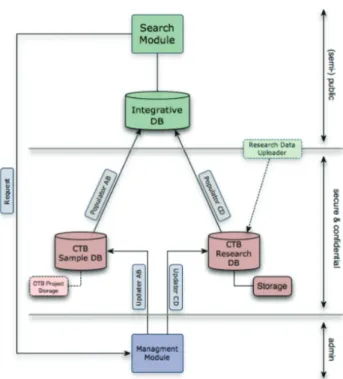
The data management infrastructure for the CTB was designed to facilitate a systems biology approach to thyroid cancer. It comprises two separate databases, plus an integrated database that serves as a portal for researchers to access information on samples and data held, and to apply for access to both data and samples (Fig. 6.1).
One, centralized web-accessible database, held on secure servers at Imperial College London holds anonymised information on donors to the CTB and the biological samples donated by them. Regular, automated transfer of patient data back to secure servers in Ukraine and Russia ensures that each center has a local mirror copy.
Detailed standard operating procedures for the collection and documentation of specimens and blood samples have been agreed upon with professional staff involved in the collection of material, and ethical standards agreed upon with the relevant authorities, conforming to the requirements of each country involved and those of the funding organisations. Each donor is identified by a unique alphanumeric code. Samples from each donor are identified by suffixes to this code enabling the specimens and any derivatives from them to be linked to the tissue block they were derived from and the individual donor. Tissue and blood samples, and extracted materials are recorded within tables in the CTB database. The database schema allows easy transfer of data between different database systems such as IBM DB2, Oracle, Microsoft SQL Server, MySQL, and PostgreSQL.
The samples database holds relevant information on the patient (date of birth, date of operation, sex, oblast of residence at the time of the accident and operation) together with pathological information and location coordinates for each sample of tissue, DNA or RNA
extracted from tissue, and blood, serum and DNA extracted from blood, and information on the quality assurance of these derivatives is also recorded within the samples database.
Dosimetry information for each patient has been provided in collaboration with Professor Ilya Likhtarov (see Chapter 2).
Security and integrity of the data in the CTB Data Warehouse is of paramount importance.
With regards to the Samples database and corresponding front-end, the access to data sets is appropriately restricted according to a country (e.g. Ukraine, Russia) and a role (e.g.
pathologist, lab technician, administrator) to which a user belongs. Integration of the Samples database with the rest of the system and transfer of data between different elements of the overall CTB Warehouse are submitted to the same strict security requirements and are designed to minimize the risks of data loss or theft. Regular, time and place restricted updates of the Integrative database from the Samples and Research databases provide the up-to-date link between the research data and the key clinical-data elements required by a researcher.
Figure 6.1. The CTB data warehouse combines the Samples, Research and Integrative Databases, Management and Search Modules with corresponding front-ends/interfaces. The system was developed with assistance from the Bioinformatics Support Services (BSS) at Imperial College, and continued close cooperation is essential for the smooth and secure integration of all the components of the overall system. Access to further samples and to information stored in the research database from the use of previous samples in research from the same patient is provided by the CTB portal.
The CTB Portal (https://cisbic.bioinformatics.ic.ac.uk/ctb/html_ctb_public/)
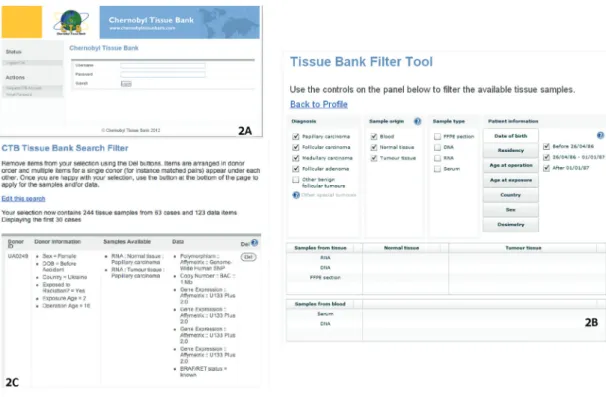
The CTB Portal provides on-line access to the resources of the CTB. Accessible either directly or from the CTB web site, the Portal gives access to a simple, but powerful, search facility that allows a researcher to search the database and check if samples are available that match the requirements for their study. Biomaterials are defined by: the type of thyroid tumor (from the consensus diagnosis of the Pathology Panel); the origin of the sample – blood, tumor tissue or normal tissue; the type of sample – FFPE section;
extracted DNA or RNA; and key patient information such as age at exposure, residency, etc. The results of the search show the number of cases that match the criteria and the number of samples that are available. The system went live on the 25th anniversary of the Chernobyl accident. Representative screenshots of the Portal and the search filter are shown in Figure 6.2.
The PI is guided through the on-line application process to request samples.
Management tools embedded within the Portal, and accessible only by the secretariat, facilitate the processing of applications and tracking progress through the review and approvals process. Once the applicant has submitted their application on-line, the secretariat checks that the application is complete. The status of the application is altered as
Figure 6.2. Representative screenshots of the CTB portal. (2A) Login entry page. (2B) User searches samples by selecting criteria of interest. As search filters are selected, numbers of samples matching criteria are shown. (2C) Representative search results page showing available samples, search criteria and additional data available for sharing.
it progresses through each stage of the process and an e-mail is automatically sent to the PI acknowledging each change of status: (submitted for review, more information required, etc.). The software automatically compiles the various sections of the application into a PDF. The secretariat then forwards this to the External Review Panel for assessment of the scientific quality of the project requesting access.
The integrative database produces a comprehensive list of all the cases identified that match the search criteria entered by the applicant. This listing is available only to the secretariat and is a significant step in the automation of the process of selecting appropriate samples for a project. The process can never be totally automated and expert oversight of the pathological information will always be required. However, the initial screening facilitates this procedure.
The CTB Portal also provides access to the Data Warehouse both for PIs to upload data from their approved CTB projects and for other researchers to be able to see if data is available linked to the cases they have selected.
Use of CTB samples in research
Biospecimens from the CTB have been provided to the major research groups involved in the studies of the consequences of the Chernobyl accident. Information on the projects receiving biosamples can be found at http://www.chernobyltissuebank.com/research.
html. Thirty projects have been approved for access to date; 11,901 samples have already been released to these projects. Of these, 11,498 were provided from the Ukrainian section of the CTB. Scientific evaluation of each project is provided by the CTB’s External Review Panel (ERP) and the outcome of the review and, where appropriate, any feedback from the ERP is provided to the applicant.
This approach provides a basis that fosters international collaboration and reduces the chance of competition and even friction between groups in their requests for this material.
Researchers who obtain material from the resource agree to provide the results of their investigation on a case-by-case basis to enable combined analysis to be carried out at a later date. The provision of extracted nucleic acid from thyroid tissue, rather than each researcher being provided with a small piece of tissue, maximises the amount of data that can, potentially, be obtained from a single operative specimen and enables multiple molecular biological studies to be carried out for each case. The median number of projects supplied by material from a single case at present is 4 with some being used in more than 9 projects. Details of the publications resulting from material supplied by the project are listed on the project website (www.chernobyltissuebank.com/papers.html). Data on Copy Number Alteration, mRNA expression, SNP and mutation/translocation of thyroid cancer key oncogenes RET and BRAF, is already available for over a quarter of the cases, with miRNA array and methylation DNA array data being made available through the EU funded EpiRadBio project. Similar data will also be available soon from patients enrolled in the Ukrainian-American Cohort.
Results of Research studies
The pathology of all cases submitted to the CTB is reviewed by an International Pathology Panel. Their review of the cases has suggested a new classification for thyroid cancer [5]
and has shown that the latency affects the morphological subtype and aggressiveness of papillary cancers [6] with the frequency of the solid subtype falling from 24 to 6% over the first two decades after the accident, and a similar decline in the frequency of extrathyroid extension and lymph node metastases [7]. A more detailed explanation of the pathological features can be found in Chapters 4 and 5 in this book.
The results of molecular biological studies that have used material from the Chernobyl Tissue Bank are included in Chapter 7 in this book. An abstract of all projects authorized to use material from the CTB, and links to papers that have resulted from these projects, are available on the project website (www.chernobyltissuebank.com).
Thus, we can conclude that understanding the major drivers in tumour growth will depend increasingly on being able to take a systems biology approach, rather than an individual gene or analytical platform approach. It is already evident from the literature that a change in copy number at the DNA level does not always result in an increase in RNA expression of all of the genes coded for by the amplified region, and that identifying critical nodes within networks of converging signalling pathways will be necessary to understand the functional biology of cancer [8]. Collating all of the research data generated from the samples donated by those affected by the Chernobyl accident is a challenge. By collating the data in a central resource, the CTB will facilitate not only projects that require access to samples alone, but also projects that wish to link their results with data already available.
Tissue banks are likely to be key players in this type of cancer research in future and should be designed from the outset to facilitate this aim.
References
1. Kazakov VS, Demidchik EP, Astakhova LN. Thyroid cancer after Chernobyl. Nature 1992;359:21.
2. Baverstock K, Egloff B, Pinchera A, Williams D. Thyroid cancer after Chernobyl. Nature 1992;
359:21-22.
3. Thomas GA, Pinchera A, Reiners C, Bauchinger M. Final report for EC contract FI4C CT98 0017; 2001.
4. Thomas GA, Bethel JA, Galpine A, et al. Integrating research on thyroid cancer after Chernobyl- the Chernobyl Tissue Bank. Clin Oncol 2011;23:276-281.
5. Williams ED, Abrosimov A, Bogdanova T, et al. Two Proposals Regarding the Terminology of Thyroid Tumors. Int J Surg Pathol 2000; 8:181-183.
6. Williams ED, Abrosimov A, Bogdanova T, et al. Thyroid carcinoma after Chernobyl latent period, morphology and aggressiveness. Br J Cancer 2004;90:2219-2224.
7. LiVolsi VA, Abrosimov A, Bogdanova T, et al. The Chernobyl thyroid cancer experience: pathology.
Clin Oncol 2011;23:261-267.
8. Faratian D, Clyde RG, Crawford JW, Harrison DJ. Systems pathology-taking molecular pathology into a new dimension. Nat Rev Clin Oncol 2009;6:455-464.