H
2/ H
∞controller design
for input-delay and preview systems based on state decomposition approach
Kotaro HASHIKURA
A dissertation submitted in partial fulfillment
of the requirements for the degree of Doctor of Engineering at Tokyo Metropolitan University
Advisor: Professor Akira KOJIMA
March, 2014
Abstract
This thesis concentrates on the efficient solution methods of H2/H∞ optimal control problems for input-delay and preview systems. Although the problems can be reformulated to the ones for delay-free systems by augmenting the state space of the controlled systems, the numerical solution of the Riccati/KYP (Kalman-Yakubovich-Popov) equations for the augmented systems requires special efforts, and complicates controller tuning. On the other hand, it is known that the optimal control laws for certain classes of time-delay systems can be constructed without solving the augmented Riccati/KYP equations. Such design problems are called reduced-order construction problems in this thesis. The solutions of the reduced- order construction problems are still limited in theoretical and practical perspectives. The main purpose of the thesis is to propose a new approach for the reduced-order construction problems, which enables to derive the optimal output feedback controllers for input-delayed and preview systems in a unified manner. We focus on the internal dynamics of the overall systems, and decompose it toward theH2 andH∞ performance objectives.
The fundamental idea of our approach is first introduced for the discrete-time input- delayed H2/H∞ control problems. The state decomposition enables to solve the output feedback problem through the simpler ones, namely, the full information and output esti- mation problems. The discrete-time optimal controllers are obtained in the Smith predictor form. They are constructed from the Riccati/KYP equations for the delay-free systems.
The solution procedure is further extended to the continuous-time previewH2/H∞control problems in an output feedback setting. The optimal utilization of the preview information is exploited at the full information and output estimation problems. The clear structures of the optimal controllers are revealed as the combination of the finite-dimensional observers and preview-feedforward compensation.
In the H∞ control problems for the input-delayed and preview systems, the J-spectral factorization techniques in the literature are employed. Their interconnection to the aug- mented Riccati/KYP equations is clarified by reviewing the techniques from a view point of the internal state dynamics.
Acknowledgement
I would like to express my gratitude to many people for their support towards the com- pletion of this thesis.
Firstly, I would like to thank my supervisor Professor Akira Kojima at Tokyo Metropolitan University for his constant advice. He guided me on every aspect of my PhD research. I am also grateful to Professor Yoshito Ohta at Kyoto University. He coauthored my journal articles and conference papers, and gave me detailed and thorough comments.
Next, I would like to thank the thesis committee members: Professor Yasuchika Mori at Tokyo Metropolitan University, Professor Shiro Masuda at Tokyo Metropolitan University and Associate Professor Koji Tsumura at the University of Tokyo. They suggested many improvements in the thesis, and directed me to fill lack in explanations and presentations.
I also appreciate Assistant Professor Ryota Ishibashi at Tokyo Metropolitan University and the current and past members of Kojima Laboratory for their research discussion and daily friendship. I am very fortunate to have been studying with them.
Finally, I would like to thank my parents for their understanding and encouragement.
Contents
Abstract iii
Acknowledgement iv
Notation viii
1 Introduction 1
1.1 Background of research . . . . 1
1.2 Motivation for reduced-order construction methods . . . . 1
1.2.1 Previous results for input-delayed control systems . . . . 2
1.2.2 Previous results for preview control systems . . . . 3
1.3 Contributions of this work . . . . 4
1.3.1 Discrete-time H2 input-delayed control . . . . 4
1.3.2 Discrete-time H∞ input-delayed control . . . . 4
1.3.3 Continuous-time H2 preview control . . . . 5
1.3.4 Continuous-time H∞ preview control . . . . 5
1.4 Organization of this thesis . . . . 6
2 Discrete-time H2 input-delayed control 7 2.1 Introduction . . . . 7
2.2 Problem formulation . . . . 7
2.3 Consideration on the Smith predictor . . . . 9
2.4 Truncation operator . . . 13
2.5 Solution via closed-loop reduction . . . 14
2.5.1 Full information problem . . . 14
2.5.2 Output estimation problem . . . 16
2.6 Increase of the optimal cost . . . 18
2.7 Example . . . 21
2.8 Proofs . . . 23
2.8.1 Proof of Lemma 1 . . . 23
2.8.2 Proof of Theorem 2 . . . 24
2.9 Conclusion . . . 25
3 Discrete-time H∞ input-delayed control 26 3.1 Introduction . . . 26
3.2 Problem formulation . . . 27
3.3 Completion operator . . . 29
3.4 Solution via closed-loop reduction . . . 30
3.4.1 Full information problem . . . 30
3.4.2 Output estimation problem . . . 36
3.5 Alternative solvability condition via min-max optimization . . . 40
3.5.1 Min-max optimization approach . . . 43
3.5.2 Interpretation of approaches . . . 49
3.6 Example . . . 52
3.6.1 Performance limit via J-spectral factorization . . . 52
3.6.2 Performance limit via min-max optimization . . . 54
3.7 Proofs . . . 56
3.7.1 Proof of Lemma 3 . . . 56
3.7.2 Proof of Theorem 3 . . . 57
3.7.3 Proof of Lemma 4 . . . 59
3.7.4 Proof of Lemma 8 . . . 60
3.7.5 Proof of Lemma 10 . . . 61
3.7.6 Proof of Lemma 11 . . . 61
3.8 Conclusion . . . 62
4 Continuous-time H2 preview control 63 4.1 Introduction . . . 63
4.2 Problem formulation . . . 64
4.3 Model matching and spectral factorization . . . 65
4.4 Solution via closed-loop reduction . . . 67
4.4.1 Full information problem . . . 67
4.4.2 Output estimation problem . . . 70
4.5 Example . . . 73
4.6 Proofs . . . 77
4.6.1 Proof of Lemma 15 . . . 77
4.6.2 Proof of Lemma 16 . . . 77
4.7 Conclusion . . . 78
5 Continuous-time H∞ preview control 79 5.1 Introduction . . . 79
5.2 Problem formulation . . . 80
5.3 Solution via closed-loop reduction . . . 81
5.3.1 Full information problem . . . 81
5.3.2 Output estimation problem . . . 85
5.4 Solution of operator Riccati equation . . . 89
5.5 Example . . . 91
5.6 Proofs . . . 93
5.6.1 Proof of Lemma 17 . . . 93
5.6.2 Proof of Theorem 10 . . . 95
5.6.3 Proof of Theorem 11 . . . 97
5.7 Conclusion . . . 98
6 Conclusion 99 6.1 Summary of the thesis . . . 99 6.2 Subjects of future research . . . 100
Bibliography 101
Publications 106
Notation
• Mij: The (i, j) block of a linear operator or matrixM.
• σ(M): The set of the spectra of a linear operatorM or set of the eigenvalues of a square matrixM.
• Js: A block matrix which defines a symplectic inner product; Js:=
O −I I O
.
• H(z−l): The orthogonal complement ofz−lH2 inH2.
• W2,1([0, l]): The Sobolev space of the functions weakly differentiable inL2([0, l]).
• Ta b: The transfer function from the inputbto the outputa.
• G∼: The para-conjugate of the transfer functionG.
• P1 P2: The Redheffer’s star product of two-input-output systems P1 and P2; For P1 : (w1, u1)→ (z1, y1) and P2 : (w2, u2) →(z2, y2), P1 P2 denotes the system obtained by connectingy1 and z2 to w2 and u1, respectively.
• C(P): The chain scattering representation of a two-input-output system P; C(·) defines the two-input-output systemC(P) : (y, u)→(w, z) fromP : (w, u)→(z, y).
• C−1(G): The inverse chain scattering representation of a two-input-output system G;
C−1(·) is the inverse mapping ofC(·).
• S(Φ): The Schur complementation transform of a two-input-output system Φ;S(·) defines the two-input-output systemS(Φ) : (h, u)→(−y, k) from Φ : (y, u)→(h, k).
• S−1(Ω): The inverse Schur complementation transform of a two-input-output system Ω;
S−1(·) is the inverse mapping of S(·).
• δφ, θ: The Kronecker’s delta; δφ, θ = 1 if φ=θ, andδφ, θ = 0 if φ=θ.
• Γθ: The trace operator; It evaluates the values off(·)∈W2,1([0, l],Rn) atθ: Γθf =f(θ).
• δθ: The delta function which has its support atθ.
• H(θ): The step function;H(θ) = 1 ifθ >0, andH(θ) = 0 if θ <0.
Chapter 1 Introduction
1.1 Background of research
Dynamical systems such as chemical, transport, and flexible structure systems are often modeled as input-delayed systems. Predictive control strategies [11], [43] are systematic ways to compensate the adverse effects of the input-delays. Time-delays are also employed to formulate preview control problems, where efficient use of future information is investigated to improve control performances [60]. They have applications in active suspension of vehicles, positioning of cranes, and shape control of rolling mills.
The state-space augmentation is known as the standard and straightforward technique which allows us to apply general theories of delay-free systems to state or input-output delayed systems. The technique regards the past history of state or input-output signals as state variables, and rewrites the delayed systems into the delay-free forms. Since the dimensions of the overall systems including the past history increases according to the delay lengths, the overall systems in the delay-free forms are called the augmented systems.
In the discrete-time settings, the H2/H∞-optimal control laws can be determined, in principle, by solving the matrix Riccati/KYP (Kalman-Yakubovich-Popov) equations for the augmented systems. However, the numerical computation of their solutions suffers from complexity and inaccuracy due to the increased orders and special structures of the delay elements [4]. In the continuous-time setting, the overall system including preview lags is an infinite-dimensional system, and the associated Riccati equation turns out to be a couple of nonlinear PDEs (partial differential equations). Although they can be approximately solved by gridding spatial domains and by selecting interpolating functions, such approximations raise stability concerns on the resulting controlled systems [25].
1.2 Motivation for reduced-order construction methods
To overcome the difficulties associated with the state augmentation, a state-prediction approach for the discrete-time input-delayed LQ control is proposed in [43]. The optimal state feedback gain and control cost are constructed from the standard Riccati equation for the corresponding delay-free system. It is also shown that the Hermitian matrix defining the optimal control cost is in fact the stabilizing solution of the standard Riccati equation for the augmented system. In the continuous-time settings, it has been known that the solutions of the operator Riccati equations can be found in some control problems [61]. The class of input-output delayed systems for which the operator Riccati equations are explicitly solvable has been expanding [28], [30].
In this thesis, we define the reduced-order construction problems as those of constructing the optimal control laws for time-delay systems without solving the augmented Riccati/KYP equations. The reduced-order construction methods enable to avoid the numerical difficulties and lead to simplification of controller tuning process. The studies in [23], [47] indicate the
reduced-order construction methods developed for the control of input-delayed systems can be generalized for that of the infinite-dimensional systems with inner functions at the control input. The optimal control problems for them have been studied from the operator theoretic perspectives [9], [22], and the explicit solutions are obtained in terms of finite-dimensional matrix operations. We cite reduced-order construction methods relevant for input-delayed and preview control problems in the two subsections below.
1.2.1 Previous results for input-delayed control systems
The results in [34] and [47] can be regarded as the extensions of that in [43] to the discrete- time LQG andH2control problems, respectively. The former deals with multiple input-output delays entering different channels. The result requires solving the control Riccati equation with its order increasing according to the time delay lengths when the number of the input delays is more than one. The latter studies the H2 control problem where the input delay is generalized to a general inner function, and revealed the relationship between the inner function and achievable control performance. However, no causally implementable form of the optimal controller is provided. The relevant results for delayed-measurement systems with its performance index as the closed-loopH∞norm are reported in [17], [56], [8]. In [17], [56], the solution of theH∞ filtering problem under one-step delayed measurement is constructed from the standard Riccati equation for the delay-free case. However, generalization of their construction methods to the multi-step delayed case is not straightforward. In [8], an alter- native approach based on theJ-spectral factorization theory is developed to theH∞filtering problem under multi-step delayed measurement. It requires constructing interactor matrices as many times as the delay length to cancel infinite zeros due to the delay element, and hence the resulting solution is not as simple as that in [43].
The continuous-time theory is more mature than the discrete-time one in that it can handle theH∞performance objective in output feedback settings. In [38], [40], anH2 control problem for a generalized rational plant with a single input-delay is solved finding constraints on the associated finite-dimensional problem. In [36], the fundamental technique of reducing an delayed J-spectral density to delay-free one is proposed . In the subsequent papers [37], [38], this technique is enhanced to treat the continuous-time H∞ problem for a generalized rational plant with a single input-delay. The dynamic programming solutions for theH2 and H∞performance objectives are given in [44] and in [52], respectively. In [28], explicit solutions of operatorH∞-type Riccati equations are constructed via state transformation and integral equations. The corresponding operatorH2-type Riccati equations can be solved using similar techniques.
Among the above continuous-time results, the resulting H∞ controller is parameterized using the Riccati equations in the standardH∞ problem in [38]. And the structure of them is identified as the Smith-type one, which consists of the finite-dimensionalH∞controller for the unstable dynamics and the measurement compensation part based on the past history of the control input. However, it is not a trivial question whether the discrete-time H∞ controller can be also parameterized using the standard Riccati or KYP equations and im- plemented in the Smith form for the following reasons: 1) the discrete-time KYP equations have more complicated structures than the continuous-time counterparts; 2) The approach in [37], [38] involves the preliminary step where the inner function at the control input channel
is regarded as a part of the controller. The step requires auxiliary arguments to guarantee the causality of the controller and elaborate manipulation of transfer functions to obtain the final implementation form.
1.2.2 Previous results for preview control systems
The reduce-order construction methods for the continuous-time H2/H∞ preview control problems have been obtained in parallel approaches for the input-delayed problems. However, most of them are limited to the full information settings. For brevity, we cite mainly the results in the continuous-time settings. In [31], [38], the continuous-time fixed-lag smoothing prob- lems are solved by reducing the infinite-dimensionalJ-spectral density to a finite-dimensional one. That technique can be regarded an extension of the J-spectral factorization technique for the input delay systems in [36]. The problem setting can be regarded as dual to the full information preview control problems. In [53], [54], both continuous- and discrete-time preview control problems are tackled via a unified game theoretical method by splitting the optimization intervals. In [45], the idea similar to [53], [54] is applied to the H2 controller design. In [28], the established state transformation technique is capable of dealing with the input delay and preview information at the same time.
In preview control systems, the control input is allowed to utilize the future information of external signals. Such situations can be artifically realized with sensors reading the in- coming signals. In active suspension control [31], the road profiles in front of vehicles can be available with displacement sensors. They are regarded as preview information and utilized for improving riding comfort or road handling. In rolling mill control [7], rough steel is fed through a series of rollers to shape it into desired forms. Upstream variation in steel thickness and roll gaps can be given to downstream controllers as preview information. As for large and complex control systems, it is difficult to prepare sensors enough to measure all the state variables and disturbances. In active suspension control, either the displacement or velocity of dumpers is often measured [18], [35]. In rolling mill control, the tension variation around rollers is estimated using disturbance observes when accurate measurement is difficult under the rolling environment [19], [62]. From the viewpoint of the practical applications, it is im- portant to identify the measurement information patterns based on which optimal preview control problems are explicitly solvable.
The output feedback H2 controller design methods are reported in [32], [57]. However, the exact optimality of the overall closed-loop system is not guaranteed because the available preview information is not considered in their first design stages. In the former method, the state-space Youla parameterization is employed for the stabilization of the system at the first stage. At this stage, the stabilizing feedback gains can be chosen arbitrarily, only if they are stabilizing. The Youla parameter is determined by the orthogonality principle inH2 space at the second stage. In the latter method, the standard finite-dimensionalH2 controller for the non-preview case is constructed at the first stage. At this state, the fact that the control input can act in advance of the disturbance is ignored. The preview information is incorporated into the additional compensation [27] at the second stage.
H∞ preview controller synthesis based on partial information on state variables and dis- turbances is addressed in [26], where the partial information on the state variables is free from measurement noise. The state transformation in [28] enabled to solve the operator Riccati
equations explicitly. A competing approach with the operator Riccati equation approach is theJ-spectral factorization approach originated in [36]. The preview control problem in the full information setting can be easily solved by dualizing the results in [31], [38]. However, the application of the technique to the output feedback setting needs further investigation.
This is because, in contrast to the input-delay problem [38], the preview action is difficult to be regarded as the constraint on the controller.
1.3 Contributions of this work
The thesis proposes alternative reduce-order construction methods of theH2/H∞optimal controllers for the input and preview systems. We focus on the internal dynamics of the overall systems, and decomposes it to derive the delay-free systems which play a key role for theH2/H∞ performance optimization. Our approach enables to derive the optimal output feedback controller in a unified manner. The output feedback problem is solved through the simpler ones, namely the full information and output estimation ones. The internal state decomposition approach is applicable in both continuous-time and discrete-time settings.
Below we explain how the proposed approach achieves the contributions, and reveals the new insights in the reduced-oder construction problems.
1.3.1 Discrete-time H2 input-delayed control
The output feedback stabilization of a discrete-time single-input input-delayed system is described as a preliminary result. We focus on the state-space representation of the input delay element, and introduce a state transformation to derive a Smith predictor.
Motivated by the state transformation, the internal state decomposition approach is in- troduced to derive the reduced-order construction method for the discrete-time input-delayed H2 control problem. The causality and stability constraints imposed by the delay element are resolved more simply in comparison with the previous approach [23], [40], [47].
We obtain the optimal controller in the Smith predictor form from the Riccati equations for the corresponding delay-free system. The resulting controller has the different structure from those in the state predictor form [34]. It is implemented with the observer for the possibly unstable dynamics and a measurement compensation part based on the past history of the control input.
1.3.2 Discrete-time H∞ input-delayed control
We pursues a parameterization of the discrete-time H∞ suboptimal controllers for the input-delayed systems. A discrete-time counterpart of theJ-spectral factorization technique in [36] and [37] is developed as the main tool. In contrast to the previous research [37, 38, 21], the first step is to simplify the original problem to an one-sided model matching problem, and to apply the J-spectral factorization technique to the latter. The second step is to formulate an output estimation problem in order to realize the control law based on partial information. Focusing on the relationship between the state variables of the irrational and reduced rationalJ-spectral densities, the measured output is modified in order to reduce the output estimation problem to finite-dimensional one. It is revealed that the parameterization
of the H∞controllers is obtained only by solving the standard KYP equations and checking the matrix eigenvalues. They are implemented in the Smith form using the past history of the control input.
The above-mentionedJ-spectral factorizability condition composes a part of the solvability conditions for the output feedback problem. The min-max optimization approach is also considered in the full information setting to obtain an alternative solvability condition. We extend the optimization technique in [52] into the discrete-time setting, and construct the stabilizing solution of the standard KYP equation for the augmented system from that for the delay-free systems. Furthermore, the J-spectral factorizability condition is proved to be equivalent to the H∞ disturbance attenuation condition by analyzing the initial finite-time response of the input-delay system, and consequently that approach is confirmed to yield the same control law as the min-max optimization approach.
1.3.3 Continuous-time H2 preview control
We investigate the effectiveness of the state decomposition in designing H2 preview con- trollers. The output feedback controller is constructed through the full information and output estimation problems. Contrary to the previous design methods [32], [57], we exploit the avail- able preview information at all the design stages, and derive the output feedback controller guaranteeing the exact optimality. The preview controller can be given the interpretation as the finite-dimensional observer combined with preview-feedforward compensation.
In the full information problem, we utilize the fact that the optimal state feedback law is obtained as the solution of the corresponding model matching problem. We introduce alterna- tive state transformations to solve the model matching problem via the spectral factorization theory [17]. One of the state transformations defines the state decomposition parallel to that in the discrete-time input-delayedH2 control problem. In the output estimation problem, we employ the newly introduced state variable to describe the infinite-dimensional generalized plant in the form amenable to the explicit solution.
1.3.4 Continuous-time H∞ preview control
We extend the design procedure of solving the full information and output estimation prob- lems to theH∞control case. The clear structure of the preview controller is again identified as the combination of the finite-dimensional observer and preview-feedforward compensation.
It is shown to be possible to construct theH∞ preview control law based on the information pattern different from those in [26].
In the full information problem, the technique of reducing an irrationalJ-spectral density to rational one [38] is employed. We clarify the relationship between the state variables of the infinite-dimensional and reduced finite-dimensional J-spectral densities by introducing the state transformations. The explicit solution to the control-type operator Riccati equation is found by combining the proposed state transformations.
1.4 Organization of this thesis
The thesis consists of six chapters including this chapter. The rest of the thesis is organized as follows:
Chapter 2 addresses the H2 control problem for the discrete-time input-delayed systems.
The fundamental idea of the state decomposition approach is introduced based on the deriva- tion of a Smith predictor for a single input-delay system. The efficient implementation of the optimal controller in the Smith predictor form is provided.
Chapter 3 pursues a parameterization of the discrete-timeH∞ suboptimal controllers. A discrete-time counterpart of the J-spectral factorization technique in [36] is developed. A discrete-time counterpart of the min-max optimization technique in [52] is also considered.
The stabilizing solution of the augmented KYP equation and another characterization of the solvability are provided using that for the delay-free case.
Chapter 4 shows that the internal state decomposition approach is also effective to derive the H2 preview output feedback controller. The clear structure of the optimal controller is identified as the combination of the finite-dimensional observer and preview-feedforward compensation. Contrary to the previous design methods [32], [57], the proposed one enables to derive the output feedback controller archiving the exact optimal performance.
Chapter 5 extends the preview control design method to theH∞control case. Our design method leads to the H∞ preview controller based on the information pattern different from those in the previous research [28]. As an additional note, the relationship between the J- spectral factorization technique in [31], [38] and the operator Riccati equation is presented.
Chapter 6 reviews the H2/H∞ controller design methods obtained in the previous chap- ters, and summerizes the features of them. The future subjects of research are stated with reference to the strength and limitations of the proposed approach.
Chapter 2 Discrete-time H2 input-delayed control
2.1 Introduction
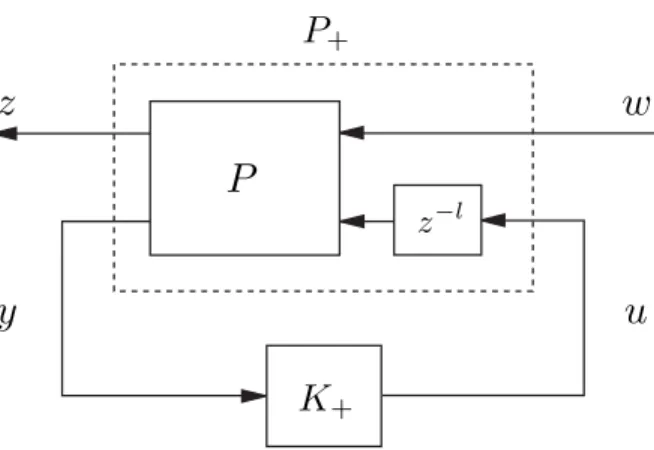
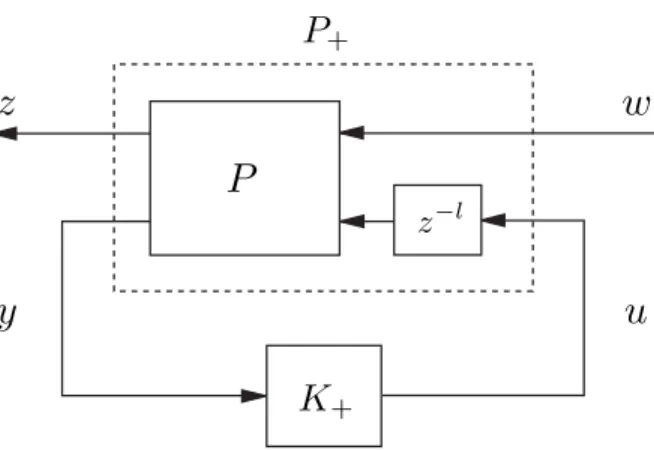
This chapter is concerned with the discrete-time H2 control problem under the setup in Fig. 2.1, whereP+ is an input-delayed generalized plant andK+is a controller to design. The generalized plantP+ consists of thel-step delay functionz−land delay-free generalized plant P. The continuous-time counterpart of the problem is solved in [40], where the delay function e−slexists at the control input. The more general continuous- and discrete-time problems are studied in [23], [47], where the delay functionse−sl andz−l are generalized to the continuous- and discrete-time inner functions m(s) and m(z), respectively. The previous approach in [23], [40], [47] regards the existence of the delay or inner function as the constraint on the stabilizing controller for the delay-free generalized plantP, and restrict the Youla parameter for the delay-free problem so that the causality and stability are preserved. The approach successfully characterizes the increase of the optimal cost due to the delay or inner functions in a closed form, and allows us to interpret the deteriorating effect of the time-delay or unstable zeros. However, it is difficult to see how the unstable dynamics ofP+ is stabilized, and in the discrete-time setting [47] the explicit optimal controller is not given.
We derive a new solution method by decomposing the state variable of P into the sum of the possibly unstable and stable ones. The former has the dimension independent of the delay lengthl. The latter has the the dimension equal to l multiplied by the number of the control inputs. Our solution method does not require considering the causality and stability constraints imposed by the input delay. The state decomposition approach reveals a new interpretation of stabilization process, and leads to the explicit form of the discrete-timeH2 optimal controller. For the derivation of the solution method, two preparations are made; 1) To describe the fundamental idea of the state decomposition approach, a discrete-time Smith- predictor for a single input-delay system is derived based on state-space representation; 2) To utilize the H2 orthogonality principle effectively, an alternative discrete-time truncation operator to the literature [47] is introduced.
This chapter is organized as follows. In Section 2.2, the problem formulation and as- sumptions are stated. In Section 2.3, the discrete-time Smith-predictor is derived based on state-space representation. In Section 2.4, the alternative discrete-time truncation operator is introduced. In Section 2.5, the state decomposition approach is developed to cope with the input delay, and the explicit optimal controller is derived. In Section 2.7, the input-delay effect on the sampled-dataH2 control performance is analyzed using the obtained results. In Section 2.8, the proofs left in the previous sections are given.
2.2 Problem formulation
We address the H2 control problem for the input-delayed plant P+. The focus is on the parameterization of the stabilizing controllerK+through the delay-free control problem. The
z w
y u
P P+
K+
z−l
Figure 2.1: Control system with input delay.
delay-free partP is assumed to be P =
P11 P12 P21 P22
=
⎡
⎣ A B1 B2 C1
C2
D11 D12 D21 O
⎤
⎦, (2.1)
and satisfies the same assumptions (A1)-(A2) as in the standardH2 control problem [20].
(A1) (A, B2) and (A, C2) are stabilizable and detectable, respectively.
(A2) For∀θ∈[−π, π],
A−ejθI B2 C1 D12
and
A−ejθI B1 C2 D21
are of full column rank and of full row rank, respectively.
The above assumptions ensure the existence of the positive semidefinite stabilizing solutions X and Y of the following control- and filtering-type Riccati equations:
Q+A∗XA−X−(S∗+B2∗XA)∗R−1c (S∗+B2∗XA) =O, Rc:=R+B2∗XB2 > O, Q´+AY A∗−Y −
S´∗+AY C2∗ R´c−1
S´∗+AY C2∗ ∗
=O, R´c:= ´R+C2Y C2∗ > O, where the following definitions are used for simplicity:
Q S S∗ R
:= C1 D12∗
C1 D12 ,
Q´ S´∗ S´ R´
:=
B1 D21
B1 D21
∗ . Furthermore, the nonsingularity of the state matrixAis required in our approach.
(H) The matrix A is nonsingular.
Based on the preliminaries in Sections 2.3 and 2.4, the discrete-timeH2optimal controller is derived via the full information and output estimation problems.
2.3 Consideration on the Smith predictor
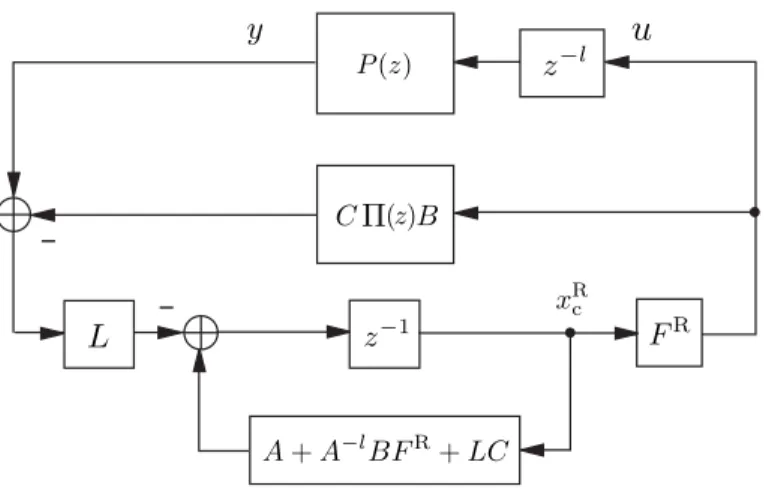
Two well-known stabilization methods for time-delay systems are the Smith’s method and the finite spectrum assignment method. In the former method, the adverse effects of time- delays are eliminated from the closed-loop systems via loop-shifting arguments with internal models [46], [48], and the resulting controller is called the Smith predictor. In the latter method, the feedback control laws which relocate the finite number of unstable spectra of the time-delay systems are constructed via state-predictive transformations [11] and the resulting controller is called the finite spectrum assignment controller. In [40], it is revealed that the H2 optimal controller for the continuous-time single input-delay system has a Smith predic- tor structure, and can be recast as the observer-predictor-based finite spectrum assignment controller.
In this section, we derive a discrete-time Smith predictor and observer-predictor-based controller for a single input-delay system via Krein’s formula [13], which expresses the solu- tions of Sylvester equations by complex integration. The presentation in this section has an important implication for deriving our solution method.
Consider the discrete-time single input-delay systemP(z)z−l (l is a positive integer):
x(n+ 1) =Ax(n) +Bu(n−l) y(n) =Cx(n).
For technical reasons, we assume thatA is nonsingular and the pairs (A, B) and (A, C) are stabilizable and detectable, respectively. Let us define the collection of the past control inputs:
υ(n) :=
⎡
⎢⎢
⎢⎣ υ(1, n) υ(2, n)
... υ(l, n)
⎤
⎥⎥
⎥⎦:=
⎡
⎢⎢
⎢⎣
u(n−1) u(n−2)
... u(n−l)
⎤
⎥⎥
⎥⎦∈Rl·dimu.
By augmenting the state space fromRdimx toRdimx×Rl·dimu, the input-delay system can be rewritten as the delay-free system:
x(n+ 1) υ(n+ 1)
=
A BΓ1
O S
x(n) υ(n)
+ O
∆l
u(n), (2.2)
y(n) =Cx(n), where
S :=
⎡
⎢⎢
⎢⎢
⎢⎢
⎣ O I
O I
... . . .
... I
O O · · · · O
⎤
⎥⎥
⎥⎥
⎥⎥
⎦
∈Rl·dimu×l·dimu,
∆l:= OT OT · · · OT IT T
∈Rl·dimu×dimu, Γ1 := I O O · · · O
∈Rdimu×l·dimu.
In Eq. (2.2), the possibly unstable mode of x(n) is influenced by the stable mode of υ(n) throughBΓ1. To eliminate BΓ1, we consider the following transformation:
I Ux O I
A−zI BΓ1 O S −zI
I −Ux
O I
=
A−zI BΓ1−(AUx−UxS)
O S −zI
, (2.3)
whereUx ∈Rdimx×Rl·dimu is a matrix, which should satisfy the Sylvester equation AUx−UxS =BΓ1
to make the (1,2) block in Eq. (2.3) zero. Using Krein’s formula, we can find the solution:
Ux= 1 2πj
∂σ(A)(zI−A)−1BΓ1(zI− S)−1dz
=A−1BΓ1+A−2BΓ1S+· · ·+A−lBΓ1Sl−1, where the following identity is used:
(zI − S)−1= I z + S
z2 +· · ·+ Sl−1 zl . Introducing a new state variablexR(n) by the equation
x(n) υ(n)
=
I −Ux
O I
xR(n) υ(n)
, (2.4)
the input-delay system is represented as xR(n+ 1)
υ(n+ 1)
=
A O O S
xR(n) υ(n)
+
A−lB
∆l
u(n), y(n) =C I −Ux xR(n)
υ(n)
, where its state-transition matrix is block-diagonalized.
Temporarily, let us assume all the state variables are available. We choose the following state feedback gain forxR(n):
FR :=F Al,
whereF is such thatA+A−lBFR=A−l(A+BF)Alis stable. SinceS is stable, the following state feedback law stabilizes the dynamics ofxR(n) and υ(n):
u(n) = FR O xR(n) υ(n)
.
Next, we introduce the following standard observer to estimatexR(n) and υ(n):
xRc(n+ 1) υc(n+ 1)
=
A O O S
xRc(n) υc(n)
+
A−lB
∆l
u(n) + LRx
LRυ C I −Ux xRc(n) υc(n)
−y(n)
.
![Figure 2.4: Impulse responses of τ z −l [G] and τ z −l [G].](https://thumb-ap.123doks.com/thumbv2/123deta/10133360.1967248/22.918.309.610.121.355/figure-impulse-responses-τ-z-g-τ-g.webp)