Breadmaking Properties of Frozen-and-Thawed Bread Dough
2015
Naomi Morimoto
Contents
Page
Chapter 1 Introduction 1
Chapter 2 Breadmaking Properties of Frozen-and-Thawed Bread Dough
Object
8
Abstract
8
Materials and Methods
8
Results and Discussion
10
Conclusion
15
Chapter 3 Restoration of Breadmaking Properties to Frozen Dough by Addition of Sugar and Yeast and Subsequent Processing
Object
17
Abstract
17
Materials and Methods
18
Results and Discussion
23
Conclusion
29
Chapter 4 Effect of Xanthan Gum on Improvement of Bread Height and Specific Volume upon Baking with Frozen and Thawed Dough
Object
31
Abstract
31
Materials and Methods
32
Results and Discussion
35
Conclusion
44
Chapter 5 Centrifuged Liquid of Frozen-and-Thawed Bread Dough
Object
46
Abstract
46
Materials and Methods
46
Results and Discussion
48
Conclusion
55
Chapter 6 Conclusions 57
List of Publications 59
Acknowledgments 60
List of Abbreviation
SV Specific volume HM pectin High Methoxyl pectin LM pectin Low Methoxyl pectin CMC Carboxymethyl cellulose
Chapter 1
Introduction
Frozen dough is widely used in the breadmaking industry, and it is generally believed that the use of frozen dough will increase in the future. The use of frozen dough has the advantage of allowing breadmaking to be discontinuous, obviating the need for the process to continue uninterrupted from start to finish. However, there are two problems with the use of frozen dough that hinder its use in the breadmaking industry. One is related to the effects of freezing on baker’s yeast and has been studied by many researchers,1) resulting in the development of freeze-resistant yeast strains.
Kline and Sugihara proposed that release of disulfide-reducing substances into the dough from dead yeast cells caused a decrease in gassing power and gradual loss of dough strength. 2) Progress being made in yeast biochemistry and the underlying genetic elements responsible for freeze-tolerance traits may soon offer opportunities to exploit the tools of biotechnology to create improved strains of yeast for frozen dough.3) Another problem is related to deterioration in the bread dough itself caused by the freezing, and this also has been studied by many researchers. According to Variano-Marston et al.,4) the structure of gluten in frozen dough was damaged by formation of ice crystals. And Wolt and D’Appolonia suggested that protein quality (strength) was important for bread production from frozen dough. 5) Inoue and Bushuk
6,7) and Inoue et al.8) reexamined the extensigraphic patterns of frozen doughs and confirmed the weakening of doughs containing yeast observed by Variano-Marston et al.4) during frozen storage and successive freeze-thaw cycles. However, the mechanism of this deterioration has not been determined. Therefore, we investigated to clarify the cause of the deterioration of breadmaking properties. First, we observed the surface of the frozen-and-thawed dough and we noticed that the dough was wet.
Thus in chapter 2, we tried to collect free water oozed from frozen-and-thawed
dough and to show the relationship between free water oozed from frozen-and-thawed dough and the dough’s breadmaking properties.
The reason is unclear why depression of breadmaking properties such as bread height (mm) and specific volume (cm3/g) caused by freezing and thawing of bread dough occurs.9) Berglund et al. observed that changes in water distribution occurred during extended frozen storage and freeze-thaw cycles, and the observed changes in the ultrastructure of the starch granules and gluten may contribute to the extended proof times and reduced loaf volumes of frozen bread doughs. 10) Lu and Grant showed that water separates from the protein and starch components in frozen dough and accumulates into a pool that subsequently crystallizes and that during prolonged frozen storage the amount of freezable water in the frozen doughs increases significantly. 11) Zounis et al. observed that the cause of disruption apparently was a change in the ice crystal structure as indicated by the appearance and increase in the size of angular voids in doughs during frozen storage. 12) Bot reported that in gluten stored at -15℃, the water content in the gluten phase decreased by around 1% over the first three weeks, and the same changes occurred in dough stored at either -15 or -25℃ as in gluten at -15℃. 13) Naito et al. reported that scanning electron microscopy images of grain pore walls that were washed with distilled water (20℃) clearly showed that gluten fibrils forming the skeletal framework of pore walls were cut and became coarse and nonuniform strings and that many knots were generated on gluten fibrils from freeze damage. 14) Esselink et al. reported that, at the macroscopic level, ice crystals are not evenly distributed over the molded dough, nor are the gas cells homogenously distributed throughout the dough.
15) Nicolas et al. indicated that after thawing, gluten microstructure exhibited a structure similar to that of fresh gluten, with the structure looking like a sponge (a fine gluten structure with tiny water pockets). 16) Seguchi et al. examined the relationship between depression of breadmaking properties and increase in the amount of the centrifuged liquid from frozen and thawed dough and reported that the amount of centrifuged liquid
In chapter 3, we studied the cause of these phenomena that were reported in Chapter 2. To better understand which breadmaking processes are affected by freezing and thawing and why freezing and thawing cause depression of breadmaking properties, we inserted a freezing step into the bread dough process (mix, proof, mold, proof, and bake). We inserted the freezing step after mixing of wheat flour, sugar, salt, and water (bread dough A); after mixing of dough A plus yeast (bread dough B); and after first proof, mold, and second proof of dough B (bread dough C). We further investigated whether acceptable breadmaking properties could be obtained when sugar and yeast were added to the thawed bread dough C. To research the effect of freezing on bread dough rheology, we further performed extension tests of dough by pulling the surface of the bread dough under reduced pressure.
It is generally known that breadmaking properties are markedly deteriorated by the freezing/thawing of bread dough; that is, bread height (mm) and specific volume (cm3/g) decrease to far lower levels.7,9,10,18-20) The amount of extruded liquid from thawed bread dough upon centrifugation was increased by freezing/thawing, and the deterioration of breadmaking properties by freezing is closely related to this increase in the volume of exuded liquid.17) The equally distributed water in the dough matrix migrated in order to form larger water crystals upon freezing; therefore, the amount of water necessary to make a bread cell wall was decreased by freezing, resulting in the deterioration of breadmaking properties.21) Ice formation and growth occur preferentially at the gas pore interface under dough freezing conditions.22) It was observed that the changes in the microstructure of the gluten network that are induced by cryodehydration were reversible upon thawing. However, since the thawed dough was remixed with sugar and yeast, and re-fermented as it was, normal breadmaking properties could be obtained. Thus, it was suggested that the damage caused by freezing/thawing to wheat flour components, such as water-soluble, gluten, prime starch, and tailing fractions, was small and it was shown that the deterioration due to freezing/thawing of yeast was also small.21) Therefore, the cause of deterioration of
bread baked with freezing/thawing was due to the loss of water from the frozen dough.
Simmons et al. reported that soy ingredients stabilized bread dough during frozen storage. 23) Sharadanant and Khan reported that the addition of gums (gum arabic, carboxymethyl cellulose (CMC), kappa (κ) carrageenan, and locust bean gum) to a frozen dough formulation helps to immobilize water and reduce the formation of large ice crystals that damage the gluten network. 24) The way of these improvements seemed to represent our conclusion in Chapter 3 which the cause of deterioration of bread baked with freezing/thawing was not dough’s components but the loss of water from frozen dough.
Thus, in chapter 4, we tried to use polysaccharides because they have a good absorption. The aim of this Chapter was to prevent bread deterioration from freezing/thawing by adding polysaccharides to the dough. To stop the loss of water from frozen dough, 13 kinds of polysaccharide (locust bean gum, guar gum, xanthan gum, tamarind seed gum, native gellan gum, dextrin, LM pectin, fermented cellulose CMC, κ-carrageenan, konjac glucomannan, HM pectin, ι-carrageenan, and λ-carrageenan) were examined. Breadmaking tests using these polysaccharides and determinations of extruded liquid from the dough upon centrifugation were performed. When xanthan gum was mixed in frozen bread dough, remarkable breadmaking properties were obtained. The mechanism of the improvement in breadmaking properties due to xanthan gum is also discussed in chapter 4.
We studied the relationship between free water oozed from frozen-and-thawed dough and the dough’s breadmaking properties (in chapter 2). Furthermore, in chapter 5, we examined which components of bread dough (sugar, salt, and yeast) affect the amount of centrifuged liquid, and we also studied the possibility that fermented products affect that. From these findings, we continued to investigate the relationship between amount of liquid centrifuged from dough and the presence of salt and fermented products.
References
1) Kulp K: 1995. Biochemical and biophysical principles of freezing. Pages 63-89 in:
Frozen and Refrigerated Doughs and Batters. K. Kulp, ed. Am. Assoc. Cereal Chem.: St. Paul, MN.
2) Kline L, Sugihara TF: Factors affecting the stability of frozen bread doughs. I.
Prepared by straight dough method. Baker’s Digest 46:44-50, 1968.
3) Casey GP, Foy JJ: 1995. Yeast performance in frozen doughs and strategies for improvement. Pages 19-51 in: Frozen and Refrigerated Doughs and Batters. K. Kulp, ed. Am. Assoc. Cereal Chem.: St. Paul, MN.
4) Variano-Marston E, Hsu KH, Mhadi J: Rheological and structural changes in frozen dough. Baker’s Digest 54:32-34, 41, 1980.
5) Wolt MJ, D’Appolonia BL: Factors involved in the stability of frozen dough. I. The influence of yeast reducing compounds on frozen-dough stability. Cereal Chem 61:209-212, 1984.
6) Inoue Y, Bushuk W: Studies on frozen doughs. I. Effects of frozen storage and freeze-thaw cycles on baking rheological properties. Cereal Chem 68:627-631, 1991.
7) Inoue Y, Bushuk W: Studies on frozen doughs. II. Flour quality requirements for bread production from frozen dough. Cereal Chem 69:423-428, 1992.
8) Inoue Y, Sapirstein HD, Takayanagi S, et al: Studies on frozen doughs. III. Some factors involved in dough weakening during frozen storage and thaw-freeze cycles.
Cereal Chem 71:118-121, 1994.
9) Selomulyo VO, Zhou W: Frozen bread dough: Effects of freezing storage and dough improvers. J Cereal Sci 45:1-17, 2007.
10) Berglund PT, Shelton DR, Freeman TP: Frozen bread dough ultrastructure as affected by duration of frozen storage and freeze-thaw cycles. Cereal Chem 68:105-107, 1991.
11) Lu W, and Grant LA: Effects of prolonged storage at freezing temperatures on starch
and baking quality of frozen doughs. Cereal Chem 76:656-662, 1999.
12) Zounis S, Quail KJ, Wootton M, et al: Studying frozen dough structure using low-temperature scanning electron microscopy. J Cereal Sci 35:135-147, 2002.
13) Bot A: Differential scanning calorimetric study on the effects of frozen storage on gluten and dough. Cereal Chem 80:366-370, 2003.
14) Naito S, Fukami S, Mizokami Y, et al: Effect of freeze-thaw cycles on the gluten fibrils and crumb grain structures of breads made from frozen doughs. Cereal Chem 81:80-86, 2004.
15) Esseliznk EFJ, van Aalst H, Maliepaard M, et al: Long-term storage effect in frozen dough by spectroscopy and microscopy. Cereal Chem 80:396-403, 2003.
16) Nicolas Y, Smit RJM, van Aalst H, et al: Effect of storage time and temperature on rheological and microstructural properties of gluten. Cereal Chem 80:371-377, 2003.
17) Seguchi M, Nikaidoo S, Morimoto, N: Centrifuged liquid and breadmaking properties of frozen-and thawed bread dough. Cereal Chem. 80:264-268, 2003.
18) Kenny S, Wehrle K, Dennehy T: Correlations between empirical and fundamental rheology measurements and baking performance of frozen bread dough. Cereal Chem 76: 421-425, 1999.
19) Le Bail A, Grinand C, Le Cleach S, et al: Influence of storage conditions on frozen French bread dough. J Food Eng 39: 289-291, 1999.
20) Nilufer D, Boyacioglu D, Vodovocz Y: Functionality of soymilk powder and its components in fresh soy bread. J Food Sci 73: C275-C281, 2008.
21) Morimoto N, Seguchi M: Restoration of breadmaking properties to frozen dough by addition of sugar and yeast and subsequent processing. Cereal Chem 88: 409-413, 2011.
22) Baier-Schenk A, Handschin S, von Schonau M, et al: In situ observation of the freezing process in wheat dough by confocal laser scanning microscopy (CLSM):
Formation of ice and changes in the gluten network. J Cereal Sci 42: 255-260, 2005.
23) Simmons AL, Smith KB, Vodovotz Y: Soy ingredients stabilize bread dough during frozen storage. J Cereal Sci 56: 232-238, 2012.
24) Sharadanant R, and Khan K: Effect of hydrophilic gums on the quality of frozen dough: electron microscopy, protein solubility, and electrophoresis studies. Cereal Chem 83: 411-417, 2006.
Chapter 2
Breadmaking Properties of Frozen-and-Thawed Bread Dough
Object
We studied the relationship between free water oozed from frozen-and-thawed dough and the dough’s breadmaking properties.
Abstract
Breadmaking properties (bread height (mm) and specific volume (cm3/g)) showed marked deterioration when bread dough was frozen and stored at -20℃ for one day.
However, these properties of bread dough baked after storage for three to six days were not further deteriorated as compared with that baked after one day of storage. A large amount of liquid was oozed from the frozen-and-thawed bread dough. The liquid was separated from the bread dough by centrifugation (38,900 g for 120 min at 4℃), and collected by tilting the centrifuge tube at an angle of 45°for 60 min. There was a strong correlation between the amount of centrifuged liquid and breadmaking properties (bread height and specific volume). The mechanism responsible for the oozing of liquid in frozen-and-thawed bread dough was studied.
Materials and Methods Wheat flour
Seven different wheat flours were used in this experiment: Camellia (Nisshin Flour Milling Co. Ltd., Japan), Red Knight and Alps (Nittofuji Flour Milling Co. Ltd., Japan), Midoriuzumaki (Masuda Flour Milling Co. Ltd., Japan), Horoshiri (Ebetsu Flour Milling Co. Ltd., Japan), and Kitakami and Nanbujigona (Fukin Flour Milling Co. Ltd., Japan). Protein conversion was N×5.7. Ash was determined by Approved Method 08-01
Preparation of bread dough and freezing-and-thawing, and baking were as reported in Seguchi et al.2) Baking absorption of each flour was determined in a farinograph with 300 g of flour (Approved Method 54-21).1) Freeze-resistant yeast (Kaneka Co. Ltd., Japan) was used in this experiment. Wheat flour (290 g), compressed yeast (8.7 g), sugar (14.5 g), salt (2.9 g), and water (estimated from farinograph at 500 BU) were mixed in a computer-controlled National Automatic Bread Maker (SD-BT6, Matsushita Electric Ind. Co. Ltd., Japan) with the first proof for 2 hr 20 min at 30℃. The time consisted of 15 min for the first mixing, 50 min of rest, 5 min for the second mixing, and 70 min of fermentation. The bread dough was divided into 120 g pieces, rounded, molded, and placed in baking pans (Approved Method 10-10A).1) The bread dough was further proofed for 22 min 15 sec at 38℃. This was the complete bread dough. The baking pan, in which the bread dough (120 g) was placed, was put into a plastic film bag, frozen, and stored at -20℃ for one, three, and six days. For the thawing, the baking pan was placed in a refrigerator at 4℃ for 16 hr, which was adequate for bread dough to thaw completely. After thawing, one part of the bread dough was used for bread-making and the other was subjected to determination of free water oozed from bread dough. The thawed dough was baked at 210℃ for 30 min in a model DN-63 oven (Yamato Scientific Co. Ltd., Japan). After baking, the bread was removed from the pan and cooled for 1 hr at a room temperature of 26℃ and relative humidity of 43%.
Bread height (mm), weight (g), and volume (cm3) were measured, and the crumb grains were evaluated visually. As a control, nonfrozen and unstored bread dough of each flour was subjected to same breadmaking.
The amount of liquid oozed from bread dough was determined. The thawed bread dough was removed from its pan. No water drops were observed in the pan or plastic film bag. The dough was centrifuged at 38,900 g for 120 min at 4℃ (Hitachi Himac CR 21G, HITACHI KOKI Co. Ltd., Japan), after which the centrifuge tube was titled at an angle of 45° for 60 min in a cold room (4℃), and the supernatant (centrifuged liquid) was collected in a dropwise manner and recorded as mL/100 g of dough. The
centrifuged liquid after dialysis against water was subjected to protein and carbohydrate determinations by the method of Lowry et al.3) and the phenol sulfuric acid method, respectively.
Statistical analysis
A statistical software package (SPSS Inc., Chicago, IL.) was used for statistical analyses. Experiments were repeated four times and the results were averaged. Analysis produced significant F values by analysis of variance, followed by Duncan’s multiple range test for comparison of means.
Results and Discussion
Breadmaking properties from frozen-and-thawed bread dough
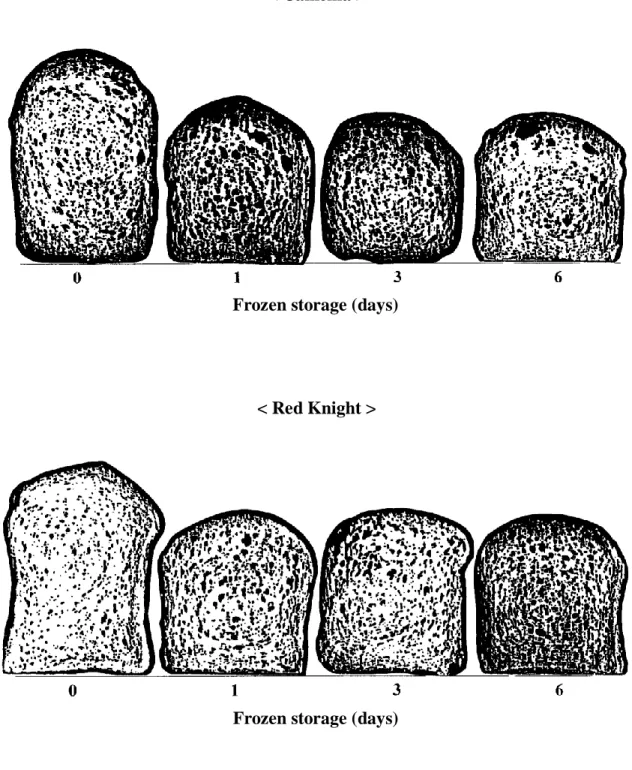
Camellia, Red Knight, Alps, Midoriuzumaki, Horoshiri, Kitakami, and Nanbujigona wheat flours were used in this experiment. The protein and ash contents of these wheat flours are listed in Table 1. Table 2 lists the changes in breadmaking properties (bread height (mm) and specific volume (cm3/g)) with increasing storage time of the bread dough at -20℃. These breadmaking properties showed marked deterioration after one day frozen storage of the bread dough compared with nonfrozen and unstored bread dough. However, no further deterioration was observed after three to six days of frozen storage. Figure 1 shows the appearance of sectioned breads baked from bread doughs stored at 0 (nonfrozen), one, three, and six days made from Camellia and Red Knight wheat flours.
< Camellia >
Frozen storage (days)
< Red Knight >
Frozen storage (days)
Fig. 1. Appearance of sectioned bread baked from bread doughs of Camellia and Red Knight wheat flours after 0 (nonfrozen), 1, 3 or 6 days in frozen storage.
Centrifuged liquid in frozen-and-thawed bread dough
It was qualitatively observed that liquid oozed from dough was increased by freezing-and-thawing, and the increased amount of liquid may be related to the deterioration of breadmaking properties baked with frozen-and-thawed bread dough.
Then, we thought that it was necessary to measure the amount of the oozed liquid from bread dough by centrifugation. Relevant studies are presented in the literature.4-8) However, to measure a similar amount of the liquid that naturally oozed from dough, we excluded the high gravity of ultracentrifugation conditions. We designed a centrifugation condition of 38,900 g for 120 min at 4℃ to obtain the amount of the centrifuged liquid. Resulting centrifugation was performed at steady state. The centrifuged liquid from nonfrozen and unstored bread dough was rather viscous and contained high protein (12.2-14.3 mg/mL) and carbohydrate (48.6-55.3 mg/mL) concentrations (Table 3). The protein and carbohydrate composition of the centrifuged liquid was not so affected by the centrifugation parameters. After one day of frozen storage, the amount of free water obtained from thawed dough samples was markedly increased, and the amounts from doughs stored for three to six days were slightly increased or decreased (Table 2). All wheat flours showed the same trends. There was a marked correlation between the increase in the amount of liquid centrifuged from frozen-and-thawed doughs and the deterioration in their breadmaking properties (Table 4). The deterioration of the breadmaking properties of frozen-and-thawed bread doughs compared with nonfrozen and unstored doughs may be due to decreases in the water binding ability of a bread dough caused by freezing-and-thawing.
Conclusion
The breadmaking properties (bread height (mm) and specific volume (cm3/g)) of breads baked from frozen-and-thawed doughs were markedly deteriorated. At the same time, the exudation of liquid from thawed bread dough upon centrifugation increases.
And we showed that there was a strong correlation between the amount of centrifuged liquid and breadmaking properties.
References
1) American Association of Cereal Chemists. 2000. Approved Methods of the AACC, 10th ed. Methods 08-01, 10-10A, and 54-21. The Association: St. Paul, MN.
2) Seguchi M, Hayashi M, Matsumoto H: Effect of gaseous acetic acid on dough rheological and breadmaking properties. Cereal Chem 74:129-134, 1997.
3) Lowry OH, Rosebrough NJ, Farr AL, et al: Protein measurement with the folin phenol reagent. J. Biol. Chem. 193: 265-275, 1951
4) Mauritzen CM, Stewart PR: The ultracentrifugation of doughs made from wheat flour dough. Aust J Biol Sci 18:173-189, 1965.
5) Mauritzen CM, Stewart PR: The disulphide and sulphydryl content of fractions prepared by the ultracentrifugation of doughs made from wheat flour. Aust J Biol Sci 19:1111-1123, 1966.
6) MacRitchie F: The liquid phase of dough and its role in baking. Cereal Chem 53:318-326, 1976.
7) Larsson H, Eliasson AC: Phase separation of wheat flour dough studied by ultracentrifugation and stress-relaxation I. Influence of water content. Cereal Chem 73:18-24, 1996.
8) Rasanen J, Blanshard JMV, Siitari-Kauppi M, et al: Water distribution in frozen lean wheat flour doughs. Cereal Chem 74:806-813, 1997.
Chapter 3
Restoration of Breadmaking Properties to Frozen Dough by Addition of Sugar and Yeast and Subsequent Processing
Object
We tried to clarify the cause of the deterioration of breadmaking properties that correlate with the increase of centrifuged liquid from frozen-and-thawed dough.
Abstract
We prepared bread dough A (a mixture of wheat flour, sugar, salt, and water), bread dough B (a mixture of bread dough A and yeast), and bread dough C (first proofed, molded, and second proofed bread dough B) and froze them at -20℃ for six days.
They were thawed at 4℃ for 16 hr and subjected to their breadmaking processes. The results indicated that breadmaking properties (bread height (mm) and specific volume (cm3/g)) after bread dough A and B processes were the same as those of control bread dough (unfrozen dough). However, in the case of bread dough C, the resulting bread showed depression of the properties. The amount of centrifuged liquid from thawed bread dough C increased. Sugar was added to thawed bread dough C (bread dough C-1), and then yeast was further added to bread dough C-1 (bread dough C-2), and they were subjected to the breadmaking process. The results showed that the breadmaking properties of bread dough C-2 were the same as those of the control. It was further found that when the first proof step in the bread dough C-2 process was omitted, the breadmaking properties were depressed. Frozen and thawed bread dough C was packed into a plastic tube, and extension of the dough was compared with that of control dough under reduced pressure. Bread dough C extended to 50 mm, compared with 70 mm for control dough. First proof, mold, and second proof steps of dough C-2 caused it to extend to the same height as control dough. It was concluded that the increased amount
of the separated liquid in thawed dough C caused depression of breadmaking properties resulting from lack of water in the appropriate places to provide the expected properties, but these properties could be restored to the levels of control bread dough by the addition of sugar and yeast following the first proof, mold, and second proof steps.
Materials and Methods Wheat flour
Four wheat flours were used in this experiment: Camellia (Nisshin Flour Milling Co. Ltd., Japan), Alps (Nittofuji Flour Milling Co. Ltd., Japan), and Haruyokoi and Kitanokaori (Maeda Grain Farm Products, Tokachi, Japan). General analysis of these flours is given in Table 1. Protein conversion was N × 5.7 (Approved Method 46-10.01).1) Ash was determined by AACC International Approved Method 08-01.01 at 14.0% mb.1)
Preparation of control (unfrozen) and frozen-and-thawed bread doughs and breadmaking
Breadmaking was performed according to Seguchi et al.2) Baking absorption of flour was determined in a farinograph with 300 g of flour (Approved Method
Wheat flour (290 g), compressed yeast (8.7 g), sugar (14.5 g), salt (2.9 g), and water (estimated from farinograph at 500 BU) were mixed in a computer-controlled National Automatic Bread Maker (SD-BT6, Matsushita Electric Ind. Co. Ltd., Japan), with the first proof for 2 hr 20 min at 30℃. The time consisted of 15 min for the first mixing, 50 min of rest, 5 min for the second mixing, and 70 min of fermentation. The bread dough was divided into 120 g pieces, rounded, molded, and placed in baking pans (Approved Method 10-10.03).1) The bread dough was further proofed for 22 min 15 sec at 38℃.
The baking pan in which the bread dough (120 g) was placed was put into a plastic film bag, frozen, and stored in a freezer (Rotary Chest MF-C29B-H, Mitsubishi Electric Ind.
Co. Ltd., Japan) at -20℃. For the thawing, the baking pan was placed in a refrigerator (SF-B100LS-AC, Toshiba Home Technology Corporation Co. Ltd., Japan) at 4℃ for 16 hr, which was adequate for the bread dough to thaw completely. After thawing, one part of the bread dough was used for breadmaking, and the other was subjected to determination of free water exuding from the dough. The thawed dough was baked at 210℃ for 30 min in a model DN-63 oven (Yamato Scientific Co. Ltd., Japan). After baking, the bread was removed from the pan and cooled for 1 hr at a room temperature of 26℃ and relative humidity of 43%. Bread height (mm), weight (g), and volume (cm3) were measured, and the crumb grains were evaluated visually.
Determination of liquid exudate from bread dough
The thawed bread dough was removed from its pan. No water drops were observed in the pan or plastic film bag. The dough was centrifuged at 38,900 g for 120 min at 4℃
(Hitachi Himac CR 21G, HITACHI KOKI Co. Ltd., Japan), after which the centrifuge tube was titrated at an angle of 45°for 60 min in a cold room (4℃), and the supernatant (centrifuged liquid) was collected in a dropwise manner and recorded as mL per 100 g of dough.3)
Effect of freezing of yeast
Compressed yeast (8.7 g) was suspended in 20 mL of water and frozen at -20℃
for six days. After thawing at 4℃ for 16 hr, it was used in breadmaking with Camellia flour.
Preparation of various bread doughs (A, B, C, C-1, and C-2) and subsequent processes
Various bread doughs (A, B, C, C-1, and C-2) were prepared, and breadmaking was performed (Figs. 1 and 2). In the case of bread dough A, wheat flour (290 g), sugar (14.5 g), salt (2.9 g), and water were mixed for 2 min at room temperature and frozen at -20℃ for six days. After thawing, the dough was mixed with yeast (8.7 g) for 1 min, first proofed for 2 hr 20 min, molded, second proofed for 22 min 15 sec, and baked at 210℃ for 30 min. In the case of bread dough B, dough A was mixed with yeast (8.7 g) for 1 min and then frozen. After the dough thawed, first proof for 2 hr 20 min, mold, and second proof were performed, and the bread was baked. In the case of dough C, dough B was first proofed, molded, second proofed for 22 min 15 sec, and then frozen.
After thawing, it was baked. In the cases of doughs C-1 and C-2, frozen dough C was thawed and mixed with sugar (14.5 g) for 1 min (dough C-1) or with sugar (14.5g) and yeast (8.7 g) (dough C-2) and then first proofed, molded, second proofed, and baked (Fig. 2). Dough C-2 was further tested with the first proof omitted. Measurements of bread height (mm), weight (g), and volume (cm3) were as described in the second section under Materials and Methods. Freezing and frozen storage equipment were described in the same section.
Bread dough extension in a vacuum
First proofed bread dough was divided into 60 g pieces, rounded, and squeezed into a plastic tube (5.0 cm diameter, 16 cm height, and 3 mm thickness) and sealed with
plastic tube was frozen at -20℃ for six days and thawed. The plastic tube containing dough was set up in a glass case (Bell Jar VKU-1000, Kiriyama Co.,Tokyo) (21.5 cm diameter, 30.0 cm height). The pressure in the glass case was reduced by an aspirator (Handy Aspirator WP-15, Yamato Scientific Co. Ltd., Tokyo) at room temperature for 420 sec. until reaching -76 cm Hg. The height (mm) of bread dough in the plastic tube was equivalent to the volume of the dough and was measured with a cathetometer (PCTM-300, Pika Co. Ltd., Tokyo) from outside the glass case.
Statistical analysis
A statistical software package (SPSS Inc., Chicago, IL.) was used for statistical analyses. Experiments were repeated two times and the results were averaged.
Significant F values by analysis of variance were followed by Duncan's multiple range test for comparison of means.
Results and Discussion
Effect of freezing of yeast on breadmaking properties
The effects of frozen and thawed yeast with or without water on breadmaking are indicated in Table 2, in which the breadmaking properties such as bread height (mm) and specific volume (cm3/g) were almost the same as the control (unfrozen bread dough). As indicated in the Materials and Methods section, not dry yeast but compressed yeast (moisture content 64.9 %) was used throughout the experiments.
Effects of freezing step in the breadmaking process
Dough A (a mixture of wheat flour, sugar, salt, and water) was frozen at -20℃ for six days. After thawing at 4℃ for 16 hr, it was mixed with yeast and processed (Fig. 1).
The results are shown in Table 3. Breadmaking properties (% vs. control) for Camellia wheat flour (bread height 100% and SV 99%), Alps (102 and 100), Haruyokoi (107 and 115), and Kitanokaori (108 and 109) were each almost the same as the control.
Centrifuged liquid in Camellia (116), Alps (105), Haruyokoi (111), and Kitanokaori (64), were not much larger than each control. It was found that the wheat flour fraction such as water solubles, gluten, prime starch, and tailings4) in bread dough was not affected by freezing and thawing, and the amount of centrifuged liquid did not increase by much.
Next, dough B (a mixture of dough A plus yeast) was frozen. After thawing, it was processed (Fig. 1). The results(Table 3)showed the same breadmaking performance for Camellia (bread height 101 and SV 104), Alps (106 and 102), Haruyokoi (104 and 113), and Kitanokaori (109 and 106) as for the control, and the amount of centrifuged liquid increased or decreased in Camellia (146), Alps (106), Haruyokoi (119), and Kitanokaori (71) compared with each control. It was found that yeast in bread dough was not affected by freezing and thawing, and the amount of centrifuged liquid did not increase by much.
After thawing of frozen dough C, breadmaking was performed (Fig. 1). The results
height 75 and SV 76), Alps (78 and 71), Haruyokoi (81 and 85), and Kitanokaori (88 and 85) compared with each control. The amount of centrifuged liquid significantly increased in Camellia (167), Alps (128), Haruyokoi (122), and Kitanokaori (372) compared with each control. From these results it was concluded that the effect of freezing and thawing of bread dough on breadmaking properties (doughs A and B) was small, but when processing was performed before freezing (dough C), the depression was large. That is, freezing of yeast and wheat flour fractions in bread dough was not related to breadmaking properties, but freezing after processing (proof and mold) was highly related to breadmaking properties. Bread dough C was damaged by freezing and thawing; that is, water separated from dough C, crystallized on freezing, and after thawing was not absorbed back into the dough. The dehydrated dough C lost its baking extensibility because moisture moved from the gluten matrix by freezing and thawing of bread dough, and acceptable breadmaking properties were not obtained.
Addition of sugar and yeast to thawed bread dough following first proof, mold, and second proof
We prepared doughs C-1 and C-2 with Camellia wheat flour and added sugar or sugar and yeast to the thawed dough C and processed them (Fig. 2). The results are shown in Table 4. Dough C-1 showed depressed breadmaking properties (bread height 62.30 mm (80%) and SV 2.24 cm3/g (68%)), which indicated that yeast in the thawed dough C did not use added sugar and generate CO2. So we added yeast to the thawed dough C and processed; however, the depression of the baking properties was not improved (data not shown here). Dough C-2 gave acceptable breadmaking properties (83.09 mm (107%) and 3.53 cm3/g (107%)), similar to control (77.80 mm (100%) and 3.31 cm3/g (100%)). It was assumed that the yeast in dough C lost its ability of CO2
generation even if sugar was added (dough C-1); however, the addition of yeast and sugar in dough C-2 could generate CO2, resulting in the same breadmaking properties as those of the control.
The reason dough C-2 showed acceptable breadmaking properties may be the CO2
generation by the addition of yeast and the repetition of the first proof, mold, and second proof steps. It is thus possible that the depression caused by freezing and thawing in bread dough C may have resulted from loss of yeast activity and a change of characteristics such as extensibility of the gluten matrix in bread dough.
Necessity of first proof step in dough C-2 processing
Next we examined whether the first proof step was necessary in bread dough C-2 processing (Fig. 2). Dough C-2 was treated with a second proof only. The results (Table 5) show that, in this case, acceptable breadmaking properties could not be obtained (bread height 58.35 mm (75%) and SV 2.24 cm3/g (68%)) compared with the control (77.80 mm (100%) and 3.31 cm3/g (100%)). It was assumed that because of the separation of water from thawed dough C, the gluten matrix in the thawed dough C did not recover to the unfrozen dough level even if yeast and sugar were added. However, the first proof, mold, and second proof steps of dough C-2 could give acceptable breadmaking properties. If yeast and sugar were added to thawed bread dough C after the initial first proof, mold, and second proof steps, the bread dough showed breadmaking properties similar to those of the control.
Low extension of bread dough related to freezing and thawing
To examine the effect of freezing and thawing on bread dough rheology, the control bread dough, frozen and thawed dough C, and first proofed, molded, and second proofed dough C-2 were examined under reduced pressure (0 to -76 cm Hg) (Fig. 3).
With reduction of the pressure in the glass case, the volume of the dough increased, and the height (mm) of the dough in the plastic tube increased. The heights of the control and of the first proofed, molded, and second proofed dough C-2 increased from 30.0 mm to 72.8 mm after 120 sec. However, frozen and thawed dough C did not increase to more than 50.0 mm. Since water was separated from the thawed dough, the growth of the dough was lower than that of the control. However, the growth of first proofed, molded, and second proofed dough C-2 was restored to the control level. The rheological properties of a wheat flour dough are extremely sensitive to water content.5) This was reflected in the recovery of the breadmaking properties of dough C-2.
Czuchajowska et al. reported that loaf volume is more affected by a water level that is too low than by one that is too high. 6)
Conclusion
Freezing of yeast and wheat flour fractions in bread dough was not related to breadmaking properties, but freezing after processing (proof and mold) was highly related to the breadmaking properties. This indicated that acceptable breadmaking properties were not obtained because moisture moved from the gluten matrix by freezing and thawing of bread dough. Thus, we could improve the properties to acceptable levels by the addition of sugar and yeast to the thawed dough and then repeating first proof, mold, and second proof steps.
References
1) AACC International. 2010. Approved Methods of Analysis, 11th Ed. Methods 08-01.01, 46-10.01, 10-10.03, and 54-21.01. Available online only. AACC International: St. Paul, MN.
2) Seguchi M, Hayashi M, Matsumoto H: Effect of gaseous acetic acid on dough rheological and breadmaking properties. Cereal Chem 74:129-134, 1997.
3) Seguchi M, Nikaidoo S, Morimoto N: Centrifuged liquid and breadmaking properties of frozen-and thawed bread dough. Cereal Chem 80:264-268, 2003.
4) Ozawa M, Seguchi M: Effect of dry-heated prime starch and tailings fractions in wheat flour on pancake springiness. Cereal Chem 85:626-628, 2008.
5) Eliasson AC, and Larsson K: Cereals in breadmaking, first edition, Eliasson AC and Larsson K (eds.), Marcel Dekker, New York, 1993, 265.
6) Czuchajowska Z, Pomeranz Y, Jeffers HC: Water activity and moisture content of dough and bread. Cereal Chem 66:128-132, 1989.
Chapter 4
Effect of Xanthan Gum on Improvement of Bread Height and Specific Volume upon Baking with Frozen and Thawed Dough
Object
From findings of chapter 3, we supposed that acceptable level of the breadmaking propterties may be obtained by preventing the movement of water. Thus, we tried to use polysaccharides. The aim of this Chapter was to prevent bread deterioration from freezing/thawing by adding polysaccharides to the dough.
Abstract
Wheat flour was preliminarily mixed with 5% polysaccharides (locust bean gum, guar gum, xanthan gum, tamarind seed gum, native gellan gum, dextrin, LM pectin, fermented cellulose CMC, konjac glucomannan, HM pectin, κ-carrageenan, ι-carrageenan, and λ-carrageenan), and then mixed with water, salt, sugar, and yeast, followed by proofing. Next, the proofed bread dough was divided into two, frozen at -20°C for 6 days, and then thawed at 4°C for 16 hr. One part of the dough was baked at 210°C for 30 min, and the other was subjected to determination of the extruded liquid from the thawed dough upon centrifugation. As the results, frozen/thawed control (wheat flour) dough presented a lower bread height (mm), lower specific volume (cm3/g), and a higher volume of exuded liquid than unfrozen dough. When polysaccharides such as guar gum, xanthan gum, and tamarind seed gum were mixed with the flour prior to making the bread dough, similar or greater bread height and specific volume than those of bread baked with unfrozen control dough were obtained.
The greatest increases in bread height and specific volume on supplementation of polysaccharides were observed when xanthan gum was used. In order to clarify why xanthan gum markedly improved the breadmaking properties, oven-spring tests were conducted for 10, 15, 20, and 30 min in a 210°C oven. The breadmaking properties
(bread height) of baking with frozen/thawed control dough increased until 10 min in the 210°C oven and then stopped. However, for the bread with xanthan gum, these variables did not stop increasing.
Materials and Methods
Wheat flour and polysaccharides
Wheat flour (Camellia) was donated by Nisshin Flour Milling Co. Ltd., Japan.
Protein conversion was carried out using the formula N x 5.7 (Approved Method 46-10, AACC International).1) Ash was determined by the AACC International method (08-01) on a 14.0% moisture basis.1) Locust bean gum, guar gum, xanthan gum, tamarind seed gum, native gellan gum, dextrin, LM pectin, fermented cellulose CMC, κ-carrageenan, konjac glucomannan, HM pectin, ι-carrageenan, and λ-carrageenan were donated by San-Ei Gen F.F.I. Co. (Tokyo, Japan). Reagent-grade xanthan gum from Xanthomonas campestris was purchased from Tokyo Chemical Industry Co. Ltd., Japan.
Breadmaking methods: Preparation of frozen/thawed bread dough and breadmaking
Breadmaking was performed according to Seguchi et al.2) Baking absorption of flour was determined in a Farinograph with 300 g of flour (AACC International method 54-21).1) In this experiment, wheat flour was mixed with 5% polysaccharides and water absorption (%) was determined. The dosage level of polysaccharides (5%) exceeded current industry practice (0.5%) by tenfold. Specifically to clarify the effect of dosed polysaccharides in this experiment, the dosage level of polysaccharides was increased to 5% instead of 0.5%. The breadmaking properties (bread height (mm) and specific volume (cm3/g)) increased linearly from 0 to 5% dosage, and clear dosage effects could be observed at 5% dosage. Freezing-resistant yeast (Kaneka Co. Ltd., Japan) was used in this experiment. Wheat flour (290 g), compressed yeast (8.7 g), sugar (14.5 g), salt
computer-controlled National Automatic Bread Maker (SD-BT6, Matsushita Electric Ind. Co. Ltd., Japan) with the first proof for 2 hr 20 min at 30°C. The time consisted of 15 min for the first mixing, 50 min of rest, 5 min for the second mixing, and 70 min of fermentation. The bread dough was divided into 120 g pieces, rounded, molded, and placed on baking pans (AACC International method 10-10A).1) The bread dough was further proofed for 22 min 15 sec at 38°C. The baking pan on which the bread dough (120 g) was placed was put into a plastic film bag, frozen, and stored in a freezer (Rotary Chest MF-C29B-H, Mitsubishi Electric Ind. Co. Ltd., Japan) at -20°C. For the thawing, the baking pan was placed in a refrigerator (SF-B100LS-AC, Toshiba Home Technology Corporation Co. Ltd., Japan) at 4°C for 16 hr, which was adequate for the bread dough to thaw completely. After thawing, one part of the bread dough was used for breadmaking and the other was subjected to determination of the amount of liquid that exuded from the dough upon centrifugation. The thawed dough was baked at 210°C for 30 min in a model DN-63 oven (Yamato Scientific Co. Ltd., Japan). After baking, the bread was removed from the pan and cooled for 1 hr at room temperature (26°C) and 43% relative humidity. Bread height (mm), weight (g), and volume (cm3) were measured, and the crumb grain was evaluated visually. Numerous other factors were influenced by the use of polysaccharides. Since bread height and specific volume are highly related to other factors and thus provide equivalent results, we determined bread height and specific volume in this experiment.
Measurement of bread temperature using an infrared thermometer
Bread temperature was measured using an infrared thermometer (ThermalView XHR 32-RA0350; pixels: 320 x 256, ViewOhre Imaging Co. Ltd., Tokyo, Japan). Bread dough was baked at 210°C for 0, 5, 10, and 30 min, removed from the oven, cut in half with a knife, and photographed using a thermal camera within 30 sec. The thermal image was saved as a bitmap image, and the temperature of the surface of sectioned bread was measured from a color bar.
Effects of frozen storage time of bread dough supplemented with 5% xanthan gum on breadmaking properties
Bread dough supplemented with 5% xanthan gum was frozen and stored at -20°C for 1, 3, and 6 days, thawed at 4°C for 16 hr, and baked at 210°C for 30 min.
Effects of baking time on the oven-spring and shrinkage (%) of bread supplemented with 5% xanthan gum, guar gum, and tamarind seed gum
After thawing at 4°C for 16 hr, frozen/thawed bread dough supplemented with 5%
xanthan gum, guar gum, and tamarind seed gum was baked in an oven (210°C) for 10, 15, 20, and 30 min, and oven-spring (bread height) was measured after being left to stand for 60 min at room temperature.
To measure shrinkage (%) of bread, bread dough (30 g) was put into a glass bottle with a size scale on it and subjected to baking at 210°C for 5, 10, 15, 20, 25, and 30 min.
Bread height (mm) was read from the bottle. Shrinkage (%) of bread at each time point was calculated as follows: (bread height (mm) just after removal from the oven – bread height (mm) at 60 min after removal from the oven) ÷ bread height (mm) just after removal from the oven × 100 = shrinkage (%) of bread.
Determination of exuded liquid from bread dough upon centrifugation
The thawed bread dough (120 g) was removed from its pan and divided into quarters, each of which was placed in a separate 38-mL plastic centrifuge tube (2.9 cm diameter x 10.3 cm length) and centrifuged at 38,900 g for 120 min at 4°C (Hitachi Himac CR 21G; HITACHI KOKI Co. Ltd., Japan), after which the centrifuge tubes were tilted at an angle of 45° for 60 min in a cold room (4°C), and total supernatant (centrifuged liquid) was collected and recorded as mL/100 g dough.3)
Statistical analysis
A statistical software package (SPSS Inc., Chicago, IL) was used for statistical analyses. Experiments were repeated twice and the results were averaged. When significant F values were obtained by analysis of variance, Duncan's multiple range test was carried out for comparison of means.
Results and Discussion
The effect of polysaccharides in frozen/thawed dough on the breadmaking properties
Wheat flour was mixed with various polysaccharides at 5%, and Brabender Farinograph tests of the flour were performed. The optimum level of water addition is related to the composition of the flour, and therefore it is necessary to determine this optimum level for each type of flour. The Brabender Farinograph is commonly used to determine water absorption. The water absorption of flour is described as the amount necessary to bring the dough to a specified consistency (normally 500 Brabender units, BU) at the point of optimum development. The content of polysaccharides has been shown to affect water absorption.4) Water absorption of the mixed flour is shown in Table 1. From these results, the amount of additional water (mL) needed for breadmaking was calculated (Table 1). Water absorption was optimized using a Farinograph and ranged from 61.4 to 106.5%. Types of dough with a wide range of water absorption were indicated; however, the specified consistency (500 BU) with the addition of various levels of water was obtained in dough mixing in breadmaking, and comparable types of bread could be obtained with a fixed mixing time for all of the flour with different polysaccharides. The mixtures were then used to make bread dough and frozen at -20°C for 6 days. After thawing at 4°C for 16 hr, they were used for breadmaking and determination of the amount of exuded liquid from the bread dough upon centrifugation (Table 2).
The breadmaking properties of control (wheat flour) bread dough worsened by freezing/thawing: bread height, from 81.50 mm to 62.05 mm; and specific volume, from 3.63 to 2.59 cm3/g. When the 13 kinds of polysaccharide were mixed in the dough, the same tendency was observed in every breadmaking process (Table 2). It is generally known that breadmaking properties such as bread height (mm) and specific volume (cm3/g) deteriorate upon freezing/thawing. To stop this deterioration in bread baked with frozen/thawed control (wheat flour) bread dough, we added various polysaccharides to the flour prior to freezing, as described below, and aimed to obtain the same level of breadmaking properties as in unfrozen control breadmaking. The results indicated that bread baked with frozen/thawed bread dough supplemented with guar gum (bread height, 77.22 mm; and specific volume, 3.19 cm3/g), xanthan gum
exhibited similar or greater bread height and specific volume than bread (81.50 mm and 3.63 cm3/g) baked with unfrozen control dough. Bread baked with dextrin (65.17 mm and 2.89 cm3/g) or konjac glucomannan (65.97 mm and 2.89 cm3/g)-supplemented frozen/thawed dough was smaller than that baked with unfrozen control bread dough.
Other polysaccharide-supplemented frozen/thawed dough also produced smaller bread than unfrozen control dough. The results of breadmaking upon supplementation with polysaccharides varied (Table 2). We looked for types of bread with similar or superior breadmaking properties compared with that baked with unfrozen control dough, and identified those supplemented with three polysaccharides: guar gum, xanthan gum, or tamarind seed gum.
The amount of extruded liquid (mL/100 g dough) from unfrozen or frozen/thawed dough upon centrifugation is presented in Table 2. For unfrozen and frozen/thawed control dough, the levels were 3.27 and 10.08 mL/100 g dough, respectively, which are similar to values reported previously.3) Similarly, when the 13 kinds of polysaccharide were mixed in the bread dough that was then centrifuged, exuded liquid was also measured. When guar gum, xanthan gum, tamarind seed gum, native gellan gum, fermented cellulose CMC, HM pectin, -carrageenan, and -carrageenan were added, the amounts of exuded liquid were small or zero in both unfrozen and frozen/thawed bread dough, owing to their high water absorption. Remarkably improved breadmaking properties were observed when guar gum, xanthan gum, and tamarind seed gum were added, and almost no centrifuged liquid was exuded from such thawed dough upon centrifugation. When native gellan gum, fermented cellulose CMC, HM pectin, ι-, and
- carrageenan were added to dough, high water absorption was found in both unfrozen and frozen/thawed dough; however, deteriorated breadmaking properties were exhibited by frozen/thawed dough compared to unfrozen control dough (Table 2). When locust bean gum, dextrin, and -carrageenan were added, the amounts of exuded liquid were the same between unfrozen and frozen/thawed control bread dough.
On the other hand, when LM pectin or konjac glucomannan was added, higher levels of exuded liquid in both unfrozen and frozen/thawed bread dough were observed upon centrifugation: LM pectin: unfrozen dough, 17.50 mL/100 g dough, and frozen/thawed dough, 20.67 mL/100 g dough; and konjac glucomannan: unfrozen dough, 5.38 mL/100 g dough, and frozen/thawed dough, 12.58 mL/100 g dough.
Seguchi et al. indicated a strong relationship between the increase of exuded liquid from bread dough (wheat flour) by freezing/thawing and the deterioration of breadmaking properties. 3) However, in these experiments, when guar gum, xanthan gum, tamarind seed gum, ι-carrageenan, and λ-carrageenan were added, exuded liquid upon centrifugation (38,900 g) from unfrozen and frozen/thawed bread dough could not be observed due to higher water absorption. However, more intense centrifugation could produce exuded liquid from these types of dough and differences in the volumes of exuded liquid were observed between unfrozen and frozen/thawed dough. Xanthan gum showed the largest contribution to improving the breadmaking properties, likely due to the chemical structures of the polysaccharide. When xanthan gum-supplemented dough was frozen/thawed, breadmaking properties deteriorated, although they were superior to those of unfrozen control dough.
Change of freezing/thawing effects on xanthan gum-supplemented bread dough The breadmaking properties (bread height (Fig. 1a) and specific volume (Fig. 1b)) upon baking with xanthan gum-supplemented bread dough deteriorated from 0 to 1, 3, and 6 days (frozen storage temperature, -20°C) of freezing (open circle); however, these properties were consistently superior to the breadmaking properties upon baking with control (wheat flour) dough throughout the 6 days of freezing (closed circle). It was thus shown that the addition of xanthan gum to bread dough could stop the deterioration of breadmaking properties caused by freezing/thawing. Figure 2 shows the change in the amount of exuded liquid from control and xanthan gum-supplemented bread doughs upon centrifugation throughout the 6 days of freezing. For the control bread dough, the
amount of exuded liquid upon centrifugation was increased by freezing/thawing;
however, that of xanthan gum-supplemented frozen/thawed bread dough did not increase due to the strong water absorption. Although there is a close relationship between the deterioration of breadmaking properties (Fig. 1a and b) and the increase of exuded liquid (Fig. 2) in control dough, as reported previously,3) in the case of 5%
xanthan gum-supplemented dough, the precise amount of exuded liquid upon centrifugation was not measured, so the relationship between the deterioration of breadmaking properties and the increase of exuded liquid was not determined.
Measurement of bread temperature using infrared thermometry
We measured the temperature of bread just after its removal from the oven using an infrared thermometer, which indicated the surface temperature of bread crumbs from a color image. The color image of the bottom and top of bread dough showed light bluish (30~35°C) and bluish (below 25°C) features at room temperature (Fig. 3A). At 5 min of baking (Fig. 3B), the center (deep blue) of the image of bread crumbs indicated a temperature of below 40°C, at which yeast could survive and produce CO2 gas; however, the temperature of the upper surface (yellowish~reddish) was around 75-80°C, at which yeast could not survive. At 10 min of baking (Fig. 3C), the temperature of the center (greenish~reddish) of the image of bread crumbs was 65-80°C, at which yeast would be killed, and the swelling of bread dough was terminated. At 30 min of baking (Fig. 3D),
the bread crumb temperature (reddish) was more than 80°C, at which the gelatinization of starch and denaturation of gluten protein ceased, followed by formation of the final bread structures.
Oven-spring by guar gum-, xanthan gum-, or tamarind seed gum-supplemented bread dough and shrinkage upon removal from the oven
Frozen/thawed guar gum-, xanthan gum-, or tamarind seed gum-supplemented dough was baked for 30 min at 210°C. The bread was removed from the oven at 10, 15, 20, and 30 min of baking, and bread height was measured after 60 min at room
gum-supplemented dough the yeast would be killed by the heat, and all doughs are likely to stop swelling at 10 min of baking (Fig. 3C); however, in the case of xanthan gum-supplemented dough, it continues to increase in height (Fig. 4). Xanthan gum-supplemented bread showed shrinkage of 34.2% (at 10 min), 13.4% (at 15 min), 4.1% (at 20 min), and 0% (at 30 min). On the other hand, control (wheat flour) or the other doughs showed almost no shrinkage at the same time point; that is, the bread heights at 10 min of baking were maintained at 30 min of baking. Xanthan gum-supplemented bread at 65-80°C appeared to continue to increase in terms of its height until 30 min of baking; however, guar gum- or tamarind seed gum-supplemented bread did not increase in this regard with more than 10 min of baking, owing to differences in the chemical structures. Among the 13 kinds of polysaccharide, xanthan gum was the most effective to prevent the deterioration of breadmaking properties exhibited by frozen/thawed control dough. Xanthan gum is a polysaccharide derived from the bacterial coat of Xanthomonas campestris. It is produced by the fermentation of glucose, sucrose, or lactose by this bacterium. It functions to protect the bacterial cell from drying, heating, cooling, and other adverse conditions. Xanthan gum can also help bread dough to endure adverse conditions associated with freezing. To ascertain the effect of xanthan gum on the improvement of bread baked with frozen/thawed dough, reagent-grade xanthan gum was used in the same manner. Table 2 shows that the same results could be obtained in bread by using reagent-grade xanthan gum.
Conclusion
13 kinds of polysaccharide were added to dough, and breadmaking tests were performed after freezing/thawing. As a result, xanthan gum, guar gum, and tamarind seed gum were shown to prevent the deterioration of breadmaking properties by freezing/thawing; in particular, xanthan gum could ensure the remarkable recovery of bread from freezing/thawing effects.
References
1) American Association of Cereal Chemists. 2000. Approved Methods of the AACC, 10th Ed. Methods 08-01, 10-10A, 46-10, and 54-21. The Association: St. Paul, MN.
2) Seguchi M, Hayashi M, Matsumoto H: Effect of gaseous acetic acid on dough rheological and breadmaking properties. Cereal Chem 74: 129-134, 1997.
3) Seguchi M, Nikaidoo S, Morimoto N: Centrifuged liquid and breadmaking properties of frozen-and-thawed bread dough. Cereal Chem 80: 264-268, 2003.
4) Eliasson AC, and Larsson K: Cereals in breadmaking, first edition, Eliasson AC and Larsson K (eds.), Marcel Dekker, New York, 1993, 261-263, 325-326.
Chapter 5
Centrifuged Liquid of Frozen-and-Thawed Bread Dough
Object
We studied the relationship between free water oozed from frozen-and-thawed dough and the dough’s breadmaking properties (in chapter 2). Thus, we studied which components of bread dough (sugar, salt, and yeast) affect the amount of centrifuged liquid, and we also studied the possibility that fermented products affect that.
Abstract
The presence of yeast and salt in bread dough was suggested to be closely related to the amount of centrifuged liquid, and fermented products particularly had a large effect on the amount of centrifuged liquid.
Materials and Methods Wheat flour
Seven different wheat flours were used in this experiment: Camellia (Nisshin Flour Milling Co. Ltd., Japan), Red Knight and Alps (Nittofuji Flour Milling Co. Ltd., Japan), Midoriuzumaki (Masuda Flour Milling Co. Ltd., Japan), Horoshiri (Ebetsu Flour Milling Co. Ltd., Japan), and Kitakami and Nanbujigona (Fukin Flour Milling Co. Ltd., Japan). Protein conversion was N×5.7. Ash was determined by Approved Method 08-01 at 14.0% mb.1)
The amount of liquid oozed from bread dough was determined. The thawed bread dough was removed from its pan. No water drops were observed in the pan or plastic film bag. The dough was centrifuged at 38,900 g for 120 min at 4℃ (Hitachi Himac CR 21G, HITACHI KOKI Co. Ltd., Japan), after which the centrifuge tube was titled at
was collected in a dropwise manner and recorded as mL/100 g of dough. The centrifuged liquid after dialysis against water was subjected to protein and carbohydrate determinations by the method of Lowry et al.2) and the phenol sulfuric acid method, respectively. Various combined bread doughs were prepared. Salt (2.9 g) and Camellia wheat flour (290 g), sugar (14.5 g) and flour, yeast (8.7 g) and flour, yeast, sugar, and flour, yeast, salt, and flour, sugar, salt, and flour, and yeast, sugar, salt, and flour (complete) were blended, respectively, and were mixed with 210 mL of water in a bread maker. They were then treated in the same manner as above. All dough samples were frozen-and-thawed after one day of storage, and the amount of liquid centrifuged from each was determined. Protein and carbohydrate in the liquid were also determined as above.
Cultured fluid/flour dough were prepared, and centrifuged liquid was determined.
Compressed yeast (4.35 g), sugar (7.25 g), and salt (1.45 g) were mixed with 105 mL of water in 300 mL conical flasks and incubated at 35℃ for 140 min with slight shaking.
This was the complete cultured fluid. Then, mixtures were boiled for 5 min to kill all the yeast and cooled with tap water. Camellia wheat flour (145 g) was mixed with above whole cultured fluid in a farinograph bowl at 30℃ for 10 min and referred to as cultured fluid/flour dough. The cultured fluid/flour dough represented dough with presence of yeast and fermentation products. Cultured fluid/flour dough (120 g) was centrifuged at 38,900 g at 4℃ for 120 min. The centrifuge tubes were titled at an angle of 45° for 60 min in a cold room (4℃), and centrifuged liquid was collected. Protein and carbohydrate in the liquid were also determined as above. Various combined cultured fluid/flour doughs were prepared with salt (1.45 g) and Camellia wheat flour (145 g), sugar (7.25 g) and flour, yeast (4.35 g) and flour, yeast, sugar, and flour, yeast, salt, and flour, sugar, salt, and flour, and yeast, sugar, salt, and flour (complete) were mixed with 105 mL of water, respectively, and treated in the same manner as above. All cultured fluid/flour doughs were frozen-and-thawed after one day of storage, and the liquid centrifuged from them was determined. Protein and carbohydrate in the liquid
were also determined as above.
Time course of liquid centrifuged from cultured fluid/flour dough was determined by incubating cultured fluids at 35℃ for 0, 70, 140, 210, and 280 min, and were treated as above. The relationship between incubation time of cultured fluid and the amount of the centrifuged liquid was investigated.
Statistical analysis
A statistical software package (SPSS Inc., Chicago, IL.) was used for statistical analyses. Experiments were repeated four times and the results were averaged. Analysis produced significant F values by analysis of variance, followed by Duncan’s multiple range test for comparison of means.
Results and Discussion
Effects of bread dough components on the amount of centrifuged liquid
It is necessary to determine which components of bread dough affect the amount of centrifuged liquid. Figure 1 lists the bread dough components (except for wheat flour) and their combinations, and shows the effects of the presence of each component and their combinations on the amount of centrifuged liquid. When the amount of centrifuged liquid from the nonfrozen and unstored complete bread dough was set as 100%, the nearest value 85%, was obtained in the nonfrozen and unstored doughs with the combination of yeast and salt, followed by 42% with the combination of salt and sugar, and 27% with salt alone. Others were all < 5%. From these results, we concluded that salt was an important component in bread dough for the centrifuged liquid. Yeast also contributed to the centrifuged liquid when it was mixed with salt and, in this case, yeast could use wheat carbohydrates as a carbon source even if sugar is absent, and the fermented products could contribute to the amount of centrifuged liquid. These changes in the amount of the centrifuged liquid with bread dough components were also