or with entcsmacro.sty for your meeting. Both can be found at the ENTCS Macro Home Page.
On Constructive Linear-Time Temporal Logic
Kensuke Kojima 1 and Atsushi Igarashi 2
Graduate School of Informatics Kyoto University
Kyoto, Japan
Abstract
In this paper we study a version of constructive linear-time temporal logic (LTL) with the “next” temporal operator. The logic is originally due to Davies, who has shown that the proof system of the logic corre- sponds to a type system for binding-time analysis via the Curry-Howard isomorphism. However, he did not investigate the logic itself in detail; he has proved only that the logic augmented with negation and classical reasoning is equivalent to (the “next” fragment of) the standard formulation of classical linear-time temporal logic. We give natural deduction and Kripke semantics for constructive LTL with conjunction and disjunction, and prove soundness and completeness. Distributivity of the “next” operator over disjunction
“(A ∨ B) ⊃ A ∨ B” is rejected from a computational viewpoint. We also give a formalization by sequent calculus and its cut-elimination procedure.
Keywords: constructive linear-time temporal logic, Kripke semantics, sequent calculus, cut elimination
1 Introduction
Temporal logic is a family of (modal) logics in which the truth of propositions may depend on time, and is useful to describe various properties of state transition systems. Linear-time temporal logic (LTL, for short), which is used to reason about properties of a fixed execution path of a system, is temporal logic in which each time has a unique time that follows it.
Davies [3] pointed out that a proof system of LTL can be related to a type system of (multi-level) binding-time analysis, which is used in offline partial evaluation [8]
to determine which part of a program can be computed at specialization-time and which is residualized. He defined a natural deduction system for a constructive LTL with only the “next” operator and implication, derived via the Curry-Howard isomorphism a typed λ-calculus λ , which was formally shown to be equivalent to a type system of multi-level binding-time analysis by Gl¨ uck and Jørgensen [6].
According to this correspondence, a formula A, which means that A holds at the next time, is interpreted as a type of (residual) code of type A; introduction and
1
Email: [email protected]
2
Email: [email protected]
elimination rules of are as Lisp-like quasiquotation and unquote, respectively.
As a result, λ terms can be considered as program-generating programs, such as parser generators or generating extensions, which manipulate code fragments by the quasiquotation mechanism. For example, a parser generator would have a type like parser spec → (string → syntax tree). Unfortunately, Davies did not investigate his system in detail, from a logical point of view: he proved only that his system augmented with negation and classical reasoning is equivalent to the classical LTL, even though the logic can be considered a constructive version of LTL.
In this paper we study logical aspects of constructive propositional LTL based on Davies’ formalization. Davies’ original system is an implicational fragment, but we also consider conjunction and disjunction. 3 Our contributions are (1) to give a Kripke semantics and a complete proof system for constructive LTL and (2) to give another formalization by sequent calculus in which cut elimination holds.
Intuitionistic versions of LTL have been already considered in the literature [9,4].
However, the LTL presented in this paper is motivated by the type-theoretic inter- pretation of A as a type of quoted code, which distinguishes our approach from others. In fact, our version of LTL is not equivalent to the intuitionistic LTLs previously considered in that the “distributivity law” (A ∨ B) ⊃ A ∨ B is not admitted in our logic, while (to our knowledge) it is admitted in the other formalizations. The reason we disallow this law will be discussed later.
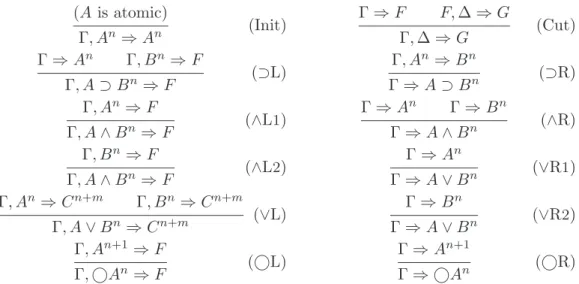
The organization of the rest of this paper is as follows. In Section 2, we discuss an implicational fragment: we first review the natural deduction by Davies, give a Kripke semantics, obtained by a natural extension of that of the classical LTL, and finally prove soundness and completeness of the proof system. We also discuss that, unfortunately, a straightforward extension of the semantics to disjunction is not suitable for our interpretation of disjunction. In Section 3 we extend the logic with conjunction and disjunction. We give another Kripke semantics, which does not admit the distributivity law mentioned above, and prove soundness and completeness of the proof system. In Section 4 we define a sequent calculus LJ , which is equivalent to the natural deduction, with its cut elimination procedure.
Finally, we give concluding remarks in Section 5.
2 Implicational Fragment
In this section, we first recall the natural deduction system by Davies and some of its properties, define a Kripke semantics for it, and prove completeness of Davies’
system.
2.1 Results by Davies
The temporal logic Davies considered contains only (“next” operator) and ⊃ (intuitionistic implication), so the language we consider in this section is constructed from propositional variables using ⊃ and .
3
Precisely speaking, Davies extended λ
with pairing and natural numbers, but did not consider conjunc-
tion or disjunction in his logic.
Γ, A n ⊢ A n (Axiom) Γ ⊢ A ⊃ B n Γ ⊢ A n
Γ ⊢ B n (⊃E)
Γ ⊢ A n
Γ ⊢ A n+1 (E)
Γ, A n ⊢ B n
Γ ⊢ A ⊃ B n (⊃I)
Γ ⊢ A n+1
Γ ⊢ A n (I)
Fig. 1. Derivation Rules of Davies’ System.
A judgment in his system takes the form A n 1
1, . . . , A n k
k⊢ B m
where A i , B are formulas and n i , m are natural numbers; it is read “B holds at time m under the assumption that A i holds at time n i (for i = 1, . . . , k)”. In what follows, we use A, B, C, D for formulas, k, l, m, n for natural numbers, F, G for annotated formulas (i.e. formulas with time annotation), and Γ, ∆ for sets of annotated formulas. We consider the left-hand side of a judgment a set.
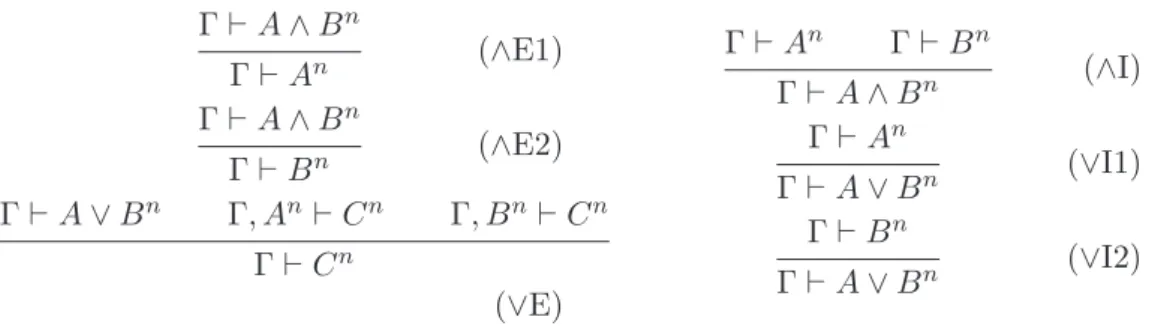
Inference rules of Davies’ system are listed in Fig. 1. The rules ⊃I, ⊃E, and Axiom are standard. The other two, the introduction and elimination rules for operator, state that A holds at time n + 1 if and only if A holds at time n. This is quite natural since A means that “A holds at the next time.”
To show that operator in this system is indeed the “next” operator in linear- time temporal logic, Davies compared his system with L , a well-known Hilbert- style proof system of the fragment of classical linear-time temporal logic consisting of only implication, negation and next operators. The axiomatization is given by Stirling, who also proved that L is sound and complete for the standard seman- tics [12]. The axioms and rules of L are as follows:
Axioms • any classical tautology instance
• ¬A ⊃ ¬ A
• ¬ A ⊃ ¬A
• (A ⊃ B) ⊃ A ⊃ B Rules • if A ⊃ B and A then B
• if A then A
Davies proved that his system extended by negation and classical reasoning is equiv- alent to L in the following sense [3]:
Proposition 2.1 A judgment A n 1
1, . . . , A n k
k⊢ B m is provable in the extended sys- tem if and only if n
1A 1 ⊃ . . . ⊃ n
kA k ⊃ m B has a proof in L . In particular,
· ⊢ A 0 is provable if and only if A is a theorem of L .
2.2 Kripke Semantics via Functional Frames
Before discussing the semantics of the implicational fragment, we briefly explain
how the usual classical semantics is given in terms of Kripke semantics. Kripke
frames we consider are functional, in the sense that the accessibility relation R on
possible worlds is a map. 4 This condition guarantees that, in a functional frame, the next state of a given state is uniquely determined, hence justifying “linear time”.
To give a semantics of constructive LTL, we follow the previous researches on Kripke-style models of intuitionistic modal logics [1,14,2] and augment functional frames by another accessibility relation ≤. This additional accessibility represents the “constructive” counterpart, as in the standard semantics of intuitionistic logic.
Definition 2.2 An intuitionistic functional frame is a triple hW, ≤, Ri of a nonempty set W , a preorder ≤ on W and a map R from W to W such that ≤ ◦ R = R ◦ ≤ holds. Here ◦ stands for a composition of binary relations defined by x R ◦ S y ⇐⇒
∃z.(x R z S y).
This notion is an extension of classical functional frames: if ≤ is the diagonal relation (that is, x ≤ y if and only if x = y) in this definition, the frame hW, ≤, Ri can be identified with a classical functional frame hW, Ri. Hereafter, we simply say functional frame when no confusion arises.
Using functional frames we can define a satisfaction relation on formulas.
Definition 2.3 Let hW, ≤, Ri be a functional frame and | = be a binary relation between W and the set of propositional variables such that w ≤ w ′ and w | = p imply w ′ | = p. We extend | = to formulas by induction with
• w | = A ⊃ B ⇐⇒ if w ≤ w ′ and w ′ | = A then w ′ | = B, and
• w | = A ⇐⇒ if w R w ′ then w ′ | = A.
We also write w | = A n for w | = n A.
This definition is one of the standard semantics of intuitionistic modal logics pre- viously considered [14]. As is easily verified by induction on the construction of formulas, this semantics satisfies the monotonicity condition.
Lemma 2.4 If w ≤ w ′ and w | = A, then w ′ | = A.
It is not very difficult to see that the Davies’ system is sound and complete for this semantics. Soundness is proved by straightforward induction on the derivation.
Completeness is proved by constructing a functional frame in which validity and provability coincide. We sketch the proof below.
For a set T of formulas, we write −1 T for the set {A | A ∈ T } and T for {A | A ∈ T }. Take the set of all theories as W , let ≤ be a set-inclusion, and R the map which sends each theory T to the theory −1 T . First we show that this defines a functional frame.
Lemma 2.5 The canonical frame hW, ≤, Ri above is indeed functional.
Proof. Among conditions of being a functional frame, the only nontrivial one is R ◦ ≤ ⊆ ≤ ◦ R. To show this, take theories T and S with −1 T ⊆ S (i.e. T (R ◦ ≤) S), and let U be the smallest theory containing T and S. We are going to show that U satisfies T ≤ U R S, i.e. T ⊆ U and −1 U = S.
Clearly, T ⊆ U holds by definition. It is also easy to see that S ⊆ −1 U : if
4
The term “functional” is, to our knowledge, first used by Segerberg [11], but not in context of semantics
of LTL.
A ∈ S, then A ∈ S ⊆ U , and from this A ∈ −1 U follows. For the converse, let A be a formula in −1 U . Then we have A ∈ U . Since U is the smallest theory containing T and S, there exist formulas A 1 , . . . , A n ∈ S such that A 1 ⊃ . . . ⊃ A n ⊃ A ∈ T . Because (A ⊃ B) follows from A ⊃ B, we also have (A 1 ⊃ . . . ⊃ A n ⊃ A) ∈ T. This implies that A 1 ⊃ . . . ⊃ A n ⊃ A ∈ −1 T ⊆ S holds. As A i ∈ S from the assumption, we conclude that A ∈ S, as required. 2 Let | = be the satisfaction relation defined by: T | = p if and only if p ∈ T . Then it holds that T | = A if and only if A ∈ T for each formula A, which is easily verified by induction on A. Finally, if Γ ⊢ A n is not provable, take the set
A
Γ ⊢ A 0 as T. Then T | = Γ holds but T | = A n does not.
2.3 A Problem with Disjunction
The proof strategy above is almost standard, but notice that we took the set of all theories as W . When we consider the full system (in particular, disjunction), the same method will not work. In the presence of disjunction, the standard way to prove completeness is to take the set of all prime. 5 Otherwise, we cannot prove the equivalence of T | = A and A ∈ T in the last step of the proof above. However, if we give W in this way, there is no natural way to define suitable R because the theory −1 T is not necessarily prime even if T is prime.
In fact, functional frames are not appropriate in the presence of disjunction because they would validate the distributivity law (A ∨ B) ⊃ A ∨ B under the straightforward interpretation of disjunction:
w | = A ∨ B ⇐⇒ if w | = A or w | = B
According to our type-theoretic interpretation of , this formula should not be valid. By the Curry-Howard correspondence, a proof of the distributive law would be considered a function which takes a value of type (A∨B ) and returns a value of type A ∨ B . While a value of the return type must be of type A or type B with a tag indicating which of the two is actually the case, a value of the argument type is quoted code, which will not be executed until the next time comes; it is in general impossible to know which value (A or B ) this code evaluates to now.
From this observation, we conclude that there is no method to turn a value of type (A ∨ B) into a value of type A ∨ B, and hence A ∨ B should be strictly stronger than (A ∨ B).
It does not seem easy to adjust the definition of the satisfaction relation to exclude the distributivity law. In fact, since necessity and possibility coincide when R is a (total) map, it may appear natural to adopt the ideas from some of the Kripke semantics for intuitionistic modal logics [13,1], which rejects distributivity
♦(A ∨ B ) ⊃ ♦A ∨ ♦B of possibility over disjunction by:
w | = ♦A ⇐⇒ ∀v.(w ≤ v = ⇒ ∃w ′ .(v R w ′ ∧ w ′ | = A)).
Unfortunately, this attempt fails. To falsify the distributivity we also need to have
≤ ◦ R 6⊆ R ◦ ≤, but then, the formula (A ⊃ B) ⊃ (A ⊃ B) becomes not
5