ウナギ仔稚魚の消化生理機能の発達過程を探る
誌名
誌名 Bulletin of Fisheries Research Agency. Supplement = 水産総合研究セン ター研究報告. 別冊
ISSN
ISSN 13469894
著者
著者 黒川, 忠英
鈴木, 徹 巻/号
巻/号 5号別冊
掲載ページ
掲載ページ p. 57-61 発行年月
発行年月 2006年3月
農林水産省 農林水産技術会議事務局筑波産学連携支援センター
Tsukuba Business-Academia Cooperation Support Center, Agriculture, Forestry and Fisheries Research Council Secretariat
長年の成熟誘起手法の改良によって,ウナギの受精 卵を得ることは比較的安定して行えるまでになってき ている(Kagawa et al., 1995; 1997)。しかし,ふ化率 や初期生残率がきわめて低い場合が多く,ウナギ種苗 生産の実現のためには,さらに様々な観点からの技術 改良が必要である(Tanaka et al., 2001)。
魚類の初期発生においては,卵黄内の母性由来の mRNAや調節因子などの蓄積量の異常が斃死や奇形を 引き起こす要因の一つになっていることが考えられる。
また,仔魚の生残率の改善には仔魚用飼料の改良が不 可欠であるが,そのためにはウナギ仔魚の消化吸収特 性を明らかにする必要がある。
そこで本研究では,ウナギ未受精卵から母性由来の mRNAを単離すると共に,それらの遺伝子発現と卵質 との関連を検討することを試みた。また,仔魚やシラ ス期の消化器官などの発達過程を解析し,仔魚期の摂 餌や消化吸収特性を明らかにすることを目的とした。
ウナギ未受精卵からのmRNAの単離
まず,未受精卵2gからtotal RNAを抽出し,未受 精卵中のtotal RNAとmRNA含量を採卵親魚ごとに比 較した。その結果,total RNAとmRNA含量にはロッ ト間での差はみられず,その後の受精率やふ化率との 相関は認められなかった。
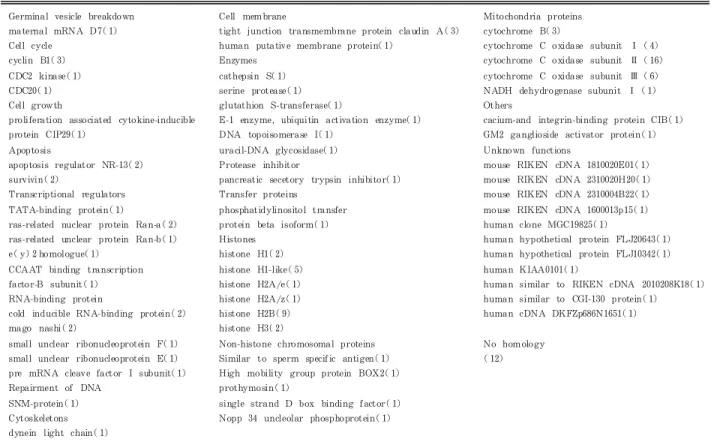
次に,ふ化率が80%以上であった良質卵からmRNA の単離を行い,一方向性にベクターに組み込んだウナ ギ未受精卵cDNAライブラリーを作製した。このライ ブラリーの無作為シーケンスを行い,57種類の遺伝子 を同定することができた(Table 1)。このうち,細胞 骨格に関係するhiston,卵最終成熟に関与すると考え られるD7,アポトーシスに関与すると考えられるsur- vivin,次 世 代 の 成 熟 に影 響 を 及 ぼ す と 考 えら れ る magonashi,プロテアーゼであるcathepsin Sとserin protease,プロテアーゼ阻害因子であるtrypsin inhib-
itorの5種類の遺伝子について,80%以上のふ化率が
ウナギ仔稚魚の消化生理機能の発達過程を探る
黒川忠英*1・鈴木 徹*1,*2
Developmental process of digestive system in Japanese eel larvae
Tadahide KUROKAWA*
1, Tohru SUZUKI
*1,*2Abstract To improve the larval rearing technology, the ontogeny of pancreatic exo- crine function and its endocrine regulation systems were examined in the early larval stage of Japanese eel. The eel pancreas starts to synthesize the digestive enzymes by 8 days post hatching and the endocrine systems for the regulation of pancreatic en- zyme secretion develop synchronously with the development of exocrine pancreas by the first feeding in eel larvae. Moreover, the digestive tract of eel larvae recognized Aquaran (freeze-dried shark egg powder) as a nutrient, and that the exocrine pan- creas secreted digestive enzymes into the intestine and began to synthesize digestive enzymes in response to feeding.
Key words: eel, larvae, digestive system, pancreatic enzyme, endocrine system
2005年11月15日 受理(Received: November 15, 2005)
*1養 殖研究 所 〒516-0193 三 重県 度会郡 南伊 勢町中 津浜 浦422-1(National Research Institute of Aquaculture, Nakatsuhamaura, Minami-ise, Mie 516-0193, Japan)
*2現 東 北大学 農学部 生物生 産情報 システ ム学研 究室 〒981-855 仙台 市青葉 区堤通 雨宮町1-1(Laboratory of Bioindustrial Informatics, Gradu- ate Schoo l of Agricultural Science, To hoku University, Aoba-ku, Sendai, Miyagi 981-8555, Ja pan)
得られた良質卵5ロットとほとんど孵化しなかった不 良卵5ロット間で,遺伝子発現に差があるか否かを定 量PCRにより比較した。しかし,いずれの遺伝子もロッ ト間での有意差は認められなかった。
ウナギ仔魚期の消化生理機能の発達過程
ウナギ仔魚期には胃腺が未発達なため,消化の主体 は膵臓由来の消化酵素群であると考えられる(Kuroka wa and Pedersen, 2001; Kurokawa and Pedersen, 2003; Pedersen et al., 2003)。そこで,まずウナギ外 分泌膵臓から, 各栄養成分に対する主要な消化酵素
(タンパク質:トリプシン;糖質:アミラーゼ;脂質:
リパーゼ)遺伝子を単離し,cDNA塩基配列を決定し た(Kurokawa et al., 2002)。これら,膵消化酵素遺 伝子のウナギ仔魚における発現部位を,whole mount in situ hybridizatin(WISH)により観察した結果,
仔魚の膵臓で特異的に遺伝子発現がみられることが確 認された(Fig. 1)。次に,仔魚期における遺伝子発現 パターンを,RT-PCRにより解析した(Fig. 1)。その 結果,トリプシンとアミラーゼはふ化後6日目から発 現がみられ7日から8日目にかけて発現量が増加して
いた。一方,リパーゼはふ化後8日目から遺伝子発現 が観察された。これらのことから,ウナギ仔魚の膵臓 では,摂餌を開始するふ化後8日目までに消化酵素の 合成が開始されるものと推察された。
膵消化酵素の分泌は,消化管ホルモンであるCCK
(分泌促進)やPYY(分泌抑制)などによって制御さ れていると考えられる。そこで,ウナギ小腸からCCK とPYY遺伝子を単離し,cDNA塩基配列を決定した
(Kurokawa et al., 2004)。ウナギ仔魚におけるCCK とPYY遺伝子の発現パターンをin situ hybridizatin
(ISH)により観察した結果,これらのホルモン遺伝子 はふ化後8日目から仔魚の腸管で発現し始めることが 観察された(Fig. 2)。
したがって,ウナギ仔魚の外分泌膵臓における消化 酵素合成能と,その内分泌制御機構は,摂餌開始時の ふ化後8日目までに連動して発達することが明らかに なった。
ウナギ膵消化酵素の消化特性
ウナギの膵液の消化特性を明らかにするため,ウナ ギ成体の膵臓の抽出液を調製し,タンパク質や糖質に 黒川忠英・鈴木 徹
58
Table 1. Identified genes from unfertilized eel eggs.
Germinal vesicle breakdown maternal mRNA D7(1)
Cell cycle cyclin B1(3)
CDC2 kinase(1)
CDC20(1)
Cell growth
proliferation associated cytokine-inducible protein CIP29(1)
Apoptosis
apoptosis regulator NR-13(2)
survivin(2)
Transcriptional regulators TATA-binding protein(1)
ras-related nuclear protein Ran-a(2)
ras-related unclear protein Ran-b(1)
e
(y)2 homologue(1)
CCAAT binding transcription factor-B subunit(1)
RNA-binding protein
cold inducible RNA-binding protein(2)
mago nashi(2)
small unclear ribonucleoprotein F(1)
small unclear ribonucleoprotein E(1)
pre mRNA cleave factor I subunit(1)
Repairment of DNA SNM-protein(1)
Cytoskeletons dynein light chain(1)
Cell membrane
tight junction transmembrane protein claudin A(3)
human putative membrane protein(1)
Enzymes cathepsin S(1)
serine protease(1)
glutathion S-transferase(1)
E-1 enzyme, ubiquitin activation enzyme(1)
DNA topoisomerase I(1)
uracil-DNA glycosidase(1)
Protease inhibitor
pancreatic secetory trypsin inhibitor(1)
Transfer proteins phosphatidylinositol transfer protein beta isoform(1)
Histones histone H1(2)
histone H1-like(5)
histone H2A/e(1)
histone H2A/z(1)
histone H2B(9)
histone H3(2)
Non-histone chromosomal proteins Similar to sperm specific antigen(1)
High mobility group protein BOX2(1)
prothymosin(1)
single strand D box binding factor(1)
Nopp 34 uncleolar phosphoprotein(1)
Mitochondria proteins cytochrome B(3)
cytochrome C oxidase subunit Ⅰ(4)
cytochrome C oxidase subunit Ⅱ(16)
cytochrome C oxidase subunit Ⅲ(6)
NADH dehydrogenase subunit Ⅰ(1)
Others
cacium-and integrin-binding protein CIB(1)
GM2 ganglioside activator protein(1)
Unknown functions
mouse RIKEN cDNA 1810020E01(1)
mouse RIKEN cDNA 2310020H20(1)
mouse RIKEN cDNA 2310004B22(1)
mouse RIKEN cDNA 1600013p15(1)
human clone MGC19825(1)
human hypothetical protein FLJ20643(1)
human hypothetical protein FLJ10342(1)
human KIAA0101(1)
human similar to RIKEN cDNA 2010208K18(1)
human similar to CGI-130 protein(1)
human cDNA DKFZp686N1651(1)
No homology
(12)
Numbers of( )indicate number of clones in this analysis.
対する消化試験を行った。ウナギ膵臓をアセトン処理 して風 乾した もの0.05gを 5 mLの10mM Tris-HCl
(pH8.0)bufferで抽出したものを,原液とした。
この膵臓抽出液で,まずマーカータンパク質および 仔魚用飼料の主成分である鮫卵の凍結乾燥品アクアラ ンのタンパク質を25℃で消化し,タンパク質に対する 消化特性を解析した。その結果,マーカータンパク質 は,10分以内に高分子は低分子に分解され,幅広いタ ンパク分子に対する消化能を有していた(Fig. 3)。一 方,アクアランにはビテロゲニンと推察される2種類 のタンパク質が主成分となっており,ウナギ膵臓抽出
液により一方は10分以内に分解されたが,もう一種類 は60分後も残存していた(Fig. 4)。
次に,レプトケファルスの体成分の特徴であるムコ 多糖類に対する消化特性を検討した。ウナギ膵臓抽出 液で,各種標品ムコ多糖類を消化した結果,タンパク 質と異なり60分後でもいずれの分子も分解されなかっ た(Fig. 5)。
これらのことから,ウナギ仔魚の消化管における消 化能力は,タンパク質の分解能力は高いが,ムコ多糖 類の分解能力は低いものと推察された。
Fig. 2. Distribution of CCK and PYY cells in Japanese eel larvae at 8 dph. Arrowheads indicate positive signals. br, brain; ey, eye;
in, intestine. Scale bars indicate 25 μm.
Fig. 1. RT-PCR analysis to expression of pancre- atic enzymes in eel larvae and adult pancreas(left photo)and whole mount in situ hybridization of 10 dph eel larvae with antisense probes of pancre- atic digestive enzyme genes(right photo). (a)
trypsinogen,(b)amylase,(c)lipase. Arrowheads indicate the positive signals in the larval pancreas.
Scale bars indicate 1 mm. (Modified from Kurokawa et al., 2002).
Fig. 3. Digestion of marker proteins by eel pancreatic extract.
Fig. 4. Digestion of Aquaran proteins by eel pancreatic extract. Arrowheads indicate the two types of vitellogenin.
ウナギ仔魚の摂餌特性
ウナギ仔魚の摂餌量を把握することができれば,仔 魚用飼料の改良をより効率的に進めることができると 考えられる。しかし,仔魚の摂餌量を求める手法は,
ウナギに限らずいずれの魚種においても確立されてい ない。そこでまず,ウナギ仔魚の摂餌速度を推定する 手法を検討した(Kurokawa et al., 2004)。
飼料原料のアクアランをFITCで蛍光標識し,FITC の蛍光量からアクアランの量を算出できるように回帰 式を作製した。次に,FITC標識アクアラン飼料を10日 齢のウナギ仔魚に摂餌させ,摂餌後の時間経過による 体内のFITC量の変化を測定し,取り込まれたアクアラ ンの量を推定した。その結果,仔魚の摂餌速度は,ア クアラン乾重量0.04μg/minと推定された。このとき の仔魚に含まれるトリプシン活性を,膵臓が含まれる 領域と腸管が含まれる領域に分割してそれぞれ測定し たところ,仔魚の摂餌後の腸管側のトリプシン活性は 摂餌前に比較して約4.2倍に上昇していたが,膵臓側の トリプシン活性は有意な上昇はみられなかった。
これらのことから,10日齢頃の仔魚は,アクアラン 乾重量で0.04μg/min程度の摂餌速度で摂餌をする能 力があり,仔魚の腸管内で人工飼料が栄養物として識 別されて,膵臓から腸管にトリプシンなどの消化酵素 が分泌されることが明らかになった。
おわりに
本研究によって,ウナギ仔魚期の消化器官やその機 能の発達過程の概要を明らかにすることができた。ウ ナギ受精卵を22℃で飼育した場合,ふ化後8日目から 仔魚は摂餌を開始する。この時点までに,仔魚の消化 の中心的役割を果たす膵臓の消化酵素合成能および,
その内分泌的制御機構が整うことが明らかになった。
また,仔魚用人工飼料の主成分であるアクアランを摂 餌することにより,仔魚の消化システムに栄養物とし て認識され,膵臓から腸管への消化酵素の分泌が起こ ることも観察された。さらに,ウナギ膵臓の消化液に より,アクアランのタンパク質が分解され高度に利用 されていることも予想された。
一方,ウナギの良質卵と不良卵との違いを遺伝子レ ベルで明らかにする試みは,十分な成果を得るには至 らなかった。ロットによっては,摂餌開始時点で形態 異常魚が高い頻度で観察される場合が少なくない(養 殖研 黒川ら,未発表)。今後,良質卵と不良卵の違い を明らかにするためには,受精率やふ化率だけでなく 形態異常魚の出現状況などさらに幅広い観点からの検 討が必要と考えられる。
文 献
Kagawa H., Tanaka H., Ohta H., Okuzawa K. and Hirose K., 1995:In vitroeffects of 17β−hydro- 黒川忠英・鈴木 徹
60
Fig. 5. Digestion of marker mucopolysaccharides by eel pancreatic extract.
xyprogesterone and 17α, 20β-dihydroxy−4−
pregnen−3−one on final maturation of oocytes at various developmental stages in artificially matured Japanese eelAnguilla japonica. Fisher- ies Sci.,61, 1012-1051.
Kagawa H., Tanaka H., Ohta H., Okuzawa K. and Iinuma N., 1997: Induce ovulation by injection of 17α, 20β−dihydroxy−4−pregnen−3−one in the artificially matured Japanese eel, with spe- cial reference to ovulation time. Fisheries Sci., 63, 365-367.
Kurokawa T. and Pedersen B.H., 2001: Digestive sys- tem of eel larvae. Proceedings of the interna- tional symposium of Advances in eel biology, pp.92-94.
Kurokawa T., Suzuki T., Ohta H., Kagawa H., Tanaka H., and Unuma T., 2002: Expression of pancreatic enzyme genes during the early larval stage of Japanese eel Anguilla japonica.
Fisheries Science,68, 736-744.
Kurokawa T. and Pedersen B.H., 2003: The digestive system of eel larvae. in "Eel Biology"(eds. by Aida K., Tsukamoto K., and Yamauchi K.), Springer, Tokyo, pp.435-444.
Kurokawa T., Iinuma N., Unuma T., Tanaka H., Kagawa H., Ohta H., and Suzuki T., 2004: Devel- opment of endocrine system regulating exocrine pancreas and estimation of feeding and digestive ability in Japanese eel larvae. Aquaculture,234, 513-525.
Pedersen B.H., Ueberscha..r B. and Kurokawa T., 2003: Digestive response and rates of growth in pre-leptocephalus larvae of the Japanese eel Anguilla japonica reared on artificial diets.
Aquaculture,215, 321-338.
Tanaka H, Kagawa H, and Ohta H, 2001: Production of leptocephali of Japanese eel (Anguilla japonica)in captivity. Aquaculture, 201, 51-60.