Original Paper ~~~~~~~~~~~~~~~~~~~~~~~~~~~~
Preparation and Characterization of Soya Film Coated Paper as Food Packaging:
A Case Study of the Packaging for Shelf Life Extension of Dried Banana
Sukrit Tantrawong
*Paper is used as packaging for various consumable products, especially food and fresh produce. The paper may come in the form of plain, waxed or polyethylene-coated paper (PE-coated paper). The latter two are either brittle or present difficulty in managing waste from the packaging. In this report, soya film coated paper (SF-coated paper) was produced by casting from soya milk. Physical properties of the coated paper were investigated, and compared with those of PE-coated and plain paper. Additionally, the lyotropic textures of the soya milk used in the casting of the soya film were investigated under optical polarizing microscopy. The results show that the textures of soya milk are comparable to those of commercially available lecithin, which is composed of bilayer structures of Maltese cross and Myelin finger. The bilayer structure plays an important role in the properties of the SF-coated paper. The SF-coated paper exhibited better physical properties than the plain paper, though, not as good as the PE-coated paper. As for the shelf life of dried banana, the SF-coated paper exhibited the best performance of all three types. Thus, the soya film coated paper might be an eco-friendly choice for the packaging of dried banana and other food produce.
Keywords:
soya film coated paper, shelf life, food packaging, lyotropic phases
Introduction
Dried bananas are one of the most popular local products of Pathumthani province, in the northern suburb of Bangkok, Thailand. Usually, bananas are best consumed fresh. However, when fresh bananas are abundant, the favorite way to preserve the excess is by drying. Normally fresh bananas are best not later than a week after harvesting. On the other hand, dried bananas can be kept on the shelf for 4-5 weeks before decomposition occurs under ambient conditions. Shelf life extension enables dried banana producers to expand their market. There are several ways to lengthen their shelf life, e.g., improving production processes, adding food preservatives, or better packaging. This report focusses on the last option, better packaging.
The dried banana producer selected is Vilailuck Dried Banana in Pathumthani. The packaging used in this factory is polyethylene coated paper (PE-coated paper). A thin sheet of polyethylene is coated on one side of 70g/m
2paper and the product detail is printed with soya ink on the other side. A dried banana is packed inside the paper (polyethylene on the inner surface) and heat sealed, and several dried bananas are put into a cardboard box ready for shelving. As mentioned above, the shelf life of this dried banana is
*Department of Chemistry, Faculty of Science and Technology, Thammasat University, Pathumthani 12121, Thailand
around 4-5 weeks. To extend the shelf life of the dried bananas, the PE-coated paper should be replaced, by changing from polyethylene film to another type of film.
From prior observation, soya film can be kept for a long time without any decomposition. It has been previously reported that soya film could extend the shelf life of fruits and prevent micro-organism growth that causes rotting by dipping the fruit into a solution containing soya extract and leaving it to dry (1).
Consequently, soya-film-coated paper (SF-coated paper) might be used to replace PE-coated paper.
The main ingredients of soya milk are various types of oil, phospholipids (e.g., lecithin) and some other proteins. Lecithin has been reported to form colloidal and lyotropic textures, Maltese cross and Myelin finger forms (2), which possess bilayer structures similar to those of the bacterium membrane (3).
This similarity, while not the same, may cause the slow-down of micro-organism reproduction as the micro-organisms need more time to aggregate enough proper molecules to form a cell membrane and other organs (3). This would extend the shelf life of the products that are packaged with the SF-coated paper.
Additionally, this report also investigated the bilayer behavior of the soya milk using an optical polarizing microscope to investigate the lyotropic phase textures, together with those of commercially available lecithin. These lyotropic textures possessing bilayer structure might explain the properties of the soya film coated on the paper.
Preliminary study of the decomposition process of the dried bananas was investigated beforehand.
When left inside its original packaging (sealed PE-coated paper) under ambient conditions in a laboratory for 6 days after Expiry Date, white fungi were observed on the surface of the bananas without any surface deformation. The deformation, together with traces of fluid and bad odors appeared after 10 days. On the other hand, when left uncovered on a petri dish for 5 days after Expiry Date, no white fungi were observed but surface deformation with traces of fluid and bad odors occurred, and the white fungi appeared after 8 days. It is concluded at this point that, in an air-tight container, the decomposition process of dried bananas starts with fungi and is followed by bacteria, and in the open-air condition, the process starts with bacteria and is followed by fungi.
The objective of this research is to study the production and properties of the SF-coated paper as an alternative to the PE-coated paper currently in use as dried banana packaging. First, SF-coated paper was produced by casting paper with soya milk and the coated paper was used as packaging for dried bananas.
The results were compared with those from plain and PE-coated paper. Furthermore, the physical properties of the 3 types of paper were investigated (4), i.e., water and oil resistivity, water and oil resistivity at fold mark, tensile strength when dry and wet, perception testing and finally the shelf life (5) of dried bananas.
Materials and Methods
1. Chemicals and samples
All chemicals (Sigma-Aldrich) used in this work were purchased from retailers (Bangkok, Thailand).
Commercially available plain paper (70g/m
2) and PE-coated paper (PE sheet coated on 70g/m
2paper)
were obtained from the Bangpa-in Paper Factory Company Limited. An Olympus BX50-P optical polarizing microscope, equipped with Olympus DP20 microscope digital camera, was employed to investigate the lyotropic textures (transparent mode) and paper surfaces (reflection mode). Skinned soya beans were bought from a supermarket (Tesco Lotus Superstore) in one batch to prevent quality variation from different cultivation. To compare the phase behavior, commercially available lecithin (MegaFood, Expiry Date: 12 January 2014) was used as a solute in a solvent of water and ethanol. Dried bananas in sealed plastic bags were bought from Future Park, Rangsit (Vilailuck Dried Banana, Production Date: 2 January 2011, Expiry Date: 31 January 2011) in Pathumthani.
2. Soya milk production
Skinned soya beans (100g) were washed with distilled water (100ml x 2) and then soaked in distilled water (300ml) for 5 hours. After the water was discarded, the swollen beans were placed in a blender equipped with filter, water was added (600ml) and the mixture was crushed and filtered to form soya milk.
The crude milk was heated at 90ºC for 2 hours and then left to cool to room temperature. The soya milk was freshly made in each experimental step.
3. Casting of solid soya film
The soya milk (10mL) was poured onto a petri dish ( 15cm) and left to dry overnight to form a soya film. The thickness of the film was measured using a micrometer and the film was investigated under an optical polarizing microscope.
4. Lyotropic textures of soya milk, solid soya film, and lecithin
The lyotropic textures of aqueous soya milk, solid soya film, and commercially available lecithin were investigated using an optical polarizing microscope. To prepare a sample slide of soya milk, a drop of soya milk was placed on a glass slide and covered with a cover slip. Then, for soya film, a small piece of soya film was nipped out from the very thin part of the film and placed between a glass slide and a cover slip. At the same time, a drop of lecithin was mixed with 2 drops of ethanol and 2 drops of water. A drop of the final mixture was placed on a glass slide and covered with a cover slip. Finally, each of the prepared sample slides was placed under an optical polarizing microscope objective at 100x magnification and crossed polarization, where lyotropic textures were elucidated from transmission arrangements and the surface textures were obtained from reflection arrangements.
5. Coating of soya film onto paper
After the soya milk was freshly prepared, it was coated onto a piece of paper in the form of a thin film for use as packaging for dried bananas. The coating was introduced when the heating of the fresh soya milk was passing into the second hour. A piece of paper was placed on the surface of the hot milk which was partially absorbed into the paper surface. After 10 seconds of absorption, the paper was removed from the liquid surface and was left to dry in air for 24 hours to obtain the SF-coated paper. To flatten the SF-coated paper, a cylindrical roller, similar to that used in cooking, was rolled over the paper.
Finally, the surface and physical properties of the SF-coated paper were investigated and the packaging
ability was evaluated.
6. Physical properties of three types of paper
Together with the plain and PE-coated paper, the properties of all 3 types of paper were investigated (4), within the categories of Grammage, thickness, water resistivity, oil resistivity, tensile strength at dry and wet, and perception testing. Each factor was averaged from 10 samplings, except the perception test.
For testing resistivity, a drop of either water or cooking oil was placed on the coated side of the paper sheet (10cm x 10cm) and the time-to-wet (resistivity time) was recorded. Furthermore, the paper (10cm x 10cm) was folded twice to make a cross mark and a drop of water or a drop of oil was positioned on the mark and the time-to-wet of the paper was recorded. To test the tensile strength of the paper, either dry or wet, a thin strip (1cm x 5cm) was hung under an increasing weight until it was completely torn apart.
Additionally, the perception test of the paper was carried out by rubbing the paper between thumb and index fingers.
7. Storage test
Freshly produced dried banana (20g) was packaged using each paper type (10cm x 10cm, 10 samples for each paper type, total 30 samples). Storage conditions were 30C and 70% humidity, in an air-conditioned room. Once a week, a sample of each type was visually checked. If a sample was rotten or fungi were found, the rest of the packed samples of that paper type were opened and the number of clean samples recorded. Additionally, 3 pieces of dried banana without any wrapping were left on a bench in the room for use as the control group.
Results and Discussion
1. Soya milk production
The extracted soya milk was pale yellow in color and almost odorless. It had a weak scent of cooked soya bean and a hint of fresh soya bean. At first there was no aggregation at the bottom of the beaker However, after cooling down to room temperature for 2 hours, some small aggregation was observed.
Consequently, the soya milk was stirred thoroughly before use. It is common for colloidal material to aggregate on cooling.
2. Casting of solid soya film
The concentration of the soya milk was calculated to be 23.2% w/v. After 10mL of soya milk was dried, the weight of solid film was 2.32g. The thickness of the soya film was 125m. The photomicrograph of the film in reflection mode is shown in
Figure 1.
3. Lyotropic textures of soya milk, solid soya film, and lecithin
The lyotropic textures of commercial lecithin in water-ethanol mixture are shown in
Figure 2. The conventional lyotropic textures, Maltese cross and Myelin finger, are clearly seen.
On the other hand, the soya milk shows only some areas of Myelin finger as in
Figure 3. The photos
show clearly that in soya milk the lecithin and some other phospholipids and proteins form lyotropic
phases in aqueous solvent. The bright short lines in
Figure 3are cell walls and some carbohydrate lumps of the crushed soya beans.
0.5 mm
LTML
0.5 mm MF MC
0.5 mm
CW SS
MF
In
Figure 1, the multiple layer structure of the solid soya film is clearly seen at the rim of the film, while some Myelin finger texture is partly visible and the lyotropic texture is frozen inside the solid soya film. This evidence shows that the soya film is composed of a number of very thin films aggregated to form a thick film, while trapping and encapsulating the lyotropic texture inside. This aggregation is stabilized by the bilayer structure of the lyotropic phases.
4. Coating of soya film onto paper
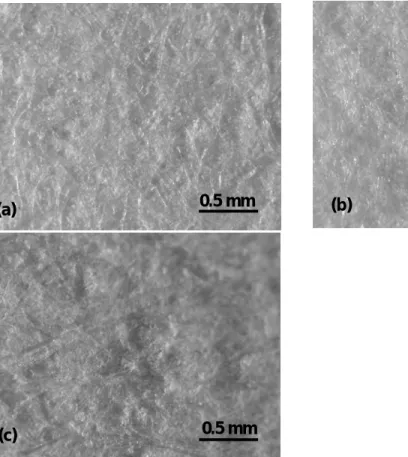
The surfaces of the plain paper, SF-coated paper and PE-coated paper are shown in
Figure 4(a)-(c),respectively. In
Figure 4(a), the roughness of the surface of the plain paper is clearly visible. The paper fibers are woven tightly together creating a flattened surface. However, the roughness arises from the small lumps of pulp scattered in the thickness of the paper and exposed at the surface of the paper.
We found that the solid coating filled the roughness thus forming a much smoother and flatter
Figure 1. Photomicrograph of soya film with crossed polarizers. The lyotropic texture (LT) is clearly visible inside the film and the multilayer composition (ML) of the film is also shown.
Figure 2. Photomicrograph of lecithin in water-ethanol solvent mixture with crossed polarizers. Most of the textures are Maltese cross (MC), with some Myelin finger (MF) texture at the top right-hand corner. The big circle is a bubble of air.
Figure 3. Photomicrograph of soya milk with crossed polarizers. The photo shows some area of Myelin finger (MF), together with cell wall (CW) and soya solid (SS).
surface of soya coated film (
Figure 4(b)) and of PE-coated film (
Figure 4(c)). The production methods of the two types of paper are different. The PE-coated paper is produced by hot pressing of a thin PE film onto the surface of the paper, thus the surface might contain some non-attached fractions as air might not be fully expelled out of the interface. On the other hand, in the production of SF-coated paper, the plain paper is placed on the surface of the liquid soya milk thus the milk is better absorbed into the fibrous structure of the paper, as seen in
Figure 5. Consequently, the soya film could adhere better to the paper surface than PE film.
0.5 mm
(a) (b) 0.5 mm
0.5 mm (c)
Figure 4. Photomicrographs of the surfaces of (a) plain paper, (b) SF-coated paper and (c) PE-coated paper, at reflection mode. The SF-coated paper is the smoothest, followed by the PE-coated paper and the plain paper.
5. Physical properties of three types of papers
The physical and packaging properties of the 3 types of paper were evaluated.
Table 1shows the Grammage, thickness, resistivity (time-to-wet) of the paper to water or oil, tensile strength of the paper strips at dry and wet, perception of the papers and the shelf life of the dried banana wrapped in each type of paper packaging.
Table 1
shows the mass of the coated paper per square meter. The mass of the soya film on the paper
surface is around 56g/m
2while the mass of the PE film on the paper surface is around 64g/m
2. The
thickness of the paper shows a similar trend, thicker on the PE-coated paper. It is also shown that plain
paper is unable to resist water and oil, with both being absorbed straight into the paper. On the other hand,
both of the coatings could withhold water and oil for a much longer time, with the PE-coated paper
having highest resistivity. However, when there was any fold mark on the paper, water and oil could penetrate through the broken texture at the coated film surface and the resistivity time was much lower.
The PE-coated paper was found to be the strongest as a result of the coated polyethylene film, either when wet or dry.
Figure 5. SEM photo of the surface of the SF-coated paper.
The surface of paper is covered with soya film containing some porous structure.
Table 1. Properties of plain paper, SF-coated paper and PE-coated paper on Grammage, thickness, water resistivity, oil resistivity, tensile strength, perception and packaging.
Properties Plain paper SF-coated paper PE-coated paper
Grammagea (g/m2) 70±3 126±5 134±4
Thicknessa (m) 91±2 125±4 143±3
Water resistivitya (sec) 1 542±12 >600 Oil resistivitya (sec) 1 350±9 422±7 Water resistivity, fold marka (sec) 1 182±6 260±6 Oil resistivity, fold marka (sec) 1 175±4 251±4 Tensile Strength, drya (g) 720±19 1080±20 1310±11 Tensile Strength, weta (g) 350±10 620±20 830±14
Perception Rough Smooth Smooth (sticky)
Shelf life (dried banana) (weeks) 5 7 4
Number of clean samples 4 3 4
a 10 Replications, average ± standard deviation
6. Storage test
Finally, the 3 types of paper were used as packaging for dried banana. Each paper type was used to pack 10 replications of 20g dried banana. Each week, one sample from each paper type was taken and checked.
At the end of week 4, the expiry date of the dried banana, white fungi were found on the sample
using PE-coated paper. All the remaining 5 samples were opened and it was found that 4 samples were
clean and 1 sample had white fungi. At the end of week 5, white fungi were observed on the sample
packaged in plain paper, and the control group that was left uncovered was rotten. All the remaining 4
samples packed in plain paper were opened and all were clean. On the other hand, at the end of week 7,
the remaining 3 samples of the SF-coated paper were opened and it was found that no sample exhibited
any white fungi and none were rotten. Consequently, the results show that the best paper for this purpose is the SF-coated paper, followed by plain and PE-coated paper. This might be due to the air permeating properties of the plain paper and the SF-coated paper. While PE film on the PE-coated paper prevents any air to pass through, the plain paper and the SF-coated paper allow the air to permeate through thus providing better ventilation (1). In this experiment, the moisture inside the PE-coated paper packaging would be in saturation which encouraged fungi growth on the dried banana, followed by bacterial growth.
In contrast, the SF-coated paper packaging allowed proper air and moisture permeation through the soya film, therefore the growth of fungi and bacteria were inhibited, thus the decomposition rate of the dried banana was slowest. Consequently, the SF-coated paper can extend the shelf life of dried banana and the paper may be a preferable choice for use as packaging to the PE-coated paper, as mentioned in the objective.
Conclusions
The organic components of soya milk exhibit lyotropic textures under optical polarizing microscopy.
Soya film can be coated on paper and SF-coated paper can be used as a substitute for PE-coated paper, even though the quality (resistivity and strength) of the former is somewhat lower. It would be beneficial for food producers to apply this option to their products, i.e., Japanese mochi or daifuku sweets.
Further study is needed on mass production of SF-coated paper, with modifications to suit specific applications. One of the ideas is to use a paper roll in production, by continuously passing the surface of the paper across the hot soya milk surface combined with blow drying. After the paper is dried, it is rolled ready for cutting and storing. Additionally, detailed study on the mechanism of food decomposition should be carried out.
Acknowledgement
This work was supported by the Higher Education Research Promotion and National Research University Project of Thailand, Office of the Higher Education Commission.
References
1) Graham-Rowe, D.; New Scientist, 2321, 24 (2001).
2) Demus, D., Goodby, J., Gray, G.W., Spiess, H.-W., and Vill, V.; Handbook of Liquid Crystals, V.1 (Vill V. ed.), Wiley-VCH, Weinheim, Germany, pp.408-411 (1998).
3) Campbell, N.A. and Reece, J.B.; Biology, 7
thed., Pearson and Benjamin Cummings, San Francisco, U.S.A., pp.119-129 (2005).
4) Scott, W.E., Abbott, J.C. and Trosset, S.; Properties of Paper: An Introduction, 2
nded., TAPPI Press, Atlanta, Georgia, USA, (1995).
5) Lima, A.W.O. and Cal-Vidal, J.; J. Stored Prod. Res., 24(2), pp. 73-78 (1988).
(Received:
January 16, 2013)
(Accepted: