Augmented Human Communication Laboratory
深層学習による機械翻訳の発展と 同時通訳への挑戦
須藤 克仁
奈良先端科学技術⼤学院⼤学
Augmented Human Communication Laboratory
ニューラル機械翻訳
2
令和元年電気関係学会関⻄連合⼤会
(2019/11/30)
Augmented Human Communication Laboratory
ニューラル機械翻訳
• 系列変換 (seq2seq) 問題として定式化
3
これ は 機械 翻訳 です⼊⼒単語のベクトル表現
エンコーダ
⼊⼒を「記憶」する
This is a machine trans- lation
出⼒単語のベクトル表現デコーダ
記憶に基づいて⽂を⽣成する
令和元年電気関係学会関⻄連合⼤会
(2019/11/30)
Augmented Human Communication Laboratory
以前の機械翻訳のアプローチ
4
新しい 標的 を 同定する ため の スクリーニング ⽅法
new target identifying
for screening method
統計的機械翻訳
(early 2000s -)
⽤例に基づく機械翻訳規則に基づく機械翻訳
(early 1980s -) (1950s -)
令和元年電気関係学会関⻄連合⼤会
(2019/11/30)
Augmented Human Communication Laboratory
従来型機械翻訳とニューラル機械翻訳
従来型
•
要素単位の翻訳を組み合わせ•
全⼊⼒単語を被覆するよう翻訳Neural
•
⼊⼒の全被覆は保証されない•
訳抜けや過剰な訳語⽣成が問題5
新しい 標的 を 同定する ため の スクリーニング ⽅法
new target identifying
for screening method
これ は 機械 翻訳 です
This is a machine trans-
lation Vector representations of input words
Vector representations of output words
Encoder
Decoder
令和元年電気関係学会関⻄連合⼤会
(2019/11/30)
Augmented Human Communication Laboratory
ニューラル機械翻訳の利点
•
流暢な訳文が得られる•
文法的に問題のある入力であっても…
•
実装が簡単• Python
数百行程度(+
深層学習フレームワーク)
•
処理の柔軟性•
多言語機械翻訳•
マルチモーダル機械翻訳(原文+画像→
訳文)6
令和元年電気関係学会関⻄連合⼤会
(2019/11/30)
Augmented Human Communication Laboratory
単純なニューラル機械翻訳の問題
• ⼊⼒⽂を LSTM で記憶
• LSTM で出⼒⽂を⽣成
これ は 機械 翻訳 です
This is a machine trans- lation
⼊⼒単語のベクトル表現
出⼒単語候補のベクトル表現 符号化(エンコーダ)
復号化(デコーダ)
『⼊⼒⽂を記憶する』
『記憶を辿って訳⽂を構成する』
⼊⼒⽂全体の記憶
(⾼々数百次元)
7
令和元年電気関係学会関⻄連合⼤会
(2019/11/30)
Augmented Human Communication Laboratory
単純なニューラル機械翻訳の問題
• ⼀つのベクトルが全てを担う
•
読み書きした単語の記憶・忘却•
端的に⽂が⻑いと荷が重いこれ は 機械 翻訳 です
This is a machine trans- lation
⼊⼒単語のベクトル表現
出⼒単語候補のベクトル表現 符号化(エンコーダ)
復号化(デコーダ)
『⼊⼒⽂を記憶する』
『記憶を辿って訳⽂を構成する』
8
令和元年電気関係学会関⻄連合⼤会
(2019/11/30)
Augmented Human Communication Laboratory
注視(attention)機構の導⼊
• 記憶を分散させ局所的に利⽤
•
記憶の途中過程を保持•
注視による記憶の加重和で訳語選択これ は 機械 翻訳 です
This is a machine trans- lation
⼊⼒単語のベクトル表現
出⼒単語候補のベクトル表現
9
令和元年電気関係学会関⻄連合⼤会
(2019/11/30)
Augmented Human Communication Laboratory
注視の仕組み
with D being our parallel training corpus.
3 Attention-based Models
Our various attention-based models are classifed into two broad categories, global and local. These classes differ in terms of whether the “attention”
is placed on all source positions or on only a few source positions. We illustrate these two model types in Figure 2 and 3 respectively.
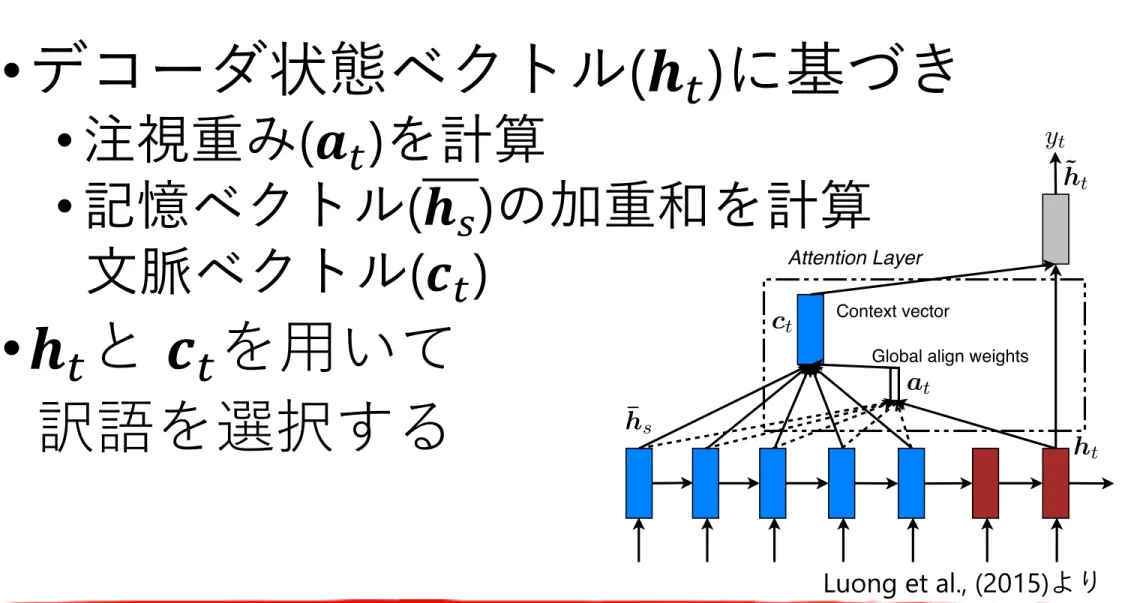
Common to these two types of models is the fact that at each time step t in the decoding phase, both approaches first take as input the hidden state h t at the top layer of a stacking LSTM. The goal is then to derive a context vector c t that captures rel- evant source-side information to help predict the current target word y t . While these models differ in how the context vector c t is derived, they share the same subsequent steps.
Specifically, given the target hidden state h t and the source-side context vector c t , we employ a simple concatenation layer to combine the infor- mation from both vectors to produce an attentional hidden state as follows:
˜ h t = tanh(W c [c t ; h t ]) (5) The attentional vector ˜ h t is then fed through the softmax layer to produce the predictive distribu- tion formulated as:
p(y t | y <t , x) = softmax(W s h ˜ t ) (6) We now detail how each model type computes the source-side context vector c t .
3.1 Global Attention
The idea of a global attentional model is to con- sider all the hidden states of the encoder when de- riving the context vector c t . In this model type, a variable-length alignment vector a t , whose size equals the number of time steps on the source side, is derived by comparing the current target hidden state h t with each source hidden state ¯ h s :
a t (s) = align(h t , h ¯ s ) (7)
= exp score(h t , h ¯ s ) P
s
0exp score(h t , ¯ h s
0)
Here, score is referred as a content-based function for which we consider three different alternatives:
score(h t , h ¯ s ) = 8 >
<
> :
h > t h ¯ s dot h > t W a h ¯ s general W a [h t ; ¯ h s ] concat
(8)
y t
˜ h t
c t
a t
h t
¯ h s
Global align weights Attention Layer
Context vector
Figure 2: Global attentional model – at each time step t, the model infers a variable-length align- ment weight vector a t based on the current target state h t and all source states ¯ h s . A global context vector c t is then computed as the weighted aver- age, according to a t , over all the source states.
Besides, in our early attempts to build attention- based models, we use a location-based function in which the alignment scores are computed from solely the target hidden state h t as follows:
a t = softmax(W a h t ) location (9) Given the alignment vector as weights, the context vector c t is computed as the weighted average over all the source hidden states. 6
Comparison to (Bahdanau et al., 2015) – While our global attention approach is similar in spirit to the model proposed by Bahdanau et al. (2015), there are several key differences which reflect how we have both simplified and generalized from the original model. First, we simply use hidden states at the top LSTM layers in both the encoder and decoder as illustrated in Figure 2. Bahdanau et al. (2015), on the other hand, use the concatena- tion of the forward and backward source hidden states in the bi-directional encoder and target hid- den states in their non-stacking uni-directional de- coder. Second, our computation path is simpler;
we go from h t ! a t ! c t ! ˜ h t then make a prediction as detailed in Eq. (5), Eq. (6), and Figure 2. On the other hand, at any time t, Bah- danau et al. (2015) build from the previous hidden state h t 1 ! a t ! c t ! h t , which, in turn,
6
Eq. (9) implies that all alignment vectors a
tare of the same length. For short sentences, we only use the top part of a
tand for long sentences, we ignore words near the end.
1414
Luong et al., (2015)より
• デコーダ状態ベクトル ( 𝒉 " ) に基づき
•
注視重み(𝒂" )を計算
•
記憶ベクトル(𝒉 $ )の加重和を計算
⽂脈ベクトル(𝒄
" )
• 𝒉 "
と𝒄 "
を⽤いて訳語を選択する
10
令和元年電気関係学会関⻄連合⼤会
(2019/11/30)
Augmented Human Communication Laboratory
Published as a conference paper at ICLR 2015
(a) (b)
(c) (d)
Figure 3: Four sample alignments found by RNNsearch-50. The x-axis and y-axis of each plot correspond to the words in the source sentence (English) and the generated translation (French), respectively. Each pixel shows the weight ↵
ijof the annotation of the j-th source word for the i-th target word (see Eq. (6)), in grayscale (0: black, 1: white). (a) an arbitrary sentence. (b–d) three randomly selected samples among the sentences without any unknown words and of length between 10 and 20 words from the test set.
One of the motivations behind the proposed approach was the use of a fixed-length context vector in the basic encoder–decoder approach. We conjectured that this limitation may make the basic encoder–decoder approach to underperform with long sentences. In Fig. 2, we see that the perfor- mance of RNNencdec dramatically drops as the length of the sentences increases. On the other hand, both RNNsearch-30 and RNNsearch-50 are more robust to the length of the sentences. RNNsearch- 50, especially, shows no performance deterioration even with sentences of length 50 or more. This superiority of the proposed model over the basic encoder–decoder is further confirmed by the fact that the RNNsearch-30 even outperforms RNNencdec-50 (see Table 1).
6
注視と単語対応
• 注視により単語対応が得られる?
• 得られることが多いが 対応は保証されない
• ニューラル翻訳は
訳せるように学習できれば何でもよい
11 Bahdanau et al., (2015)より
令和元年電気関係学会関⻄連合⼤会
(2019/11/30)
Augmented Human Communication Laboratory
効果:⻑⽂における精度改善
• ⻑い⽂でも精度が安定
Published as a conference paper at ICLR 2015
0 10 20 30 40 50 60
Sentence length
0 5 10 15 20 25 30
BLEU score
RNNsearch-50 RNNsearch-30 RNNenc-50 RNNenc-30
Figure 2: The BLEU scores of the generated translations on the test set with respect to the lengths of the sen- tences. The results are on the full test set which in- cludes sentences having un- known words to the models.
2012 and news-test-2013 to make a development (validation) set, and evaluate the models on the test set (news-test-2014) from WMT ’14, which consists of 3003 sentences not present in the training data.
After a usual tokenization 6 , we use a shortlist of 30,000 most frequent words in each language to train our models. Any word not included in the shortlist is mapped to a special token ( [ UNK ] ). We do not apply any other special preprocessing, such as lowercasing or stemming, to the data.
4.2 M ODELS
We train two types of models. The first one is an RNN Encoder–Decoder (RNNencdec, Cho et al., 2014a), and the other is the proposed model, to which we refer as RNNsearch. We train each model twice: first with the sentences of length up to 30 words (RNNencdec-30, RNNsearch-30) and then with the sentences of length up to 50 word (RNNencdec-50, RNNsearch-50).
The encoder and decoder of the RNNencdec have 1000 hidden units each. 7 The encoder of the RNNsearch consists of forward and backward recurrent neural networks (RNN) each having 1000 hidden units. Its decoder has 1000 hidden units. In both cases, we use a multilayer network with a single maxout (Goodfellow et al., 2013) hidden layer to compute the conditional probability of each target word (Pascanu et al., 2014).
We use a minibatch stochastic gradient descent (SGD) algorithm together with Adadelta (Zeiler, 2012) to train each model. Each SGD update direction is computed using a minibatch of 80 sen- tences. We trained each model for approximately 5 days.
Once a model is trained, we use a beam search to find a translation that approximately maximizes the conditional probability (see, e.g., Graves, 2012; Boulanger-Lewandowski et al., 2013). Sutskever et al. (2014) used this approach to generate translations from their neural machine translation model.
For more details on the architectures of the models and training procedure used in the experiments, see Appendices A and B.
5 R ESULTS
5.1 Q UANTITATIVE R ESULTS
In Table 1, we list the translation performances measured in BLEU score. It is clear from the table that in all the cases, the proposed RNNsearch outperforms the conventional RNNencdec. More importantly, the performance of the RNNsearch is as high as that of the conventional phrase-based translation system (Moses), when only the sentences consisting of known words are considered.
This is a significant achievement, considering that Moses uses a separate monolingual corpus (418M words) in addition to the parallel corpora we used to train the RNNsearch and RNNencdec.
6 We used the tokenization script from the open-source machine translation package, Moses.
7 In this paper, by a ’hidden unit’, we always mean the gated hidden unit (see Appendix A.1.1).
5
Bahdanau et al., (2015)より
12
令和元年電気関係学会関⻄連合⼤会
(2019/11/30)
Augmented Human Communication Laboratory
Transformerの構成
• 要素間関係を注視のみで記述
• Attention is All You Need
• 複数回注視を⾏い抽象化
13
ベクトル単語 単語
ベクトル 単語 ベクトル
John runs .
ベクトル単語 単語
ベクトル 単語 ベクトル
<start>
ジョン が単語ベクトル位置依存 位置依存
単語ベクトル 位置依存 単語ベクトル
位置エンコーディング 正規化
複数ヘッド
⾃⼰注視
正規化
FFNN
正規化
複数ヘッド
⾃⼰注視
正規化
FFNN
正規化
複数ヘッド
⾃⼰注視
正規化 N層 FFNN
単語ベクトル位置依存 位置依存 単語ベクトル
位置エンコーディング 正規化
複数ヘッド
⾃⼰注視
正規化 FFNN
N層
複数ヘッド クロス注視
正規化 正規化
複数ヘッド
⾃⼰注視
正規化 FFNN
複数ヘッド クロス注視
正規化
ジョン が
須藤, ニューラル機械翻訳の進展─系列変換モデルの進化とその応⽤─
⼈⼯知能学会誌Vo.34, No.4
令和元年電気関係学会関⻄連合⼤会
(2019/11/30)
Augmented Human Communication Laboratory
Transformerの特徴
• エンコーダを並列化
•
位置情報を周期関数で埋め込む(positional encoding)
• 注視の⼯夫
•
⾃⼰注視(self attention)
•
エンコーダが⼊⼒,デコーダが(直前までの)出⼒を注視可能
•
複数ヘッド(multi-head) 注視
•
異なるタイプの情報を独⽴に注視可能14
令和元年電気関係学会関⻄連合⼤会
(2019/11/30)
Augmented Human Communication Laboratory
Transformerの応⽤
• NMT の新しい de facto standard
•
対訳データが⼤量にあれば特に強⼒• BERT: Transformer を⽤いた⽂符号化
•
⾃然⾔語処理の事前知識として利⽤•
質問応答等の様々な応⽤で精度向上•
様々な⾔語で学習済みモデル公開15
令和元年電気関係学会関⻄連合⼤会
(2019/11/30)
Augmented Human Communication Laboratory
⾃動同時通訳の実現に向けて
16
※
本研究の⼀部はJSPS科研費JP17H06101の助成を受けたものです令和元年電気関係学会関⻄連合⼤会
(2019/11/30)
Augmented Human Communication Laboratory
逐次通訳と同時通訳
•
逐次通訳•
発話ごとに通訳• 同時通訳
•
発話と同時並⾏で通訳17
令和元年電気関係学会関⻄連合⼤会
(2019/11/30)
Augmented Human Communication Laboratory
同時通訳における遅延
18
(1) The relief workers (2) say (3) they don’t have (4) enough food, water, shelter, and medical supplied (5) to deal with (6) the gigantic wave of refugees (7) who are
ransacking the countryside (8) in search of the basics (9) to stay alive.
出典: ⽔野 的
(Akira Mizuno),『同時通訳の理論:認知的制約と訳出⽅略』
令和元年電気関係学会関⻄連合⼤会
(2019/11/30)
Augmented Human Communication Laboratory
同時通訳における遅延
19
(1) The relief workers (2) say (3) they don’t have (4) enough food, water, shelter, and medical supplied (5) to deal with (6) the gigantic wave of
refugees (7) who are ransacking the countryside (8) in search of the basics (9) to stay alive.
(1)
救援担当者は(9)
⽣きるための(8)
⾷料を 求めて(7)
村を荒らし回っている(6) ⼤量の
難⺠たちの世話をするための(4)
⼗分な⾷料や⽔,宿泊施設,医薬品が (3)
無いと(2)
⾔っています
令和元年電気関係学会関⻄連合⼤会
(2019/11/30)
Augmented Human Communication Laboratory
順送りの訳
20
(1) The relief workers (2) say (3) they don’t have (4) enough food, water, shelter, and medical supplied (5) to deal with (6) the gigantic wave of
refugees (7) who are ransacking the countryside (8) in search of the basics (9) to stay alive.
(1)
救援担当者たちの(2)
話では(4)
⾷料,⽔,宿泊施設,医薬品が
(3)
⾜りず(6) ⼤量の難
⺠たちの
(5)
世話ができないとのことです. (7)
難⺠たちは今村々を荒らし回って,(9)
⽣ きるための(8)
⾷料を求めているのです.令和元年電気関係学会関⻄連合⼤会
(2019/11/30)
Augmented Human Communication Laboratory
遅延削減に向けた戦略
1.
部分的な訳出が可能になった時点で訳出を開始する
2. 訳出の順序を⼊⼒に近いものに変更する 3. 訳出を簡明 (concise) にする
4. ⼊⼒を予測する (anticipation)
21
現時点では未だ「翻訳」
令和元年電気関係学会関⻄連合⼤会
(2019/11/30)
Augmented Human Communication Laboratory
漸進的⾳声認識
Novitasari, Tjandra, Sakti, and Nakamura: Sequence-to-Sequence Learning via Attention Transfer for Incremental Speech Recognition, Proc. Interspeech 2019, pp. 3835-3839 (2019)
22
令和元年電気関係学会関⻄連合⼤会
(2019/11/30)
Augmented Human Communication Laboratory
⾳声認識と漸進的処理
•
⾳声認識における⽂脈情報•
タスク⾃体はmonotoneで並べ替えはない•
⾔語モデル観点での⽂脈は必要•
漸進的処理を実現する⽅式• HMM: ⻑距離/後⽅⽂脈を考慮できない → ⾃明
• End-to-End: ⼊⼒全体を注視機構で参照可能
•
処理単位を分割して参照範囲を限定•
どう注視範囲を限定させるか?23
令和元年電気関係学会関⻄連合⼤会
(2019/11/30)
Augmented Human Communication Laboratory
提案⼿法: 注視転移による漸進的⾳声認識
•
教師モデルは全 体を参照可能• ⽣徒モデルは局 所情報のみ利⽤
•
教師モデルの 注視を最⼤限 真似る学習24
令和元年電気関係学会関⻄連合⼤会
(2019/11/30)
Augmented Human Communication Laboratory
漸進的機械翻訳
帖佐, 須藤, 中村: 英⽇同時翻訳のためのConnectionist Temporal
Classificationを⽤いたニューラル機械翻訳, 情報処理学会研究報告 2019-NL-
241 (2019)
25
令和元年電気関係学会関⻄連合⼤会
(2019/11/30)
Augmented Human Communication Laboratory
遅延と流暢さのトレードオフ
•
遅延を短くすれば流暢さは⼀般に低下26
I’m going to take you on a journey
in the next 18 minutes.
皆様をお連れします旅へ今から18分後です
今から18分で
皆様を旅へお連れします
令和元年電気関係学会関⻄連合⼤会
(2019/11/30)
Augmented Human Communication Laboratory
提案⼿法: デコーダにおける適応的遅延
• 特殊記号 <wait> を定義し遅延を制御
27
ブッシュ ⼤統領 は プーチン と 会談 するPresident Bush <wait> meets with Putin
<wait>
<wait>
令和元年電気関係学会関⻄連合⼤会
(2019/11/30)
Augmented Human Communication Laboratory
⽬的関数
•
⼆種類の損失を最⼩化•
遅延•
単語予測誤り28
これ は 機械 翻訳 ですThis Vector representations of input words
this a was is goes are translation machine
令和元年電気関係学会関⻄連合⼤会
(2019/11/30)
Augmented Human Communication Laboratory
<wait>挿⼊位置の問題
• <wait> の位置は⾃由度が⾼い
• President Bush meets <wait> with
• President Bush <wait> meets with
• President <wait> Bush meets with
• …
• Connectionist Temporal Classification (CTC) に 基づく最適化(動的計画法)
29 [A. Graves+ ICML 2006]
令和元年電気関係学会関⻄連合⼤会
(2019/11/30)
Augmented Human Communication Laboratory
漸進的テキスト⾳声合成
Yanagita, Sakti, and Nakamura: Neural iTTS: Toward Synthesizing Speech in Real-time with End-to-End Neural Text-to-Speech Framework, Proc. of the 10th ISCA Speech Synthesis Workshop, pp. 183-188 (2019)
30
令和元年電気関係学会関⻄連合⼤会
(2019/11/30)
Augmented Human Communication Laboratory
テキスト⾳声合成と漸進的処理
•
アクセント/ イントネーション決定に⽂脈が
必要•
英語: 2単語程度? ⽇本語: 2アクセント句程度?(提案⼿法における実験結果より)
•
漸進的合成でも⾳声を滑らかに繋ぐ•
分割して出⼒しても繋ぎ⽬の連続性が欲しい31
令和元年電気関係学会関⻄連合⼤会
(2019/11/30)
Augmented Human Communication Laboratory
提案⼿法: 合成過程の分割と直前結果参照
• 学習データも分割
• 合成時は直前の結果を初期値として再利⽤
…
<s> This is </m>
…Unit 1
Neural iTTS
<m> the TTS</m>
Unit 2
Neural iTTS or
<m>: 途中の合成セグメントの開始 <s>: ⽂の開始 </s>: ⽂の終了 </m>: 途中の合成セグメントの終了
<s>Nice to meet you.</s>
<s>This is Tacotron.</s>
Text and acoustic features
<s>This is an inital step.</s>
<s>This is </m>
<s>Nice </m>
<s>This </m> <m>is </m>
<m>Tacotron.</s>
<m>an </m>
<m>inital step.</s>
<m>to meet </m> <m>you.</s>
零ベクトル
零ベクトルか
直前のメルスペクトログラムベクトル
32
令和元年電気関係学会関⻄連合⼤会
(2019/11/30)
Augmented Human Communication Laboratory
⾳声から⾳声への 同時通訳システム
33
令和元年電気関係学会関⻄連合⼤会
(2019/11/30)
Augmented Human Communication Laboratory
34
デモ: 同時⾳声翻訳
令和元年電気関係学会関⻄連合⼤会
(2019/11/30)
Augmented Human Communication Laboratory
おわりに
35
令和元年電気関係学会関⻄連合⼤会
(2019/11/30)
Augmented Human Communication Laboratory
おわりに
•
深層学習による機械翻訳の進展•
急速に実⽤化,実装技術も含め⽇進⽉歩•
研究レベルでは対訳⽂によらない「教師なし機 械翻訳」も• ⾃動同時通訳への挑戦
•
より挑戦的な課題へ• 表層的でない「深い」翻訳が将来的な課題
36
令和元年電気関係学会関⻄連合⼤会