Econometrics II
(Wed., 8:50-10:20)
Room # 509 ( 法経大学院総合研究棟 )
• The prerequisite of this class is knowledge about Econometrics I (last semester)
and Econometrics (undergraduate level).
TA Session (by Mr. Kinoshita):
From Oct. 9, 2013 Wed., 13:00 - 14:30
Room # 505 (
法経大学院総合研究棟)
Content: Matrix Algebra
Econometrics (Undergraduate Course) Mon., 8:50-10:20 ( 基礎工 B401) Fri., 8:50-10:20 ( 基礎工 B401)
• If you have not taken Econometrics in undergraduate level, attend the above class.
• Textbook:
『計量経済学』(
山本 拓 著,新世社)
1 Regression Analysis ( 回帰分析 )
1.1 Setup of the Model
When (x 1 , y 1 ), (x 2 , y 2 ), · · · , (x n , y n ) are available, suppose that there is a linear rela- tionship between y and x, i.e.,
y i = β 1 + β 2 x i + u i , (1) for i = 1 , 2 , · · · , n. x i and y i denote the ith observations.
−→ Single (or simple) regression model (
単回帰モデル)
y i is called the dependent variable (
従属変数) or the explained variable (
被説明変 数), while x i is known as the independent variable (
独立変数) or the explanatory (or explaining) variable (
説明変数).
β 1 = Intercept (
切片), β 2 = Slope (
傾き)
β 1 and β 2 are unknown parameters (
パラメータ,母数) to be estimated.
β 1 and β 2 are called the regression coe ffi cients (
回帰係数).
u i is the unobserved error term (
誤差項) assumed to be a random variable with mean zero and variance σ 2 .
σ 2 is also a parameter to be estimated.
x i is assumed to be nonstochastic (
非確率的), but y i is stochastic (
確率的) because y i depends on the error u i .
The error terms u 1 , u 2 , · · · , u n are assumed to be mutually independently and iden- tically distributed, which is called iid.
It is assumed that u i has a distribution with mean zero, i.e., E(u i ) = 0 is assumed.
Taking the expectation on both sides of (1), the expectation of y i is represented as:
E(y i ) = E( β 1 + β 2 x i + u i ) = β 1 + β 2 x i + E(u i )
= β 1 + β 2 x i , (2)
for i = 1 , 2 , · · · , n.
Using E(y i ) we can rewrite (1) as y i = E(y i ) + u i .
(2) represents the true regression line.
Let ˆ β 1 and ˆ β 2 be estimates of β 1 and β 2 .
Replacing β 1 and β 2 by ˆ β 1 and ˆ β 2 , (1) turns out to be:
y i = β ˆ 1 + β ˆ 2 x i + e i , (3) for i = 1 , 2 , · · · , n, where e i is called the residual (
残差).
The residual e i is taken as the experimental value (or realization) of u i .
We define ˆy i as follows:
ˆy i = β ˆ 1 + β ˆ 2 x i , (4)
for i = 1 , 2 , · · · , n, which is interpreted as the predicted value (
予測値) of y i .
(4) indicates the estimated regression line, which is di ff erent from (2).
Moreover, using ˆy i we can rewrite (3) as y i = ˆy i + e i .
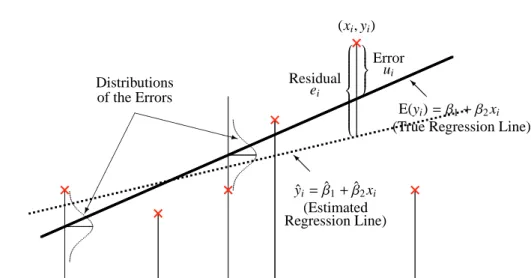
(2) and (4) are displayed in Figure 1.
Figure 1. True and Estimated Regression Lines (
回帰直線)
y
XXXXX XX z Distributions
of the Errors
×
...
...
×
...............
...
...
×
Error u
iResidual
e
i(x
i, y
i)
×
×
×
@ @ I
ˆy
i= β ˆ
1+ β ˆ
2x
i(Estimated Regression Line)
@ @ I
E(y
i) = β
1+ β
2x
i(True Regression Line)
Consider the case of n = 6 for simplicity.
× indicates the observed data series.
The true regression line (2) is represented by the solid line, while the estimated regression line (4) is drawn with the dotted line.
Based on the observed data, β 1 and β 2 are estimated as: ˆ β 1 and ˆ β 2 .
In the next section, we consider how to obtain the estimates of β 1 and β 2 , i.e., ˆ β 1
and ˆ β 2 .
1.2 Ordinary Least Squares Estimation
Suppose that (x 1 , y 1 ), (x 2 , y 2 ), · · · , (x n , y n ) are available.
For the regression model (1), we consider estimating β 1 and β 2 .
Replacing β 1 and β 2 by their estimates ˆ β 1 and ˆ β 2 , remember that the residual e i is given by:
e i = y i − ˆy i = y i − β ˆ 1 − β ˆ 2 x i . The sum of squared residuals is defined as follows:
S ( ˆ β 1 , β ˆ 2 ) =
∑ n
i = 1
e 2 i =
∑ n
i = 1
(y i − β ˆ 1 − β ˆ 2 x i ) 2 .
It might be plausible to choose the ˆ β 1 and ˆ β 2 which minimize the sum of squared residuals, i.e., S ( ˆ β 1 , β ˆ 2 ).
This method is called the ordinary least squares estimation (
最小二乗法,OLS).
To minimize S ( ˆ β 1 , β ˆ 2 ) with respect to ˆ β 1 and ˆ β 2 , we set the partial derivatives equal to zero:
∂ S ( ˆ β 1 , β ˆ 2 )
∂ β ˆ 1
= − 2
∑ n
i = 1
(y i − β ˆ 1 − β ˆ 2 x i ) = 0 ,
∂ S ( ˆ β 1 , β ˆ 2 )
∂ β ˆ 2
= − 2
∑ n
i = 1
x i (y i − β ˆ 1 − β ˆ 2 x i ) = 0 .
The second order condition for minimization is:
( ∂
2S ( ˆ β
1, β ˆ
2)
∂ β ˆ
21∂
2S ( ˆ β
1, β ˆ
2)
∂ β ˆ
1∂ β ˆ
2∂
2S ( ˆ β
1, β ˆ
2)
∂ β ˆ
2∂ β ˆ
1∂
2S ( ˆ β
1, β ˆ
2)
∂ β ˆ
22)
=
( 2n 2 ∑ n
i=1 x i 2 ∑ n
i = 1 x i 2 ∑ n
i = 1 x 2 i )
should be a positive definite matrix.
The diagonal elements 2n and 2 ∑ n
i = 1 x 2 i are positive.
The determinant:
2n 2 ∑ n
i = 1 x i 2 ∑ n
i = 1 x i 2 ∑ n
i = 1 x 2 i
= 4n
∑ n
i=1
x 2 i − 4(
∑ n
i=1
x i ) 2 = 4n
∑ n
i=1
(x i − x) 2
is positive. = ⇒ The second-order condition is satisfied.
The first two equations yield the following two equations:
y = β ˆ 1 + β ˆ 2 x , (5)
∑ n
i = 1
x i y i = nx ˆ β 1 + β ˆ 2
∑ n
i = 1
x 2 i , (6)
where y = 1 n
∑ n
i = 1
y i and x = 1 n
∑ n
i = 1
x i .
Multiplying (5) by nx and subtracting (6), we can derive ˆ β 2 as follows:
β ˆ 2 =
∑ n
i = 1 x i y i − nxy
∑ n
i = 1 x 2 i − nx 2 =
∑ n
i = 1 (x i − x)(y i − y)
∑ n
i = 1 (x i − x) 2 . (7)
From (5), ˆ β 1 is directly obtained as follows:
β ˆ 1 = y − β ˆ 2 x . (8)
When the observed values are taken for y i and x i for i = 1 , 2 , · · · , n, we say that ˆ β 1
and ˆ β 2 are called the ordinary least squares estimates (or simply the least squares estimates,
最小二乗推定値) of β 1 and β 2 .
When y i for i = 1 , 2 , · · · , n are regarded as the random sample, we say that ˆ β 1 and ˆ β 2
are called the ordinary least squares estimators (or the least squares estimators,
最小二乗推定量) of β 1 and β 2 .
1.3 Properties of Least Squares Estimator
Equation (7) is rewritten as:
β ˆ 2 =
∑ n
i = 1 (x i − x)(y i − y)
∑ n
i = 1 (x i − x) 2 =
∑ n
i = 1 (x i − x)y i
∑ n
i = 1 (x i − x) 2 − y ∑ n
i = 1 (x i − x)
∑ n
i = 1 (x i − x) 2
=
∑ n
i = 1
x i − x
∑ n
i = 1 (x i − x) 2 y i =
∑ n
i = 1
ω i y i . (9)
In the third equality,
∑ n
i = 1
(x i − x) = 0 is utilized because of x = 1 n
∑ n
i = 1
x i . In the fourth equality, ω i is defined as: ω i = x i − x
∑ n
i = 1 (x i − x) 2 .
ω i is nonstochastic because x i is assumed to be nonstochastic.
ω i has the following properties:
∑ n
i=1
ω i =
∑ n
i=1
x i − x
∑ n
i = 1 (x i − x) 2 =
∑ n
i = 1 (x i − x)
∑ n
i = 1 (x i − x) 2 = 0 , (10)
∑ n
i = 1
ω i x i =
∑ n
i = 1
ω i (x i − x) =
∑ n
i = 1 (x i − x) 2
∑ n
i = 1 (x i − x) 2 = 1 , (11)
∑ n
i = 1
ω 2 i =
∑ n
i = 1
( x i − x
∑ n
i=1 (x i − x) 2 ) 2
=
∑ n
i=1 (x i − x) 2 (∑ n
i = 1 (x i − x) 2 ) 2 = 1
∑ n
i=1 (x i − x) 2 . (12)
The first equality of (11) comes from (10).
From now on, we focus only on ˆ β 2 , because usually β 2 is more important than β 1 in the regression model (1).
In order to obtain the properties of the least squares estimator ˆ β 2 , we rewrite (9) as:
β ˆ 2 =
∑ n
i=1
ω i y i =
∑ n
i=1
ω i ( β 1 + β 2 x i + u i )
= β 1
∑ n
i=1
ω i + β 2
∑ n
i=1
ω i x i +
∑ n
i=1
ω i u i = β 2 +
∑ n
i=1
ω i u i . (13)
In the fourth equality of (13), (10) and (11) are utilized.
Mean and Variance of ˆ β 2 : u 1 , u 2 , · · · , u n are assumed to be mutually indepen- dently and identically distributed with mean zero and variance σ 2 , but they are not necessarily normal.
Remember that we do not need normality assumption to obtain mean and variance but the normality assumption is required to test a hypothesis.
From (13), the expectation of ˆ β 2 is derived as follows:
E( ˆ β 2 ) = E( β 2 +
∑ n
i = 1
ω i u i ) = β 2 + E(
∑ n
i = 1
ω i u i )
= β 2 +
∑ n
i = 1
ω i E(u i ) = β 2 . (14)
It is shown from (14) that the ordinary least squares estimator ˆ β 2 is an unbiased estimator of β 2 .
From (13), the variance of ˆ β 2 is computed as:
V( ˆ β 2 ) = V( β 2 +
∑ n
i = 1
ω i u i ) = V(
∑ n
i = 1
ω i u i ) =
∑ n
i = 1
V( ω i u i ) =
∑ n
i = 1
ω 2 i V(u i )
= σ 2
∑ n
i = 1
ω 2 i = ∑ n σ 2
i = 1 (x i − x) 2 . (15)
The third equality holds because u 1 , u 2 , · · · , u n are mutually independent.
The last equality comes from (12).
Thus, E( ˆ β 2 ) and V( ˆ β 2 ) are given by (14) and (15).
Gauss-Markov Theorem (
ガウス・マルコフ定理): It has been discussed above that ˆ β 2 is represented as (9), which implies that ˆ β 2 is a linear estimator, i.e., linear in y i .
In addition, (14) indicates that ˆ β 2 is an unbiased estimator.
Therefore, summarizing these two facts, it is shown that ˆ β 2 is a linear unbiased
estimator (
線形不偏推定量).
Furthermore, here we show that ˆ β 2 has minimum variance within a class of the linear unbiased estimators.
Consider the alternative linear unbiased estimator ˜ β 2 as follows:
β ˜ 2 =
∑ n
i = 1
c i y i =
∑ n
i = 1
( ω i + d i )y i ,
where c i = ω i + d i is defined and d i is nonstochastic.
Then, ˜ β 2 is transformed into:
β ˜ 2 =
∑ n
i = 1
c i y i =
∑ n
i = 1
( ω i + d i )( β 1 + β 2 x i + u i )
= β 1
∑ n
i = 1
ω i + β 2
∑ n
i = 1
ω i x i +
∑ n
i = 1
ω i u i + β 1
∑ n
i = 1
d i + β 2
∑ n
i = 1
d i x i +
∑ n
i = 1
d i u i
= β 2 + β 1
∑ n
i = 1
d i + β 2
∑ n
i = 1
d i x i +
∑ n
i = 1
ω i u i +
∑ n
i = 1
d i u i .
Equations (10) and (11) are used in the forth equality.
Taking the expectation on both sides of the above equation, we obtain:
E( ˜ β 2 ) = β 2 + β 1
∑ n
i = 1
d i + β 2
∑ n
i = 1
d i x i +
∑ n
i = 1
ω i E(u i ) +
∑ n
i = 1
d i E(u i )
= β 2 + β 1
∑ n
i = 1
d i + β 2
∑ n
i = 1
d i x i .
Note that d i is not a random variable and that E(u i ) = 0.
Since ˜ β 2 is assumed to be unbiased, we need the following conditions:
∑ n
i=1
d i = 0 ,
∑ n
i=1
d i x i = 0 .
When these conditions hold, we can rewrite ˜ β 2 as:
β ˜ 2 = β 2 +
∑ n
i = 1
( ω i + d i )u i . The variance of ˜ β 2 is derived as:
V( ˜ β 2 ) = V ( β 2 +
∑ n
i = 1
( ω i + d i )u i
) = V ( ∑ n
i = 1
( ω i + d i )u i
) =
∑ n
i = 1
V (
( ω i + d i )u i
)
=
∑ n
i = 1
( ω i + d i ) 2 V(u i ) = σ 2 (
∑ n
i = 1
ω 2 i + 2
∑ n
i = 1
ω i d i +
∑ n
i = 1
d i 2 )
= σ 2 (
∑ n
i = 1
ω 2 i +
∑ n
i = 1
d i 2 ) .
From unbiasedness of ˜ β 2 , using ∑ n
i=1 d i = 0 and ∑ n
i=1 d i x i = 0, we obtain:
∑ n
i = 1
ω i d i =
∑ n
i = 1 (x i − x)d i
∑ n
i = 1 (x i − x) 2 =
∑ n
i = 1 x i d i − x ∑ n
i = 1 d i
∑ n
i = 1 (x i − x) 2 = 0 ,
which is utilized to obtain the variance of ˜ β 2 in the third line of the above equation.
From (15), the variance of ˆ β 2 is given by: V( ˆ β 2 ) = σ 2 ∑ n i = 1 ω 2 i . Therefore, we have:
V( ˜ β 2 ) ≥ V( ˆ β 2 ) , because of ∑ n
i=1 d 2 i ≥ 0.
When ∑ n
i=1 d 2 i = 0, i.e., when d 1 = d 2 = · · · = d n = 0, we have the equality: V( ˜ β 2 )
= V( ˆ β 2 ).
Thus, in the case of d 1 = d 2 = · · · = d n = 0, ˆ β 2 is equivalent to ˜ β 2 .
As shown above, the least squares estimator ˆ β 2 gives us the minimum variance
linear unbiased estimator (
最小分散線形不偏推定量), or equivalently the best
linear unbiased estimator (
最良線形不偏推定量,BLUE), which is called the
Gauss-Markov theorem (
ガウス・マルコフ定理).
Asymptotic Properties (
漸近的性質) of ˆ β 2 : We assume that as n goes to infinity we have the following:
1 n
∑ n
i = 1
(x i − x) 2 −→ m < ∞,
where m is a constant value. From (12), we obtain:
n
∑ n
i = 1
ω 2 i = 1
(1 / n) ∑ n
i = 1 (x i − x) −→ 1
m .
Note that f (x n ) −→ f (m) when x n −→ m, called Slutsky’s theorem (スルツキー
定理), where m is a constant value and f ( · ) is a function.
We show both consistency (
一致性) of ˆ β 2 and asymptotic normality (
漸近正規 性) of √
n( ˆ β 2 − β 2 ).
●
First, we prove that ˆ β 2 is a consistent estimator of β 2 .
[Review] Chebyshev’s inequality (
チェビシェフの不等式) is given by:
P( | X − µ| > ) ≤ σ 2
2 , where µ = E(X) and σ 2 = V(X).
[End of Review]
Replace X, E(X) and V(X) by:
β ˆ 2 , E( ˆ β 2 ) = β 2 , and V( ˆ β 2 ) = σ 2
∑ n
i=1
ω 2 i = σ 2
∑ n
i = 1 (x i − x) .
Then, when n −→ ∞ , we obtain the following result:
P( | β ˆ 2 − β 2 | > ) ≤ σ 2 ∑ n i=1 ω 2 i
2 = σ 2 n ∑ n i=1 ω 2 i
n 2 −→ 0 , where ∑ n
i = 1 ω 2 i −→ 0 because n ∑ n
i = 1 ω 2 i −→ 1
m from the assumption.
Thus, we obtain the result that ˆ β 2 −→ β 2 as n −→ ∞ .
Therefore, we can conclude that ˆ β 2 is a consistent estimator (
一致推定量) of β 2 .
●