The deep-sea mysid genus Paramblyops was established by Holt and Tattersall (1905) for the reception of P. rostratacollected from on the sea- floor at 810–900 m deep off the west and south- west Ireland. Since then, six species (P. bidigita- tus W. Tattersall, 1911, P. brevirostris O. Tatter- sall, 1955, P. globorostris Birstein and Tchin- donova, 1970, P. japonicus Murano, 1981, P.
tenuicaudus Murano, 2002, and P. spatulicaudus Murano, 2002) were added to this genus. The present specimens were taken from on or just above the sea-floor at 465–547 m deep in the Timor Sea during R/V Hakuho-Maru Cruise KH- 72-1. All the specimens examined are stored in the National Museum of Nature and Science (NSMT).
Paramblyops macropssp. nov.
(Figs. 1–3)
Type series. Holotype (NSMT-Cr 17737), adult male (10.7 mm); paratypes (NSMT-Cr 17738), 1 adult male (10.1 mm), 1 immature male (9.6 mm) and 2 juveniles (7.3, 6.9 mm), 12°42.2S 123°07.6E to 12°42.0S 123°08.5E, off Sahul Shelf, Timor Sea, 26 June 1972, 535–
547 m, plankton net installed at mouth of 3-m beam trawl, coll. M. Murano.
Other materials. 1 adult male (divided into two parts) (NSMT-Cr 17739), 1 immature female (9.1 mm) and 1 juvenile (anterior half of body), 09°30.9S 127°56.6E, Timor Sea, 19 June 1972, 465–490 m, plankton net installed at mouth of 3- m beam trawl, coll. M. Murano.
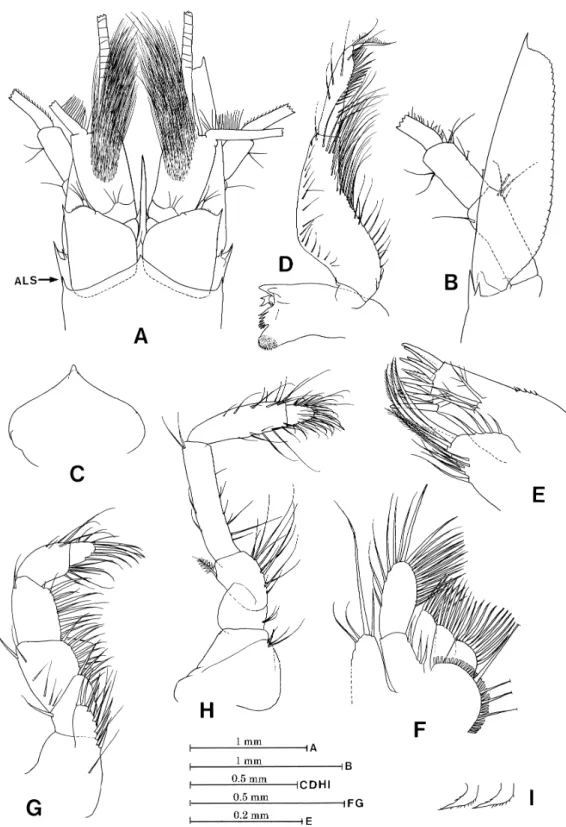
Description of holotype. Body without ster- nal processes. Strong spear-shaped median pro- jection (Fig. 1A) arising from front of labrum and extending beyond halfway of third segment of antennular peduncle.
Rostrum (Fig. 1A) produced into low triangu- lar plate with pointed apex not extending to base of antennular peduncles, covering basal part of eyeplates; lateral marings (Fig. 1A) slightly con- cave, with pair of strong antero-lateral spines (ALS) above outside of eyestalks. Lower anterior corners of carapace rounded. Posterior margin of carapace emarginate, leaving last thoracic somite exposed.
Eyes (Fig. 1A) plate-like without definite eye- stalk, clearly separated from each other, visual el- ements reduced completely; each plate large, quadrangular in shape, extending to distal margin of second segment of antennular peduncle; outer margin straight, naked, about twice longer than inner margin, terminating in sharply pointed spine; anterior margin slightly convex, with small
A New Species of the Genus Paramblyops (Crustacea, Mysida, Mysidae) from the Timor Sea
Masaaki Murano
3–32–36 Shimotakaido, Suginami-ku, Tokyo 168–0073, Japan E-mail: [email protected]
Abstract A new species of the genus Paramblyops, P. macrops, is described based on specimens collected from the depth of about 500 m in the Timor Sea. Of seven known species of the genus, this species closely resembles P. brevirostrisfrom the Schollaert Channel of the Antarctic Peninsu- la, but is different from that species in the larger eyes, a pair of the strong spines on the antero-lat- eral margin of the carapace, and the shorter telson. From the other species, P. macropsis easily dis- tinguished by the shapes of the eyes and the rostrum.
Key words : Mysidae, Paramblyops, new species, Timor Sea.
knob at about center, minutely spinulose between small knob and outer spine; inner distal corner rounded.
Antennular peduncle (Fig. 1A) robust; first segment about as long as broad, outer distal cor- ner prolonged anteriorly into narrow lobe tipped with several setae; second segment short, with some short setae on anterior margin; third seg- ment longest, much longer than first and second segments together, 1.7 times as long as broad.
Appendix masculina growing from ventral side of third segment so hirsute that aspect of own segment is disappeared even in dorsal observa- tion.
Antennal scale (Fig. 1A, B) long, extending beyond distal end of third segment of antennular peduncle for more than 1/3 of its length, gradual- ly narrowing distally from proximal 1/3 part, at which maximum breadth is located; outer margin naked, slightly convex, terminating in spinous process; distal lobe hardly developed. Antennal peduncle (Fig. 1A, B) elongated, slightly longer than antennular peduncle, extending to distal 1/3 of antennal scale, with second segment longest.
Antennal sympod (Fig. 1A, B) with 2 unequal spines at outer distal corner.
Labrum (Fig. 1C) shorter than broad, with frontal margin produced into short triangular process with pointed apex.
Mandibular palp (Fig. 1D) slender, second segment armed with many setae along inner and outer margins, especially along distal half of outer margin; third segment narrow, about 5 times as long as broad, more than half of length of second segment.
Maxillule and maxilla as shown in Fig. 1E and F, respectively.
Endopod of first thoracic limb (Fig. 1G) small, rather slender, armed with many strong barbed setae on inner margin; terminal claw long and stout. Endopod of second thoracic limb (Fig. 1H) rather short, ischium with about 10 long and slender setae on inner margin; merus equal to combined length of carpopropodus and dactylus, 4.5 times as long as broad; carpopropodus 3.5 times as long as broad, slightly broader in middle
portion than in proximal and distal ones; dactylus armed with long, stout terminal claw and many setae.
Endopod of third to eighth thoracic limbs very slender; in one of anterior limbs (maybe third en- dopod) (Fig. 2A), merus 13 times as long as broad at proximal end; carpus about 1/3 length of merus, with long setae at distal end; propodus di- vided obliquely from carpus, 2-subsegmented with transverse articulation, proximal subseg- ment longer than distal, both subsegments armed with many long slender setae on distal margin;
dactylus short and narrow, with slender terminal claw. Endopod of one of posterior thoracic limbs (seventh or eighth endopod) (Fig. 2B) extremely elongated; merus slightly curved outwardly, about 30 times as long as broad at proximal end;
carpus straight, slightly more than half of merus in length, connected obliquely with propodus;
propodus divided into 2 subsegments, proximal subsegment slightly longer than distal one, armed with about 10 long setae on distal margin, distal subsegment armed on distal margin with numer- ous long setae by which condition of dactylus and terminal claw can not be observed. Basal plate of exopod of thoracic limbs with antero-lat- eral corner rounded in first, second, seventh and eighth limbs and pointed in third to sixth limbs;
flagellipart 9-segmented in first limb and 10-seg- mented in second to eighth limbs.
Genital organ (Fig. 2C, D) curved anteriorly, becoming gradually broader to halfway, then nar- rowed to distal end at which 5 curved setae are arising.
First 5 abdominal somites subequal in length;
sixth somite about twice as long as fifth, with postero-lateral corners pointed (Fig. 3G).
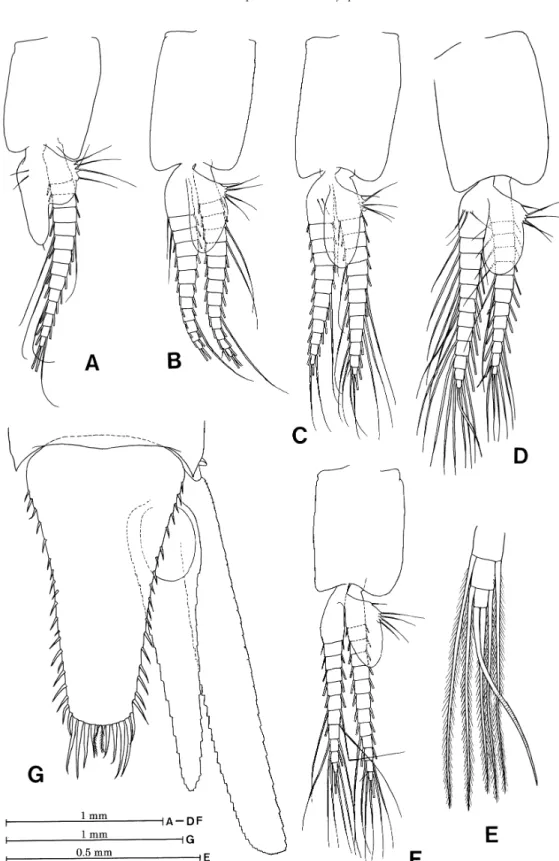
Pleopods natatory and biramous (Fig. 3A–D, F). First pleopod (Fig. 3A) with 14-segmented exopod and unsegmented endopod, endopod ex- tending distally beyond fifth segment of exopod and armed with 1 tiny seta at apex, pseudo- branchial lobe of endopod very broad. Second and third pleopods (Fig. 3B, C); exopod longer than endopod, 14-segmented in second pleopod and 13-segmented in third pleopod, armed with
106 Masaaki Murano
Fig. 1. Paramlyops macropssp. nov., A–H, holotype, I, one of juvenile paratype (damaged). A, anterior part of body; B, antenna (left); C, labrum; D, mandible and mandibular palp (right); E, maxillule (left); F, maxilla (left); G, endopod of first thoracic limb; H, endopod of second thoracic limb; I, sternal processes on fourth and fifth thoracic somites. (ALS: antero-lateral spine)
108 Masaaki Murano
Fig. 2. Paramlyops macropssp. nov., holotype. A, endopod of one of anterior thoracic limbs; B, endopod of one of posterior thoracic limbs; C, exopod of eighth thoracic limb and genital organ; D, genital organ.
Fig. 3. Paramlyops macropssp. nov., holotype. A, first pleopod (left); B, second pleopod (left); C, third pleopod (left); D, fourth pleopod (left); E, distal part of endopod of fourth pleopod (left); F, fifth pleopod (left); G, uropod (right) and telson.
short naked seta at inner distal corner of penulti- mate segment; endopod 12-segmented. Fourth pleopod (Fig. 3D, E); exopod 13-segmented, shorter than endopod, without modified setae, penultimate segment armed with short naked seta, which is longer than those of preceding 2 pleopods; endopod 12-segmented, inner distal seta curved sigmoidally, almost naked and needlelike distally. Fifth pleopod (Fig. 3F) small- er than second to fourth pleopods, exopod 13- segmented, longer than endopod, penultimate segment armed with small naked seta; endopod 11-segmented. Pseudobranchial lobe from basal segment of endopod of second to fifth pleopods in form of large flat plate.
Uropod (Fig. 3G); exopod long, straight, over- reaching posterior end of telson for more than distal 1/3 of its length; endopod of intermediate length between exopod and telson, unarmed with spines in statocyst region.
Telson (Fig. 3G) as long as sixth abdominal somite, nearly twice as long as broad at base;
posterior margin arched, 1/3 of breadth at base, armed with 6 pairs of spines of which innermost pair is very short, next pair is 4 times longer than innermost one, third pair is 1.25 times longer than second, fourth pair is longest, more than 1/5 of telson length, fifth pair is slightly shorter than fourth and longer than third, outermost pair is about half length of fifth pair and is equal to dis- talmost lateral spine in length; pair of feeble me- dian plumose setae present. Lateral margin of tel- son slightly concave, armed throughout with 18 or 19 spines, which become longer posteriorly as a whole.
Etymology. The specific name, macrops, is derived from the big eyes.
Remarks. Murano (2002) classified the seven known species of this genus into three groups, rostratus-group, bidigitatus-group and globorostris-group, based on the characters of the rostrum, the eyes, the spear-shaped ven- trofrontal projection and so on. The new species is judged to belong to the rostratus-group by rea- son of the close resemblance in main characters to S. brevirostris, which is a member of this
group. The new species, together with P. brevi- rostris, differs from the other three species of this group, P. rostratus, P. tenuicaudusand P. spatuli- caudus, in the shorter rostrum and the quadran- gular eyeplates. Furthermore, it is distinguished from P. brevirostrisby the following respects. (1) The eyeplates of P. brevirostris are short and not extending to the distal margin of the first anten- nular peduncle segment, while that of P. macrops is large and extending to the distal margin of the second antennular peduncle segment. (2) The an- tero-lateral margins of the carapace are smooth in P. brevirostris, whereas in P. macropsthe margins are furnished with a pair of strong spines above the outer margins of the eyeplates. (3) The telson of P. brevirostrisis 2.5 times as long as broad at the base and not armed with a pair of median plumose setae on the posterior margin, while that of P. macropsis less than twice as long as broad and armed on the posterior margin with a pair of plumose setae, although it is feeble. (4) The mar- ginal spines of the telson are longer and more slender in P. macrops. (5) The body length is smaller in P. macrops(10.1 and 10.7 mm in adult male) than in P. brevirostris(15 mm in adult male and 16 mm in adult female).
O. Tattersall (1955) discovered sternal process- es in the male specimen of P. brevirostris, but could not find them in any of the female speci- mens, which were all fully adult. In P. macrops, the processes were confirmed in an immature male (9.6 mm, Fig. 1I) and three juvenile speci- mens without clear indications of their gender, but could not find in the three mature males and the immature female (9.1 mm) with a marsupium in an early stage.
Brevirostris-group is allied to the genus Sco- lamblyopsMurano, 1974, in the shape of the eye- plate and the armature on the posterior margin of the telson. Each eyeplate of Brevirostris-group is clearly separated from the other, while the eye of Scolamblyops is separated into two immovable plates in contact with each other in their inner margins (S. japonicus) or united into a single plate (S. oculospinum), and the telson is armed throughout with spines on the lateral margin in
110 Masaaki Murano
the brevirostris-group while it is naked in the proximal 1/4 to 2/5 part in Scolamblyops. Be- sides, brevirostris-group is different from Sco- lamblyopsin having the remarkable spear-shaped antero-ventral projection and the labrum with an acute apex.
The present specimens were surely taken from on or just above the sea-floor of about 500 m deep, although any of closing devices was not used through the collection. The species is a bot- tom living form inhibiting about 500 m deep.
Distribution. P. macrops has been collected only in the Timor Sea.
References
Birstein, J. A. and J. G. Tchindonova, 1970. New mysids (Crustacea, Mysidacea) from the Kurile-Kamchatka Trench. Trudy Institute Okeanology, 86: 277–291.
Holt, E. W. L. and W. M. Tattersall, 1905. Schizopodous
Crustacea from the North-east Atlantic slope. Annual Report of Fisheries, Ireland, 1902–03, Pt. 2, Appendix 4, 99–152, 11 pls.
Murano, M., 1974. Scolamblyops japonicusgen. nov., sp.
nov. (Mysidacea) from Suruga Bay, Japan.
Crustaceana, 26: 225–228.
Murano, M., 1981. Mysidacea from the central and west- ern Pacific. V. Genera Heteroerythrops, Meierythrops, Pleurerythrops, Gibberythrops, Illigiella, Dactylambly- ops, Pseudamblyops, Paramblyops, Dactylerythrops and Nakazawaia(tribe Erythropini). Publications of the Seto Marine Biological Laboratory, 26: 261–302.
Murano, M., 2002. Two new species of the genus Paramblyops (Crustacea : Mysidacea : Mysidae) from the Sulu Sea. Bulletin of the National Science Museum, Tokyo, Ser. A, 28: 35–41.
Tattersall, O. S., 1955. Mysidacea. Discovery Reports, 28:
1–190.
Tattersall, W. M., 1911. Schizopodous Crustacea from the North-east Atlantic slope. Second supplement. Depart- ment of Agriculture and Technical Instruction for Ire- land, Fisheries Branch, Scientific Investigations, 1910, 2: 1–77, 8 pls.