The Effects of Genre-Based Instruction on Content, Structure, and Accuracy
in Descriptive Writing
Taeko Kamimura
Gaku Uehara
1. Introduction
Research in writing started with a focus on product, that is, what is written in a composition. In this product-oriented view of writing, researchers were interested in examining formal features of texts (e.g., O’Donnell & Smith, 1975; Ho-Peng, 1983). However, researchers who argued that written text is only the end product of composing began to appear, and therefore, they shifted their attention from the written text to the writers and explored the process of writing, through which the text comes into being (Flower & Hayes, 1981; Zamel, 1983). The process-oriented view of writing has had a significant impact on both writing researchers and teachers, especially in North America.
2. Genre-Based Writing Pedagogies
The basic principle of a genre-based writing course is that “literacy development requires an explicit focus on the ways texts are organized and the language choices available to users to achieve their purposes in particular contexts” (Hyland, 2014, p. 118, italics are by Kamimura and Uehara). In this pedagogical perspective, instructors first need to give their students explicit instruction when they provide a writing task that has a clear purpose situated in a specific context, and they then teach their students particular structural and language features that would enable the students to achieve the specified purposes.
There are a number of typical genres found in educational contexts, such as narrative, recount, description, information report, and explanation. Each genre has a social purpose, and structural and language features. For instance, the purpose of the recount genre is to retell events in order to inform or entertain a listener or a reader. Recounts are structured in the following order: “orientation,” “a sequence of events,” “personal commentary,” and “re-orientation.” Language
features that characterize this genre are “the past tense,” “human participants,” “time elements,” and “evaluative language to express feelings and judgments of
people and events” (Department of Education and Children’s Services, 2013, p. 14, cited in Hyland, 2016, p. 177).
in the target genre by receiving a teacher’s scaffolding. The fourth stage is “independent construction of the text”; in this stage, the students create their own texts with little assistance, which is given only as they need it, from other students or teachers, and achievement assessment can also be made. The final stage is “linking related texts,” where the students relate what they have learned about a target text in the preceding stages to other texts to discover similarities and differences between varying types of texts and their uses. Feez maintained that this teaching-learning cycle was flexible enough to be adapted to the students’ needs. Therefore, a teacher can start with any stage, skip some stages, or return to the previous stage for review.
By applying Feez’s teaching-learning cycle (2002) to a Japanese context, Ataka and Matsuzawa (2016) conducted a study in which Japanese junior high school students and a teacher participated. In this study, a Japanese teacher gave her students genre-based instruction so that the students could produce an effective descriptive text as a speech manuscript where they would introduce to an ALT teacher some famous spots and special products in the town where they
lived. Ataka and Matsuzawa further incorporated into the teaching-learning cycle genre-based writing assessment proposed by Byrnes, Maxim, and Norris (2010), who argued that teachers could measure their students’ writing achievement if they gave the students genre-based tasks and assessed how effectively they could produce a text in a target genre. In preparing their genre-based writing assessment, Ataka and Matsuzawa combined students’ self-evaluations and teacher feedback and used both in the joint construction stage in the teaching-learning cycle. The results of the survey revealed that the students appreciated both the genre-based writing instruction and assessment and gained significant confidence in producing cohesive texts.
There are, however, only a few studies that have been conducted from the perspective of genre-based writing in a Japanese context and that have investigated the effectiveness of genre-based writing assessment. The present study, therefore, attempted to design genre-based writing instruction for Japanese university EFL students and examine its effects on their production of descriptive writing.
3. Purpose of the Present Study
The purpose of the present study was twofold, as follows:
1) To design effective genre-based instruction to develop Japanese university EFL students’ ability to produce descriptive writing; and
2) To examine the effects of the instruction on the students’ production of descriptive writing.
4. Procedure 4.1 Participants
four-year Japanese university. They were English majors, and their English proficiency was considered to be at the intermediate level, with an average TOEIC® Listening
and Reading score of 456 points. 4.2 Genre-Based Writing Task
A genre-based writing task was prepared, where (1) a target genre, (2) purpose, (3) context, (4) audience, (5) structural features, and (6) language features were specified. Description was chosen as a target genre for the task because it is listed as one of the typical genres in education contexts and its purpose was specified as describing some of the features of a particular person (Department of Education and Children’s Services, 2004, p. 101, cited in Hyland, 2016, p. 176). The context was to write an email to a particular reader specified in the task.
4.3 The Pre- and Post-Tests
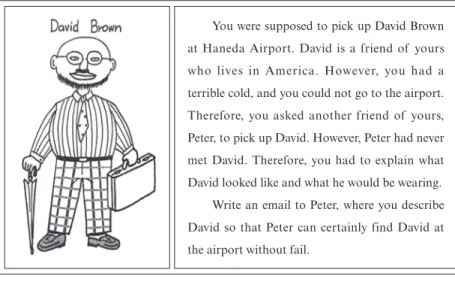
The present study was conducted by following a research design, in which the students took the pre- and post-test and received the genre-based writing instruction in between. In both the pre- and post-test, the students were shown a picture of David Brown and told to write an email to the specified reader, that is, Peter, by considering the given context, in 20 minutes without using a dictionary. Figure 2 shows the picture of David Brown and the writing prompt for the tests.
The students took the post-test one month after completing the final task of the writing instruction.
5. Genre-Based Writing Instruction
The students were provided with writing instruction that consisted of a series of genre-based writing tasks based on Feez’s teaching-learning cycle Figure 2. The picture of David Brown (Oi, Kamimura, and Sano, 2017, p. 23) and the writing prompt for the pre- and post-tests.
(2002). Because this study focused on description as the only target genre, the final stage in the cycle, that is, “linking related texts,” was not included in the instruction. The following sections explain each of the tasks that corresponded to the different stages of Feez’s cycle.
5.1 Task 1: The Stage of “Developing the Context” in the Teaching-Learning Cycle
For the stage “developing the context” in Feez’s teaching-learning cycle (2002), Task 1 was prepared, where the students were assigned a picture-description task that was similar to the one used in the pre-test. Figure 3 displays the picture and the prompt.
5.2 Task 2: Analyzing the Model Text in the Stage of “Modelling and Deconstructing the Text” in the Teaching-Learning Cycle
In this task, the students were given a model description of Mary White, Figure 3. The picture of Mary White and the writing prompt for Task 1
You were looking forward to attending a Halloween party with George and your friend Mary White. Mary was supposed to join both of you in front of Shibuya Station. However, just before you left home, you accidentally fell down the stairs at home and broke your leg. Therefore, you had to ask George to meet Mary at Shibuya Station. However, you had some problems. First, George had never met Mary before. In addition, you first thought of sending him a picture of her, but you soon realized that she was going to dress up in disguise for the Halloween party. However, fortunately, Mary had told you before about what she would be wearing for the party.
which was incorporated into an email addressed to George. The following is the model description (genre) of Mary White shown in bold, with a beginning and concluding message in an email (text-type) addressed to George in italics. This activity attempted to raise the students’ “rhetorical consciousness” of a target genre (Hyland, 2016, p. 163). The students were told to analyze the model passage in terms of both the structural features and three kinds of language features, that is, (1) vocabulary items, (2) kinds of verbs, and (3) verb tenses.
5.2.1 Analyzing the Structural Features
The students closely studied the model passage and were told to consider Hi, George. Thank you very much for your help. I will describe how she looks and what she will be wearing.
First, let me tell you about Mary’s general appearance. She is an American in her twenties. She is quite tall and slim. She is about 185 centimeters tall and maybe weighs only 45 kilograms.
Second, let me describe her face. She has a round face, with long, curly, blond hair. She has narrow eyes and a turned-up nose. Her mouth is very small. She also has a mole on her left chin.
Third, I will explain her clothes. She will be wearing a short-sleeved, striped blouse and a flower-patterned skirt. She will be wearing her glasses with round frames and her favorite pendant. Also, she will be wearing leather high heels.
Finally, let me tell you what she will be carrying. She will be carrying a fake knife in her right hand and a fashionable designer umbrella in her left hand.
the organization of the model until they discovered two basic principles of the structural sequence that needed to be adhered to in describing a person. The first principle was “from the general to the specific,” where a description began with a person’s general appearance, followed by his/her specific physical features. The second principle was “from the top to the bottom,” which was applied to the parts that illustrated the “specific” features of a person. Namely, by applying the general-to-specific principle, what needed to be first written about was information about Mary’s general appearance, such as her nationality, age, gender, height, and build. This should be followed by a description of her face, clothes, and belongings according to the second top-down principle. The importance of these structural principles was also stressed by Sanmori (2010) in the context of teaching description in Japanese as a first language. Considering those two principles, the students were told to analyze the model passage and fill in Table 1 by finding the sequential categories and specific physical features that fell into each category.
Table 1
Structural Categories and Specific Features (Expected Answers)
Sequence Category Special features
1 Mary’s general appearance nationality, age, gender, height, build
2 her face shape, hair, eyes, nose, mole
3 her clothes glasses, blouse, skirt, accessory,
shoes
5.2.2 Analyzing the Language Features
Next, the students were told to pay careful attention to the language features of the model description and asked what vocabulary items, kinds of verbs, and verb tenses were used to express each of the specific physical features of Mary White. Specifically, as Table 2 shows, it was expected that students would recognize that, in order to illustrate Mary’s general appearance, they needed to use (1) lexical items that described such features as her nationality, age, gender, height, build, and to choose (2) the “be-verb” and (3) the present tense. In describing her face, they needed to use (1) lexical items that characterized parts of her face (e.g., “round,” “long,” and “narrow”), (2) the “be-verb” or the verb “have,” and (3) the present tense. Likewise, the students were instructed to learn (1) various vocabulary items they needed in describing Mary’s clothes and belongings. However, they needed to recognize that, unlike the situation where they illustrated Mary’s general appearance and physical features, (2) verbs such as “wear” or “carry” and (3) the future progressive tense should be employed in explaining Mary’s clothes and belongings, respectively.
5.3 Task 3: Comparing the Model Writing and the Students’ Own Writing in the Stage of “Modelling and Deconstructing the Text” in the Teaching-Learning Cycle In this task, the students compared the model description and their own writing by focusing on the structural and language features.
5.3.1 Comparing the Structural Features
The students closely looked at their own writing to examine whether it followed the two basic organizational principles explained before; that is, their writing met the structural requirement, if their passage started with the information about Mary White’s general appearance, and if subsequent sentences depicted her specific features (the general-to-specific principle) in the order of her face, clothes, and belongings (the top-down principle).
In this task, as is displayed in Table 3, the students were shown a sample passage and told how to analyze their own description. The first sentence in the sample passage described Mary’s hair; therefore, this sentence fell into the structural category of “face.” The second sentence wrote about her build Table 2
(slim), which belonged to the category of “general appearance.” However, according to the general-to-specific principle, the order of the first and second sentences should have been reversed; therefore, in this case, there was a discoursal digression or a “jump” between the first and second sentence.
Another example of a jump was observed between the fifth and sixth sentences. The fifth sentence mentioned Mary’s skirt in the category of “clothes,” but the sixth sentence described her eyes, which belonged to the category of “face”; thus, between the fifth and the sixth sentence, the structural flow did not adhere to the top-down principle. In total, five jumps appeared in this sample passage. In this manner, the students were instructed to analyze their own composition in terms of the organizational sequence, and to count the number of jumps observed in their composition.
Table 3
5.3.2 Comparing the Language Features
After analyzing the structure of their own writing, they then focused on the lexicogrammatical features. First, they determined whether they used the appropriate vocabulary items to delineate the general and specific physical characteristics of Mary White, as is shown in Table 2. When they found some unfamiliar words that they did not come up with in writing the description, they wrote in those words in their own descriptive writing. Next, they also examined whether the appropriate verbs (“be-verb” and “have,” “wear,” and “carry”) and tenses (the present tense and future progressive tense) were used, and if not, they underlined the parts that included errors in these grammatical features. 5.4 Task 4: Describing William or Sophy in the Stage of “Joint Construction of the Text” in the Teaching-Learning Cycle
The purpose of Task 4 was to consolidate what the students had learned in the previous tasks. The appendix shows the worksheet used for Task 4. The following is the writing prompt used for Task 4.
Prompt Task 4
You were supposed to see William and Sophy at ABC Station, but you had some business to do and could not see them there. Therefore, you had to ask William and Sophy to meet with each other at the station without you. Write an email either to William or Sophy.
In this task, the students worked in pairs, and each student drew a picture of William or Sophy. They then wrote an email where they described him or her by using vocabulary items given. After writing an email, the students exchanged the emails with their partners and read them as pair work. Based on the information included in the emails, the students drew a picture of William or Sophy. This is similar to an information gap activity, where each one of the students in a pair has information that is not known to the other. In this task, the students freely illustrated the appearance of William or Sophy and wrote an email on their own; in this way, the degree of freedom increased, which enabled the students to move on to the next stage of “independent construction of the text” without much difficulty.
5.4.1 Post-test: Describing David Brown in the Stage of “Independent Construction of the Text” in the Teaching-Learning Cycle
In the present study, the post-test was regarded as a task that corresponded to the stage of “independent construction of the text” in Feez’s teaching-learning cycle (2002). Here, the students were expected to write an email where they described David Brown by carefully considering the target genre’s structural and lexicogrammatical features.
6. Analysis
To measure the effects of the instruction, both quantitative and qualitative analyses were conducted. Each of the analyses will be explained respectively in the following sections.
6.1 Quantitative Analysis 6.1.1 Analysis by Idea Units
of the instruction. Thus, each student’s writing was segmented into different idea units. A total of 20 idea units were expected for describing David Brown: six for his general appearance, seven for his face, five for his clothes, and two for his belongings. These 20 idea units are shown in Table 4.
On the basis of these idea units, the pre- and post-tests were compared. The main focus of the analysis was whether students acquired the structural and language features of descriptive writing. Specifically, the students’ descriptions written in the pre- and post-tests were compared from the perspective of (1) the number of jumps, (2) the number of idea units, and (3) the number of correctly-written idea units. The first analytical measure was used for the structural features while the other two concerned the language features. Also, to measure an effect size, Cohen’s d was used1.
6.1.2 The Number of Jumps
The numbers of jumps observed in the descriptions in the two tests were Table 4
compared to investigate if the students had acquired the structural features of descriptive writing. The jump means an informational digression from an expected sequence of descriptive writing (see 5.2.1). Thus, it was considered that there was one jump if an idea unit that illustrated David Brown’s face was followed by another that described his general appearance, as follows: “His face is round” and “He is short.” The decrease in the number of jumps suggests that there was an improvement in students’ performance on the structural features. 6.1.3 The Number of Idea Units
To investigate the change in content, the number of idea units was compared between the pre- and post-tests. The students were expected to include as many idea units as possible so that readers could obtain a clear picture of David Brown. Because of this, an increase in the number of idea units was regarded as an improvement in the use of language features, that is, the use of various lexical items needed to describe David Brown.
6.1.4 The Number of Correctly-Written Idea Units
In addition to the number of idea units, the two tests were compared in terms of the number of correctly-written idea units. Here, the main focus was placed on grammatical accuracy, specifically on the correct use of verbs and tenses. Thus, the increase in the number of correctly-written idea units was considered an increase in the students’ understanding of the accurate ways to express idea units in descriptive writing.
6.2 Qualitative Analysis
correctly-written idea units) were adopted. 7. Results and Discussion
7.1 Quantitative Analysis
In the subsequent sections, results of statistical comparisons between the pre- and post-tests are shown. All of these results were compared by the Wilcoxon signed-rank tests because they did not follow a normal distribution. 7.1.1 Jumps
Table 5 presents the descriptive statistics for the jumps.
The results of the Wilcoxon signed-rank test revealed a significant decrease in the number of jumps from the pre- to post-test (z = -3.30, p = .001, d = -2.38[-3.27, -1.49]2). In addition, as shown in Table 5, the standard deviation
decreased from the pre- (1.32) to the post-test (0.94). Furthermore, the 95% confidence interval for the mean number in the post-test included a zero. This indicates that the majority of the students made no jump in the post-test. These results suggest that most students acquired the structural features of descriptive writing through the instruction devised in the present study.
7.1.2 Idea Units
Table 6 presents the descriptive statistics for the number of idea units. Table 5
According to the Wilcoxon signed-rank test, there was a statistically significant increase in the number of idea units from the pre- to the post-test (z = 3.64, p < .001, d = 1.88[0.99, 2.77]). If writers provide more information about a target person, the image that the readers form will be clearer. Thus, the instruction used in the present study was effective in inducing the students to use a larger number of vocabulary items, which contributed to a more detailed, elaborate portrayal of the target person (David Brown).
7.1.3 Correctly-Written Idea Units
The numbers of correctly-written idea units were compared between the pre- and the post-tests. The descriptive statistics for the number of the correctly-written idea units are presented in Table 7.
The result of the Wilcoxon signed-rank test revealed that the number of correctly-written idea units increased significantly from the pre- to the post-test (z = 3.523, p < .001, d = 3.18[2.29, 4.07]). This suggests that the majority Table 6
The Descriptive Statistics for the Number of Idea Units
Table 7
of students, in the post-test, could provide more correct information, which is necessary for readers to imagine the target person correctly.
On the other hand, as can be seen in Table 7, the standard deviation in the post-test (3.96) is larger than that in the pre-test (1.52). In short, despite a significant increase in the number of the correctly-written idea units, there were still some idea units that contained errors in the tense or verbs, and thus required further instruction even after the post-test. These kinds of idea units will also be clarified in the qualitative analysis.
7.2 Qualitative Analysis
The main purpose of a qualitative analysis is to investigate the effects of the instruction by conducting a close analysis of the samples. Therefore, one of the best samples, where a significant improvement was found, was analyzed. By examining such a sample, it would be possible to confirm the effects of the instruction. For the investigation into the samples, the same three perspectives, that is, (1) the number of jumps, (2) the number of idea units, and (3) the number of correctly-written idea units, were adopted.
7.2.1 Sample Analysis
Sample A (pre-test)
(1)He is 150cm. / (2)He wears stripe shirt, (3)check bottom, (4)dot tie and (5)glasses. (6)He has a suit case and (7)an umbrella. / (8)His hair style is skin head. Also (9)he
has masturch and (10)beard.
jumps: 2, idea units: 10, correctly-written idea units: 3
Note. The slashes (/) indicate that there is a jump between the two sentences. Also, the parenthesized numbers are allocated to each idea unit. Furthermore, correctly-written idea units are underlined. As mentioned before, the main focus of the correctly-written idea units was placed on accurate use of tenses and verbs; therefore, lexical errors were not taken into account. All of these are also applied to the rest of the samples.
In the pre-test, two jumps were found, as follows:
1. He is 150cm (general appearance) / He wears stripe shirt (clothes) 2. an umbrella (belongings) / His hair style is skin head (face)
Sample B (post-test)
(1)David Brown is a man in his fourtys. (2)He is fat a little. (3)He is about 160
centimeters tall. (4)His face is round. (5)He doesn’t have any hair. (6)His eyes are
small. (7)His nose is big. (8)His mouth is big. (9)He has masterch and (10)beerd. (11)He will be wearing grasses with round flames. (12)He will be wearing a
long-slieved striped shirt. (13)He will be wearing a dotted tie. (14)He will be wearing a
long checked pants. (15)He will be wearing lether shoes. (16)He will be carrying
an umbrella in his right hand. (17)He will be carrying a suit case in his left
hand.
jumps: 0, idea units: 17, correctly-written idea units: 16
On the other hand, no jump was found in the post-test. Also, almost all the idea units, 16 out of 17, were written correctly. This suggests that S1 understood not only the structural features but also a variety of expressions for descriptive writing. Furthermore, these expressions were appropriately written to meet the demands of the context. In short, besides the structural features, S1 acquired the language features of descriptive writing.
8. Conclusion
The present study was conducted for the following purposes:
1) To design effective genre-based instruction to develop Japanese university EFL students’ ability to produce descriptive writing; and
2) To examine the effects of the instruction on the students’ production of descriptive writing.
instruction was effective in teaching descriptive writing to Japanese university EFL students. The teaching-learning cycle (Feez, 2002), especially, where a target genre, purpose, context, audience, structural features, and language features were specified, can be applied effectively to the Japanese context.
Second, although a statistically large effect was found for the analysis of the structural features and language features, the effect was limited, because there was an increase in the standard deviation from the pre- to the post-test in both the number of idea units and correctly-written idea units. This suggests that some students could produce only a limited number of idea units in the post-test. Also, some of those idea units were not correctly written. Therefore, additional instruction is needed for these types of idea units.
In both the pre-test and the post-test, the future progressive tense is required for expressing both clothes and belongings. Also, the verbs “wear” and “carry” need to be used for them, respectively. In the pre-test, however, the present tense verb “wears” for clothes instead of “will be wearing,” and the present tense verb “has” for belongings in place of “will be carrying” were commonly used. These types of erroneous use of the tense were typical even in the post-test. This might be the main reason why the standard deviation increased in the number of correctly-written idea units in the post-test.
The present study has some limitations. First, the participants were limited to only university students at the intermediate English proficiency level. Thus, a study involving more students whose English proficiency is higher and/or lower than those of the present study is needed. Also, only one genre, description, was addressed in the present study. A different type of genre, such as narrative, recount, information report, needs to be investigated as a target genre. Finally, further analyses of the types of errors that the students typically made have to be conducted.
understand how the texts function in a specific context and to provide their students with the knowledge to create communicatively effective texts. In Japan, however, there are only a limited number of studies on genre-based writing instruction; thus, further studies are called for to examine its effects on Japanese EFL students.
Notes
1. According to Okubo and Okada (2012), there are several possible ways to measure the effect sizes of within-group contrasts. One of them is to use Glass’s Δ , where the standard deviation of the pre-test is placed in the denominator. Another way is the use of “dD,” in which covariances (Pearson’s
correlation coefficients) are composed. Although these effect sizes are probably suitable for a within-group contrast such as the present study, the standard Cohen’s d was used for the sake of the meta-analysis.
2. In order to show adequate information, 95% CI for the effect sizes was also calculated.
Acknowledgments
References
Ataka, I. & Matsuzawa, S. (2016). Matomari no aru bunsho o kakuchikara no shido to hyoka no kaizen―janru to gakushu renshu hyoka tasuku o mochiite [Improvement of teaching and assessing the skill of writing cohesive texts: Effects of using genre-based learning, practice and assessment tasks]. KATE Journal, 30, 167-180.
Byrnes, H., Maxim, H. H., & Norris, J. M. (2010). Assessing foreign language writing development in genre-based writing tasks. The Modern Language Journal, 94, 144-159.
Department of Education and Children’s Services. (2004). R-10 English teaching resource. Government of South Australia: Department of Education and Children’s Services.
Department of Education and Children’s Development. (2013). Professional learning module: Genres in secondary school. Government of South Australia: Department of Education and Children’s Development.
Feez, S. (2002). Heritage and innovation in second language education. In A. M. Johns (Ed.), Genre in the classroom: Multiple perspectives (pp. 43-69). New York: Routledge.
Flower, L., & Hayes, J. (1981). A cognitive process theory of writing. College Composition and Communication, 32, 365-387.
Ho-Peng, L. (1983). Using T-unit measures to assess writing proficiency of university ESL students. RELC Journal, 14, 35-43.
Hyland, K. (2014). Genre and second language writing. Ann Arbor: The University of Michigan Press.
Hyland, K. (2016). Teaching and researching writing (3rd Ed.). New York: Routledge.
awareness of syntactic structure through direct instruction. Research in the Teaching of English, 9, 257-262.
Oi, K., Kamimura, T., Sano, K. M. (2017). Writing power (Revised Ed.). Tokyo: Kenkyusha.
Okubo, M., & Okada, K. (2012). Tsutaerutame no shinritokei: Kokaryo, shinraikukan, kenteiryoku [Effective use of statistics in psychology: Effect
size, confidence interval, and power] Tokyo: Keiso Shobo.
Sanmori, Y. (2010). Ronriteki ni kangaeru chikara o hikidasu [Developing abilities in logical thinking]. Tokyo: Isseisha.
Swales, J. (1990). Genre analysis: English in academic and research settings. Cambridge: Cambridge University Press.