WASEDA UNIVERSITY
Graduate school of Fundamental Science and Engineering
A Study on Analysis of User's Response for Mobile Number Portability in Myanmar Using Game Theory
July 19th, 2016
PHYU SIN NYEIN
(5114FG22-0)
Supervisor
Takuro Sato
Acknowledgement
Firstly, the author would like to express to special thanks to her academic supervisor, Professor Takuro SATO, the Graduate School of Fundamental Science and Engineering, for his kindness, his valuable advices and care suggestion for the completion of this study, for giving guidance to the presentation, the preparation of the thesis and for reviewing this manuscript.
Greatly thanks to all professors for their valuable lecturer and office staffs working at the Graduate School of Fundamental Science and Engineering, Waseda University, for their great supports.
She is really grateful to the organization of Japanese Grant Aid for Human Resource Development Scholarship (JDS) and JICE offices from Myanmar and Japan. Their supports can encourage her to overcome all challenges and difficulties.
Moreover, she really appreciates to the responsible persons of Japan and Myanmar government officials giving her a chance to attend this master course at Waseda University. In addition, the author would like to express her thanks to her parents, family members and friends for giving her encouragement all the time to finish this course.
Abstract
Since Telecommunication plays an important role in the development of a nation, the huge amount of mobile phone users is increasing dynamically worldwide. According to statistical researches, the number of mobile phone users will become to reach 4.77 billion in 2017. In the later years, we can see the dynamic increase of the number of mobile users as very significant in developing countries, for example, Myanmar. With increased competition by Mobile Service Providers in world telecom markets, they need to be more powerful and reliable to provide better services and show their better image to mobile user.
As late developed manner of developing countries, Myanmar has been booming in the number of mobile user during this year. According to the Ministry of Communication and Information Technology, Myanmar's Mobile penetration rates have increased to over 75 percent. This reflects the mobile penetration rates in near future to exceed that of the fixed network. This fact becomes the main motivation of mobile number portability (MNP) of administrative bodies of telecom marketin order to reduce the significant barriers of entry for competition among service providers.
In this research, we look into the implementation of Mobile Number Portability (MNP) and appraise its successes and failures in Myanmar telecommunication market in near future.
We consider user's best response for services provided by service provider as a consequence of implementing MNP in Myanmar telecommunication markets. Payoff values will be presented as benefits of mobile user and service provider. Finally, we approve the result of analysis our scenario by using game theory.
i
Table of Contents
Contents ... i
List of Figures ... iii
List of Tables ... iii
Abstract ... 1
Chapter 1 Introduction ... 1
1.1 Introduction to Mobile Number Portability ... 1
1.2 Aim and Objectives ... 3
1..3 Scope of search………..3
1.4 Thesis Organization……….4
Chapter 2 Mobile Number Portability ... 5
2.1 Mobile Number Portability ... 5
2.2 Some Experiences of MNP ... 6
2.2.1 Experience in Malaysia ... 6
2.2.2 Experience in India ... 7
2.3 Success and Failure of MNP ... 8
2.3.1 Reasons for the success of MNP.………..8
2.3.2 Reasons for the Failure ... 10
2.4 Service Providers in Myanmar ... 10
Chapter 3 Overview of Game Theory ... 14
3.1 Introduction of Game Theory ... 14
3.1.1 Essential Elements in Games ... 14
3.1.2 Lists of Games ... 15
3.1.3 Stag Hunt ... 15
3.2 Forms of Games ... 16
3.2.1 Normal Form ... 16
3.2.2 Extensive Form ... 17
3.2.3 Characteristic Function Form ... 17
3.3 Classification of Games ... 17
3.3.1 Symmetric/Asymmetric ... 18
ii
3.3.2 Zero-Sum/non-zero-sum ... 18
3.3.3 Simultaneous/Sequential ... 19
3.3.4 Perfect Information and Imperfect Information ... 19
3.3.5 Differential Games ... 19
3.3.6 Metagames ... 20
3.4 Advantages and Limitations of Game Theory ... 20
3.4.1 Advantages of Game Theory ... 20
3.4.2 Limitations of Game Theory ... 20
Chapter 4 Analysis of User’s Best Response Using Game Theory ... 21
4.1 Imperfect Vs Incomplete Information Game ... 21
4.1.1 Stag Hunt Game ... 21
4.2 Developing Payoff Matrixes ... 21
4.2.1 Condition 1:Current Situation in Myanmar ... 22
4.2.2 Payoff Values If Service Provider Provide MNP in Near Future ... 24
4.3 Analysis of Two Conditions and Extensive Form ... 26
4.3.1 Case Study 1:SP With the Higher Probability of Being Nice ... 26
4.3.2 Case Study 1:SP With the Higher Probability of Being Selfish ... 27
4.3.3 Analysis of Case 1 and Case 2 ... 28
Chapter 5 Conclusion and Future Works ... 31
5.1 Conclusion ... 31
5.2 Future Works ... 32
References ... 33
iii
List of Figures ... 30
Figure 1.1: Example of changing service providers... 2
Figure 2.1: Malaysia Plan For MNP ... 6
Figure 2.2: Porting Requests of the First Twelve months in India ... 8
Figure 2.3: Mobile penetration rate of each operator in 2016 ... 10
Figure 2.4: Growth of Number of Subscriber of Million in Each Operator ... 10
Figure 2.5: Comparison of Costs for voice call for each operator ... 11
Figure 2.6: Data Charges For MPT ... 12
Figure 2.7: Data Charges For Telenor ... 12
Figure 2.7: Data Charges For Ooredoo ... 13
Figure 3.1: Example of Stag Hunk Game ... 16
Figure 3.2: an example of normal form of two players and two strategies game ... 16
Figure 3.3: an extensive form of a game ... 17
Figure 3.4: an example of asymmetric game ... 18
Figure 3.5: an example of zero-sum game ... 18
Figure 4.1: The benefit of user and service provider in current condition ... 22
Figure 4.2: payoff matrix for current situation ... 23
Figure 4.3: The Benefit of player if service provider support MNP ... 24
Figure 4.4: payoff matrix if service provider provides in near future ... 25
Figure 4.5: Extensive Form with higher probability being nice ... 27
Figure 4.6: Extensive Form with higher probability being selfish ... 28
Figure 4.7: Normal increased numbers of subscribers in million with No MNP service ... 29
Figure 4.8: Estimated number of subscribers in million with MNP service ... 30
List of Tables ... Table 2.1: MNP implement and penetration rate ... 5
1
Chapter 1 Introduction
1.1 Introduction to Mobile Number Portability
Telecommunications plays as a significant role for socio economic development for a country and also is an essential tool for the modern world and its accelerated development of economy. Telecommunication has also turned out to be a vital recently for enormous growth of information and communication technology and its imposed impact on the various branches of social business environment. It can strongly effect on socio economic development and drive to contribute to the increased efficiency.
Since the later years of 19 centuries the introduction of Mobile Number portability (MNP) has emerged and increased level of customer’s satisfaction and freedom for switching between service providers. On the other hand, it might have improvement in competition among network operators and makes them to improve their service quality and standards for customer satisfaction.
Conventionally, Mobile subscribers faced with switching costs that contains money and time expended for moving to an another service provider, difficulties to synchronize phone numbers and the loss of their social benefits and economic benefits because of changing to new number and give up a phone number when changing operators. Therefore, customers are hesitant to switch their network operator even though they do not satisfy the services of current service provider. Switching existing telephone numbers to the new one can be a major drawback and obstruction for convenient of mobile users. Mobile Number portability (MNP) enables to
2
solve above problems and inconvenience. Mobile Number Portability is a service offered by all mobile operators which allows you to switch over from existing operator to another service provider while retaining your existing mobile phone number.
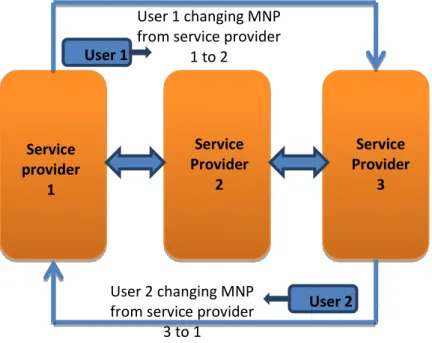
Figure 1.1: Example of changing service providers
Figure 1.1 shows example of user changing service from current service provider to new one. There may be two or above service providers who provide mobile number portability service and user who wants to use better services offered by another operator without changing to new contact number.
In customer side, non-portability of mobile number is a huge obstacle and still one in Myanmar that has not yet introduced Mobile Number Portability. From a user’s perspective, mobile number portability is able to provide an ability to switch mobile network without the extra cost and difficulties for changing of their telephone number. Since the mobile phone number is considered to be one of the most personal assets of a subscriber, most of subscribers are predominantly reluctant to change their provider.
Service Provider
2
Service Provider
3 Service
provider 1
User 1 changing MNP from service provider
1 to 2
User 2 changing MNP from service provider
3 to 1 User 1
User 2
3
This research will identify the benefits of mobile number portability, introduce to Myanmar users about the knowledge of mobile number portability service, and help service providers for championing in market competition.
1.2 Aim and Objectives
To provide the solution for barrier of changing new phone number and inconvenience of having many contact numbers
To enlighten user's awareness about mobile number portability
To describe benefits of user and service provider providing mobile number portability service
To develop payoffs matrixes for user's and service provider's strategies
To analyze the payoffs and probability in extensive form
To examine user's best response for mobile number portability
1.3 Scope of Research
Since game theory is an essential tool for decision making of conflict behaviors in social environment, this will be applied to find out user's preference in this work when mobile number portability is provided in an appropriate time. The benefits of mobile number portability service for both user's side and operator's side will be identified in this work to examine the user's best response for mobile number portability. The probability of service provider's strategies and user's preference will be explored in stag hunt game and analyzed by using extensive form of incomplete information game.
4
1.4 Thesis Organization
Chapter 2 describes information about mobile number portability, some experiences in other countries and some information of mobile operators in Myanmar. Chapter 3 gives the overview of game theory to give basic knowledge and understand the applications in this work.
Chapter 4 discusses user's best strategy by analyzing payoff matrix and the probability of service provider's preference. Chapter 5 presents the conclusion of analysis and future works.
5
Chapter 2
Mobile Number Portability
2.1 Mobile Number Portability
Mobile number portability is a service that enables mobile subscriber to switch service providers without changing current contact number. Today world is so fast and mobile penetration rates grow rapidly. This challenge demands mobile number portability in new society environment.
Some developed countries started to implement mobile number portability in the early year of twenty centuries, such as UK and Hong Kong. Out of the four countries on the Southeast Asia region, such as, Singapore, Malaysia, Thailand and Vietnam, most of countries seem to be not to have implemented the Mobile Number Portability. Singapore and Malaysia are leading the telecom market of Southeast Asia by penetrating mobile user of 93% and 58 % in 2014 and also they are the earliest MNP implement countries in South East Asia as shown in Table (2.1).
Table(2.1) MNP implement and penetration rate
According to ERICSSON mobility report, the Philippines, Indonesia, Vietnam, and Myanmar are expected to rise in a big increase of mobile user. Early signs from the newest
Country Name MNP implemented date penetration rate
Singapore 13.06.2008 98%
Malaysia 15.10.2008 58%
Thailand 15.12.2010 48%
Vietnam 30.11.2011 27%
Myanmar - -
6
location for democratized data in Asia are promising: an astonishing 80% of Myanmar users are on smartphones, and rural data usage is almost 60% of urban.
2.2 Some Experiences of MNP
There are some related experiences of MNP in some countries but in hear, Malaysia, one of South East Asian country and India, the second largest population country will be described as the examples of experienced countries.
2.2.1 Experience in Malaysia
Malaysia is a member of Asian country and had experience of Mobile number portability.
Malaysian Communications and Multimedia Commission (MCMC) announced that number of subscribers in Malaysia were over 35.7 million in 2011 with a penetration rate of 124.7%.
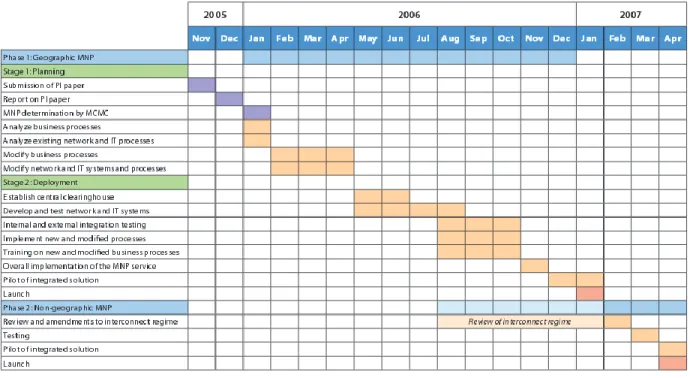
Figure 2.1: Malaysia's Plan for MNP (reference: The Malaysian Communications and Multimedia Commission, 2005)
7
The Malaysian Ministry of Energy, Water and Communications directed to start MNP service in Malaysia in Sept 2004 but it was not until 2005. However, the MCMC made Public Inquiry. The operators commented to implement a simple and low-cost service as Hong Kong's MNP implementation. The MCMC built a database solution and overcame the comments of operators that suffered expensive efforts and inefficient service to subscribers. Malaysia has a well-built infrastructure to create a directive for MNP and they made an implementation plan for MNP service.
Malaysia has launched MNP to country in October 2008— after four years planning. The subscriber can change mobile operators as they wish, and the average number of subscribers switching operators is about 2.13 % per year.
2.2.2 Experience in India
India is the second largest population country in the world. It continues to increase number of mobile subscribers with a large number at 1 million a week. The numbers of subscribers were at 881 million and a penetration rate is63 percent in 2012.The implementation of MNP in India was different from the others and it selected two administrators: Telcordia and Syniverse. They are responsible for porting transactions but operate differently in their respective zones. Although the Telecom Regulatory Authority of India (TRAI) selected administrators to support MNP in March 2009 but the MNP service was lately launched, in January 2011.
8
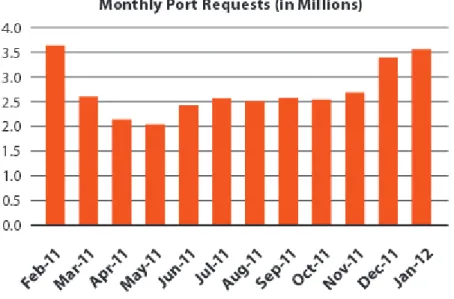
Figure 2.2 Porting Requests of the first twelve months in India(reference: Telecom Regulatory Authority of India, 2011 and 2012 Monthly Press Releases)
The number of subscriber who requested for switching operator was about 3.66 percent in the first twelve months. A large number of rejected requests, user's complaints and switching time delays happened in those days. Over 25 percent of switching requests submitted in2011. The different reasons for rejections were terrifying amount of bills, user's identity problem, contractual problems or ports requested within restricted period.
2.3 Success and Failure of MNP
The Success and Failure of MNP is especially related with high porting rates. This is because large switching rates show that the service is useful for users and confirm that mobile subscribers are in highly demand of the service.
2.3.1 Reasons for the success of MNP
Quick porting time access
Low price for call and data
Better services or promotions provided by service provider
9
User awareness of service
Entrance of new service provider 2.3.2 Reasons for the Failure
Porting time delay
Expensive cost for call and data
No promotion
Bad customer care
High switching costs
2.4 Service Providers in Myanmar
As a consequence, international telecommunication companies focused to extend their market by competing two operating licenses of Myanmar in 2013, Norway’s Telenor and Qatar- based Ooredoo awarded for these license and competed Myanmar Post and Telecommunications (MPT), the first and leading telecommunications operator in Myanmar.
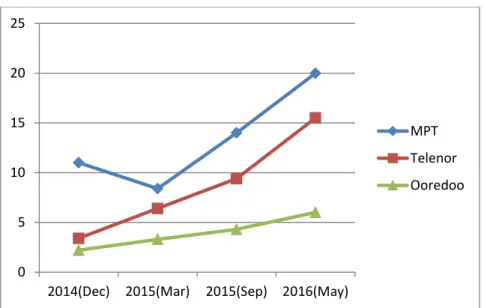
According to Myanmar Time Report in April 2015, Myanmar Posts and Telecommunications (MPT) served more than 19 million customers and leading the highest penetration rate and Telenor Myanmar has increased to 15.5 million subscribers and followed up the second highest penetration rate. Meanwhile, the country’s third operator, Ooredoo Myanmar, it counted more than 6 million users on its network. Myanmar Posts and Telecommunications (MPT) officially announced that their number of subscribers reached up to 20 million in May 2016.
10
Figure 2.3: Mobile Penetration rate of each operator in 2016
Figure 2.4: Growth of number of subscribers in million for each operator
According to telegraphy report, Ooredoo Myanmar has launched Myanmar’s first commercial 4G LTE service in selected parts of some cities in Myanmar in May 2016. Telenor Myanmar has also launched 4G services in Nay Pyi Taw in July 2016 and these two service providers now plan to gradually introduce the service to other cities. Meanwhile, MPT is still providing both 2G and 3G services for nationwide network.
When changing operators from current one to new service provider mobile subscribers is willing to spend switching costs to take advantage of lower call rates and potentially better
0 5 10 15 20 25
2014(Dec) 2015(Mar) 2015(Sep) 2016(May)
MPT Telenor Ooredoo
11
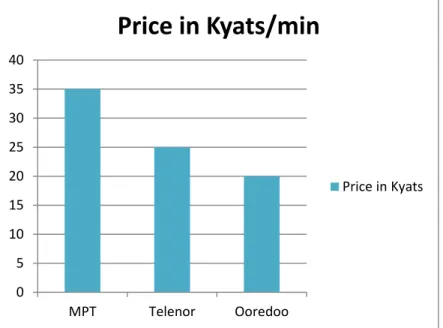
services.All of network providers in Myanmar sell their sim cards with a price of 1500 Kyats per sim (1.26 US Dollar). Voice call for each operator cost for the highest price for MPT and the cheapest for Ooredoo as 35 Kyats per minute for MPT, 25 Kyats per min for Telenor and 20 Kyats per min for Ooredoo. Figure (2.5) describes the comparison of costs for voice call for each operator.
Figure 2.5: Comparison of costs for voice call for each operator
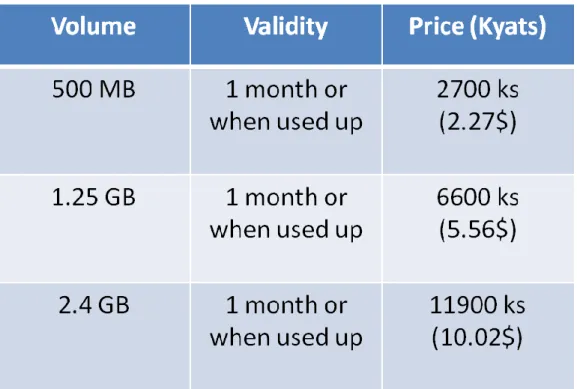
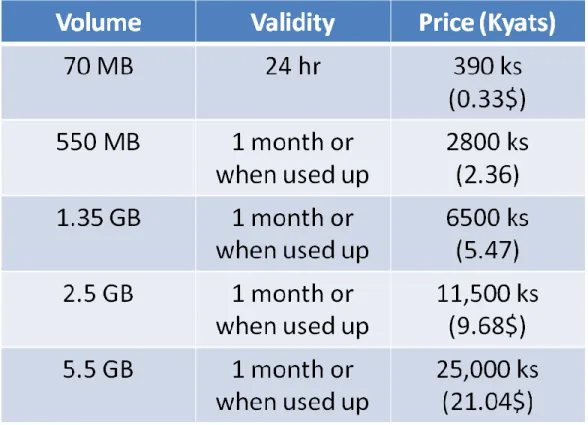
Default data is 7.5 kyats per MB for MPT users, 6 kyats per MB for Telenor users and 8 kyats (7am-7pm) and 6 kyats (7pm-7am) per MB for Ooredoo users. The data charges for each operator are shown in following figures.
There are different types of data packages offered by each operator and they are 2.36
$ (2800 Kyats) for 550MB , 5.47$ (6500 Kyats) for 1.35GB , 21.04 $ (25000 Kyats) for 6.5GB for data of MPT, 2.27$ (2700 Kyats) for 500MB, 5.56$ (6600 Kyats) for 1.25GB, 10.02$ (11900 Kyats) for 2.4GB for data of Telenor and 2.36$ (2800 Kyats) for 550MB, 5.47$ (6500 kyats) for
0 5 10 15 20 25 30 35 40
MPT Telenor Ooredoo
Price in Kyats/min
Price in Kyats
12
1.35GB,9.68$ (11500 Kyats) for 2.5GB, 21.04$ ( 25000 Kyats) for 5.5GB for data of Ooredoo.
These data will be invalid in 30 days or when it used up.
Fig 2.6: Data charges for MPT
Figure 2.7: Data charges for Telenor
13
Figure 2.8: Data charges for Ooredoo
Currently, these three operators are running in Myanmar mobile market competition and the fourth service provider will come to race in 2017. Therefore, there will be an exciting competition in Myanmar mobile market and service provider with better and more convenience service will be champion in future.
14
Chapter 3
Overview of Game Theory
3.1 Introduction of Game Theory
Game theory is a study of quarrel and cooperation between several decision-makers.
Game theoretic concepts are applied when the actions or choices of decision-makers are in interactive situation. Decisions makers are defined as agents or players in game and these players may be individuals, groups, animals, human, things, networks or any combination of these. Game theory provides to understand structure and analyze the strategic scenarios. Game theory is widely used in economics, psychology, biology, political science, logic, computer science and poker.
3.1.1 Essential Elements in Games
To solve the games, some specific elements are needed to be defined in a game.
The players of the games
actions of players
Payoffs
These elements are used to deduce the equilibrium and best response strategies of players. Players of the games are participants in game who decide the actions or make the choices in game. There are at least two players or several players in a game. Actions of players are the decisions or choices of players at each decision points. The players have to perform their best action to win in the game. Payoffs are measure of players' preferences to pay different amount
15
for goods or services. Payoffs may be benefits, satisfactions for services, or happiness from players' wants that cannot be measured directly.
3.1.2 Lists of games
There are several different games in game theory based on the number of players and the number of strategies per players. The games which have two players and two strategies are Battle of Sexes, Chicken, Deadlock, Dollar auction, Matching Pennies, Prisoner's Dilemma, Stag Hunt and War of Attrition.
Moreover, there are some games in which number of players may be two or above and numbers of strategies may be variable or infinite or a number greater than 1. They are Blotto Games, Cake Cutting, Centipede Game, Coordination Game, Cournot Game, Dictator Game, Diner's Dilemma and so on. These games are used according to number of players, strategies and their scenarios.
3.1.3 Stag Hunt
The stag hunt is a game that represents the conflict between safety and social cooperation. In stag hunt game, two individuals go out for hunting and each can choose hunting a stag or a hare. For hunting stag, they must cooperate with their partner to succeed in hunting.
Each can hunt a hare individually but a hare worth less than a stag and if one hunts a hare, he can eat but he can be discovered and others will go hungry. If all the hunters cooperate, they will get a stag and all eat. Another example is to row a boat and if both of them row, they will reach to destination successfully but if one doesn't row, then the other's effort is wasted.
Each player has to choose a move without knowing other's action in stag hunt game. There are two pure strategies Nash equilibrium in the stag hunt.
16
When both players choose to cooperate
When both players choose to defect
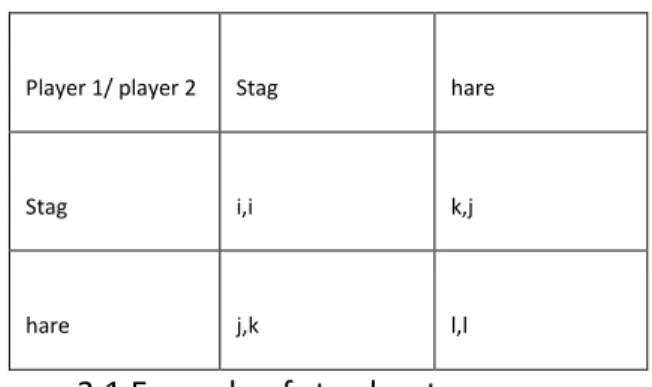
Player 1/ player 2 Stag hare
Stag i,i k,j
hare j,k l,l
Figure 3.1 Example of stag hunt game
The payoff matrix in figure 3.1 shows an example of hunt game, where i> 𝑗 ≥ 𝑘 > 𝑙.
3.2 Forms of Games
There are three forms to represent the game for analyzing the scenarios.
Normal Form
Extensive Form
Characteristic Function Form 3.2.1 Normal Form
Player 1/ player 2 Cooperative Defect
Cooperative 1,1 0,2
Defect 2,0 0,0
Figure 3.2An example of normal form of two players and two strategies game
17
Normal form is used to describe a game in a matrix where players, preferences and payoff value are shown to understand the game. There are at least two players and each player have two strategies. Players move simultaneously and get the payoffs for each player.
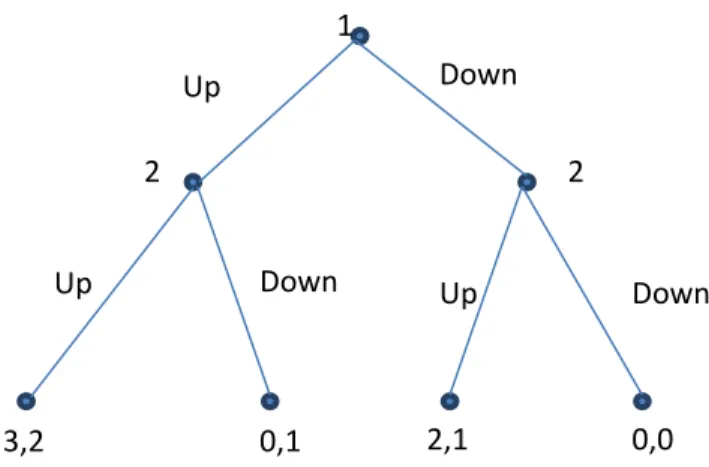
3.2.2 Extensive Form
Games are played on tree in extensive form and each node represents a decision point for players. At this point, players make their choices and the vertex refers to the action of each agent. Both players' payoffs are shown at the end of the tree.
Figure 3.3 An extensive form of a game 3.2.3 Characteristic Function Form
In a game where groups of players may implement cooperative behavior and this type of game is competition between coalitions of players. The coalitional game contains a finite set of players N, the grand coalition and a characteristic function ν :2N→ R .
3.3 Classification of Games
There are several types of games to solve the best strategy of players in game theory.
Types of games are different based on the strategies, preferences of players, payoff nature and Down
3,2
1 Up
Up Up
Down
Down
2 2
0,1 2,1 0,0
18
information or actions decided by player at each decision points. There are some examples of types of games.
3.3.1 Symmetric/ Asymmetric
Player1/
player 2 A B
A 1,2 0,0
B 0,0 1,2
Figure 3.4 An example of asymmetric game
In a symmetric game payoff for playing strategies do not depend on the players so that types of players can be able to change without changing payoff values. There are no identical strategy sets for players in a common asymmetric game. Many of two players and two strategies games, 2×2 matrix games are symmetric.
3.3.2 Zero-sum/ Non-zero-sum
Player1/
player 2 C D
C -1,1 3,-3
D 0,0 -2,2
Figure 3.5 An example of zero-sum game
19
The total value of benefits of all players will be added to zero in Zero-sum game. Any game can be transformed into a zero-sum game by adding a dummy player, the board whose losses compensate the players' net winnings.
3.3.3 Simultaneous/ Sequential
The later player does not know the action of earlier player in simultaneous games although the later player has some knowledge of action of earlier player in sequential game.
Knowledge of later player does not need to be perfect information. Simultaneous games use normal form while sequential games use extensive form for their representation.
3.3.4 Perfect information and Imperfect information
Perfect information game is one of the important subset of sequential games. In extensive form game, if one player knows the previous information of another player's move, it is called perfect information game. In simultaneous games, all simultaneous moves in extensive form are unknown. So, simultaneous games can never be perfection game. Most of the games exploring in game theory are imperfect-information games.
By adding the Nature's move, imperfect information game can be incomplete information game.
3.3.5 Differential Games
The continuous pursuit and evasion games are differential games in which differential equation are used to govern the evolution of the player' state variable. There are open-loop strategy and closed-loop strategy to find an optimal strategy in differential game. Terminal time is random variable in those games.
20 3.3.6 Metagames
Metagames are used to develop the rules for another intended game and metagames increase the values utility of the developed set.
3.4 Advantages and limitations of Game Theory
There are some advantages and limitations of game theory to analyze the conflict and decision making problem.
3.4.1 Advantages of Game Theory
Game theory develops a framework to analyze the decision making when participants are interdependent
Game theory can be used in the situation of conflict and coalition
Game theory helps players to choose best response or optimal strategy 3.4.2 Limitations of Game Theory
Solving technique in large payoff matrix mixed strategies games is too complicated
The assumption of players knowing information of their own payoff and other's payoff is not practical
All of conflict and competitive games cannot be analyzed and solved with a help of game theory
21
Chapter 4
Analysis of User’s Best Response Using Game Theory
4 . 1 Imperfect Vs Incomplete Information Game
In an imperfect information game, both players do not know the action selected by another player but they know the players, their strategies and their preferences. Information of other players in imperfect game is complete.
Players may or may not know other players' type, their strategies and their preferences in incomplete information game. In this work, user is assumed that he does not know whether service provider will support MNP in near future or not.
4.1.1 Stag Hunt Game
The stag hunt is a game that represents the conflict between safety and social cooperation.
In stag hunt game each player has to choose a move without knowing other's action. In this work, the stag hunt game is used to describe the players' strategies and payoffs. There are two players where user is considered as player 1 and service provider (SP) is considered as player 2 in this work.
4.2 Developing payoff matrixes
We will consider two conditions to set the payoff values of user and service provider as current condition in Myanmar when service provider still does not provide mobile number portability and near future when mobile number portability will be provided to user. The strategies for service provider are providing MNP service and providing normal service (No MNP)
22
while user strategies are using MNP service and using normal service (No MNP). We consider the two conditions which are current condition service provider providing normal service and condition when service provider providing MNP service but we are not sure whether service provider will support MNP service or not. Only service provider will know his preferences. This means that service provider knows his type but user is unaware of service provider's type. So, our works will go as incomplete information game.
4.2.1 Condition 1: Current Situation in Myanmar
Mobile number portability service is still not introduced to user by any mobile service provider. Payoff values of user and service provider will be presented as the benefits of user and service provider. The benefits of user and service provider for current condition are shown in figure as follow.
Figure 4.1 The benefits of user and service provider in current condition
We present the payoffs of user and service provider as their benefits for choosing MNP service or No MNP service. One benefit will count as 1 and total payoff is the sum of benefits for related action. Suppose that if both user and service provider choose C= cooperate (MNP), they will get payoff value 2 for each other according to their benefits.
23
Benefits of user for choosing MNP = Easy to move & easily contact + Cost effective = 1+ 1= 2 Benefits of service provider for playing MNP = More user + More Profit = 1+ 1 = 2
If both user and service provider play D= defect (No MNP), the will get payoff value 1 for each. This means that service provider is still providing normal service and user is also still using this service.
Benefit of user for playing No MNP = Current service provided by No MNP service provider= 1 Benefit of service provider for playing No MNP= Current customer = 1
If one player plays MNP and another player’s choice is No MNP, the player who plays No MNP will get payoff value 1 as current situation is normal service without providing MNP. The player who chooses MNP will get payoff value 0 because this player cannot gain any benefit from another one and current condition in Myanmar is still not provided by MNP.
Payoff matrix for current condition will be present with these payoff values of both players.
Figure 4.2 Payoff matrix for current situation (SP providing normal service)
Where SP means service provider, User means mobile user, C = cooperate (playing MNP service) and D = defect (playing No MNP).
C D
C
D
SP
User
24
4.2.2 Payoff Values If Service Provider provide MNP in near future
When service provider really supports MNP service as a fulfillment of current demands, service provider is providing better service to user and their image will be better for fulfillment of demands and understanding to support the requirement. The benefits and payoff values when service provider supports MNP are as follow:
Figure 4.3 The benefits of players if service provider support MNP
Each benefit will be counted as 1 and payoff value will be sum of benefits for related action. If both players make a move as MNP, their payoffs will be 3 for each.
Benefits of user for MNP = Easy to move & easily contact + Cost effective + Better services = 1 + 1+ 1
= 3
Benefits of service provider for MNP = More User + More profit + Better image = 1+ 1+ 1
= 3
25
If both players choose to play No MNP, their payoffs will be 0 because service provider's preference is playing MNP in this condition. This means that both players will not receive any benefit for both playing No MNP.
Benefit of user for No MNP = No benefit = 0
Benefit of service provider for No MNP = No benefit = 0
If one player plays MNP and another player’s choice is No MNP, the player who plays No MNP will get payoff value 0 as the condition is SP providing MNPservice. The player who chooses MNP will get payoff value (-1) because for service provider, he has investment cost to provide MNP service but user's choice is No MNP and for user, he has many sim numbers which cause higher cost because he chooses No MNP service provider.
Payoff matrix when service provider support MNP service will be present with these payoff values of both players.
Figure 4.4 Payoffs Matrix If Service Provider provide MNP in near future
Where SP means service provider, User means mobile user, C = cooperate (playing MNP service) and D = defect (playing No MNP).
C D
C
D
SP
User
26
4.3 Analysis of two conditions in extensive form
To analyze these conditions, we will add "Nature" as a participant to make a move to help the user because user is unaware of service provider's preference whether he will support MNP service or not. To play "Nature", we will set the probabilities of service provider being nice and selfish. If service provider is nice, he will provide MNP service and if service provider is selfish, he will not support MNP service. To know whether service provider is nice or selfish, we will analyze in two extensive forms: one is with higher probability of service provider being nice and another one is higher probability of service provider being selfish.
4.3.1 Case study 1: SP with a higher probability of being nice
Probability of service provider being nice is1⁄2, so we set 2⁄3 as higher probability of being nice and 1⁄3as lower probability of being nice (probability of being selfish). In this extensive form, Nature will help to know service provider's preferences of being nice and selfish. Service provider will decide to choose cooperative or defect by playing C or D and user will also make a move as cooperative or defect, playing C or D, with the prediction of service provider's preference by using Nature's help The payoff vales of user and service provider are showing in the boxes and they will represent as the action of user and service provider in extensive form.
Where SP means service provider, User means mobile user, C= cooperate (MNP), D= defect (No MNP).
27
Figure 4.5 Extensive form with higher probability being nice 4.3.2 Case study 2: SP with a higher probability of being selfish
Probability of service provider being selfish is 1⁄2 , so we set 2⁄3 as higher probability of being selfish and 1⁄3as lower probability of being selfish (probability of being nice).
SP SP
User User
User User
Nature
C D C D C D D
SP: 2 SP: 0 SP: 1 SP: 1 SP: 3 SP:-1 SP: 0 SP: 0
C
C D D
U : 2 U : 1 U : 0 U : 1 U : 3 U : 0 U :-1 U : 0
1/3, Selfish P 1/3 2/3, Nice P 2/3
C
28
Figure 4.6 Extensive form with higher probability being selfish
Where SP means service provider, User means mobile user, C= cooperate (MNP), D= defect (No MNP).
4.3.3 Analysis of case 1 and 2
Service provider knows his type, and plays his preferred strategyD if he is selfish and plays C if he is nice. Based on the probability of service providerbeing nice or selfish, user’s choice will depend on his expectation from service provider. Suppose user will attach probability (p) to service providerplaying C, and so (1-p) is the probability that service provider is playing D.
Therefore,
SP SP
User User
User User
Nature
C D C D C D D
SP: 2 SP: 0 SP: 1 SP: 1 SP: 3 SP:-1 SP: 0 SP: 0
C
C D D
U : 2 U : 1 U : 0 U : 1 U : 3 U : 0 U :-1 U : 0
2/3, Selfish P 2/3 1/3, Nice P 1/3
C
29 User's expected payoff from SP with no MNP = 2p+1(1-p) User's expected payoff from SP providing MNP = 3p+0(1-p)
User's expected payoff from SP with no MNP = Use's expected payoff from SP providing MNP 2p+1(1-p)= 3p+0(1-p)
P= 1⁄2
According to the result, user’s best response is to play C (MNP) if p>1⁄2, and to playD (No MNP) if p<1⁄ .2 Therefore, User will play MNP for case study 1 where service provider with higher probability of being nice, MNP probability, p=2⁄3. User will play No MNP for case study 2 where service provider with lower probability of being nice, No MNP probability, p=1⁄3.
Based on the user's best response for the case of service provider with higher probability of supporting MNP, there are not only the highest value of the benefits of user and also the highest value of the benefits of service provider. Therefore, this result of user's preference gives the best choice for both players.
According to payoffs, the benefits of user and subscribers for choosing MNP service are twice of the benefits of user and subscriber for choosing No MNP service. So, estimated number of subscribers for MNP service will be twice of normal increased numbers of subscribers. We estimate the average percentage of increased number of subscribers for operators in Myanmar.
Increased number = New number – Original number
Increased Percent (%) = (Increased number/ Original number) * 100
Average Percentage = Total Increased Percent for all operators/ No: of Operators
30
Figure 4.7: Normal increased numbers of subscribers in million with No MNP service
In figure 4.7, we represented the normal increased numbers of subscribers in million with No MNP service and estimated number of subscriber with No MNP service between 2016 and 2017.
Figure 4.8: Estimated number of subscribers in million with MNP service
Figure 4.8 describes the estimated number of subscribers in million with MNP service. In the situation of providing MNP service, we estimated that the average value of the numbers of subscribers will increase 25% than normal increased amount of subscribers for No MNP serviceby analyzing the historical data.
31
Chapter 5
Conclusion and Future Works
5.1 Conclusion
The objective of this work is to find out user's best response to service provider's preferences of providing mobile number portability service or supporting only normal service. To fulfill this purpose, the author has developed payoff matrixes for user and service provider in two conditions when service provider providing normal service and when service provider providing MNP service. The payoff values of user and service provider represents the benefits of each doing an action for MNP and No MNP. These payoff matrixes are developed as stag hunt game.
Since user not knowing what the service provider's preference is, analysis of this incomplete information game has done in extensive form with the move of "Nature" as a participant. By analyzing two cases: case of service provider with higher probability of being nice and case of service provider with higher probability of being selfish, user's best response results as user will play MNP if service provider is nice or user will play No MNP if service provider is selfish.
Based on the result, if service provider still provides normal service, he has to do more promotion to appeal the user and user will not get any benefit from service provider.If service provider provides MNP, user will choose the provider who supports MNP service and the provider can get more users, profits and better image. According to the user's best response for the case of service provider with higher probability of supporting MNP, there are not only the highest
32
value of the benefits of user and also the highest value of the benefits of service provider. By providing MNP service, the average value of the numbers of subscribers will increase 25% than normal increased number of subscribers with No MNP service. Therefore, this result of user's preference gives the best choice for both players and encourages the service provider to provide mobile number portability service in Myanmar near future.
The provider can also increase number of subscribers and can come first in market competition.The result based on user's best response using game theory proves that the cooperation of both players will have more benefits than before.Therefore, providing MNP service will make service provider success in market and user satisfied.
5.2 Future Works
In this research the benefits of user and service provider are used as payoff values and analyzed in extensive form. Since Myanmar has never been introduced mobile number portability, this work has analyzed on the benefits of using mobile number portability service. For future work, the other types of payoffs or numbers such as call routing can be used to develop better implementation.
33
References
[1] JenniferPigg, Affiliate, [email protected], "Number Portability Through the Global Lens," Whitepaper: Number Portability Through the Global Len,Jul y 2012.
[2] Tahani Iqbal1: ‘Mobile Number Portability in South Asia,’ Proceeding of the 5th of acron- redecomconference , lima, May 12-20 2011.page 259-266
[3] Theodore L. Turocy, Bernhard von Stengel, ‘’Game Theory,’’ CDAM Research Report LSE- CDAM-2001-09, October 8, 2001.
[4] AtiyaFaiz, Khan ‘’mobile number portability; challenges and solutions ,‘’ journal of emerging trends in computing and information sciences, Volume 2 special issue, 2010-2011.
[5] Martin Schmid, ‘’ Game Theory and Poker,’’ Department of Applied Mathematics, Prague 2013
[6] Githii Stephen Kagwathi ,JohnNjauKamau, ‘’ FACTOR INFLUENCING MOBILE NUMBER PORTABILITY(MNP) IN KENYA: THE CASE OF AFRICA NAZARENE UNIVERSITY,’’ Annual International Interdisciplinary Conference, , Azores, Portugal, AIIC, 24-26 April, 2013.
[7] PartiksinhSureshsinhVaghela, ‘’Customer Preference for Mobile Number Portability,”
International Journal of Management and Social Sciences Research (IJMSSR) ISSN: 2319-4421, Volume 1, No. 3, December 2012.
[8] Winfred O. Larkotey, 2 Ed. DansoAnsong, 3 Dominic Damoah, 4 J. Abandoh-Sam,Mobile Number Portability in Developing Countries: Its successes and failures. Case Study- West African Sub-Region, International Journal of Societal Applications of Computer Science Vol 1 Issue 1 November 2012.
34
[9] http://www.ramauniversityjournal.com/commerce/pdf_file/7-12.pdf
[10] https://www.telegeography.com/products/commsupdate/articles/2016/05/24/ooredo o-launches-myanmars-first-4g-lte-service/
[11] https://www.telegeography.com/products/commsupdate/lists/country/myanmar [12] https://www.telegeography.com/products/commsupdate/articles/2016/07/08/telenor-
myanmar-launches-lte-in-nay-pyi-taw/
[13] http://www.telecomsinsight.com/industry-trend-analysis-fourth-operator-propel- myanmars-mobile-market-maturity-june-2016
[14] https://www.neustar.biz/carrier/docs/whitepapers/number-portability-through-global- lens-archived.pdf
[15] http://www.mmtimes.com/index.php/business/technology/20007-telenor-reaches-15- 5m-users.html
[16] http://www.mpt.com.mm/en/mpt-cele-its-20m-sub/