Foreign Direct Investment into the Western Balkans:
The Statistical Analysis of Determinants in Bilateral Investment
Kimiko Uno and Sho Sakuma
1This paper aims to analyze the determinants of foreign direct investment (FDI) in the Western Balkans, which are located in the western part of the Balkan Peninsula. This region is one of the poorest regions in Europe and their need for the economic development is necessary. In this paper, we analyzed the relationship between the latest FDI data and the amount of offi cial development assistance (ODA), the number of emigration, religious similarity and the existence of investment treaties by using statistical methodology.
The results indicate that ODA and the religious similarity are positively correlated with FDI flows. We also find correlation between FDI and the number of emigration. However, its impact is different by country. While in Bosnia and Herzegovina and Slovenia the number of emigration is positively correlated, in Macedonia and Montenegro it is negatively correlated with FDI fl ows.
I. Introduction
The Western Balkans, which are specifically defined as following eight countries- Slovenia, Croatia, Bosnia and Herzegovina (BiH), Serbia, Montenegro, Kosovo, Macedonia and Albania-are located in a part of
1 Professor and graduate student respectively, at Tokyo University of Foreign Studies (uno @ tufs.ac.jp)
Southeast Europe. From worldwide point of view, what is well known about this region is the wars in 90’s. Slovenia, Croatia, Bosnia and Herzegovina, Kosovo and Macedonia suffered massive wars in the past.
More than ten years has passed since the final war ended in Macedonia in 2001 and it is often said that direct infl uence from a series of wars have already disappeared. Indeed, according to the World Bank’s data base “World Development Indicators”, income levels of these countries are rated not so bad (only is Kosovo classifi ed as “Lower middle income” and the other countries are classifi ed as “High income” or “Upper middle income”).
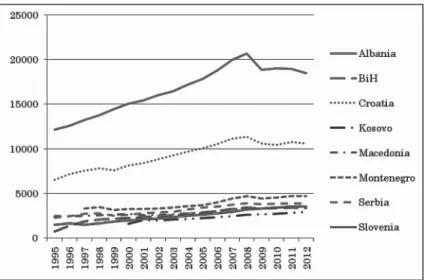
Compared to the least developed countries (LDCs), economic situation the Western Balkans face today looks less serious than that of LDCs. Similarly, GDP per capita of the Western Balkans from 1995 to 2012 has been growing gradually as a whole (see Figure 1).
However, the Western Balkans still holds some concerns in their society behind these indicators. The Western Balkan countries, which experienced the shift of economic system during the past two decades, are defi ned as transitional economies. Economic system of these governments is
Figure 1: GDP per capita in the Western Balkans (constant 2005 US $) Source: World Development Indicators
now capitalism, but their free market is still unstable. Secondly, bribery in the arena of politics and business has been recognized as conventional practices in the Western Balkans. There is some concern of bribery causing weak governance. From a viewpoint of business conduct, bribery causes extra cost for enterprises and it usually plays a role of obstacle to the business conduct.
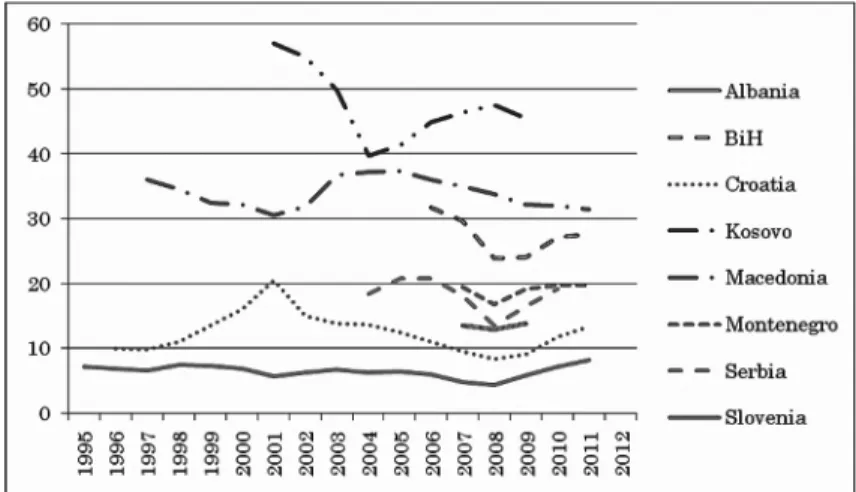
Thirdly, unemployment rate in the Western Balkans is extremely high in general. Especially in Kosovo, Macedonia and Bosnia and Herzegovina, more than one from fi ve people does not work in recent decade (see Figure 2).
Then see the Figure 3, which indicates inward FDI trend into the Western Balkans these days.
The major driving forces of FDI attraction are Croatia and Serbia (Serbia and Montenegro, by 2006). Nearly 59% of total FDI infl ow into the region goes only to these two countries. From 1995, FDI infl ows have been increasing in all countries by 2008 in general, but after the global fi nancial crisis its volume fell down sharply and still has not recovered in the level of 2008.
Figure 2: Unemployment rate in the Western Balkans (% of total labor force) Source: World Development Indicators
The Western Balkans countries are in transition in various points and their institutions are not functioning properly. Firstly, all countries of the Western Balkans sifted their economic systems to capitalism after the end of the Cold War, but the process of transition to free market has not completed yet. Secondly, most of the Balkan countries are trying to be a member of the European Union (EU). Slovenia and Croatia already joined EU in 2004 and 2013. The other countries have already applied for membership or are recognized as candidates or potential candidates by EU member countries.
EU membership requires the adoption of EU legislation across the range of commercial and civil law, including trade rules, fi nancial regulation, and competition policy. However, the process of this adoption is also still in the middle.
At the end of the introduction, we state two research questions of this paper to enter the next chapter.
1) What are the major determinants of attracting FDI into the Western Balkan countries that leads to economic development?
Figure 3: Foreign direct investment, net infl ows in the Western Balkans (Current US $, millions)
Source: World Development Indicators
2) How much of the amount of inward FDI could be estimated if the influential determinants change, that found through the following statistical analysis?
II. Previous works and backgrounds
In this chapter, we review the previous studies on FDI in the Western Balkans.
There are a few quantitative economic studies.
Jelena (2011) analyzes the economic environment that the Western Balkan countries face after the global economic crisis and assessed its effect on FDI. She states that it is the indigenous structural problem in the Western Balkans that caused inward FDI reduction, so just focusing on dealing with economic crisis is not suffi cient to the FDI attraction. Valerija (2010) shows the relationship between the level of privatization of national companies and FDI attraction in the Western Balkans using the panel data framework.
Valerija and Lorena (2006) investigate the main determinants of FDI in the Southeast European Countries by using regression-based estimation. They conclude privatization, trade openness and density of infrastructure appear to be robust as determinants of inward FDI. Hubert and Phanindra (2004) also try to fi nd the FDI determinants between EU member countries and central and east European candidate economies in transition. They reveal that the key determinants are size of the host economy, host country risk, labor costs in host country and openness to trade. In terms of the effects of EU accession on inward FDI, Alan and Saul (2004) fi nd that besides unit labor costs, gravity factors, market size and proximity, announcements about EU accession proposals have an influence on FDI inflows into the European transition economies.
These studies mainly focus on the national status of destination countries of FDI. For that reason, bilateral indicators have been hardly analyzed as variables. The traditional variables such as the level of privatization, trade openness, density of infrastructure, size of the host country do not vary from whichever country inward FDI originates. On the
other hand, bilateral indicators such as inward ODA, geographic distance, the number of emigration always vary depending on the combination of host county and origin country.
In this paper, therefore, the relationship between FDI flows and economic indicators, emphasizing on bilateral indicators, are analyzed.
III. The analytical method and the model
We determine a model to see the correlation between inward FDI into the Western Balkans and bilateral indicators. Based on the model proposed by Alan and Saul (2004), we use the following arranged one to employ regression analysis in this paper.
lnFDItij = α + βlnODAtij+ γlnEMItij + δCRDtji+ εITDtij
We denote the year by t, the origin country by j, and the host country among the Western Balkans by i. FDI is placed at the left side as dependent variable.
Independent variables are ODA, EMI, CRD and ITD. “Offi cial Development Assistance” (ODA) represents the amount of money officially given by the government of origin country. “Emigration” (EMI) represents the total number of people who left country i and are living in country j. This variable measures only outflows of the people from arbitrary countries among the Western Balkans so inflows of the people from outside do not affect its values. A dummy variable “Common Religion Dummy” (CRD) represents 1 when the selected two countries i and j share common religion as the largest majority of the population in their own country. A dummy variable “Investment Treaty Dummy” (ITD) represents 1 when the selected two countries i and j ratifi ed bilateral investment treaty among them and it had already took effect at that time.
In order to put each values of real number into above variables in the model, we employ natural logarithm (ln) of ODA, EMI and FDI. The selected countries i and j are indicated in Table 1. Origin countries are selected for
their large amount of investment during the period 1995-2012.
The range of the year t is basically from 1995 to 2012 (1995≦t≦2012).
The data of countries which became independent after 1995 (Serbia, Montenegro and Kosovo) covers the period after their independence. Because of the limitation of available data, the original data downloaded from online databases contained some defect part. As for variable EMI, we substituted the
estimated values. Combinations of the dataof ODA, EMI, CRD and ITD that have still some defect part are dropped from the dataset. Finally the remaining data is all arranged in the table which has years as columns and countries as rows to put this panel data into regression analysis.
The original data used for these variables are obtained from following websites. FDI from International Monetary Fund “Coordinated Direct Investment Survey”, ODA and EMI from Organisation for Economic Co-operation and Development “OECD.stat”, CRD from Central Intelligence Agency “The World Factbook” and ITD from International Centre for
Host country (i) origin country (j)
Albania Austria
Bosnia and Herzegovina France
Croatia Germany
Kosovo Greece
Macedonia Hungary
Montenegro Italy
Serbia Luxembourg
Slovenia Netherlands
㻌 Switzerland
㻌 United Kingdom
Table 1: Country list to analyze
Settlement of Investment Disputes “ICSID Database of Bilateral Investment Treaties”.
We employed two types of aggregation in this study. In the first stage, the dataset is aggregated by the host country (i). In the second stage, we changed the way of aggregation using the same dataset, in order to inspect the determinants from the side of the origin country (j). These results are indicated independently in the next chapter.
IV. The empirical results
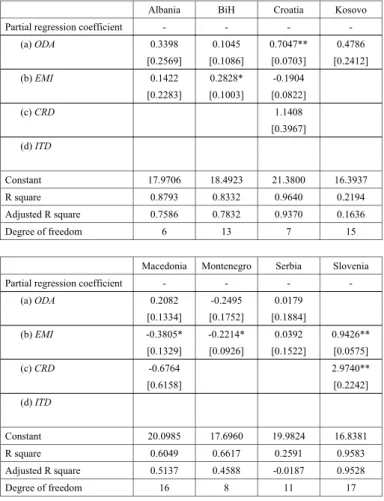
The results of regression analysis based on the model discussed in the previous chapter are shown in Table 2 and 3.
Comparing the obtained coeffi cients by country, we can see that the number of emigration from the host country is correlated with FDI infl ows in most of the Western Balkans, but its effect is not the same direction. While in Bosnia and Herzegovina and Slovenia emigration and FDI is in positive correlation, in Macedonia and Montenegro they are in negative correlation.
As for Croatia, not the number of emigration but ODA allocation from abroad has signifi cantly positive effect with FDI infl ows. The country which shows significant positive correlation between common religion dummy and FDI inflows is Slovenia. This means Slovenia attracts more FDI from the catholic countries. We could not observe any difference by adding ITD variable, because all of the selected countries i and j had already held bilateral investment treaty with any other partner country. That is why ITD rows remain null.
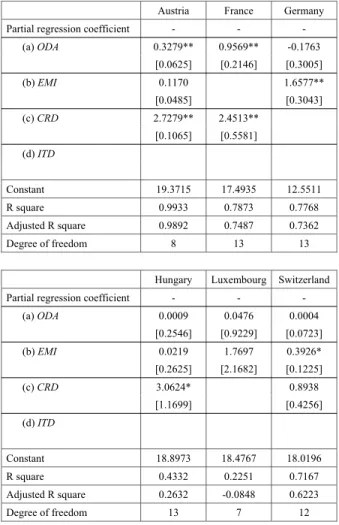
Table 3 shows results of regression analysis by the origin countries.
In this analysis, we choose Austria, France, Germany, Hungary, Luxembourg and Switzerland to aggregate the dataset. We analyzed these six origin countries of FDI and summarized the results of regression analysis below.
Seen from the points of views of origin countries, variable which positively correlated with FDI is the similarity of religion between origin countries and host countries. Austria, France and Hungary show signifi cant
correlation between FDI and CRD. In other words, these three countries tend to choose Catholic countries in the Western Balkans as a destination of their direct investment. Austria and France also hold ODA as a positively correlated variable in the second place. In contrast, from the columns of Germany and Switzerland we can see a positive correlation of variable EMI with FDI.
㻌 Albania BiH Croatia Kosovo
Partial regression coefficient - - - -
(a) ODA 0.3398 0.1045 0.7047** 0.4786
㻌 [0.2569] [0.1086] [0.0703] [0.2412]
(b) EMI 0.1422 0.2828* -0.1904 㻌
㻌 [0.2283] [0.1003] [0.0822] 㻌
(c) CRD 㻌 㻌 1.1408 㻌
㻌 㻌 㻌 [0.3967] 㻌
(d) ITD 㻌 㻌 㻌 㻌
㻌 㻌 㻌 㻌 㻌
Constant 17.9706 18.4923 21.3800 16.3937
R square 0.8793 0.8332 0.9640 0.2194
Adjusted R square 0.7586 0.7832 0.9370 0.1636
Degree of freedom 6 13 7 15
㻌 㻌 㻌 㻌 㻌
㻌 Macedonia Montenegro Serbia Slovenia
Partial regression coefficient - - - -
(a) ODA 0.2082 -0.2495 0.0179 㻌
㻌 [0.1334] [0.1752] [0.1884] 㻌
(b) EMI -0.3805* -0.2214* 0.0392 0.9426**
㻌 [0.1329] [0.0926] [0.1522] [0.0575]
(c) CRD -0.6764 㻌 㻌 2.9740**
㻌 [0.6158] 㻌 㻌 [0.2242]
(d) ITD 㻌 㻌 㻌 㻌
㻌 㻌 㻌 㻌 㻌
Constant 20.0985 17.6960 19.9824 16.8381
R square 0.6049 0.6617 0.2591 0.9583
Adjusted R square 0.5137 0.4588 -0.0187 0.9528
Degree of freedom 16 8 11 17
Table 2: The results of regression analysis by the Western Balkan countries
* represents P value under 0.05. ** represents P value under 0.01.
Standard errors in [brackets].
Historically these two countries have adopted characteristic immigration policy that they acquire international immigrants positively, so that the two countries now accommodate a lot of foreign people including the Western Balkan people.
㻌 Austria France Germany
Partial regression coefficient - - -
(a) ODA 0.3279** 0.9569** -0.1763
㻌 [0.0625] [0.2146] [0.3005]
(b) EMI 0.1170 㻌 1.6577**
㻌 [0.0485] 㻌 [0.3043]
(c) CRD 2.7279** 2.4513** 㻌
㻌 [0.1065] [0.5581] 㻌
(d) ITD 㻌 㻌 㻌
㻌 㻌 㻌 㻌
Constant 19.3715 17.4935 12.5511
R square 0.9933 0.7873 0.7768
Adjusted R square 0.9892 0.7487 0.7362
Degree of freedom 8 13 13
㻌 㻌 㻌 㻌
㻌 Hungary Luxembourg Switzerland
Partial regression coefficient - - -
(a) ODA 0.0009 0.0476 0.0004
㻌 [0.2546] [0.9229] [0.0723]
(b) EMI 0.0219 1.7697 0.3926*
㻌 [0.2625] [2.1682] [0.1225]
(c) CRD 3.0624* 㻌 0.8938
㻌 [1.1699] 㻌 [0.4256]
(d) ITD 㻌 㻌 㻌
㻌 㻌 㻌 㻌
Constant 18.8973 18.4767 18.0196
R square 0.4332 0.2251 0.7167
Adjusted R square 0.2632 -0.0848 0.6223
Degree of freedom 13 7 12
* l d 0 0 ** l d 0 01
* represents P value under 0.05. ** represents P value under 0.01.
Standard errors in [brackets].
Table 3: The results of regression analysis by the origin countries
V. Concluding Remarks
We analyzed in this study what are the main determinants for the Western Balkan countries to attract FDI from abroad. In specific, through applying statistical regression analysis to the latest available data, we examined if inward FDI and those variables – the amount of ODA, the number of emigration from the Balkan country, similarity of religion and existence of bilateral investment treaty – show some correlation through two types of aggregation.
Though these Balkan countries are bounded on each other and they were forming one country in the near past except Albania, we fi nd that economic characteristics from the viewpoint of FDI are different among countries. Even though they are called “the Western Balkans” as the united group, the Western Balkans hold diversity in its attraction of FDI.
Also in the second analysis, we observed similar phenomenon in terms of the difference in signifi cant variables among origin countries of FDI.
Because of the defect parts of some countries in raw data, we were not able to conduct regression analysis with all of the origin countries. However, the result that ODA and acceptance of immigrants have a positive correlation with FDI fl ows suggests that policies taken by each government have infl uence on the money fl ows in private sector even though it is indirect.
Looking into the analytical results by country in the Western Balkans, we can see that Slovenia and Croatia, which are the more developed countries among the Western Balkans, show different characteristic from the others in that their signifi cant variable to FDI is not EMI. It may likely imply further study on economic development and variables used in this study.
Also sophistication of estimation method of missing values and adding more various bilateral variables would be benefi cial for more precisely identifying FDI attraction factors in the Western Balkans.
Since the global economic crisis occurred in the first decade of the 21st century, the Western Balkans, as well as the other part of the world, has been experiencing difficult economic conditions. The empirical
fi ndings examined through this paper would be one of the keys to the future development of the Western Balkans.
References
Barolli, Blendi, Koji Takahashi and Toshikatsu Tomizawa (2009), “The impact of political volatility on foreign direct investment: evidences from the Western Balkan countries”, Bulletin of Yamagata University (Social Science) 40(1), 65-78.
Bellak, Christian, Markus Leibrecht and Aleksandra Riedl (2008), “Labour costs and FDI flows into Central and Eastern European countries: a survey of the literature and empirical evidence”, Structural Change and Economic Dynamics 19, 17-37.
Bevan, Alan A. and Saul Estrin (2004), “The determinants of foreign direct investment into European transition economies”, Journal of Comparative Economics 32, 775-787.
Botrić, Valerija (2010),”Foreign direct investment in the Western Balkans:
privatization, institutional change, and banking sector dominance”, Economic Annals LV (No.187), 7-30.
Botrić, Valerija and Lorena Škuflić (2006), “Main determinants of foreign direct investment in the Southeast European countries”, Transition Studies Review 13 (2), 359-377.
Carstensen, Kai and Farid Toubal (2003), Foreign Direct Investment in Central and Eastern European Countries: A Dynamic Panel Analysis, Kiel Working Paper No. 1143, Kiel: Kiel Institute for World Economics.
Clausing, Kimberly A. and Cosmina L. Dorobantu (2005), “Re-entering Europe: does European Union candidacy boost foreign direct investment?” Economics of Transition 13 (1), 77-103.
Egger, Peter and Michael Pfaffermayr (2004), “The impact of bilateral investment treaties on foreign direct investment”, Journal of Comparative Economics 32, 788-804.
Galego, Aurora, Carlos Vieira and Isabel Vieira (2004), “The CEEC as FDI attractors: a menace to the EU periphery?” Emerging Markets Finance and Trade 40 (5), 74-91.
Guenther, Fink and Silvia Redaelli (2009), Determinants of International Emergency Aid Humanitarian Need Only? Washington, D.C.: The World Bank East Asia Human Development Department Social Protection Division.
Janicki, Hubert P. and Wunnava V. Phanindra (2004), “Determinants of foreign direct investment: empirical evidence from EU accession candidates”, Applied Economics 36, 505-509.
International Commission on the Balkans (2005), The Balkans in Europe's Future, Report, Sofi a: Centre for Liberal Strategies.
International Monetary Fund (2013), Financing Future Growth: The Evolving Role of Banking Systems in CESEE, Central, Eastern and Southeastern Europe—Regional Economic Issues, Washington, D.C.: International Monetary Fund.
Jelena, Budak and Edo Rajh (2011), Corruption as an Obstacle for Doing Business in the Western Balkans: A Business Sector Perspective, EIZ Working Papers EIZ-WP-1104, Zagreb: The Institute of Economics.
Karakaplan, Ugur M., Bilin Neyapti and Selin Sayek (2005), Aid and Foreign Direct Investment: International Evidence, Ankara: Bilkent University.
Multilateral Investment Guarantee Agency (2006), Investment Horizons:
Western Balkans Benchmarking FDI Opportunities, Washington, D.C.:
The World Bank Group/MIGA.
Tešić, Jelena (2010), “Institutional Environment and Foreign Direct Investment in the Western Balkans”, Institute for the Danube Region and Central Europe.
Žugić, Jelena (2011), “Foreign direct investment and global economic crisis in the Western Balkans”, Journal on European Perspectives of the Western Balkans 3 (1), 69-90.
小山洋司 (2010) 『南東欧バルカン経済図説』(ユーラシア・ブックレッ トNo. 160)東洋書店.
千田善 (1999) 『ユーゴ紛争はなぜ長期化したか悲劇を大きくさせた欧米 諸国の責任』勁草書房.
月村太郎 (2006) 『ユーゴ内戦―政治リーダーと民族主義』東京大学出版 会.
百瀬亮司編 (2012) 『旧ユーゴ研究の最前線』渓水社.