WASEDA BUSINESS & ECONOMIC STUDIES 2012 NO.48
Green Action as a Luxury Strategy in the Field of Cosmetics
by
Shin’ya Nagasawa * and Yumiko Kizu **
Abstract: Taking measures for environmental conservation is one of the CSR- related activities that is becoming more significant as environmental awareness grows in relation to, for example, global climate warming and natural destruction. Especially in the cosmetics industry, which benefits from natural substances, each firm is pursuing its unique environmental conservation programs under the umbrella of Green Action.
Recently, it has become possible to see Green Action that is directly linked to the products of cosmetic brands termed “luxury cosmetics”. Given this new trend, through the analysis of four cases, this paper aims to examine how Green Action as a CSR, currently a big trend in the cosmetics industry, is influencing cosmetic brands’ luxury strategies.
1. Introduction and Objectives
As the French expression noblesse oblige (moral duty of the high social position) symbolizes, support and charity are essential elements for luxury brands. In the present day, the expression has been replaced by the term “Corporate Social Responsibility”
(CSR), and this concept has multiple aspects that vary as times change.
* Shin’ya Nagasawa is a professor of Luxury Branding (LVMH Moët Hennessey.
Louis Vuitton Chair) at Waseda Business School, Graduate School of Commerce, Waseda University, Tokyo, Japan, and also a visiting professor of ESSEC Business School, Cergy, France (2008-2009). He holds a Doctor of Engineering from Waseda University.
** Yumiko Kizu is a graduate at Waseda Business School, Graduate School of Commerce, Waseda University, Tokyo, Japan. She is now a beauty editor (a freelancer). She holds a Master of Business Administration from Waseda University.
This paper is revised from the paper presented on 11th International Marketing Trends Conference (IMTC2012), Venice, 2012.
According to Kagata (2006), the concept of CSR was born in the 1920s, when, in the US, the large modern companies arose and their social impacts started to become significant. In order to acquire legitimacy as a social entity, these large companies created this concept. Then social movements became more active in accordance with the improvement of living standards due to mass production and mass consumption. In the 1960-70s, when the investment trust dealing with Social Responsible Investment (SRI) appeared, the scope of the issue expanded; companies’ working practices and engagement with environmental issues began to be examined. Moreover, in 1984, Freeman advocated the Stakeholder Concept, which seriously considered not only the company’s viewpoint but also the viewpoints of stakeholders (interested parties), i.e., stockholders, workers, customers, clients, financiers, and society. Mécénat (activity of supporting culture) and philanthropy (activity of social contribution) began under the concept of the Good Cooperate Citizen. In recent years, as globalization has advanced, Sustainable Development, which encompasses a variety of issues — such as the environment, the North and South problem, poverty, unemployment, and race relations — has arisen as a problem.
Following this tide, cosmetic companies have come to engage in many CSR activities; because their main target is women, their keywords often include “women.”
There are a number of representative examples; the Avon Foundation for Women (philanthropy focusing on women’s issues in order to improve their lives) started in 1955, Estee Lauder’s Breast Cancer Awareness Campaign, started in 1992, and the L’ORÉAL Group’s L’Oreal-UNESCO Awards for Women in Science, started in 1998.
Since global warming and the destruction of nature are currently discussed widely, emphasis has shifted to “conservation of the environment.” Considering the time, this shift, focusing on provisions for environmental issues, seems natural. For cosmetic companies, which customarily offer new products every season, the standard Stock Keeping Unit (SKU) is around 1,000, but they must be consumed or dumped after a few months; moreover, natural ingredients are necessary for their products. On the one hand, against the background of this trend, new brands, such as Natural Cosmetics, LOHAS Cosmetics, and Organic Cosmetics, have been at the forefront of a large movement. On the other, traditional brands have pursued new technology and have also made new developments recently. This is known as “Green Action directly linking to products.”
In this paper, we deal with some examples concerning Green Action directly linking to products, and consider its meaning for constructing luxury brands.
2. Methods
This paper focuses on four among many cosmetic companies: CHANEL’s cosmetics, the representative luxury brand; GUERLAIN, which has a history spanning more than one hundred and eighty years; L’ORÉAL Group; and ESTÉE LAUDER Group; all of which have many brands. They are the leading companies in the cosmetic industry, and have the brands designated as “luxury.”
Selecting information concerning Green Action from press releases about cosmetic products — as a beauty editor, one of the authors has gathered these at press conferences
— this study clarifies the main points of the activities of each company. Since press conferences are held only for the media, the documents distributed there are as a rule closed. Some companies publish them on their official website; the four companies we address here never do so. This study, then, analyzes documents that cannot be obtained by the public.
Based on twenty years’ experience of one of authors in the cosmetic industry, this study considers the difference between the Green Action of the four companies from the traditional CSR, and from the new force, Organic Cosmetics. Moreover, it discusses how Green Action relates to the luxury strategy, using the definitions in Kapfere and Bastien (2009) as the frame of analysis.
3. Case Analysis of CHANEL - Activities in Madagascar and the Himalayas - CHANEL has a close relationship with plants; it created fragrance “N°5” in 1921 and has its own fields for jasmine and Rose de Mai in Grasse, in the South of France.
When they produced Sublimage Essential Revitalizing Concentrate in 2010, they distributed to the media a public booklet about their approach to conservation of nature.
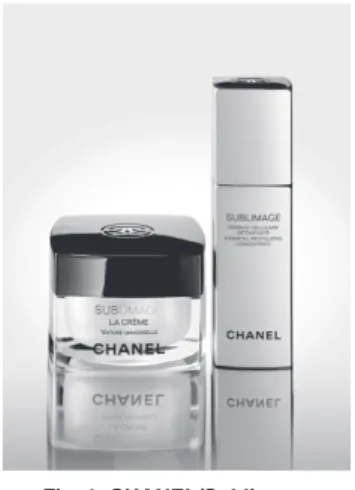
Having observed the cosmetic industry for twenty years as a beauty editor, one of the authors believes this was the first time they mentioned their engagement in the conservation of nature. According to the booklet FROM GRASSE TO THE HIMALAYAS…, CHANEL “started to walk on the road to conservation of nature” when they developed Sublimage (Fig.1) in 2006, now their first-class skin-care series.
Sublimage is a skin-care series compounded with an active ingredient extracted from vanilla planifolia of Madagascar by an original process. As they used golden champa grown in the Himalayas for the Sublimage Essential Revitalizing Concentrate, launched in 2010, the company entered into a partnership with LSTM (Ladakh Society for Traditional Medicines), an NGO there, and began a new project to protect natural resources and traditional knowledge by constructing a network for communication
among the Amchi and supporting women and children in the whole area.
Furthermore, at the press conference for Sublimage la Crème in 2011, they mentioned the establishment of “Shader, a special plant which recreates the most appropriate environment for cultivation of vanilla planifolia.”
As the booklet argues, “we cannot say that we take the environment into consideration without taking all things concerning the natural environment into consideration and thinking of their future.” The CSR activity, which CHANEL finally exhibits, is a large-scale conservation effort that aims to protect not only nature but also the people who should protect it.
From her experience as a beauty editor, one of the authors understands that, at the press conferences for new skin-care products, the company tends to strongly emphasize the innovativeness of the materials and technology, and their effects on the skin. This applied at the press conference for the first product of the series in 2006. Meanwhile, however, they had launched the project. After it became firmly established, they announced it in their press release, and they placed the special content on the website to inform the public about it. These facts indicate that, for CHANEL, Green Action is an important brand strategy today.
Fig. 1 CHANEL/Sublimage (source: CHANEL press release)
4. Case Analysis of GUERLAIN - Establishment of World-Wide Platform for Research -
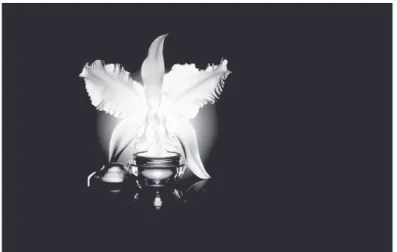
Orchidée Impériale (Fig. 2) is a first-class skin-care series of GUERLAIN that extracts its essence from the orchid, a flower associated with long life, and compounds the original active ingredient. When releasing Orchidée Impériale Cream in 2006, they started an unprecedented project: establishing their own research platform, called the Orchidarium.
The aim of this platform is to analyze and illuminate the vital energies of the orchid.
Under the direction of GUERLAIN’s institute, it consists of three complementary research centers: the Agrobiology Center, an experimental garden near the border between France and Switzerland; the Phytochemistry Center, an institution for basic study at the University of Strasbourg in France; and the Biodiversity Center, a natural conservation area for research in Yunnan in China. Each center has a specific mission, and specialists for each field pursue that mission. From this platform, they succeed in both the protection and harvest of orchids, operating a program for natural conservation based on the Rainforestation Jungle Farming System; they secure a stable supply of active ingredients extracted from the orchid, and then activate the economy around this area by sharing the profit.
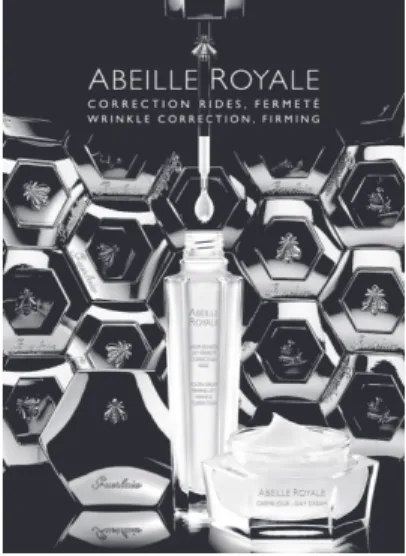
In addition to Orchidalium, GUERLAIN established the Abeille Royale Research Platform when it produced a new skin-care series in 2010, Abeille Royale (Fig. 3), whose chief ingredient comes from honey.
Fig. 2 GUERLAIN/Orchidée Impériale (source: GUERLAIN press release)
Fig. 3 GUERLAIN/Abeille Royale (source: GUERLAIN press release)
GUERLAIN uses the honey of the black bee, which lives only on Ouessant Island in France, as the chief ingredient for Abeille Royale. The reason for their use of this honey is that, since the island has a good natural environment, there are 30 districts for apiculture, and they are able to gather honey of the highest purity. Through researchers from outside, GUERLAIN continues to conduct research on the island on the bee and ingredients that stem from honey. In addition, backing up the activity of L'Association Conservatoire de l'Abeille Noire Bretonne (ACANB), they save the supply route of the material by conserving the black bee and supporting honey production on Ouessant Island.
After the establishment of these two platforms, the style of GUERLAIN’s press conference concerning the two series changed. At the conferences for both series, the managers of the skin-care products started by explaining the platform before the products. About half of the conference was devoted to the presentation of this platform, and they showed video letters from agriculturists and professors of pharmacy. thus, they evidenced their pride: Other companies have not started such advanced activities.
GUERLAIN is a brand that has produced various products of fragrance, make-up, and skin-care in the course of its history of over 180 years, spurred by a policy of innovation. It is assumed that Green Action has recently become one of its brand policies.
5. Case Analysis of L’ORÉAL GROUP - Realization of Green Chemistry - The L’ORÉAL Group is a cosmetics company established by a chemist, Eugène Schueller, in Paris in 1909 that now has 31 brands in 100 countries and regions. As mentioned previously, they support a variety of activities concerning CSR, and in 2009, their centennial anniversary, they announced they had launched 100 new social causes.
They have also begun to engage in CSR through the development of Pro-Xylane, a new anti-aging molecule produced in 2007. It was revolutionary in the development of ingredients in that it was the first time the L’ORÉAL Group adopted Green Chemistry, an eco-friendly synthesis process. They explain this process as follows:
The chief material of this revolutionary ingredient is natural Xylose, a sustainable material, which is extracted from the beech commonly seen in West Europe. Only two steps of chemical synthesis are required to produce Pro-Xylane; we use less energy and produce less waste. Also, Pro-Xylane is biodegradable, not persistent, bioaccumulative and toxic chemicals. In brief, Pro-Xylane meets the strict standard for Green Chemistry whose aim is natural conservation.
Beginning with the development of Pro-Xylane, the L’ORÉAL Group has continued to develop ingredients based on the concept of Green Chemistry. Their next one is Bio-Cellulose, a natural non-synthetic organic material that is generated by fermentation of bacteria. L’ORÉAL applies this material to a sheet mask.
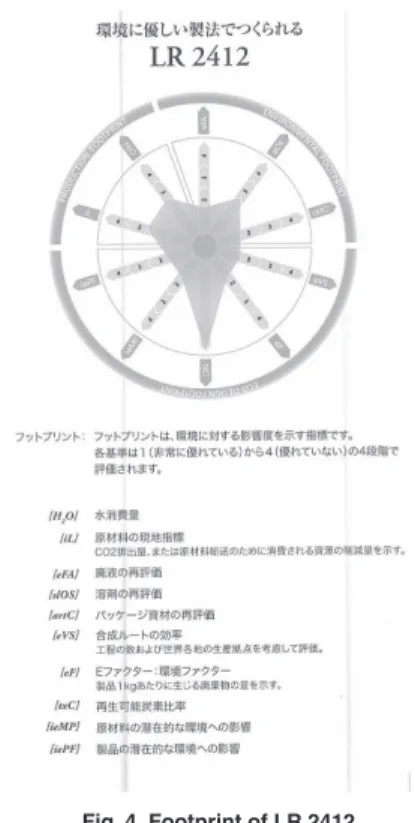
Furthermore, in August 2011, they introduced the new ingredient LR2412, developed after a research process of 20 years. LR2412 is also produced by Green Chemistry called “Hydrogénèse in one-pot.” The press release specified the percentage of molecule use (77%) and synthetic yield (98%), in addition to various footprints (Fig.4).
Another interesting point of the Green Chemistry initiative within the L’ORÉAL Group is the fact that all the three ingredients were first introduced through LANCÔME (Fig.5).
NIHON L’ORÉAL is currently developing eighteen brands categorized in four business groups: Consumer Products, Professional Products, Luxury Products, and Active Cosmetics. Instead of other brands, the company chose its top luxury brand LANCÔME to start its green initiative that will then be expanded to other brands.
As for LR2412, the company gave priority to LANCÔME, and its expansion to other brands is not scheduled at the moment.
This leads us to ask, Why LANCÔME? The reason seems to be related to the fact that the brand was the L’ORÉAL Group’s first luxury brand. When L’ORÉAL
Fig. 4 Footprint of LR 2412 (source: LANCÔME Visionnaire press release)
Fig. 5 LANCÔME/from left, Absolue ßx Beauty Essence (Pro-Xylane), Génifique Mask (Bio-Cellulose), Visionnaire Serum (LR 2412)
(source: LANCÔME official website)
corporatized LANCÔME, this brand, which was founded in 1935, had already been developed globally as a total luxury brand of French elegance. The acquisition of LANCÔME served as a stepping stone to luxury strategies for the group. Thus, the importance of the brand was huge, and cannot be overstressed. Pierre Yves Arzel, then CEO of NIHON L’ORÉAL, spoke about his brand strategy in an interview with the female fashion magazine Marie Claire Japan, for which one of the authors worked as senior beauty editor.
We are not interested in merely growing the company. However, it is important to develop continuously. Thus, we consider carefully which brand to invest in and how to produce and grow it. In so doing so, we enable the company and brands to complement each other and engage in a win-win relationship.
He also said,
We must never develop all brands at the same place by the same people. If you want to become a top brand, you will need to provide the perfect products and special experiences. The brand should be desired by consumers and provide exclusive experiences that they cannot have with any other brand.
The company has chosen to introduce this new eco-conscious ingredient based on the newest science and technology, through luxury products instead of starting with brands that have a group name or take medical approaches. This case study demonstrates the deep relationship between contemporary Green Action and luxury brands.
6. Case Analysis of ESTÉE LAUDER GROUP - A Luxury Approach Suited to a Brand’s Characteristics -
ESTÉE LAUDER Group (hereafter ELGC) is an American cosmetic company founded in 1946 by Ms. Estee Lauder. Of the twenty-eight brands selling in the United States, only ten are available in the Japanese market.
The CSR activities of this brand are characterized by the “Pink ribbon campaign” (a Breast Cancer awareness campaign). While this is a companywide activity, each brand has its own activities as well. Here, we will focus on three brands among the ten selling in Japan (Fig. 6) that facilitate Green Action.
Fig. 6 from left: AVEDA, ORIGINS, DE LA MER (source: ELGC official website and press release)
6.1 AVEDA
AVEDA was founded by an Australian hairstylist, Horst M. Rechelbacher, in 1978, in Minnesota. An encounter with Ayurveda pushed him to study Ayurveda medicine in India. He then created the brand AVEDA, a pioneer in plant-based cosmetics. After two decades of management, Rechelbacher sold his company to ELGC in 1997.
ELGC proceeded to make the company “go green,” while achieving high profitability. Based on its mission BEAUTY IS AS BEAUTY DOES, the brand has aimed to build an “AVEDA model” focused both on environment and business growth, and AVEDA is certainly the leading company in this field, as its early initiatives and results proves. For this reason, AVEDA was the third company in the world to obtain Cradle to Cradle (C2C) certification for its product lifecycle management system, which focuses on environment preservation.
As shown above, AVEDA is evolving to become an environmentally conscious brand supported by the newest scientific knowledge. It is thus worthy of its name, AVEDA, which means “all the wisdom” in Sanskrit.
6.2 ORIGINS
ORIGINS was born as the first wellness brand of ELGC for department stores in 1990. During the period of economic growth in the 1990s, while other cosmetics companies did not yet pay the attention to ecology, ORIGINS focused on ecology and animal protection using natural ingredients, 100% pure essential oils, and recycled material.
Since then, ORIGINS has continued to promote its company vision. It launched
Dr. ANDREW WEIL FOR ORIGINS in 2006 and then ORIGINS ORGANICS in the Japanese market in 2008. The former was a skin care series developed in collaboration with Andrew Weil, M.D., pioneer in integrative medicine. Dr. Weil contributes all of his after-tax profits from the sale of Dr. ANDREW WEIL FOR ORIGINS to the Weil Foundation, a non-profit organization he created in 2004 to support integrative medicine. The latter was an organic series certified by the USDA or ECOCERT with its percentages of ingredients listed on the label.
In 2007, Jane Lauder, Ms. Estee Lauder’s granddaughter, was promoted to the position of global president of ORIGINS and “Ojon.” She then launched the new strategy of the brand: “Powered by Nature, Proven by Science,” which is displayed within the brand logo. Further development of its activities is expected under her presidency.
6.3 DE LA MER
The naissance of the cream DE LA MER (Original name is LA MER) dates back to 1965. Max Huber, the founder, was an aerospace physicist at NASA, and his prescription for handmade cream is extremely unique. It includes the extract of seaweed taken from the California coast in winter, minerals and vitamins, wheat germ, and sesamoid. The cream is fermented for 2 months, then put under a spotlight for 2 hours a day. The sound of bacteria growth also enhances its efficiency. The cream is manually bottled and blended to keep the best balance possible.
ELGC bought this brand in 1995 and revived its cream by producing a version closer to the original recipe. Given this background, Green Action of DE LA MER focuses on the marine preservation. It has supported OCEANA, a non-profit organization for marine conservation, since 2005, donating a total of 200,000 dollars, which was distributed internationally. Every year, the brand sells “Crème DE LA MER World Oceans Day limited edition” exclusively for this purpose. DE LA MER expresses its original Green Action approach, which is deeply related to the sea, in its brand name.
As shown above, the ELGC brands develop Green actions suitable to their own products. However, the group started the Pink Ribbon Campaign in 1992. From my point of view, it has become a large project in Japan as well in recent years, and PR managers of each brand lead it after 6 months of preparation every year.
Based on the fact that ELGC continuously invests in its pink ribbon campaign, which aims to raise awareness of breast cancer through limited products specially designed for it, it might be assumed that “Green Action directly linking to products” is the brand strategy of ELGC.
7. Findings
In this research, we analyzed the latest case studies of four companies, including CHANEL, GUERLAIN, L’ORÉAL GROUP and ESTÉE LAUDER GROUP. Table 1 below summarizes the characteristics of each brand.
Table 1 Key Points of Green Action in Four Cosmetic Companies
Company Brand/Product Key Ingredient Action
CHANEL Sublimage Vanilla Planifolia of
Madagascar ・Establishment of Shader
・Partnership with Native People
Golden Champa of
Himalayas ・A new project to protect natural resources and traditional knowledge in the whole area
・Partnership with LSTM GUERLAIN Orchidée Impériale Orchid ・Establishment of
Orchidarium Abeille Royale Honey of the black
bee on Ouessant Island
・Establishment of Abeille Royale Research Platform L'OREAL
GROUP LANCÔME/
Absolue Pro-Xylane ・Green Chemistry
LANCÔME/
Généfique Mask Bio-Cellulose ・Green Chemistry
LANCÔME/
Visionnaire LR2412 ・Green Chemistry
“Hydrogenèse in one-pot”
ESTEE LAUDER GROUP
AVEDA/all
products Organic & natural ・Fair trade
・100% certified wind power
・100% post-consumer recycled package, etc.
ORIGINS (ORIGINS, ANDREW WEIL FOR ORIGINS, ORIGINS
ORGANICS) /all products
Organic & natural ・Fair trade
・100% certified wind power
・100% post-consumer recycled package, etc.
・Supporting the Weil Foundation DE LA MER/
Crème DE LA MER World Oceans Day limited edition
Natural ・Supporting OCEANA
Previously, the social responsibility of big global companies has been realized through individual rights protection, personal information protection, disclosure, and social activities under the form of Mécénat or philanthropic activities. However, the case studies discussed earlier prove that CSR, as “Green Action directly linking to products,”
has become more concrete since the twenty-first century began.
8. Discussion
We could identify two commonalities among the four case studies: 1) directly linking to products and 2) managed systematically and globally.
These Green Action efforts are globally managed and not limited to mere use of organic or fair-trade ingredients in order to secure a comprehensive return in production regions from the long-term standpoint.
The long-term standpoint seeks ecological and social environment sustainability. It also promises, at the same time, brand sustainability.
Table 2 Factors of Green Action
Managed systematically and globally
Directly linking to (A) ○/○ (C) ○/×
Products (B) ×/○ (D) ×/×
Focused on the correlation between the elements “directly linking to products” and
“managed systematically and globally,” the activities of the four companies will be categorized as belonging to the (A) group in Table 2. The (B) group includes traditional CSR activities, such as Mécénat or philanthropy, while the (C) designation indicates cases in which CSR is based on the use of natural and fair trade ingredients, known as “organic cosmetics.” In this context, what does “Green action directly linking to the products and globally managed” mean for luxury brands?
Fig. 7 Layers of Luxury Communication
In Kapfere and Bastien (2009), luxury communication layers are defined as in Fig.
7. The figure indicates the mode of communication and its importance varies depending on the layer of the pyramid. While the authors included Charity in the top layer, they offer only a minimal explanation on this point, stating: “In fact, luxury also gives a great deal.” It assumes Mécénat or philanthropy activity. However, we would suggest that
“Green action directly linking to products and managed systematically and globally”
should be added to the top layer as one of the most important luxury communication strategies today, through the analysis of four case studies. In other words, we should not say these brands are a luxury today unless they do not practice “Green action directly linking to the products and managed at the global and organizational level.”
9. Limitations
This study argued that “Green Action directly linking to the product, and managed globally and systematically” is an important element of luxury strategies for today’s cosmetic brands. In the future, we must examine cases of the other cosmetic brands that do not adopt the luxury strategy. In particular, we need to compare this study to the cases of Organic Cosmetics that are increasing rapidly nowadays. There are two points to address in this consideration.
First, the cosmetics called Natural Cosmetics, Ethical Cosmetics, and Organic Cosmetics, which have become popular in the last 10 years, are not produced through sufficient Green Action. These cosmetics are often displayed as Eco-friendly Cosmetics in stores. However, as a beauty editor, one of the authors has observed that these companies do not adhere to a global standard for certification of Organic products and that each has its own standards. Moreover, She observes that, even though many products that do not have certification are compounded with organic materials, the percentages of the
composition is unclear or the management of materials—actually, the OEM deals with this—is insufficient.
Second, among the cosmetic companies producing Organic Cosmetics, WELEDA, for example, has followed a brand philosophy of symbiosis between nature and society since its establishment in 1921. By making comparisons with such companies, we can clarify the luxury strategy of the cosmetic companies in terms of Green Action.
10. Managerial Implications
Through analyzing the cases of these four companies, this study proves that “Green Action directly linking to the product,” and being “managed globally and systematically”
are important elements of the luxury strategy for today’s cosmetic companies. This conclusion may also apply to other industries, such as food, drink, and furniture.
Through “Green Action directly linking to products,” consumers can directly or indirectly contribute to society by purchasing certain products. In addition, it enables the brands and consumers to share in the project’s Green Action. This fact must serve to make these brands favorable and reliable for consumers. As Kapferer and Bastien (2009) says, “Luxury and communication are consubstantial” and “Luxury seeks participation and active membership from the client.” That is to say, “Green Action directly linking to products” is a brand equity only the luxury brands can acquire.
In addition, the cases discussed above pertain to brands that sell their product directly to consumers at department stores. Under ELGC, AVEDA is not a brand for the department store, but it sells its products directly to the consumers only at direct management shops and beauty salons. This means that each brand communicates the authenticity of its Green Action to consumers, and strongly attracts their attention.
Therefore, “Green Action directly linking to products” is the element that should be adopted as the luxury strategy by today’s company, regardless of their type of business.
References
AVEDA (2010), Kankyo to Business no Ryoritsu wo Mezasu Aveda no Torikumi, 3, 15, 27
AVON official website (accessed July 28, 2011), [available at www.avoncompany.com/
corporatecitizenship/avonfoundation.html]
CHANEL (2011), Sublimage la Crème Press Release
DE LA MER (2011), Crème De La Mer World Ocean Day Limited Edition Press Release
ESTÉE LAUDER official website (accessed July 28, 2011), [available at www.bcap.jp/
about01.php]
ESTÉE LAUDER official website (accessed July 28, 2011), [available at www.
elcompanies.com/]
GUERLAIN (2010), Orchidée Impériale Press Release GUERLAIN (2011), Abeille Royale Press Release
Hachette Fujingaho (2008), Supplement to the November issue, 8-11[Y. Kizu as a Beauty Editor]
INTELLIGENT NUTRIENTS official website (accessed July 28, 2011), [available at http://www.intelligentnutrients.com/
Kapferer, J. N. and V. Bastien (2009), “The Luxury Strategy,” Kogan Page, 210-214 Katsuki, H. (2010), “Cosmetic Marketing,” Nihon Noritsu Management Center, 360 Kagata, K. (2006): “Kigyo no Shakaiteki Sekinin (CSR) — Sono Rekishiteki Tenkai to
Konnichiteki Kadai —,” Kwansei Gakuin Policy Studies Review 7, 43-65 (in Japanese)
Kizu, Yumiko, Shin'ya Nagasawa: Creating the New Brand Equity through EcoDesign of Cosmetics, in Mitsutaka Matsumoto, Yasushi Umeda, Keijiro Masui, and Sinichi Fukushige eds., Design for Innovative Value Towards Sustainable Society — Proceedings of EcoDesign 2011: 7th International Symposium on Environmentally Conscious Design and Inverse Manufacturing —, pp.463-467, Union of EcoDesigners, and National Institute of Advanced Industrial Science and Technology, 2011.12.2, also Springer Netherlands, 2012.4.5, e-ISBN 978-94-007- 3010-6
LANCÔME (2010), Génifique Mask Press Release LANCÔME (2011), Visionnaire Serum Press Release
Nagasawa, Shin’ya (2002), An Unpainted Face of the Empire of Luxury Brands: LVMH Moët Hennessy. Louis Vuitton, Nihon Keizai Shimbunsha. (in Japanese) and Taiwan Business Weekly (Taipei). (translated in Chinese, 2004)
Nagasawa, Shin’ya ed. (2006), with Nagasawa’s Laboratory in the Waseda Business School, Creating Customer Experience in Long Standing Companies: Design Management of Encounters with Customers, Doyukan. (in Japanese) and Corporate Synergy Development Center (Taipei). (translated in Chinese, 2008) Nagasawa, Shin’ya ed. (2007), with Kenji Ohizumi, and Kazuaki Maeda, The Principles
of Louis Vuitton: The Strongest Brand Strategy, Toyo Keizai Shinposha. (in Japanese) and Between Line Publishers (Seoul). (translated in Hangul, 2009) and
Technology Promotion Association (Bangkok). (translated in Thailand Language, 2009)
Nagasawa, Shin'ya (2009a), Creating Customer Experience in Luxury Brands ? Comparison of Hermes, Louis Vuitton and Coach —, Waseda Business &
Economic Studies, No.44, pp.25-39, Graduate School of Commerce, Waseda University.
Nagasawa, Shin'ya (2009b), Marketing Principles of Louis Vuitton — The Strongest Brand Strategy —, Waseda Business & Economic Studies, No.44, pp.41-54, Graduate School of Commerce, Waseda University.
Nagasawa, Shin’ya ed. (2009c), The Secrets of Louis Vuitton: Why Louis Vuitton is tough in hard times? Kodansha. (in Japanese)
Nagasawa, Shin’ya ed. (2010), with Kana Sugimoto, CHANEL Strategy: Management of the Ultimate Luxury, Toyo Keizai Shinposha. (in Japanese)
NIHON L’ORÉAL official website (accessed July 28, 2011), [available at www.nihon- loreal.co.jp/_ja/_jp/index.aspx?direct1=00008&direct2=00008/00001]
NIHON L’ORÉAL official website (accessed July 28, 2011), [available at www.nihon- loreal.co.jp/_ja/_jp/index.aspx?direct1=00008&direct2=00008/00001]
NIHON L’ORÉAL official website (accessed July 28, 2011), [available at www.nihon- loreal.co.jp/_ja/_jp/index.aspx?direct1=00006&direct2=00006/00005]
ORIGINS website (accessed July 28, 2011), [available at http://www.origins.com/
customer_service/aboutus.tmpl]
VOGUE NIPPON (1999), Nikkei Conde Nast, October Issue, 46 [Y. Kizu was a Beauty Editor]
Sugimoto, Kana, and Shin'ya Nagasawa (2009): The Succession of Technology and Production of the Technology Management Brand of “Chanel,” Proceedings of International Conference on Kansei Engineering and Emotion Research 2009, 14G-01, pp.1-7, Japan Society of Kansei Engineering.
Tajima, K. (2009), Graduate School of Engineering, Hokkaido University official website ( a c c e s s e d Ju l y 2 8 , 2 0 1 1 ) , [ a va i l a b l e a t w w w. e n g . h o k u d a i . a c . j p / engineering/2009-01/feature0901-03.html]