Homeomorphically irreducible spanning trees
in fullerene graphs
School of Network and Information, Shoichi Tsuchiya
Keywords : fullerene graph, homeomorphically irreducible spanning tree (HIST), cubic graph plane graph
1
Introduction
Fullerenes are cubic carbon molecules in which
the atoms are arranged on a sphere in pentagons and hexagons. Fullerene graphs are connected, 3-regular plane graphs with pentagonal and hexago-nal faces, where a k-regular graph is a graph with all vertices have degree k and a plane graph is a graph drawn on the plane without edge-crossings. Such graphs are suitable models for fullerenes : car-bon atoms are represented by vertices of the graph, whereas the edges represent bonds between adja-cent atoms. It is known that fullerene graphs satisfy many properties. For example, every fullerene graph is 2-extendable (cf. [5]), contains at least 2n−38061
per-fect matchings [3] where n is order of the graph, and so on.
In graph theory, it is a fundamental problem de-ciding a given graph contains a spanning tree with some properties. A homeomorphically irreducible
spanning tree (or a HIST) is a spanning tree with no
vertices of degree 2. Recently Hoffmann-Ostenhof, Noguchi and Ozeki [2] found an infinite family of fullerene graphs containing a HIST. In this paper, we consider conditions of fullerene graphs to have a HIST. In particular, we give a necessary and suf-ficient condition for the existence of a HIST in a fullerene graph (Section 3). Also, we show that there exists an infinite family of fullerene graphs without a HIST (Section 4).
2
Preliminaries
For a graph G, V (G) and E(G) denote the set of vertices and edges of G, respectively. Similarly,
Vi(G) denote the subset of V (G) consisting of all
degree i vertices in G. Also,|G| and |E(G)| denote the number of vertices and edges of G, respectively. For a vertex v ∈ V (G), dG(v) denote the degree of
v in G.
2.1
Basic
properties
of
fullerene
graphs
Proposition 1 Let G be a fullerene graph. Then G
has 3
2|G| edges, exactly twelve pentagonal faces and
|G|
2 − 10 hexagonal faces.
Proof. Let G be a fullerene graph and let p, q and
r be the number of vertices, edges and faces of G,
respectively. Let f5 and f6 be the number of
pen-tagonal faces and hexagonal faces of G, respectively. By Euler’s formula, we have
p− q + r = 2 (2.1)
Since G is 3-regular, we have
3p = 2q (2.2) Thus we can see that G has 32|G| edges. Since all
faces of G are pentagonal faces or hexagonal faces, we have
2q = 5f5+ 6f6= 5r + f6 (2.3)
By combining (2.2) and (2.3), we have
5r = 2q− f6= 3p− f6 (2.4)
By combining (2.1), (2.2) and (2.4), we have
p = 2f6+ 20 (2.5)
and
q = 3f6+ 30 (2.6)
By (2.5), we have f6= p2− 10. By (2.3) and (2.6),
we have f5= 12. □
trivial if one of the components is a cycle. By the
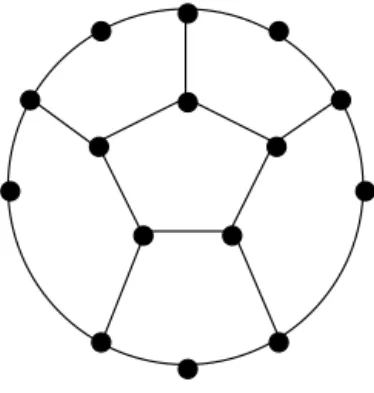
definition, every fullerene graph has a trivial cyclic 5-edge-cut. On the other hand, fullerene graphs con-taining non-trivial cyclic 5-edge-cut are character-ized by Kardoˇs and ˇSkrekovski [4]. A pentagonal cap is a plane graph depicted in Figure 1. In a fullerene graph G, a hexagonal ring is a ring consisting of five hexagonal faces such that in each hexagon in the ring there exists a vertex having a neighbor inside this ring, and a vertex having a neighbor outside this ring. Let Gk denote a fullerene graph with the
structure that two pentagonal caps are joined by k layers of hexagonal rings.
図 1: A pentagonal cap.
Theorem A (Kardoˇs and ˇSkrekovski [4]) A
fullerene graph G has a non-trivial cyclic 5-edge-cuts if and only if G is isomorphic to Gk for some integer
k≥ 1.
2.2
Properties of HISTs in fullerene
graphs
First, we introduce a proposition for trees consist-ing of degree 1 and 3 vertices.
Proposition 2 Let T be a tree each of whose vertex
is degree 1 or 3. Let t1 and t3 be the number of
vertices of T with degree 1 and 3, respectively. Then t1= t3+ 2, that is t1= |T |2 + 1 and t3= |T |2 − 1.
Proof. Let q be the number of edges of T . Since T is a tree, we have
2q = t1+ 3t3, q = t1+ t3− 1
Thus we have t1= t3+ 2. □
If a 3-regular graph has a HIST H, then H con-sists of vertices with degree 1 or 3. Thus, by Propo-sition 2, we can see the following.
Proposition 3 Let G be a fullerene graph of order
n. Then G has a HIST if and only if G has 2-regular graph S of order m = n
2 + 1 such that G− E(S)
is connected (i.e., S is the set of facial cycles of G which are non-separating).
Proof. If G has a HIST H, then it is obvious that
G− E(H) is a 2-regular graph S if we delete all
degree 0 vertices. Also, G− E(S) is connected. So,
we show that|S| = n
2 + 1. Since |H| = n, |E(H)| =
n− 1. Also, |E(G)| = 3
2n, and hence
|S| = |E(S)| = |E(G)|−|E(H)| = 32n−(n−1) = n2+1
Next we show that if G has 2-regular graph S of order m = n2 + 1 such that G− E(S) is connected,
then G has a HIST. Let H′be a graph obtained from
G by deleting all edges of S. By the assumptions, H′ is connected graph consisting of degree 1 and 3 vertices. Thus it suffices to show that H′ is a tree.
Since|S| = n
2 + 1,|E(S)| =
n
2 + 1. So, we have
|E(H′)| = |E(G)| − |E(S)| = 3 2n− (
n
2 + 1) = n− 1 Since |H′| = n and H′ is connected, H′ is a tree.
□
For S in Proposition 3, we can show the following. Proposition 4 Let G be a fullerene graph of order
n with a HIST and let S be 2-regular graph of order m = n2+ 1 such that G− E(S) is connected. Then, for any face f in G, there exists at least one edge on the boundary of f which is contained in E(S). Proof. By the proof of Proposition 3, we can see that G− E(S) is a HIST of G, and hence G − E(S) has no cycle. □
3
Necessary and sufficient
con-dition of fullerene graphs to
have a HIST
Let G be a plane graph and let G∗ be a graph obtained from G by the following operations:
1. Put a new vertex v∗ in each face f of G.
2. For every edge e of G, connect the vertices v∗
The resulting graph G∗ is called a dual of G. Note that G∗ may have a loop or multiple edges. By the
definition, we can see that if G is a fullerene graph, then G∗is a plane triangulation (i.e., a plane graph
with all faces are triangular faces) without a loop and multiple edges.
Theorem 5 Let G be a fullerene graph of order n
and let G∗ be the dual of G. Then G has a HIST if
and only if G∗contains a spanning tree T such that (i) for each v∈ V5(G∗), dT(v) is either 1 or 5,
(ii) for each u∈ V6(G∗), dT(u) is either 1, 2 or 6,
(iii) for any x, y∈ V (T ) with degree 2, xy /∈ E(T ), (iv) for any x, y ∈ V (T ) with dT(x) = 2 and
dT(y) = 1, xy /∈ E(T ).
Proof. First, we show “only if part”. Let H be a HIST of G. By Proposition 3, G has a 2-regular graph S of order m = n
2+1 such that G−E(S) = H.
By the proof of Proposition 3, we can see that every vertex with degree 1 of H is contained in V (S). By Proposition 4, for each face f in G, there exists at least one edge on the boundary of f which is con-tained in E(S).
Since G∗is a dual of G, G∗contains 12 vertices of
degree 5,n
2−10 vertices of degree 6 and 3
2n edges. By
the definition of the dual, every edge of G∗crosses to exactly one edge of G and vice versa. Let T be the graph obtained from G∗by deleting all edges which are crossing to E(H). Since H is a spanning tree of
G,|E(H)| = n − 1, and hence |E(T )| = 32n− (n − 1) = 1
2n + 1 =|T | − 1 Also, T has no cycle (otherwise H is not connected, a contradiction). Consequently, T is a spanning tree of G∗. Thus it suffices to show that T satisfies the
conditions (i)-(iv).
(i) We show that dT(v)̸= 2, 3, 4. Suppose not. Then
there are five cases depicted in Figure 2. When the case dT(v) = 4, (a) and (c), H is not connected
because the strong lines are independent edges in H, a contradiction. When the case (b) and (d), both vb
and vdare degree 1 vertices of H. However, they are
not contained in V (S), a contradiction.
(ii) We show that dT(u) ̸= 3, 4, 5. Suppose not.
Then there are seven cases depicted in Figure 3. When the case dT(v) = 5, (a) and (d), H is not
connected because the strong lines are independent edges in H, a contradiction. When the case (b), (c),
dT(v) = 4 dT(v) = 3 dT(v) = 2 (a) (b) (c) (d) vb vd
図 2: A part of G (the solid lines) and T (the dot lines).
(e) and (f), vb, vc, ve and vf are degree 1 vertices
of H. However, they are not contained in V (S), a contradiction.
dT(u) = 5 dT(u) = 4 dT(u) = 3
(a) (b) (c) (d) (e) (f) vb vc ve vf
図 3: A part of G (the solid lines) and T (the dot lines).
(iii)-(iv) Let x be a vertex of degree 2 in T and let
e1 and e2 be edges of T incident to x. By the same
arguments in the proof of (i)-(ii), edges e1 and e2
are crossing antipodal edges of the hexagonal face of G corresponding to x (otherwise, H contains an independent edge or a degree 1 vertex not contained in V (S), a contradiction). Thus, H contains a vertex of degree 2, a contradiction.
Next we show “if part”. So, we prove that if G∗
from G by deleting all edges crossing to E(T ). Since
|T | = n2 + 2 and T is a tree, |E(T )| =
n 2 + 1, and hence E(H) = 3 2n− ( n 2 + 1) = n− 1
Also, H has no cycle (otherwise T is not connected, a contradiction). Therefore, H is a spanning tree of
G. So, we show that H has no vertices of degree
2. Suppose not. Then let x be a vertex of H with
dH(x) = 2, and let e1, e2, e3 be edges incident to x
where e1, e2∈ E(H) and e3∈ E(H). Let f/ 1 (resp.,
f2) be the face of G incident to e1 and e3 (resp., e2
and e3). By the conditions (i) and (ii) of T , both f1
and f2 are corresponding to vertices of degree 1 or
2 in T . By the conditions (iii) and (iv), we have f1
and f2 are corresponding to vertices of degree 1 in
T , contrary to that T is a spanning tree of G∗. □
4
Fullerene graphs without a
HIST
Theorem 6 Let G be a fullerene graph. If G has a
non-trivial cyclic 5-edge-cuts, then G has no HIST. Proof. By Theorem A, it suffices to show that Gk
has no HIST for each integer k ≥ 1. For a
contra-diction, suppose that Gk has a HIST H for some k.
By the construction of Gk,
|Gk| = 2 · 15 + 10(k − 1) = 10k + 20.
By Proposition 3, Gk contains 2-regular subgraph S
such that|S| = 10k+20
2 + 1 = 5k + 11 and Gk− E(S)
is connected. For a face f of Gk, we call that the
boundary cycle of f is contained in S if all edges
bounding f are contained in S. By Proposition 4, for each face f in Gk, there exists at least one edge
on the boundary of f which is contained in E(S). Therefore, for each pentagonal cap of Gk, at least
one pentagonal face is contained in S. Let fi and
fk,jbe faces depicted in Figure 4 (f2,j are pentagonal
faces when k = 1).
Suppose that the facial cycle of f0 is contained
in S. Then, for each i ∈ {1, 2, 3, 4, 5}, facial cycles
of fi and f1,i are not contained in S because G−
E(S) is connected. By Proposition 4, for some j ∈ {1, 2, 3, 4, 5}, facial cycles of f2,j are contained in
S. By symmetry, we assume that the facial cycle of f2,1 is contained in S. Then, for each j ∈ {2, 5},
facial cycles of f2,j are not contained in S because
G− E(S) is connected. By Proposition 4, at least
f0 f1,1 f1,2 f1,3 f1,4 f1,5 f1 f2 f3 f4 f5 f2,2 f2,1 f2,3 f2,4 f2,5 · · · · · · 図 4: A pentagonal cap in Gk.
one edge of the boundary cycle of f1,2is contained in
S. Also, at least one edge of the boundary cycle of f1,4is contained in S. Therefore, for each j∈ {3, 4},
facial cycles of f2,j are contained in S, contrary to
that G− E(S) is connected.
Thus the facial cycle of f0 is not contained in S.
By Proposition 4, for some i ∈ {1, 2, 3, 4, 5}, facial cycles of fi are contained in S. By symmetry, we
assume that the facial cycle of f1 is contained in S.
Then, for each i∈ {0, 2, 3, 4, 5} and j ∈ {1, 2, 4, 5}, facial cycles of fi and f1,j are not contained in S
because G− E(S) is connected. Similarly, the facial cycle f2,1is not contained in S. This implies that the
facial cycle of f1,3is contained in S by Proposition 4.
Therefore, for each j ∈ {2, 3, 4, 5}, facial cycles of
f2,j are not contained in S.
By the above arguments, the graph obtained from the union of boundary cycles of f0, f2, f3, f4, f5, f1,1
and f1,5 by deleting edges of the union of boundary
cycles of f1 contains a cycle (and hence G− E(S)
contains a cycle), contrary to that G− E(S) is a HIST of G. □
Acknowledgment
References
[1] T. Doˇsli´c, Cyclical edge-connectivity of fullerene graphs and (k, 6)-cages, J. Math. Chem. 33 (2003) 103-111.
[2] A. Hoffmann-Ostenhof, K. Noguchi and K. Ozeki, On Homeomorphically Irreducible Spanning Trees in Cubic Graphs, Submitted (arXiv:1507.07689).
[3] F. Kardoˇs, D. Kr´al’, J. Miˇskuf and J.S. Sereni, Fullerene graphs have exponentially many per-fect matchings, J. Math. Chem. 46 (2009), 443– 447.
[4] F. Kardoˇs, and R. ˇSkrekovski, Cyclic edge-cuts in fullerene graphs, J. Math. Chem. 44 (2008) 121–132.