Intimacy Crossroads:
Turkish - Japanese Transnational Marriages Through Lenses of Culture, Religion and Gender
文化・宗教・ジェンダーから見たトルコ人-日本人国際結婚 A dissertation presented
by
Zeliha Müge Igarashi
to
Graduate School of Asia-Pacific Studies in candidacy for the degree of
Doctor of Philosophy in the subject of International Studies
Waseda University Tokyo, Japan September 2014
Copyright ©2014 by Zeliha Müge Igarashi All rights reserved
Abstract
Globalization and resulting increased mobility have been increasingly interconnecting different populations and cultures. This in return has resulted in increased interaction among people from diverse cultures. One of the important outcomes of this process has been the increase in the establishment of transnational ties and formation of transnational families.
The case of Japan is no exception to the trend outlined above. The number of transnational marriages in Japan has increased significantly in past decades. When we look at the gender breakdown of foreign spouses in Japan, most of them are Asian females. Japanese men’s foreign spouse choices are strongly marked by the rate of Chinese, Koreans and Filipinas who account for the majority of these marriages. Japanese females’ foreign spouse choices on the other hand show diversity. Within this diversity, the rate of Muslim foreigners has increased significantly in the past two decades.
Japanese women’s marriages with Muslim men from Pakistan and Iran in particular has been attracting more attention with emphasis on conversion of these women to Islam and its impact on these families’ everyday family lives.
When we look at the existing literature on transnational marriages in Japan it has few shortcomings. First of all, most of the research remains focused on above outlined foreign spouse groups which undermines the diversity of foreign spouses. Although 30 per cent of immigrants in Japan are highly skilled, their transnational marriages remain underrepresented as most of the research is focused on spouses from middle or lower social classes. The number of spouses from lower social classes might be higher as marriage migration provides a loophole for low skilled workers to enter Japanese labor market (Brody, 2000). When we look at the largest categories of foreign spouses in the literature, a huge number of them have previously worked in Japan, legally or illegally and many have over stayed their visas at the time of marriage.
The second shortcoming of the literature is its foundation on women’s narratives as Japanese wives of foreign men or foreign wives of Japanese men. This is both the strength and the weakness of previous research. It is the strength as it provides detailed accounts by focusing on a specific unit.
However it remains weak in explaining gender relations in intercultural communication. In simple terms, it leaves the reader with only one side of the story. I argue that research on marriage requires the incorporation of both genders in order to go beyond the monologue of one gender.
Thirdly, although studies on marriages with Muslim men have been attracting more attention, the relation between social class and religiosity is often overlooked. An important reason underlying this limitation is the difficulty for researchers to access these groups. Researchers who are outsiders to groups they study tend to search for Muslim interviewees through mosques and religious organizations.
This inevitably produces data on religious people only. This handicap is important to overcome as research has shown that religiosity is closely linked to social class (Çarkoğlu & Toprak, 1999; 2006;
Baltaş & Steptoe, 2000).
This research contributes to the literature on transnational marriages in Japan by addressing the shortcomings outlined above. The research presents data on intercultural communication of Turkish – Japanese couples with reference to gender, culture and the Turkish spouses’ religiosity. The focus of the research is on marriages with middle and upper middle class Turkish spouses. I argue that social class plays an important role in Japanese transnational marriages but it has often been overlooked. The research portrays this through de-emphasis of some topics that were significant in previous research, such as visas of foreign spouses, and through emphasis on topics that had not been previously explored, such as living space arrangements.
The ethnographic data for this research was collected from September 2009 to October 2013 through semi-structured interviews with Turkish – Japanese couples and participant observation at activities organized by diverse Turkish immigrant groups in Japan. Based on research findings, I suggest that religious or cultural differences are not significant in couples’ initial decision to get married. Furthermore, similarities in the way gender relations are defined in Turkish and Japanese societies allow couples to have a smooth transition to married life. Couples deal with religious and cultural problems as they arise during their marriage. Most of these are companion couples who found their marriages on friendship and communication. The most problematic areas of these marriages are in line with most transnational marriages, such as relations with in-laws and bicultural childrearing.
Religion, on the other hand, does not cause major problems in these marriages or families’ everyday lives. These transnational families have an incorporative approach to embracing all religions rituals rather than choosing one and following strict rules. This is highly influenced by these spouses’ social classes as well as how religiosity is constructed in Turkey. Turkey as a laic state does not require foreign spouses to convert to Islam for marriage.
ABSTRACT
TABLE OF CONTENTS
CHAPTER I: INTRODUCTION ... 1
TRANSNATIONALMARRIAGES... 2
TRANSNATIONALMARRIAGES INJAPAN... 6
CONCEPTUALFRAMEWORK... 12
SIGNIFICANCE OFSTUDY... 15
RESEARCHOBJECTIVES ANDRESEARCHQUESTIONS... 17
ORGANIZATION OFSTUDY... 18
CHAPTER II: LITERATURE REVIEW ... 21
MARRIAGE... 21
Historical Evolution of Marriage and Family in Japan... 25
Marriage in Contemporary Japan ... 27
Historical Evolution of Marriage and Family in Turkey ... 31
Marriage in Contemporary Turkey ... 34
Gender Relations and Family Dynamics in Comparison... 36
TRANSNATIONALMARRIAGES... 44
Intersection of Migration, Gender and Social Class ... 44
Cultural Conflict and Marital Problems in Transnational Marriages ... 48
CHAPTER III - METHODOLOGY ... 56
RESEARCHER... 57
FIELDRESEARCH... 59
THESTATISTICALDATA... 60
THEQUALITATIVEDATA... 60
PARTICIPANTOBSERVATION... 62
Participant Observation 1: Low Skilled Laborers... 66
Participant Observation 2: Middle and Upper Middle Class Turkish Males ... 71
Participant Observation 3: Upper Middle Class Turkish Females... 73
LIMITATIONS... 77
CHAPTER IV: FORMING FAMILIES ... 79
SPOUSECHOICES... 80
Initial Encounter ... 80
Gender Roles ... 88
Household Management ... 90
Country of Residence ... 96
CULTURAL, RELIGIOUSDIFFERENCES ANDSOCIALCLASS... 102
Cultural and Religious Differences... 102
Social Class... 106
CHAPTER V: NEGOTIATING DIFFERENCES IN MARRIED LIFE... 114
INTERCULTURALCOMMUNICATION... 114
RELATIONS WITHIN-LAWS... 120
In-laws’ Reactions to Potential Foreign Spouses... 120
Relations with In-laws After Marriage ... 126
Family Ties ... 131
Language Barrier and Communication Problems with in-laws... 139
RAISINGBICULTURALCHILDREN... 142
Decision to Have Children... 144
Name selection ... 147
Language Choices and Schooling... 150
Citizenship, Cultural Identity and Socialization... 159
Islam: Circumcision, Religious Rituals and Pork Consumption ... 163
Transition to Parenthood: From “Husband and Wife” to “Father and Mother” ... 166
SEXUALITY... 169
Turkish Sexuality... 169
Japanese Sexuality... 173
Sexuality of Turkish – Japanese Couples ... 176
LIVINGSTANDARDSREDEFINED THROUGHLIVINGSPACE... 178
CHAPTER VI: RELIGIOUS PRACTICE AND IDENTITY CONSTRUCTION IN MARRIAGE .. 186
POLITICIZATION OFRELIGION INTURKEY... 186
TURKISHSPOUSES’ FORMULATION OFRELIGIOSITY... 189
JAPANESESPOUSES’ PERCEPTIONS OFISLAM... 194
RELIGIOUSRITUALS INCOUPLES’ LIVES... 200
CHAPTER VII: CONCLUSION ... 206
WHATMATTERS INTURKISH– JAPANESETRANSNATIONALMARRIAGES? ... 208
WHAT ISWORTHFIGHTING FOR INTURKISH– JAPANESETRANSNATIONALMARRIAGES?... 211
RELIGIOSITY ANDRELIGIOUSPRACTICES... 214
SIGNIFICANCE ANDCONTRIBUTION OFRESEARCH... 216
LIMITATIONS OFSTUDY ANDFUTUREPROJECT... 217
APPENDIX I: DETAILS OF INFORMANTS ... 219
APPENDIX II: INTERVIEWEE INFORMATION FORM... 223
APPENDIX III: INTERVIEW QUESTIONS ... 225
REFERENCES... 230
Chapter I: Introduction
Increased globalization has caused structural changes which have in return facilitated and increased movement of people across borders. Today almost 200 million people in the world live outside of their country of origin (Inglehart & Norris, 2009; Bloemraad, Korteweg & Yurdakul, 2008).
This has inevitably led to diverse encounters and interactions between people from various cultures.
An important outcome of this process has been the increase in transnational marriages in Japan as elsewhere. Marriages between Japanese men and Asian women compose a significant majority of transnational marriages in Japan and the existing literature is constructed mostly on these foreign wives’ narratives. The high percentage of these marriages between Japanese men and Asian women is closely related to Japan’s lessening marriages, dropping birthrate and aging population. Recently there has been a new branch that emerged within the literature of transnational marriage in Japan. This new body of literature mostly relies on narratives of Japanese women who have married Muslim men and converted to Islam in the process. This body of literature has been attracting increasing attention as the number of Muslim foreign spouses has increased in past decades.
Research on transnational marriages in Japan focuses especially on migrant identities of these foreign spouses because the majority of these spouses, male or female, are low skilled laborers. This implies that for many of these spouses it would not have been possible for them to reside or work in Japan without their spouse visa. Although professionals sum up to almost one third of foreigners living in Japan, they are underrepresented within the literature on transnational marriages in Japan.
This dissertation focuses on a group of neglected foreign spouses, namely foreign spouses from middle and higher middle class. It presents findings on transnational marriages of Turkish – Japanese couples in Japan with reference to gender relations as well as cultural and religious differences. The dissertation aims to shed light on what motivates the formation of these marriages and how their dynamics are different from couples covered in the existing literature on transnational marriages in Japan. This aim is realized with reference to the middle and upper middle class of
Turkish spouses as well as their Muslim identities. Within this process, contrary to the existing literature which relies heavily on women’s narratives, this research brings in men’s voices as it relies on narratives of both genders.
Transnational Marriages
Intensification of globalization provides people with increased variety of choices to re- formulate their individual definitions of culture and how they would like to construct it. As Gordon Mathews puts it, people choose what they want to consume from the global supermarket in cultural terms and this contributes to the reshaping of cultures (Mathews, 2000, p.308). Choices of spouses are no exception in this prospect. Today, the number of individuals choosing foreign spouses is increasing.
These couples form transnational families in which they construct their own culture according to the combination of personal preferences.
When we look at the definition of transnational families, there is diversity within the literature.
This term could denote the move of a family to another country (Ong, 2003), the migration of one family member to another country for work (Hondagneu-Sotelo & Avila, 1997; Parreñas, 2001) or families that are formed by two individuals from different countries of origin and culture. This research focuses on the latter definition which shows similarities with international marriages, cross- border marriages and transnational marriages. This research adopts an approach similar to that outlined by Frank Kalter and Julia H. Schroedter (2010) as well as Liversage (2013). These scholars define transnational marriage specifically as a marriage between a migrant and his or her spouse from the host society. Accordingly, the data presented in this research was gathered from Turkish – Japanese couples residing in Japan.
Terms such as cross-border marriages and transnational marriages are sometimes used interchangeably in the literature (Levchenko, 2013; Lyons & Ford, 2008; Piper, 1997, 2003; Constable, 2005, 2009). Although often similarly formulated, the term cross-border marriage often implies geographical proximity between spouses’ country of origin such as marriages within East Asia (Yang and Lu, 2010) or within Europe (Charsley, 2012). On the other hand, a term that had previously
dominated the literature in defining these couples, international marriages, is slowly disappearing.
This is not due to the decreasing interest in these marriages but changes in their nature which is reflected on the conceptualization of these marriages. The latter is being replaced by the term transnational marriages.
The term transnational is more contemporary compared to the term international which lacks the complexity to explain current dynamics. The term transnational is a relatively new term and has emerged as an attempt to redefine migrants and their characteristics that have changed. These characteristics have become much more complex through the impact of globalization (Glick-Schiller, Basch & Szanton-Blanc, 1995). The term transnational emphasizes a move beyond borders, rather than relations between individuals from two different countries or cultures, as implied by international.
Through the increased impact of globalization, the nature of people’s move across borders has changed. Migrants no longer migrate leaving their home country behind but on the contrary, they maintain multiple links. Consequently their public identities are formulated with reference to more than one country. That is why they are referred to as “transmigrants” (Glick-Schiller, Basch &
Szanton-Blanc, 1995). These transmigrants who are in the case of transnational marriages “trans- spouses” mobilize resources as well as goods and services as they move between countries. The establishment of a transnational marriage by default obliges at least one of the couples to become an immigrant. In some cases they might both become immigrants if they choose to reside in a third country. Transnational marriages are characterized by mobility of spouses who move across borders several times. For these transnational spouses, moving across borders and relocations are naturalized, even normalized. It is a defining characteristic of their married lives. These marriages produce transnational families for whom migration is the norm rather than the exception, they travel back and forth between their home and host countries unlike previous generations of migrants who settled down in the host country (Levchenko, 2013; Levitt, 2001).
In terms of their identities, transnational spouses’ cultural identities goes hand in hand with flexible citizenship, in line with works of Aihwa Ong (1999) and Yasemin Soysal (1994). Citizenship is a mere legal formality rather than core identity. Their public identities are formed through a
combination of elements from the host society and home society (Glick-Schiller, Basch & Szanton- Blanc, 1995). Even when immigrant spouses adapt to their spouses’ and host country’s culture, they inevitably continue to reflect their own cultural values that had formed their primal socialization (Inglehart & Norris, 2009, p.6). Consequently, interactions of migrants with their host societies cause changes in both the immigrant group itself and the host society. If immigrants are not incorporated well into their host societies there are risks of alienation and radicalization (Crul & Doomernik, 2003).
For example, some Muslim immigrants’ choice of radicalization over assimilation has caused a growing fear of Islam in Western Europe (Hillifield, 2004). It is important to ask whether these immigrants themselves refused to integrate or were they not accommodated into the host society.
There is the choice of naturalization in most countries around the world however it is important to note that most immigrants prefer to integrate into their host societies in various ways and degrees while staying connected to their country of origin which is what renders them transnational.
Transnational marriages can be analyzed at various levels with diverse frameworks. When the topic is elaborated upon under the framework of migration and networks, push and pull forces between migrant sending and receiving countries become significant. On the one hand there are factors within migrants’ home country that are motivating them to move abroad, these are push forces.
On the other hand there are factors that render the country of destination appealing, these are pull forces (Knight, 2002). It is important to note that marriage could be either the cause or consequence of migration. Transnational marriages do not by default indicate move of a spouse after marriage. There are many couples who have met in a country and continued residing there after marriage.
Discussions on social class are important for transnational marriages. For low skilled laborers, there is a stigma attached to “fake” marriages for the sake of a spouse visa. This categorization of marriages as real or fake is problematic because what a marriage entails shows great differences based on personal preferences. Kim (2011)’s research on Chinese – Korean brides who migrate to South Korea provides an insightful presentation on how and why this distinction between fake and real marriage is problematic. Her research presents findings on how the government’s attempts to classify marriages as fake or real have failed and put many marriage migrants in a disadvantaged
position. The reason governments intervene in intimacy of couples is because movement of people across borders is not without consequences. This is part of governments’ attempts to control migration flows, in particular unskilled labor movements. Governments have to adapt and formulate new policies to deal with immigrants if their number is increasing. This was not a pressing issue for governments prior to 1960 but as movement across borders intensified, migration became problematic for sending and receiving countries. On the one hand, sending countries fear brain drain, the loss of human capital to other countries. On the other hand, receiving countries face the challenge of sustaining their welfare systems while absorbing immigrants into their social and economic systems (Knight, 2002, p.3). Consequently, some developed countries chose to favor the flow of professionals rather than low skilled laborers (Ong, 2003, p.271). However as indicated above, spouse visas allow low skilled laborers to access labor markets that are otherwise inaccessible to them legally.
Under these circumstances governments still maintain power on the decision to either grant or deny the right to a spouse visa, though it is more often granted than denied exactly because of the difficulty in classifying marriages as fake or genuine. Japan is one of these industrial countries that favors inflow of professionals while keeping low skilled laborers out (Brody, 2000). That is why discussions on transnational marriages and migration are strongly concentrated around spouses who could not have resided in Japan without a spouse visa or those who have previously worked in Japan as low skilled laborers.
When we look at transnational marriages in the world, most of them take place in Europe followed by North America and then Asia (Inglehart & Norris, 2009, p.5). There are many factors that lead to formation of transnational marriages but two factors are repeatedly found in the literature and are most significant in the case of Japan. These factors are declining birth rate and aging population (Kim & Oh, 2011, Yang & Lu, 2010; Takeshita, 2010a). There is an increasing trend of declining birth rate in many industrialized countries. Although this problem is less worrying for immigration destination countries, countries with strict immigration control policies are at risk. The latter are becoming aging societies and this is alarming for the sustainability of their economies in the future. It is alarming because with the majority of population being over 65, their retirement pensions will be a
heavy burden on the shrinking work force. Within this process, local governments as well as provincial administration such as cooperatives first started promoting marriage through diverse policies and agencies. When policies within countries to promote marriage and childrearing failed to have significant impact, some industrial countries such as Japan and Korea became dependent on the migration of brides from other countries. These countries turned mostly towards other Asian countries to bring in brides from 1980’s onwards. This has led to the rise of the controversial mail order brides literature that is formulated around female marriage migrant networks (Kim, 2011; Constable, 2009;
Faier, 2009; 2007; Suzuki, 2003a; 2003b; 2005; 2010).
Transnational Marriages in Japan
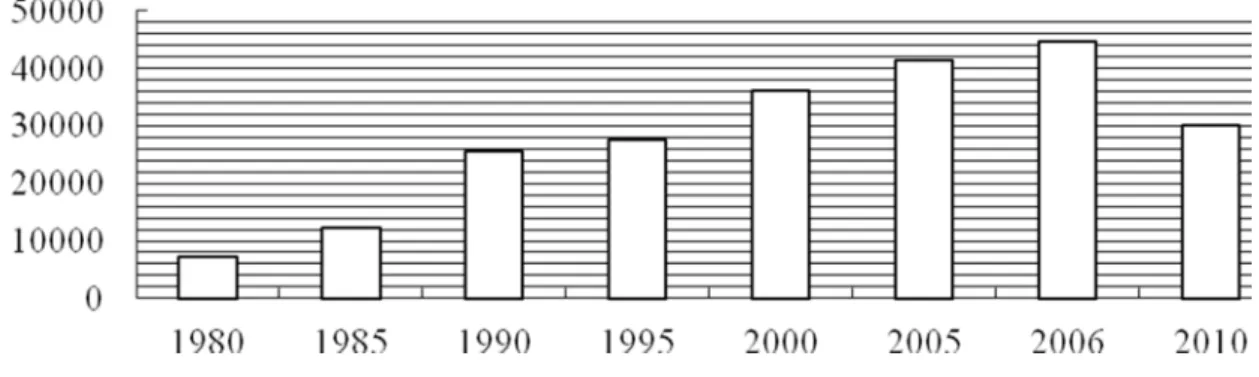
Globalization has established new migration networks through which migration to Japan has been increasing and diversifying. This has been the direct outcome of increased interaction between geographically remote communities and facilitation of people’s movements across borders. Figure 1.1 shows that the number of legally registered foreigners in Japan has risen significantly in the past decades, especially from the end of 1980’s to 2010.
Figure 1.1 Number of legally registered foreigners in Japan 1950 – 2013
Source: Japanese Ministry of Justice, 2013.
Figure 1.1 indicates a sharp increase in the number of foreigners in Japan, especially from 1990’s onwards. This trend is in parallel with the increase in number of transnational marriages portrayed in Figure 1.2 below.
Figure 1.2 Transnational Marriages of Japanese Nationals, 2010
Source: Ministry of Health, Labor and Welfare, 2010
The number of Japanese nationals getting married to foreigners in 2006 was almost six times higher than in 1980, a significant sharp increase. The parallel trends between Figures 1.1 and 1.2 re- affirm that transnational marriages are significant to study under the framework of migration either as the cause or consequence of migration (Faier, 2007; Constable, 2005; Piper, 2003; Brody, 2000). As indicated at the beginning of this chapter, marriage could be the cause or the consequence of migrations.
The gender breakdown of transnational marriages in Japan is portrayed in Figure 1.3 presented below. According to this figure 79 per cent of these marriages are between Japanese men and Asian women.
Figure 1.3 Gender Breakdown of Transnational Marriages in Japan
Japanese husband &
foreign wife Japanese wife &
foreign husband
Source: Ministry of Health, Labor and Welfare, Vital Statistics of Japan, 2010.
When we look at the composition of Japanese men’s spouse choices, the largest groups of foreign spouses are Chinese, Filipinas and Koreans. The Chinese sum up to almost half of all transnational marriages with Japanese men at a rate as high as 44 per cent (Ministry of Health, Labor and Welfare, Vital Statistics, 2010). The high composition of Asian wives in Japanese transnational marriages is reaffirmed by the large amount of literature formulated on narratives of these foreign wives (Le Bail, 2012, 2011; Faier, 2009, 2007; Piper, 2003, 1997; Suzuki, 2010, 2005, 2003a, 2003b;
Sellek, 1994). While Japanese men’s spouse choices could be easily categorized, Japanese women’s spouse choices, on the other hand, show much more diversity. Categories of foreign spouses are the same for women and men but the diversity in Japanese women’s foreign spouse choices is clearly reflected through the thick category of “other nationals” recorded at 31 per cent. This constitutes the largest category for Japanese women’s foreign spouse choices which is almost one third of their husbands’ choices. It is followed by a high rate of Korean spouses (Ministry of Health, Labor and Welfare, Vital statistics of Japan, 2010).
The high rate of Korean spouses for both Japanese men and women is founded historically in Japan’s colonial past. During Japan’s colonial rule, all colonial subjects were granted Japanese citizenship, but this changed with the implementation of the San Francisco Treaty in 1952. With this peace treaty, signed on April 28th, 1952 colonial subjects residing in Japan lost their Japanese citizenships and became foreigners (Morris-Suzuki, 2010, p.113). These subjects were given the option of acquiring Japanese citizenship if they wished. However, this process required their naturalization as Japanese citizenship is based on jus sanguinis. In jus sanguinis nationality is inherited through bloodline whereas injus solinationality is acquired by place of birth (Morris-Suzuki, 2010, p.112). This option was rejected by many Koreans mainly due to nationalistic sentiments.
Consequently, many among this population have continued living in Japan as foreigners and today present a unique case of up to fourth generation residents of a country without citizenship. Although they are given more rights than other foreigners residing in Japan, under their classification as ‘special permanent residents’, when they marry Japanese citizens, their numbers are included under the
category of foreigners. Thus, this is one of the important factors that explain the high number of marriages with Koreans (West, 2011). They constitute the only large category of foreign spouses that Japanese men and women share.
Dynamics of gender are at play in Japanese foreign spouse choices. This is reflected in the variation between foreign spouse choices of Japanese women and Japanese men. In terms of Japanese men’s choices of foreign spouses, socio-economic factors play an important role. The high rate of Chinese and Filipina spouses are the outcome of the agency mediated transnational marriages,kokusai omiai kekkon. Due to changing conditions and increased urbanization there was a bride shortage in the countryside from the 1970’s onwards. Many farmers in the countryside were having difficulties finding Japanese life partners due to their social status and residence in the countryside. Living standards they could offer their wives had become less and less appealing for contemporary Japanese women who preferred to live in urban areas and have careers. Although a farmer’s income level could hardly be classified as low, their profession was looked down upon as physically tiring manual labor.
Being a farmer’s wife and living in the countryside was a demanding task and Japanese women had become less willing to carry on this burdensome role (Le Bail, 2011; 2012; Suzuki, 2010; 2005;
2003a; 2003b; Moon, 1998; Nakane, 1967). This had led to what was known as bride shortage, famine or drought in the country side. These are referred to as yome busoku (bride shortage), yome kikin (bride famine), yome hideri (bride drought) respectively. Local governments as well as provincial administration such as cooperatives have attempted to promote marriage through diverse policies and intensified interaction with agencies. They failed to attract more brides from within Japan and thus turned towards other Asian countries in the 1980’s to bring in brides. These dynamics have led to the rise of literature which opposed the practice of mail order brides (Faier, 2009; 2007; Suzuki, 2010, 2005, 2003a, 2003b). Many of these spouses came from China, Philippines, Korea, Thailand and Sri Lanka. The creation of marriage migration networks between these countries and Japan is a good example of how new migration networks are created under globalization. (Le Bail, 2012, 2011; Faier, 2007, 2009; Constable, 2009, 2005; Piper 2003, 1997; Suzuki, 2010, 2005, 2003a, 2003b).
At first glance these marriages seems profitable for both parties. On the one hand, it provides wives for men who want to get married but have limited choices. On the other hand it allows these women to live in Japan without fear of deportation, except of course in the case of divorce (Suzuki, 2010). It is underlined in the mail order brides’ literature that many of these foreign women have previously been to Japan in order to work in the entertainment industry. Thus, for this particular group of brides who had previously worked in Japan’s entertainment sector, the spouse visa is an advantageous aspect of marriage. This marriage migration pattern faces harsh criticism from feminists who categorize it as commodification of women, human trafficking or even prostitution (Oishi, 2005, pp.36-7).
When we look at Japanese women’s foreign spouse choices, these are much more diversified and complex in terms of motives. First of all, international upward mobility chances through marriage are influential in Japanese women’s foreign spouse choices (Kelsky, 2001a). Accordingly, nationals of English speaking countries are preferred as they offer a future possibility of living abroad in an English speaking country. This upward mobility is motivated especially by the will to escape from sexual discrimination in the workplace and the society in general (Borovoy, 2005). Data provided by the Ministry of Health, Labor and Welfare (2010) re-affirms this tendency as Americans, British and Canadians constitute large groups of foreign spouses for Japanese women.
Secondly, Japanese women’s place in their society and gender roles projected on them play important roles in their foreign spouse choices. Borovoy (2005, p.29) touches upon the impact of Japan’s engagement with the US with reference to the place of Japanese women in Japanese society and links it to Karen Kelsky's book “Women on the Verge: Japanese Women, Western Dreams”. In her book, Kelsky (2001a) explains how today many Japanese women seek to break free from gender discrimination and are fetishizing foreign men as emblems of “sexual potency, romance and passion, upward social mobility, and chivalry” (Borovoy, 2005, p.29). Borovoy also refers to Kelsky’s work as it underlines the labeling of Japanese men as poor lovers, selfish, infantile and tasteless. These criticisms outlined by Kelsky and re-produced by Borovoy are closely related to the Japanese household roles in which men are breadwinners while women bear all the housework. Women are
responsible for taking good care of their husband and addressing their needs. Criticism of Japanese husbands by Japanese wives is presented in both Kelsky (2001a; 2001b)’s and Borovoy (2005)’s research. These show similarities with criticism towards Japanese husbands in research based on their foreign wives’ narratives (Lieba, 2007; Piper, 2003; Nitta, 1990). According to Lebra (1984), Japanese men do not do housework because it is like a threat to their masculinity. This is closely related to how masculinity is defined in Japan through the role of the breadwinner. In line with this division of labor in the household, Barbara Holthus (2009) has researched on how the image of foreign husbands is projected in Japanese media. The foreign spouse is portrayed as a husband that spends more time at home and helps his wife with housework. This topic is even covered in some magazines as promotion for Japanese women to get married to foreigners (Richardson, 2004; Holthus, 2009). In accordance, Kudo’s (2007) research on Japanese women who have converted to Islam shows that these women’s choices of Pakistani husbands is based on qualities that are opposite to the criticism outlined above for Japanese husbands. These Muslim husbands are labeled as honest, kind, caring and family oriented by their Japanese wives. Takeshita (2010a) and Kudo (2011) focus on the increase in Japanese women’s spouse choices from Muslim countries, especially from Pakistan and Iran. Takeshita (2010a) demonstrates that the number of Pakistani and Iranian husbands have increased by 86.1 per cent and 154.9 per cent respectively from 1995 to 2000. (Takeshita, 2010a). Pakistani husbands constitute the sixth largest category of foreign husbands whereas Iranians constitute the seventh.
The above section has attempted to outline patterns of foreign spouse choices in Japan with reference to gender differences. However, decision making for marriage includes many factors at different levels and priorities in spouse choices diverge greatly from one individual to another. The divergence in Japanese men’s and women’s foreign spouse choices can be explained by their differing approach to marriage and priorities in marital life choices. In order the better grasp what marriage entails and how transnational marriages are defined, the next section elaborates on concepts that are central to this research.
Conceptual Framework
Marriage can have various meanings for different people but it is basically a contract between two individuals under an authority. In social terms, marriage is a natural stage of adult life course that has to do with “position within the life-cycle” (Castles, 2004; Edwards, 1982; 1987; 1989) and marriage timing is closely linked to age, especially for females (Brinton, 1992; Baltaş & Steptoe, 2000). The unifying thread for all relationships is the search for “intimacy” and people have different priorities in partner selection at different stages of their lives (Sassler, 2010). Who marries who is the outcome of individual preferences and social settings. Consequently there are different approaches and elaborations on spouse choices and marriage decision. In terms of spouse choices, “love” is the very problematic but most common motivation that comes out often in narratives within research on marriage. Swidler (2001) outlines a contradiction within narratives on marriage, even when interviewees expressed realist and pragmatic views on spouse selection and de-emphasized mythic romanticism, in many cases their approach to marriage inevitably incorporated characteristics of this mythic love that was de-emphasized. Swidler (2001) explains this through the dual nature of marriage as both an institution and a relationship. The above outlined findings were based on research conducted on American couples. Two years after Ann Swidler’s book, “Talk of Love: How culture matters” came out, Farrer and Zhongxin (2003) have used the guideline of cultural codes that Swidler had provided in her study to investigate marriages in China. Their findings were remarkably different.
This difference was in line with Dion and Dion (1996)’s research which has shown that individuals’
approach to marriage is shaped by cultures. Farrer and Zhongxin (2003) indicate that their Chinese respondents rather emphasized “responsibility” in marriage. When narratives were analyzed, the definition of responsibility was extended to financial, sexual and domestic elements but excluded extramarital affairs. This implied that for their Chinese correspondents, having an extramarital affair did not by default conflict with their responsibilities towards their marriage. Their definition of responsibility was “context specific”. This was in line with Swidler (2001)’s finding that people have the tendency to contradict themselves in their narratives simply because for them love was context specific.
Following up on the importance of responsibilities in a marriage, in some cultures duties are closely related with kinship in terms of obligations towards parents and social pressures that frame these. In such cultures the kin and especially parents are influential in the spouse choice and marriage decision. Smart & Shipman (2004)’s research on three religious groups in Britain has shown that this obligation towards parents in finding appropriate spouses was considered as a responsibility in all Hindu, Muslim and Catholic minorities. Furthermore, the research has shown that for these migrants, marriages arranged by parents did not conflict with individual freedom of choice. On the contrary, some of the informants found it to be practical and less troublesome than searching for a spouse themselves in the marriage market. These informants approached the issue of spouse selection as a burdensome task. This approach has its echo in transnational marriages within Kim (2011)’s research in which the task of finding a suitable marriage partner has been pointed out as troublesome.
Searching for a spouse is hard work and this is most clearly reflected through the terminology of konkatsu in Japan which implies that search for a spouse is similar to search for employment in the Japanese labor market (Kitamura, 2010).
When we look at transnational marriages, we see that spouses tend to project their cultural framing of marriage on to their transnational marriages. For example, Liu-Farrer (2010)’s research on Chinese and Japanese couples revealed a pattern similar to that outlined by Farrer and Zhongxin (2003) mentioned above. Within this research as well, duties were emphasized. Contextually, duties were defined as providing meals and generous allowances to Japanese husbands. Once again extramarital affairs did not imply a contradiction to wifely duties (Liu-Farrer, 2010, p.107). When we look at another group of foreign spouses for Japanese men, Filipinas, we see the emergence of another projection of marriage culture, formulated on “love” rather than duties. Narratives of Filipina wives provided by Faier (2009) draws attention to how these women emphasize their emotional ties with their husbands. Their choices on defining relations within marriage is contextual as well, their self- definitions of intimacies renders them modern and equips them with agency within a global setting.
These women’s emphasis on “love” is closely related to discussions on upward social mobility through marriage as well as what Constable (2009) has defined as global paradoxal endogamy. One’s
place in the global setting has implication on social class. In its purest definition social class is defined through the distinction and relationship between the exploited and the exploiter as opposed to the privileged and the underprivileged. This discourse is often projected on marriage migrants who can be defined either as the exploiters of the spouse visa or exploited migrants.
Defining social class in transnational marriages has two main problems: the first is a gender based difficulty with reference to measuring housewives’ social class and the second is the difficulty in cross-country social class definition. With reference to the first problem, defining women’s social class is problematic even when they are not in transnational marriages. The dilemma lies within defining women’s social class based on their own qualities or the qualities of the household she belongs to. We observe that in most cases a woman’s social class is derived from the husband’s social class based on income, education and occupation. There are four different approaches in calculating women’s social class. The first is the borrowed method in which the husband’s social class is taken as base. The second model is the independent status model which is based on the woman’s own qualities such as income and education level. The third is the shared status model which is based on the average of both spouses’ social class. And the last model is the dominant status model in which the spouse who has the higher social class defines the family’s social class (Tachibanaki, 2010, p.43-4). This research utilizes the latter to calculate foreign women’s social class.
When we look at Japan in general, there has been a shift from a dominant middle class ideology to a gap society (Ishida & Slater, 2010). This has had its implications on marriage as well since it limits potential spouse choices as Japanese tend to marry into the same social class (Shirahase, 2010). This is in line with Gordon Mathews’ declaration that: “One’s cultural choices must fit within one’s social world, which is more limited” (Mathews, 2000, p.22).
Social class and culture are important factors to elaborate on in transnational marriages. A form of cultural formation that requires further elaborations is religion. Religion cannot be separated from culture because it is a cultural structure (Geertz, 1993). It is “the way of life of people” just as culture is (Mathews, 2000, p.4). Furthermore, there are individualized diversities within religions. Just as Muslims show diversity, their problems do as well. For example, although Muslim Taiwanese have
Chinese characteristics, they face resentment due to their Muslim faith. According to Chang (2010), this is a “mental barrier of cultural recognition” (Chang, 2010, p.3). Religion is outlined as an important cause of conflict in transnational marriages with Muslims in Europe. However it is important to note that religiosity is closely linked to social class (Çarkoğlu & Toprak, 1999; 2006) and that studies on groups from the same culture and religion show diversity according to social class (Baltaş & Steptoe, 2000).
Elaborations on marriage with reference to position in life cycle, intimacy, love and responsibility in different cultures share the similarity of being highly contextual. In transnational marriages, even social class, culture and religion are contextual. Transnational marriages are more complicated as they import more cultural elements to the delicate equation of marriage. Furthermore, problems encountered by these couples are more diversified particularly due to the transnational nature of these marriages. Some of the cultural areas that become problematic in transnational marriages that are outlined especially in the case of Japan are: gender relations, relations with the foreign spouses’ kin, balancing religious differences, language barrier in communication and challenges in bicultural childrearing.
Significance of Study
Literature on transnational marriages and families have been gaining increasing attention in the academia especially in the past decades (Charsley, 2012) and this is the direct outcome of increasing migration flows (Lu & Yang, 2010). The literature is strongly dominated by social class and gendered aspect of migration and focuses mostly on female care work and marriage migrants.
Consequently, the existing literature is highly dominated by narratives of migrant women who are studied from aspects such as mail order brides, commodification (Constable, 2009), victimization (Suzuki, 2003a, 2003b, 2005), human trafficking (Oishi, 2005), empowered individuals who have agency in a globalized world (Faier, 2007, 2009), transnational mothers who re-define family relations (Hondagneu-Sotelo & Avila, 1997; Parreñas, 2001), inter-generational differences that emerge and develop differently in the host society (Ong, 2003; Kalter & Schroedter, 2010), changing
power relations within families with reference to gender and social class within host society (George, 2005), loss in social position in return for higher living standards, also known as paradoxal global hypergamy (Constable, 2005) and so on. These will be further elaborated upon in the second chapter, under literature review. With reference to characteristics outlined in this chapter so far, the existing literature on transnational marriages has four shortcomings. The literature is highly focused on low skilled laborers and creates a category of neglected foreign spouses composed of middle or upper middle class immigrants in Japan. Professional migrants make up almost one third, 30 per cent, of all migrant workforce in Japan (Kim & Oh, 2011, p.1568). Despite this fact, research conducted on marriages with middle class and upper middle class foreigners remains limited. Their underrepresentation in the literature could be explained through the structure of Japan’s labor market and marriage migration being a loophole in the system for low skilled laborers to live and work in Japan. This dominant view in the literature is reinforced with employment history of the majority of marriage migrants in Japan. While scholars such as Piper (1997), Suzuki (2010) and Faier (2009) underline that most Filipina wives had previously worked in the entertainment sector, Kudo (2007) and Takeshita (2010) underline that more than half of Pakistani husbands interviewed had overstayed their visas. These facts strengthen negative perceptions of these foreign spouses as well as perceptions of upward social mobility through acquisition of a spouse visa. This in turn has resulted in a strong re- emphasis of paradoxal global hypergamy within the literature (Constable, 2009).
Secondly, the literature on transnational marriages is dominated by research based on women’s narratives. As Constable argues, “still lacking are studies of men as intimate gendered subjects, as providers of care work and intimacy, and not just as consumers of sexual services.”
(Constable, 2009, p.58; Malik, 2012). Research including narratives of husbands in these marriages remains limited. In the case of Japan as well, a large amount of research is based on foreign women’s narratives and Japanese wives’ narratives. This leads to the accumulation of gender biased literature.
This research attempts to counter-balance this gap by elaborating on gender and gender relations with the incorporation of men’s narratives.
Thirdly, following up on gender, I argue that similarities in how gender relations are constructed in Japan and Turkey are influential in the way families are formed. Existing literature on transnational marriages of Turkish nationals in Europe underlines that gender-roles driven cultural conflict is an important source of disagreement in Turkish - European marriages. I argue that the case of Turkish immigrants in Japan is different as these two societies show similarities in the definition of gender roles within the household as compared to Europe. These similarities are reflected in their smooth transitions to married life in terms of their gender roles within the family.
Fourthly, Islam blends with different cultures in different ways and it is difficult to differentiate religion from culture (Geertz, 1993). This is a problem in the existing literature on transnational marriages. When researchers are foreign to the Muslim communities they study, their research is often guided by religious migrants they have reached through mosques or mesjits. To put this problem in perspective, research on middle and upper middle class Turks in England has shown that middle and upper middle classes have tendency not to frequent mosques or fast during Ramadan.
Out of thirty-two interviewees included in the above mentioned research, all of them neither went to the mosque nor fasted during Ramadan (Baltaş & Steptoe, 2000). This is closely linked to the way religiosity is constructed and politicized in Turkey. In their research on religiosity, Çarkoğlu and Toprak (1999; 2006) have shown that there is a strong link between religiosity and social class. Their research findings suggest that individuals from higher social classes are more likely to be less religious.
I argue that this link between religiosity and social class is important for understanding dynamics of transnational marriages between Muslims and non-Muslims.
Research Objectives and Research Questions
This research analyzes transnational marriages of Turkish - Japanese couples through lenses of culture, religion and gender. It focuses on the group of neglected foreign spouses, namely foreign spouses from middle and higher middle class. The first aim is to analyze motivations for transnational marriages when the narrative of upward social mobility of foreign spouses is minimized, to see how
these couples balance their cultural and religious differences in their everyday lives, especially with reference to the Turkish spouses’ religiosity. Within this section, the impact of social class on religiosity is fundamental. Lastly, contrary to the existing literature on transnational marriages which heavily relies on women’s narratives, this research brings in men’s voices and the analysis is constructed on narratives of both genders.
In summary, the research questions are as follows:
(1) The marriage decision making process: to what extent do their cultural or religious differences matter in the marriage decision making process and to what extent are they aware of these at the beginning of their relationship?
(2) Negotiation and balancing of cultural and religious differences in couples’ everyday lives.
What matters and what is worth fighting for? What are their intercultural communication dynamics to overcome problems?
(3) Influence and perceptions of the Turkish spouses’ Muslim identity on their family life analyzed through higher social class and lower religiosity.
Organization of Study
The dissertation is organized into seven chapters. This first chapter as the introduction aims at familiarizing the reader with the research topic and presents the foundation of the research through theories on transnational marriages. This section aims to prepare the ground for research objectives and research questions which are outlined towards the end of the section.
Chapter Two as the literature review presents academic literature that this research is based on and is analyzed through. This chapter is divided in two sections: marriages and transnational marriages.
The chapter is organized in this way because transnational marriages are complex versions of marriages and it is important not to mistake gender relations in marriages with cultural clash in transnational marriages. That is why the first section of this chapter presents dynamics of marriages in general followed by dynamics in Turkish and Japanese marriages respectively. The second section focuses on transnational marriages in particular and introduces important topics in the literature. This
section then passes on to dynamics of transnational marriages in Japan in particular as the focus of the research is on Turkish – Japanese couples residing in Japan.
The third chapter is the methodology and provides details on how the research was conducted and how data was collected. It starts out with a detailed introduction of the researcher followed by details on how the field research was conducted. The chapter then passes on to the introduction of the data in detail. The last section of this chapter introduces the Turkish community in Japan that is the subject of this research and provides details on characteristics and dynamics of three social groups: low skilled laborers, middle and upper middle class Turkish males and lastly, upper middle class Turkish Females.
Chapter Four aims to answer the first research question outlined in Chapter One. This chapter is on forming families and is organized in two sections. The first section analyzes the process from encounter to marriage with focus on topics that have been underlined as problematic in transnational marriages. The chapter elaborates on elements that are significant in Turkish – Japanese marriages and why. This first section has an emphasis on the construction of gender roles within these transnational families. The second section of this chapter focuses on cultural, religious differences and social class.
It is constructed on elaborations on how these issues are approached in these marriages. This section also provides elaborations on social class and perceptions of social class at the marriage decision making process.
Chapter Five presents elaborations on how these couples negotiate their differences in their married lives. This chapter is divided according to the main problematic areas outlined in the transnational marriages literature and those that were significant for Turkish – Japanese couples. There are five sections in this chapter. The chapter starts with elaborations on intercultural communication followed by sections on relations with in-laws, bicultural childrearing, sexuality and living standards redefined through living space. The second, third and fourth sections are in conformity with the existing literature whereas the fifth topic is new. The issue of how living space becomes a problem for couples remains unexplored under the topic of transnational marriages in Japan.
Chapter Six is on religious practices and identity construction in these marriages. The first section of this chapter provides an outline of the religiosity of Turkish spouses with reference to how religion has been politicized in Turkey. The chapter then passes on to elaborations on how spouses perceive the Turkish spouses’ religiosity. The last section in this chapter is focused on rituals in couples’ lives with an emphasis on death as it has been outlined as one of the most problematic topics in this research.
Chapter 7 as the conclusion elaborates on findings of the research outlined in previous chapters while answering the research questions outlined in Chapter One. Limitations of the study and prospective future research, as well as significance and contributions of the study are included in this section.
Chapter II: Literature Review
This chapter is organized into two sections: marriages and transnational marriages. The marriage section starts with elaborations on marriage in general and its conceptualization. This section includes five sub-sections. While the first two sub-sections are devoted to presenting the historical evolution of marriage and family in Japan, the third and fourth sub-sections present the case of Turkey.
The fifth sub-section links these two cultures under subjects framing the gender roles within the family.
The second section of this chapter is transnational marriages. It starts out with a general conceptualization of transnational marriages and is followed by main topics that emerged from the literature under this topic with reference to dynamics and regional differences. There are two sub- sections in this section. The first sub-section addresses the issue of how transnational marriages constitute an intersection of migration, gender and social class. The second sub-section on the other hand is devoted to cultural conflict and marital problems in transnational marriages that are outlined as significant in the literature. These subjects are elaborated upon one by one.
Marriage
Marriage is an institution that is defined in different ways in context around the world. It shows variations according to cultures in general and individuals in particular. Thus the study of marriages shows great variation. There are, however, concepts that are common to many cultures that could be useful in understanding what marriage entails. These are gender, sexuality, childbearing and kinship (Girgis, George & Anderson, 2010). In terms of power relations in marriages, Resource Theory formulated by Blood and Wolfe (1960) has been the dominant line of work for many decades now. According to this approach, the value of resources that one spouse can channel into the marriage determines his or her power within the marriage.
There is a historical construction of romantic intimacy (Giddens, 1992; Padilla et al., 2007).
There is also the differentiation between pragmatic and romantic love. Swidler (1986) shows that there
is a tendency to idealize romantic love while relying on pragmatic choices in real life. When we look at the way intimate relationships are formulated, cultures play an important role. When we look at the literature on marriages, there are large formulations concentrated around individual choice with a shadow of romantic ideas, namely love, which is the case of Americans (Swidler, 1986). On the other side of the spectrum, there is responsibility which is emphasized by cultures such as Chinese, Pakistanis, Japanese and Turks (Farrer & Zhongxin, 2003; Charsley, 2012; Liversage, 2012).
Responsibility could be towards the spouse, in terms of meeting basic needs within the household, or it could be towards parents and kin in terms of choosing appropriate spouses and keeping up appearances. It could also be responsibility related to social pressures.
Dion and Dion (1996) have shown that there are cultural differences in approaching and defining the relation between love and marriage. They make the distinction between individualism and collectivism in this respect. While individualism assumes close ties between love and marriage, the latter distances these and burdens love with negative connotations such as pain and suffering. Dion and Dion (1996) argue that values at both societal and psychological levels should be taken into account for an in-depth analysis. People have different priorities in life partner selection at different life stages of their lives and as expressed in the introduction chapter, marriage spouse choices are very contextual (Sassler, 2010). That is why marriage has to do with one’s position within the life- cycle (Castles, 2004).
In many countries marriage is regulated by civil law, thus it is the ratification of a bond between two people with a legal contract under state authority (Girgis, George & Anderson, 2010).
However, it is important to bear in mind that what marriage entails legally varies from country to country and what it entails emotionally or physically varies from person to person. In some cases it might entail affectionate emotions such as love and willingness to share a living space with another person and/or to have legally recognized offspring. On the other hand, in some cases, it might just be treated as a practical process, a means to escape from solitude or even a means to secure a visa for higher living standards in a foreign country (Willis & Murphy-Shigematsu, 2008). Regardless of these variations in the approach to marriage, it is considered as a natural stage of adult life and a part of the
life cycle in various cultures (Edwards, 1982, 1987, 1989; Castles, 2004). The family is considered to be the outcome of historical and social circumstances that should be evaluated through people’s experiences in terms of time, places, and social situation. Thus, marriage itself is very contextual.
In different cultures, different aspects of marriage come forward as more significant. While love is emphasized in some cultures, responsibilities, kinship and childrearing are emphasized in others. When we look at what marriage entails, this also shows diversity according to cultures. While it is formulated around access to sexuality in some cultures, it allows social recognition as an adult in others. Although it might denote co-habitation in many cultures, it is not always the case (Lyons &
Ford, 2008). At the end when we look at diverse elaborations on marriage, the unifying thread is a search for a form of intimacy (Sassler, 2010). In this process of search for intimacy, gender relations are negotiated in various ways and re-defined. Economic power is reflected in the marriage as leverage, for example, when women work they gain more power while men lose their ground (Sassler, 2003, p.259).
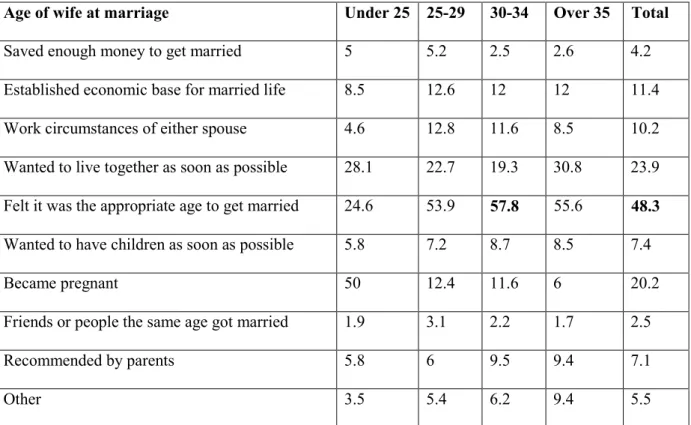
Data from the National Institute of Population and Social Security Research (2012) illustrate the motives behind the decision to get married in Japan. As shown in Table 2.1, the highest percentage is 48.3 for “Felt it was the appropriate age to get married”. The table also portrays that couples in which Japanese women were between 30-34 years old this “timing” pressure was especially strong.
The issue of timing was much less significant for couples in which the women were under 25 years old.
Table 2.1 Motives for Decision to Get Married, 2012
Age of wife at marriage Under 25 25-29 30-34 Over 35 Total
Saved enough money to get married 5 5.2 2.5 2.6 4.2
Established economic base for married life 8.5 12.6 12 12 11.4
Work circumstances of either spouse 4.6 12.8 11.6 8.5 10.2
Wanted to live together as soon as possible 28.1 22.7 19.3 30.8 23.9 Felt it was the appropriate age to get married 24.6 53.9 57.8 55.6 48.3 Wanted to have children as soon as possible 5.8 7.2 8.7 8.5 7.4
Became pregnant 50 12.4 11.6 6 20.2
Friends or people the same age got married 1.9 3.1 2.2 1.7 2.5
Recommended by parents 5.8 6 9.5 9.4 7.1
Other 3.5 5.4 6.2 9.4 5.5
Source: National Institute of Population and Social Security Research, 2012
In terms of marriage timing, age is a significant factor for Japanese women. This was in accordance with the “Christmas cake” approach according to which women are like Christmas cakes – if not sold by the 25th of December they have to be discarded - it is difficult for women to get married after age 25 (Brinton, 1992; Nakano, 2011). This is not limited to Japanese society, but in Vietnamese society as well women or men who are not yet married at an appropriate age undergo social discrimination (Thai, 2003, p.236). This view is important in understanding the social pressures placed on getting married. However it should also be noted that the age of first marriage has risen for both men and women in Japan (Ministry of Health, Labor and Welfare, 2013). Reasons for delaying marriage will be further elaborated on in this chapter under the topic of “Marriage in Contemporary Japan”.
Coming back to the issue of social pressures, these are not limited to Japanese women. When we look at the case of Turkish women, we see that they also face pressures to get married early especially with reference to virginity which symbolizes their and their family’s honor. This topic is elaborated upon in detail at the end of this chapter under the topic of “Historical Evolution of Marriage
and Family in Turkey”. Social pressures are not limited to starting a marriage but to ending it as well.
Divorce is stigmatized in many countries around the world such as Turkey, Vietnam, and Japan (Thai, 2003; Parla, 2001; Hertog, 2009). Although stigmatized, there is an increasing trend of divorces in many countries and this has to do with how the approach to marriage has changed and evolved.
Patterns related to marriage are changing both in Japan and Turkey. In terms of similarities, we observe the increase in love marriages in both Turkey and Japan. Both countries reflect a shift from arranged marriages referred to as omiaiin Japan andgörücü usulüin Turkey to love marriages referred to asrenaiin Japan andaşk evliliği in Turkey. This implies that rather than being introduced for the particular aim of getting married, young people enter relationships with personal motives, not knowing whether it will end up in marriage or not. Although parents and relatives have previously played an important role in the spouse selection process, their influence is weakening as individual decision making is becoming stronger. Marriage has different historical evolutions in Japan and Turkey, these will be elaborated upon in detail from this point onwards and followed by an explanation of contemporary dynamics and patterns of marriage in these two countries.
Historical Evolution of Marriage and Family in Japan
Marriage has traditionally been an important institution for social recognition in Japan and is the norm in the adult life course to becomeichininmae, that is, an adult. Children are considered as the ratification of a happy marriage (Edwards, 1982). At this point it is important to note that the rate of childrearing outside marriage has traditionally been low in Japanese society (Takenaka & Rebick, 2006). Thus marriage is an important social status that offers Japanese adults an appropriate social place within society.
During the Meiji restoration, the family system was institutionalized which made theieliving arrangement the civil code. The term ie basically means family but it also denotes a system of continuity based on the family name. It was established as a koseki, a registration system, to ensure that all members of the family shared the same last name and it later became a social system that aims
at the continuation of the family. Women are part of their father’s registry until marriage and part of their husband’s registry after marriage. (Krogness, 2011; Ronald & Alexy, 2011; Hertog, 2009; Sand, 2003; Hendry, 1987a; 1987b). Before the institutionalization of the family system, during the Edo period, everyone had to register at a Buddhist Temple under the Tokugawa Shogunate and this was replaced by the national family registration system in 1871 (Kawano, 2005).
Theieincorporates all the ancestors and the unborn of the family, thus it represents more than the sum of all its members and is a continuous system. It is characterized by vertical relations rather than horizontal ones and is structured by a hierarchy based on age, sex and expectance of permanency.
It is based on Confucian principles of loyalty and benevolence so relations within theieare about duty and filial piety rather than love and affection. It was ideologically constructed as a nationwide social network under which every house was seen as a branch of the imperial family line. This ideologically implied that the whole nation is interconnected through this system (Krogness, 2011; Ronald & Alexy, 2011; Hendry, 1987b; Bachnik, 1983).
In the ie family system, co-habiting family members compose essential small units and the continuation of the family line in the home is vital. The eldest son is responsible for bringing in an appropriate bride, who would take care of his parents, produce offspring and guarantee the continuation of the family. The importance of marriage was vital in this respect as it was a duty to ensure the continuation of the family. However, co-habitation of more than one couple from the same generation was not allowed. There were only two permanent positions in the family, one male and one female,atatoriandyome,thus the groom and the bride (Hendry, 1987b; Bachnik, 1983).
The survival of the ie and the continuation of the family name was essential and this family system was constructed in a way to adapt to different conditions. The continuation of the ie was so important that there was even a last resort of youshi, that is, adoption of a son for the sake of the continuation of theie. This system requires the adoption of a grown man into the family, a man who is willing to ensure the continuation of the family through marriage with an appropriate bride (Takenaka
& Rebick, 2006; Bachnik, 1983). At the end of the Edo period, the percentage of farmers who adopted a successor in this manner was as high as 20 per cent (Kawano, 2010, p.164).
This family system empowered the man as the head of the family and the father figure. His powers were symbolic rather than legal, women ran the household but special treatment was given to fathers, when at home (Hidaka, 2011). Women were more powerful in the private sphere and a mother’s ideal characteristics included “endurance, patience and constant support for dependent family members” (Borovoy, 2005, p.3) including the father. Women’s role as caretakers in the home was considered as the natural outcome of her biology, fertility. Women’s place in the household was strengthened by the language used, the term okusan which is used for wives in Japanese can be translated as the person inside or in the back (Lock, 1993, p.86, 93).
As explained above, there was a constant emphasis on continuation through marriage.
Marriage was defined as a step into adulthood. It changed the position of members in the family (Edwards, 1987). As the continuation of the family line was essential, the elderly arranged marriages and the young members’ duties towards the family were emphasized. In couples’ relations love was de-emphasized, so that the couple could focus on more important things in their marriage, like their duties.
Although there has been a transition away from the above outlined family system, some of its characteristics have been carried on to contemporary nuclear families. The previous family system repressed sexuality, individual based partnership and affection among couples with an emphasis on their roles to be carried within the family. This has been extended to some contemporary families.
This is closely linked to the sexless marriages literature on Japanese families according to which these couples tend to seek satisfaction of emotional and sexual needs outside the family (Ronald & Alexy, 2011, p.18; Suzuki, 2010; Holloway, 2010; Hendry, 1987a, p. 34).
Marriage in Contemporary Japan
When we look at family structures in contemporary Japan, the twentieth century has marked the weakening of the ie family system outlined above and there has been a clear transition to the nuclear family system. According to Kawano (2010, p.61), more than half of Japanese of households
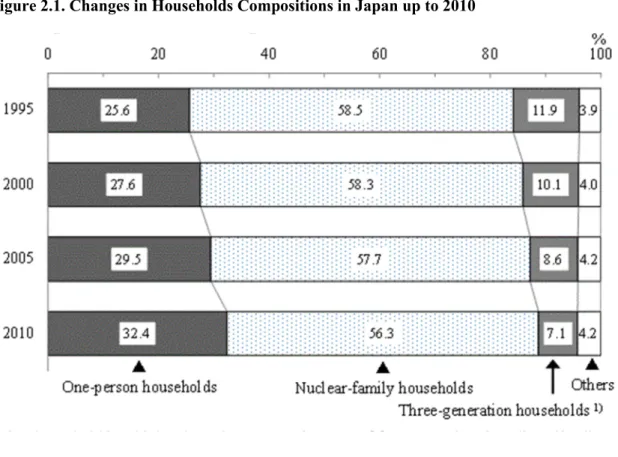
were already nuclear family households in 1920. Figure 2.1 below portrays changes in Japan’s household compositions up to 2010.
Figure 2.1. Changes in Households Compositions in Japan up to 2010
Source: Statistics Bureau, Statistical Handbook of Japan, 2013.
The changing household composition in Figure 2.1 shows a clear pattern as the percentage of three generation households is as low as 7.1 per cent against 56.3 per cent of nuclear families which compose the largest category. Figure 2.1 also displays the increasing trend of one person households which reflect the decreasing number of marriages. This is closely related to the lateness and lessening of marriages which define the situation in contemporary Japan. However Tachibanaki (2010) points out that despite these trends, Japan is still a marrying society as about 90 per cent expressed the willingness to get married one day (Tachibanaki, 2010, p.94). This implies that what have changed are expectancies from a marriage rather than the willingness to get married. Konkatsu, the search for an appropriate spouse has become a serious business in Japan (Le Bail, 2011; Kitamura, 2010). However the definition of an “appropriate spouse” shows diversity from one person to another. The trend of building marriages on friendship and forming companion couples have become popular in the world in