Two models of a farming environment: the fate of Escherichia coli contaminating either soil or water with soil
Yukie Hosotani
1, Susumu Kawasaki
1, Thongsavath Chanthasombath
2, Borarin Buntong
3, Md Latiful Bari
4, and Yasuhiro Inatsu
1*1
Food Hygiene Laboratory, National Food Research Institute, NARO, 2-1-12, Kannondai, Tsukuba, Ibaraki 305-8642, Japan
2
Ministry of Agriculture and Forestry, Department of Agriculture, Clean Agriculture Development Centre, P.O. Box 811, Vientiane, Lao PDR
3
Department of Postharvest Technology, Royal University of Agriculture, Chamkar Daung, Dang Kor District, P.O. Box 2696, Phnom Penh, Cambodia
4
Department of Microbiology, University of Dhaka, Dhaka 1000, Bangladesh
Pathogenic bacteria contaminating raw vegetables are known to pose a risk of foodborne illnesses. Recent studies showed that the contamination with these bacteria may originate from irrigation water, agricultural materials, or entry of animals onto farms. Here, we conducted a pilot study on the fate of the mixture of 18 Escherichia coli strains artificially added to 4 kinds of soil or water with these soils (as a model of irrigation water). Water content and pH of the soils were 14–31% and 6.2–6.6, respectively. The log reduction in the number of E. coli cells in water (6.5 log CFU mL-1) 4 weeks after inoculation was 1.8–4.1 log CFU mL-1 under natural conditions. The log reduction in the number of E. coli cells in soil (3–6 log CFU g-1) was 0.5–2.9 log CFU g-1 in the same period. No relation between the log reduction and initial load of the strains was found. These results are suggestive of long-term survival of contaminating E. coli in a farm environment.
Key words: Escherichia coli O157, soil, water, PCR-DGGE, good agricultural practices
Abstract
*Corresponding author (Tel./Fax: +81 29-838-8067, E-mail: [email protected])
報 文
Introduction
Fresh vegetables have been implicated in microbial foodborne diseases worldwide1). The incidence of foodborne illnesses attributed to fresh vegetables is increasing2). Reported outbreaks associated with fresh vegetables are noteworthy because of the wide geographical distribution of the contaminated products and large numbers of consumers exposed, and thus the large number of cases3) 4).
Fresh vegetables are grown in environments that
are subject to many accidental or intentional inputs that are potential sources of microbial foodborne hazards and may lead to contamination of produce5). Fresh vegetables produced in open growth fields may be contaminated at some point as a result of various intentional or accidental inputs such as fecally contaminated irrigation water or immature manure. The intrinsic factors of the environment such as temperature, pH, and water activity may affect the growth, survival, and persistence of bacterial foodborne pathogens6).
The role of contaminated water (used for production
of vegetable crops) as a vector for transmission of these pathogens to humans is less clear. Nonetheless, poor quality of irrigation water (according to elevated fecal coliform counts) has long been known to correlate with the incidence of human pathogens in leafy-vegetable crops7). Epidemiological evidence from specific outbreaks also points to the role of irrigation water in the introduction of pathogens into the production environment. For example, contamination of iceberg lettuce during a large outbreak of foodborne illnesses caused by Escherichia coli O157 in Sweden was linked to the use of contaminated irrigation water drawn from a small stream8). The risks of contamination of fresh vegetables with enteric pathogens from irrigation water have been quantified in several risk assessment studies9) 10). Many fresh vegetables represent a nutrient-rich and moist environment suitable for the survival and growth of contaminating bacteria coming from surface irrigation water or from the attached bits of soil11).
Recent studies revealed a relation between the rate of decay (reduction in live-cell number) of contaminating pathogens/fecal indicators in soil/sand and the diversity of natural bacterial flora by means of polymerase chain reaction (PCR) with denaturing gradient gel electrophoresis (DGGE)12)-14). Unfortunately, only a small number of inoculated strains was used in these experiments. Considering the possible diversity of the survival ability of E. coli in soil or irrigation water, the use of several strains may yield much more realistic results. In the present study, we evaluated the fate of a mixture of 18 E. coli strains added to 4 kinds of soils or water samples contaminated with one of these soils under natural conditions during a summer in Japan.
Materials and Methods
Eighteen E. coli strains (derived from 2 beef meat samples, 5 chicken meat samples, 5 pork meat samples, and 6 samples of vegetables) were used to prepare the inoculums. All of the strains showed different patterns of RAPD-PCR15). Each of the strains was cultivated in 5 mL of brain heart infusion broth (Nissui Co., Ltd., Tokyo) at 35°C for 18 hours. All the cultures were mixed after centrifugation and washing with phosphate-buffered saline (PBS). Four soils (code-named “A” to “D”) were collected from different vegetable fields in Japan. PCR-DGGE analysis of the collected soil samples was performed according to
the standard manual from the National Institute for Agro- Environmental Sciences, Japan16). In brief, total DNA in soil was extracted by means of the Fast DNA SPIN Kit for Soil (Q-BIOGene, USA) and a bead mill homogenizer. The V6-8 variable region of 16S ribosomal RNA (rRNA) genes was amplified by PCR and subjected to DGGE analysis by means of a Bio-Rad DCode system (Bio-Rad, Co., Ltd., Tokyo).
Each 95 g sample of the soils or each 90 mL sample of water mixed with 5 g of one of the soils was placed in a sterile plastic cup (200 mL). Five milliliters of PBS diluted inoculums was mixed in the cup with the soil or contaminated water. Acidity and water content of the soil samples were measured by means of the Satotech DM-15 instrument (Sato Co., Ltd., Kawasaki). These cups were left outside (27–33°C) in Tsukuba city, Japan, from July to September 2011. A 10 g portion of the soil samples was stomached for 1 minute with 90 mL of PBS to prepare an emulsion (10- fold dilution). One milliliter of this emulsion or original water samples was serially diluted and used for counting of viable cells. Typical purple colonies that grew on Merck Coliform agar (Merck, USA) plates were counted. Several colonies were picked and confirmed as E. coli by means of API 20E (bioMérieux, France). The above experiments were performed in duplicate and repeated 3 times during the same season. Each of the 6 resulting viable-cell counts was subjected to statistical analysis: analysis of variance (ANOVA) with the Tukey-Kramer multiple comparison test after logarithmic conversion.
Results and Discussion
The pH of the collected samples was in the range 6.5 to 7.4, and no significant difference among the 4 kinds of tested samples was observed (P > 0.05). Water content of soil samples A through D was 24%, 30%, 17%, and 38%, respectively. The PCR-DGGE profile of soils A through D is shown in Fig. 1. Soils C and D yielded similar patterns, and soil A contained relatively fewer strains of bacteria than did the other tested soils.
The fate of contaminating E. coli in water containing 5% of soil (6.5 log CFU mL-1) is shown in Fig. 2. The average log reduction after 4 weeks of storage under natural conditions was 3.5 (samples A and C), 1.8 (sample B), and 4.1 log CFU mL-1 (sample D). The rate of log reduction in the number of viable cells in sample B was significantly
slower in comparison with the other tested water samples (P < 0.05).
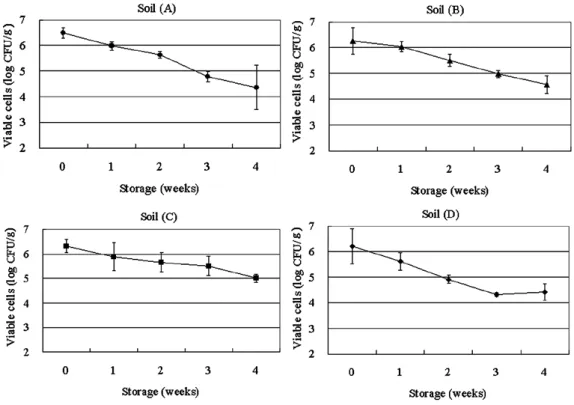
The fate of contaminating E. coli in the soil samples (6.3 log CFU g-1) is shown in Fig. 3. The average log reduction after 4 weeks of storage under natural conditions was 2.1 (sample A), 1.7 (sample B), 1.3 (sample C), and 1.8 log CFU g-1 (sample D). The rate of log reduction in the number of viable cells in sample C was significantly slower in comparison with the other water samples tested (P < 0.05). Contaminating E. coli in the soil samples tended to survive better than that in water with the same soil type.
When we compared the time points 0 weeks and 4 weeks for each soil, the fate of E. coli contaminating soils A, B, and D indicated decay by more than 1.0 log CFU g-1 independently of the range of 3 to 5 log CFU g-1 of the initial load of E. coli in the soil. At the same time, the fate of E. coli in soil C was consistent with decay, but the difference from other soil samples was not significant (Fig. 4).
Pathogenic enteric bacteria like E. coli O157:H7 and Salmonella can persist for extended periods in a manure- amended soil, with survival times ranging from several weeks to several months and even up to 2 years in some cases17)-20). Survival in a manure-amended soil is generally reduced by higher temperatures, higher levels of native microflora19), lower levels of easily available nutrients21), increased
levels of microbial diversity22), and lower clay content23). Generally, growth activity of bacteria contaminating soils is maximal in soils with 60% water content24). Recent research revealed that bacterial cells enter the phase of vegetative cells that repeat cell divisions actively under rich-nutrient
Fig. 1 Profiles of PCR with denaturing gradient gel electrophoresis (DGGE) of the soils tested.
Fig. 2 The fate of Escherichia coli in water with 5% of soil.
conditions, but once environmental nutrients run low, bacteria turn into dormant cells and resting cells. Bacterial cells under these conditions were reported to show high
stress tolerance and resistance25). In the present study, E. coli contaminating soil C tended to survive longer than in the other 3 soils tested. One of the reasons may be lower water Fig. 3 The fate of Escherichia coli in the soil samples.
Fig. 4 Dependence of the decay of inoculated Escherichia coli cells on the initial load. Asterisks indicate a significant difference (p < 0.01) according to analysis of variance (ANOVA) with the Tukey-Kramer test for multiple comparisons.
(and nutrient) content, which may reduce activity of bacteria in this soil; thus, E. coli contaminating soil C may have turned into dormant and resting cells and were less likely to enter the growth phase and accordingly remained alive longer in comparison with the other soils. For the reasons stated above, the differences in the fate of E. coli between the contaminated water samples and soil samples may be related to water content of each sample. Additionally, it is possible that soil C contained relatively lower levels of some compounds that suppress the growth of E. coli because E. coli contaminating water sample C also tended not to decay rapidly. It is not clear whether the relation with decay is due to the viable cells of E. coli or due to the microbial flora of the soils used in this study.
Conclusion
The numbers of viable cells of the 18 strains of E. coli that we tested here were reduced to 1–3 log CFU mL-1 in water with soil and to 2–3 log CFU g-1 in soil samples after 4 weeks under natural summer conditions in Japan. The contaminating E. coli tended to decay more rapidly in water than in soil. Soil type-dependent rates of reduction in the number of viable cells were observed both in soil and in water with soil. These results point to the importance of prevention of bacterial contamination in a field soil and irrigation water. In addition, the collected field samples for an assay of bacterial contamination should not be kept for long under natural hot conditions. Otherwise, some portion of the contaminating bacteria may die during storage.
Acknowledgement
This work was supported by JSPS KAKENHI Grant Number 23580353.
要 旨
病原微生物の付着した生野菜は,食中毒のリスクと して認識されている.近年の研究では,これらの微生 物汚染は灌漑用水や,農業資材,圃場に侵入した野生 動物に起因することが指摘されている.農業生産現場 における病原微生物汚染の消長を明らかにするための 試験的研究として,我々は18種の大腸菌を4種の土壌 検体,および灌漑用水モデルとしてこれらの土壌と水 を混和した検体に混入させ,その中における大腸菌の
生存期間の消長について検討を行った.灌漑用水モデ ルは,pH6.2から6.6,土壌含有量は14-31%とした.初 発菌数6.5 log CFU mL-1で大腸菌を接種した灌漑用水 モデルを自然天候の下で保管した場合,4週間後に は4.1〜1.8 log CFU mL-1対数的に減少した.また,初 発菌数3から6log CFU g-1で大腸菌を接種した土壌検 体においては,同様の条件の下で保管した場合,4週 間後には0.5〜2.9 log CFU g-1減少した.大腸菌生菌数 の対数的減少と,検体への接種菌量に相関は見られな かったが,本結果は農業環境中に混入した大腸菌が,
長期間に渡り生存する可能性が示された.
References
1) Beuchat, L.R., Vectors and condition for pre-harvest contamination of fruits and vegetables with pathogens capable of causing enteric diseases. British Food Journal, 108, 38-53 (2006).
2) Herman, K.M., Ayers, T.L., and Lynch, M., International Conference on Emerging Infectious Diseases, March 16-19, 2008 Atlant a, Georgia, USA, 27-28 (2008).
3) Klontz K.C., Klontz J.C., Mody R.K., Hoekstra R.M., Analysis of tomato and jalapeño and Serrano pepper imports into the United States from Mexico before and during a National Outbreak of Salmonella serotype Saintpaul infections in 2008. J Food Prot., 73, 1967- 1974 (2010).
4) Soon, J.M., Seaman, P., and Baines, R.N., Escherichia coli O104:H4 outbreak from sprouted seeds. Int. J. Hyg.
Environ. Health., 216, 346-354 (2013).
5) Brackett, R.E., Incidence, contributing factors, and control of bacterial pathogens in produce. Postharvest Biology and Technology, 15, 305-311 (1999).
6) De Roever, C., Microbiological safety evaluation and recommendations on fresh produce. Food Control, 9, 321-347 (1998).
7) Norman, N.N., Kabler, P.W., Bacteriological study of irrigated vegetables. Sewage Ind. Wastes, 25, 605-609 (1953).
8) Soderstrom, A., Lindberg, A., and Andersson, Y.
EHEC O157 outbreak in Sweden from locally produced lettuce, August–September 2005. Eurosurveillance.
10(38), 22 September 2005 (2005).
9) Hamilton, A.J., Stagnitti, F., Premier, R., Boland, A.-M.,
and Hale, G., Quantitative microbial risk assessment models for consumption of vegetable crops irrigated with reclaimed water. Appl. Environ. Microbiol, 72, 3284-3290 (2006).
10) Stine, S., Song, I., Choi, C., and Gerba, C., Application of microbial risk assessment to the development of standards for enteric pathogens in water used to irrigate fresh produce. J. Food Prot., 68, 913-918 (2005).
11) Ingram, D.T., Patel, J., and Sharma, M., Effect of repeated irrigation with water containing varying levels of total organic carbon on the persistence of Escherichia coli O167:H7 on baby spinach. Journal of Food Protection, 74, 709-717 (2011).
12) Feng, F., Goto, D., and Yan, T., Effects of autochthonous microbial community on the die-off of fecal indicators in tropical beach sand. FEMS Microbiol Ecol, 74, 214- 225 (2010).
13) Ibekwe, A.M., and Ma, J., Effects of fumigants on microbial diversity and persistence of E. coli O15:H7 in contrasting soil microcosms. Sci Total Environ, 409, 3740-3748 (2011).
14) Van Elsas, J.D., Chiurazzi, M., Mallon, C.A., Elhottova, D., Kristufek, V., Salles, J.F., Microbial divernsity determines the invasion of soil by a bacterial pathogen.
Proc. Natl. Acad. Sci. USA., 109, 1159-1164 (2012).
15) Elano, R.R., Kitagawa, T., Bari, M.L., Kawasaki, S., Kawamoto, S., and Inatsu, Y., Comparison of the effectiveness of acidified sodium chlorite and sodium hypochlorite in reducing Escherichia coli. Foodborne Pathog Dis., 7, 1481-1489 (2010).
16) Tsushima, S., and Matsushita, Y., Technical report on the PCR-DGGE analysis of bacterial and fungal soil communities. ver. 3.3, National institute for agro- environmental sciences.,Tsukuba, Japan (2010).
17) Franz, E., van Diepeningen, A.D., De Vos, O.J., and van Bruggen, A.H.C. Effects of cattle feeding regimen and soil management type on the fate of Escherichia coli O157:H7 and Salmonella enterica serovar typhimurium in manure, manure-amended soil, and lettuce. Applied
and Environmental Microbiology, 71, 6165-6174 (2005).
18) Islam, M., Doyle, M. P., Phatak, S.C., Millner, P., and Jiang, X., Persistence of enterohaemorrhagic Escherichia coli O157:H7 in soil and on leaf lettuce and parsley grown in fields treated with contaminated manure composts or irrigation water. Journal of Food Protection, 67, 1365-1370 (2004).
19) Jiang, X., Morgan, J., and Doyle, M.P., Fate of Escherichia coli O157:H7 in manure-amended soil.
Applied and Environmental Microbiology, 68, 2605- 2609 (2002).
20) Nicholson, F.A., Groves, S.J., and Chambers, B.J., Pathogen survival during livestock manure storage and following land application. Bioresource Techn, 96, 135- 143 (2005).
21) Franz, E., Klerks, M.M., De Vos, O.J., Termorshuizen, A.J., and van Bruggen, A.H.C., Prevalence of Shiga toxin-producing Escherichia coli stx1, stx2, eaeA, and rfbE genes and survival of E. coli O157:H7 in manure from organic and low-input conventional dairy farms.
Applied and Environmental Microbiology, 73, 2180- 2190 (2007a).
22) Van Elsas, J. D., Hill, P., Chronakova, P., Grekova, M., Topalova, Y., Elhottova, D., and Kristuvek, V., Survival of genetically marked Escherichia coli O157:H7 in soil as affected by soil microbial community shifts. The ISME journal, 1, 204-214 (2007).
23) Franz, E., Semenov, A.V., Termorshuizen, A.J. , De Vos, O.J., Bokhorst, J.G., van Bruggen, A.H.C., Manure- amended soil characteristics affecting the survival of E. coli O157:H7 in 36 Dutch soils. Environmental Microbiology, 10, 313-327 (2007b).
24) Katzenelson, H., Stevenson, I.L., Observations on the metabolic activity of the soil microflora., Canadian Journal of Microbiology., 2, 611 (1956).
25) E. Abel-Santos ed., Bacterial Spores: Current Research and Applications, Caister Academic Press (2012).