1666 IEICE TRANS. FUNDAMENTALS, VOL.E103–A, NO.12 DECEMBER 2020
LETTER
Expectation Propagation Decoding for Sparse Superposition Codes
Hiroki MAYUMI†,Nonmember andKeigo TAKEUCHI†a),Member
SUMMARY Expectation propagation (EP) decoding is proposed for sparse superposition coding in orthogonal frequency division multiplexing (OFDM) systems. When a randomized discrete Fourier transform (DFT) dictionary matrix is used, the EP decoding has the same complexity as approximate message-passing (AMP) decoding, which is a low-complexity and powerful decoding algorithm for the additive white Gaussian noise (AWGN) channel. Numerical simulations show that the EP decoding achieves comparable performance to AMP decoding for the AWGN channel.
For OFDM systems, on the other hand, the EP decoding is much superior to the AMP decoding while the AMP decoding has an error-floor in high signal-to-noise ratio regime.
key words: sparse superposition codes, orthogonal frequency division multiplexing (OFDM), discrete Fourier transform (DFT) dictionary, ap- proximate message-passing, expectation propagation
1. Introduction
Sparse superposition (SS) codes [1]–[3] are an error- correcting code achieving the Shannon capacity of the ad- ditive white Gaussian noise (AWGN) channel. A codeword of an SS code is generated as the multiplication of a dense dictionary matrix by a sparse information vector. Thus, the codes are called SS codes.
Approximate message-passing (AMP) decoding[4],[5]
is a low-complexity and capacity-achieving algorithm for SS codes with zero-mean independent and identically dis- tributed (i.i.d.) dictionary matrices. Numerical simulations in[4]showed that, when a randomized Hadamard dictionary matrix is used instead, AMP achieves good performance comparable to the case of zero-mean i.i.d. Gaussian matri- ces. Hadamard dictionary matrices allow us to implement low-complexity encoding and decoding of SS codes.
A limitation of AMP is that it fails to converge when the dictionary matrix is ill-conditioned[6]. This convergence issue is practically important since fading in wireless com- munication systems[7]might convert the dictionary matrix into an ill-conditioned effective dictionary matrix. The pur- pose of this letter is to propose a novel decoding algorithm that converges in fading channels.
As an important example of fading channels, we con- sider orthogonal frequency division multiplexing (OFDM).
When SS coding is performed across OFDM subcarriers, Manuscript received May 13, 2020.
Manuscript revised June 24, 2020.
Manuscript publicized July 6, 2020.
†The authors are with the Department of Electrical and Elec- tronic Information Engineering, Toyohashi University of Technol- ogy, Toyohashi-shi, 441-8580 Japan.
a) E-mail: [email protected] DOI: 10.1587/transfun.2020EAL2053
the effective dictionary matrix is the product of the original dictionary matrix and a diagonal matrix that consists of chan- nel gains in frequency domain. Fading makes the diagonal matrix ill-conditioned.
We extend expectation propagation (EP) [8] in com- pressed sensing to the decoding issue of SS codes. EP can be regarded as a Bayes-optimal version of orthogonal AMP[9]or equivalently vector AMP[10], which was orig- inally proposed in[11]. The main advantage of EP is the Bayes-optimality for all unitarily invariant matrices[8],[10], including ill-conditioned effective dictionary matrices. Nu- merical simulations in this letter show that the proposed EP decoder has good convergence properties for ill-conditioned effective dictionary matrices, where AMP without damping fails to converge.
2. System Model
2.1 OFDM
We consider OFDM transmission of block lengthNb[7]. A complex codeword of lengthN >Nbis sent overK=N/Nb OFDM blocks. For simplicity, we assume thatNis divisible by Nb. The frequency-domain received vectoryk ∈CNbin OFDM blockk∈ {0, . . . ,K−1}is given by
yk =Λkck +wk, wk ∈ CN(0,N0INb). (1) In (1), ck ∈ CNb is part of a codeword c ∈ CN in frequency domain, i.e. c = (cT0, . . . ,cTK−1)T. The vectors {wk}are independent AWGN vectors with varianceN0. The nth diagonal element λk,n of the complex diagonal matrix Λk =diag(λk,0, . . . , λk,Nb−1)represents the channel gain of subcarriern∈ {0, . . . ,Nb−1}in OFDM blockk. Assuming the use of cyclic prefix longer than the delay spread of the fading channels, we have
λk,n=
Nb−1
X
p=0
hk,pe−2πjpn/Nb, (2)
wherehk,p ∈Cdenotes the time-domain channel gain of the pth resolvable path in OFDM blockk.
2.2 SS Coding
We consider a complex SS code with length N, L sec- tions, and section size M. The codewordc = Dβ ∈ CN Copyright © 2020 The Institute of Electronics, Information and Communication Engineers
LETTER
1667
is generated as the multiplication of a complex dictio- nary matrix D ∈ CN×M L by an information vector β = (βT[0], . . . ,βT[L−1])T. We assume the uniform power allocation and write the average power as P > 0. Letem denote themth column of theM×Midentity matrix. The in- formation vectorβ[l]∈CMin sectionlis a 1-sparse vector
√
PMem, in which the messagemis sampled from the index set{0, . . . ,M−1}uniformly and randomly. Since we have Mdifferent codewords per section, the transmission rate per complex channel use is defined as
R= L
N log2M. (3)
We use a randomized discrete Fourier transform (DFT) dictionary matrixDobtained by selectingNdifferent rows from the rows of an M L×M LDFT matrix uniformly and randomly. The norm of each row is normalized to 1. Since E[ββH]=PIM Lholds, this normalization implies the aver- age power constraint
1 NEβ
fkck2g
= 1 NTr
DEf ββHg
DH
=P. (4) The DFT dictionary matrix allows us to implement an efficient SS encoder. When the fast Fourier transform is used, the computational complexity in encoding isO(M LlogM L) sinceNis smaller thanM Lin general.
3. Expectation Propagation Lety= (yT0, . . . ,yT
K−1)Tandw=(wT0, . . . ,wT
K−1)Tin (1).
To propose EP decoding, we rewrite the SS-coded OFDM system (1) as
y=Aβ+w, A=ΛD, (5)
withΛ=diag(Λ0, . . . ,ΛK−1). The purpose of the decoder is to estimate the information vectorβfrom the knowledge about the received vectoryand the effective dictionary ma- trixA.
As derived in Appendix, the proposed EP decoder con- sists of two modules—called modules A and B. Suppose that the extrinsic meanβB→A,t ∈CM Land variancevB→A,t >0 of the information vectorβhave been passed from module B to module A. The module A uses the linear minimum-mean square error (LMMSE) filter to compute the extrinsic mes- sagesβA→B,t ∈CM Land variancevA→B,t>0.
βA→B,t=βB→A,t+γtAHΞ−t1(y−AβB→A,t), (6)
vA→B,t=γt−vB→A,t, (7)
with
Ξt =N0IN+vB→A,tAAH, (8) γt−1= 1
M LTr
Ξ−t1AAH−1. (9) In the initial iteration,βB→A,0 =0andvB→A,0=Pare used.
Remark 1: Module A requires the matrix inversionΞ−t1in
(6). While the singular-value decomposition (SVD) of A allows us to circumvent this high-complexity matrix inver- sion[10], the SVD itself needs high complexity in general.
Fortunately, this complexity issue does not occur in OFDM systems because the SVDA=ΛDis given explicitly.
Module B usesβA→B,t=(βTA→B,t[0], . . . ,βTA→B,t[L− 1])T ∈ CM L and vA→B,t to compute the posterior mean βB,t+1 = (βTB,t+1[0], . . . ,βB,t+1T [L−1])T ∈ RM Land vari- ance vBt+1 > 0. Consider the virtual AWGN channel for sectionl
βA→B,t[l]=β[l]+zt[l], zt[l]∼ CN(0, vA→B,tIM).
(10) The posterior mean and variance are given by
βB,t+1[l]=E
fβ[l]|βA→B,t[l]g
, (11)
vB,t+1 = 1 L M
L−1
X
l=0
E
fkβ[l]−βB,t+1[l]k2
βA→B,t[l]g . (12) Sinceβ[l] follows the uniform distribution on the discrete set {√
PMe0, . . . ,√
PMeM−1}, we have the explicit formulas, βB,t+1,m=
√ PM e2
√
P M<[βA→B,t,m]/vA→B,t
PM−1 m0=0e2
√
P M<[βA→B,t,m0]/vA→B,t
, (13)
vB,t+1 =P− 1 L M
L−1
X
l=0
kβB,t+1[l]k2. (14) In (13) and (14), βA→B,t,mandβB,t+1,mdenote themth ele- ments ofβA→B,tandβB,t+1, respectively. The notation<[z] means the real part of a complex numberz∈C.
Estimation of the information vector β[l] is based on the hard decision ofβB,t+1[l]. To improve the decoding per- formance, module B feeds the extrinsic messages βB→A,t+1 andvB→A,t+1back to module A,
βB→A,t+1=vB→A,t+1
βB,t+1
vB,t+1 −βA→B,t vA→B,t
!
, (15)
1
vB→A,t+1 = 1
vB,t+1 − 1
vA→B,t. (16)
The EP decoder may have a bad convergence prop- erty for finite-sized systems. To improve the convergence property, we replace the messages βB→A,t+1 andvB→A,t+1
with the damped messagesθβB→A,t+1+(1−θ)βB→A,tand θvB→A,t+1 +(1−θ)vB→A,t for damping factor θ ∈ [0,1], respectively.
The proposed EP decoding withTiterations is presented in Algorithm 1. The computational complexity of the EP de- coding is dominated by the updates in module A. For a DFT dictionary matrix, they can be computed inO(M LlogM L) time. Thus, the proposed EP decoding has the same com- plexity per iteration as AMP decoding[4],[5].
1668 IEICE TRANS. FUNDAMENTALS, VOL.E103–A, NO.12 DECEMBER 2020
Algorithm 1EP Decoding
Require:Received vectoryand the effective dictionary matrixA. 1: LetβB→A,0=0andvB→A,0=P.
2: fort=0, . . .,T−1do 3: Computeγtgiven in (9).
4: ComputeβA→B,tandvA→B,tgiven in (6) and (7).
5: ComputeβB,t+1andvB,t+1given in (13) and (14).
6: ComputeβB→A,t+1andvB→A,t+1given in (15) and (16).
7: UpdateβB→A,t+1←θβB→A,t+1+(1−θ)βB→A,t. 8: UpdatevB→A,t+1←θvB→A,t+1+(1−θ)vB→A,t. 9: end for
10: Output hard decision ofβB,t+1.
4. Numerical Simulation
The EP decoding is compared to conventional AMP decod- ing[4],[5]in terms of section error rate (SER). We simulated damped AMP decoding with two damping factorsθA∈[0,1]
andθB ∈ [0,1] shown in Algorithm 2. The average power Ebper information bit is defined asEb =P/R, with the rate Rgiven in (3).
We first compare the EP decoding with the AMP de- coding for artificial fading channels. Letλn=[Λ]n,ndenote thenth diagonal element ofΛin (5). For condition num- ber κ = λ0/λN−1 ∈ [1,∞), we assume λn = dλn−1 for d = κ−(N−1)−1 and N−1PN−1
n=0 λ20 =1. In particular, κ =1 implies the AWGN channelλn=1.
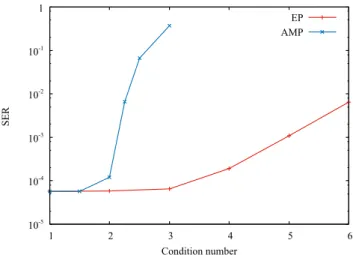
Figure 1 shows the SERs of the EP and AMP decoding for the artificial fading channels. The two algorithms are comparable to each other for the AWGN channelκ=1. The AMP decoding has poor performance when the condition number is larger than 2. On the other hand, the EP decoding has comparable SER to the AWGN channelκ=1 whenκis below 3. These results imply that the EP decoding is robust against ill-conditioned fading channels.
Algorithm 2AMP Decoding
Require:Received vectoryand the effective dictionary matrixA. 1: LetβB,0=0,vB,0=P,βA,−1=0,vA,−1=P, andz−1=0. 2: fort=0, . . .,T−1do
3: Computezt=y−AβB,t+vB,tzt−1/vA,t−1. 4: ComputeβA,t =NβB,t/(M L)+AHzt. 5: ComputevA,t =N0+vB,t.
6: UpdateβA,t ←θAβA,t+(1−θA)βA,t−1. 7: UpdatevA,t←θAvA,t+(1−θA)vA,t−1. 8: ComputeβB,t+1andvB,t+1given in (13) and (14).
9: UpdateβB,t+1←θBβB,t+1+(1−θB)βB,t. 10: UpdatevB,t+1←θBvB,t+1+(1−θB)vB,t. 11: end for
12: Output hard decision ofβB,t+1.
We next compare the EP decoding with the AMP de- coding in OFDM systems. We assume independent Rayleigh fadinghk,p ∼ CN(0, σ2p)in (2) with the exponential power decayσ2p =Ce−0.1p, in whichC is the normalization con- stant to imposePNb−1
p=0 σ2p=1. The average condition num- ber of this fading channel is very large, e.g. approximately
Fig. 1 SER versus the condition numberκfor the artificial fading chan- nels. L=256,M =16,N=512,Eb/N0=4 dB, 20 iterations,θ=0.9 in the EP decoding,θA=1 andθB=0.9 in the AMP decoding.
Fig. 2 SER versusEb/N0forL =256,M =16, andN =512. For OFDM systems with block length Nb=64, 50 iterations,θ=0.8 in the EP decoding, andθA=θB=0.5 in the AMP decoding were used. For the AWGN channel, 20 iterations,θ=0.9,θA=1, andθB=0.9 were used.
100 forN =512 andNb =64.
Figure 2 shows the SERs of the EP and AMP decoding for both OFDM and AWGN channels. For the AWGN chan- nel, the EP decoding is comparable to the AMP decoding for all signal-to-noise ratios (SNRs). For OFDM systems, the EP decoding is much superior to the AMP decoding while the AMP decoding has an error-floor in the high SNR regime. The poor performance of the AMP decoding is due to ill-conditioned effective dictionary matrices. The EP de- coding has a good convergence property even for such an ill-conditioned case.
Acknowledgments
K. Takeuchi was in part supported by the Grant-in-Aid for Scientific Research (B) (JSPS KAKENHI Grant Number
LETTER
1669
18H01441), Japan.
References
[1] A. Joseph and A.R. Barron, “Least squares superposition codes of moderate dictionary size are reliable at rates up to capacity,” IEEE Trans. Inf. Theory, vol.58, no.5, pp.2541–2557, May 2012.
[2] A. Joseph and A.R. Barron, “Fast sparse superposition codes have near exponential error probability for R < C,” IEEE Trans. Inf.
Theory, vol.60, no.2, pp.919–942, Feb. 2014.
[3] Y. Takeishi, M. Kawakita, and J. Takeuchi, “Least squares superpo- sition codes with Bernoulli dictionary are still reliable at rates up to capacity,” IEEE Trans. Inf. Theory, vol.60, no.5, pp.2737–2750, May 2014.
[4] C. Rush, A. Greig, and R. Venkataramanan, “Capacity-achieving sparse superposition codes via approximate message passing decod- ing,” IEEE Trans. Inf. Theory, vol.63, no.3, pp.1476–1500, March 2017.
[5] J. Barbier and F. Krzakala, “Approximate message-passing decoder and capacity achieving sparse superposition codes,” IEEE Trans. Inf.
Theory, vol.63, no.8, pp.4894–4927, Aug. 2017.
[6] S. Rangan, P. Schniter, A. Fletcher, and S. Sarkar, “On the con- vergence of approximate message passing with arbitrary matrices,”
IEEE Trans. Inf. Theory, vol.65, no.9, pp.5339–5351, Sept. 2019.
[7] D.N.C. Tse and P. Viswanath, Fundamentals of Wireless Communi- cation, Cambridge University Press, Cambridge, UK, 2005.
[8] K. Takeuchi, “Rigorous dynamics of expectation-propagation-based signal recovery from unitarily invariant measurements,” IEEE Trans.
Inf. Theory, vol.66, no.1, pp.368–386, Jan. 2020.
[9] J. Ma and L. Ping, “Orthogonal AMP,” IEEE Access, vol.5, pp.2020–
2033, Jan. 2017.
[10] S. Rangan, P. Schniter, and A.K. Fletcher, “Vector approximate mes- sage passing,” IEEE Trans. Inf. Theory, vol.65, no.10, pp.6664–6684, Oct. 2019.
[11] M. Opper and O. Winther, “Expectation consistent approximate in- ference,” J. Mach. Learn. Res., vol.6, pp.2177–2204, Dec. 2005.
Appendix: Derivation of EP Decoding
We follow [8] to derive the EP decoding. The purpose of EP is to compute the marginal posterior distribution p(β[l]|y,A) approximately. The marginal posterior distri- bution is approximated via a tractable distribution
qA(β)∝p(y|A,β)
L−1
Y
l=0
qB→A(β[l]), (A·1) with
qB→A(β[l])∝exp −kβ[l]−βB→A[l]k2 vB→A
!
, (A·2)
where f(x) ∝ g(x)means that there is an x-independent constant C > 0 such that f(x) = Cg(x) holds. Let βB→A = (βB→A[0]T, . . . ,βB→A[L − 1]T)T and βA = (βA[0]T, . . . ,βA[L −1]T)T. Following[8], we can evalu- ate the marginalization of (A·1) over{β[l0] :l0,l}as
qA(β[l])∝exp −kβ[l]−βA[l]k2 vA
!
, (A·3)
with
βA=βB→A+vB→AAHΞ−1(y−AβB→A), (A·4) vA=vB→A−γ−1(vB→A)vB2→A, (A·5) Ξ=N0IN +vB→AAAH, (A·6) γ−1(v)= 1
L MTr
Ξ−1AAH
. (A·7)
The main difference between conventional[8]and pro- posed EP is in the update rule of qB→A. We define the extrinsic distribution ofβ[l] as
qA→B(β[l])∝ qA(β[l])
qB→A(β[l]). (A·8) We write the mean and variance of β[l] with respect to qA→B(β[l])p(β[l])as
βB[l]=
Pβ[l]β[l]qA→B(β[l])p(β[l])
Pβ[l]qA→B(β[l])p(β[l]) , (A·9) vB[l]= 1
M
Pβ[l]kβ[l]k2qA→B(β[l])p(β[l]) Pβ[l]qA→B(β[l])p(β[l])
− 1
MkβB[l]k2. (A·10) LetqBnew→A(β[l])denote an updated message ofqB→A(β[l]) given by
qnewB→A(β[l])∝exp* ,
−kβ[l]−βnewB→A[l]k2 vBnew→A +
-
. (A·11)
Then, the messageqB→A(β[l])is updated so as to satisfy the moment matching conditions
βB[l]=
Pβ[l]β[l]qA→B(β[l])qBnew→A(β[l])
Pβ[l]qA→B(β[l])qBnew→A(β[l]) , (A·12) M
L−1
X
l=0
vB[l]=
L−1
X
l=0
Pβ[l]kβ[l]k2qA→B(β[l])qBnew→A(β[l]) Pβ[l]qA→B(β[l])qBnew→A(β[l])
−
L−1
X
l=0
kβB[l]k2. (A·13) The remaining derivation is similar to in [8], so that we omit it. The extrinsic distributionqA→Bin conventional EP[8]was defined element-wisely since i.i.d. signals were assumed. On the other hand, (A·8) has been defined for each section because β[l] has dependent elements. Here is the main difference in the derivations of conventional and proposed EP algorithms.