PAPER
Correlation of Column Sequences from the Arrays of Sidelnikov Sequences of Different Periods ∗
Min Kyu SONG†a),Nonmember andHong-Yeop SONG†b),Member
SUMMARY We show that the non-trivial correlation of two properly chosen column sequences of lengthq−1 from the array structure of two Sidelnikov sequences of periodsqe−1 andqd−1, respectively, is upper- bounded by(2d−1)√
q+1, if 2 ≤e <d< 12(√
q−√2q +1). Based on this, we propose a construction by combining properly chosen columns from arrays of size(q−1)×qq−1e−1withe=2,3, ...,d. The combining process enlarge the family size while maintaining the upper-bound of max- imum non-trivial correlation. We also propose an algorithm for generating the sequence family based on Chinese remainder theorem. The proposed algorithm is more efficient than brute force approach.
key words: Sidelnikov sequences, array structure, correlation
1. Introduction
Sequences with good correlation properties have been used for various applications such as serving multiple users over the same channel, estimating the channel state in digital com- munications [3], and ranging the distance in GPS/GNSS systems[1]. For communication systems employing code division multiple access using direct-sequence spread spec- trum (DS-CDMA), it is important to serve a given number of multiple users with as low interference as possible, since such systems are known to be interference-limited[5],[13].
Therefore, sequences have been designed so that their cor- relation properties satisfy some optimality condition main- taining certain reasonable size restriction.
Recent success in commercial mobile communications through various generations up to 5G has reached a posi- tion where “massive connectivity” and “grant-free access”
are getting more and more attentions and non-orthogonal multiple access schemes need to be studied [11]. Dai et al.[11, page.74] mentioned that “...due to the rapid devel- opment of the Internet of Things (IoT), 5G needs to support massive connectivity of users and/or devices to meet the de- mand for low latency, low-cost devices, and diverse service types.” Lots of multiple access (MA) schemes have recently been proposed for massive connectivity and/or grant-free access. Among these, the code-based MA schemes, for ex- ample, MUSA (Multi-User Shared Access), are getting an
Manuscript received August 13, 2018.
Manuscript revised February 28, 2019.
†The authors are with Yonsei University, Seoul, Korea.
∗This work was supported by the National Research Foundation of Korea (NRF) grant funded by the Korea government (MSIP) (No.
2017R1A2B4011191). This paper was presented in part at 2016 International Symposium on Information Theory.
a) E-mail: [email protected]
b) E-mail: [email protected] (Corresponding author) DOI: 10.1587/transfun.E102.A.1333
attention for supporting massive connectivity and grant-free access[19]. Therefore, now, we have to pay a lot more at- tention on increasing the family size as much as possible in the designing sequences for MA with correlation properties somewhat compromised. This gives a motivation of studying and developing sequence families of size as big as possible with reasonable condition on correlation magnitude.
For the DS-CDMA, one has to find sequence families with as low complex correlation as possible, with reasonable number in size. Gold sequence family[2], constructed using an m-sequence and its decimations, is a famous example of optimal binary sequences family in correlation magnitude with fairly large size. From then on, so many examples of both binary and non-binary families with optimal correlation properties have been studied with limited number in sizes[4], [6]–[10],[17]. Sidelnikov sequences[12], which have been initially presented as having good auto-correlation property, have also been considered for the multiple acess for the first time in[6]and this family has been considerably improved in size by many others [4], [7], [8], [17]. The approach in this line was to employ ‘multiplying constants’ or ‘shift- and-add’ to increase the family size [4],[6],[7]. In 2010, Yu and Gong proposed a sequence family construction from the (q−1)×q2−1
q−1 array structure of Sidelnikov sequences of periodq2−1[17]. Later, this idea is generalized to use Sidelnikov sequences of periodqd−1 and its array structures of size(q−1)×qd−1
q−1 [8]. Their main contribution is to study the various properties of the column sequences of such array structures[8]. Here, we would like to note that[17]and[8]
are considered correlation properties of column sequences from the array structure of the same Sidelnikov sequence.
The main theme of this paper is investigation of corre- lation properties of some column sequences of lengthq−1 from the array structure of Sidelnikov sequences of possi- bly different periodsqe−1 andqd−1, respectively, where 2 ≤e < d < 12(√
q−√2
q +1). For this, we first present a brief review of previous results in Sect. 2. After then, Sect. 3 is devoted to discuss correlation of some column sequences from the array structure of Sidelnikov sequences of differ- ent lengths. This allows us to combine columns sequences from Sidelnikov-sequence-arrays of different lengths while remaining the same upper-bound on the maximum non- trivial correlation. By this process, the combined sequence family is of size slightly larger than that of sequence fami- lies given by[8]. For some efficient implementation of the proposed family, we give a construction in Sect. 4, which is Copyright © 2019 The Institute of Electronics, Information and Communication Engineers
much better than brute force approach discussed in[8]. In Sect. 5, we finish this paper with some concluding remarks.
Throughout this paper, we will use the following nota- tion:
• pis a prime number.
• qis a prime powerq=pr with a positive integerr.
• GF(q)is the finite field withqelements.
• Znis the integers modulon.
• Mis a divisor ofq−1 withM ≥2.
• αis a primitive element ofGF(qd).
• β=αq d−q−11 is a primitive element ofGF(q).
• logβ(·)is a discrete log overGF(q)such that logβ(x)= k if and only if non-zero x = βk inGF(q). We use logβ(0)=0 for convenience.
• pl(x)is the minimal polynomial of−α−loverGF(q).
• ωM =exp
2π√
−1 M
is a primitiveM-th root of unity.
• ψ is a multiplicative character of GF(q) of order M defined byψ(x)=ωlogMβ(x). Note thatψ(0)=1.
2. Preliminaries
2.1 Correlation of Sequences
Let x = {x(n)}nL−=01 and y = {y(n)}L−n=01 be two M-ary se- quences of period L. When we regard them as the phase sequences of certain polyphase sequences, then the (peri- odic) complex correlation betweenxandyat time shiftτis given by
Cx, y(τ)=
L−1
X
n=0
ωx(n)−y(n+τ)
M .
If y is cyclically equivalent to x, i.e., y is a cyclic shifted version of x, then it is called autocorrelation and denoted byCx(τ), simply. Otherwise,Cx, y(τ)is correlation of two cyclically inequivalent sequences x, y. In this case, it is called crosscorrelation.
For a given setK of M-ary sequences of periodL, the maximum non-trivial complex correlation among sequences inK, denoted byCmax(K), is
Cmax(K)=max
maxx∈K
τ,0
|Cx(τ)|, max
x, y∈K x,y
Cx, y(τ)
.
2.2 Sidelnikov Sequences and Their Array Structure Letαbe a primitive element ofGF(qd), andβbe the prim- itive element ofGF(q)given by the relation
β=αq dq−−11.
Then, for a divisorMofq−1 withM ≥2, thet-th term of anM-ary Sidelnikov sequence{sd(t)}qt=0d−1of periodqd−1
* . . . . . . . . . . . . ,
sd(0) sd(1) · · · sd(qq−1d−1−1)
sd(qq−1d−1) sd(qq−1d−1+1) · · · sd(2×qq−1d−1−1)
... ... . .. ...
sd((q−2)×qq−1d−1) sd((q−2)×qq−1d−1+1) · · · sd(qd−2) + / / / / / / / / / / / / - Fig. 1 The 2-D array structure of a Sidelnikov sequencesd(t)of period qd−1.
can be written by[8]
sd(t)≡logβ
N1d(αt+1)
(mod M), (1)
whereN1d(x)is the norm function fromGF(qd)toGF(q), defined by
N1d(x)=
d−1
Y
i=0
xqd =x(qd−1)/(q−1).
Consider the array of a Sidelnikov sequence by writing the M-ary Sidelnikov sequence of periodqd−1 as a(q−1)×qq−d−11 array shown in Fig. 1. Then, thet-th term of thel-th column {vl(t)}q−t=01of the array can be written as
vl(t)=sd qd−1 q−1 t+l
!
. (2)
According to [8], these can be classified cycli- cally inequivalent columns by using a q-cyclotomic coset modqq−d−11. For a given integerl, denote by ˆCl(d) the q- cyclotmic coset mod qq−d−11 defined by
Cˆl(d)=(
l,lq,lq2, ...) ,
and letml be the cardinality of ˆCl(d). Then,mlis the least positive integer such that[8]
qd−1
(qml −1)gcd(mdl,q−1)
l. (3)
Then, thel-th column sequence given by (2) has the following properties:
Fact 1 (Theorem 3 and Corollary 1 in[8]) Let{sd(t)}be anM-ary Sidelnikov sequence of periodqd−1given by(1) and consider its(q−1)×qd−1
q−1 array structure.
1. The first column{v0(t)}can be written as v0(t)≡dlogβ(βt+1) (modM).
2. Two column sequencesvl1(t) and vl2(t) are cycli- cally equivalent if l1,l2 are in the same q-cyclotomic coset mod qq−d−11.
3. Ifml =d, then{vl(t)}is of periodq−1for anyM.
To consider cyclically inequivalent columns of period q−1 regardless ofM, we will consider the setΛ0(d)defined
as the following: Λ(d)is the set of smallest representatives of all the q-cyclotomic cosets ˆCl(d) modqq−d−11 except for l=0, and
Λ0(d)={l∈Λ(d)|ml =d}. (4) The exact size of Λ0(d) was known by[17]for d = 2 as bq/2cand was known by[8]for some cases ofd. It is also known by[8]that, ford ≥3, asq→ ∞,
Λ0(d)
∼ qd−1
d . (5)
Ifl ∈Λ0(d), a column sequence{vl(t)}defined by (2) can be alternatively written as[8]
vl(t)=logβ
βlpl
βt , (6)
where pl(x) is a minimal polynomial over GF(q) which has−α−l as a root. In[8], there were some constructions for sequence families having good correlation properties by using different subsets ofΛ(d). Here, we review only the case withΛ0(d), which will be considered in this paper:
Fact 2 (Theorems 4, 6 in[8]) For an integerdin the range 2≤d < 12(√
q−√2
q +1), define a set of column sequences Σ0(d)by
Σ0(d)=cvl(t)|l ∈Λ0(d),1≤c<M , wherevl(t)is given by(2).
1. Cmax(Σ0(d)) ≤ (2d−1)√
q+1. As a result, all the sequences inΣ0(d)are cyclically inequivalent to each other.
2. |Σ0(d)| ∼ (M−1)qd−1
d .
In[8], they combinedΣ0(d)with two previous known sequence familiesISof[6]andASof[7]and[4]which are sequence sets of periodq−1 and defined by
IS ={cs1(t)|1≤c<M}, (7) AS =
(
c0s1(t)+c1s1(t+δ)|1≤δ≤
$q−1 2
%) , (8) respectively, wheres1(t)is the Sidelnikov sequence of period q−1 generated byβ=αq d−q−11 and 1≤c0,c1<Mif 1≤δ≤ bq−21cand 1 ≤ c0 < c1 if δ = q−21. One interesting point is that, even those are combined, the maximum non-trivial complex correlation is still upper-bounded by(2d−1)√
q+1.
The folowing have been used to obtain upper-bound on the maximum non-trivial complex correlation:
Fact 3 (Weil bound[16]) Let f1(x), ...,fl(x) be l distinct monic irreducible polynomials over GF(q) which are of positive degree d1, ...,dl, respectively. Letei be the num- ber of distinct roots of fi(x)inGF(q)for1 ≤i ≤land k be the number of distinct roots ofQl
i=1 fi(x)in its splitting field overGF(q). Letψ1, ..., ψlbe multiplicative characters ofGF(q), with ψi(0) = 1 for 1 ≤ i ≤ l. If the product
characterQl
i=1ψi(fi(x))is non-trivial for somex, then
X
x∈GF(q)
ψ1(a1f1(x))· · ·ψl(alfl(x))
≤(
l
X
i=1
di−1)√ q,
for anyai ∈GF(q)\ {0},1≤i≤l.
3. Column Sequences from Sidelnikov Sequences of Dif- ferent Lengths
Our first goal is analyzing the cross-correlation of two col- umn sequences of period q−1 from arrays of two M-ary Sidelnikov sequences of periodsqe−1 andqd−1, respec- tively, where 2≤e≤d< 12 √
q−√2 q +1
.
Lemma 1 Let e,d be two positive integers with 2 ≤ e ≤ d < 12(√
q−√2
q +1) and consider GF(qe) and GF(qd).
There exist primitive elements of these fields, say, αe and αd, respectively, such thatα
q e−1 q−1
e =α
q d−1 q−1
d ∈GF(q).
Proof Leth =lcm(e,d), andαhbe a primitive element of GF(qh). Chooseαe=α
q h−1 q e−1
h andαd =α
q h−1 q d−1
h . Then, it is obvious that
αeq e−1q−1 =αdq dq−−11 ∈GF(q),
which is desired.
Here after, we will use the notation that α
q e−1 q−1
e =α
q d−1 q−1
d = β
is the primitive element ofGF(q)in the representation (1).
Theorem 1 Leteanddbe some integers with2≤e<d <
12(√ q−√2
q+1). If we constructΣ0(e)andΣ0(d)by choosing primitive elementsαeandαdas in Lemma 1, then any two sequencesa(t)∈Σ0(e)andb(t)∈Σ0(d)have
Ca,b(τ)
≤(e+d−1)√ q+1
as their maximum correlation magnitude. Hence, they are cyclically inequivalent.
Proof From Lemma 1, make N1e(αte+1) andN1d(αt
d+1) be functions of a primitive element β of GF(q). Then, a(t)∈Σ0(e)with constant1≤c1 <Mand column indexl1 is
a(t)=c1logβ βl1pl1(βt),
and b(t) ∈ Σ0(d) with constant 1 ≤ c2 < M and column indexl2is
b(t+τ)=c2logβ βl2pl2(βt+τ),
Table 1 Comparison ofΣ0(d)in[8]andΣ0U(d)in Def. 1 whenq=101,M=100, andd=3,4.
Set size Asymptotic size (10) Maximum correlation Bound (9)
Σ0(3)in[8] 339,966 336,633 39.849 50.249
Σ0U(3) 344,916 336,633 39.849 50.249
Σ0(4)in[8] 25,749,900 25,499,950 43.475 70.349
Σ0U(4) 26,094,816 25,499,950 44.147 70.349
where βl1pl1(x)and βl2pl2(βτx)are two distinct monic ir- reducible polynomials of degreeeandd, respectively. Then, their complex cross-correlation function becomes
Ca,b(τ)=
q−2
X
t=0
ωa(t)−b(t+τ) M
=
q−2
X
t=0
ψ1(βl1pl1(βt))ψ2(βl2+τdβ−τdpl2(βt+τ)),
where ψ1 = ψc1 and ψ2 = ψM−c2 are both non-trivial multiplicative characters. Here, note that β−τdpl2(βt+τ) = pl2(βt). So, by applying the Weil bound in Fact 3, we have
|Ca,b(τ)|
=
X
x∈GF(q)∗
ψ1
βl1pl1(x) ψ2
βl2pl2(βτx)
≤
X
x∈GF(q)
ψ1
βl1pl1(x) ψ2
βl2pl2(βτx)
+1
≤(e+d−1)√ q+1. Note that, since(e+d−1)√
q+1<q−1under the assumption, a(t)andb(t)are cyclically inequivalent.
From Theorem 1, we can construct a set of sequences by taking a union of all the sequence families from the ar- ray structures of Sidelnikov sequences of periods q2 −1, q3 −1, ..., qd −1 without increasing the upper-bound on the maximum non-trivial complex correlation. Here, we have to use some appropriate primitive elements of GF(q2),GF(q3), ...,GF(qd), respectively, all obtained from a primitive element ofGF(qh)whereh=lcm(2, ...,d). Definition 1 (Unified sequence family) Assume that all the primitive elements are chosen properly and letΣ0U(d)be the set ofM-ary sequences of periodq−1, given by
Σ0U(d)= [d
e=2
Σ0(e).
Corollary 1 If2 ≤d <12(√ q−√2
q +1), then Cmax(Σ0U(d))≤(2d−1)√
q+1. (9)
Since the sequence family inDefinition 1is the union
ofΣ0(d)in[8], we can directly combine it withIS andAS to construct new sequence families.
Corollary 2 With all the previous assumptions and nota- tions, construct a new set of sequences by combinining Σ0U(d),IS, andAS. Then, any pair of sequences in the set are cyclically inequivalent and
Cmax(Σ0U(d)∪ IS∪ AS)≤(2d−1)√ q+1.
Note that, even though Σ0U(d) is union of properly chosen columns from arrays of size (q −1)× qe−1
q−1 with e=2,3, ...,d, from the asymptotic size ofΣ0(d)in (5), we have
Σ0U(d)
∼(M−1)qd−1/d. (10) Table 1 shows the comparison of Σ0(d) of [8] and Σ0U(d) of this paper forq =101, M =100, andd =3,4.
Here, all the appeared maximum correlation magnitudes are calculated by using up to one million pairs of sequences.
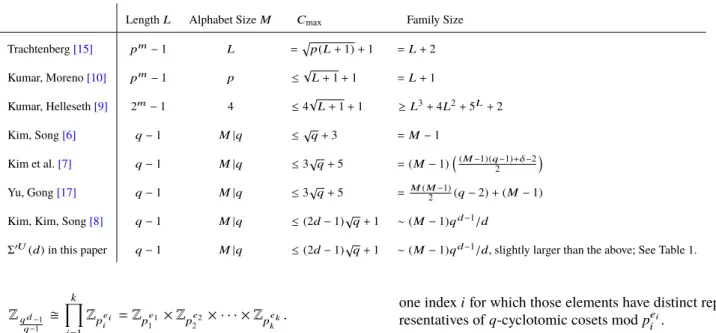
In this table, Σ0U(d) is of size slightly larger than that of Σ0(d). This is becauseΣ0U(d)additionally containsΣ0(2), ... Σ0(d−1), all of which are only of marginal size compared with that ofΣ0(d). We finish this section with Table 2 which gives a comparison of the proposed familyΣ0U(d)with some well-known polyphase sequence families.
4. Problem of Constructing forΛ0(d)
So far, we have just defined the set Λ0(d) mathematically over the integers mod(qd−1)/(q−1). As mentioned in[8], a brute force approach for obtainingΛ0(d) may take time- complexity on the order of
qd−1 q−1
2
and the required memory size is approximately qd−d1 × dlog2qq−d−11e. This may be huge for largeqandd. To overcome this, we need more efficient construction forΛ0(d).
Letqq−d−11 =Qk
i=1pkekbe the prime factorization ofqq−d−11 and consider a map fromZq d−1
q−1 toQk i=1Zpei
i given by f :x7−→
x modpe11, x modp2e2, ..., x modpekk
,(x1,x2, ...,xk). (11)
By the Chinese remainder theorem, it is known that the map in (11) defines a ring isomorphism
Table 2 Comparison with some known polyphase sequence families.
LengthL Alphabet SizeM Cmax Family Size
Trachtenberg[15] pm−1 L =p
p(L+1)+1 =L+2
Kumar, Moreno[10] pm−1 p ≤√
L+1+1 =L+1
Kumar, Helleseth[9] 2m−1 4 ≤4√
L+1+1 ≥L3+4L2+5L+2
Kim, Song[6] q−1 M|q ≤√
q+3 =M−1
Kim et al.[7] q−1 M|q ≤3√
q+5 =(M−1)(M−1)(q−1)+δ−2 2
Yu, Gong[17] q−1 M|q ≤3√
q+5 =M(M−2 1)(q−2)+(M−1)
Kim, Kim, Song[8] q−1 M|q ≤(2d−1)√
q+1 ∼(M−1)qd−1/d Σ0U(d)in this paper q−1 M|q ≤(2d−1)√
q+1 ∼(M−1)qd−1/d, slightly larger than the above; See Table 1.
Zq d−1 q−1
k
Y
i=1
Zpei
i =Zpe1 1 ×Zpe2
2 × · · · ×Zpek
k
. That is, the map preserves additions and multiplications of el- ements. (Here, additions and multiplications overQk
i=1Zpeii
are performed component-wise.) The inverse map of (11) is well-known by
g:(x1,x2, ...,xk)7−→
k
X
i=1
xiyizi =x, (12) where yi = (qd −1)/(q−1)piei andzi = yi−1 (modpeii). Here,q.0 (modpiei)for anyisinceqd≡1 (mod qq−d−11). Lemma 2 For a prime powerq, letQk
i=1pekk be the prime factorization of qq−d−11 and f be the function given by(11).
1. For an integera ∈Zq d−1 q−1
, theq-cyclotomic cosetCˆa(d) mod qq−d−11 is of size d if and only if there exists some indexisuch thatqjai ≡ai (modpeii)only when jis a multiple ofd.
2. Two integers a,b ∈ Zq d−1 q−1
are not in the same q- cyclotomic coset mod qq−d−11 if and only if there exists somejsuch thataj ,qubj for anyu=0,1,2, ...,d−1. Proof We omit the proof since it is straightforward.
Based on Lemma 2,Λ0(d)can be obtained by picking up an element inQk
i=1Zpeii according to the following rules and applying the mapggiven by (12):
FIRST RULE: For the condition
Cˆa(d)
= d, from Lemma 2-1, pick up an elementa fromQk
i=1Zpei
i in
whichqjai ≡ai (modpeii)only when jis a multiple ofd.
SECOND RULE:To pick up representatives of different q-cyclotomic cosets mod qq−d−11, there should be at least
one indexifor which those elements have distinct rep- resentatives ofq-cyclotomic cosets modpiei.
Here, if ei = 1, finding all the representatives of q- cyclotomic cosets mod pi can be done in a straightforward manner as follow:
Lemma 3 For a prime powerqand an integerd ≥2, letpi
be a prime factor of qq−d−11, andδbe a primitive root ofZpi. Then,
(
δx|0≤x≤ pi−1
v −1
)
is a set of all the representatives ofq-cyclotomic cosets mod pi, wherev is the smallest positive integer such thatqv ≡1 (mod pi).
Proof Note that q . 0 (modpi), since qd ≡ 1 (mod qq−d−11). Therefore, q can be written as a power of δ, i.e.,
q=δu(p−v1)
where v is the smallest positive integer such that qv ≡ 1 (mod pi). Then,δx .qiδy (mod pi)for anyi, if0 ≤ x<
y ≤ piv−1 −1. And, obviously, if piv−1 ≤ y ≤pi−1, there exist somexwith0≤x ≤ piv−1 −1such thatδx=qiδyfor somei.
Example 1 Letq=7andd=3. Then,(qd−1)/(q−1)= 57 =3×19is a multiple of two odd prime numbers. By Lemma 3, we can find representatives of all theq-cyclotomic cosets mod3and all theq-cyclotomic cosets mod19, respec- tively. Here, sinceq ≡1 (mod 3), any element ofZ3 is a representative of aq-cyclotomic coset mod3. Note that any elements ofZ3 represents aq-cyclotomic coset mod3with cardinality1. Therefore, according toFIRST RULE, it is enough to considerZ19. Choose2as a primitive root ofZ19. Lemma 3 implies that
Algorithm 1An Algorithm for constructingΛ0(d)
Input: Two integersqandd Output: The setΛ0(d)
1: Determine prime factors: qq−d−11=Qk i=1pkek 2: Determine(q1,q2, ...,qk)=f(q)by (11) 3: SetT=(
i|qix .1 (modpeii)for anyxnot a multiple ofd) 4: fori=1 tokdo
5: SetAi=∅ 6: ifi∈Tthen
7: Find all the representatives ofq-cyclotomic cosets modpiei of sized, and put them intoAi
8: end if 9: end for
10: SetU={(u1,u2, ...,uk)|ui ∈Z2fori∈Tand ui=0 fori<T} \ {(0,0, ...,0)} 11: SetB=∅
12: for eachu∈Udo
13: B←B∪ {(x1,x2, ...,xk)|xi ∈Aiforui =1 and xi ∈Zpei
i
\Aiforui =0} 14: end for
15: return {g(b)|b∈B}wheregis defined in (12)
(
2x |0≤ p2−1
3 −1=5)
={1,2,4,8,16,13} (13) is the set of all the representatives2xof7-cyclotomic cosets mod19. Note that the size of the coset represented by2x above can be either1or3. Just check the size of each and obtain the set A2 of representatives of q-cyclotomic cosets mod19of sized=3, as
A2={1,2,4,8,16,13}.
By using the function g defined in (12), we can construct Λ0(d)as
Λ0(d =3)={g(b1,b2) |b1 ∈Z3,b2 ∈ A2}, and hence,
Λ0(3)
=|Z3| × |A2|=18.
The process in Example 1 can be generalized as Algo- rithm 1. When we use Algorithm 1 without pre-computed information about Ai’s, the time-complexity of construct- ing each Ai by checking 1 topeii −1 is order ofp2ei i. So, total time-complexity is at most order ofPk
i=1p2ei i, which becomes much smaller than
qd−1 q−1
2
=Qk i=1pi2ei.
When we use Algorithm 1 with pre-computed informa- tion ofAi’s, the required memory size is reduced to at most Pk
i=1 piei
d × dlog2pieiebits, and hence, the required memory size also becomes smaller as the number of distinct prime factors of qq−d−11 becomes larger.
5. Concluding Remarks
The main contribution of this paper is the analysis of cross- correlation of some column sequences from the array struc- ture of Sidelnikov sequences of periodq2−1,q3−1, ...,qd−1, and enlarging size of the previous family by involving all of
them while preserving upper-bound on the correlation. The proposed sequence family may be applicable to code-based non-orthogonal multiple access schemes for massive connec- tivity and/or grant-free access. We also gave an algorithm to generate the proposed family. The proposed algorithm is more efficient than brute force approach, but it might be not enough to use them in practice. Therefore, it would be important to find a more efficient manner for identifying the setΛ0(d).
References
[1] Global Positioning Systems Directorate Systems Engineering & In- tegration Interface Specification, document IS-GPS-200H, March 2014.
[2] R. Gold, “Maximal recursive sequences with 3-valued recursive crosscorrelation functions,” IEEE Trans. Inf. Theory, vol.14, no.1, pp.154–156, Jan. 1968.
[3] S.W. Golomb and G. Gong, Signal Design for Good Correlation: For Wireless Communications, Cryptography, and Radar, Cambridge University Press, 2005.
[4] Y.K. Han and K. Yang, “NewM-ary sequence families with low correlation and large size,” IEEE Trans. Inf. Theory, vol.55, no.4, pp.1815–1823, April 2009.
[5] J.K. Holmes, Spread Spectrum Systems for GNSS and Wireless Communications, Artech House, 2007.
[6] Y.-J. Kim and H.-Y. Song, “Cross correlation of Sidelnikov sequences and their constant multiples,” IEEE Trans. Inf. Theory, vol.53, no.3, pp.1220–1224, March 2007.
[7] Y.-S. Kim, J.-S. Chung, J.-S. No, and H. Chung, “New families of M-ary sequences with low correlation constructed from Sidelnikov sequences,” IEEE Trans. Inf. Theory, vol.54, no.8, pp.3768–3774, Aug. 2008.
[8] Y.-T. Kim, D.S. Kim, and H.-Y. Song, “NewM-ary sequence fam- ilies with low correlation from the array structure of Sidelnikov sequences,” IEEE Tans. Inf. Theory, vol.61, no.1, pp.655–670, Jan.
2015.
[9] P.V. Kumar, T. Helleseth, A.R. Calderbank, and A.R. Hammons, Jr.,
“Large families of quaternary sequences with low correlation,” IEEE Trans. Inf. Theory, vol.42, no.2, pp.579–592, March 1996.
[10] P.V. Kumar and O. Moreno, “Prime-phase sequences with periodic correlation properties better than binary sequences,” IEEE Trans. Inf.
Theory, vol.37, no.3, pp.603–616, May 1991.
[11] L. Dai, Y. Yuan, S. Han, I. Chih-Lin, and Z. Wang, “Non-orthogonal multiple access for 5G: Solutions, challenges, opportunities, and future research trends,” IEEE Commun. Mag., vol.53, no.9, pp.74–
81, Sept. 2015.
[12] V.M. Sidelnikov, “Some k-valued pseudo-random sequences and nearly equidistant codes,” Problemy peredachi Information, vol.5, no.1, pp.16–22, 1969.
[13] M.K. Simon, J.K. Omura, R.A. Scholtz, and B.K. Levitt, Spread Spectrum Communications Handbook, McGraw-Hill, New York, 1994.
[14] M.K. Song, H.-Y. Song, D.S. Kim, and J.Y. Lee, “Correlation prop- erties of sequences from the 2-D array structure of Sidelnikov se- quences of different lengths and their union,” Proc. 2016 IEEE Inter- national Symposium on Information Theory (ISIT 2016), pp.105–
109, Barcelona, Spain, July 2016.
[15] H.M. Trachtenberg, On the Crosscorrelation Functions of Maximal Linear Sequences, Ph.D. dissertation, Dept. EE-Syst., Univ. Southern California, Los Angeles, CA, USA, 1970.
[16] N.Y. Yu and G. Gong, “Multiplicative characters, the Weil bound, and polyphase sequence families with low correlation,” IEEE Trans.
Inf. Theory, vol.56, no.12, pp.6376–6387, Dec. 2010.
[17] N.Y. Yu and G. Gong, “New construction ofM-ary sequence families
with low correlation from the structure of Sidelnikov sequences,”
IEEE Trans. Inf. Theory, vol.56, no.8, pp.4061–4070, Aug. 2010.
[18] Z. Yuan, G. Yu, W. Li, Y. Yuan, X. Wang, and J. Xu, “Multi-user shared access for Internet of Things,” Proc. IEEE 83th Conf. Veh.
Tech., pp.1–5, May 2016.
[19] T. Yunzheng, L. Long, L. Shang, and Z. Zhi, “A survey: Several tech- nologies of non-orthogonal transmission for 5G,” China commun., vol.12, no.10, pp.1–15, Oct. 2015.
Min Kyu Song received his B.S. degree in Electronic Engineering from Konkuk University, Seoul, Korea, and M.S. degree in Electrical and Electronic Engineering from Yonsei University, Seoul, Korea, in 2011 and 2013, respectively.
He is currently a Ph.D. candidate working in Channel Coding and Crypto Lab. at Yonsei Uni- versity. His area of research interest includes PN sequences, cryptography, and coding theory.
Hong-Yeop Song received his BS degree in Electronic Engineering from Yonsei Univer- sity in 1984, MSEE and Ph.D. degrees from the University of Southern California, Los Angeles, California, in 1986 and 1991, respectively. He spent 2 years as a research associate at USC and then 2 years as a senior engineer at the standard team of Qualcomm Inc., San Diego, California.
Since Sept. 1995, he has been with Dept. of elec- trical and electronic engineering, Yonsei Univer- sity, Seoul, Korea. He had been serving IEEE IT society Seoul Chapter as a chair from 2009 to 2016, and served as a gen- eral co-chair of IEEE ITW 2015 in Jeju, Korea. He was awarded the 2017 Special Contribution Award from Korean Mathematical Society for his con- tribution to the global wide-spread of the fact that Choi (1646–1715) from Korea had discovered a pair of orthogonal Latin squares of order 9 much earlier than Euler. His area of research interest includes digital communi- cations and channel coding, design and analysis of various pseudo-random sequences for communications and cryptography. He is a member of IEEE, MAA(Mathematical Association of America) and domestic societies KICS, IEIE, KIISC and KMS.
![Table 1 Comparison of Σ 0 (d) in [8] and Σ 0U (d) in Def. 1 when q = 101, M = 100, and d = 3 , 4.](https://thumb-ap.123doks.com/thumbv2/123deta/5634429.1501524/4.892.212.677.145.264/table-comparison-σ-d-σ-u-def-m.webp)