• 検索結果がありません。

トップページ - 横浜国立大学学術情報リポジトリ

N/A
N/A
Protected

Academic year: 2021

シェア "トップページ - 横浜国立大学学術情報リポジトリ"

Copied!
28
0
0

読み込み中.... (全文を見る)

全文

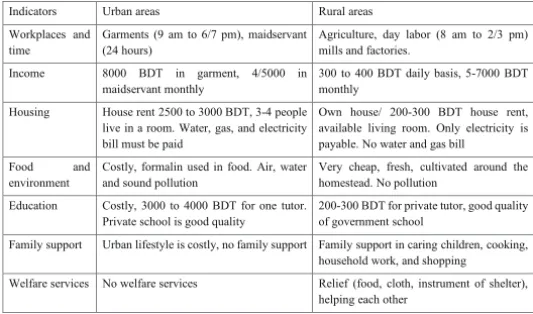
83Assessing the factors of rural to urban migration of less-educated women. Abstract Every year, due to various factors, educated and less-educated males and females migrate to urban areas in Bangladesh. The common destination of the most less- educated women is the garment industry. The main objective of this study is to identify the factors that cause less-educated rural women to migrate to urban areas and join the garment industry. The qualitative research data were collected from female garment workers at Gazipur in Bangladesh, who had migrated from rural areas, and analyzed thematically. The findings of the study show that rural poverty was a minor factor of migration for less-educated rural women because rural working opportunities have been increasing sharply. However, the findings also reveal that families and societies view divorced and separated women as bad omens, which have made their lives very uncomfortable in villages. It shows that the intolerable torture of broken families, inhuman living conditions within rural families and communities, and the demand for dowry force them to be migrants. Simultaneously, the restricted lifestyle and less freedom in villages have caused them to migrate toward urban freedom. The research findings show that for such women, urban jobs are harder to come by outside the scope of the garment industry; also, the presence of more women in the garment industry was a bonus factor. The garment industry employed more rural women as workers for their own interests. These factors were discussed and analyzed through migration theories and a new model of the rural to urban migration process in Bangladesh was created. The migration in urban is not bad but the causes and process are not good. The female migrants suffer physical and mental problems after migration. It is necessary for rural community to provide equal rights for both male and female, and for. Assessing the factors of rural to urban migration of less-educated women: A qualitative study on female garment workers in Bangladesh. Saidur Rahman. 研究論文:査読論文. 2020final.indd 83 2021/02/21 14:24. 84 研究論文:査読論文. employers to ensure proper rights for female workers.. Keywords: Rural to urban migration, rural culture, dowry, freedom, less-educated. women, female garment workers, broken family, garment industry, Bangladesh. 1. Introduction Bangladesh has a population size of 160 million and is one of the most densely. populated countries in the world. It has a long history of migration, though the data is. unavailable. The urban population in 2001 and 2011 was about 24% and 31%,. respectively (population census, 2011), which increased to 36.55% in 2018 (UNFPA,. 2018). Almost 13.5 million people left their district (internal migration), out of which,. 40% male and 28% female migrated from rural to urban places between 1990 to 2015. (UNICEF, 2015). Educated migrants get good jobs; less-educated migrant men work as. rickshaw pullers, day laborers, garment workers, whereas less-educated women work in. the garment industry¹ and few of them work as maidservants². Here, less-educated. women mean women who did not clear the Secondary School Certificate (SSC). examination in Bangladeshi education system³. At present, approximately 4 million. workers are working in the garment industry and 80% of them are women (Bangladesh. Garment Manufacturers and Exports Association, 2019). In the early stage (1980), only. 1.8% of the total workers were women. Between 2010 and 2018, the percentage. increased from 75 to 80; among the female garment workers, 85 to 90% came from. rural areas (BBS, 2019).. The legal minimum wages for garment workers are 8000 (including all⁴) BDT. (Bangladeshi currency; $95) per month (The Daily Independent, 2019). In contrast,. the estimated cost of living in Gazipur is 13,630 BDT ($177) if people live in unhealthy. places and eat minimally nutritious foods (Khan et al., 2016). Consequently, they. cannot afford good nutritious meals (consuming cheap unhealthy food) and 4/5 people. share one room (Bhuiyan, 2012, Rahman and Rahman, 2020). Female workers are. physically, verbally, mentally, and sexually abused inside and outside the factories. (Siddiqi, 2003; Rahman et al., 2018). They work on an average of 11-12 hours per day,. which can extend up to 12-16 hours during peak times (Sikder et al., 2014; Kabeer,. 2001). Due to the long working hours and arduous nature of the job, they are vulnerable. to diverse physical (headache, eye trouble, back pain, menstruation problems, etc.) and. psychological health hazards that lead to job dissatisfaction (Mahmud et al., 2018). At. the same time, since 2005, more than 700 workers have died (excluding Rana plaza) as. 2020final.indd 84 2021/02/21 14:24. 85Assessing the factors of rural to urban migration of less-educated women. a result of unsafe working conditions (ILR, 2018).. All facilities are available and seem to be better in rural areas than in urban areas (Table. 1). The minimum living cost in Gazipur is higher than earning wages of women. garment workers. The Japan News (2020) reported that job opportunities for women. in rural areas have been rapidly increasing (now 38%) and decreasing in urban areas. (now 36%). Therefore, the questions raised are about the exact factors behind the rural. to urban migration of less-educated women and their work in the garment industry in. Bangladesh. The main question of the study is, “What factors make the rural less-. educated women migrate to urban areas and join the garment industry in Bangladesh?”. The research has some additional questions based on the main research question: 1). What factors make them migrants?, 2) How do the factors combine in the process of. migration?, 3) What are the reasons for their joining the garment industry despite. facing adverse working conditions?, and 4) What makes employers interested in. employing more women though both male and female workers receive the same salary?. There is limited research available on these issues in the literature.. The structure of this study is as follows. In Section 2, the author reviews the literature.. Next, the methodology is described in Section 3. Then, the results of the interviews are. categorized based on research questions in Section 4. Next, Section 5 contains the. discussion and analysis of the study. Lastly, the concluding section contains the scope of. the discussions that will be effective for further researchers and policymakers; it will. also provide insights into the awareness of the rural family and community on migrants.. Table 1: Comparing urban and rural facilities in every sector Indicators Urban areas Rural areas. Workplaces and time . Garments (9 am to 6/7 pm), maidservant (24 hours). Agriculture, day labor (8 am to 2/3 pm) mills and factories. . Income 8000 BDT in garment, 4/5000 in maidservant monthly . 300 to 400 BDT daily basis, 5-7000 BDT monthly . Housing House rent 2500 to 3000 BDT, 3-4 people live in a room. Water, gas, and electricity bill must be paid. Own house/ 200-300 BDT house rent, available living room. Only electricity is payable. No water and gas bill. Food and environment. Costly, formalin used in food. Air, water and sound pollution. Very cheap, fresh, cultivated around the homestead. No pollution. Education Costly, 3000 to 4000 BDT for one tutor. Private school is good quality. 200-300 BDT for private tutor, good quality of government school. Family support Urban lifestyle is costly, no family support Family support in caring children, cooking, household work, and shopping. Welfare services No welfare services Relief (food, cloth, instrument of shelter), helping each other. Sources: Khan et al., 2016; Financial express, 2019. 2020final.indd 85 2021/02/21 14:24. 86 研究論文:査読論文. 2. Literature review In this section, the literature is reviewed to examine the research questions. Some. research data are available on the first and second research questions, but the literature. is limited on the third and fourth research questions. The author classifies the literature. review into two parts. The first part (2.1) is based on first and second research questions,. and the second part (2.2) is based on the third and fourth research questions.. 2.1 What factors make less-educated rural women migrants? How do the factors combine in the process of migration?. The migration factors vary from society to society, community to community, religion. to religion, and country to country. There is no particular theory that can describe all. the internal migration factors and the process itself. The author reviewed major theories. related to internal migration to examine the first and second research questions.. Theories such as 1) neoclassical theory, 2) the new economic theory, 3) push-pull. models, 4) system and network theory, and 5) feminist theory are most applicable and. useful for explaining internal migration.. First, the neo-classical migration theory describes the vast wage gap between rural and. urban areas (Todaro, 1970). The labor surplus in rural areas supplies the urban. industries and the migrants are purely rational actors mentioned in theory (Lewis,. 1954). Akar (2010) mentions that some of the main factors of migration are economic. disparities as well as discrimination between rural and urban structures. Moreover,. income disparity, poverty (Kibria, 1998), geographical location (Finan, 2004), and. unequal distribution of wealth (Afsar, 2003) are the prominent factors of rural to. urban migration. The theory explains the wage gap between rural and urban areas, but. it does not explain the cheap living cost in rural areas. The main basic needs are available. in rural areas rather than in urban areas (see table 1). The theory also indicates labor. surpluses in rural areas. At present, job opportunities are increasing rapidly in rural. Bangladesh (Japan News, 2020). Theory mentions that migrants calculate cost and. effect. However, here, the migrants did not calculate the cost-effect or wanted to escape. from rural bad culture. Therefore, the neo-classical theory does not apply to this study.. Second, families and households are chiefly responsible for migration. Here, the. decision of migration comes from the household, not the individual. People migrate to. mitigate credit barriers, as indicated in the new economic theory (Stark and Levhari,. 1982). The theory highlights that the decision of migration depends on the well-being. 2020final.indd 86 2021/02/21 14:24. 87Assessing the factors of rural to urban migration of less-educated women. of families (Kibria, 1998) and the children’s future (Hossain, 2016). This theory is. applicable in Bangladesh for those women who work under family obligations or want. to live with families in urban areas. The theory does not explain the reason behind rural. women who migrate for personal interest, not for their families’ interests. There were. no similarities between this theory and the migration factors of rural women in this. study.. Third, push-pull models explain the pressure on natural and agricultural resources; low. yield in agriculture land pushes people away as better economic conditions pull them. toward urban areas (Lee, 1966; Castles et al., 2014). When rural people lose their. homestead and cultivatable lands due to disaster, NGOs pressurize them to repay their. loans (Rashid, 2013), and fall in extreme poverty then migrate to urban (Bridges et al.,. 2011). Year-round unemployment, landlessness, and smaller properties increase. seasonal migration (Hossain, 2001). Good job opportunities, education, and treatment. in urban areas pull them to urban (Al Amin, 2011). However, the effects of agricultural. revolution disagree with the theory. Farmers are producing more harvests and can now. profit more than in the past. The theory is only applicable during disasters and for. women who work in agriculture for the family without pay. Better economic conditions. in urban areas are only reserved for the educated and businessmen, not for less-educated. migrants. Thus, this theory is partly relevant to the current study.. Fourth, network theory indicates the interpersonal relationship between migrants and. non-migrants in places of origin and destination through the ties of friendship, kinship,. and community. It creates a social network and reduces the financial cost and increases. social security (Weeks, 2008). Lack of internal migration policies (Long et al., 2008),. low migration cost, and easy access (Ortega and Perl, 2009) are additional factors.. Network theory is more relevant; it was used in the current study as rural people. maintain a good relationship with migrants.. Fifth, feminist theory indicates that our society is patriarchal, which gives men. preferential access to resources, affecting women's ability to migrate. If a breadwinner. (usually male) dies, the patriarchal society is, in particular, responsible for female. migration (Kabeer and Mahmud, 2004). Married women migrate to urban areas for. jobs, to live with their family, and marriage (Todaro, 1970). Women migrate to urban. areas to save themselves from domestic violence (Alam, 2014) and early marriages. (Rashid, 2013). The principles of feminist theory are relevant to the current study.. 2020final.indd 87 2021/02/21 14:24. 88 研究論文:査読論文. The literature explains the rural to urban migration factors, which are rural poverty, job. scarcity, properties and homestead destroyed in disasters, loss of agricultural production,. credit burden, family obligation, and hope for a bright future in an urban area free from. domestic violence. Urban areas have good educational institutions, specialized hospitals,. job opportunities, and modern facilities, which act as additional factors.. The literature provides some answers to the first and second research questions but did. not touch important factors related to the current study, such as rural job opportunities,. rural facilities, inhuman urban living conditions, other urban problems, and the. migration process. This gap between the literature and the current situation of. Bangladesh motivated the author to conduct interviews with female garment workers. who have migrated from rural areas. The author obtained the answer to the first and. second research questions from interviews that have been discussed in the results. section.. 2.2 What are the reasons for joining the garment industry despite facing adverse working conditions? What makes employers interested in employing more women though both male and female workers receive the same salary?. The author reviewed the available literature to examine research questions three and. four. Very few studies have addressed these issues. The network theory indicates that. when a known person has a job, they help others to get jobs in the same industry. The. lack of alternative jobs, low skill, domestic violence (Kabeer, 2001), and a brighter. future for the children (Rushidan et at., 2013) force women to join the garment. industry. Moreover, employers want to employ more rural women to provide less salary. (Kabeer and Mahmud, 2004).. The literature reveals that when rural people migrate to urban areas, they join the. garment industry for social networking and unavailable jobs without garment industry.. The literature reveals partial answers to the second and third research questions but. does not explain the family cycle, gender issues, and the interest of employers towards. female garment workers because the salary is the same for both male and female. workers. This gap between the literature and real-life conditions inspired the author to. conduct interviews. The results of the interviews answered the third and fourth. research questions.. In conclusion, it can be said that the literature is available for first and second research. 2020final.indd 88 2021/02/21 14:24. 89Assessing the factors of rural to urban migration of less-educated women. questions but does not explain the reason behind rural to urban migration from a. Bangladeshi perspective. Moreover, very few studies have focused on the third and. fourth research questions.. 3. Methodology of the field research The methodology is the science and philosophy behind all research. This highlights the. overall issues of the research. This section has clarified the participants, methods, and. framework of the study. The author used social work research methods⁵ in the. qualitative process of exploring the reasons behind the rural to urban migration of less-. educated women and getting jobs in the garment industry through the participants’. observations and in-depth interviews. The research was conducted and reported. following the Consolidated Criteria for Reporting Qualitative Studies (COREQ). (Tong et al., 2007). Total 25 interviewees [14 (A to N) currently working⁶ and 5 (O to. S) less-educated retired female garment workers⁷, respectively, who migrated from rural. areas; 3 (T to V) employers from the garment industry and 3 (W to Y) experts⁸) on this. issue] were selected through purposive and snowball sampling techniques from. Gazipur. The workers (19 participants) were interviewed through interview schedules. based on the first, second, and third research questions. Lastly, employers and experts. (6 participants) were interviewed based on the third and fourth research questions.. With the permission of the interviewees, the sessions were audio-recorded and later, the. recordings were transcribed into English. Participants signed an informed consent. form (no obligation for publication). The author used the N-Vivo software for. identifying the emerging themes to analyze the data. Lastly, the results of the study. were discussed, interpreted, and triangulated. Finally, the author developed a new. model for rural-urban migration.. 4. Results of the interviews This section presents the results of the interviews. The total number of participants was. 25 (details in the methodology section). The participants (female workers) were from. rural backgrounds, aged between 16 and 45 years at the time of the interviews. Out of. the 19 respondents, 14 had completed class six to nine and the rest had completed. primary school education (up to class 5). There were 17 Muslim and 2 Hindu. participants. All of them had migrated to urban areas and joined the garment industry. through the social network (relatives, friends, cousins, family). The participants had. come from 12 districts. Out of the six other participants, three were experts with. 2020final.indd 89 2021/02/21 14:24. 90 研究論文:査読論文. research experiences on the issue. The other three participants were employers who. recruited garment workers. The results have been discussed broadly under themes and. subthemes with the narratives of the participants to enrich the results. The N-Vivo. software was used to identify the themes. First, the collected data of interviews were. coded, followed by the sub-themes, and finalized within the themes (Table 2, 3, & 4) in. Figure 1.. The results are presented in three sections based on the research questions. Themes 4.1. to 4.5 (Table 2) are the main results of why participants migrated to urban areas. (research questions 1 and 2), 4.6 (Table 3) contains the causes of joining the garment. industry (research question 3), and 4.7 (Table 4) is the interest of employers to employ. women (research question 4). Participants were given a pseudonym to protect their. anonymity.. 4.1 Economic depression and rural poverty The economic crisis was very high in the rural areas of Bangladesh due to the political. unrest in 1971, a devastating famine in 1974, which was followed by many additional. disasters. Rural people had limited job opportunities; in contrast, urban areas were. Codes Themes (4.1 to 4.7). Sub- themes. Figure 1: Selecting process of themes. Source: The N-vivo software. Table 2. Factors of rural to urban migration among less-educated women in Bangladesh Present female garment workers. Themes Sub-themes Single female garment. workers (N=9). Female workers who have children. (N=5). Female retired garment. workers (N=5). 4.1 Economic depression and rural poverty. • ! Economic crisis within family and rural unemployment. 2 2 5. • ! Disasters make migrants 4 3 3 • ! Unpaid work 2 0 0. 4.2 Avoiding unpleasant social situations. • ! Social Attitudes 5 1 2 • ! Social class 0 1 1 • ! Social Prejudice 1 1 1. 4.3 Different aspects of the family environment. • ! Broken family 4 1 1 • ! Gender inequality within the family 5 1 4 • ! Non-cooperation from breadwinners 2 1 0. 4.4 Women’s freedom in urban areas. • ! To avoid the illogical parent’s decision. 3 1 1. • ! To be free in all aspects of life 8 2 0 4.5 A bright future • ! Shape their own future 5 2 1. • ! Cost of marriage (dowry) 7 1 2 • ! To support family 2 0 2. Source: The author (interviews with female garment workers). 2020final.indd 90 2021/02/21 14:24. 91Assessing the factors of rural to urban migration of less-educated women. industrialized.. Economic crisis within the family and rural unemployment Breadwinners of rural families were unable to feed their children properly. Outside. work was not easy for women. All the retired workers and one-third of the current. female garment workers migrated due to family crisis (Table 2). Interviewee Q. mentioned her family:. “When I was a kid, I had many siblings. My parents had no land and worked as day. laborers. He was unable to take care of us. I did not find regular basic work in the. village. All family members were about to die from hunger.”. It can be said that, in the past, participants were forced to migrate due to the economic. vulnerabilities in rural areas.. Disasters make migrants The people of the north-west part of the country are most affected by disasters. Most of. the participants (12 out of 19) have come from areas affected by Monga⁹, which forced. them to migrate.. “Our house was located beside the river. For four months of a year, our house was waterlogged. Our home went underwater and was destroyed by the flood. We had no work, no food, or shelter to live.” (Interview with K). As a result of a disaster, people lose their homestead and cultivated lands. Some of them. migrate to urban areas with the whole family.. Unpaid work In agriculture, 50% of the workforce are women, but the majority of them are not paid. as they work for the family. Consequently, they face serious economic problems. To. mitigate the economic crisis, they migrate.. “In the village, I did agriculture work for my family, but my parents did not pay me the money I needed. What will I do if I need money? Who will bear my cost?” (Mentioned, A). This is a common scenario in rural areas where women work for their families but are. not paid. For the sake of their future, they migrate to urban areas.. 2020final.indd 91 2021/02/21 14:24. 92 研究論文:査読論文. 4.2 Avoiding unpleasant social situations In rural areas, single women (unmarried) or women who have married late are. considered unlucky. Rural people discriminate between higher and lower classes, and. always try to avoid divorced or single women. It is predicted that they are inauspicious. for rural society.. Social attitudes Rural people still have negative social attitudes. About half of the total single migrant. workers were discriminated (Table 2). Participant M indicated:. “When I was 16 years old, I wanted to work outside. My parents agreed, but the villagers did not give me any work. They said I was a woman, physically weak. That is the perception of our rural society, which became my main reason for migration.”. Interviewees faced negative social attitudes within their communities. To get away,. they migrated to urban areas.. Social class Social class and caste systems are prevalent in the Hindu community. The upper-class. Hindus ignore and neglect the lower-class Hindus. They do not intermarry. To negate. such discrimination, Hindu women migrate to gain independence.. “My family is lower class Hindu. When I wanted to talk with upper-class Hindus, they were very angry at me because of the caste problem although we live in the same community, and no one agreed to marry me. Community people did not accept us. To avoid unpleasant situations, one day, we left the house and came to Gazipur.” (Interview with S). It has been shown that participants suffered from the social class system. Most of the. time, it was unbearable for them.. Social prejudices In rural societies, the common perception is that women must stay at home and cannot. go out for work. Moreover, single and divorced women are seen as the sin of society. At. present, these are some of the important factors of rural to urban migration.. “They (my husband’s parents) mentally pressurized me to bring money (dowry). 2020final.indd 92 2021/02/21 14:24. 93Assessing the factors of rural to urban migration of less-educated women. from my parents. Unfortunately, we were separated and divorced. I came back to my parents’ house, but they ignored me. I was physically strong and wanted to work outside the village. Community people did not give me work for being divorced. They thought I was inauspicious for society.” (Interview with D) “I am a divorced woman. My parents did not accept me because of ego problems and to avoid the negative attitude of community people. I asked them why they ignored me? They (community people) think divorced women are sinful. I am inauspicious for them.” (Interview with L). Social prejudices are exercised in rural areas. Divorced, separated women are the victims. of this system. This was one of the main factors affecting the interviewees’ migration.. 4.3 Different aspects of the family environment In Bangladesh, some parents discriminate among siblings. Most of the problems are. created in broken families¹⁰. Children of these families always feel insecure, inferior,. and mentally pressured. Near about two-thirds of the female workers migrated for. these reasons (Table 2).. Broken family Children of broken families do not receive proper care, always facing ignorance and. physical torture. About half of the total single female garment workers migrated from. broken families. Participant E clarified.. “I was born into an extended family. My father took a second wife beside my mother. My father did not look after me properly. If I wanted something, he refused although he was a rich man. He gave priority to other children of the second mother.” “When I was 3 years old, my father died from a disease. My mother married and relocated to her second husband’s house with us. My stepfather and his family members tortured me and discriminated among siblings.” (Interview with C). Narratives of interviewees reveal that children of the broken family suffer physical and. mental problems within and outside the family. They wanted to change their domestic. situation.. Gender inequality within the family Participants clarified that parents think, when they will older, their sons will take care. 2020final.indd 93 2021/02/21 14:24. 94 研究論文:査読論文. of them. Their daughter will go to the husband's house after marriage. Consequently,. parents discriminate between their children, which creates a sense of inferiority among. girls.. “My family was extended, 10 siblings. The government provided free education from class one to five. I went to school until class five. After completing my primary education, parents stopped my education. They gave more priority to my brothers’. (Interview with R). Discrimination within the family among siblings increases the mental pressure of the. victim and makes them leave the discriminatory family.. Non-cooperation from breadwinners Lack of cooperation is a common issue in rural areas from parents or breadwinners.. Participant J explained her non-cooperation from her husband and his family.. “My husband was a day laborer. He used to leave home in the morning and return at night. The whole day, I would stay with my father in law and mother in law. They did not look after me properly, always neglected and tortured me. My husband did not support me; he took his parents’ side. One day I came out from home just to inform my husband that I was going to Gazipur.”. When parents, husbands, or breadwinners do not cooperate or inspire, children or wives. face difficulties in living with their families. After a certain time, they leave the family.. 4.4 Women’s freedom in urban areas Almost everything about a woman in the family is decided by the parents or. breadwinners. Women sometimes feel very upset and terrified about their future. On. the other hand, women enjoy more freedom in urban areas. Consequently, they migrate.. All single female garment workers migrated for their freedom (Table 2).. To avoid the illogical parent’s decision Parents or breadwinners in rural areas impose their decisions on their daughters, wives,. sisters, or any subordinate women in the family. If the decision was wrong, women had. no way to deny the decision. However, the participants L explained:. “It was a bad story. I chose a man (now he is my husband) when I was young. When. 2020final.indd 94 2021/02/21 14:24. 95Assessing the factors of rural to urban migration of less-educated women. I was 14 years old, my parents tried to make me marry a man who was 35 years old. I denied and said I wanted to marry the boy who loved me. My parents did not agree, and they forced me to marry. Consequently, I left home and got married to that boy without informing my parents and came to Gazipur.” (Stated, L). The study shows that women are being dominated by men from their families and. workplaces. However, the interviewees wanted to live freely.. To be freed in all aspects of life Participants mentioned that they watched television and compared their lifestyles with. those in urban areas. In rural areas, they are restricted. However, urban women have. total freedom. Some of the participants migrated for their freedom.. “In my rural area, I have limited freedom. On the other hand, the urban area gives me total freedom. I wanted to be free from all boundaries.” (Stated, A) “In the village, we were a middle-class family. My parents fed me properly; we had no problem with food. I used to go to school with my cousins and siblings. But I had no freedom. Parents took decisions on my behalf that I did not like. It was my main reason for migration.” (Interview with L). Participants had access to other facilities in the family but no freedom. They wanted to. move freely, talk to others without hesitation, and do everything without barriers.. Consequently, they migrated.. 4.5 A bright future Participants explained that they migrated to urban areas for their own and family’s. future. Table 2 indicates that about all single female garment workers migrated for the. sake of their future.. Shape their own future Participants reported that men hold power because of money and property; women's. future depends on men. Rural women do not know what will happen in the future.. “I thought, if I stay at home, my future will vanish, no profit will come. Why do I keep myself confined inside the house? My friends and cousins are earning money. They will be financially stable, and I will be a loser. So, I came to Gazipur and joined the garment industry.” (Interview with G). 2020final.indd 95 2021/02/21 14:24. 96 研究論文:査読論文. Interviewees’ lives were dependent on the head of the family. They wanted self-reliance. that was not possible in rural areas.. The cost of marriage (dowry) In Bangladesh, most adult women are married. Dowry system¹¹ exists in some districts of. Bangladesh. Two-thirds of the participants migrated from those districts. When rural. women feel uncertain about their marriage due to dowry, they migrate to urban areas.. “I will go back to our village after saving some money. This money will be needed for my marriage because the dowry system still exists in the northern part of Bangladesh.” (Interview with H) “When I was 15 years old, my mother tried to get me married but did not find any boy because of our family status and lack of money (Dowry). It had upset me, and I decided to come to an urban area and earn money.” (Stated, B). It has been shown that when their (participants) marriages were broken, society. responded negatively. To escape such negativity and to pay their dowry, they came to. urban areas.. To support family Participants indicated that the oldest child is responsible for supporting their parents.. Some participants migrated to support the family and the children.. “I directly asked my father to permit me to go to urban areas and work in the garment industry. I told my father that after earning money for my sister’s marriage and my marriage, I would come back home.” (Interview with R). Few interviewees migrated to urban areas to support their families.. Table 3. The reasons behind migrant women joining urban garment industry Current female garment workers. Theme • ! Sub-themes Single female. garment workers (N=9). Female workers who have children. (N=5). Retired female. garment workers (N=5). Employers and. experts (N=6). 4.6 Aspects related to garment industry. • ! Family cycle 3 1 1 2. • ! Limited jobs for less-educated women, easy access in the garment industry, no job experiences required. 7 4 4 6. • ! Social networks 6 4 4 6 Source: The Author (interviews with female garment workers, employers, experts). 2020final.indd 96 2021/02/21 14:24. 97Assessing the factors of rural to urban migration of less-educated women. 4.6 Aspects related to the garment industry Table 3 contains the results of aspects related to the garment industry based on the. third research question (Why migrant women join the garment industry?).. Family cycle Participants mentioned that a daughter of garment workers is under the obligation to. join the garment industry. About one-fifth of workers joined the garment industry. because their parents forced them (Table 3).. “I stood first in class eight. I had thought in vain that one day, I would be a doctor. When I was 15 years old, my parents forced me to join the garment industry where they worked. I disagreed but had no way to ignore though they (my parents) had handsome properties.” (Stated, F). Employers justified the statements of female garment workers.. “I saw, a woman garment worker brought her daughter to the garment industry when she retired. Her daughter was 15/16 years old.” (Interview with employer W). Some participants were forced to join the garment industry because of their parents.. Limited jobs for less-educated women (easy access in the garment industry, no job experience required) Urban jobs require educational qualifications and experience except for the garment. industry, but the participants had no such qualifications. They had no options other. than jobs at garment industry although they were aware of the adverse working. conditions. All participants joined the garment industry due to these reasons (Table 3).. “I have passed class eight, no other job is available for me. Only garment industry have provided me with a job opportunity. I know the problems of the garment industry; I face these problems when working. In contrast, when I lived in the village, I felt suffocated all 24 hours of the day.” (Interview with P) “I was informed about the problems of the garment industry, but I ignored it. When I came to work, I saw the problems. I wanted to go back to the village but, then, I thought I had freedom, I can move freely in urban areas.” (Interview with I). 2020final.indd 97 2021/02/21 14:24. 98 研究論文:査読論文. No formal written exams or viva voce tests are required for a job in the garment. industry. Young women who are physically fit and migrate from rural areas are given. more priority.. “No written examination or previous experiences are needed to be garment workers. Workers come in front of the gate, we talk to them and appoint them if we have a good feeling. We take a photocopy of their national identity card (provided by Bangladeshi government for all citizens), nothing more than that.” (Interview with employer W). Participants were less educated, and in urban areas, they had few job opportunities. outside the garment industry. Moreover, they desperately needed jobs.. Social networks The basic information of the participants shows that all took jobs provided by a social. network. Interviewees came to the garment industry with the help of relatives, family,. friends, or any other social network.. “I shared the bad story with my cousin (garment worker); she inspired me to go to urban areas. She helped me to go to Gazipur to get a job.” (Explained, O). Employers gave many examples of providing jobs in the garment industry through a. social network.. “I have many examples; workers request us to give jobs to their relatives, friends, or others. They mention that relatives or friends have come from rural areas to their house, who now need a job.” (Interview with employer Y). All participants mentioned that they came to urban areas and joined the garment. industry with the help of social networks (an acquaintance).. Table 4. The reasons for prioritizing rural women in garment industry Themes Sub-themes Employers (N=3) Experts (N=3). 4.7 Aspects related to the authorities of garment industry. Owners profit more 2 3. No risk of labor unrest (easy to control) 2 3. Good finishing needs women 3 2. Source: The Author (interviews with employers and experts). 2020final.indd 98 2021/02/21 14:24. 99Assessing the factors of rural to urban migration of less-educated women. 4.7 Aspects related to the authorities of the garment industry Table 4, based on the fourth research question, contains information on the reasons. why the garment industry authorities prioritize rural migrant women over men. The. study reveals important issues.. Owners profit more The owners of the garment industry want more profits but to pay less to workers.. Experts explained that if industry owners appoint educated women, they will have to. raise their salary.. “Industry always wants more profit. If they appoint educated workers, they have to spend lots of money on the salary perspective. Otherwise, less-educated women receive limited wages. They do not know about their rights and always feel shy. As a result, employers give priority to less-educated women." (Interview with expert T),. An employer mentioned that the owner directs them to appoint more women. Women. are a weapon to earn more profits.. “This is off the records; the owner of the garment industry always wants more profits by any means. Limited wages are paid to less-educated women. Considering all sides, we give priority to women.” (Interview with employer Y). Most garment workers are rural women. They have no way to go back even if they are. paid less. The authorities of the garment industry force them to work more, which is. more profitable for them.. No risk of labor unrest (easy to control) Women are easily manageable and always terrified. If workers are men, educated, and. know about their rights, they can protest. As a result, the authorities give more priority. to less-educated rural women.. “Owners of garment industry always want to control the workers. If anything happens inside a garment industry, men gather workers against authorities. In contrast, rural women never protest because they have no way to return to villages. So, they give more priority to rural women.” (Interview with expert U) “We give priority to rural women. We believe that they are manageable and can be. 2020final.indd 99 2021/02/21 14:24. 100 研究論文:査読論文. easily controlled. They never go against us if something is wrong in the industry.” (Interview with employer Y). Employers believe that they can easily control female workers. If the authorities do. anything wrong, female workers will not protest, but male workers will do.. Good finishing needs women All employers agreed that, naturally, women are calmer and work with a softer touch. than men. The works on the garments require a calm mind and soft hands. As a result,. the authorities prioritize female workers.. “About every section (sewing, cutting, finishing) of garment manufacturing needs more patient workers. Otherwise, the product will be defective and buyers will not buy the defected product. Naturally, women are calm and can finish their work without defects. Men are mostly appointed in heavier industrial work.” (Mentioned, employer X).. It can be said that the quality of female workers’ production is more accurate than that. of male workers.. 4.8 Summary of the interview results To sum up, economic depression and rural poverty articulate the economic crisis within. families and communities in rural areas. Disasters in some districts, especially in. Monga areas, and unpaid agricultural works for women in rural areas play a vital role in. women migration. Avoiding unpleasant social situations as people in rural areas still. have prejudices is an additional factor. The social class system divides the rural people,. and social prejudices impose some illogical and illegal activities, which is why. participants decided to leave the place. Different aspects of family environment. articulate the impacts of broken families on family members, especially girls; the gender. discrimination within the family among siblings that creates a division between boys. and girls as well as non-cooperation from family members or parents, makes it easy to. migrate. Women’s freedom describes the restriction of women’s movement in rural. areas, the imposed decision of parents or breadwinners, or male members of the family,. which are important migration factors. It also focuses on women’s freedom in urban. areas, which inspires them to migrate. To avail of the opportunity that can help secure. the future of themselves, family, and children, rural women migrate to urban areas. It. also explains why rural women, who are unable to pay the dowry of their marriage,. 2020final.indd 100 2021/02/21 14:24. 101Assessing the factors of rural to urban migration of less-educated women. migrate to urban areas. The aspects related to the garment industry indicate that. women join the industry due to family pressure, lack of alternative jobs, an easy process. without educational qualifications and experiences, and the presence of more women in. the garment industry and social networks. Finally, aspects related to authorities focus. on employers recruiting rural women for more profits, to avoid labor unrest, to easily. control the workers, and to increase the quality of production.. 5. Discussions and Analysis The findings from the study show that participants migrated to urban areas to escape. discriminatory rural culture, broken family, dowry, backward society, and find urban. freedom. It also discloses that family pressure and social network pushed them to the. garment industry and the employers pulled them in to make more profit. In the section,. the author elucidates and interprets the major findings of the interviews that were not. discussed in the literature, based on four research questions.. 1) The first research question, “what factors make them migrants despite rising job. opportunities in rural areas and inhuman living conditions in urban areas?” The study. reveals that unemployment and poverty were key factors of rural to urban migration in. Bangladesh; however, now they are minor issues (Table 2) as job opportunities have. increased in rural areas (Japan News, 2020). At the same time, exploring the vulnerable. conditions of migrants in urban areas, a study found that migrants from rural areas to. cities did not have good financial conditions and most of them settled in slums and. squatter settlements (Afsar, 1999). In contrast, the neo-classical theory and push-pull. model mention good economic conditions for migration. The theories are not pertinent. for the rural to urban migration of less-educated women in Bangladesh. The findings. of the study show that parents discriminated among siblings in rural areas on education,. property, food, and other rights. Participants were usually stopped from attending. school before or after class ten, but boys were allowed to pursue higher education;. properties were given to the sons, not the daughters. Good and delicious food was fed to. the sons, depriving the daughters. These indifferences consecutively increased the. participants’ mental stress levels and family life became hell for them. A previous study. indicated that girls only attend primary and high school (6-15 years old) because. primary and secondary education is free for girls, but boys continue their education. until post-graduation (Nahar and Abu, 2018). The feminist theory demonstrates. similar results in that men are everything in the family. Another study found that rural. women always face discrimination (Kabeer and Mahmud, 2004; Zaman, 1999).. 2020final.indd 101 2021/02/21 14:24. 102 研究論文:査読論文. The study reveals that unpleasant situations within the family and society caused the. rural to urban migration of women. Participants who were divorced and returned to. their parents’ family were not accepted. They faced many problems, such as being. ignored and neglected by their community and family members, including parents.. Villagers avoided them at work because of their divorce or separation. They were seen as. sinners due to social prejudices. Consequently, they faced economic and social. problems; their children grew up with a negative mentality and were gradually isolated,. which increased their vulnerabilities. Research shows that most of the rural divorced. women cannot fulfill their dreams, facing intolerable suffering and an uncertain. future, which increase their vulnerability (Patoari, 2020; Abbas and Mushtaque,. 1997). The literature did not touch these issues of migration. Table 2 reveals that about. two-thirds of participants migrated in urban areas to escape unpleasant social. situations. The study further shows the negative impact of the broken family.. Participants from broken families were physically and mentally tortured by their. stepparents. In addition, they were physically beaten, locked within the house and were. not allowed to get higher education; they suffered from unhealthy living conditions as. they were forced to wear old dresses and had less food. The participants were mentally. tortured by stepparents such as rough behavior and caring like maidservants but kids. from new families got good behavior. It increased their mental stress and uncertainty in. the future. A previous study found that children of broken families are particularly. vulnerable, and they are always mentally stressed (Aktar, 2013). The new economic. theory states that women migrate for the benefits of family. On the other hand, the. study shows that participants migrated to escape from their family’s tortures.. The study further reveals that the marriages of the participants were cancelled for. dowry. Parents of the bride were unable to meet the dowry. Participants’ stories. demonstrate that the unmarried women were paralyzed with the fear that if they did. not manage to provide the dowry money, they would have no future. People treated. them as evil. The study shows that most of the participants migrated from the northern. districts of Bangladesh where a dowry system still exists. A previous study revealed that. about 80% of marriages required dowries in the northern districts of Bangladesh. (Begum, 2014). It can be said that the dowry system forced the participants to migrate.. Participants in this study also reported that they had less freedom in every aspect of. their rural life. The selection of groom was fixed by their parents without their consent.. The study also reveals that they had limited freedom in selecting friends, education,. work, and movement outside their home. On the contrary, urban women have the. freedom to move freely to anywhere, choose their groom, and have no obligation to. 2020final.indd 102 2021/02/21 14:24. 103Assessing the factors of rural to urban migration of less-educated women. their families. In contrast, the neo-classical theory explains the migrants as purely. rational actors; they calculate cost-benefits, expect more wages, and benefits. However,. the study shows that participants did not calculate the cost-benefit; they just wanted to. escape from rural areas. Table 2 proves that about all current female garment workers. migrated for dowry and urban freedom.. 2) The second research question, “how do these factors combine in the migration. process?” The author created a model of the rural to urban migration process (Figure 2). and combined the migration factors based on the study findings.. The tendency to migrate occurs when, for different reasons, people feel that rural. society is a cursed place. Participants of the study reported that they faced familial,. social, and cultural problems that made their lives in the village burdensome; they were,. then, determined to escape from such places. Feeling an inspiration to migrate, people. calculate the benefits of migration. The study shows that interviewees wanted to leave. their village homes at any cost to escape from bitter rural living conditions. They. (Individual, household and. community). • Broken families. • Non-cooperation. • Rural culture. • Social class, prejudices and negligence. • Social diseases (dowry). • Subordinate life. • Discriminations . • Backdated community. Social networking with friends, family, relatives, and nearest person. (Benefits). • Release from family unrest. • Busy people in urban areas, no time to criticize. • Stress-less life. • Relief from social hazards. • Get a good husband. • Freedom in every aspect of life. Finally migrating to urban areas!. Tendency to migrate. (incidents). Inspiration to migrate. Take decision to. migrate. Intentions to migrate. Source: Designed by the author based on the study findings. Figure 2: Model and process of rural to urban migration in Bangladesh. 2020final.indd 103 2021/02/21 14:24. 104 研究論文:査読論文. thought that by changing their living space, they will be free; there will be no stress, no. social barriers, no family conflict, and the freedom to do everything without. accountability. This is followed by the intentions to migrate; people communicate with. migrants who have migrated before. Participants’ basic information demonstrates that. female garment workers communicated with migrants and shared their problems,. expressing their intention to migrate. Last, the final decision; when people get positive. news about job vacancies and shelter from migrants, they finally left the rural areas.. 3) The third research question was, “what are the reasons for their joining the garment. industry despite facing adverse working conditions?” The study shows that participants. joined the garment industry due to their low educational qualification, family. obligation, easy process, and social networking (Table 3). In urban areas, all jobs need. good educational qualifications and experience except for the garment industry.. Participants’ stories confirm that none of them has SSC level of education. The study. also reveals that family cycles and social networks play an important role in the garment. workers’ lives. Families, parents who worked in the garment industry, force their. daughters to work in the same industry without their consent. In the case of social. networks, participants maintained relationships with migrants who were mostly. garment workers and helped them to get jobs in the same industry. Network theory. indicates that migrants help non-migrants. Kabeer (2001) mentioned the smaller scope. of jobs, uncertain future, and loss of breadwinners. Participants in the study reported. that when they saw about four-fifths of garment workers were women, they were. inspired to work in the garment industry.. 4) The fourth research question, “what makes employers interested in employing. women though the salary is the same for male and female workers?” The study reveals. that the authorities in the garment industry find women easy to control, who provide. them with quality work (Table 4). In addition, if the employers do anything wrong,. such as pressurizing the workers for extra work, providing salary late, or cutting off. other facilities, female workers do not protest because they want to live in cities and. have no way to go back to the village. Thus, the authorities are interested in recruiting. rural women to make more profits. A previous report by John Chalmers in Reuters. (2013) found that the Bangladesh garment boom made X (pseudonym) a wealthy man. from a single garment. His elegant home in Dhaka looks like heaven. The study further. shows that the garment works need calm workers who can work with a singular focus.. Naturally, women work with a calmer mind and their finishing is better than male. workers, which is another factor.. 2020final.indd 104 2021/02/21 14:24. 105Assessing the factors of rural to urban migration of less-educated women. 6. Conclusions The main purpose of this study is to determine the factors that make rural less-educated. women migrants and join the urban garment industry in Bangladesh. The literature. focuses on rural poverty, agriculture, calamity, domestic turmoil, patriarchy, and urban. facilities, which are the factors of rural to urban migration. It also highlights that. migrants join the garment industry for social networking as other jobs are unavailable. for them in urban areas; employers recruit more rural women to provide less wages.. This was a qualitative research study, conducted at Gazipur district in Bangladesh. among female garment workers who have migrated from rural areas. The N-Vivo. software was used to shape the themes of the research results, focusing on the research. questions.. The results of the interviews were based on the research questions and were thematically. analyzed. The findings of the study revealed that participants migrated to urban areas. to escape discrimination among siblings, negligence, and oppression by step-parents. within their broken families as well as ignorance and social superstition towards. divorced or separated women by their family and community, impacts of the dowry. system, and a confined lifestyle to find urban freedom. The study also shows that they. desperately wanted to escape from rural problems and contacted migrants who had. migrated earlier. Participants maintained the migration process (Figure 2) that the. author created and combined with the migration factors based on the results of the. interviews. The findings of the study show that migrants joined the garment industry. because of the family cycle, bigger working opportunities, the presence of more female. workers, and former migrants. It also shows that employers are interested in employing. more women because they are easily manageable with no risk of labor unrest, making. better products and bringing in more profit.. Less-educated rural women are now in a dilemma where they will go, live, and what. they will do. Both villages and cities are not suitable places for them. In villages, they. have very limited freedom, and face social negligence. Due to situations (migration. factors), nearly all less-educated rural women grow up with trauma in Bangladesh. To. relief from trauma, they migrate to urban areas. On the other hand, cities have freedom. but bad experience with basic needs and social security, inhuman life. In this. perspective, migration is not the way of solution. Government, non-government. organizations, and voluntary associations should come forward to minimize the rural. unpleasant situations. Identifying the factors of migrations, the rural community. should be awarded on the negative consequences of migrations. Formulating and. strictly implementing the laws to ensure the equal rights of men and women in rural. 2020final.indd 105 2021/02/21 14:24. 106 研究論文:査読論文. Footnotes. 1. The garment industry is a sector that manufactures semi-durable consumer goods to fulfill the basic clothing needs of individuals. It produces all kinds of clothes and accessories that include outerwear, underwear, leather clothes, etc.. 2. Maidservant is a female domestic worker who is assigned to all household works. No limited working time, no formal salary, it is a contractual basis.. 3. https://www.scholaro.com/pro/Countries/Bangladesh/Education-System. 4. House rent, health insurance, transport bills, etc.. 5. Social work research means conducting inquiry according with the scientific method. The aim of social work research is to search for hidden answer that have not yet identified or known and to build social work knowledge base in order to give conclusions on observations. To observe and collect the data, social work relies on several research methods as like survey, case study, anthropological, historical and focus group discussion (Rubin, et al. (2011). “Social work research begins with practical problems and its objective is to produce knowledge that can be put to use in planning or carrying on social work programs.”-Marry E. M.. 6. Present female garment workers mean single (unmarried or divorced without children) female garment workers and married female garment workers who have children. 7. Ex-female garment workers indicate women, who did the job in the garment industry now retired from the garment.. 8. Experts are NGO workers and university professor.. 9. Monga is a Bengali word referring to the yearly cyclical phenomenon of poverty and hunger for disaster. 10. Broken family means divorce of participants, divorce or separation of parents and second marriage of mother or father.. 11. Dowry means, at the time of marriage, the groom or his family demand money or goods and the bride or her family fulfill the demands.. areas that can safeguard for rural women. Despite new efforts to identify rural to urban. migration, more research is needed on rural women, rural culture, and rural. development including more samples, villagers, family members, and local government. representatives. Further research is needed on the well-being and their survival. strategies of female garment workers who have already migrated and work in the. garment industry.. References. Abbas, B. & Mushtaque, C. (1997). The Effect of Divorce on Child Survival in a Rural Area of Bangladesh, Population Studies, 51:1, 57-61. DOI: 10.1080/0032472031000149726. Afsar, R. (2003). Internal migration and the development nexus: The case of Bangladesh. paper presented at the regional Conference on Migration. Development and Pro-Poor Policy Choices in Asia, Dhaka.. Akar, H. (2010). Challenges for schools in communities with internal migration flows: evidence from. 2020final.indd 106 2021/02/21 14:24. 107Assessing the factors of rural to urban migration of less-educated women. Turkey. International Journal of Educational Development, 30, 263-276.. Aktar, S. (2013). Effects of family breakup on children: A study in Khulna city. Bangladesh E-journal of sociology, 10(1) 138-152. Retrieved from https://www.bangladeshsociology.org/BEJS%2010.1%20 Shirina%20Aktar.pdf. Al Amin, M. M. (2011). Aspects at the back of internal migration and exploring the changes in migrant’s livelihood after their arrival in Dhaka city, Bangladesh (Master’s thesis). Retrieved from file:///C:/ My%20documents/Folder%20of%20thesis/Article%20(with%20nvivo,%2017,3,2020)/ Applicatuion%20of%20theory%20in%20text.pdf. Alam, Z. (2014). Migration scenario in Bangladesh: prospects, problems and policy issues. Migration and Urbanization. Retrieved from file:///C:/My%20documents/Kubayashi%20Sensei/Migration%20 theory/Internal/Migration_scenario_in_Bangladesh_Prospec.pdf. Bangladesh Bureau of Statistics (BBS). (2019). Labour Force Survey. Ministry of Planning, Bangladesh: Bangladesh Bureau of Statistics. Retrieved from:<http://bbs.portal.gov.bd/sites/default/files/files/ bbs.portal. gov.bd/page/96220c5a5763 4628 9494 950862accd8c/QLFS2015.pdf>. Bangladesh Garment Manufacturers and Exporters Association (BGMEA). (2019). Retrieved from http:// www.bgmea.com.bd/home/pages/TradeInformation. Begum, A. (2014). Dowry in Bangladesh: a search from an International perspective for an effective legal approach to mitigate women’s experiences. Retrieved from https://ro.uow.edu.au/cgi/viewcontent. cgi?referer=https://www.google.com/&httpsredir=1&article=2532&context=lhapapers. Bhuiyan, M. Z. A. (2012). Present Status of Garment workers in Bangladesh: An analysis. IOSR Journal of Business and Management, 3(5), 38–44. Doi: 10.9790/487X-0353844. Bridges, S; Lawson, D; Begum, S. (2011). Labour Market Outcomes in Bangladesh: The Role of Poverty and Gender Norms. European Journal of Development Research, 23, Retrieved from www.palgrave- journals.com/ejdr.. Castles, S. et al. (2014). The Age of Migration International Population Movements in the Modern World (4th ed.). Palgrave: Macmillan. . Editorial, (2019, November 4). Improving rural people’s living standard. The Financial Express. Retrieved from https://thefinancialexpress.com.bd/editorial/improving-rural-peoples-living- standard-1572884205. Finan, T. (2004). The dynamics of debt in southeast Bangladesh. Dhaka, mimeo: CARE Bangladesh.. Hossain, B. M. et al. (2016). The contribution of garments industry in Bangladesh economy. International Journal of Advanced Scientific Research, 1(6), 11-14. Retrieved from www.allscientificjournal.com. Hossain, M. Z. (2001). Rural-Urban Migration in Bangladesh: A Micro-Level Study. Paper presented at the International Union for the Scientific Study of Population (USSP), General Conference, Salvador.. ILR. (2018). The Rana Plaza Accident and Its Aftermath. Retrieved from https://www.ilo.org/global/ topics/geip/WCMS_614394/lang--en/index.htm. John, C. (2013). How textile kings weave a hold on Bangladesh (special report). Reuters. Retrieved from https://www.reuters.com/article/us-bangladesh-garments-special-report/special-report-how-textile- kings-weave-a-hold-on-bangladesh-idUSBRE9411CX20130502. Kabeer, N. & Mahmud, S. (2004). Globalization, gender and poverty: Bangladesh women workers in export and local marker. Retrieved from file:///C:/My%20documents/Folder%20of%20thesis/Article%20 (with%20nvivo,%2017,3,2020)/why%20they%20came%20to%20garment.pdf. Kabeer, N. (2001). Bangladeshi Women Workers and Labour Market Decisions: The Power to Choose. Dhaka: UPL.. Khan, M. E., Anker, R., Anker, M., & Barge, S. (2016). Living wage report, Dhaka, Bangladesh and satellite cities, context: the garment industry. Retrieved from https://www.isealalliance.org/sites/default/files/. 2020final.indd 107 2021/02/21 14:24. 108 研究論文:査読論文. resource/2017-12/Dhaka_Living_Wage_Benchmark_Report.pdf. Kibria, N. (1998). Becoming a garments worker: The mobilization of women into the garments factories of Bangladesh. UNRISD Occasional Paper, No. 9 Provided. Lee, S. E. (1966). A Theory of Migration. Demography, 3(1), 47-57.. Lewis, W. A. (1954). Economic Development with Unlimited Supplies of Labour. Retrieved from http:// www. globelicsacademy.net/2008/2008_ lectures/lewis%20unlimited%20 labor%20supply%201954. pdf. Long, H.; Wu, X.; Wang, W. & Dong, G. (2008). Analysis of Urban-Rural Land Use Change during 1995- 2006 and Its Policy Dimensional Driving Forces in Chongqing, China. Sensors, 8, 681-699.. Mahmud, R. et al (2018). Health Issues of Female Garment Workers: Evidence from Bangladesh. The Journal of Population and Social Studies, 26(3), 181-194. Retrieved from https://doi.org/10.25133/ jpssv26n3.013. Nahar, A. & Abu, A. M. H. (2018). Women Empowerment: Trends, Problems and Prospects. Dhaka: Agami Publication.. Ortega, F. & Perl, G. (2009). The Causes and Effect of International Migration: Evidence from OECD Countries 1980-2005. Retrieved from file:///C:/Users/Saidur%20Rahman/Downloads/The_ Causes_and_Effects_of_International_Migrations.pdf. Patoati, M. H. (2020). Socio-economic and cultural causes and effects of increasing divorce rate by women in Bangladesh: A critical analysis. Asian journal of social sciences studies, 5 (1), 21-31. Retrieved from https://doi.org/10.20849/ajsss.v5i1.713. Population and Housing Census. (2011). Socio-Economic and Demographic Report National Series. Statistics and Informatics Division (SID), Ministry of Planning: Bangladesh Bureau of Statistics (BBS). Retrieved from http://203.112.218.66/WebTestApplication/userfiles/Image/BBS/Socio_ Economic.pdf. Rahman, S. Yesman, K. & Ahmed, R. (2018). Working environment of the female garment workers in Bangladesh: An observation. The journal of empowerment, 25 (1), 47-63. Retrieved from https://www. researchgate.net/publication/339781653_Working_Environment_of_the_Female_Garments_ Workers_in_Bangladesh_An_Observation_Working_Environment_of_the_Female_Garments_ Workers_in_Bangladesh_An_Observation. Rahman, T and Rahman, S. (2020). Workplace environment of garment industry: An opinion survey of the adolescent female garment workers in Bangladesh. Paper presented at Malaysia in International conference on social sciences. Retrieved from https://www.researchgate.net/publication/339781401_ Work_Place_Environment_of_Garment_Industry_An_Opinion_Survey_of_the_Adolescent_ Female_Garment_Workers_in_Bangladesh. Rashid, M. M. (2013). Rural-Urban Female Migration in Bangladesh: Need for Information Support and Institutional Responses. Global Journal of Human Social Science Sociology & Culture, 13(5), 249-260.. Rubin, A. & Babbie, E. (2011). Research methods for social work (seventh edition). USA: Belmont, CA 94002-3098. Rushidan, I. R. and Rizwanul I. (2013). Female labour force participation in Bangladesh: trends, drivers and barriers. ILO Asia-Pacific Working Paper Series. India: DWT. Shimbun, Y. (2020, March 6). Bangladesh: Female employment falling in cities in contrast to rural areas. The Japan News. Retrieved from https://the-japan-news.com/news/article/0005978632. Siddiqi, D. M. (2003). The Sexual Harassment of Industrial Workers: Strategies for Intervention in the Workplace and Beyond. Retrieved from https://cpd.org.bd/pub_attach/unfpa26.pdf. Sikder, H. M. et al., (2014). Socio-Economic Conditions of the Female Garment Workers in the Capital City of Bangladesh. International Journal of Humanities and Social Science, 4(3), 173-179. Retrieved. 2020final.indd 108 2021/02/21 14:24. 109Assessing the factors of rural to urban migration of less-educated women. from http://www.ijhssnet.com/journals/Vol_4_No_3_February_2014/17.pdf. Staff reporter, (2019, January 14). Government revises pay structure for RMG workers. The Daily Independent. Retrieved from http://www.theindependentbd.com/post/183137. Stark, O., & Levhari, D. (1982). On migration and risk in LDCs. Economic Development and Cultural Change, 31(1), 191-196.. Todaro, M. P. (1970). Internal Migration in Developing Countries: A Survey. In R.A. Easter line (Ed.), Population and Economic Change in Developing Countries. Chicago: University of Chicago Press.. Tong, A., Sainsbury, P., & Craig, J. (2007). Consolidated criteria for reporting qualitative research (COREQ): A 32-item checklist for interviews and focus groups. Int. J. Qual. Health Care, 19, 349– 357. UNFPA Bangladesh, (2018). Progress and highlights. Retrieved from https://bangladesh.unfpa.org/sites/ default/files/pub-pdf/UNFPA_Bangladesh_2018_annual_report-HR-MAY%2020.pdf. UNICEF. (2015). Migration profiles (report). Retrieved from https://esa.un.org/miggmgprofiles/ indicators/files/Bangladesh.pdf. Weeks, R.J. (2008). Population: An Introduction to Concepts and Issues. WADSWORTH CENGAGE Learning, USA.. Zaman, H. (1999). Violence against women in Bangladesh: issues and responses. Women’s study international forum, 22(1), 37-48. https://doi.org/10.1016/S0277-5395(98)00093-4. Acknowledgement. First of all, indebtedness and thankful to my honorable academic supervisor SATO Mine (Associate Professor, Yokohama National University, Japan) for her cooperation, guidelines, and valuable instructions. Female garment workers, respondents of the study; special thanks for their participation. I am grateful to Mustofa and Saiful, who managed the participants for interviews. I am thankful to Kazia Yesman and Papia Khatun, who supported to collect the data. Also thankful to Hasan Faruque and Sohag Hossain, who checked Bangla and English scripts with audio recording as well as field notes. I acknowledge the Editage for the proofreading.. ( 1. Ph. D. Student, Institute of Urban Innovation, Yokohama National University, Japan. 2. Assistant Professor, Institute of Social Welfare and Research, University of Dhaka, Bangladesh.). Received after peer review on December 1st, 2020. 2020final.indd 109 2021/02/21 14:24. 110 研究論文:査読論文. 毎年、バングラデシュでは、高等教育を受けていない地方の女性が、都. 市部の縫製産業の工場で勤務するために移住している。農村部での労働機. 会が急激に増加しており、そこからの収入も向上しているにもかかわらず、. その波が止まることはない。そこで本研究では、それらの女性が都市部に. 移住し、縫製産業に参加する要因について分析・考察する。質的調査デー. タは、ダッカ近郊のガジプールに農村から移住した女性紡績工から収集・. 分析された。調査結果によると、プッシュ要因としては、離婚・別居した. 女性へのスティグマ、男尊女卑的な生活条件、結婚時の持参金の強要、な. どジェンダー差別に関わる要因が彼女らに移住を決意されることが理解さ. れた。プル要因としては、工場で働く知人友人からの勧誘、都市でのより. 束縛されないライフスタイルの希求が挙げられた。また、雇用者への聞き. 取りから調査結果によると、手先が器用でモビリティが低く低賃金で働き. 彼女らはボーナス要因であることも理解された。本稿では更に、これらの. 要因と移住理論を比較検討し、バングラデシュの農村から都市への移住プ. ロセスの新しいモデルが作成し、提言へつなていく。. 農村から都市への高等教育を受けていない 女性による移住の要因分析 バングラデシュの女性縫製労働者に関する定住的研究. Saidur Rahman. 日本語要約(Summary in Japanese). 2020final.indd 110 2021/02/21 14:24

Table 1: Comparing urban and rural facilities in every sector
Figure 1: Selecting process of themes
Table 3. The reasons behind migrant women joining urban garment industry  Current female garment workers  Theme  •! Sub-themes  Single female  garment  workers (N=9)  Female  workers who  have children  (N=5)  Retired female garment  workers  (N=5)  Employ
Table 4. The reasons for prioritizing rural women in garment industry
+2

参照

関連したドキュメント

n , 1) maps the space of all homogeneous elements of degree n of an arbitrary free associative algebra onto its subspace of homogeneous Lie elements of degree n. A second

After proving the existence of non-negative solutions for the system with Dirichlet and Neumann boundary conditions, we demonstrate the possible extinction in finite time and the

This paper presents an investigation into the mechanics of this specific problem and develops an analytical approach that accounts for the effects of geometrical and material data on

The object of this paper is the uniqueness for a d -dimensional Fokker-Planck type equation with inhomogeneous (possibly degenerated) measurable not necessarily bounded

In the paper we derive rational solutions for the lattice potential modified Korteweg–de Vries equation, and Q2, Q1(δ), H3(δ), H2 and H1 in the Adler–Bobenko–Suris list.. B¨

Abstract. The backward heat problem is known to be ill possed, which has lead to the design of several regularization methods. In this article we apply the method of filtering out

While conducting an experiment regarding fetal move- ments as a result of Pulsed Wave Doppler (PWD) ultrasound, [8] we encountered the severe artifacts in the acquired image2.

In section 4 we use this coupling to show the uniqueness of the stationary interface, and then finish the proof of theorem 1.. Stochastic compactness for the width of the interface