Decentralization and Local Development in Indonesia:
A Case Study of Mining Transnational Corporation
DOCTORAL DISSERTATION
Prepared By:
Indra Pradana Singawinata
(61104002)
Supervisor:
Professor Miyoshi Koichi
GRADUATE SCHOOL OF ASIA PACIFIC STUDIES
RITSUMEIKAN ASIA PACIFIC UNIVERSITY
JAPAN
2006
TABLE OF CONTENTS
CHAPTER 1 INTRODUCTION... 1
1.1 The Research Problem 1
1.2 Research Questions 7
1.3 Research Objectives 9
1.4 Scope of the Research 10
1.5 Significance of the Research 11
1.6 Limitations of the Research 13
1.7 Structure of the Paper 14
CHAPTER 2 METHODOLOGY... 18
2.1 Research Paradigm 18
2.2 Methodological Philosophy and Strategy of Enquiry 19
2.3 Data Collection 20
CHAPTER 3 LITERATURE REVIEW ... 27
3.1 Theories of Governance 27
3.1.1 Decentralization, Governance and Mining 29
3.2 Economic Development 35
3.3 Sustainable Development Concept 39
3.4 Environmental Impact Analysis 42
3.5 Social Change 45
3.6 Political Theory 48
3.7 Conceptual Framework 52
CHAPTER 4 MINING INDUSTRY (1945-2005) ... 54
4.1 Post-colonial period (1945 - 2005) 54
4.2 Parliamentary Democracy: December 1949 - July 1959 57
4.3 Guided Democracy: July 1959 - March 1966 61
4.4 Pancasila Democracy: March 1966 - May 1998 70
4.5 Era Reformasi: May 1998 - Present 80
4.6 Regime Change and Mining 93
CHAPTER 5 MINING UNDER REGIONAL AUTONOMY ... 100
5.1 Indonesian Mining Industry Condition: 2000-2005 100
5.2 Potential of the Indonesian Mining Sector 102
5.3 The Mining Industry’s Contribution to National Development 106 5.4 The Problems: Dramatic Decrease in Investment in the Mining Industry 111
5.6 The Impact of Regional Autonomy on the Mining Industry 121
5.7 Summary of findings 125
CHAPTER 6 INCO AND LOCAL STAKEHOLDERS ... 128
6.1 PT International Nickel Indonesia (INCO) 128
6.2 INCO’s Contribution to Regional Development 133
6.2.1 Community Development Program 138
6.3 Mining Circle Areas 139
6.4 Sorowako 143
6.5 Recent Issues 148
CHAPTER 7 CONTRIBUTION TO THE LOCAL DEVELOPMENT ... 150
7.1 Economic Development Perspective 150
7.2 Environmental Impact Management System 156
7.3 New Sustainable Development Model Approach 160
7.4 Summary of findings 171
CHAPTER 8 THE IMPACT OF MINING INDUSTRY ON THE LOCAL
COMMUNITY UNDER THE DECENTRALIZATION ... 173
8.1 Local Stakeholders in INCO’s Operations 173
8.2 Local Stakeholders’ Perception 181
8.3 Critics from The Environmental NGOs’ Perception 226
8.4 Summary of findings 229
CHAPTER 9 CONCLUSION AND RECOMMENDATION... 239
9.1 Summary of Discussion and Main Findings 239
9.2 Conclusions and Recommendations for Policy 242
9.3 Areas for Further Research 248
CHAPTER 1 INTRODUCTION
1.1 The Research Problem
In the few decades or so global minerals extraction has been transformed from a
rather fragmented industry characterized by small-scale operations to one dominated by
a relatively concentrated group of transnational corporations (TNCs) managing massive
operations in remote areas of the developing world. Such large operations are bound to
have considerable impacts on people living in the vicinity, the most affected of who are
often poor, rural and indigenous. Decentralization of government has also become a
global phenomenon in the last few years and almost all developing countries have
attempted some kind of decentralization. This research attempts to discuss a TNC
mining operation in the context of highly-decentralized Indonesia.
Indonesia; the archipelagic country with vast and various natural resources, is
prospectively one of the richest countries in the world (Coutrier 2002). Spreading from
Sabang in the northern part of Sumatra to Merauke in Papua (formerly known as Irian
Jaya) natural resource deposits such as oil, gas, minerals, and geothermal resources, are
found in abundance (Coutrier 2002; Wahju 2002). The Dutch, Portuguese and English
Colonial Period in the 18th Century up until the archipelago gained independence in
August, 1945.
Directly after Independence, it was stated in the first verse of Article 33 of the 1945
National Constitution (UUD 1945) that natural resources are under the sovereignty of
the state and that their utilization should be maximized in order to bring prosperity to
the people of the Republic of Indonesia. This Article is the legal basis that allows any
capable entity or institution in the country to explore, use, manage and utilize natural
resources in order to bring the people’s wealth to higher level as the ultimate goal
(Kiroyan 2002a). Regarding the ultimate goal, it is highly expected that people's
prosperity will be significantly increased through the exploitation of such resources. In
short, significant results in economic and social welfare developments must be proven
by implementing some indicators as assessment tools.
In addition, to give positive impact on the environment and community’s
development, environmental management must be considered and becomes a high
priority in achieving the meaning of “development” itself. In this context, management
of the environment is now being formulated as integrated activities and efforts in
utilizing, arranging, preserving, supervising, controlling and evaluating (environmental
(Kiroyan 2002a).
In modern times, even during the monetary crisis in the late 1990s, the mining
sector as one area of natural resource exploitation continues to contribute to Indonesian
domestic income a relatively consistent amount. This averaged at around 3 - 5 percent
of total GDP in 1999 – 2005 (Purnomo 2005). The statistical data of Gross Domestic
Income in 2002 showed that the mining sector alone had contributed Rp. 1.340 trillion
(PricewaterhouseCoopers 2003). That was from the cash inflow. Furthermore, if we
look at overall development in the local areas, in general mining sectors have
contributed significantly in terms of development results to the local social welfare such
as wealth, physical infrastructures such as roads, communication systems, water
supplies, electricity and also some multiply effects like new development in local
economic sectors such as localbusiness activities, shops, markets, and so on (Kiroyan
2000a; Wahju 2002). One significant positive factor is the opportunity of increased
employment for local people. This is something which holds much promise for the
future if giant mining companies would expand their operational area wider, a move
which is also expected to involve multiplier effects and important consequences for
regional development (LPEM UI 2005).
occur and have become some of the most talked about issues in Indonesia today. The
problem is also very complex because this issue is multidimensional and involves
economic, social, environmental and political elements. This is indicated by the
involvement of a wide array of different kinds of interest groups. An example of this
complexity is the Freeport case in Timika, Irian Jaya. In 1995 riots exploded between
the local people and the company’s employees and security forces, representing one of
the biggest social disturbances involving the mining industry in Indonesia. The case was
connected to some of the highest and most powerful groups in Indonesia, such as
Soeharto’s family and clan, the Indonesian armed and security forces (including both
the army and the police) and even U.S politicians (Leith 2003). Since the problem was
first discovered and exposed by the media in 1995, Freeport has faced both national and
international critics including allegations of environmental damage, human rights issues,
money politics and other KKN-related issues. This case has also negatively impacted
seriously on the image of the national mining industry in general, leading to a dramatic
increase in radical anti-mining campaigns held by environmental NGOs (Leith 2003).
Era reformasi (the era of reformasi) was heralded when Soeharto finally stepped
down from his position as President on May 21st 1998. Since this important event the
included the freeing of the press, lifting restrictions on the number of political parties
allowed and a reduction of the military’s political role. These changes led to calls for a
restructuring of relations between Jakarta and the regions. These calls were particularly
vocal in resource-rich yet impoverished areas and were answered with one of the
biggest political changes in the history of the nation. The implementation of a
decentralized system which devolves significant power and authority to the regions
under the new national system coined ‘regional autonomy’ (Tim Redaksi Kompas
1999b). Ordinance No. 22/1999 on regional government (and its subsequent revision –
Ordinance No. 32/2004) and Ordinance No. 25/1999 on the fiscal balance between the
central and regional governments (which was also revised and replaced by Law No.
33/2004) were enacted officially in January 2001. The promulgation of these laws
signified Indonesia’s entrance into a new era in which substantial powers,
responsibilities and financial capacities are delegated from the central government to
regional authorities, mostly to the regency/municipal (kabupaten/kota) level. To a
significant extent, these laws allow regional authorities to autonomously govern and
manage their own respective finances, political and administrative institutions and
natural resources (Brodjonegoro 2002; World Bank 2003; Ahmad & Hofman 2000)).
surrounding natural resources, the decentralization policy would be expected to amount
to significant changes in policy regarding the mining sector. Mining is a huge source of
revenue and thus very important to the development of regions especially in
decentralization era, as is the foreign investments in the sector. Some investors and
business journals predicted that the decentralization and democratization of Indonesia
would cause confusion, extra demands and a more difficult operating environment for
multinational-backed mining ventures. As one author claimed ‘what concerns
companies is the way the draft mining legislation weighs them down with additional
social responsibilities’ (McBeth 2002). Also according to one senior mining executive:
‘in effect, they’re asking us to take the place of the government’ (McBeth 2002).
Increased conflict and threat of violence directed at public and private resource
extraction companies was also expected as one consequence of decentralization (Peluso
2007).
Other sources note that the political changes amount to a long-awaited victory and
hold much hope for the future of people and communities whose lives are affected by
mineral extraction operations (Legowo & Takahashi 2003). The decentralization policy
was expected to empower many of these communities who believed that the historical
their favor, involved coercion and also that they were never properly compensated for
their loss of land and livelihoods.
1.2 Research Questions
The research problem for this study, therefore, involves a need to present and clarify
what has actually been the impact of decentralization on the mining sector in Indonesia.
This problem includes several dimensions:
• Mining sector policy and governance;
• The behavior of multinational-backed companies in regards to their contributions
to communities and their development; and
• The condition of mining affected communities.
How these have changed along with the regime and decentralization is the main focus of
this study. These will be explored through an in-depth case of one largest nickel-mining
operation located in Sorowako, South Sulawesi.
In order to address this main question a number of supporting sub-questions have
been formulated. These include:
1. With decentralization, how have the political, economic, and environmental
2. Are there changes evident in the mining sector itself? If so, what are they?
3. Have decentralization and the changes in the mining sector policy brought
about a change in the multinationals’ performance in terms of contribution to
local development? In what way?
4. Have the changes translated into a change of condition (economic, social,
environmental) for mining-affected communities?
The first and second of these sub-questions are addressed in Chapters 4 and 5
through a detailed and systematic description and analysis of the political conditions
and impacts on the mining industry since independence in 1945 up to reformasi until
2005. Chapters 6 and 7 provide the answer to the third sub-question through and
represent the first part of the case study, which focuses on the case corporation (PT
INCO in Sorowako). The fourth and final sub-question is addressed through the second
half of the case study which focuses on the local community actors and is outlined in
1.3 Research Objectives
A number of research objectives were formulated in response to the research
problem and in order to answer the research questions, both of which are outlined above.
The research objectives have also served to provide guidance and direction to the study.
Before detailing the objectives of the study it is useful to note that the main purpose of
the research was to produce a single, in-depth case study of a multinational mining
company operating in Indonesia.
Specific issues to be analyzed for this case included: the contribution of the
company to the local communities affected by its operations; the local actor’s condition
as a result of these contributions; the personal or group factors that relate to the different
local actors (regency government, regency parliament (DPRD), district government, and
the community councils); the perceptions of these local actors towards the performance
of INCO’s current contribution; how the system of the company’s community
development contributions works in relation to the various local actors; the benchmarks
for measuring the adequacy of INCO’s contributions; whether or not there is evidence
of a gap between the local perception and other benchmarks; and the factors that
contribute to the appearance of different perceptions on the performance of INCO’s
The specific research objectives developed to support formation of the case were to:
• Conduct a comprehensive analysis of the actors’ perceptions and expectations in
regards to INCO’s nickel mining operations and its impacts on economic
development and socio-environmental aspects in the newly decentralized context;
• Map the actors concerning these issues at the local level;
• Investigate the rationale behind the establishment of community councils and to
question whether inadequate representation at the regional level was the basis for
this development;
• Assess the potential security issues that may present themselves in the future.
In regards to the logic of these objectives and the research questions listed above, it
is a main preposition of this research that personal or group factors play a significant
role in affecting the perception of the different local actors on the implementation of
INCO contributions following the enactment of the decentralization policy in Indonesia.
1.4 Scope of the Research
This study does not intend to analyze the economics of mining, since this is already
an academic discipline on its own. This study is also not an environmental paper that
research focuses on the contributions and obligations of mining companies to the
communities affected by their operations and their economic and environmental
well-being in light of the prevailing socio-political situation.
The nature of this study is primary data research. The reason for this focus on
primary data is the nature of this study that is multi-discipline and is aimed at
uncovering the actual conditions in the field.
1.5 Significance of the Research
There have been various studies on mineral resources, including those focusing on
the environmental aspects, economic aspects as well as the social impacts and political
processes behind mining. Especially with regards to INCO’s operation; the first book
was written by Australian anthropologist, Kathryn Robinson in 1986 and the other one
was by Indonesian well-known environmentalist figure, Arianto Sangaji in 2002. The
studies are quite similar in nature in that both concentrated on the negative aspect of
INCO’s operation.
This study is significant for the quality of the data that is obtained through field
visits and interview with the various stakeholders in mining industry. The findings of
socio-environment in mining operation area in light of changing socio-political situation at
national level.
The findings of this study provide inputs for policy recommendation in minimizing
the impacts of the changing the actors’ perception in mining industries. There are indeed
various NGO papers directed at this issue, however most of it has been questionable due
to the strong bias towards anti-mining movements.
This study does not serve as a pro-mining paper, instead this study tries to take a
neutral stand by looking at the actual demand from the stakeholders, and how the
research object has fulfilled the obligations. The gap between the performance of the
research object and the demand from the stakeholders serve as a useful policy input as
well as in identifying possible inconsistencies in each stake holder’s view that may arise
due to the prevailing socio-political environment.
Last but not least, this study is local-oriented, with particular concentration on the
area-specific characteristics in the local research area. Therefore, this study seeks to
provide an update to the studies on the dynamics occurring in the mining sector, in
particular with the interactions between the mining company and the local stakeholders
1.6 Limitations of the Research
Time, field areas, political situation and financial constraints limited the focus of the
research to INCO’s operations in Sorowako, South Sulawesi. In actual fact, INCO also
has another mining concession area in Bahodopi, Central Sulawesi. This area has not
been looked at as in-depth for this study as was originally hoped due to the constraining
factors listed above.
A rapidly changing political environment also presented difficulties and therefore
constraints on the research. It is important to notice that during the fieldwork there were
changing circumstance within the local authorities as the impact of regional autonomy
system; where since May 2003 INCO’s operational areas is no longer under the North
Luwu Regency, but under the administration of the newly formed East Luwu Regency.
With regard to this condition, therefore the primary sources are not fully from East
Luwu, but some of them were from North Luwu.
To get the perception from the local executive (regency government), the interviews
were conducted with senior staffs of East Luwu regency government (Kabupaten),
while the perception of local legislative was held by interviewed with senior members
of North Luwu parliament (DPRD II), not East Luwu parliament. There are two reasons
INCO longer then those from East Luwu. Second, when the fieldwork was conducting
the structure of East Luwu parliament had not been settled yet. Because of this
transition, the East Luwu regency regional budget also still recognize as part of the
North Luwu regency regional budget (APBD 2003 – 2005).
When INCO for the first time started its operation in 1969, Sorowako was under the
Luwu regency, but as the impact of the regional autonomy there are movements in
establishing new provinces and regencies to separate from their old administration. This
trend is also applied to Luwu regency. There are two times of local administration’s
changing by the establishment of two new regencies as follows:
- April 27th 1999: The establishment of North Luwu, separated from Luwu
(Kompas, November 7th 2000).
- May 3rd 2003: The establishment of East Luwu, separated from North Luwu
(Kompas, May 5th 2003).
1.7 Structure of the Paper
In the first part of this study, Chapter 1 has provided a brief explanation pertaining
to the background of the study as well as its overall content. It includes a clarification
why the author has deemed this theme interesting enough to be written as an academic
paper. It also includes the research questions that were employed as guidelines. The
main objectives of the study are clearly stated and explained in this chapter in order to
provide background information for the readers. Furthermore, this chapter explains the
scope and the significance of the research.
Chapter 2 explains the research’s conceptual model, which is shown and described
by figure and explanation, in order to give the logical framework of the research. This
chapter also discusses the theories and concepts used by the research as references, tools
or models to explain the main issues that will be analyzed further in the following
chapters.
The methodology employed for the study is presented in Chapter 3. This includes
the selected research areas, respondents, data collection and data analysis techniques.
This chapter also describes about the actors’ (focus groups) interests and function.
Chapter 4 gives an overview of the Indonesian mining industry especially in
relation to the prevailing social-political environment in the country since it’s
independence in 1945. Indonesia has undergone four major political transformations
since 1949 to the present day. These four major periods will be described
economic orientation and mining industry condition in each period. The author’s
analysis on the prevailing social political environment in Indonesia and its impact on
the national mining industry condition will be placed in the last part of this chapter as a
background analysis.
Following the discussion of the prevailing social political situation, Chapter 5
includes a more detailed discussion and further analysis of the Indonesian mining
industry specifically under the decentralization system, which was implemented in
January 2001, just over two years after the new era of Reformasi or “Reformasi” which
was marked by the fall of President Soeharto in May 1998. This chapter also analyzes
the condition of mining industry for the past six years by taking the data from two
different perspectives; from those who are anti-mining and those who are pro-mining.
Chapters 6 and 7 consist of a description of the company and actors and an
evaluation of the company’s performance in regards to its contribution to the local
development, respectively. This is done through the use of indicators from economic
development theory. In addition criteria from the new mining sustainable development
model are evaluated to gauge the level of sustainability of such development
contributions.
community councils to be specific, on the company’s contribution. The other purpose
of this chapter is to explore the actual perception from each of the local stakeholders
regarding the existence of the mining operations. An important part of the analysis of
this chapter is the changing of relations between INCO as a mining company in
Indonesia and the various concerned actors (central and local) under the
decentralization system period. The analysis on the local actors’ perception is divided
into different levels, ranking from the high level actors (local government and
parliament) down to the local actors or stakeholders or the grass roots level. This
chapter attempts to provide the answers to the research’s main question in Chapter 1
based on the results that shown by the local actors’ perception.
Chapter 9 provides a concise summary of the main arguments taken in the research
and also outlines the implications that these present for policy decisions as well as
CHAPTER 2
METHODOLOGY
This chapter explains the methodology for this research, including the rationale for
the selected methodology, the construction of research framework and the strategy to
respond to the research questions and achieve research objectives, and the process of
data collection and analysis.
2.1 Research Paradigm
Restating the introduction chapter in this research, the main objective of this
research is to analyze the impact of mining industry to the local development and how
decentralization has changed the prevailing socio-economic situation and condition
that significantly affects the expectation placed upon the incumbent mining corporation.
Careful observation to the research objective is central to the selection of methodology
in answering the research questions.
Principally, a research can be quantitative, qualitative or a combination of both.
The degree to which a research is considered quantitative or qualitative is very often
difficult to measure (Selener 1997). To make a research fully quantitative while
the contrary, the use of quantitative analysis helps increase the reliability of the data by
reducing the possible bias from researcher’s personal opinion as well as establishing a
commonly accepted basis for drawing conclusion (Taggart 1997).
Within the context of this research, measuring the changing expectation of shareholders cannot be achieved by using raw numeric data. Nevertheless, to gauge the
actual impact of the mining company’s operations in establishing a comparison as a
proxy indicator to assess the reasonability of the expectations, the aid of numeric data
is necessary. If the researcher is to provide a definite selection of method between
quantitative and qualitative, this research would be better suited as a qualitative
research. However, it is important to note that the aid of numeric data still forms an
integral contribution to the analysis in this research.
2.2 Methodological Philosophy and Strategy of Enquiry
Having selected qualitative methodology for this research, the next step is to
formulate the structure of such methodology to fit with the fundamental philosophy
that forms the background and eventually the objective of this research. The key
aspects of this research are decentralization, mining impact and local development.
prevailing socio-economic situation and condition in the research area with respect to
the mining impact and local development.
In measuring the impact of decentralization, this research should therefore focus
on the changes that take place before and after decentralization. The prevailing
socio-economic situation and condition that changes as a consequence to decentralization is
hypothesized to be represented by the changing expectations of the local actors and
governance structure that relates to the interaction with mining company in particular
the administering of community development funds and other contributions.
2.3 Data Collection Schedule
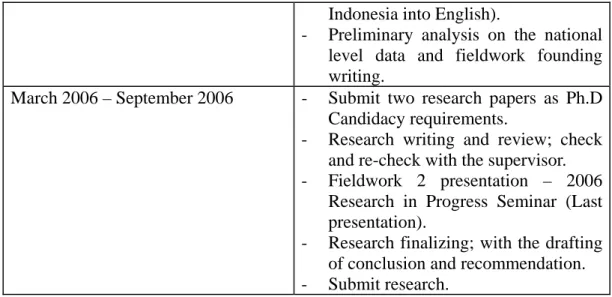
Period Activity September 2004 – July 2005 - First fieldwork – Data collection and
in-depth observations in local level (Soroako, South Sulawesi).
- Documents translation (Bahasa Indonesia into English).
- Preliminary analysis on local level data and fieldwork founding writing. - Fieldwork 1 presentation – 2005
Research in Progress Seminar.
October 2005 – February 2006 - Second fieldwork – Data collection and in-depth observations at national level (Jakarta).
- Data collection and in-depth observations on Kaltim Prima Coal (KPC) case in KPC head quarter Jakarta.
Indonesia into English).
- Preliminary analysis on the national level data and fieldwork founding writing.
March 2006 – September 2006 - Submit two research papers as Ph.D Candidacy requirements.
- Research writing and review; check and re-check with the supervisor. - Fieldwork 2 presentation – 2006
Research in Progress Seminar (Last presentation).
- Research finalizing; with the drafting of conclusion and recommendation. - Submit research.
Table 2.3.1: Research’s Timeline (Produced by author)
Selected Respondents and Secondary Data
Information and data collection required for the analysis are obtained by direct
sources collection and group as follows:
1. Primary Data; the data and information obtained directly from the sources who
act directly as “actors” by conducting in-depth and open – ended interviews
both in oral and written. The term of “actors” in this research refers to those
who play two important roles; legitimated decision makers and influential
figures or elements in the society (individual or group), therefore the actors in
this research are as follows:
- National level:
2 people (28 October 2005)
b. National Parliament members (DPRD-RI): 3 people (30 October 2005)
c. Senior members of Indonesian Mining Association (IMA): 2 people (4
November 2005)
d. Senior staffs in INCO: 3 people (7 November 2005)
e. INCO’s former CEOs: 4 people (13 November 2005)
f. Environmental NGO’s activists: 3 people (16 November 2005)
g. Journalists: 2 people (17 November 2005)
- Local level (Kabupaten or Regency and Kecamatan or District):
a. Senior officers of East Luwu Kabupaten (executive in regency level): 2
people (5 September 2004)
b. Members North Luwu Parliament (legislative in regency level): 2
people (7 September 2004)
c. Senior officers of Kecamatan (district level): 3 people (9 September
2004)
d. Coordinators of Community Councils (5 Community Councils): 10
people (11 – 15 September 2004)
f. Local journalist: 1 person (20 September 2004)
Notification of confidentiality: Due to the strict confidential requested by the
primary sources, the author regretfully has to refrain from disclosing the names.
However, on the personal contact basis, the author is willing to clarify.
2. Secondary Data; the written data and information which are collected from each
source (actor). These documents would be like; the actors’ general policy,
annual report, numerical and statistical data, historical information and other
related data; therefore the secondary data are:
- The data and documents of INCO.
- The data and documents of East Luwu Regency.
- The data and documents of the Indonesian mining industry.
- The data and documents from NGOs (national and local).
- Theoretical data obtained from relevant text books that will be used as the
theoretical frameworks in analyzing.
- Other related data from journals and media such as; newspapers (local,
Research Site
The research fieldwork as well as data gathering was conducted in Jakarta and East
Luwu Regency by taking its three districts; Nuha District, Towuti District and Malili
District. However, as the mining operations main area is located in Sorowako village
(under Nuha District), therefore the research will more focus on the grass roots in
Nuha District. East Luwu Regency itself is under the administration of South Sulawesi
Province.
Methods
The reason why this research is using the in-depth open ended interviews, because
in-depth interviews allow the researcher to ask questions and listen to the answers and
then follow up with further questions to really understand what people feel and think.
One key function of in-depth interviews is to elicit detailed and sensitive stories about
people’s experiences with problems that amenable to collective solution (Rubin et all,
2001: 177). In order to explore the perception of the actors on INCO’s operations in the
area, the in-depth methodology is the most reliable one. Because the sources can
express and say whatever they think about INCO and its activities freely without any
Challenges
Access to Primary Sources: It was quite hard to make interviews with the primary
sources who are in the high level position; especially those who are in the government
and parliament. The second issue is difficulties to reach the primary sources in the
grass roots, where some of them are living in the pure remote area with a very limited
of transportation access. This difficulty was however unable to be compromised with,
therefore the researcher had to visit, even the most remotely located primary sources.
Solution: interviews were conducted by included other issues as a “gate” to get the
important information.
Reliability of Primary Sources: There is a possibility that the primary sources’
answer does not reflect the actual logic that drive the decision making for this local
actors.
Solution: during the interview the researcher has prepared supporting documents and
evidences (available secondary data) that may be used to counter or confirm the
Multidimensionality of Research Discipline: this research is case-driven rather than
subject discipline-driven, therefore it is difficult to specifically limit the subject
discipline of this research. The combination of various theories from different
disciplines is inevitably needed in providing a comprehensive and multi-angular
perspective-driven analysis in assessing the various data and findings.
Solution: the research remains very much within the subject discipline of development
sociology, nevertheless the research acknowledges the importance of theories from
other discipline in providing an analysis that better reflects the case study fundamental
rather than submitting to the fundamental notion of such subject discipline that may
limit the scope of solution, which at the same time may compromise the reliability of
CHAPTER 3
LITERATURE REVIEW
This chapter attempts to set the literary and theoretical background for the research,
which is based upon governance theory (Frederickson and Smith, 2003; Peters, 2001),
economic development theory (Tan, 1997; Todaro, 2003), the sustainable development
concept (Goodwin, 2001; Hosoi, 2003), environmental impact analysis (Indonesian
Environmental Impact Law under Ordinance No. 23/1997), social change theory
(Giddens, 2001) and the principals of political theory (Budiardjo, 1998). By
collaborating together the main thrusts of these theories, this study aims to analyze the
relationship between the local actors and the mining operators in their area and the
changes in the national social-political condition.
3.1 Theories of Governance
This research is, more than anything else, a discussion of governance. Governance
theory is a modern theory of public administration. Governance theory recognizes that
there have been many changes to the nature of public administration recently.
Governance theory holds true that 1) there have been trends towards privatization of
are more market-based management and resource allocation techniques used in public
administration (Frederickson and Smith, 2003).
These changes in public administration have created a need to change theories of
public administration to include many stakeholders. “Public administration” is no
longer limited to public servants, but also must take into consideration institutions,
organizations, and their relationships between one another, the government, and the
people (Frederickson and Smith, 2003).
In Frederickson and Smith’s book, The Public Administration Theory Primer
(2003), it is noted that governance theory is not a universal definition or a concrete
body of theories. Citing Lynn et al, 3, 2003, governance theory is defined as the
following:
“regimes of laws, administrative rules, judicial rulings, and practices that
constrain, prescribe, and enable government activity, where such activity is
broadly defined as the production and delivery of publicly supported goods
and services.”
Frederickson and Smith say that governance theory looks similar to traditional public
administration theories, but that they also involve the intellectual incorporation of
range of stakeholders in government and the resulting complexity of relationships
between such stakeholders is what we would like to emphasize in this section.
3.1.1 Decentralization, Governance and Mining
This paragraph aims to draw from the literature the relevant issues regarding
decentralization in relation to governance and natural resources. Decentralization may
be defined as ‘the transfer of authority and responsibility for planning, management,
and resource raising and allocation from the central government and its agencies to: (a)
field units of central government ministries or agencies, (b) subordinate units or levels
of government, (c) semiautonomous public authorities or corporations, (d) area-wide
regional or functional authorities, or (e) nongovernmental private or voluntary
organizations’ (Rondinelli 1981: 1). This broad definition is currently still the basis for
most definitions of decentralization today. Ribot for example states that
‘decentralization is any act by which a central government formally cedes powers to
actors and institutions at lower levels in a political administrative and territorial
hierarchy’ (2004: 9). One important development however is the further refining of
such definitions so as to delineate between two variations of decentralization:
Democratic decentralization (often also referred to as political decentralization or
devolution) occurs when powers and resources are transferred to authorities
representative of and accountable to local populations. These are typically elected local
governments. Democratic decentralization aims to increase public participation in local
decision making. Democratic decentralization is an institutionalized form of the
participatory approach. Of the two primary forms of decentralization, democratic
decentralization is considered the stronger and the one from which theory indicates the
greatest benefits can be derived (Ribot 2004: 9).
Administrative decentralization, or deconcentration, on the other hand concerns
transfers of power to local branches of the central state, such as prefects, administrators,
or local technical line ministry agents. These upwardly accountable bodies are
appointed local administrative extensions of the central state. They may have some
downward accountability built into their functions, but their primary responsibility is to
central government. Deconcentration is considered the weaker form of decentralization
because downward accountability is not as well established as in the democratic or
political form of decentralization (Ribot 2004: 9).
The literature describes decentralization as having a range of possible benefits
and Manor 1998); rural development/local economic development (de Valk 1991; Roe
1995, p. 833; UNDP 1999; Helmsing 2001; Ribot 2002; Bennett 1990b); public service
performance (World Bank 2000: 107); poverty alleviation (Crook and Sverrisson 2001:
iii); relief of fiscal crisis (Meinzen-Dick and Knox 1999: 5; Olowu 2001); political and
macro-economic stability (World Bank 2000: 107; Prud’homme 2001: 14); and
national unity and state building (Mamdani 1996; Conyers 2000: 7; Bazaara 2001:
7-13).
Of the abovementioned possible benefits, those that this research is most concerned
with include those related specifically to governance. Aspects of governance which
appear to be most likely affected by decentralization include responsiveness,
accountability, diversity and political participation (Wolman 1990: 32).
Greater responsiveness of government is expected with decentralization due to the
placing of government closer to the people. Superior knowledge of decision-makers at
local levels of the needs of the area combined with higher accountability due to direct
elections are expected to lead to increased responsiveness of policy-making to the will
of the people as well as a closer correspondence of public preferences and public
policy (Wolman 1990). Accountability is expected to be increased due to the ability of
policy-making is centralized this becomes very difficult. Decentralized policy-making
will also create local policy diversity, which may be desirable when different localities
have different requirements and desires (Wolman 1990: 34; see also Tiebout 1956).
Increased levels of political participation by citizens and resulting positive implications
for education and leadership are expected due to increased public interest and political
debate.
Bennett argues that representation (external accountability) of local government is
an important issue in regards to decentralization (1990c). Representation is outlined as
‘the link in democracies between the government and its administrators, on the one
hand, and individuals and businesses, on the other hand’ (Bennett 1990c: 17).
Discussions by Verba (1971) and Binder et al (1971) relate the process of
representation to participation through four concepts:
1. Identity: the maintenance of community interest and mutual support between
individuals and groups within areas.
2. Legitimacy: the extent to which governmental decisions are accepted as ‘right’
by individuals and groups.
3. Penetration: the extent and effectiveness of government impacts on individuals
4. Distribution: the extent of social transfers which mediate between those who
depend on government and those who provide the financial and other means to
support services (cited in Bennett 1990c: 18).
From the discussion of the literature on theories of governance in the previous
section and the brief account of decentralization given above, it can be predicted that
decentralization will have various positive impacts on governance: accountability,
representation and so on. However, the literature implies also that decentralization will
also cause governance to become more complicated, as the interests of a wider range
of stakeholders will undoubtedly have to be included in the process and relationships
between said stakeholders are likely to become more complex. What implications does
this have for issues surrounding the governance of natural resources? Literature
addressing this problem is overviewed in the following paragraphs.
Concern over potentially adverse environmental impacts of mining often results in
opposition to mining at the local level, whereas the benefits of mining to the national
economy and development influence national level agendas quite differently.
Decentralization to the local levels therefore may cause local governments to end up
over-riding national agendas regarding mining. Indeed this seems to have been the case
significant devolution of authority to local democratic government. Democratic
decentralization in the Philippines lead to the voicing of environmental concerns
regarding mining and election of candidates for local office who opposed mining,
which in turn lead to the withholding of consent to mining projects by local
governments and, in some cases, the implementation of moratoriums to ban mining
(Holden & Jacobson 2006). Central to this opposition were the activities of civil
society groups, and their collaboration with local governments. Holden and Jacobson
describe the actions of these actors as ‘good examples of the concept of governance, a
dispersed process wherein society manages itself for the betterment of all its members’
(2006: 188). The main implication of this for mining companies seeking to implement
mineral extraction operations is that having the consent of the national government is
no longer sufficient. Rather that of local governance forces, including both formal local
government bodies and more informal civil society organizations, must also be
considered (2006: 194).
The increased voice of localities which is expected to come with decentralization
reforms is just one of a wide array of forces recently causing TNCs to be more careful
with local community relationships and to value issues of corporate social
investment decisions being linked to social risk; the development of social reporting;
the promotion of a sustainable development agenda; and an increasing need for
effective stakeholder management (Kapelus 2001: 2). Such forces are said to be
increasing the costs of not upholding community relationships and social
responsibilities and causing such practices, when successfully achieved to have a direct
and positive affect on company profits.
3.2 Economic Development
Economic development is distinct from other branches economics, such as
macroeconomics, labor economics, public economics or monetary economics. The
nature of development economics is divided as such (Todaro, 2003):
- Traditional economics – Traditional economics is concerned primarily with the
efficient, lowest-cost allocation of scarce productive resources, with the
optimal growth of these resources over time to produce an ever-expanding
range of goods and services. Traditional economics can also be considered the
classical and the neoclassical economics taught in the introductory textbooks.
Traditional neoclassical economics deals with an advanced capitalist world of
made on the basis of margins; private-profit; and utility calculations and
equilibrium outcomes in all product and resource markets. It assumes
economic “rationally” and purely materialistic, individualistic, self-interested
orientation toward economic decision making.
- Political economy; Political economy goes beyond traditional economics to
study, among other things, the social and institutional processes through which
certain groups of economic and political elites influence the allocation of scare
productive resources now and in the future, either exclusively for their own
benefit or for that of the larger population as well. Political economy is
therefore concerned with the relationship between politics and economics, with
a special emphasis on the role of power in economic decision making.
- Development economics; Development economics has an even greater scope.
In addition to being concerned with the efficient allocation of existing scarce
(or idle) productive resources with their sustained growth over time, it must
also deal with the economic, social, political, and institutional mechanisms,
both public and private, necessary to bring about rapid (at least by historical
standards) and large-scale improvements in levels of living for masses of
America.
Development economics, to a greater extent than traditional neoclassical
economics or even political economy, must be concerned with the economic, cultural,
and political requirements for effecting rapid structural and institutional
transformations on entire societies in a manner that will most efficiently bring the fruits
of economic progress to the broadest segment of their populations. It must focus on the
mechanisms that keep families, regions, and entire nations in poverty traps, and on the
most effective strategies for breaking out of these traps. To make it real, a larger
government role and some degree of coordinated economic decision making directed
toward transforming the economy are usually viewed as essential components of
development economics (Todaro 2003: 9).
The term “development” has different meanings to different people; therefore
many disagreements have occurred in economic development literature. Gerald Tan
(1997) wrote that the reason for this strong disagreements amongst scholars is about
what constitutes economic development, because what some economist consider being
economic development is often opposite of what other economist regard as economic
development. Moreover, Tan views these disagreements by categorizing the
neo-Marxist economists (Tan 1997: 99, 101). Despite the debate over the definition of
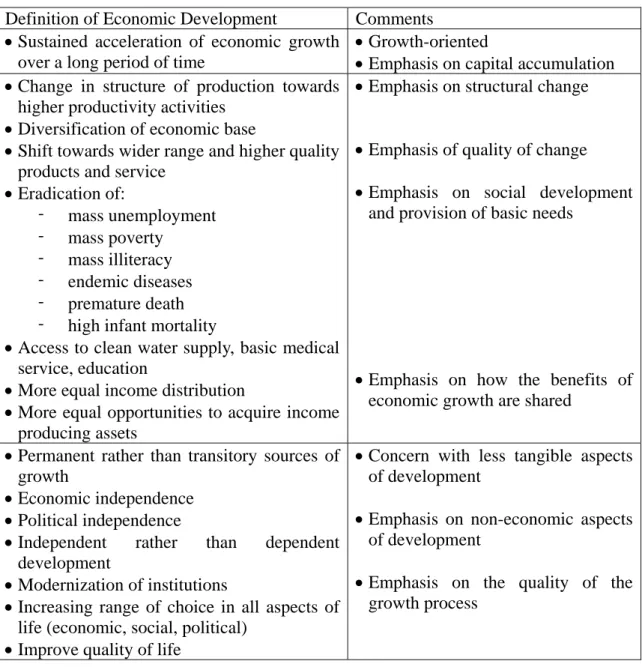
economic development, the indicators of economic development in this table are still
relevant and reliable as a measurement tool (Tan, 1997):
Definition of Economic Development Comments • Sustained acceleration of economic growth
over a long period of time
• Growth-oriented
• Emphasis on capital accumulation • Change in structure of production towards
higher productivity activities • Diversification of economic base
• Shift towards wider range and higher quality products and service
• Eradication of: ⁃ mass unemployment ⁃ mass poverty ⁃ mass illiteracy ⁃ endemic diseases ⁃ premature death ⁃ high infant mortality
• Access to clean water supply, basic medical service, education
• More equal income distribution
• More equal opportunities to acquire income producing assets
• Emphasis on structural change • Emphasis of quality of change
• Emphasis on social development and provision of basic needs
• Emphasis on how the benefits of economic growth are shared
• Permanent rather than transitory sources of growth
• Economic independence • Political independence
• Independent rather than dependent development
• Modernization of institutions
• Increasing range of choice in all aspects of life (economic, social, political)
• Improve quality of life
• Concern with less tangible aspects of development
• Emphasis on non-economic aspects of development
• Emphasis on the quality of the growth process
Table 3.2.1 Definition of Economic Development (Source: Tan 1997: 3)
The table above illustrates the spectrum of economic development which range from
very narrow to very broad. The table starts with a narrow economic development
definition, that only focus on the accumulation of capital growth / gain to broader
definitions, which also include qualitative changes in all facets of life (not just
economic).
3.3 Sustainable Development Concept
The issue of environment recently has become crucial and important for the
economic development discourses. Similar to the debate over the definition of
economic development by the mainstream economists and radical economists; the
environmental issue has also risen as the issue of “rapid economic growth versus
environment protection”. The rapid economic growth, associated with industrialization
and urban development, may alleviate poverty, but on the other side can also cause
environmental degradation (Tan 1997: 289).
The term sustainable development was first introduced in 1987 the World
Commission on Environment and Development in order to discuss the conflicts
between environmental and developmental goals. The idea of sustainable development
development is development that meets the needs of the present without compromising
the ability of future generations to meet their own needs (WCED 1987).
In the extensive discussion and use of the concept since then, there has been a
growing recognition of three essential aspects of sustainable development (Goodwin
2001: xxix):
- Economic: An economically sustainable system must be able to produce goods
and services on a continuing basis, to maintain manageable levels of
government and external debt, and to avoid extreme sector imbalances that
damage agricultural or industrial production.
- Environmental: An environmentally sustainable system must maintain a stable
resources base, avoiding overexploitation or renewable resources systems or
environmental sink functions and depleting nonrenewable resources only to
extent that investment is made adequate substitutes. This includes maintenance
of biodiversity, atmospheric stability, and other ecosystem functions not
ordinarily classed as economic resources.
- Social: A socially sustainable system must achieve fairness in distribution and
opportunity, adequate provision of social services, including health and
In the context of mining sector, Yoshitaka Hosoi (2003) argues that they are
actually two models of mining development; namely “traditional enclave model” and
“new sustainable development model”. The traditional enclave model refers to the
period from the 1960s to the 1980s, where mining activities were dominated by
handful of companies and nations. They were centralized and did not take into
consideration the local communities or the environment (Hosoi 2003; Leith 2003).
Furthermore, they placed priority on the benefits of their projects.
Hosoi then argues that the new sustainable development model started to be
recognized in the 1990s when the mining activities were conducted by companies
consensually with local communities and central and local governments through
cooperation. Hosoi emphasizes not only mine development and progress, but also
what the local community and the company can do after the mines are closed.
In Hosoi’s perception, the things that must be discussed by all the related parties
(central government, company, local government and community) should cover all the
industrial stages; from the agreement (contract), to the exploration and until the mine’s
closure. Hosoi’s model for the stages of sustainable development for mining is as
Traditional Enclave Model Sustainable Development Model • Negotiations and agreements between
central government and mining company.
• Taxes and royalties all go to central government.
• Compensation for individuals.
• Training dedicated to the needs of the mine.
• Employment positions filled by newcomers.
• Inputs sourced from outside the community.
• Negotiations and agreements include communities and regional/local authorities.
• Central government shares taxes and royalties.
• Compensation includes infrastructure for community.
• Training is expanded to benefit community as well as mine.
• Mine services outsourced to community. • Employment positions for community
not just outsiders.
• Inputs sourced from local community and region as well as outside.
Table 3.3.1 Traditional Enclave versus Sustainable Development Model (Source: Yoshitaka Hosoi retouched to John Strongman, World Bank, and Hiroshi Kubota,
Metal Mining Agency of Japan, 1998)
3.4 Environmental Impact Analysis
A chronic problem of industrial activities and processes is pollution. In the case of
the mining industry, theoretically the unavoidable impacts of a mining operation are
changing topography of the area, soil removal and tailing disposal (Coutrier 2002: 3).
Moreover, in general, surface mining will create more negative environmental impacts
than underground mining because changes the topography of the surrounding area. In
terms of this study it must be noted that INCO’s operation includes surface mining.
Paul L. Coutrier (2002) in brief has identified some environment impacts from
- Tin: soil – topography – vegetation – water – tailing – social - tradition
- Nickel: soil – vegetation – water – social - tradition
- Bauxite: soil – vegetation – water – social - economy
- Coal: soil – topography – vegetation – water – air – noise – social - tradition
- Copper: soil – topography – vegetation – water – air – tailings – social –
tradition - heritage
- Gold: soil – topography – vegetation – water – air – noise – tailings – social –
tradition - heritage
- Silver: soil – topography – vegetation – water – air – noise – tailings – social –
tradition - heritage
- Industrial Minerals: soil – topography – vegetation - heritage
In the case of Indonesia, it is not clear when the environmental concern regarding the
mining industry took shape, but it was generally accepted that formal outlook started
when Ordinance No. 4/1982 on “The Basic Provisions of Environmental Management”
was promulgated. Before 1982, however, several technical sectors had already issued
regulations pertaining to the protection of the environment (Coutrier 2002: 5).
Later on in October 1997, a new Ordinance No. 23/1997 was established replacing
Management. It is more operational in nature and very strict, including heavy criminal
penalties like ten years jail and 500 million rupiah for pollution violations (previously
only one year and ten million rupiah). AMDAL becomes compulsory and should
involve public participation.
Under the new Ordinance No. 23/1997 there are four basic principles on
environmental management as follows (Coutrier 2002: 5):
- Strict Liability: It is no longer the duty of the victim of pollution to prove that
pollution occurs, but it is the accused polluter that should prove that they are
not polluting. This is a good message to all developers, including the mining
industry, to monitor consistently all their effluent and emissions to prevent
pollution from happening.
- The Polluter Pays: This principle means that polluter is liable to pay for all the
damage claimed from the pollution. All developers should have an effective
monitoring system to enable proper quantification of value of the damage.
- Environmental Impact Analysis (AMDAL): Is a study of large and significant
impacts of a planned business and/or activity that is needed in the decision
making process regarding business and/or activity implementation. It tries to
activities and what should be done to develop the positive impact and prevent
or mitigate the negative impacts of the development. The study not only covers
the physical, biological, chemical and geological impacts, but also the
socio-economic impact of the development.
- Sustainable Development: Is development that takes into consideration the
needs of the present generation without compromising the needs of the next
generation. There is no fixed guideline for sustainable development.
3.5 Social Change
Social change is difficult to define, because there is a sense in which everything
changes, all of the time. Identifying significant change involves showing how far there
are alterations in the underlying structure of an object or situation over period of time.
In the case of human societies, to decide how far and in what ways a system is in a
process of change we have to show to what degree there is any modification of basic
institutions during a specific period (Giddens 2001: 42).
Even though the social theorists have tried for the past two centuries to develop a
grand theory that explains the nature of social change there is still no single factor
and gathering and pastoral societies to traditional civilizations and finally to the highly
complex social system of today (Giddens 2001: 42).
However, Anthony Giddens (2001) views that the three main factors that have
consistently influenced social change are as follows:
- The physical environment - The physical environment often has an effect on
the development of human social organization. The people always must
organize their way of life in relation to the natural condition of the place they
are living.
- Political organization - Political organization is the second factor strongly
influencing social change. In rural / traditional societies, this influence is at a
minimum, since there are no political authorities capable of mobilizing the
community, however still the existence of political agencies; tribal chiefs, land
lords and kings strongly affects the course of development a society takes.
Political agencies do not always refer to the government or political parties in
modern society, but rather those that act as rulers in the society.
- Cultural factors - The third main influence on social change consists of cultural
factors, which include the effects of religion, communication systems and
than three hundred ethnic groups, therefore the cultural factors still remain a
very crucial factor for the social change.
Moreover Giddens adds that main factor for change in the period of modernity (the last
two hundred years) can be categorized along lines similar to the factors that have
influenced social change throughout history above, except that it shall subsume the
impact of the physical environment within the overall importance of economics factors.
These factors are:
- Economic influences - Modern industry differs in a fundamental way from
pre-existing production system, because it involves the constant expansion of
production and ever-increasing accumulation of wealth. Capitalism promotes
the constant revision of the technology of production, a process into which
science is increasingly drawn. The rate of technological innovation fostered in
modern industry is vastly greater than in any previous type of economic order.
It can say that both the rapid growth of economic and the innovation of
technology are supporting each other massively in this modern era.
- Political influences - The second major type of influence on change in the
modern period consists of political development. Political influence in the last
economic change has influenced politics. Nowadays government play a major
role in stimulating (and sometimes retarding) rates of economic growth and in
all industrial societies there is a high level of state intervention in production,
the government being far and away the largest employer.
- Cultural influences - Among the cultural factors affecting processes of social
change in modern times, the development of science and the secularization of
thought have each contributed to the critical and innovation character of the
modern outlook.
3.6 Political Theory
Miriam Budiardjo (1998), a senior Indonesian political scientist, states that even
though there are a lot of definitions of politics formed by many scholars, there are five
main concepts of political science as follows:
a. Politics as a Concept of State
State is the organization in a certain place that has the highest level of legitimate power
and is obeyed by its people. In this concept, the scholars emphasize the state as the
central of politic and giving strong attention to the state’s official institutions, therefore
this concept also recognize as “institutional approach”. Roger F. Soltau in
purposes….the institutions by which these are going to be realized, its relations with its
individual members, and other states” (Budiardjo 1998: 9).
b. Politics as a Concept of Power
Power is the capability of a person or group to influence the behavior of other people
or groups to obey and go in line with his/her or their idea/goal. The central issue of this
concept is seeing politics as the process of how to get and retain the power, or also
called by power struggle. W. A. Robson in “The University Teaching of Social
Sciences” states that political science is concern with the study of power in
society….its nature, basis, processes, scope and results. The focus of interest of the
political scientist….centers on the struggle to gain or retain power, to exercise power
or influence over others, or to resist that exercise (Budiardjo 1998: 10).
c. Politics as a Concept of Decision Making
Decision making refers to the process of making or choosing from alternatives. The
central point in this concept is viewing politics as a decision making process to reach
one consensus which is held by the society in a collective way and the people in the
society must respect every decision they have made together. Joyce Mitchell writes in
“Political Analysis and Public Policy,” “Politics is collective decision making or
d. Politics as a Concept of Policy
Policy is a collection of decisions that have been taken and compiled by a person or
group in order to formulate and decide on some objectives / goals and the strategy or
step to achieve those objectives / goals. Scholars in this field believe that every society
has its own vested interest / goal. And to reach this goal, society should have
cooperation between it members who have a legitimate authority (in this context the
government) to formulate the consensus that must be written as the legal policies.
David Easton views that political science is a study of the making of public policy.
Furthermore, Easton states in “The Political System,” “Political life concerns all those
varieties of activity that influence significantly the kind authoritative policy adopted
for a society and the way it is put into practice. We are said to be participating in
political life when our activity relates in some way to the making and execution of
policy for a society.” (Budiardjo 1998: 13).
e. Politics as a Concept of Distribution / Allocation
Distribution / Allocation is a giving or transfer of portion / share of values in society.
The scholars whose emphasize the politics as the matter of how to reach a very fair
distribution view that the main conflict that may occur in this issue is when the
on the ruler’s power and government policy is the most important factors to find where
the weak spot of the unfair distribution is. Harold Laswell views politics in the very
simple perspective as in his point of view, politics is only a matter of who gets what,
3.7 Conceptual Framework
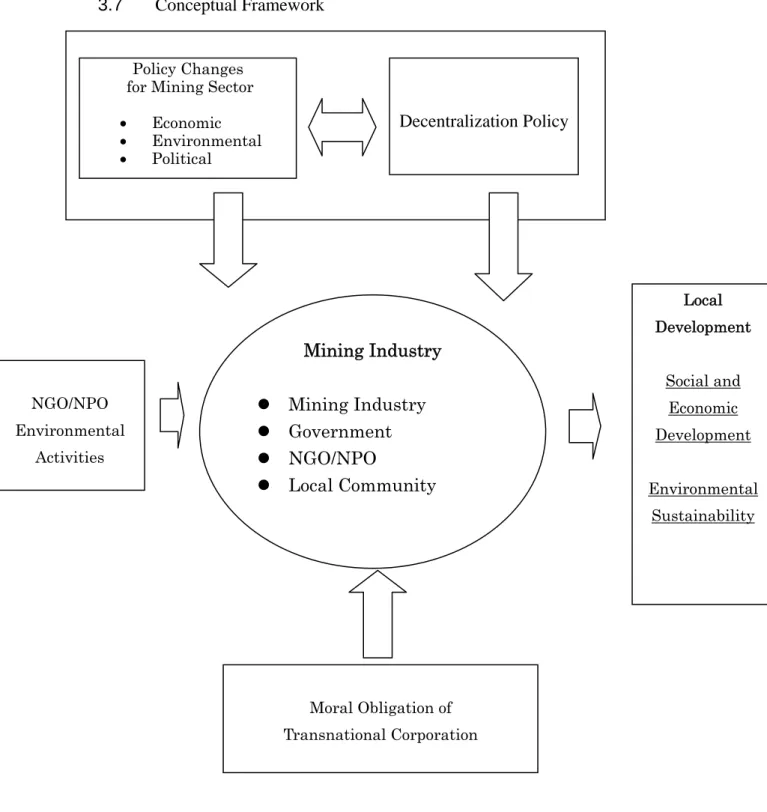
Decentralization Policy Policy Changes
for Mining Sector • Economic • Environmental • Political Mining Industry z Mining Industry z Government z NGO/NPO z Local Community Social and Economic Development Environmental Sustainability Local Development NGO/NPO Environmental Activities Moral Obligation of Transnational Corporation
Figure 3.7.1 Conceptual Framework
The framework in Figure 3.7.1 above illustrates that the relationships between the
governments, local communities, NPO/NGOs and the mining industry are impacted
upon by a number of major activities/processes and in turn affect the condition and
performances of the local people. The aforementioned processes/activities include:
changes to mining policy, brought about by the decentralization policy; the activities of
concerned environmental NPOs/NGOs; and the moral obligation (corporate social
responsibility) of the transnational corporation, which is increasingly the major