Phase
field
model of mode
III-type
crack evolution and its
energy
estimation
1,*)
Takeshi Takaishi
,
2)Masato Kimura
l
) Faculty
of Information
Design,
Hiroshima Kokusai Gakuin
University
2
)Faculty
of
Mathematics,
Kyushu
University
*E-mail:
[email protected]
Keywords: crack evolution, phase field model, numerical simulation
1
Model
for
Crack Evolution
Many methods
are
proposed fornumerical
computationson
crack evolutionproblems, because of the difficulty of the singularity arising from the crack tip,
change of computational boundary arising from the
new
crack surface, lack ofthe explicit method to determine the direction of expand the crack. We show
that the mode III (anti-plane shear mode) crackgrowth on aplate is describedas
reaction-diffusion system that is consistedby the of the anti-plane displacement
and the phase field that describes the crack[2]. This system is derived from the
energy description
introduced
by Francfort and Marigo[l], We show that thisreaction-diffusion system make the computation of the crack problem easy.
(a) (b) (c)
Figure 1: 3 modes ofthe crack evolution
on
a plate (a) mode I, (b) modeII, (c)mode III.
We derive equation for the crack evolution of the plate, that is expanded
by the small anti-plane displacement (Figure 1 $(c)$). Let $\Gamma$ be a bounded two
dimensional domain with a piecewise smooth boundary $\Gamma_{N}$, and let $\Gamma_{D}$ be a
components. We define $\Gamma_{N}$ $:=\Gamma\backslash \Gamma_{D}$
.
For$t>0$,we
consider the equations:$\{\begin{array}{ll}\alpha_{1}\frac{\partial u}{\partial t} = div((1-z)^{2}\nabla u) x\in\Omega, t>0\alpha_{2}\frac{\partial z}{\partial t} = (\epsilon\triangle z-\frac{\gamma^{2}}{\epsilon}z+|\nabla u|^{2}(1-z))_{+} x\in\Omega, t>0u(x, t) = g(x, t) x\in\Gamma_{D}, t>0\frac{\partial u}{\partial n}=0 x\in\Gamma_{N}, t>0, \frac{\partial z}{\partial n}=0 x\in\Gamma, t>0u(x, 0)=u_{0}(x), z(x, 0)=z_{0}(x) x\in\Omega\end{array}$
(1)
where $u(x, t)$ represents the small anti-plane displacement at the position$x\in\overline{\Omega}$
and time $t\geq 0$, and $g(x, t)$ is
a
given anti-plane displacementon
the boundary$\Gamma_{D}$
.
The variable $z(x, t)$ satisfies $0\leq z(x, t)\leq 1$ in $\Omega$ and represents thecrack shape,
as
$z\approx O$in the region without crack and $z\approx 1$near
the crack. Theminimumlength scaleof$z$is given
as
$O(\epsilon)$ witha
small regularization parameter$\epsilon>0$ for the numerical stability. The function $z(x, t)$ is called the phase field
for the crack shape. For stable numerical simulations,
we
also introduce small time relaxation parameters $\alpha_{1}\geq 0$ and $\alpha_{2}>0$.The first equation of (1) expresses the force balance in the uncracked region
$(z\approx 0)$, and the second equation expresses the crack evolution due to the
modulus
of
the stressVu
$|$.
The material constant $\gamma>0$ is called thefracture
toughness,
which
prescribesthe critical value of the energy release rate
in theGriffith$s$ criterion. It is harder for the crack to grow, ifthe value of
$\gamma$ is larger.
A crack
once
generatedcan
beno
longer repaired. We put $($ $)_{+}$ to the righthand side of the second equation, where $(a)_{+}= \max(a, 0)$
.
It guarantees thenon-repair condition for the crack: $\frac{\partial z}{\partial t}\geq 0$
.
This model has advantages for numerical simulation of crack evolution
as
followings: i) automatic path selection of the crack that
means
the possibility of calculation of the outbreak of new crack and sub-crack, ii) possibility touse
theordinal method (for example, FDM, FVM, and FEM) for numerical simulation
because of the PDE model on fixed domain, iii) numerical stability introduced
by the regularization parameter $\epsilon>0$, iv) potential to adopt the spacial profile
or
hysteresis of thefracture
toughness $\gamma$.
2
Energy
estimation
Griffith focused on the energy balance of the material that includes the crack,
because he thinks that the rupture strength is mainly dominated by the stress
concentration at the tip of the crack. He introduced the relation between the
energyfor making
new
cracksurface and that for releasing by the crack evolutionStarting
from
the internal energyproposed byFrancfort-Marigo [1],we
treatthe following energy description:
$\{\begin{array}{ll}\mathcal{E}(u, z) := \mathcal{E}_{1}(u, z)+\mathcal{E}_{2}(z)\mathcal{E}_{1}(u, z) ;= \frac{\mu}{2}\int_{\Omega}(1-z)^{2}|\nabla u|^{2}dx-\int_{\Omega}fudx\mathcal{E}_{2}(z) := \frac{1}{2}\int_{\Omega}\gamma(x)(\epsilon|\nabla z|^{2}+\frac{1}{\epsilon}z^{2})dx\end{array}$ (2)
where $\mathcal{E}_{1}(u, z)$ is the regularized elastic energy of the plate, and $\mathcal{E}_{2}(z)$ is the surface energy of the crack. $\gamma(x)>0$ is fracture toughness on $x\in\Omega$. In [1],
they proposedthis energy and investigated precisely. Bourdin et al. and Buliga
made
some
numerical simulations of crack evolution that minimize the energysimilar to (2).
We
set
the totalenergy
$\mathcal{E}$as
a
freeenergy of
Ginzburg-Landau Theory, andderive the temporal evolution equations of the displacement and the phase field.
Though the detailed derivation of (1) is written in [3], the reaction-diffusion
equation on two scalar variable (1) is given when we set $f=0,$$\gamma(x)\equiv\gamma>$
$0,$$\mu=1,$$\epsilon\equiv\epsilon\gamma$
.
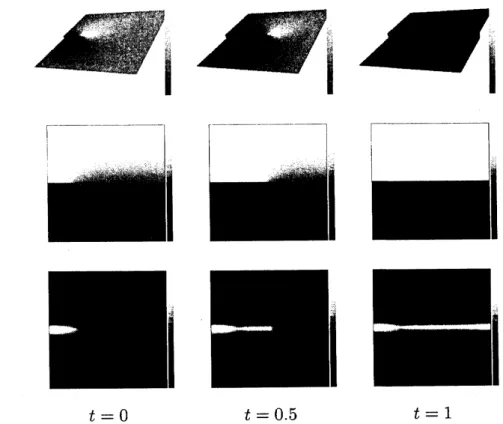
$t=0$ $t=0.5$ $t=1$
We studied that crack evolution phenomena
can
bedeveloped bythenumer-ical
simulations
of (1) with $g(x, t)$ ([2],[3]). In this model, quasi-staticenergy
relaxation that leads the crack evolution is assumed, then,
we
confirm that thisassumption is kept in the numerical simulation.
Set
the initial crack at $t=0$, we make a numerical simulation fixed theboundary condition
as
$g(x, t)=g(x)$.
In the following simulations,we
put$\epsilon=10^{-3},$ $\alpha_{1}=0,$ $\alpha_{2}=10^{-3},$$\gamma=0.5$ in (1), and set the computational domain
as
$\Omega=(-1,1)\cross(-1,1)$, with $\Gamma_{D}=\{(x_{1}, x_{2})|x_{1}\in(-1,1), x_{2}=\pm 1\}$.
Theboundary condition for $u$ is given
as
$g(x, t)=5x_{2}(x\in\Gamma_{D}, t\geq 0)$.
Time
Figure
3:
Temporal evolution of$\mathcal{E}$ (solid line), $\mathcal{E}_{1}$ (dashed line), $\mathcal{E}_{2}$ (dotted line).The temporal evolution of $u$ (Figure 2) shows the crack evolution, however,
velocity of the crack expansion
becomes
slower by time. From the results ofnumerical simulation,
we
calculate theenergy
of system (2). Figure3
showsthe temporal evolution ofenergy that the elastic energy $\mathcal{E}_{1}$ is decaying, surface
energy$\mathcal{E}_{2}$ is growing, and total energyis decaying slowly
as
the crack growth tillthe material is fractured $(t\sim 1)$. We confirm thatthese numerical results follow
our
model and describe the crack evolution phenomena, The physicalcharacter-istics of the material
can
be estimated by calculating the stress intensity factorfrom these numerical results.
References
[1] G. A. Francfort and J.-J. Marigo, Revisiting brittle fracture
as an
energyminimization problem. J. Mech. Phys. Solids, 46 $(1998),1319-1342$
.
[2] T. Takaishi and M. Kimura, Phase field model for mode III crack growth,
[3] Takeshi Takaishi, Mode-III kiretsushinten no phase field model to