Success Factors of Participatory Irrigation
Management: Case of the Busao Communal
Irrigation System in Bohol, Philippines
Ieko KAKUTA
Faculty of International Relations, Asia University, Tokyo, Japan
Abstract
The National Irrigation Administration (NIA) in the Philippines has promoted participatory irrigation management (PIM) in Communal Irrigation Systems (CISs) since the mid-1970s; however, CIS performance has generally been poor. One exception is the Busao CIS in Bohol Province and its water users association (WUA), the BATS Irrigators’ Association (IA). This study examines the factors behind the successful management of the Busao CIS and BATS IA, using the theories of common-pool resources management proposed by Ostrom (1990) and Freeman (1989, 1992). The fundamental reason for the successful performance of the BATS IA is that it uses a distributional share system, which Freeman refers to as the heart of an effective WUA. In the BATS IA, the irrigation service fee (ISF) is set as 10% of the harvested rice, which is considered to be almost equivalent to the volume of water a member receives. Thus, the water volumes received by each member are roughly proportionate to the share of system costs paid by each member. Additionally, the BATS IA conducted canal cementing to ensure that irrigation water can reach downstream, based on external aids from the Embassy of Japan (EOJ) and the NIA. Further,
the IA water tender monitors and cleans the canals every day to avoid a water shortage. Consequently, the BATS IA can attain equal water distribution within the CIS. Moreover, the number of members on the Board of Directors selected from each barangay (village) is proportionate to the number of IA members of each barangay. As such, in the BATS IA, a member’s share of cost is proportionate to his/her share of water and share of vote. Therefore, a distributional share system exists in the BATS IA, and the sense of fairness is shared among IA members. In addition, the BATS IA has sophisticated irrigation management systems that fit the theories of Ostrom and Freeman. Therefore, the BATS IA has cooperative IA members that participate in IA activities and follow IA bylaws, leading to equal water distribution across all parts. The irrigation facilities are also successfully operated and maintained by the BATS IA. There are few conflicts, and the IA can attain 100% ISF collection. Further, since the BATS IA has the ability to negotiate with outsiders such as the NIA, local government, and EOJ, the latter can assign the IA with many projects and provide assistance. Consequently, the BATS IA has stable and successful IA management in the long run.
I. Introduction
In irrigation management, irrigation management transfer (IMT) has become popular worldwide. IMT aims to transfer the management of an irrigation system, which was managed by the government until the canals reached their lowest level, to the beneficiary farmers (i.e., water users). To make IMT successful, it is necessary to establish participatory irrigation management (PIM) in which a water users association (WUA) manages the irrigation system. IMT is expected to not only reduce the government’s
management costs, but also improve the management efficiency of irrigation systems owing to the intensive management undertaken by beneficiary farmers.
Since the mid-1970s, the National Irrigation Administration (NIA) in the Philippines has promoted the PIM approach for Communal Irrigation Systems (CISs), which irrigate farmer-owned and -managed areas below 1000 ha. In the 1980s, the NIA expanded this approach to National Irrigation Systems (NISs), which are owned and managed by the government and cover more than 1000 ha. The NIA assigns an Institutional Development Officer (IDO) to the irrigated area to organize a WUA, referred to as an Irrigators’ Association (IA), before the construction of any CISs and NISs (Bagadion and Korten, 1991).
However, the performance of PIM has generally been poor (Maleza and Nishimura, 2007). The average collection rate of the Irrigation Service Fee (ISF) from 1998 to 2000 was only 38% for NISs, and 80% of NISs were reported to need prompt repair. Moreover, a survey by the NIA of 1674 IAs in 1999 showed that 38% of these IAs were not functional (KRI International Corporation, 2001).
Nonetheless, some successful cases can be found, including the Busao CIS in Bohol Province in the Philippines and its WUA, namely the BATS IA. Thus, this study examines the factors behind the successful management of the Busao CIS and BATS IA, using the theories of common-pool resource (CPR) management proposed by Ostrom (1990) and Freeman (1989, 1992). The rest of this paper is organized as follows. First, the analytical framework and methodology of the study are presented. Next, the irrigation system and IA are described. Then, the performance of the irrigation system is evaluated. Finally, in the conclusion, the reasons for the
successful management of the system are considered.
II. Analytical Framework and Methodology
1) Theories of CPR Management
Evaluating the management of an irrigation system demands an appropriate analytical framework. Since the irrigation water and system that delivers water to beneficiary farmers are considered to be CPRs, which are commonly managed by local people, the author applies Ostrom’s (1990) design principles of long-enduring CPRs and Freeman’s (1989, 1992) distributional share system model to assess performance.
Ostrom’s (1990) design principles are illustrated by case studies of long-enduring CPR institution, such as the Philippines’ Zanjera traditional irrigation system and cattle grazing on the Swiss Alps. According to Ostrom (1990), although there are differences among CPR settings, long-enduring and self-governing CPR institutions share eight design principles. If a CPR institution does not share these eight design principles, it cannot avoid free-riders, who break its rules and appropriate resources unfairly without fulfilling their obligations as members of the institution. As a result, the deterioration and dysfunction of the CPR institution ensues, finally leading to the depletion and destruction of the resources themselves (see Table 1) (Ostrom, 1990)ⅰ.
Freeman’s conceptual model is equivalent to Ostrom’s design principles; however, it is specially formulated to apply to irrigation systems and WUAs. His conceptual model was drawn from his own case studies in the
ⅰ For a detailed explanation of the eight design principles of long-enduring CPR
institutions, see Ostrom (1990, pp.88-102). Ostrom was awarded a Nobel Prize for economics in 2009 because of this research on CPR management.
western United States, Pakistan, and Nepal as well as from other case studies of successful irrigation systems globally. According to Freeman, to manage an irrigation system successfully, a WUA should be sufficiently Table 1. Ostrom’s design principles illustrated by long-enduring
common-pool resources (CPR) institutions 1. Clearly defined boundaries
Individuals or households who have rights to withdraw resource units from the CPR must be clearly defined, as must the boundaries of the CPR itself. 2. Congruence between appropriation and provision rules and local conditions
Appropriation rules restricting time, place, technology, and/or quantity of resources units are related to local conditions and to provision rules requiring labor, material, and/or money.
3. Collective-choice arrangements
Most individuals affected by the operational rules can participate in modifying the operational rules.
4. Monitoring
Monitors, who actively audit CPR conditions and appropriator behavior, are accountable to the appropriators or are the appropriators.
5. Graduated sanctions
Appropriators who violate operational rules are likely to be assessed graduated sanctions (depending on the seriousness and context of the offense) by other appropriators, by officials accountable to these appropriators, or by both.
6. Conflict-resolution mechanisms
Appropriators and their officials have rapid access to low-cost local arenas to resolve conflicts among appropriators or between appropriators and officials. 7. Minimal recognition of rights to organize
The rights of appropriators to devise their own institutions are not challenged by external governmental authorities.
8. (For CPRs that are parts of larger systems) Nested enterprises
Appropriation, provision, monitoring, enforcement, conflict resolution, and governance activities are organized in multiple layers of nested enterprises. Source: Ostrom (1990:90).
effective to provide efficient and equitable water control. Indeed, Freeman (1989, 1992) presents six essential characteristics of an effective WUA, as shown in Table 2.
Among these six essential characteristics, Freeman categorizes the third and fourth ones as the “water share distributional system” (i.e., a distributional share system) and points out that this system is at the heart of any effective WUA.
Freeman (2009) states that if the first four attributes, namely local leadership (attribute 1), the leadership responsibility of local members (attribute 2), and the existence of a distributional share system (attributes 3 and 4), are fulfilled, the remaining two (water control ability and the propensity of members to support the local organization) will be realized. Therefore, the last two attributes are outcomes of the first four.
On the contrary, if the irrigation system lacks a distributional share system, upstream farmers have no incentive to invest in activities aimed at improving the condition of the canals in the downstream part. This results in inequitable water distribution between upstream and downstream Table 2. Freeman’s six essential characteristics of an effective WUA
1 Leaders of the local organization should not be cosmopolitan outsiders but irrigators representing the various reaches of the local canal system.
2 Leadership and staff of the local organization are responsible to local members.
3 Water delivery is dependent on the fulfillment of organizational obligations (distributional share system).
4 The water share system should remove head and tail distinctions in service queues (distributional share system).
5 Water resource control of members is high.
6 Propensity of members to support the local organization is high. Source: Freeman (1989:25).
farmers (Freeman, 1992), lowering the ability of the WUA to control water as well as the propensity of downstream members to support the WUA (Freeman, 2009).
Indeed, Freeman (1992) points out that a sense of fairness must be shared among WUA members to manage an irrigation system sustainably in the long run. Hence, a distributional share system should be introduced into WUA management, which has the following three aspects: (1) share of water, (2) share of cost, and (3) share of vote.
While water share arrangements may vary considerably from locale to locale, Freeman (1992) points out the three important considerations to making WUAs successful. First, each member’s share of water should be equivalent to his/her share of cost; that is, the water volumes received by each member are roughly proportionate to the share of system costs paid by each member. Second, a WUA should remove head and tail distinctions in the service queue; it provides the same volume of water per unit area in the command area of the irrigation system. To do so, it needs to measure the water volume used on each member’s farmland. Third, conflicts in a WUA are resolved based on each member’s share of vote.
On the above-mentioned second consideration, Freeman (1992) explains, “The water share system overcomes the problem of distributing
inequitable volumes of water to the head and tail location of irrigators …Head irrigators are uninterested in spending their money on behalf of those less well located. [Therefore,] head-tail problems can hobble WUA’s. On the other hand, it is quite possible to organize the head-tail distinction out of the irrigation community and create a common interest of all - head and tail - in the performance of the canals.
Irrigators do this by measuring water volume delivered to the field gate. If water is distributed by volume, or some rough approximation of it, and if a poorly performing canal delivers a given volume only over a longer period of time toward the tails, and if ‘head’ farmers cannot obtain their next delivery until the tails are served, they will feel the pinch of poorly performing canals and become interested in their improvement. Water lost downstream is also lost to [head farmers]. All irrigators then share a common interest in investing in the best possible canal management.” (Freeman, 1992, p. 3)
Freeman’s distributional share system means that a member’s share of cost for system management is proportionate to his/her share of water and share of vote in the management of a WUA. If a member’s share of cost is larger, his/her share of water and share of vote in the WUA will also be larger (Freeman, 1992). This is clearly decided as the WUA’s rule and applied in WUA management. In addition, a WUA should have a management rule that if a member receives more benefits (e.g., water in a timely way) than do other members, he/she must pay more management costs (e.g., via an ISF or in labor, materials, etc.). If the member receives less water than others, his/her management cost should be less (Freeman, 2009).
According to Freeman (1992), if a distributional share system is introduced into WUA management and if the equity (i.e., equivalence of each WUA member’s share of cost and share of water) is made known among WUA members, any non-payer or free-rider who breaks the equity among beneficiaries will be readily identified and sanctioned. Therefore, each member will be inclined to comply with the rules and members will
be able to resolve conflicts among themselves.
On the contrary, if such free-riders are not sanctioned, other members also tend to act in the same manner. Hence, free-rider behavior becomes prevalent in the irrigation system. This discourages members who are honest and good payers, who may choose to withdraw from WUA management. Then, the activities of the WUA become inactive and the performance of the irrigation system drops (Freeman, 2008).
A sense of fairness must thus be constantly shared among members for a WUA to be successful. To encourage this understanding of fairness, the obligation of each member must be equivalent to his/her benefit and must be known to all members. That is, the volume of water received by each member and organizational obligations (e.g., ISF payment and provision of labor) borne by each member must be clear to all. Therefore, the volume of water delivered to each member’s farmland must be measured. In addition, the irrigation system must have suitable irrigation facilities (canals and farm ditches) to provide irrigation water to the farmland of individual member.
On the contrary, if members share common turnouts and, therefore, do not know the exact volume of water used by each member, any members who feel their burden is larger than their benefit will be dissatisfied, possibly leading to withdrawal from the WUA. However, it is difficult for central government agencies or large donors to design detailed plans for irrigation facilities that cover every farm ditch and turnout at the individual farm level because of insufficient labor, budget, and construction periods. Such complicated work should thus be undertaken at the local level (Freeman, 2008).
staff being accountable to local members (the first and second essential characteristics). As an outsider, a staff member of the central government agency, even one with deep knowledge of irrigation engineering and highly motivated to do his/her job of managing irrigation systems, cannot attain the specific local knowledge on individual irrigation systems that is needed for the management of an effective distributional share system at the site. Furthermore, an outsider would be unable to create local social capital, which is necessary for resolving the conflicts and problems that occur in irrigation systems among beneficiaries. Such conflicts and problems should be resolved by local people themselves; accordingly, the members of the Board of Directors (BOD) and staff should be composed of local farmers (Freeman, 1992).
In sum, Freeman’s distributional share system means that a member’s water delivery and voice are dependent on the fulfillment of organizational obligations (a member’s share of water and share of vote are proportionate to his/her share of cost), and water is allocated equally from the upstream to the downstream parts in the irrigation system. In this way, the head and tail distinction of water delivery is removed from the irrigation system. Therefore, to introduce a distributional share system, an irrigation system needs to pursue the following six aims:
(1) To secure sufficient water sources for the irrigation system;
(2) To have irrigation facilities that can allocate water equally to the whole irrigation system from the head to the tail parts (i.e., allocate the same volume of water per ha);
(3) To make clear to WUA members the volume of water each member receives and the obligations fulfilled by the member, therefore levying the ISF by volume of water (not by size of farmland), and to measure
the volume of water delivered to each farmland;
(4) To have a WUA with a monitoring function that can enforce sanctions on the violators of WUA rules and that can resolve conflicts to avoid free-rider behaviors;
(5) To have a leader with strong leadership skills and support from members, thereby allowing the WUA to enforce the management rules; and
(6) To have a good relationship between the WUA and government organizations and to ensure that these government organizations have sufficient funds and technical skills so that the WUA has the necessary support at the appropriate time from governments and/or donors.
Case studies of successful irrigation systems that have distributional share systems and Freeman’s (1989, 1992) essential characteristics of effective WUAs have been carried out (Freeman, 1992; Maass and Anderson, 1978; Martin and Yoder, 1988; Siy, 1982). This study assesses the successful performance of the Busao CIS in Bohol Province, Philippines, using Freeman’s essential characteristics of effective WUAs and Ostrom’s design principles. Among Ostrom’s eight design principles, the second (congruence between appropriation and provisional rules and local conditions) is considered to be equivalent to Freeman’s third essential characteristics, namely that water delivery is dependent on the fulfillment of organizational obligations (i.e., the distributional share system).
2) Research Method
The author uses the field data gathered from surveys of various stakeholders involved in the Busao CIS in Bohol Province in February
1998, August 1999, and August 2005. Each field survey in 1998 and 1999 lasted two to three weeks, and that in 2005 lasted one day. The survey was conducted by using Rapid Rural Appraisal, especially semi-structured interviews and participatory observations. The interviews asked about respondents’ activities in the IA, farm, and social settings as well as their social and family relations. Interviewees consisted of the members of the BOD, employees and ordinary members of the BATS IA of the Busao CIS, officials of the NIA, and staff of the local government of the municipality and villages (barangays) in which the Busao CIS is located.
III. Description of the Busao CIS
The Busao CIS spreads to four barangays: Santo Rosario (including one resident from Bitaugan) in Municipality Antequella and Toril, Busao, and Agahay in Municipality Maribojoc, Bohol Province. The Busao CIS is located 14 kilometers (30 minutes by car) from Tagbilaran, the capital city of Bohol Province. It is located in a rather isolated inland area (see Figure 1). Access to the Busao CIS is insufficient because people have to enter via a terraneous provincial road from a paved national road. In 1998, a public bus travelled to and from Tagbilaran three times a day; another main transportation system was habal habal (motorbike taxi). Further, in 1998, three people owned cars in the Busao CIS area, but Mr. M, the IA President, was the only one who drove his car daily.
Farmers in this area are mostly small landowners or small tenant farmers, and thus the economic gap between famers is small. Landholding size varies from 0.01 to 1.27 ha, and the average size is 0.18 ha. Moreover, farmland is inherited equally by all children. Therefore, landholding size has become smaller from generation to generation. Since a person inherits
Figure 1. Map of B ohol Province. Source: NIA B ohol Provincial Office Tagbilaran City
farmland from both the father’s and mother’s sides of the family, his/her farms are typically dispersed in the area. As such, people produce rice mainly for home consumption, not for sale.
In this area, many formal and informal organizations exist in a barangay, such as those for funerals, weddings, bayanihan (mutual assistance), hog hog (informal lending), transplanting, and harvesting. Residents in the same barangay have close and multiple social relationships. In the evening, people gather at the waiting shade of their barangay or in front of the sali sali store (grocery store), and engage in close information exchanges. Most residents are devoted Catholics, so there is a chapel in each barangay. Among them, only Busao Chapel in Barangay Busao holds mass every Sunday; thus, it plays the role of the central church among the five barangays.
Residents from different barangays are not necessarily as acquainted as those from the same barangay; however, they know each other because of marriages, land dispersions, or the few permanent migrations or immigrations of families in this area. Moreover, they meet each other at Busao Chapel as well as at the Parent-Teacher Association (PTA) meetings of Busao Elementary School and Busao Junior High School, for instance. Hence, the residents in this area are socially, economically, and culturally homogeneous.
The irrigation area of the Busao CIS is rather small, at 26 ha, and it consists of four kilometers of the main canal. Since there is no lateral canal, farmers take water directly from the main canal, which is then delivered to other farms from paddy to paddy. Moreover, the irrigation area is divided into three sectors, from the upper part downward of Sector Santo Rosario, Sector Toril, and Sector Busao (see Figure 2). Since the water source is
SPRING B Santo Rosario Sector T oril RI VE R B T oril TO ANTEQUERA IA Dr
yer Sector Busao
N
Elementar y School B Busao Busao Chapel B Agahay TO TAGBILARAN ● TOT AL IRRIGABLE AREA = 26.00 has ⑳ ⑲ ⑱ ⑰ ⑯ ⑮ ⑭ ⑬ M A I N RI VE R CA NE LSector Santo Rosario
INAMBACAN SPRING ⑫ ⑩ ⑪ ⑨ ⑧ ⑦ ⑥ ⑤ ④ ③ ② ①
Figure 2. Map of Busao CIS.
Source:
NIA
B
ohol
a natural spring that provides sufficient water throughout the year, the Busao CIS has sufficient water in both rainy and dry seasons.
The Busao CIS was constructed in 1972 by a Chinese merchant. Based on the agreement with the merchant, beneficiary farmers were requested to pay 10% of their harvested rice as the ISF to the merchant during every cropping season. Since then, farmers have continued this ISF payment system. In 1984, beneficiary farmers requested that the NIA Bohol Provincial Office rehabilitate the irrigation system. Since the NIA requested that farmers organize the IA, as a condition of the rehabilitation work, the beneficiary farmers of the Busao CIS organized the BATS IAⅱ in
1984. By 1998, there were 145 IA members.
The BATS IA is a strong WUA, named the Most Outstanding IA in Region VII in 2003 by the NIA Regional VII Office because of its performance as an IA. The Busao CIS is the only CIS that collects 100% of the ISF among the 32 CISs in Bohol Province. Since it has sufficient water, it provides equal water distribution from the head to tail parts. The irrigation facilities are successfully operated and maintained by the BATS IA. Moreover, the few conflicts in the IA are easily resolved. In addition, since the BATS IA has the ability to negotiate with outsiders, it has received many projects and much assistance from outsiders such as the NIA, local government (municipality, province), congressmen, and the Embassy of Japan (EOJ). For example, the BATS IA received a Grassroots Grant Assistance Project from the EOJ in 1999 to construct the concrete lining of some parts of the earth canal.
ⅱ The name of the BATS IA comes from the first letter of the four barangays, Busao,
Agahay, Toril, and Santo Rosario. ────────────
IV. Evaluation of the Organizational Performance of the
BATS IA
This study proposed that the success of the BATS IA is because its organizational performance fits the abovementioned theories of Ostrom and Freeman, especially in that it has a distributional share system. Freeman’s model is first used to assess the BATS IA’s organizational performance. 1) Source of Leadership
Freeman points out that WUA leaders should be irrigators representing the various reaches of the local organization. Freeman’s model stipulates a “local leader” that can serve and even unite beneficiary farmers and other stakeholders.
One of the success factors of the BATS IA is the contribution of Mr. M, who has strong leadership skills and has successfully built patron client relationships with IA members.
Mr. M has been the IA President since 1984; he lives in Barangay Toril, the middle part of the Busao CIS, and is a Barangay Captain (Village Chief), a political leader of the local area. At the same time, he serves as an informal leader. His grandfather and father were also Barangay Captains of Toril, and he comes from a local elite family in his barangay. Moreover, he is a wealthy person in the community, with a store in Tagbilaran. In addition, he commutes to his store everyday using his own car. People consider him to be honest, fair, and generous; as such, he has many patron client relationships with outside politicians and government officers. By using his network, he can provide much assistance to Barangay Toril and the Busao CIS. Further, he has strong management skills and has solved various problems in CIS management. By using his various positions and
skills, he has provided many benefits to his barangay and IA members. Not only does he allocate water equally among IA members, but he also sometimes brings snacks for the IA General Assembly, using his own money. Once, his car was even used as an “ambulance” that took an emergency patient to a hospital in Tagbilaran. Additionally, he lends money to the barangay people without interestⅲ. Based on such kind manners,
people respect him.
Because of the many favors from Mr. M, IA members have become indebted to him; thus, they cooperate with certain IA activities such as the ISF payment and canal cleaning in which Mr. M asks that they participate. In traditional Philippine society, there is a patron client relationship (called utang-kabubot-on in Visaya) in which a leader (patron) does favors for his/her followers (client); the followers are then indebted to the leader and must be loyal to the leader to repay the debt. This seems to be the relationship between Mr. M and IA members.
At the monthly BOD meeting of the BATS IA, the BOD presents ideas on various issues as well as discusses and decides the plan. After the meeting, the person who implements the decided plan (e.g., purchase of high yield rice seeds for IA members) is always Mr. M, who has strong relationships with outsiders. As such, Mr. M is very busy, since he simultaneously serves as Barangay Captain of Toril. He always claims that he wants to resign because he is too busy or too old to serve, but the BOD and IA members do not allow him to resign.
As he has stated, “My motto is not how much I can take from the barangay people, but how much I can give to the people.” Therefore, it
ⅲ In Barangay Toril, if one borrows money from a local moneylender, the interest is
usually 10% per year. ────────────
seems that his interest is not in accumulating financial wealth, but in accumulating social assets from local people (i.e., earning members’ loyalty and respect).
2) Staff Responsibility
Freeman notes that the leadership and staff of the WUA are responsible not to the central government, but to local members. To encourage leaders and staff to serve their local members, they should not be appointed by the irrigation agency, but selected by a general election held in the WUA. Moreover, they should be paid not by the government, but by the local members.
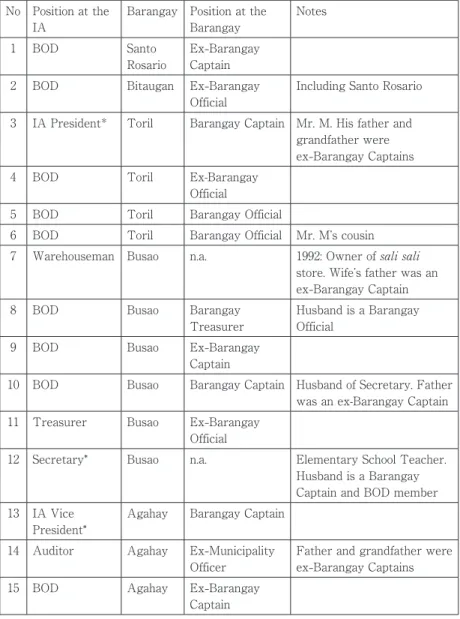
The BATS IA had 15 members on the BOD in 1998; some members were elected as IA President, IA Vice President, Secretary, Treasurer, Auditor, and Warehouseman. Their monthly allowance was quite low, at 25 pesos (around $0.60), making it almost a voluntary service for them. However, they are appreciated by IA members for their “devoted” services. Further, the BATS IA hires a water tender and a bookkeeper as staff members, paid a monthly salary.
The BOD members, including the IA President, are elected at the IA election every two years. Most BOD members have been reelected because IA members want them to continue their duties.
Most BOD members also serve as current or ex-Barangay Captains or Officials (see Table 3). They further serve as leaders of local formal and informal organizations such as the Catholic Church as well as local political and social leaders and, simultaneously, local elites who can manage their own barangay members. Moreover, BOD members have close relationships with each other (e.g., neighbors, relatives, friends, classmates, church
Table 3. The Board of Directors (BOD) of BATS IA in 1998 No Position at the
IA
Barangay Position at the Barangay
Notes
1 BOD Santo
Rosario Ex-Barangay Captain
2 BOD Bitaugan Ex-Barangay
Official Including Santo Rosario
3 IA President* Toril Barangay Captain Mr. M. His father and
grandfather were ex-Barangay Captains
4 BOD Toril Ex-Barangay
Official
5 BOD Toril Barangay Official
6 BOD Toril Barangay Official Mr. M’s cousin
7 Warehouseman Busao n.a. 1992: Owner of sali sali
store. Wife’s father was an ex-Barangay Captain
8 BOD Busao Barangay
Treasurer
Husband is a Barangay Official
9 BOD Busao Ex-Barangay
Captain
10 BOD Busao Barangay Captain Husband of Secretary. Father
was an ex-Barangay Captain
11 Treasurer Busao Ex-Barangay
Official
12 Secretary* Busao n.a. Elementary School Teacher.
Husband is a Barangay Captain and BOD member 13 IA Vice
President*
Agahay Barangay Captain
14 Auditor Agahay Ex-Municipality
Officer Father and grandfather wereex-Barangay Captains
15 BOD Agahay Ex-Barangay
Captain
Notes: *= BOD since 1984 when the BATS IA was established.
organization officials) and meet frequently. Since they are close to each other, they become very active BOD members who cooperate with Mr. M. 3) Distributional Share System
Freeman points out that the distributional share system is the core of any effective WUA. This means that water delivery is dependent on the fulfillment of organizational obligations. Moreover, the water share system should remove the head and tail distinction in the service queue. As mentioned above, Freeman says that a member’s share of cost for system management is proportionate to his/her share of water and share of vote. It can thus be said that the distributional share system has been introduced into IA management in the BATS IA.
a. Share of Cost at the BATS IA
In the BATS IA, members’ organizational obligation is the ISF payment. Since the beginning of the CIS, farmers have agreed that the ISF is set as 10% of the rice harvest. Although many factors influence the size of the rice harvest such as fertility, pests, diseases, and amount of sunshine, people consider the harvest of rice to be larger (smaller) if they receive larger (smaller) amounts of water. Thus, this ISF is considered to be roughly proportionate to the volume of water that each member receives. Therefore, in the BATS IA, they apply the ISF levied by volume of water; here, the share of cost is equivalent to the share of water. This is very different from the other CISs in the Philippines, which levy the ISF by size of area (e.g., 175 kg (3.5 cavans; 1 cavan=50kg) of rice per ha). In the BATS IA, the ISF collection system is also unique. One day before the harvest, the water tender of the IA is informed by the tinakin (harvester)
that there will be a harvest at a member’s farm the next day. Therefore, on the day of the harvest, the water tender and Warehouseman go together to the member’s farm. There, the water tender collects 10% of the harvested rice. The collection of ISF rice is overseen by the IA member, tinakins, and Warehouseman; as such, nobody can escape this ISF payment on the farm. In this way, the BATS IA can achieve a 100% ISF collection, using this simple yet sophisticated method to avoid free-rider behaviors. However, there are two exceptional previous cases in which members did not pay their ISF on the farm. In the late 1980s, one IA member tried to secretly take his harvested rice by boat to his house, but he was caught and had to pay the 10% ISF. He made an excuse that because of unexpected rainfall, he had to take the rice to his house to avoid damage and that he did not intend to escape the ISF payment. In the other case, in 1998 on rotation farming landⅳ, when one farmer from another barangay
took his turn at cultivation, he did not pay his ISF at the farm, but brought his harvested rice directly to the water tender’s house. The water tender strictly warned the farmer not to do it again. These are the only cases of ISF non-payment on the farm.
b. Share of Water Allocation in the BATS IA
In the BATS IA, before 1999, irrigation water was lost at the earth canal because of canal leakage; moreover, there was a water shortage at the downstream part in the dry season. Therefore, downstream members had to receive water by rotation. In 1999, the BATS IA received a Grassroots
ⅳ In the Busao area, since the size of farmland is very small, farmers who inherit land do
not subdivide it, but rather rotate farming during every crop or every year among the inheritors.
Grant Assistance from the EOJ to construct the concrete lining of some parts of the earth canal. After the rehabilitation work, the water shortage downstream was resolved and equal water distribution from upstream to downstream was attained.
Since 1999, the BATS IA has continued to introduce outside resources from the NIA Bohol Office and other donors, and it was finally able to complete the concrete lining of the whole canal of the Busao CIS in 2005. Thus, the BATS IA can supply sufficient water, in a timely manner, to the tail part of the canal.
The water tender is responsible for daily water allocation and canal cleaning. Every day, he opens and closes the intake from the water source (a natural spring) and removes any mud and trashes from the canal to allow the irrigation water to flow smoothly to the tail part. Further, he is responsible for allocating water as well as operating and maintaining irrigation facilities (intake and canal).
In the Busao CIS, since some parts are located on the edge of a cliff, the earth canal has been damaged by landslides caused by typhoons and heavy rain. In this case, the BATS IA has hired laborers from IA members and repaired the canal in a few days. Further, since the BATS IA cemented the whole canal, the repair work needed has become less, which has reduced the IA’s maintenance costs. Indeed, because of the concrete lining of the canal and effective daily operation and maintenance, there has been no water shortage downstream since, allowing the BATS IA to attain equal water distribution at the head and tail parts.
c. Share of Vote at the BATS IA
four barangays (Santo Rosario, Toril, Busao, and Agahay) (see Table 4). The number (proportion) of BOD members from each barangay is two (13.3%) from Santo Rosario, four (26.7%) from Toril, six (40.0%) from Busao, and three (20.0%) from Agahay. These rates closely reflect the number of IA members in each barangay. Therefore, the share of BOD members (equivalent to the share of vote of each barangay) is equivalent to the share of members in each barangay (equivalent to the share of cost of each barangay). Thus, as Freeman mentions, the share of cost is equivalent to the share of vote. Here, requests from IA members (e.g., repair of facilities) are approved in a BOD meeting related to the share of vote of each barangay. The barangay with the larger number of members (i.e., Barangay Busao) is considered to have the greater influence over decision making at the BOD meeting. Hence, a sense of fairness is attained among IA members.
Hence, since a member’s share of water and share of vote is Table 4. Share of Board of Directors (BOD) per number of members in the
BATS IA Name of Barangay Number of Members Share of the Number of Members (%) Number of BOD Members Share of the Number of BOD Members (%) Santo Rosario 16 (1 from
Bitaugan) 11.0 2 13.3 Toril 33 22.8 4 26.7 Busao 70 48.3 6 40.0 Agahay 26 17.9 3 20.0 Total 145 100 15 100
proportionate to his/her share of cost, a distributional share system exists in the BATS IA.
4) Water Control Ability of the BATS IA
Freeman states that among the six essential characteristics, if the first four are fulfilled, then the remaining two (water control ability and the propensity of members to support the local organization) will be realized. The BATS IA has high water control ability; it owns and controls the entire irrigation system from the water source to the downstream part. Since the water source is a natural spring, the volume of water decreases in the dry season. However, it still offers sufficient water to irrigate the whole CIS.
After the Grant Assistance from the EOJ in 1999, the canal was cemented to prevent further leakage in the canal and allow water to reach all the way downstream. This has reduced water shortages in that part, even in the dry season. Furthermore, since there was actually too much water just after the Grant Assistance Project, the BATS IA adopted a water management method to control the volume of water by narrowing the opening of the main gate at the water source. Furthermore, the BATS IA drained the excess water to the river in the middle part of the CIS. The water tender operates this allocation of water daily.
Later, the BATS IA planned the extension of the canal downstream and expansion of the irrigation area to Barangay Agahay to use the excess water, based on the requests of farmers there.
Therefore, the BATS IA provides sufficient water in a timely manner to all IA members; as such, it has high water control ability.
5) Members’ Support to the BATS IA
Leading on from the previous section, because the water control ability is high, so is support from members.
As mentioned above, IA President, Mr. M, has strong leadership skills with regard to IA management. Therefore, the BOD and IA members do not allow him to resign, even though he claims that this is his wish. Indeed, he has been reelected every two years at the IA election with strong support from IA members. Members’ strong support can also be seen from the fact that the ISF collection rate is 100% in the BATS IA, with only a few cases of water stealing and disputes, which have been easily settled. IA members also cooperate with IA activities and adhere to IA bylaws. BATS IA members typically have close social, economic, and political relationships of debt of gratitude. Moreover, they are highly homogeneous socially, economically, and culturally. Therefore, it is easy for IA leaders to manage members and organize them into one group.
In the BATS IA, the boundary of the IA covers the whole irrigated area of the Busao CIS. In addition, at the same time, it covers the various human relationships of debt of gratitude among IA members, or between IA members and BOD. Hence, the IA President has an obligation to provide the benefit of equal irrigation to all IA members. As mentioned above, he is capable to give many other variable benefits to IA and BOD members. While Mr. M passes on benefits such as irrigation water to IA members, the cooperative attitude of IA members to Mr. M (and BOD members) continues; as a result, IA members participate in activities such as ISF payment or cooperate to solving conflicts.
performance.
6) Clearly Defined Boundaries of the BATS IA
Ostrom states that individuals or households that have the right to withdraw resource units from the CPR must be clearly defined, as must the boundaries of the CPR itself (see Table 1). Freeman (2009) defines “organizational boundaries in terms of water share ownership.” The WUA must clearly define its members who are entitled to receive their water and required to fulfill organizational obligations, such as paying the ISF. The boundaries of local organizations as well as the membership of the BATS IA are clearly defined. Indeed, all families that cultivate farmland inside the Busao CIS are registered as IA members of the BATS IA, although some families rotate farming duties by season or year among family members. The BATS IA has an IA member list, which it updates every year.
Since BOD members control IA members in their barangay, no free-rider who is a beneficiary of the irrigation system, but does not join the BATS IA, can exist in the Busao CIS. Here, the boundary of the CPR and membership are clear.
7) Collective-Choice Arrangement in the BATS IA
In the third design principle, Ostrom states that most individuals affected by the operational rules can participate in modifying these rules (see Table 1). Freeman (2009) points out that “at the level of the local commands, the collective choice arrangements are in the conceptual models mostly about administering the three-sided share system.” Hence, most WUA members can participate in modifying the rules of the share system such as receipt
of benefits (i.e., water distribution), member obligations such as ISF payments, and members’ voting privileges.
All BOD members, except those who are sick or have emergency situations, attend the BATS IA BOD meeting every month. At this meeting, BOD members discuss and amend the operational rules necessary for the management of the CIS. The main issues are the irrigation schedule, collection of ISF rice, rental of the IA tractor, distribution of good rice seeds, repair work on the irrigation canal, and sale of ISF rice; members rarely discuss dispute management or new projects for CIS rehabilitation or expansion.
The issues discussed are presented at the General Assembly, which is held once a year, and approved by IA members. The attendance rate for the General Assembly is only around 40-50 %. However, since many formal and informal information exchanges occur in each barangay between BOD and IA members, the low attendance rate is not a concern. In each barangay, an IA member that is a resident can receive information on irrigation through various social relationships. At the same time, requests from IA members on the repair or construction of irrigation facilities, new projects for the IA, and so on are heard by BOD members at each barangay. BOD members present the requests from each barangay at the monthly BOD meeting, where the requests are discussed and measures are decided. Through such a collective choice arrangement system, each IA member can participate in modifying the operational rules of the IA. 8) Monitoring in the BATS IA
Ostrom states that monitors, who actively audit CPR conditions and appropriator behavior, are accountable to the appropriators or are
themselves the appropriators (see Table 1). If a clear share system arrangement exists, the WUA should be able to monitor whether water is being properly delivered to each member as planned, whether members have paid the ISF and fulfilled their obligations to the WUA, and whether collectors have remitted the ISF to the WUA.
In the BATS IA, water delivery is monitored daily by the water tender. Every day, he opens and closes the intake from the natural spring, monitors the canal from upstream to downstream, and cleans the canal (removing trash and mud) in order to maintain the proper delivery of irrigation water and avoid water shortage.
Monitoring of the ISF payment is also done properly in the BATS IA to avoid free-rider behaviors. As mentioned above, at the time of harvest, the water tender collects 10% of the harvested rice on the farm. The IA member, the tinakins, and Warehouseman oversee the ISF collection. Therefore, no IA member can escape the ISF payment, aside from the few aforementioned cases.
The BATS IA also has a proper monitoring system for the ISF collector. Collected ISF rice is stored in an IA warehouse by the water tender and Warehouseman after collection. The Warehouseman oversees the water tender to avoid any misuse. Previously, at the time of the former water tender, there was no position of Warehouseman. The water tender collected ISF rice and stored it an IA warehouse alone. Mr. M felt that the monitoring of the water tender was insufficient and, at the next election in 1992, he changed the water tender to the present person; at the same time, he established the new position of Warehouseman and assigned a BOD that he trusted. Further, he made the new Warehouseman always monitor the water tender when he collects and stores the ISF rice. By introducing such
a monitoring system, the BATS IA can avoid any misuse by the water tender (ISF collector).
Moreover, in the BATS IA, the Treasurer records ISF payment of each IA member and the expenditure of the IA. In addition, the Auditor makes an audit report at the BOD meeting and General Assembly. The financial management of the BATS IA is appropriate. Further, records of meetings are properly kept. The Secretary keeps the minutes of every BOD meeting and General Assembly. She reads the minutes from the former meeting at the beginning of every meeting.
Hence, in the BATS IA, IA activities are properly monitored, and the IA has effective methods to prevent the occurrence of free-rider behaviors. 9) Graduated Sanctions in the BATS IA
Ostrom states that appropriators who violate the operational rules are likely to be assessed graduated sanctions by other appropriators, by officials accountable to these appropriators, or by both (see Table 1). In the BATS IA, bylaws detail the graduated sanctions against offenses. At the first offense, the violator receives a warning from the IA. At the second offense, he or she is fined. However, violators never repeat an offense. Indeed, there are few conflicts, and the IA does not need to apply more severe sanctions than a warning.
10) Conflict Resolution Mechanism in the BATS IA
Ostrom points out that appropriators and officials have rapid access to low-cost local arenas for the resolution of conflicts among appropriators or between appropriators and officials (see Table 1).
summons both parties to the BOD meeting and the IA President explains and arbitrates between the two parties. Mr. M does not scold the violator who steals the water as a child, but explains the problem to him/her saying, “If there is no water, everybody has difficulty getting food. So, you should not steal the water.” He persuades the violator to respect his/her honor and not injure his/her pride. In this case, the BATS IA can make an amicable settlement. Since each IA member is indebted in various ways to Mr. M, he/she is persuaded and does not repeat the offense.
Additionally, in the BATA IA, cases of the non-payment of the ISF on the farm are rare.
As mentioned above, IA members have close and multiple social relationships, especially in the same barangay. For example, many IA members join the PTA of Busao Elementary School, in which the Secretary of the BATS IA serves as a schoolteacher. A PTA meeting is run monthly. Moreover, many IA members in Barangay Busao come to the sali sali store run by the Warehouseman of the BATS IA. There, people exchange information on many issues including irrigation management. Therefore, since IA members have close patron client relationships with the IA President, BOD members, and other IA members, these relationships function as the social sanctions to avoid offenses.
Hence, the BATS IA has a high capacity of conflict resolution. 11) Minimal Recognition of Rights to Organize within the BATS IA
Ostrom states that the rights of appropriators to devise their own institutions are not challenged by external governmental authorities (see Table 1).
operation and maintenance of hydrologically meaningful units (the entire irrigation system in the CIS). Moreover, the IA holds the legal water rights, which protects its members’ water access, and it is registered with the nation’s Securities and Exchange Commission, receiving permission to own property, make and receive contracts, collect fees, and impose sanctions. Further, the IA is an autonomous unit not directly belonging to any governmental agency. On the contrary, the NIA helps it maintain its accountability to its members; the legal framework provides an enabling setting in which the IA can potentially play a meaningful role (Korten and Siy, 1989).
In the NIA’s PIM, farmers have the right to be involved in key decisions, which gives them the confidence to deal with NIA staff as equals, not as passive recipients of governmental aid. The NIA encourages farmers to take a key role in the development of the irrigation system from the outset of the project. To promote this PIM’s idea, the NIA assigns an IDO as a community organizer at the beginning of the project. However, the IDO’s role is a supportive one; he/she does not lead the farmers, but rather catalyzes the development of their own leadership capacities (Siy, 1989). In PIM, the NIA promotes the policy that farmers play the central role in irrigation management, while the role of the governmental agency (i.e., the NIA) is to support farmers.
In this sense, the policy of the NIA’s PIM legally guarantees the IA’s right to organize as well as positively encourages farmers to organize the IA to be self-independent. In PIM, the IA should handle problems by itself, while the NIA can provide indirect support and monitoring. Moreover, the IA should be fully independent from the NIA’s control, as provided by its bylaws.
In the BATS IA, one IDO is assigned by the NIA Bohol Provincial Office, and she attends every monthly BOD meeting. However, the IDO only observes the BOD meeting and does not intervene in the management of the IA. Here, the role of the IDO is to monitor the IA management and listen to the needs of the IA.
Additionally, in the model of bylaws presented by the NIA Central Office, the term of BOD members (including the IA President) should not exceed two terms (one term is one to two years), to avoid the intervention of factionalism or local political disputes. At the same time, this bylaw model aims to prevent the dominance or corruption that would be created if the same person were to stay in his/her position as IA leader. Moreover, there is a bylaw model in which the political positions above Barangay Official should not take the position of a BOD member in the IAⅴ.
However, in the BATS IA, both the IA President and BOD members are the leaders (Barangay Captain or Official) of their own barangay. Moreover, they remain serving in their positions at the IA for many terms, contrary to the bylaw, based on the strong request of IA members. Additionally, BATS IA applies the ISF levied by 10% of harvested rice, that is different from NIA bylaw model which levies the ISF by size of area, such as 3.5 cavans (175kg) of rice per ha. The NIA Bohol Provincial Office does not bring these facts into question or protest against them. On the contrary, the BATS IA was praised as the Most Outstanding IA in Region VII
ⅴ Under the IA bylaw, in Article VII. Board of Directors and Committees, Section 1.
Number of Directors and Qualifications, 6. “He must not be holding any elective position in the government higher than a barangay councilman nor actively engaged in partisan politics.” In Article VII. Section 2. Election and Term of Office, “No director shall be elected for more than two consecutive terms” (Republic of the Philippines Securities and Exchange Commission, 1998)
in June 2003 by the NIA Regional Office of Region VII. Thus, the NIA appreciates and respects the unique management system of the BATS IA. In addition, the BATS IA has healthy financial management, leading to independent IA management. Before 1999, in the dry season, farmers in Sector Busao had to rotate irrigated water which led to a decrease in rice harvested downstream, and thus decreased the amount of ISF collected. However, after the concrete lining of the canal in 1999, the amount of ISF increased.
Collected rice is sold to an intermediary in the provincial capital when its market price is highest. The rice sales are remitted to the bank account of the IA. The BATS IA uses these funds to purchase equipment and facilities, such as a hand tractor, thresher, and IA warehouse. Moreover, the IA purchases good rice seeds and distributes them to IA members. On the contrary, the BATS IA does not lend money to members to avoid jeopardizing the financial management of the IA. In other IAs, there are many cases where the IA has exhausted its funds and been forced to suspend IA activities because it has been unable to get back the money lent to members. The BATS IA prevents such a case.
If the BATS IA cannot deal with a case by itself, it introduces the necessary outside resources by negotiating with outside governmental agencies and donors. As mentioned above, the BATS IA received a Grassroots Grant Assistance Project from the EOJ for the canal cementing and rehabilitation. Moreover, it requested that the NIA Bohol Provincial Office implement a canal extension project, and the National Food Authority construct a new IA warehouse. Additionally, the IA received a mechanical rice drier from the Congressman’s fund. Further, the Municipality Agriculture Office provided assistance to construct a model
farm of good rice seeds at Mr. M’s rice field, who negotiated with influential external people such as politicians (e.g., Governor and Congressman) and governmental officials (e.g., Director of the NIA Bohol Provincial Office), making full use of his patron client relationships to obtain assistance for the IA. Because of these efforts, the BATS IA has stable management. Thus, the NIA Bohol Provincial Office highly approves of its performance and respects its unique and self-reliant management style.
12) Nested Enterprises
Ostrom states that for CPRs that are part of a larger system, appropriation, provision, monitoring, enforcement, conflict resolution, and governance activities are organized in multiple layers of nested enterprises (see Table 1).
The BATS IA has sufficient structure and function for nested enterprises. It is organizationally divided into three sectors from upstream: Sector Santo Rosario, Sector Toril, and Sector Busao. However, these sectors are just geographical divisions, and there is no activity in each sector.
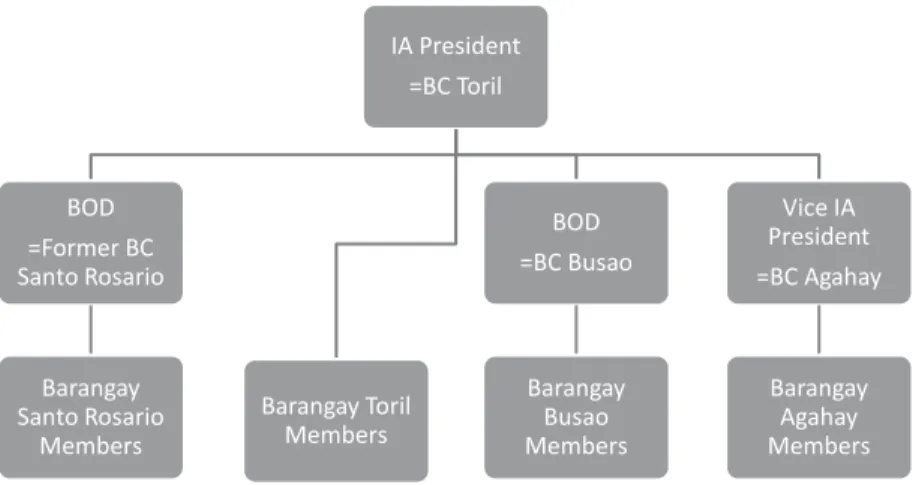
On the contrary, in the BATS IA, there are four barangays. IA members belong to one of the four barangays, which are controlled by BOD members, who are also current or former Barangay Captains or Officials (see Figure 3). In each barangay, an assembly is held every month; sometimes, irrigation issues are discussed. These four barangays serve as the units under the IA, fulfilling the functions of monitoring, enforcement, and conflict resolution for IA members.
As mentioned above, BOD members also cooperate with Mr. M since they have many relationships of debt of gratitude with one another.
Figure 3: Management system of BATS IA managed by BODs, who are at same times Barangay Captain (BC) & Officials (source: Author’s survey)
Therefore, the IA President can manage BOD members and, then, BOD members manage IA members in their barangays. This is the way in which Mr. M gains the cooperation of IA members in other barangays, with regard to IA activities. This is considered to contribute to the high abilities of the BATS IA in monitoring violations, sanction, and conflict resolution.
In summary, based on Freeman and Ostrom’s models, the organizational performance of the BATS IA is successful as a WUA (see Table 5).
Table 5. Evaluation of the organizational performance of the BATS IA
Indicator Evaluation Notes
Source of leadership
Yes (Local)
Mr. M is simultaneously a Barangay Captain of Toril, local elite, and wealthy person. He has strong leadership and creates patron client relationships
with his followers (barangay residents and IA BOD members).
Responsibility of leader and staff
Yes BOD members, who are simultaneously Barangay
Captains or Officials, are selected by IA members at the IA election. BOD members serve for IA members “devotedly.”
Share system of water delivery and obligation
Yes A member’s share of water is equivalent to his/
her share of cost and share of vote. Since the ISF is set as 10% of the harvest and the collection rate of the ISF is 100%, a member who receives more water pays a higher ISF. Since the number of BOD members per barangay is proportionate to the number of IA members per barangay, a barangay that pays a greater ISF has a larger voice (existence of the distributional share system).
Head and tail distinction
Yes Equal water distribution from upstream to
downstream is attained. There is no water shortage downstream because of the concrete lining of the canal and daily canal cleaning by a hired water tender (existence of the distributional share system). Water resources
control ability
Yes The IA owns and manages the entire irrigation
system from the water source (a natural spring) to the tail parts, and it lined the earth canal with concrete to resolve the water shortage downstream in the dry season. The water tender operates the allocation of water daily. The IA can deliver sufficient water in a timely manner to members (the IA has high water control ability).
Members’ support Yes Members’ support to IA is high. IA members
cooperate with IA activities and follow IA bylaws. IA and BOD members do not allow the IA President to resign.
Clearly defined boundaries
Yes The boundary of the irrigation area is clear. All
beneficiaries of irrigation are registered as IA members. The IA updates the IA member list. BOD members control IA members in their barangays. Free-riders do not exist in the CIS.
Collective choice arrangement
Yes BOD members discuss the modification of the
operational rules at the monthly BOD meeting. There are many formal and informal information exchanges at the barangay level between BOD and IA members. Requests from IA members are heard by BOD members at each barangay. BOD members present the requests from each barangay at the monthly BOD meeting, allowing IA members to participate in modifying the operational rules.
Monitoring Yes IA activities are monitored and reported to IA
members. The water tender monitors the canal every day to attain equal water distribution. The collection of 10% of the harvested rice as ISF is monitored by the IA member, harvesters, water tender, and Warehouseman on the farm to avoid free-riders. Collected ISF rice is stored in the IA warehouse by the water tender together with the Warehouseman, who oversees the water tender to avoid misuse. The IA Treasurer records the ISF collection. The Auditor’s report is done at the BOD meeting and General Assembly. The Secretary keeps and reports the minutes of the BOD meeting and General Assembly. Graduated
sanctions
Yes IA bylaws set a rule of graduated sanctions. At the
first offense, violators receive a warning. At the second offense, they are fined. However, there is no case of a second offense.
Conflict resolution mechanisms
Yes There is no case of ISF non-payment. There are
only a few conflicts, such as water stealing and disputes, and these have been easily resolved inside the IA. IA members cooperate to resolve conflicts because they are indebted to the IA President and they have close and multiple patron client relationships, especially in the same barangay, which function as social sanctions to avoid offenses. Minimal
recognition of rights to organize
Yes The IA manages the CIS independently. The NIA
appreciates and respects the unique management system of the BATS IA. The NIA IDO visits
regularly but does not intervene in IA management. The IA was praised as the Most Outstanding IA in Region VII by the NIA.
Nested enterprises
Yes The BATS IA consists of four barangays. BOD
members simultaneously acting as Barangay Captains or Officials in each barangay control IA members in their barangay. These four barangays serve as the units under the BATS IA and fulfill the function of monitoring, enforcement, and conflict resolution.
Overall performance
Successful Source: Author’s survey
V. Conclusion
One of the important factors of the successful performance of the BATS IA as a WUA is the competent IA President, Mr. M. However, the fundamental reason that Mr. M tries to distribute irrigation water equally to all IA members and to maintain a 100% ISF collection rate is that the BATS IA has a variation of a distributional share system. In the BATS IA, the ISF is set as 10% of the harvested rice. If an IA member receives more water, he/she will have more harvest; thus, 10% of harvested rice is considered to be almost equivalent to the volume of water that a member receives. As such, the water received by each member is roughly proportionate to the share of system costs paid by each member. Here, each member’s share of water is equivalent to his/her share of cost. Therefore, Mr. M tries his best to provide equal water distribution.
If water shortage occurs downstream, this decreases the total ISF paid by members to the IA. If the IA wants to have healthy and sustainable financial management, it is necessary to collect much ISF. Thus, the BATS
IA constructed the concrete lining of the canal to ensure that irrigation water reaches the end of the canal downstream, introducing external aid from the EOJ and NIA. In the daily operation of the CIS, the IA hires a water tender and lets him monitor and clean the canals every day, as the IA watches carefully that a water shortage does not occur in the CIS. Consequently, by removing head and tail distinctions in service queues, the BATS IA can attain equal water distribution within the CIS.
Furthermore, in the BATS IA, the number of BOD members selected from each barangay is proportionate to the number of IA members of each barangay. Therefore, a member’s share of water is not only equivalent to his/her share of cost, but also to his/her share of vote. Requests from members are approved according to the respective share of vote of the barangay to which they belong. As a result, a sense of fairness is shared among IA members; those who bear smaller costs (upstream) do not receive more benefits (water).
Therefore, a distributional share system exists in the BATS IA, which Freeman (1989,1992) points out as the heart of any effective WUA, since share of cost, share of water, and share of vote are proportionate.
Furthermore, the four barangays function as subunits of the BATS IA, in which each Barangay Captain and Official serves as a BOD member. Thus, BOD members can control their barangay members, who are also IA members. Hence, the four barangays manage the monitoring, enforcement, and conflict resolution activities of the BATS IA.
Additionally, in the BATS IA, there are only a few cases of the violation of IA bylaws; moreover, even in such cases, violators are prevented from re-offending with just a warning by the IA President or BOD, with no fines needed to be applied. This is because, within each barangay, an IA
member has a close social relationship (patron client relationship) with the IA President, BOD, and other IA members. These close relationships in the barangay serve as a type of social sanction to avoid offenses by members. Moreover, since the water source of the Busao CIS is a natural spring, the irrigation water is abundant, even in the dry season. The BATS IA owns and manages the entire system of the Busao CIS from the natural spring to the end of the canal. Hence, it can decide the volume and timing of irrigation alone, giving itself the strong ability to control its water resources.
In conclusion, the BATS IA has a sophisticated irrigation management system, which fits Ostrom’s design principles of long-enduring CPR, and Freeman’s essential characteristics of an effective WUA. As the BATS IA receives cooperation from IA members who join IA activities and follow IA bylaws, there are few conflicts and the IA can attain 100% ISF collection. Consequently, the BATS IA is able to maintain stable and successful IA management in the long-term.
On the contrary, the NIA PIM does not include a distributional share system. The ISF is set as a fixed rate per farm size by the NIA Central Office and is not linked to the volume of irrigation water that each farmer receives (Kakuta, 2014). Since the head and tail distinction remains in the service queue, farmers in the tail part are disadvantaged by water shortages (Freeman, 1992). These farmers have to pay a relatively higher ISF compared with the farmers in the head part. As such, those in the tail part have an increased sense of unfairness toward the management of the IA, and the IA loses their support.
In addition, water delivery is not dependent on members’ fulfillment of their obligations to the organization. Even if a member in the tail part
fully pays the ISF, he/she may not receive sufficient water because of a water shortage. Therefore, the incentive of the IA member to pay the ISF remains low (Freeman, 2008).
Further, even if a member does not pay the ISF, or if a farmer is a non-member, he/she can still take water from the canal, since IA members share common turnouts, meaning that the IA cannot apply effective sanctions such as stopping water delivery against the offenders. Hence, free-riders who break rules and continue to receive water cannot be avoided (Freeman, 2008). Therefore, although there is sufficient water, IA management is unsuccessful in the NIA PIM. The lack of a distributional share system in the design principles of NIA’s PIM is thought to have led to the unsuccessful management of CISs in the Philippines.
Acknowledgements
The author wishes to thank Dr. David Freeman, Professor Emeritus, Colorado State University, for his valuable comments and suggestions.
REFERENCES
Bagadion, B. and Korten, F. (1991), “Developing Irrigators’ Organization: A Learning Process Approach,” in M. Cernea, ed., Putting People First: Sociological Variables in Rural Development. Second Edition, New York: Oxford University Press: 73-112.
Freeman, D. (1989), Local Organization for Social Development: Concepts and Cases of Irrigation Organization, Colorado: Westview Press.
Freeman, D. (1992), Creating a Supportive Policy Environment for Irrigation System Turnover and Joint Management, Irrigation Management Project HMG/USAID/Nepal Technical Assistance Team.
Freeman, D. (2008), Improvement of the irrigation system management, Interview by Ieko Kakuta on February 11, 2008.
Freeman, D. (2009), Personal conversation by e-mail on August 27, 2009. Kakuta, I. (2014), “Impact of Participatory Irrigation Management on the
Bohol Irrigation Project in the Philippines,” in Journal of the Institute for Asian Studies. 41: 123-162.
Korten, F. F. and Siy, Jr.,R.Y. (1989), “Summary and Conclusion,” in F.F. Korten and R.Y. Siy, Jr. eds., Transforming a Bureaucracy: The Experience of the Philippine National Irrigation Administration, Quezon City: Ateneo de Manila University Press: 145-157.
KRI International Corporation (2001), The Study on Strengthening of NIA’s Management System. First Report Volume I: Main Report, Tokyo: Japan International Cooperation Agency.
Maass, A. and Anderson, R. (1978), …and the Desert Shall Rejoice: Conflict, Growth and Justice in Arid Environments, Florida: RE Krieger.
Maleza, M. and Nishimura, Y. (2007), “Participatory processes and outcomes: The case of national irrigation system management in Bohol, Philippines,” in Irrigation and Drainage 56: 21-28.
Martin, E. and Yoder, R. (1988), “A comparative description of two farmer-managed irrigation system in Nepal,” in Irrigation and Drainage Systems 2: 147-172.
Ostrom, E. (1990), Governing the Commons: The Evolution of Institutions for Collective Action, New York: Cambridge University Press.
Republic of the Philippines Securities and Exchange Commission (1998), Article of Incorporation and Bylaws of Luna Quirino Irrigators’ Association Inc., National Irrigation Administration.
Zanjera, Quezon City: University of Philippines Press.
Siy, Jr., R.Y. (1989), “A tradition of collective action: farmers and irrigation in the Philippines,” in F. F. Korten and R.Y. Siy, Jr. eds., Transforming a Bureaucracy: The Experience of the Philippine National Irrigation Administration, Quezon City: Ateneo de Manila University Press: 20-30.