Studies on preventive and improvement effects
of a kampo medicine on the decline in
reproductive functions and peripheral blood
flow in aged female rats
著者
Ichihashi Masaru
内容記述
学位授与大学: Osaka Prefecture University(大阪
府立大学), 学位の種類: 博士(獣医学), 学位記番
号: 論獣第139号, 学位授与年月日: 2010-02-20,
指導教員: 久保喜平.
大阪府立大学博士(獣医学)学位論文
Studies on preventive and improvement effects of a kampo
medicine on the decline in reproductive functions and
peripheral blood flow in aged female rats
(漢方方剤の老齢雌ラットの生殖機能ならびに末梢血流量低下に
対する予防および改善効果に関する研究)
2
Contents
PrefaceChapter 1 A correlation between the value in electrical
impedance and the conditions of the epithelial cell
layer of vaginal mucosa in aged female rats
Summary Introduction
Materials and Methods Results
Discussion
Tables and Figures
Chapter 2 Effects of Nanpao
®, a kampo medicine, on the decline
in estrous cyclicity with advancing age in female rats,
as measured by vaginal impedance methods.
Summary Introduction
Materials and Methods Results
Discussion
Chapter 3 Preventive and improvement effects of Nanpao
®,
a kampo medicine, on biological dysfunctions in aged
female rats
Summary Introduction
3-1 Anti-aging effects of Nanpao® on reproductive functions
in aged female rats Materials and Methods Results
Discussion
Tables and Figures
3-2 Effects of Nanpao® on peripheral blood flow and surface
4
List of Publications References
Preface
Aging is the accumulation of changes in an organism or object over time (Bowen and Atwood, 2004). In biology, senescence is the state or process of aging. Cellular senescence is a phenomenon where isolated cells demonstrate a limited ability to divide in culture (Hayflick and Moorhead, 1961), while organismal senescence is the aging of organisms. The organismal senescence is characterized by the declining ability to respond to stress, increasing homeostatic imbalance and increased risk of disease. This irreversible series of changes inevitably ends in death. Although the age-related changes are obvious from the molecular to the physiological and behavior levels, there is no one unifying theory to explain them. The mechanisms of aging could be quite complex and have diversity in organisms, tissues, and cells (Troen, 2003). There are many environmental factors including stress influence the age-related changes. For example, it is reported that the increase in oxidative stress, an imbalance between endogenous levels of oxygen radicals and antioxidative defense, is one of the
6
researches (Sone et al., 2007; Sasaki et al., 2008). It is also reported that
senescence marker protein-30 (SMP30) knockout mice which having an increased mortality rate at the 3 months of age, being attribute to highly susceptible to various harmful reagents, may be a useful tool for aging and biological monitoring (Maruyama et al., 2004). Because progression of aging is influenced not by the one gene function, but by multiple genetical and environmental factors described as above, it is not clear whether SMP30 KO mice represent whole of the accerelated aging process as an model of biological dysfunctions. The further investigations are needed to reveal them.
Reproduction is one of the most fundamental biological characteristics common to all mammals. The aging researches on reproduction have characterized the reproductive aging of female laboratory rats using fertility
and fecundity on Long-Evans (Matt et al., 1986; Matt et al., 1987) and
estrous cycles on Sprague-Dawley (Clements and Meites, 1971; Quadri et al., 1973; Everett, 1980), since the primary mechanism is mostly identical between rats and humans. The estrous cycle well reflects ovarian activity, which is regulated through the hypothalamus-anterior pituitary axis. The estrous cycle is thus a convenient and useful parameter for monitoring individual reproductive aging throughout the lifespan of the rats. Nowadays, both the observations of the vaginal smear and the measurements of the electrical impedance in the vagina (EIV) are used for classification of stages of the estrous cycle. Vaginal cytology is used for classification of female rat estrous cycle stages which can be reliably identified from vaginal smears
(Montes and Luque, 1988). Recently, Rezac (2008) described that the measurement of EIV is convenient and reliable to explore various reproductive processes. Although female rodents do not experience menopause, they undergo a transition from regular ovulatory cycles to irregular cycles to acyclicity. The process of reproductive aging appears to be divided into three sequential phases based on the cyclicity: the cyclic disturbance, the cycle cessation, and the postcyclic vaginal state. The mechanisms for these changes are largely unknown, but it is believed that these biological dysfunctions are affected by multiple factors.
The treatment and prevention of the age-related changes has been examined from epochs beyond historical reach. It has been described that there are many approaches to prevent the progression of senescence. In these days, caloric restriction (CR) with adequate nutrition, nutritional supplements and hormonal therapy and kampo therapy are getting attention. CR has been shown to reduce oxidative stress, improve insulin sensitivity, and alter neuroendocrine responses and central nervous system function in
animals (Martin et al., 2009). It has particularly profound and complex
8
women for symptoms of aging, but side effects such as increase the risk for heart attack, strokes and breast cancer have also been reported (O’Connor et al., 1998).
A number of kampo medicines have been used for many centuries in East Asia, including China and Japan, for the treatment of menstrual disorders, infertility and undefined symptoms, e.g. hot flushes and chilly sensation. In general, the traditional Chinese herbal prescriptions are rather inexpensive and safe with little side effects, and have properties for normalizing biological balances. Also, the characteristics of medicinal herbs, especially their applications in different disease stages (prevention and intervention) and multi-targets properties, allow them to be potential anti-aging intervention in prevention and treatment of the aging-associated disorders. However, animal studies that evaluating the effects of the administration of kampo medicines on the age-related biological dysfunctions have little been performed. It is considered that examining evidence to support the effectiveness of the kampo medicines may provide useful information for clinical applications for various age-related symptoms in human.
The objects of the present study were to examine the preventive and improvement effects of Nanpao, a kampo medicine, on biological dysfunctions in aged female rats. In Chapter 1, the author examined the correlation between the value of EIV and morphological conditions of the epithelial cell layer of vaginal mucosa in the aged Sprague-Dawley rats exhibiting abnormal estrous cycles. In Chapter 2, the author performed to actually investigate the utility of the method for the measurement of vaginal
impedance in the study of the progression of reproductive aging in female rats and to evaluate the time-dependent effects of the administration of Nanpao on the age-related changes in the estrous cycle. In Chapter 3, the author examined the effects on a decline in various reproductive functions of administration of Nanpao (Chapter 3-1). Moreover, the effects on cold constitution of Nanpao were examined quantitatively and objectively using measurements of peripheral blood flow and surface skin temperature in aged female rats (Chapter 3-2).
10
Chapter 1
A correlation between the value in electrical impedance
and the conditions of the epithelial cell layer of vaginal
Summary
Age-related changes, including loss of regular estrous cycles in female rats
are well known phenomenon (Meites and Huang, 1976; Lu et al., 1979).
The estrous cycle is thus a convenient and useful parameter for monitoring individual reproductive aging throughout the lifespan of the rats.
The measurement of electrical impedance in the vagina (EIV) can be used for monitoring various reproductive events in female mammalian. In this Chapter, the author examined the correlation between the value of EIV and the morphological conditions of the epithelial cell layer of vaginal mucosa in the aged Sprague-Dawley rats exhibiting abnormal estrous cycles. The value of EIV was considered to correlate with vaginal cytology in aged rats as well as in young rats. Moreover, the values of EIV both in persistent estrus and continual diestrus rats reflected the histological conditions of the epithelial cell layer of vaginal mucosa. In conclusion, the author describes that the measurement of EIV is useful for studying the progression of reproductive aging.
12
Introduction
The average rat lifespan is approximately 2 to 3 years. By 2 months of age, young female rats are reproductively mature and exhibit estrous cycles and ovulation every 4 to 5 days (Kohn and Clifford, 2002). The rat estrous cycles can be further divided into four stages: proestrus, estrus, metestrus, and diestrus. The estrous cycle is characterized by cyclical changes in the uterus,
ovaries, vaginal mucosa, behavior, and hormone levels (Maeda et al. 2000;
Nicholas, 1949).
The loss of a regular estrous cycle is well known as one of the representative declines in reproductive performance in aged female rats (Meites and Huang, 1976; Lu et al. 1979; Ichihashi et al., 2008). Beginning at middle age (at the age of 6 to 10 months), many females display prolonged, irregular estrous cycles instead of regular cyclicity (Aschheim, 1976; Meites and Huang, 1976; Lu et al., 1979; Westwood, 2008). Shortly thereafter, aging females become persistently estrus, a condition resulting from chronic anovulation. This may be followed by state in which cycles are ten to fourteen days long, suggestive of prolonged luteal phase, which termed repetitive pseudopregnancy (Nelson and Felicio, 1985). The final stage of reproductive senescence is persistent diestrus (vom Saal et al., 1994).
Vaginal cytology is used for classification of female rat estrous cycle stages which can be reliably identified from vaginal smears (Montes and Luque, 1988). In addition to the vaginal smears, the measurement of electrical impedance in the vagina (EIV) can be used to identify estrous in several species (Bartos, 1977; Taradach, 1982). Consequently, the elevation (over 3.0
kΩ) of EIV accompanying cornification of the epithelial cell layer in the proestrus stage indicates the optimum day for mating in rats and mice (Koto et al., 1987 a; Koto et al., 1987 b). A transient increase in EIV correlated strongly with changes in estradiol levels (Bartos, 1977; Koto et al., 1987 b).
Rezac (2008) described that the measurement of EIV may be useful to explore various reproductive processes. However, age-related EIV characteristics are not well known. Recently, longitudinal studies, such as the effect of chronic atrazine on estrous cycle patterns (Eldridge et al., 1999) and changes of the F344/N estrous cycle with aging (Sone et al., 2007) were performed using female rats in the field of reproductive toxicology, physiology and theriogenology. Since it is not easy to purchase aged rats from breeders, aged rats are very valuable for executing studies and there is a need for these research fields to collect data without autopsy. Therefore, if the present study were to demonstrate that the value of EIV reflect the morphological conditions of vaginal mucosa in rats exhibiting abnormal estrous cycles, the measurement of EIV is helpful to predict temporal vaginal histology without autopsy. Moreover, since these measurements are technically easy, their detection may allow us to improve efficiency for
14
which was reported a correlation between EIV and the hormone levels in the proestrus stage (Taradach, 1982).
Materials and Methods
AnimalsFemale rats of the Sprague-Dawley (Crl: CD [SD]) strain were purchased from Charles River Japan, Inc. at the age of 5 months (n=12) or at the age of 14 weeks (n=10), and used in this study. Eight of 12 and remaining four rats purchased at the age of 5 months were examined at the age of 13 months (13 M) and at the age of 19 months (19 M), respectively. During the experimental period, the animals were housed individually in stainless steel wire cages (W: 430 × D: 450 × H: 170 mm) in a barrier-sustained animal room (temperature: 23 ± 1°C; relative humidity: 55 ± 5%; fresh-air ventilation: 12 changes/hr; lighting: 12h/12h light/dark cycle). The animals were allowed free access to food (CRF-1, Oriental Yeast Co., Ltd., Tokyo, Japan) and tap water. All animal studies were approved by the Institutional Animal Care and Use Committee of Mitsubishi Tanabe Pharma Corporation in accordance with the “Guidelines for Animal Studies”.
16
day 14. They were anesthetized with ether, and then sacrificed by exsanguination by cutting abdominal artery and vein under the deep ether anesthesia, and the vaginas were taken.
Vaginal cytology
The vaginal smears were taken by wiping the vaginal wall lightly with a water-moistened cotton swab, Giemsa-stained on glass slides. Slides were examined for the following features: cornified epithelial cells, nucleated epithelial cells, leukocytes, and mucus. Estrous cycle stage then was
determined using the following criteria (Maeda et al., 2000; Sharp et al.,
1998; Weiss et al., 2000): 1) proestrus-predominantly nucleated epithelial
cells, few cornified epithelial cells, and few leukocytes; 2) estrus-predominantly cornified epithelial cells; 3) metestrus-predominantly leukocytes and cornified epithelial cells; and 4) diestrus-predominantly leukocytes, some nucleated epithelial cells, and mucus. In the observation of vaginal smears of each animal, the estrous cycles were defined as “regular estrous cycles” when a regular cycle of 4- or 5-days was observed in at least 2 consecutive periods, as “irregular estrous cycles” when one estrous cycle was prolonged, respectively. Aged rats that had exhibited persistent vaginal cornifications continuously for 2 weeks were considered to be in persistent estrus (Lu et al., 1979), whereas rats that had displayed diestrus smears for 2 weeks were considered to be in continual diestrus (repetitive pseudopregnancy or persistent diestrus (Westwood, 2008)).
Vaginal impedance measurements
Vaginal impedance measurements were using the Impedance Checker MK-10B (Muromachi Kikai Co., LTD, Tokyo, Japan). The vaginal probe was inserted until taking constant impedance measurements. All impedance measurements were done immediately before collection of vaginal smears. The vaginal impedance probe was cleaned with 70 % alcohol before each measurement.
Vaginal histology
The vagina of each rat was dissected and fixed in 10 % neutral buffered formalin and processed for histology using routine paraffin-embedding. Sections were prepared at 5-6 μm and stained with hematoxylin and eosin by the routine method for microscopy.
18
Results
Observations of estrous cycles by cytologyAll young animals exhibited regular estrous cycles (data not shown). Rats classified in proestrus (4.0 ± 1.5 kΩ, n=31 samples) by vaginal cytology had higher EIV than in the other estrous stages (estrus, 2.2 ± 1.1 kΩ, n=35; metestrus, 1.2 ± 0.1 kΩ, n=33; diestrus, 1.1 ± 0.2 kΩ, n=41).
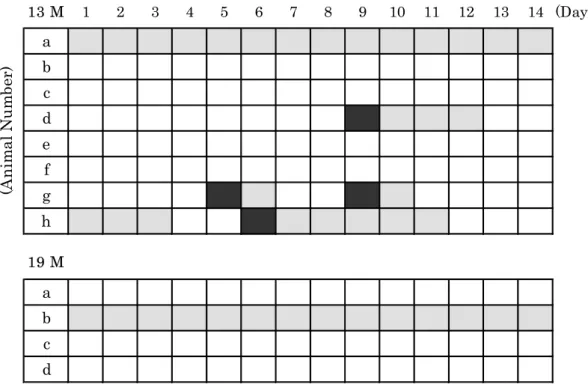
Figure 1-1 summarizes the estrous cycles in individual rats from 13 M and 19 M groups. All aged rats exhibited irregular estrous cycles.
In the 13 M group, one rat (13M-g) showed both regular estrous cycle and intermittent prolonged diestrus. Two rats (13M-d and 13M-h) showed persistent estrus after transition from proestrus to estrus. One rat (13M-a) showed a persistent estrus characterized by chronic anovulation and persistent vaginal cornification. During the persistent vaginal cornification, the vaginal smear consisted of clumped-to-densely packed fields of cornified epithelial cells. Nucleated epithelial cells were present in spare to slight number (Figure 1-2-A). The remaining four rats (13M-b, 13M-c, 13M-e and 13M-f) showed persistent diestrus characterized by a number of leukocyte and some epithelial cells. Moreover, the mucin was observed sporadically in the smear during persistent diestrus (Figure 1-2-B).
In the 19 M group, all rats displayed irregular estrous cycle. One rat (19M-b) showed persistent estrus and the remaining three rats (19M-a, 19M-c and 19M-d) showed persistent diestrus.
Relationship between vaginal cytology and vaginal impedance value
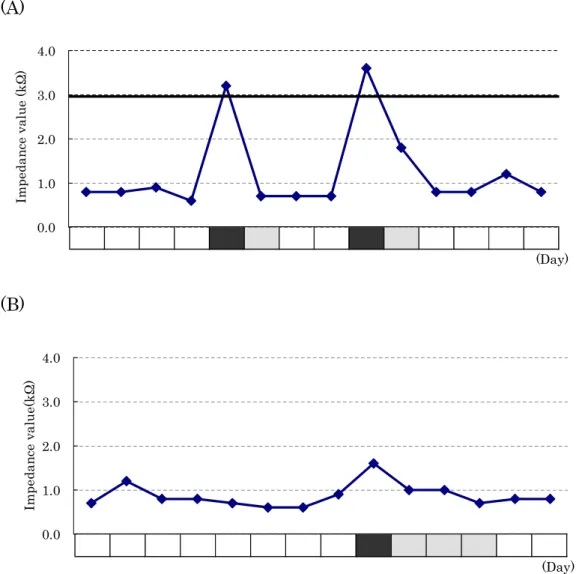
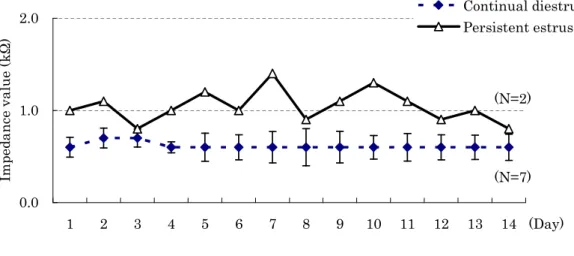
One rat (13M-g) that had showed almost regular estrous cycle had displayed enough elevation (over 3.0 kΩ) of EIV in proestrus stage (Figure 1-3-A). All animals except 13M-g had not displayed enough elevation of EIV in all stages. Among these rats, two rats (13M-d and 13M-h) that had shown persistent estrus after transition from proestrus to estrus had not displayed enough elevation (under 3.0 kΩ) of EIV even in proestrus stage (Figure 1-3-B). In addition, the average values of EIV in two rats (13M-a and 19M-b) classified in persistent estrus by vaginal cytology had higher than those of seven rats (13M-b, 13M-c, 13M-e, 13M-f, 19M-a, 19M-c, and 19M-d) classified in persistent diestrus for 2 weeks (Figure 1-4).
Relationship between vaginal histology and vaginal cytology
The histological appearance of rats classified in persistent estrus by vaginal cytology is shown Figure 1-5-A. The epithelium in the right side was composed both of a stratum germinativum that was similar to day of estrus and a stratum germinativum and a stratum granulosum that was similar to
20
Discussion
In this Chapter, the author examined the correlation between the value of EIV and the cytological and histological conditions of the epithelial cell layer of vaginal mucosa in the aged rats exhibiting the decline in the reproductive functions.
All young animals exhibited regular estrous cycles. Rats classified in proestrus by vaginal cytology had higher EIV than in the other estrous stages. These results were consistent with those from previous reports (Koto et al., 1987 a; Taradach, 1982). In contrast to these findings, Singletary et al. (2005) indicated that estrus Wistar rats had higher EIV than did nonestrus rats, that no correlation occurred between EIV and hormone levels in proestrus rats. However, correlation between EIV and hormone levels in their study was not examined at estrous stage associated with increase in impedance. These findings suggest that the association of EIV with respect to estrous cycle stage and hormone levels may vary between rodents stocks and strain.
All aged rats exhibited irregular estrous cycles. There are many reports concerning of the age-related loss of regular estrous cycles in rats (Ingram,
22
13M-g rat was sufficient since it is reported that the vaginal cornification occurred concurrently the elevation of EIV in the proestrus stage of rats exhibiting regular estrous cycles (Koto et al., 1987 b). In addition, since the vaginal cornification was caused by estrogen (Montes and Luque, 1988; Allen,
1922; Evans et al., 1990; Boutin and Cunha, 1997), it was presumed that
secretion of hormone in 13M-g rat was almost regular. On the other hand, two rats (13M-d and 13M-h) that had shown persistent estrus after transition from proestrus to estrus had not displayed enough elevation of EIV even in proestrus stage. From these results, though estrous cycle stage was judged to be proestrus by vaginal cytology, the cornification of the epithelial cell layer of the vaginal mucosa was considered to be not sufficient in these rats. The insufficient cornification of the epithelial cell layer in these rats was considered to be due to age-related decrease in serum estrogen levels. The determination of the hormone levels and the vaginal histological appearance in the proestrus rats might be needed to further define and confirm these results.
In the observation of estrous cycle of 13 and 19 M groups, two rats (13M-a and 19M-b) and seven rats (13M-b, 13M-c, 13M-e, 13M-f, 19M-a, 19M-c, and 19M-d) showed persistent estrus and persistent diestrus, respectively. The vaginal histological appearance of rats classified in persistent estrus was a mixture of findings observed in proestrus and estrous stages of rats exhibiting regular estrous cycle, not typical smear appearance observed in estrus rats. In the vaginal histology, the stratum corneum-like structure was confirmed in the part of epithelial cell layer in the persistent estrus rat. In
addition, the average of impedance values in persistent estrus rats was approximately-constant for 2 weeks. The previous studies have reported that the noncyclic patterns of estrogen and progesterone secretion in aging persistent estrus rats resulted in persistent vaginal cornifications (Lu et al., 1979). Nagaoka et al. (1995) reported that the histological changes, such as vaginal epithelium cornifications, observed in persistent estrus rats at the age of 10 to 12 months are considered to be signs of estrogenization, and in fact the results coincided with increased estrogen: progesterone ratios during the period. On the other hand, the vaginal histological appearance of rats classified in persistent diestrus was almost the same findings observed in diestrus of rats exhibiting regular estrous cycle. The stratum corneum-like structure was not observed in the vaginal mucosa of persistent diestrus rats. The average of impedance values in persistent diestrus rats was approximately-constant, but were lower impedance values than those in persistent estrus throughout 2 weeks. These results suggested that the continuous high value of EIV in persistent estrus rats was considered to be due to continuous a slight stratum corneum-like structure in the epithelial cell layer. Since the serum levels of estrogen were greater in persistent
24
estrous cycles as well as in young rats. Moreover, the values of EIV both in persistent estrus and continual diestrus rats reflected the histological conditions of the epithelial cell layer of vaginal mucosa. These results indicated that the measurement of EIV is useful for predicting temporal vaginal histology without autopsy in the fields of reproductive physiology and toxicology and might be worthwhile approach to study more precisely the age-related reproductive processes in rats.
13 M 1 2 3 4 5 6 7 8 9 10 11 12 13 14 (Day) a b c d e f g h 19 M a b c d (A n im al N u m be r)
Fig. 1-1. The estrous cycles for 2 weeks in individual rats from 13 M and 19 M groups. Black, stippled and white blocks represent proestrus phase, estrus phase and diestrus phase, respectively.
26
(A) (B)
Fig. 1-2. Photomicrographs of typical vaginal smears taken from 13M rats. (A) Feature of rats classified in persistent estrus by vaginal cytology.
(B) Feature of rats classified in continual diestrus by vaginal cytology. Giemsa stain.
(A) 0.0 1.0 2.0 3.0 4.0 Im pe da n ce v al u e (k Ω ) (Day) (B) 0.0 1.0 2.0 3.0 4.0 Im pe da n ce v al u e( k Ω ) (Day)
Fig. 1-3. Relationship between vaginal cytology and the value of EIV for 14 days (A) in 13M-g rat and (B) in 13M-d rat, respectively. Black, stippled and white blocks represent proestrus phase, estrus phase and diestrus phase, respectively.
28 0.0 1.0 2.0 1 2 3 4 5 6 7 8 9 10 11 12 13 14 (Day) Im pe da n ce v al u e (k Ω ) Continual diestrus Persistent estrus (N=7) (N=2)
Fig. 1-4. Comparison of the average values of EIV between persistent estrus and continual diestrus rats for 14 days. Points are means, and vertical lines represent SD.
(A)
30
Chapter 2
Effects of Nanpao
®, a kampo medicine, on the decline
in estrous cyclicity with advancing age in female rats,
as measured by vaginal impedance methods
Summary
In this Chapter, the author performed to evaluate the time-dependent effects of Nanpao, a kampo medicine, on age-related changes in the estrous cycle of female rats, and to investigate the utility of measuring EIV for studying transitional changes in the estrous cycle. Rats were allocated to 3 groups: control, Nanpao 30 mg/kg/day, and 100 mg/kg/day groups. EIV measurements and cytology samples were taken for 14 days at the age of 6 months before the initial treatment. After the start of the treatment, these data were collected at about monthly intervals until the age of 10 months in the same manner. Observations at the ages of 7 (weeks 2–3 of dosing) and 8 months (weeks 6–7 of dosing) showed that loss of a regular estrous cycle in the 100 mg/kg/day group was inhibited as compared to the control group. Moreover, at the ages of 9 (weeks 11–12 of dosing) and 10 months (weeks 17–18 of dosing), these effects were identified not only in the 100 mg/kg/day group, but also in the 30 mg/kg/day group. Since vaginal cytology and EIV gave almost concordant results as indicators of estrous cyclicity, the measurement of EIV was capable of detecting time-dependent changes in the estrous cycle as well as observations of vaginal smears. In conclusion,
32
Introduction
A number of kampo medicines have been used for many centuries in East Asia, including China and Japan, for the treatment of menstrual disorders, infertility and undefined symptoms, e.g. hot flushes and chilly sensation. In general, the traditional Chinese herbal prescriptions are rather inexpensive and safe with little side effects, and have properties for normalizing biological balances. Nanpao, the test drug used in the present study, is an over-the-counter kampo medicine for humans. It is a mixture of 31 Chinese crude drugs (Table 2-1) and exerts a nourishing and revitalizing effect. The test drug is reported to be clinically effective in treating various age-related symptoms such as fatigue, excessive sensitivity to cold feeling and feeling of weakness (Kumahara et al., 1989). On the other hand, it is reported that a long-term administration of the test drug improves decreases in sexual behaviors (grooming and mounting), copulation rate and insemination rate
in male rats (Kobayashi et al., 1996). However, the effects of Nanpao on
reproductive functions in female rats are not examined.
The stages of the estrous cycle of the rat can be reliably identified cytologically from vaginal smears (Montes and Luque, 1988). In addition, measurement of the EIV is one of the methods that can be used to monitor various reproductive events in several species, including the rat (Rezac, 2008; Taradach, 1982). In Chapter 1, the author showed that the value of EIV correlate with vaginal cytological changes in aged rats exhibiting abnormal estrous cycles as well as in young rats. Moreover, the values of EIV both in persistent estrus and continual diestrus rats reflect the histological
conditions of the epithelial cell layer of vaginal mucosa. Therefore, EIV measurement allows us to improve efficiency for studying progression of reproductive aging.
In this Chapter, the author performed to actually investigate the utility of the method for the measurement of vaginal impedance in the study of the progression of reproductive aging in female rats and to evaluate the time-dependent therapeutic effects of the administration of Nanpao on the aged-related changes in the estrous cycle.
34
Materials and Methods
AnimalsFemale rats of the Sprague–Dawley (Crl: CD [SD]) strain were purchased from Charles River Japan, Inc. at the age of 5 months (n = 36). During the experimental period, the animals were housed in the same manner as described in Chapter 1.
All animal studies were approved by the Institutional Animal Care and Use Committee of Mitsubishi Tanabe Pharma Corporation as described in Chapter 1.
Group composition and treatment
Female rats (n = 36) were stratified by body weight at the end of the quarantine/acclimation period and randomly allocated to three groups. The control group (n = 12) received distilled water alone; a second group (n = 12) was given the test drug at 30 mg/kg/day (equivalent to the clinical dose for adult humans); and a third group (n = 12) was given the test drug at 100 mg/kg/day.
The test drug or distilled water was administered to the animals by oral gavage once a day for 5 days a week from the age of 6 months onwards. The test drug (Nanpao powder extract, Lot No. 69044; Mitsubishi Tanabe Pharma Corporation, Osaka, Japan) was dissolved in distilled water just before daily dosing. The volume administered was set at 5.0 mL/kg bodyweight. The week at which administration was initiated was defined as
week 0 of dosing.
General study design and sampling
All the rats were sampled once daily (between 13:00 and 15:00) for 14 days for vaginal impedance and cytology measurements at the age of 6 months, before the initial treatment (pretest measurements). After the start of treatment, sampling for vaginal impedance and cytology measurements was performed at the ages of 7 (weeks 2–3 of dosing), 8 (weeks 6–7 of dosing), 9 (weeks 11–12 of dosing) and 10 months (weeks 17–18 of dosing) in the same manner as that used for the pretest sampling. All rats were sacrificed immediately after the final sampling by exsanguination by cutting the abdominal artery and vein under deep ether anesthesia.
Vaginal cytology
Vaginal smears were taken in the same manner, and the stage of the estrous cycle was determined in the same criteria as described in Chapter 1.
36
Statistical analysis
Mean values for the drug-treated group and control group were compared by Dunnett’s multiple comparison test, and pre- and post-treatment
comparisons in each group were made using the paired t-test. Values are
presented as mean ± S.D. Statistical analysis was performed with EXSAS
version 7.50 (Arm Corp., Osaka, Japan), and P values less than 0.05 were
Results
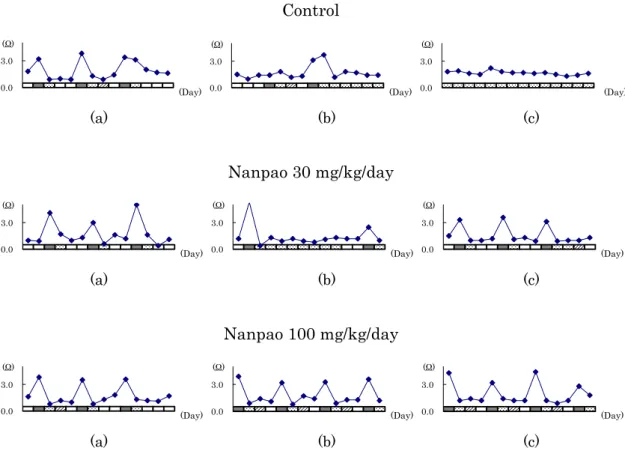
The results of the observations of the estrous cycle and measurements of EIV at the ages of 6–10 months are shown in Table 2-2. Time-dependent changes in animals exhibiting typical estrous cycle patterns in each group are shown in Figure 2-1.
At the age of 6 months (before initiation of daily treatment with water or Nanpao), the rats in each group exhibited various patterns of estrous cycles. Regular estrous cycles (three or more cycles in 2 weeks) were observed in 17 of the 36 (47.2%) animals. The remaining 19 animals exhibited abnormal estrous cycles. Among these 19 animals, the incidence of animals showing two cycles, one cycle, and persistent estrus was 12/36 (33.3%), 6/36 (16.7%), and 1/36 (2.8%), respectively. Animals with each of these estrous cycle patterns were distributed almost equally across the three groups. There were no differences in mean estrous cycle length and the mean number of cycles per animal among the three groups. The mean frequency of proestrus by vaginal cytology and the mean number of days with EIV over 3.0 kΩ were similar in all groups (Table 2-2).
38
days (P < 0.05 vs. pretreatment). The mean number of cycles per animal decreased to 2.0 ± 1.1. In the 30 mg/kg/day group, the pattern of estrous cycles was the same as that observed in the same animals at 6 months of age. In addition, changes in other parameters were not observed, with no difference between the control and 30 mg/kg/day groups. On the other hand, a progressive decline in estrous cyclicity was not observed in the 100 mg/kg/day group. In this group, the mean frequency of days in proestrus and with EIV over 3.0 kΩ was 2.6 ± 1.2 days and 2.2 ± 1.1 days, respectively, higher than in the control group. Mean estrous cycle length in the 100 mg/kg/day group was 6.8 ± 4.5 days, which was shorter than in the control group; the mean number of cycles per animal was 2.4 ± 0.9, which was also higher than in the control group.
At the age of 8 months (weeks 6–7 of dosing), estrous cycle patterns in the control and 30 mg/kg/day groups were almost the same as those observed at 7 months. Changes in other parameters were not observed in the control and the 30 mg/kg/day groups, and there was little difference between the control and the 30 mg/kg/day groups. On the other hand, the frequency of animals with regular estrous cycles was higher in the 100 mg/kg/day group than in the control group. Moreover, mean estrous cycle length and the mean number of estrous cycles per animal in the 100 mg/kg/day group was 6.2 ± 3.8 days and 2.3 ± 1.1 times, respectively, with differences between the control group and the 100 mg/kg/day group. There were differences in the mean frequency of proestrus by vaginal cytology and the mean number of days with EIV over 3.0 kΩ between the control and 100 mg/kg/day groups.
At the age of 9 months (weeks 11–12 of dosing), the number of animals showing regular estrous cycles was lower than in 8-month-old animals. In particular, persistent estrus was observed in many animals in the control group. In the control group, the mean estrous cycle length (11.8 ± 4.1 days) was significantly longer than in the pretreatment period (P < 0.01). In this group, there were also significant decreases in the mean frequency of days in proestrus and with EIV over 3.0 kΩ and the mean number of cycles per animal. On the other hand, more than half of the animals in the treated groups had estrous cycles with at least two cycles in 2 weeks. The mean estrous cycle length was 8.9 ± 4.6 days in the 30 mg/kg/day group and 8.8 ± 4.0 days in the 100 mg/kg/day group, shorter than in the control group. The mean frequency of days in proestrus and the mean number of days with EIV over 3.0 kΩ were higher in the treated groups than in the control group.
At the age of 10 months (weeks 17–18 of dosing), only 1 of the 12 animals in the control group exhibited regular estrous cyclicity. Most animals had completely lost cyclicity. Moreover, the mean frequency of days in proestrus and the mean number of days with EIV over 3.0 kΩ were markedly lower than the values in this group at 9 months. In the treated groups, changes in
40
similar regardless of administration of the test drug. In addition, the concordance rate of days in proestrus by vaginal cytology and by days with EIV over 3.0 kΩ was approximately the same (63.2–85.7%) at each measurement point. In most cases, the EIV value of animals with a prolonged estrous cycle did not exceed 3.0 kΩ even in the proestrus stage, although the value tended to be higher in proestrus than in other stages of the cycle.
Discussion
In this Chapter, the author performed to investigate the utility of vaginal impedance as a method for detecting the progression of reproductive aging in female rats and to evaluate the time-dependent effects of the administration of the test drug, Nanpao, on age-related changes in the estrous cycle.
Before the initiation of daily treatment with water or Nanpao, abnormal estrous cycles were observed in about one half of the animals. Subsequently, the number of animals with abnormal estrous cycles and the degree of abnormality of the estrous cycle increased gradually in the control group from 7 to 10 months of age. In particular, persistent estrus was observed in about half of the 10-month-old animals in the control group. There are many reports of age-related loss of regular estrous cycles in mammalian species (Jones and Krohn, 1961; Talbert, 1968; Meites and Huang, 1976; Finch, 1978). It is also known that the estrous cycles become irregular in rats between the ages of 6 and 10 months (Aschheim, 1976; Meites and Huang, 1976; Lu et al., 1979; Westwood, 2008). Changes in the volume of hormones secreted by the hypothalamic region, the pituitary gland, and the ovary resulting from the effect of aging on the hypothalamic–pituitary control
42
(Nass et al., 1984; Wise, 1984; Lu et al., 1985), decreases in the progesterone and LH surges in proestrus (Gray et al., 1980; Lu et al., 1980; Wise, 1982), and a deficiency in progesterone secretion (Tsai et al., 2004). In most cases, cessation of cyclicity was followed by persistent estrus in SD rats (Finch et al., 1984). Felicio et al. (1984) indicated that the appearance of persistent estrus and its duration depended on the age at cycle cessation. Persistent estrus is considered to be an estrogenic state dependent on continued secretion of estrogens by the ovaries, and its duration is therefore limited by
the size of the oocyte reserves in the ovaries (Finch et al., 1984). In the
present study, the age-related changes in the estrous cycle observed in the control group had a course similar to those described in the reports discussed above.
In the present study, observations of the estrous cycle and measurement of EIV at the ages of 7 (weeks 2–3 of dosing) and 8 months (weeks 6–7 of dosing) demonstrated nearly normal estrous cycles in many of the animals in the 100 mg/kg/day group, and the mean estrous cycle length in this group was shorter than that of the control group. The mean frequency of days with EIV over 3.0 kΩ in proestrus and the mean number of cycles in 2 weeks were higher in the 100 mg/kg/day group than in the control group. Moreover, at the ages of 9 months (weeks 11–12 of dosing) and 10 months (weeks 17–18 of dosing), an increase in the number of animals with abnormal estrous cycles was prevented not only in the 100 mg/kg/day group, but also in the 30 mg/kg/day group. These results indicate that a short period of administration of the test drug prevented the age-related loss of regular estrous cycles.
Studies on the effects of other herbal medicines have indicated that herbs can improve estrogen status and have pro-fertility effects (Qian et al., 1998). In addition, studies on the effects of herbal formulas in androgen-sterilized rats showed that these formulas restored regular estrous cycles and induced ovulation, possibly by regulating the expression of hypothalamic
neuropeptide Y and leptin receptor mRNA (Sun and Yu, 1999; Sun et al.,
2000). Although the mechanism of the effect of the test drug on the decline in reproductive function in female animals was not clear in the present study, the author consider the mechanism by which Nanpao produced its effects involved multiple effects on the pituitary–ovarian axis and the adrenal glands (Wise et al., 1989).
Since the concordance rates of days in proestrus by vaginal cytology and EIV over 3.0 kΩ in the present study were high and approximately constant, we suggest that the measurement of EIV, as well as the observation of the estrous cycle based on vaginal smears, can be used to detect the progression of reproductive aging in female rats. In a review, Rezac (2008) reported that electrical impedance methods may be used not only to predict ovulation, but also to explore various other reproductive processes. The present results
44
the proestrus stage. We do not think cornification of the epithelial cell layer of the vaginal mucosa is an adequate explanation of this finding in rats exhibiting prolongation of the estrous cycle. In this regard, the disturbance in hormone balance seen in animals exhibiting abnormal estrous cycles is considered to affect the histology of the vagina (Nass et al., 1984; Wise, 1984). Although changes in EIV in young animals exhibiting regular estrous cycles are physiologically sound, the physical and biological factors that may affect the variation in impedance in the female reproductive system are still poorly understood. Investigations of these questions may provide information that will enable vaginal impedance methods to reflect more accurately the histology of the epithelial cell layer of the vaginal mucosa and to provide useful information for studies of reproductive functions.
In conclusion, administration of Nanpao inhibited the age-related loss of regular estrous cycles in female rats. Moreover, the author showed that the measurement of EIV is a worthwhile approach to the examination of estrous cyclicity and the histological condition of the vaginal mucosa in studying the
po ne nt s an d th ei r c on te nt s in d ai ly d os e of N an pa o fo r h um an u se if ic at io n C om po ne nt s P in Y in N am e A m ou nt (m g) L in ne an C la ss if ic at io n C om po ne nt s P in Y in N am e A m ou nt (m g) or nu Lu ro ng 67 C is ta nc hi s H er ba R ou co ng ro ng 67 t T es tis G ua ng go us he n 53 C yn om or ii H er ba Su oy an g 67 et T es tis H ei lv sh en 23 5 D ip sa ci R ad ix C hu an jid ua n 33 ix D an gg ui 13 3 R eh m an ni ae R ad ix Sh ud ih ua ng 13 3 R en sh en 13 3 R ub i F ru ct us Fu pe nz i 67 x M ud an pi 33 A co ni ti T ub er Pa of uz i 67 H ai m a 67 L yc ii Fr uc tu s G ou qi zi 13 3 or te x D uz ho ng 67 S cr op hu la ria e R ad ix X ua ns he n 67 um A jia o 67 A st ra ga li R ad ix H ua ng qi 13 3 or te x G ui pi 53 A tr ac ty lo di s R hi zo m a B ai zh u 67 hi zo m a X ia nm ao 67 C or ni F ru ct us Sh an zh uy u 67 en T us iz i 67 H oe le n Fu lin g 13 3 en B ug uz hi 67 O ph io po go ni s T ub er M ai m en do ng 67 Y in ya ng hu o 13 3 A ch yr an th is R ad ix N iu xi 33 m en H ul ub a 67 G ly cy rr hi za e R ad ix G an ca o 33 ix B aj iti an 67
46 T ab le 2 -2 . E st ro us c yc le o bs er va ti on s an d m ea su re m en ts o f E IV f or 2 w ee k s in fe m al e ra ts a t th e ag e of 6 1 0 m on th s N an p ao N an p ao N an p ao N an p ao N an p ao N an p ao 30 m g/ k g/ da y 10 0 m g/ k g/ d ay 30 m g/ kg /d ay 10 0 m g/ kg /d ay 30 m g/ kg /d ay 10 0 m g/ kg /d ay N o. o f an im al s ex am in ed 12 12 12 12 12 12 12 12 12 N o. o f da ys i n p ro es tr us ( m ea n ± S D ) 32 (2 .7 ± 1 .2 ) 24 ( 2. 0 ± 1. 2) 29 ( 2. 4 ± 1. 3) 24 ( 2. 0 ± 1. 1) * 25 ( 2. 1 ± 1. 3) 31 ( 2. 6 ± 1. 2) 23 ( 1. 9 ± 1. 7) 23 ( 1. 9 ± 1. 4) 33 ( 2. 8 ± 1. 5) N o. o f da ys w it h E IV o f ov er 3 .0 k Ω (m ea n ± S D ) 23 (1 .9 ± 1 .0 ) 16 ( 1. 3 ± 1. 3) 20 ( 1. 7 ± 1. 4) 18 ( 1. 5 ± 1. 2) 20 ( 1. 7 ± 1. 3) 26 ( 2. 2 ± 1. 1) 17 ( 1. 4 ± 1. 6) 17 ( 1. 4 ± 1. 3) 28 ( 2. 3 ± 1. 4) C on co rd an ce r at e be tw ee n v ag in al c yt ol og y an d E IV , % a ) 71 .8 66 .6 69 .0 75 .0 80 .0 83 .9 73 .9 73 .9 84 .8 E st ro u s cy cl e le n gt h s, d ay , m ea n ± S D 6. 4 ± 3. 8 7. 8 ± 4. 0 6. 7 ± 3. 7 8. 4 ± 5. 0 * 7. 6 ± 4. 1 6. 8 ± 4. 5 8. 4 ± 5. 0 7. 8 ± 4. 7 6. 2 ± 3. 8 C yc le p er a n im al , n , m ea n ± S D 2. 3 ± 1. 0 2. 1 ± 0. 8 2. 3 ± 0. 8 2. 0 ± 1. 1 2. 1 ± 1. 0 2. 4 ± 0. 9 1. 8 ± 1. 3 1. 9 ± 1. 2 2. 3 ± 1. 1 N o. o f an im al s w it h 3 cy cl e or m or e 7 4 6 6 5 8 5 6 8 N o. o f an im al s w it h 2 cy cl e 3 5 4 1 4 1 1 1 1 N o. o f an im al s w it h 1 cy cl e 1 3 2 4 2 3 3 3 2 N o. o f an im al s w it h p er si st en t es tr u s 1 0 0 1 1 0 3 2 1 N an p ao N an p ao N an p ao N an p ao 30 m g/ k g/ da y 10 0 m g/ k g/ d ay 30 m g/ kg /d ay 10 0 m g/ kg /d ay N o. o f an im al s ex am in ed 12 12 12 12 12 12 N o. o f da ys i n p ro es tr us ( m ea n ± S D ) 12 ( 1. 0 ± 1. 3) * ** 19 ( 1. 6 ± 1. 2) 21 ( 1. 8 ± 1. 4) 6 (0 .5 ± 0 .9 ) ** * 18 ( 1. 5 ± 1. 4) 23 (1 .9 ± 1 .7 ) # N o. o f da ys w it h E IV o f ov er 3 .0 k Ω (m ea n ± S D ) 8 (0 .7 ± 0 .8 ) * * 12 ( 1. 0 ± 1. 0) 18 ( 1. 5 ± 1. 4) 4 (0 .3 ± 0 .7 ) * * 12 ( 1. 0 ± 1. 3) 16 ( 1. 3 ± 1. 5) C on co rd an ce r at e be tw ee n v ag in al c yt ol og y an d E IV , % a ) 66 .6 63 .2 85 .7 66 .6 66 .6 69 .6 E st ro u s cy cl e le n gt h s, d ay , m ea n ± S D 11 .8 ± 4 .1 * * 8. 9 ± 4. 6 8. 8 ± 4. 0 12 .6 ± 3 .4 * ** 9. 3 ± 5. 0 9. 5 ± 4. 8 C yc le p er a n im al , n , m ea n ± S D 1. 0 ± 1. 1 ** 1. 8 ± 1. 1 1. 7 ± 1. 2 0. 8 ± 1. 0 ** * 1. 7 ± 1. 3 1. 6 ± 1. 2 N o. o f an im al s w it h 3 cy cl e or m or e 2 4 3 1 5 4 N o. o f an im al s w it h 2 cy cl e 1 3 5 1 1 2 N o. o f an im al s w it h 1 cy cl e 4 3 1 4 3 3 N o. o f an im al s w it h p er si st en t es tr u s 5 2 3 6 3 3 a) (T ot al n u m be r of d ay s w it h E IV o f ov er 3 .0 k Ω / T ot al n um be r of d ay s in p ro es tr us b y va gi n al c yt ol og y) x 1 00 *, P < 0 .0 5; * *, P < 0 .0 1; * ** , P < 0 .0 01 v s. p re -t re at m en t (6 m on th o f ag e) b y pa ir ed t -t es t #, P < 0 .0 5 vs . t h e co n tr ol g ro u p by D u nn et t m et h od m u lt ip le c om pa ri so n 9 m on th s of a ge ( at w ee k s 11 - 12 o f d os in g) C on tr ol 10 m on th s of a ge ( at w ee k s 17 - 18 o f d os in g) C on tr ol C on tr ol 8 m on th s of a ge ( at w ee ks 6 –7 o f d os in g) 6 m on th s of a ge ( pr io r to t re at m en t) 7 m on th s of a ge ( at w ee ks 2 –3 o f do si ng ) C on tr ol C on tr ol
Control 0.0 3.0 (Ω) (Day) 0.0 3.0 (Ω) (Day) 0.0 3.0 (Ω) (Day) (a) (b) (c) Nanpao 30 mg/kg/day 0.0 3.0 (Ω) (Day) 0.0 3.0 (Ω) (Day) 0.0 3.0 (Ω) (Day) (a) (b) (c) Nanpao 100 mg/kg/day 0.0 3.0 (Ω) (Day) 0.0 3.0 (Ω) (Day) 0.0 3.0 (Ω) (Day) (a) (b) (c)
Fig. 2-1. Time-dependent changes in vaginal cytology and the value of EIV in animals exhibiting typical estrous cycle patterns each group. Black, stippled, diagonal and white blocks represent proestrus, estrus, metestrus, and diestrus phase, respectively. Correlation between vaginal cytology and the value of EIV for 14 days (a) at 6 months of age (prior to treatment), (b) 8 months of age (at weeks 6 – 7 of dosing), and (c) 10 months of age (at weeks 17 – 18 of dosing), respectively.
48
Chapter 3
Preventive and improvement effects of Nanpao
®Summary
In this Chapter, the author evaluated the improvement effect of Nanpao on the age-related decline in reproductive function (Chapter 3-1) and cold constitution (Chapter 3-2) in female rats given the test drug for a long-term period. In Chapter 3-1, young rats were allocated to the cesarean section and natural delivery groups to examine reproductive performance (young rat groups). Five-month-old rats were allocated to the 3 groups (aged rat groups): 1 control and 2 Nanpao-treated groups. Five-month-old rats were given orally in a dose of 0, 30 or 100 mg/kg/day of the test drug. In aged rats, the first mating experiment was initiated at Week 21 of dosing to evaluate reproductive performance by natural delivery and the second mating experiment at Week 31 of dosing to evaluate them by cesarean section. In the first and second mating experiments, various reproductive functions decreased in aged rats as compared with young rats. On the other hand, loss of regular estrous cycles, decreases in delivery and pregnancy rates and mean fetal weights were inhibited in the treated groups as compared with the control group. In addition, decreases in the numbers of mean live offspring and fetuses were inhibited in the 100 mg/kg/day group. It was
50
Nanpao, the peripheral blood flow increased dose-dependently compared to that in the control group. Moreover, the surface skin temperature after immersion in ice-cold water was higher in the treated groups than in the control group at all measurement points. These results suggest that Nanpao has the potential to improve cold constitution associated with decreased peripheral blood flow in women. In this Chapter, the author indicated that Nanpao had the preventive and improvement effect on the age-related biological dysfunctions in female rats.
Introduction
A decline in reproductive performance is well known as one of the representative biological dysfunctions associated with aging. Some reports described age-related changes, including loss of regular estrous cycles in
female rats (Meites and Huang, 1976; Lu et al., 1979). Simultaneously, a
decline in uterine function (Miller and Riegle, 1980), a decrease in fertility (Ingram et al., 1958; Miller et al., 1979; Matt et al., 1986) and an increase in
developmental defect of embryos (Matt et al., 1987) are reported the
age-related changes.
Some kampo medicine has been reported to be effective in the treatment of pituitary-ovarian dysfunction in young women, the treatment of infertility in women during the reproductive age and the treatment of several undefined symptoms in peri-and postmenopausal women (Ushiroyama, 2007). In Chapter 2, the author indicated that administration of Nanpao inhibited the age-related loss of regular estrous cycles in female rats. It is study of interest research in assessing the anti-aging effects on reproductive performance and embryo-fetal development of Nanpao.
52
Nowadays, majority of women suffer from cold constitution; therefore, the potential of Nanpao for improvement of cold constitution has important implications for enhancing the quality of life in women. As part of the elucidation of the mechanism of the effects of Nanpao on cold constitution, the author performed with a focus on improving hemodynamics and maintaining surface temperature, since Nanpao contains herbs with vasodilatory effects.
In this Chapter, the author examined the effects on a decline in various reproductive functions of administration of Nanpao (Chapter 3-1). Moreover, the effects on cold constitution of Nanpao were examined quantitatively and objectively using measurements of peripheral blood flow and surface skin temperature in aged female rats (Chapter 3-2).
3-1 Anti-aging effects of Nanpao
®on reproductive functions
in aged female rats
Materials and Methods
AnimalsFemale rats of the Sprague-Dawley (Crl: CD [SD]) strain were purchased from Charles River Japan, Inc. at the age of 5 months (n=49) or at the age of 11 weeks (n=32), and used in this study. During the experimental period, the animals were housed in the same manner as described in previous Chapter.
From Day 21 of gestation to Day 21 of lactation, the animals were housed individually in plastic cages (W: 275 × D: 425 × H: 204 mm). In addition, necessary numbers of 12-week-old fertile males of the same strain were purchased and subjected to mating.
All animal studies were approved by the Institutional Animal Care and Use Committee of Mitsubishi Tanabe Pharma Corporation as described in previous Chapters.
54
not given the test drug and their reproductive performances were compared with those in the aged rats which were not given the test drug (control group).
Aged female rats (n=49) purchased at the age of 5 months were stratified by body weights determined at the end of the quarantine/acclimation period and randomly allocated to the 3 groups: the control group (n=16) given distilled water alone, the 30 mg/kg/day group (n=17) (30 mg/kg/day: equivalent to the clinical dose of adult humans per day), and the 100 mg/kg/day group (n=16).
The test drug or distilled water was administered to the animals by oral gavage once a day for 5 days a week from the age of 5 months. The animals in which the copulation was confirmed were given the test drug once a day during the gestation and lactation periods. The test drug (Nanpao powder extract, Lot No.; 58025, Tanabe Seiyaku Co., Ltd., Osaka, Japan) was prepared by in the same manner as described in Chapter 2.
The week at which the administration was initiated was defined as Week 0 of dosing, and in the reproductive function tests, the day when the copulation was confirmed was considered as Day 0 of gestation and the day showing the end of delivery was defined as Day 0 of delivery (Day 0 of lactation).
General signs, body weights and food consumptions
The animals were observed daily for general signs by inspection and palpation. Body weights were measured once a week and food consumptions
twice a week except the mating period. Body weights and food consumptions of females with the confirmed copulation were measured on Days 0, 4, 9, 14, 17 and 21 of gestation. During the lactation period, body weights and food consumptions of dams were measured on Days 0, 4, 9, 14, 17 and 21 of lactation.
Reproductive and developmental function tests
The mating in young animals was initiated at the age of 14 weeks. In aged animals, the first mating was initiated at Week 21 of dosing (at the age of 10 months) and the second mating at Week 31 (at the age of 12 months) to examine the respective reproductive and developmental functions.
Methods of mating and estrous cycle observations
The animals were mated on a-one-to-one basis from the evening to the following morning during the mating period. Copulation was regarded as established when sperm was found in the vaginal smears taken the following morning. The females in which copulation could not be confirmed were
56
glass slides, and examined for assessment of the estrous cycles. In the observation of vaginal smears of each animal, the estrous cycles were defined as “regular estrous cycles” when a regular cycle of 4- or 5-days was observed in at least 2 consecutive periods, as “irregular estrous cycles” when one estrous cycle was prolonged, and as “persistent estrous” when persistent vaginal cornification was observed continuously for 2 weeks (Lu et al., 1979), respectively.
Mating experiment in young rats
As mentioned above, young female animals were used for mating at the age of 14 weeks. The animals with confirmed copulation were randomly allocated to the following 2 groups: the cesarean section group and natural delivery group.
The animals of the caesarean section group were anesthetized with ether on Day 21 of gestation and the abdomen was incised to confirm the pregnancy by the presence or absence of implantations in the uterus. In pregnant animals, the number of corpora lutea in the ovaries and the number of implantations in the uterus were counted to calculate the implantation rate. All the fetuses removed from each dam were checked for survival. The surviving fetuses were examined for the external abnormalities, sexed and weighed. Deaths and absorbed fetuses (embryos) were classified into early or late resorption embryos and macerated fetuses.
parturition twice a day (at about 10:00 and 16:00) from the morning on Day 21 to Day 23 of gestation. The gestation period and number of days required for parturition were calculated as follows: The morning on Day 0 of gestation was defined as Day 0.0 of gestation and the afternoon on Day 0 of gestation as Day 0.5 of gestation. The gestation period was regarded as the period from Day 0.0 of gestation to the day of gestation when the parturition was started, and the number of days required for parturition was regarded as the period from the day of gestation (when the parturition was started) to the day of gestation when the completion of delivery was confirmed.
On Day 0 of lactation, the number of newborns (offspring and stillborns) was counted and offspring were sexed by the genital-anal distance. General signs (including external and behavior abnormalities) were observed and body weights were measured. Thereafter general signs were observed daily in individual offspring until Day 21 of lactation. All the offspring were bled to death under ether anesthesia by cutting the axillary artery on Day 21 of lactation. In addition, the dams in which the parturition was completed and the animals in which the copulation could not be confirmed were all euthanized in the same manner.
58
16:00) from the morning on Day 21 to Day 28 of gestation. The calculation of the gestation period and the number of days required for parturition and observation of newborns (offspring and stillborns) on Day 0 of lactation were examined in the same manner as in the young rats of the natural delivery group. Thereafter, general signs were observed in individual offspring once a day up to Day 21 of lactation and body weights were examined on Days 4, 9, 14, 18, and 21 of lactation. All the offspring were bled to death under ether anesthesia by cutting the axillary artery on Day 21 of lactation. However, since the number of offspring for observation and measurement was not sufficient, data for body weights, sex ratio and weaning rate of offspring were excluded from the evaluation data.
In the first mating experiment, dams in which parturition was completed and the individual animals which did not give birth even after Day 28 of gestation and the animals with unsuccessful copulation were given the test drug continuously and used for the second mating experiment.
The second mating experiment in aged rats
The second mating test was performed at Week 31 of dosing (at the age of 12 months). The animals with confirmed copulation were anesthetized with ether and euthanized by exsanguination on Day 21 of gestation and the caesarean section was performed in the same manner as in the young animals of the caesarean section group. The pregnancy was judged based on the presence or absence of implantations in the uterus, and the number of
corpora lutea in the ovaries and the number of implantations were counted to calculate the implantation rate. All fetuses were removed from each dam and checked for survival. The surviving fetuses were examined for external abnormalities, sexed and weighed. Deaths and absorbed fetuses (embryos) were classified into early or late resorption embryos and macerated fetuses.
Statistical analysis
The homogeneity of variance was analyzed by Bartlett’s test for data on body weights, food consumptions, estrous cycles (frequency of estrous phase), numbers of days required for copulation (the number of mating days for copulation), numbers of corpora lutea, numbers of implantations, implantation rates, pre- and post-implantation losses of embryos (fetuses), numbers of live fetuses and mean fetal weights (level of significance: 5%). Multiple comparison was carried out using the parametric Dunnett method when a set of variance was homogenous and using the non-parametric Dunnett method when a set of variance was not homogenous to test the difference in mean between the treated groups and control group (level of
60
Results
General signs, body weights and food consumptions
No noteworthy changes were observed in general signs in young female animals. On the other hand, eye discharge, chromodacryorrhea and loss of fur were noted sporadically in the aged animals during the observation period, regardless of administration of the test drug.
No abnormal changes were observed in body weights and food consumptions in the young animals (data not shown). The body weights of aged animals in the treated groups increased during the measurement period as compared with the control group (Figure 3-1-1). In addition, the body weights of animals in the 30 and 100 mg/kg/day groups increased significantly from Week 27 and Week 11 of dosing onwards, respectively. Changes in food consumptions of aged animals were similar to those in body weights (Figure 3-1-2).
In the reproductive function tests at the age of 10 and 12 months, body weights and food consumptions of pregnant animals increased significantly in the treated groups as compared with the control group (data not shown).
Reproductive and developmental functions The mating experiment in young rats
The results of the reproductive function in the young animals are shown in Tables 3-1-1, 3-1-2 and 3-1-3. These results in the young animals are shown below, comparing with those in the aged animals.
The first mating experiment in aged rats
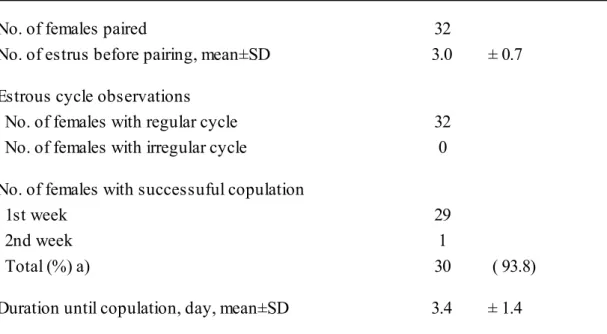
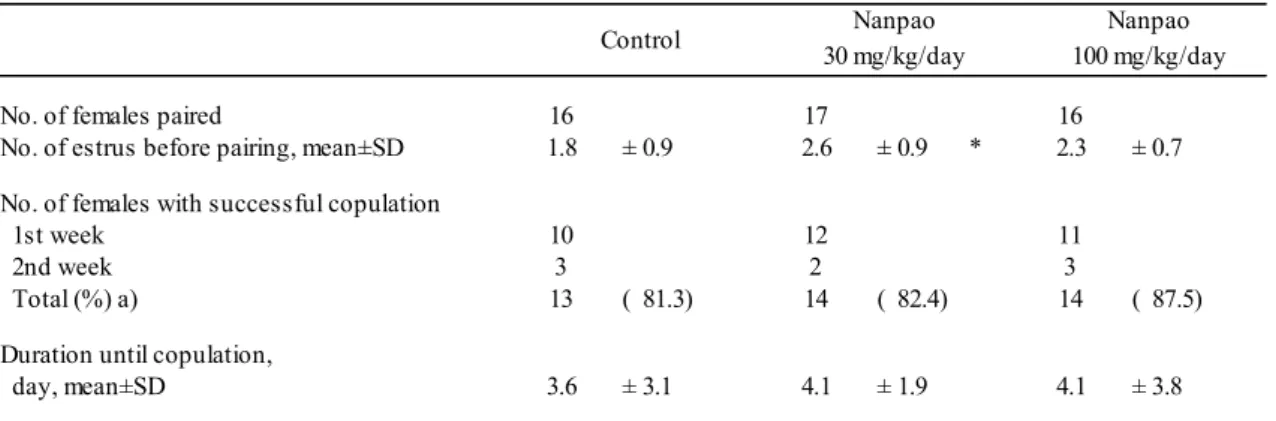
In the observation of the estrous cycles for 2 weeks before mating, regular estrous cycles were observed in all young animals (Table 3-1-1), but in 4 of the 16 aged animals (25.0%) in the control group (Figure 3-1-3). On the other hand, the incidences of regular estrous cycles were 52.9% (9/17) in the 30 mg/kg/day group and 56.3% (9/16) in the 100 mg/kg/day group (Figure 3-1-3). The mean frequency of estrous phase was 3.0 times in the young animals (Table 3-1-1), whereas it was 1.8 times in the aged animals of the control group (Table 3-1-4). On the other hand, the mean frequency of estrus phase was higher in the treated groups than in the control group (Table 3-1-4). In particular, the mean frequency of estrus phase was significantly higher in the 30 mg/kg/day group than in the control group, with no great differences between the aged animals of the 30 mg/kg/day group and the young animals (Tables 3-1-1, 3-1-4). The copulation rate and the number of days required for copulation were 93.8% and 3.4 days, respectively, in the young females (Table 3-1-1) and 81.3% and 3.6 days, respectively, in the aged animals of the control group (Table 3-1-4), with little differences between the young and the
62
significantly higher in the 100 mg/kg/day group than in the control group. Also, the ratio of live newborns to total newborns was higher in the treated groups than in the control group (Table 3-1-5). The gestation period and the number of days required for delivery were 22.0 days and 0.5 days, respectively, in young animals (Table 3-1-2), whereas they were 25.8 days and 1.8 days, respectively, in aged animals of the control group (Table 3-1-5). On the other hand, they were short in the 100 mg/kg/day group, as compared with the control group (Table 3-1-5). In addition, no abnormal changes in the lactation state of dams or in general signs were observed in offspring during the lactation period.
The second mating experiment in aged rats
In the observation of the estrous cycle for 2 weeks before mating, the number of animals showing irregular estrous cycles increased in the aged animals of each group (the control and treated groups), as compared with that in the first mating experiment (Tables 3-1-4, 3-1-6). Persistent estrus characterized by chronic anovulation and persistent vaginal cornification was observed in some aged animals. The incidences of regular estrous cycles in the control, 30 and 100 mg/kg/day groups were 6.3% (1/16), 29.4% (5/17) and 37.5% (6/16), respectively (Figure 3-1-4).
The mean frequency of estrus phase was slightly higher in the 100 mg/kg/day group than in the control group (Table 3-1-6). The copulation rate in the aged animals of each group (the control and treated groups) was
clearly lower than that in the young animals (93.8%), and that in the aged animals in the first mating experiment (Tables 3-1-1, 3-1-4, 3-1-6). The number of days required for copulation tended to be slightly longer in the 100 mg/kg/day group than in the control group (Table 3-1-6). The pregnancy rate was 100.0% in young animals (Table 3-1-3), whereas it was clearly low, 25.0% in the aged animals of the control group (Table 3-1-6). On the other hand, the pregnancy rate was higher in the treated groups than in the control group (Table 3-1-6).
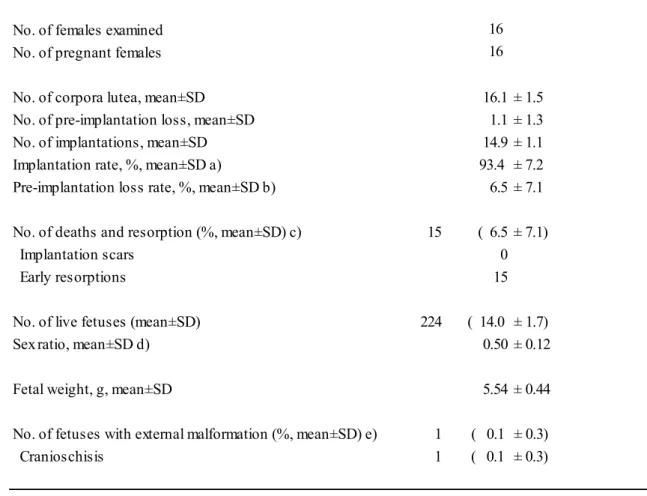
There were no differences between the young and the aged animals of each group in the mean number of corpora lutea, and the test drug did not affect the number of corpora lutea (Tables 3-1-3, 3-1-7). On the other hand, the implantation rate was 93.4% in the young animals but was clearly low, 41.1% in the aged animals of the control group (Tables 3-1-3, 3-1-7). In addition, the implantation rate was higher in the 100 mg/kg/day group than in the control group (Table 3-1-7). The post-implantation loss rate was 6.5% in the young animals but was clearly high, 50.0% in the aged animals of the control group (Tables 3-1-3, 3-1-7). On the other hand, the post-implantation loss rate was lower in the treated groups than in the control group (Table
64
animals of the 30 mg/kg/day group. No abnormal changes were noted in the other fetuses (Tables 3-1-3, 3-1-7).
Discussion
In this section, the author performed to compare reproductive and developmental functions of the young female rats and those of the aged female rats in detail and to investigate the effect of the test drug, Nanpao, on aged-related changes in reproductive performances.
Body weights of the aged animals were significantly higher in the treated groups than in the control group throughout the experiment period. This was considered to be due to an increase in food consumption reflecting the orexigenic effect of the test drug.
In the observation of estrous cycles of the young and the aged animals in the control group during the pre-mating period of 2-weeks, the estrous cycles were regular in all the young animals, while irregular in many aged animals. The number of animals with irregular estrous cycles increased in the 12-month-old animals as compared with the 10-month-old animals. Persistent estrus was observed in about one half of the 12-month-old groups. There are many reports of aged-related loss of regular estrous cycles in mammalian species (Jones and Krohn, 1961; Talbert, 1968; Meites and Huang, 1976; Finch, 1978). In addition, it is also known that the estrous