Iournal of the Operations Research Society of I apan
Vol. 27, No. 1, March 1984
DIFFUSION APPROXIMATION FOR A GI/G/m QUEUE
WITH GROUP ARRIVALS
Tadashi Ohsone Tokyo Institute of Technology
(Received August 3,1983: Revised November 12, 1983)
Abstract This paper deals with the GI/G/m queueing system with group arrivals via diffusion approximation. We present approximate formulae for the distribution of the number of customers, the mean number of customers and the mean queue length. Moreover a modified approximation is considered to improve the accuracy of these formulae. The accuracy of the approximate formulae is numerically examined in some examples.
1. Introduction
This paper analyzes a many server queueing system with group arrivals denoted by
G~/G/m
via diffusion approximation. TheG~/G/m
system is of interest from the view point of practical applications. It is, however, extremely difficult to investigate such a system analytically. There are several studies about a certain subclass ofG~/G/m
systems; see Chaudhry and Templeton [4]. The~1/M/m
system was studied by Kabak [15] and Abol'nikov [1]. Cromie et al. [7] extended and corrected their results. Bolman et al. [13] investi.gated theF!f!M/m
system and obtained the moments of the queue length. Baily and Neuts [3] and Baba [2] provided algorithmic methods for theG~/M/m
and~/PH/m
systems, respecti.vely. Although these algorithmic methods give exact solutions, it often takes a very long time to execute computation. Therefore we need approximate methods such as diffusion approximation.the idea that the discrete-state process:
{Q(t); t
~o}
can be approximated by an appropriate diffusion process {X(t); t ~o}.
Since Q(.) should take nonnegative values, it is necessary to impose an impenetrable boundary at the origin of X( .. ). Usually, either the rE,flecting boundary (RB) or the elemen-tary return boundary (ERB) has been used as such a boundary. There is a considerable amount of literature on diffusion approximations with these boundaries; see [6,8,11,12,18,20,21,22] for the RB, and [5,6,9,16,17] for the ERB. It is, however, known that diffusi.on approximations with the RB are only effective in heavy traffic, and that those with the ERB are essentially appropriate only for systems with Poisson arrivals.Gelenbe [10] studied a diffusion process with the ERB where sojourn times have a Coxian distribution. In this paper, using this process, we will provide a diffusion approximation for queueing systems with general arrivals. In Section 2, we give a formulation by CL diffusion process with the ERB. From this formulation, approximate formulae of some basic queueing character-istics are derived in Section 3. In Sec:tion 4, a modified approximation is considered to improve the accuracy of these formulae. Finally, the accuracy of these two diffusion approximations for the mean number of customers in the system is numerically examined in Section 5.
2.
Formulation for the GIX/G/m System
We consider a many server queueing system with group arrivals denoted by
GJC/G/m.
This queueing system is specified by the following assumptions. Customers arrive in groups of random sizes at a service facility with infinite waiting room. The group size X is a positive integer-valued LLd. random variable with a distributiontion
{gn}
has the mean y ~ 1) and the{g ,
n=
1,2, ••• }. ~ . 2 finlte varlancea.
g The distribu-The inter-arrival times T are general 1.. 1.. d. random variables with mean l/A and finite variance a • 2a Customers are served by one of
m
servers in order of arrivals. Their service times are also general i.i.d. random variables with the meanl/~
and the finite variancea
2s • Letc
a Aa ,a c s ~a s and c
=
a /y be the coefficient of variation of interarrival times, serviceg g
times and group sizes, respectively. Since we consider the system in the steady-state in this paper, we assume that p
=
Ay/m~ < 1.80 T.Ohsone
unstable
G~/G/m
system converges weakly to a Brownian motion process. It suggests the idea of an approximation for the stable queueing system, espe-cially, in heavy traffic. Our diffusion approximation is based on the heavy traffic limit theorems.We proceed to the diffusion approximation for the
G~/G/m
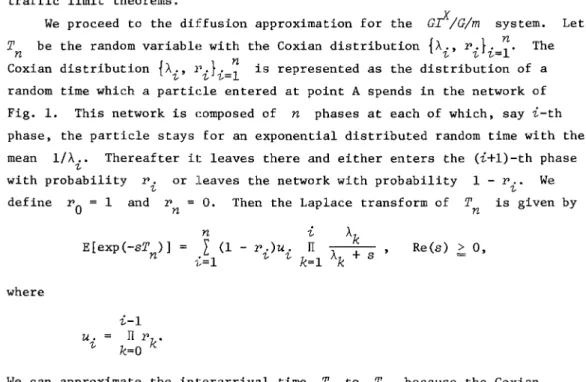
system. Let T be the random variable with the Coxian distribution {A., r.}. n1• The
n "
",,=
Coxian distribution {A.,
1"}'
n1 is represented as the distribution of a
" ",,=
random time which a particle entered at point A spends in the network of Fig. 1. This network is composed of n phases at each of which, say i-th phase, the particle stays for an exponential distributed random time with the mean 1/A ..
"
Thereafter it leaves there and either enters the (i+1)-th phasewith probability r.
"
or leaves the network with probability 1 - 1'.."
Wedefine
where
and l '
n O. Then the Lap1ace transform of T n
n
i
Ak E[exp(-sT )] =I
(1 - r.)u. IT A ' ni=l
" " k-1 k
+
s u."
i-1 ITr
k•k-O
Re(s) > 0, is given byWe can approximate the interarriva1 time T to T because the Coxian n
distribution can approximate a general distribution by means of matching its first
K
moments, whereK
can be arbitrarily large.1'1 1'2 l '
n-1 l ' =0
\
A2 A n n1-1'1 1-1' 1-1' 1-1' =1
2 n-1 n
Fig. 1. Coxian distribution {A., r.}. n 1.
" ",,=
We next consider a diffusion process
{X(t); t
~ O} which approximates the process{Q(t); t
~al.
The process X(·) is represented by twodiffusion parameters
b(x)
anda(x)
called infinitesimal mean and infini-tesimal variance. respectively. which are defined asb(x)
=
limE[X(t
+
~t)- X(t) [X(t)
xJ
~t+O ~t
and
a(x) =
limVar[X(t
+
~t)- X(t) IX(t)
xJ
~t+o M
Kimura and Ohsone [17J used
b(x)
=
Ay -Oxl
A m)]J. anda(x)
= A(Y 2+
0 2 )+
Oxl
A m)]J302.g 8
for the
tI/G/m
system. where A stands for minimum andrxl
denotes the smallest integer not smaller thanx.
The positive integerrxl
Am
corre-sponds to the number of busy servers. Considering the result of Chiamsiri and Leonard [5J. we adopt(2.1)
b(x)
=
Ay -(rxl
A m)]J.and
(2.2)
a(x)
=
A(c2y2+
02)+
(rxl
a
g
as the diffusion parameters for the
2 A m)]Jc •
8
GIX/G/m system. It is noted that both
b(x)
anda(x)
are piecewise continuous functions having(m -
1) first order discontinuity points.Since Q(o) remains in the nonnegative region. it is necessary that we should impose a boundary at the origin of
X(o).
We adopt an ERB as the boundary at the origin. since this boundary is effective. especially. for queueing systems with group arrivals; se.:! [6J and [17J. The trajectory ofX(o)
behaves as a free Brownian motion process on the open interval (0. 00).However. when it reaches the boundary at x
=
O. it remains there for a random interval of timeTO
called a sojourn time at the origin. Thereafter. in the interval (0. 00) the trajectory jumps to a random point x whose p.d.f. is fO(x). and then starts from seratch. For the GIX/G/m system. the number of customers in the system inereases instantaneously to k after an arrival of a new k-sized group to the empty queue. Therefore it is82 T. Ohsone
natural to define 00
(2.3)
where 8(x - k) is Dirac.'s delta function concentrated at x
=
k.We approximate the sojourn time TO to the stationary residual lifetime of the interarrival time T with the Coxian distribution
{A.,
r.}. n
l. From
n 1.- 1.- 1.-=
the following proposition, it is found that the stationary residual lifetime distribution of the Coxian distribution
{A.,
r.}. nl
1.- 1.- 1.-= is the Coxian
distribu-tion
{Ai'
Ri}i=~
whereRi
is a function ofAj
and r. (j = 1,2, ••• ,n). JProposition.
tion
{Ai'
ri}i=~'
Coxian distribution
R.
1.-Let '1' n be the random variable with the Coxian distribu-then the stationary residual lifetime of
{A., R.}. nI' where RO = 1, R = 0
1.- 1.- 1.-= n and
for
i
1,2,···,n-l.T
n has the
The proof is given in the Appendix.
Now we consider the diffusion process {X(t); t ~ O} with the ERB, whose sojourr. time
T
n has the Coxian distributionfA.,
R.}.
nI' as the1.- 1.- 1.-=
process expressing {Q(t); t ~ O} approximately. As found in Gelenbe [10], the equations expressing the above process are given by
(2.4)
at
a
p(x,t) 1 8 2a
"2
~iX2{a(x)p(x,t)} -ax
{b(x)p(x,t)} n+
L
A.(l - R.)P.(t)fO(x),i=l
1.- 1.-1.-(2.5)
A1Pl(t)+
t
~x
{a(x)p(x,t)} - b(x)p(x,t)Ix=o'
(2.6)LP .
(t)+
A.lR.
lP, 1 ( t) ,~ 1.- 1.-- 1.-- 1.-- for i 2,3,· •• ,n,
where p(x,t) denotes the p.d.f. of X(t) and P. (t)
1.- the probability that
the trajectory of X(t) is in the i-th phase of the sojourn time at the boundary at time t.
We consider the case that X(t) is in the steady-state. Then the equations (2.4) '\, (2.6) ean be reduced to
(2.7) (2.8) (2.9) where and 1 d2 d n
0="2 dxzia(x)P(x)} - dx {b(x)p(x)}
+
I
A.(l - R.)P.fo(x), i=l 1.- 1.-1.-1 d {
I
o
= -
AlPl+"2
dx a(x)p(x)} .. b(x)p(x) x=O'o
A.P. 1.- 1.-+
A.
1.--lR. lP. l ' 1.-- 1.--p(x) lim p(x,t), ttoo P.= Urn P. (t) • 1.- ttoo 1.-for i 2,3,···,n,From the equation (2.9), we can derive
n n
(2.10)
I
A. (1 - R.)P.=
I
A.P. i=l 1.- 1.- 1.- i=l1.-and also we have for i 2,3,···,n
(2.11) where
P.
1.-u.
1.-A. lR. 1 1.--1.--A.
1.-i-I IT R .• j=O J A. 1.--2R . 1.--2A. 1
1.--Let
nO
be the probability that the trajectory is at the boundary in the steady-state. Then it follows from (2.11) thatn
I
P. i=184 we have n
L
(U./)'.)i=l
'Z- 'Z-2 (1+
c )/ZA. a T. Ohsone Thus we have (2.12)From (2.10) and (2.12), the equations (2.7) and (2.8) are finally reduced to
(2.13)
(2.14)
where
1 d2 d
2
dx
2{a(x)p(x)} - dx {b(x)p(x)}
= -
ATIofo(x) ,
i
~
{a(x)p(x)} - b(x)p(x)
\x=o
= ATIo'
A = 2A/(1
+ (
a 2).It is noticed that these equations depend not on
Ai
andRi
but only on the mean of the stationary residual lifetime of interarriva1 times.3. A Solution of the Diffusion Equation
Before we proceed to solve (2.13) and (2.14), the normalizing condition and appropriate boundary conditions should be added:
(3.1)
TIO
+
r:
p(x)dx
=
1,
(3.2) and (3.3) limp(x)
xi-O limp(x)
xt
oo 0,o.
Integrating (2.13) with respect to x and using (2.3) and (2.14), we have
(3.4)
i
~
{a(x)p(x)} - b(x)p(x)
=
ATIO{l -
Y
gkU(x - k)},
k=l
the system of ordinary differential equations
(3.5)
2
1ak
d dxPk(x) -
b~k(x)=
ATIog~, for k=
1,2,···,where
a
k
=
a(k), b
k
= b(k),
tion of p(x) to the interval of (3.5) is given by
(3.6)
k-1
gk
=
1 -Ei =lgi
andPk(x)
is therestric.-(k-1, k].
For eachk,
a general solutionJiij,
-
_'~} b., '1<'
where
C
k
denotes an integration constant. In order to determine unknownintegration constants, we impose the following conditions of the continuity of p(x):
(3.7) for k 1,2,···.
Therefore, we obtain
(3.8)
We can calculate
{qk}
by the recursive procedure:86 T. Ohsone
A -
2bk
A-+
-b-
gk)exp(-) --b gk'
k
ak
k
i fi f
If
b
k
# 0 fork
= 1,2,···,m-l, then TIO is determined by (3.1):(3.9)
m-I
ak
ak
+
l
1
+
'i ( -
- - -
)qk=l 2bk
2b k
+
l
k
When there exists a k such that b
k 0, ITa can be obtained by letting b
k tend to zero in (3.9).
Discretizing
p(x)
provides approximate formulae for the distribution of the number of customers, the mean queue length and the mean number of customers in the system. LetQ
denote the number of customers in the .system in the steady-state and let'ITk
=
p{Q=
k} (k '"
0,1,"')' Althoughthere are several ways to discretize
p(x),
f~-l
Pk(x)dx
fork
=
1,2"", and we dohave for k
=
1,2,·",(3.10)
we approximate
'ITk
to TIk=
'ITa
to TIO' Then, from (3.8), weUsing TIk
(k
1,2, •• ·), we can obtain approximate formulae for the mean queue length ~[L] and the mean number of customers in the system ~[Q] as follows: (3.11) ~[L] ()()I
(k - m)TI kk=m
[ a 2 b - l- 7To
;~b:
{I - exp(a:)} qm
Aa m- 2b 2
m m-I{y -
m -
'i
(k - m)gk}
. k"'land
(3.12)
E[Q]
m-1 )
- L
(k-m+1)gk} • k=l4. A Modified Diffusion Approximation
In this section we shall present a modified diffusion model for the GJC/G/m system. This model can be obtained by replacing fO(x) in (2.3) with the p.d.f.
00
(4.1) k
+
Z), 1The above modification is based on an intuitive consideration that x = k -
Z
1 is more appropriate than x = k as a representative point of (k-1, k). From(2.13), we have
(4.2)
Z
1 d:~ d;;da(x)p(x)} - d dx {b(x)p(x)} - AnL
gk C (x - k+
t) .
o
k=lIntegrating (t~.2) under the condition (2:.14), it yields the system of ordi-nary differential equations
1 d
-Z
aj( dx Pk(x) - bkP"k(x) AnO£lk' (4.3) for k 1,2,··· , 1 d+
Z
ak. dx Pk (x) - b~k(x)+
AnO£7k+l ' where P"k(x) (k-l, k-O.S) and and+
Pk(x) are the restrictions of p(x) in the interval (k-O.S,
k],
respectively. The general solutions of (4.3) are given by88 T.Ohsone
P"k(x)
and
_ Agk+1 } b k '
where
C"k
andC~
are integration constants. Using (3.2) and the continu-ity conditionsand
lim
Pk+1
(x) ,x+k
we have the recursive equations
where Moreover we have for k
=
1,2,"', A-- b
gk+1' k+
11 _2bk
f
(qk-1
+ b
k
gk)exp{
-2k
(x - k
+
1)}1
+
211-qk-1
+
a-
gk(x - k
+ 1), k and{
2::
(q"k -
q~-l)
-
2~k ~~k'
1 -+
"4
(qk
+ qk-1) ,
+
Jk
+
<Pk
'=k_l
qk(x)dx
2 ak+
-
A-f
2b
k
(qk - qk) - 2b
k
gk+1'
11
+
-"4
(qk
+
qk)'
A
-- b
gk'
kin the similar manner as in Section 3. Therefore we have a modified approxi-mate formulae for the distribution of the number of customers in the system:
-
-
+
TIk
=
TIO(<Pk
+
<Pk )
_ ak
+
+
A -
- }
{
TIo{ 2b
k
(qk - qk-1) - 2b
k
(gk+1
+
gk) ,
{-
TIO(qk
+
+
2qk
-
+ qk-1) /4,
+
}
90 T.Ohsone
00
Using
Crr
k} , we can obtain the modified formulae for the mean queue length and the mean number of customers in the system.5. Numerical Examples
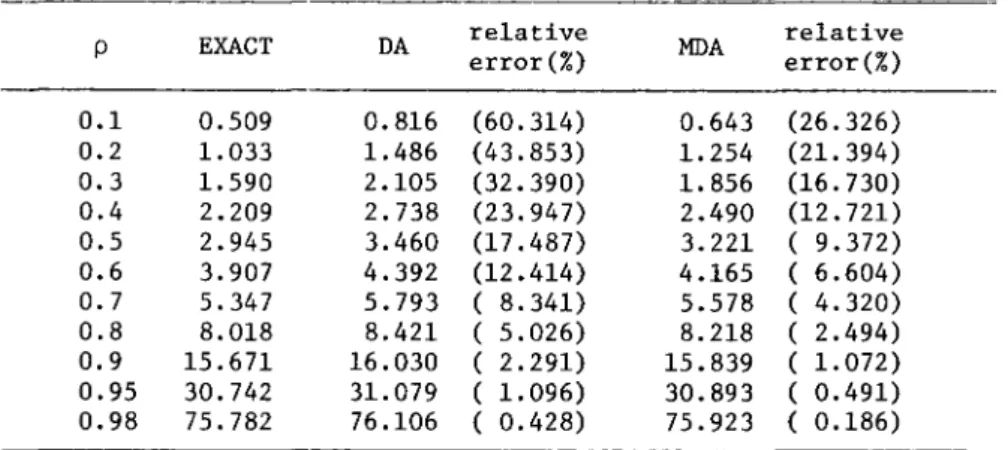
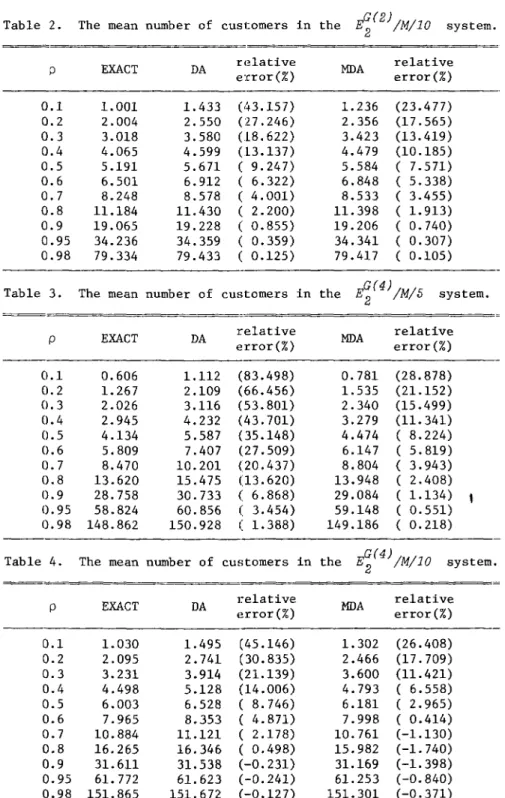
To examine the accuracy of the diffusion approximations, we shall numer-ically compare them with the exact solutions for the mean number of customers. For some
~M/m
systems, Tables 1~
4 showand EXACT DA
exact solutions,
the diffusion approximations in Section 3,
MDA : the modified diffusion approximations in Section 4.
For notational convenience, we use in these tables the symbol G(kJ instead of
X
to denote the geometric distribution with meank.
It is found from these tables that the MDA is more accurate than the DA for most cases, especially, when the number of servers is small and the mean group size is large. The MDA is, however, little effective when the number of servers is large. We can further observe that the accuracy of both DA and the MDA becomes much better as the mean group size decreases.
Table 1. The mean number of customers in the EG(2)/M/5
2 system.
EXACT DA relative MDA relative
p error(%) error(%) 0.1 0.509 0.816 (60.314) 0.643 (26.326) 0.2 1.033 1.486 (43.853) 1.254 (21. 394) 0.3 1.590 2.105 (32.390) 1. 856 (16.730) 0.4 2.209 2.738 (23.947) 2.490 (12.721) 0.5 2.945 3.460 (17.487) 3.221 ( 9.372) 0.6 3.907 4.392 (12.414) 4.165 ( 6.604) 0.7 5.347 5.793 ( 8.341) 5.578 ( 4.320) 0.8 8.018 8.421 ( 5.026) 8.218 ( 2.494) 0.9 15.671 16.030 ( 2.291) 15.839 ( 1. 072) 0.95 30.742 31. 079 ( 1.096) 30.893 ( 0.491) 0.98 75.782 76.106 ( 0.428) 75.923 ( 0.186)
Table 2. The mean number of cus1:omers in the
EG(2) /M/1O
2 system.
EXACT DA relative MDA relative
p e:cror(%) error(%) 0.1 1.001 1.433 (,U.157) 1.236 (23.477) 0.2 2.004 2.550 (27 .246) 2.356 (17.565) 0.3 3.018 3.580 (18.622) 3.423 (13.419) 0.4 4.065 4.599 (13.137) 4.479 (10.185) 0.5 5.19l 5.671 ( 9.247) 5.584 ( 7.571) 0.6 6.501 6.912 ( 6.322) 6.848 ( 5.338) 0.7 8.248 8.578 ( 4.001) 8.533 ( 3.455) 0.8 11.184 11.430 ( 2.200) 11.398 ( 1. 913) 0.9 19.065 19.228 ( 0.855) 19.206 ( 0.740) 0.95 34.236 34.359 ( 0.359) 34.341 ( 0.307) 0.98 79.334 79.433 ( 0.125) 79.417 ( 0.105) Table 3. The mean number of customers in the
EG(4)/M/5
2 system.
EXACT DA relative MDA relative
p error(%) error(%) 0.1 0.606 1.112 (83.498) 0.781 (28.878) 0.2 1.267 2.109 (66.456) 1.535 (21.152) 0.3 2.026 3.116 (53.801) 2.340 (15.499) 0.4 2.945 4.232 (43.701) 3.279 (11. 341) 0.5 4.134 5.587 (35.148) 4.474 ( 8.224) 0.6 5.809 7.407 (27.509) 6.147 ( 5.819) 0.7 8.470 10.201 (20.437) 8.804 ( 3.943) 0.8 13.620 15.475 (13.620) 13.948 ( 2.408) 0.9 28.758 30.733 ( 6.868) 29.084 ( 1.134) 0.95 58.824 60.856 ( 3.454) 59.148 ( 0.551) 0.98 148.862 150.928 ( 1.388) 149.186 ( 0.218) Table 4. The mean number of customers in the
EG(4) /M/1O
2 system.
EXACT DA relative MDA relative
p error(%) error(%) 0.1 1.030 1.495 (45.146) 1.302 (26.408) 0.2 2.095 2.741 (30.835) 2.466 (17.709) 0.3 3.231 3.914 (21.139) 3.600 (11.421) 0.4 4.498 5.128 (14.006) 4.793 ( 6.558) 0.5 6.003 6.528 ( 8.746) 6.181 ( 2.965) 0.6 7.965 8.353 ( 4.871) 7.998 ( 0.414) 0.7 10.884 11.121 ( 2.178) 10.761 (-1.130) 0.8 16.265 16.346 ( 0.498) 15.982 (-1.740) 0.9 31.611 31. 538 (-0.231) 31.169 (-1.398) 0.95 61.772 61.623 (-0.241) 61. 253 (-0.840) 0.98 151.865 151. 672 (-0.127) 151.301 (-0.371)
92 T. Ohsone
Acknowledgements
I wish to express my deep appreciation to Professor Hidenori Morimura for his invaluable comments and criticisms. I also wish to thank Assistant Professor Toshikazu Kimura for his helpful suggestions and discussions.
Appendix
Proof of Proposition in Section 2
Let
Tr
andTR
be the random variables with the Coxian distributions{A.,
r.}.
n
l
and{A.,
R.}. nI'
respectively, and let TO be the stationary" ",,=
"" ,,=
rresidual lifetime of
T
r
.
Furthermore, denote the p.d.f.s ofT
r
, T;
andTR
bygr(X)' g;(x)
transform by ~r(B),
and
gR(x),
respectively, and denote their Laplace ~;(B) and ~R(8) (Re(8) ~ 0), respectively. From the definition ofRi'
we have(A.l) where mial n
I
U. (1i=l "
iAk
R.) IT ," k=l /\k
+
8 n( I
i=2
n
A.n
n
u.
n
(IT _ 1 , _ ) { IT (1+
~) -
I
--.!:.. IT (1+
~ )8},i=l Ai
+
8k=2
Ak
i=2 Ai k=i+l
Ak
i-l
Ui
ITk=ORk ,
for1:
1,2,···,n.
Let An
(i,j)
(i ~ 1, j2:
0) be the coefficient ofn 8
ITk_i(l
+
T ) '
that is,- k n IT (1
+
~k=i
Ak
n-i+l
.
I
A
(i,j)8
J •j=O n
in thepolyno-Then, it is easily verified that the following equations hold:
and
A n
(i,O)
1,
A
n(i,j) -
A
n(i+l,j)
-+-
/\. nA
(i+l,j-l),
"
A
n(i,j)
=
-+-
/\. nA
(i+l,j-l),
for
i
1,2,···,n-j,
Using these equations, we can rewrite (A.l) as
(A.2)
n-l . n U. n-i '+1
S (s){ L A (2,j)sJ - L "A~ L A (i+l,j)sJ }
n j=O n i=2 i j=O n
( n-l n-j+l U. .) S (s) 1 + L
{A
(2,j) - LTA
(i+l,j-l) }sJ , n j=l n i=2 i n where n "A. S (s) = IT ~ n i=l "Ai + s On the other hand, we have(A.3) From U. ~ (A.4) 1 - £; (s) £;0 (13) = r r s (l/"A)
n
u. i
"Ak+
L
~ IT } i=2 \ k=l Ak+
sn
u. n
ASn (s).L
A~
IT. (1+
~
)
~=l ~ k=~+l k ( n-l n-j u,,' .) = S (s) 1+
A L L -r~ A (i+l,j)sJ . n j=l i=l ~~ n nAII1<=i (Uk/Ak) , we obtain
n-!'+l U. A (2,j) - ~ A (i+l ,ti-l) n i=2 Ai n n-j n u k
A
LA
(i+l,j) L ~ i=l n k=i k n-j u. A L A (i+l,j) -~ i=l n AiConsequently, from (A. 2), (A.3) and (A. ,q, we obtain
94 To Ohsone
References
[1] Abol'nikov, L. M.: A Multichannel Queueing System with Group Arrival of Demands. Engineering Cybernetics, Vol.4 (1967), 39-48.
[2] Baba, Y.: An Algorithmic Solution to the M/PH/c Queue with Batch Arrivals. Journal of the Operations Research Society of Japan, Vol.26, No.l (1983), 33-50.
[3] Baily, D. E. and Neuts, M. F.: Algorithmic Methods for Multi-Server Queues with Group Arrivals and Exponential Services. EW'opean JoW'nal of Operational Research, Vol.8, No.2 (1981), 184-196.
[4] Chaudhry, M. L. and Templeton, J. G. C.: A First CoW'se in Bulk Queues. John Wiley
&
Sons, New York, 1983.[5] Chiamsiri, S. and Leonard, M. S.: A Diffusion Approximation for Bulk Queues. Management Science, Vol.27, No.lO (1981), 1188-1199.
[6] Chiamsiri, S. and Moore, S.
c.:
Accuracy Comparisons between Two Diffusion Approximations for MX/G/l Queues - Instantaneous Return vs. Reflecting Boundary. presented at the ORSA/TIMS Joint National Meeting, Atlanta, November 1977.[7] Cromie, M. V., Chaudhry, M. L. and Grassmann, W. K.: Further Results for the Queueing System
~f/M/c.
JOW'nal of the Operational Research Society, Vol.30, No.8 (1979), 755-763.[8] Gaver, D. P.: Diffusion Approximations and Models for Certain Congestion Problems. JOW'nal of Applied Probability, Vol.5, No.3 (1968), 607-623. [9] Gelenbe, E.: On Approximate Computer System Models. JOW'nal of the
Association for Computing Machinery, Vol.22, No.2 (1975), 261-269. [10] Gelenbe, E.: Probabilistic Models of Computer Systems. Acta Informatica,
Vol.12, No.4 (1979), 285-303.
[11] Halachmi, B. and Franta, W. R.: Diffusion Approximation to the Multi-Server Queue. Management Science, Vol.24, No.5 (1978), 522-529.
[12] Heyman, D. P.: A Diffusion Model Approximation for the GI/G/l Queue in Heavy Traffic. The Bell System Technical JOW'nal, Vol.54, No.9 (1975), 1637-1646.
[13] Holman, D. F., Grassmann, W. K. and Chaudhry, M. L.: Some Results of the Queueing System
E~/M/c.
Naval Research Logistics Quarterly, Vo1.27, No.2(1980), 217-222.
[14] Iglehart, D. L. and Whitt, W.: Multiple Channel Queues in Heavy Traffic. IT: Sequences, Networoks and Batches. Advances in Applied Probability, Vo1.2, No.2 (1970), 355-369.
[15] Kabak, 1.. W.: Blocking and Delays in M(x)
IMlc
Bulk Arrival Queueing Systems. Management Science, Vo1.1", No.1 (1970), 112-115.[16] Kimura, T.: Diffusion Approximation for an M/G/m Queue. Operations Research, Vo1.31, No.2 (1983), 304-·321.
[17] Kimura, T. and Ohsone, T.: A Diffusion Approximation for an M/G/m Queue with Group Arrivals. to appear in Management Science, Vo1.30, No.3
(1984).
[18] Kobayashi, H.: Application of the Diffusion Approximation to Queueing Networks. I: Equilibrium Queue Distributions. JOUY>nal of the Association for Computing Machinery, Vo1.21, No.2 (1974), 316-328.
[19] Ohsone, T. and Kimura, T.: Diffusion Approximation for Multi-Server Queueing Systems with Coxian Arrivals. RIMS Kokyuroku, No.490, Research Institute for Mathematical Sciences, Kyoto University, 1983 (in
Japanese).
[20] Reiser, M. and Kobayashi, H.: Accuracy of the Diffusion Approximation for Some Queueing Systems. IBM Journal of Research and Development, Vo1.18, No.2 (1974), 110-124.
[21] Sunaga, T., Kondo, E. and Biswas, S. K.: An Approximation Method Usi.ng Continuous Models for Queueing Problems. Journal of the Operations Research Society of Japan, Vo1.21, No.1 (1978), 29-44.
[22] Sunaga, T., Biswas, S. K. and Nishida, N.: An Approxi.mation Method Using Continuous Models for Queueing Problems IT (Multi-Server Finite Queue). Journal of the Operations Research Society of Japan, Vo1.25, No.2 (1982), 113-127.
Tadashi OHSONE: Professor Morimura's La.boratory, Department of Information Sciences, Tokyo Institute of Technology, Oh-okayama, Meguro-ku, Tokyo, 152, Japan.