
Southeast Asian Studies, Vo1.36, No.3, December 1998
Skill Formation in Malaysia: The Case of ·Auto Parts Industry
Yuri SADOI*Abstract
This study takes the auto parts industry in Malaysia to demonstrate the difficulties a developing country faces in promoting skill development. Auto parts production needs a wide range of production techniques, which in turn require many types and levels of skilled workers. Realizing the importance of skilled workers, the Malaysian government has been emphasizing skill formation by increasing the number of technical schools, introducing a skill certification system, and giving a tax incentive to companies which undertake training for employees. Malaysia, however, lacks skilled workers, especially those at an advanced level, in order to sustain industrialization. This study attributes the shortage to the following four factors: insufficient government support, employers' lukewarm attitude, unfavorable skill environment, and weak individual interest. Korea is used as a contrast since it has overcome successfully the problems Malaysia has been facing.
I
Introduction
My earlier study, "Auto Parts Localization in Malaysia" [Sadoi 1997J, examined the pace of localization of auto parts and the problems associated with it. Although the national car project developed the auto industry rapidly, the local content rate and the technical capability of workers in the Malaysian auto industry did not develop as smoothly as in Korea. Fig. 1 shows the auto parts localization rates and automobile production volume in Malaysia and Korea. Korea, which started its national car project in 1975, ten years earlier than Malaysia, already had a high local content rate at the beginning of the project. The major problems were the lack of technical competence in such processing skills as forging and precision machining and the low designing capability of parts makers. Both problems were due to slow manpower development.
Since Prime Minister Dr. Mahathir Mohamad first announced Vision 2020, Malaysians have been hoping that the nation will achieve a developed nation status by the year 2020. Dr. Mahathir mentioned that human resource development was the crucial factor for realizing the goal of Vision 2020. He added that Malaysia not only needs to acquire skills and knowledge but also strengthen the work ethic.
Although Malaysia has been developing human resources by educating and training a great
*
ftc±+t-
';fi£, Graduate School of Human and Environmental Studies, Kyoto University, 46 Shimo-adachi-cho, Yoshida, Sakyo-ku, Kyoto 606-8501.Japan1400
-:e
1200 ·c :J 8 fOOO 0»
800 E :J <5 > 600 c: 0....
400 u :J "0e
200 Q. 0 co 0 N CD,...
... 0'> 0'> 0'> 100% 90% 80% c: 70%....
0 ('Q 60% .!:! (ij 50% 00 ...J 40%....
0 30% $('Q cr 20% 10% 0% N "<t CD co 0 N "<t CD to co to . co 0'> 0'> 0'> 0'> 0'> 0'> 0'> 0'> 0'> 0'> 0'> 0'> Yearc=:JProduction Volume (Korea:Hyundai )
~ProductionVolume (Malaysia:Proton)
-+-Rate of Localization (Korea:Hyundai)
...•... Rate of Localization(Malaysia:Proton)
Fig. 1 Localization Rates and Production Volume (Malaysia and Korea) Sources: Proton Company Profile; Hyundai Motor Company; Mitsubishi Motors
Corporation
Note: Rate of localization is calculated based on local content point system in each country.
number of engineers, technicians, and skilled workers in the past decade, the absolute number and level of technicians and skilled workers are not enough to develop high value-added industries. The government will continue to play an important role in strengthening the educational and technical level of people, but it cannot do it by itself. Enterprises and individuals have to cooperate to realize the goal.
The purposes of this study are, first, to analyze the present skill situation in Malaysia; then, examine what kinds and levels of skill are required for further progress of the auto parts industry; third, consider the problems which the government and private sector encounter in strengthening the skill base.
II
Sources of Skill Formation
II-1 State Institutions
At present, skill training in the public sector is conducted by the following four agencies; the Manpower Department in the Ministry of Education, Ministry of Human Resources, the Ministry of Youth and Sports, and Majlis Amanah Rakyat (MARA).
The Ministry of Education is in charge of secondary vocational and technical education. The Ministry of Human Resources gives skill certifications through the National Vocational Training Council (NVTC) and operates training institutions such as Industrial Training Institutes (ITO and Center for Instructor and Advanced Skill Training (ClAST). The
Y. SADOI : Skill Formation in Malaysia
Ministry of Youth and Sports is in charge of youth training centers (PLB) which provide vocational training to youths between 16 and 26 as well as of advanced training centers (ATC). Majlis Amanah Rakyat (MARA) is in charge of Pusat Giat (skill development centers) (GIAT) and Institut Kemahiran MARA (MARA vocational institute) (IKM). Here, we would like to focus on three major systems: vocational and technical education, training centers, and skill certification.
II -1-1 Vocational and Technical Education
The Ministry of Education manages secondary technical-vocational schools and polytechnics which have played an important role in producing skilled workers. As shown in Fig. 2, the Malaysian education system consists of a 6-year primary education, 3-year lower secondary education, 2-year upper secondary education, 2-year post secondary, and tertiary and higher education.
Primary education is for all Malaysian children who reach the age of SIX. The national
primary school curriculum was introduced in 1983 and its full implementation was achieved in 1988. Children have choices of enrolling in the national school with Malaysian as the teaching medium or in the national type schools where vernacular Chinese or Tamil language is the instructional medium. In 1995. 2,766,870 students were enrolled. and about 95% of them were estimated to complete primary education. All students take the Primary School Assessment
A~ PMR
6 7 8 9 10 11 12 13 14 Exam 15 16
(~~I
Enr lement Rate
25 50 75 IDe, --...-Primary 2,766.870 Upper Secondary Lower Secondary 1.124.910
Fig.2 Malaysian Education System (1995)
Sources: Numbers of Students arc from Malaysia. Ministry of Education [1994J and Malaysia [1996]. Hearing from Majilis Amanah Rakyat (MARA) in 1998.
Test (UPSR) when they graduate.
Having completed primary education, students from national schools enter lower secondary education, while students from national type schools spend an extra year studying the Malaysian language before they proceed to lower secondary education. However, those with good scores in the UPSR are able to skip the extra year and start lower secondary education right away. The enrollment rate in lower secondary schools was about 75% in 1995.
Since 1993, students have been required to take PMR (the Lower secondary assessment exam) to gauge their academic achievement before proceeding to upper secondary education. The students are tested on five subjects, of which Malay language and mathematics are required subjects. Based on their PMR results
0,
2, 3, and Fail grades), students are channeled into either the academic, technical, or vocational streams. In general, students in higher grades are channeled into academic and technical schools, and those in lower grades into vocational schools and public skill development centers such as GIAT. A part of grade F students and dropouts are channeled into youth training centers. The enrollment rate in upper secondary education was about 50% in 1995. A total of 514,970 students were enrolled in upper secondary schools, among whom 3,386 were in technical and 29,083 were in vocational schools.I)Secondary vocational school graduates are mainly absorbed by the job market as semi-skilled workers. In vocational schools, more than 50% of the curriculum is devoted to vocational education (technical skills, home economics, commerce, and agriculture) and the rest to general education. Students select a specialty after the common curriculum in the first year of two-year education. Based on their performance, students are channeled either into the academic or skill stream. The academic stream places strong emphasis on academic subjects and leads the students to take the Malaysian Certificate of Education (Vocational) or SPM (V) examination. Successful students in the exam continue on to post secondary education, while others go to work or continue education in public and private skill training institutions such as IKM. In the skill stream, students spend more time on practical work than those in the academic stream and develop the level of proficiency in the skills as required by industry. The students prepare themselves for the skill certificates (basic) conducted by the NVTC.
Technical schools, which are similar to academic schools, provide general education with some specialization in the industrial field and lead the students to the SPM or SPMV examination. Successful students in the exams are able to enter polytechnics or pre-university programs which prepare students for entering university.
In order to increase skilled manpower, 20 secondary vocational schools were converted into technical schools in 1996. As a result, the number of vocational schools declined from 69 to 49 and that of technical schools increased from 9 to 29. According to the Seventh Malaysia Plan
(1996- 2000), all the secondary vocational schools will be converted to secondary technical schools. During the Seventh Malaysia Plan, secondary technical schools are expected to
1) Total number of students in upper secondary education are taken from Seventh Malaysia Plan 1996- 2000 and number of students in technical and vocational school are from Yearbook of Statistics Malaysia 1996.
Y. SADOI : Skill Formation in Malaysia
increase the enrollment to 89,440 students, and raise the standards of students' skill proficiency.
II-1-2 Training Centers
The training provided by secondary education does not always come up to the expectation of enterprises. Higher levels of skills are too specialized to be taught in schools. Training centers teach immediately usable practical skills.
By 1985, training centers had attracted a small number of people. In 1980, 3,890 trainees and in 1985, 5,880 trainees were enrolled. During 1984-85, 1,500 youths were enrolled at Youth Training Centers, and 370 more at ClAST, out of which 120 were trained as instructors [Malaysia 1986J. During the five years (1981-85) before Malaysia started the national car project, 32,543 were enrolled in training centers [ibid.], one tenth in the Korean number during the five years before Korea started the national car project (1972-76, 312,736 skilled workers).
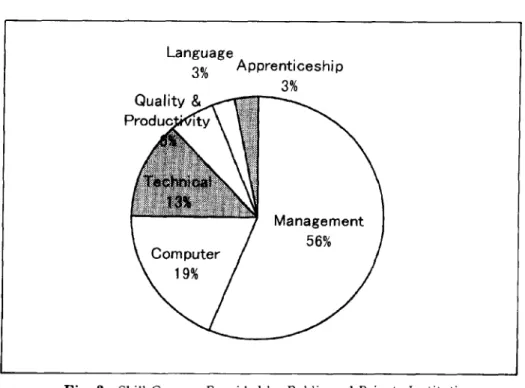
To meet the needs for training, many training centers were established in recent years. A total of nearly 300 centers offered training in a variety of courses in 1997, such as management/supervisory, computer, quality/productivity, language/writing, and technical skills. The public training centers had dominated the training centers until 1995. The total number of training recipients there between 1991 and 1995 was 115,540, while the number at private training centers was 31,970 [Malaysia 1996]. In the near future, the latter will become more important, and by the year 2000, they will be training as many as public centers.
The ratio of technical skill courses offered by public and private training centers IS low. In 1995, 56% of the courses were related to management, administration, and supervision; 19%, computer skills; and 13%, technical skills. Most of them were a few day courses and only 3% were 2-3 year apprenticeship courses (see Fig. 3) .
Among these training centers, skill development centers (GIA T) and MARA vocational institute (IKM) by MARA play an important role in developing semi·skilled and skilled workers. CIA T provides 6 to 12 month training for students who finished lower secondary education. Those who finished GIA T start working as semi-skilled workers or enter IKM. IKM offers 18 to 36 month skill programs for students who have passed grade 3 in SPM or SPMV examination. The curriculum is 70% practical and 30% theoretical. In 1997, among 27,000 applicants for IKM, only 18.000 students were admitted based on mathematics and sCIence scores in the SPM or SPMV examination.2l Those who are not admitted enter other training centers or start working. IKM is popular because it provides practical skills needed in industries. The students in IKM are fully supported by government. They are not only exempted from tuition fees but also given an allowance of RM$200 per month by government.
The major institutions of high technical-skill training for instructors and diploma courses are ClAST, German-Malaysian Institute (GMI) , and Malaysia-France Institute (MFI). ClAST was established in 1984 with the Japanese government as the sponsor under the ASEAN Human 2) Information obtained from an interview with a director in Majlis Amanah Rakyat, Bahagian Kemahiran
Mara. Oune 1998)
Language
3% Apprenticeship 3%
Fig. 3 Skill Courses Provided by Public and Private Institutions Source: [Challenger Concept (M) Sdn. Bhd. 1995]
Resources Development Project. The courses are for instructor training, supervisory training and advanced skill training. They consist of 36 repair service, 52 processing, and 12 designing courses of one to four week duration. ClAST is capable of training 3.000 participants a year.
GMI is a joint venture project between the governments of Malaysia and Germany. The project was launched in 1991 and registered as a limited company in 1992. The objective is to support the Malaysian industry by producing the manpower capable of combining theoretical knowledge with practical know-how through "learning by doing" methods. GMI offer 30 short programs and 53-year diploma programs.
MFI is a joint venture project between the government of Malaysia and France. It has several diploma programs such as machine and maintenance technology and metal fabrication technology.
II -1-3 Skill Certification System
The skill certification system started III 1973 under the National Industrial Training and Trade Certification Board (NITTCB). The NITTCB was reorganized into National Vocational Training Council (NVTC) in the Ministry of Human Resources in 1989. The purpose of the NVTC is to formulate, promote, and coordinate vocational training activities in Malaysia. The number of certificate holders, which was only 82 in 1973, gradually increased and reached 150,000 in 1995. In 1996, there were tests for 71 courses at Ll-basic. L2-intermediate. and L3-advanced levels. Fig. 4 shows the number of skill certificate holders in each level from 1973. Fig. 5 shows the number of certificate holders of skills which are needed for auto parts production. Most of them have basic level certificates, whereas some have intermediate, and a
Y. SADOI : Skill Formation in Malaysia 30000 25000 20000 VI c: 0 15000 VI
..
<l> 0-10000 5000 0 C"") It) r-- r--a> a> r-- 0> C"") It) r-- 0> M It)r-- r-- co co co co co a> a> a>
0> a> 0> a> 0> en en a> a> 0>
Year DAdvanced
• Intermediate .Basic
Fig.4 Number of Skill Certificates Holders
Source: [Malaysia, National Vocational Trainig Council Various years]
few have advanced level certificates.
In 1993, as the number of certificate holders increased. the examination system was modified from the centralized examination by NVTC into the evaluation of students' performance by individual training institutions based on the NVTC criteria. The reason of the modification was a lack of manpower and budget to conduct centralized tests on a greater scale.3) Under the new system. accredited centers approved by NVTC undertake training and
assessment leading to skill certificates. By December 1997, the NVTC had approved a total of 252 accredited training centers, including 11 company~training centers such as Produa, the second national car assembler, and Automotive Manufactures (M) Sdn. Bhd.
In 1997, in order to motivate more workers to upgrade their skills, in addition to the current Ll-basic, L2-intermediate, and L3-advanced level of certificates, two higher skill certification levels were added. The two levels are L4-diploma (technology) and L5-advanced diploma (technology). These higher diploma levels are for those who aspire to obtain advanced skills. But no one had passed the L4-diploma and L5-advanced diploma as of 1998.4)
II-2 Enterprises
In Malaysia, two important human resources development policies, Double Deduction Incentive (DDIT) and the Human Resources Development Fund (HRDF). were introduced in order to promote enterprise~basedtraining. In 1987, DDIT was introduced to encourage firms to train their workers, especially to develop the skills needed to introduce new products and processes
3) Information obtained from an interview with an officer in National Vocational Training Council Ministry of Human Resources Malaysia. (August 1997)
4) Information obtained from an interview with an officer in National Vocational Training Council. Ministry of Human Resources Malaysia. (June 1998)
DAdvanced .Intermedi ate I!IBasic Draftsman-Mechanical Ultrasonic Tester-Casting and forging
Industrial Radigrapher-Casting
Pattern- Wood and Metal (Foundry) Moulder and Coremaker (Foundry) Millwright Electroplater (f) (l) (f)
"- Tool and Die Maker :l
0 0
Steel Fabncator and Erector Sheet Metal Worker
Welder-Arc Welder-Gas General Mechanic Miller General Mechanic Turner General Mechanic Filler 0 1000 2000 3000 4000 5000 Persons
Fig. 5 Skill Certificate Holders by Course (1992-1997)
Source: [Malaysia, National Vocational Training Council Various years] Note: Skills used in auto parts production process are shown in this Figure.
and raise productivity and quality standards, by permitting employers to claim double the cost of training as expenses [The World Bank 1997J_ Before 1993, only 8.3% of the firms used the DDIT [MITP Survey 1994 and 1995J.
In 1992, the HRD Act was passed In Parliament, which subsequently led to the establishment of HRDF in 1993. Under the HRD Act, the employer with 50 or more employees in a manufacturing industry has to register with the HRD Council (HRDC) and pay a HRD levy at the rate of one per cent of monthly salaries to HRDF. Ifthe employer enroLLs participants in HRDC approved courses, he enjoy large discounts because they are funded by HRDC, or a rebate on fees. In 1995, the coverage was extended to service industries and firms with ten or more employees and a paid-up capital of RM$2. 5 million and above. In 1996, manufacturing companies with 10 to 49 employees and paid-up capital of less than RM$2. 5 million were allowed to register with the HRDC if they chose to do so.
The areas covered by the fund are computer-related skills for automation; die making, welding, fitting, and machining; maintenance; management and supervision; research and
Y. SAOOI : Skill Formation in Malaysia
development; company-wide productivity and quality improvement programs; and basic education for skills training. The financial assistance of HRDF is 80% of the training expense of technical and computer-related skills, 75% of all other retraining and skills upgrading, and 50% of overseas training. As of July 1994, a total of 3.417 employers were registered with HRDF and a levy of RM$88.1 million was collected. An estimated sum of RM$26, 4 million or 30% of the total levy collected was given as training grants. About 320,133 workers benefited from HRDF training courses [Challenger Concept (M) Sdn. Bhd. 1995J.
Enterprise-based training takes three main forms: (1) off-the-job training (Off-J-T), which enables workers to take short training courses done in-house or external training centers: (2) on-the-job training (OJT) , which lets workers get trained at production site under the supervision of skilled workers and technical advisors from overseas; (3) overseas training, which gives the operational and maintenance training which cannot be effectively done at home because of a lack of necessary machinery or technical advisors.
II-2-1 Off-the-Job Training (Off-I- T)
Off-J -T is implemented only at about 20% of companies in Malaysia. According to the Malaysia Industrial Training and Productivity (MITP) survey, which covered 2.200 manufacturing firms in 1994 and 1995, about 20% of the firms had enterprise-based Off-JoT and most of them (17%) combined it with OJT, as shown in Fig. 6. The proportion of firms giving Off-JoT increases with firm size. While the Off-JoT ratio was only 10% among the firms of 15 or fewer workers,
Large Medium Q) N
en
Small E...
ti: Micro Overall 0% 20% 40% 60% 80% 100%o
Off-J-T and OJTo
Only OJT • Only Off-J- T • No trainingFig. 6 Enterprise-Based Training in Malaysia Source: [MITP Survey 1995]
Notes: Micro=15 or fewer workers: Small=16-100 workers; Medium=lOl-250 workers: Large=over 250 workers
the ratio was over 70% among the firms of over 250 workers.
Fig. 7 shows the places of Off-]- T done by four sizes of firms. In large firms, 53 percent use in-house training. The proportion of firms that give in-house training decreases as the size of firms decreases. Only some large firms have their own training centers and training curriculums. For example, Produa set up its training center in 1994, whereas Proton started its training center in 1996.
Public training centers such as CIAT, ClAST, and ITI are popular external training centers. But the role of private training centers is increasing. Fifty-three percent of large firms use private training centers; 44% of medium firms; 28% of small firms; and 25% of micro firms. In any size of firms, about 25% use buyers and material suppliers as the place of training for their workers. In the auto-related industry, the suppliers are usually machine tool makers, and provide operational training as one of sales conditions.
In-house VocationallTechnical Schools Advanced Skills Training (ClAST) Skills Development
,;;;;;;=::::_
Centers (GIAT) ~ Institute Kemanhiran Mara (IKM) Industrial Training Institute (ITI) Polytechnics • Large ClMedium • SmallIII
Micro Other Government":=:=:::=~pm.
Institutes ,.'+-~ Youth Training Centers
41
(J
Cll
a::
Joint Venture Partners
Buyers/Material
E;;;;;;;;;;
Suppliers .~Private Training
~;=i==;i;=~~~~~~~3:::::;;;:=:::::::l
Institutes ~Overseas Training
o
10 20 30%
40 50 60
Fig. 7 Places of Off· the-JobTraining by Firm Sizes Source: [MITP Survey 1995J
Y. S1\OOI : Skill Formation in Malaysia
Although in-house training was introduced into about 20% of firms, its recipients are small in number and its program is inadequate. Fig. 8 shows the ratio of workers getting formal in-house training by skill level and position. In 1995, 13% of unskilled workers, 16% of skilled workers, 32% of technicians, and 25% of supervisors received in-house training in 2,200 firms surveyed.
In order to examine the skill formation by Off-]- T in the auto parts industry, we surveyed 212 workers in five auto parts makers in 1998_ The results are shown in Table 1. According to the survey, 35.4% of 212 respondents received at least one Off-J-T on an ad hoc basis during the 5.7 years of their average working years. But the proportion of recipients varies by product; the lowest was 0% in a forging maker, the highest was 72.2% in a metal sheet maker. Out of 212 respondents, 13 workers took skill training courses in ClAST and other training centers, 14 took in-house QC or ISO-9000 training, 12 took in-house computer training, 7 took in-house supervisory training, 6 took English courses and others took safety, fire drill, or discipline training. Three workers took overseas training when something new started, such as installment of new machinery and new production lines.
Formal training for new workers is only a one-day orientation which consists of instruction on safety, health, 5S,S) job procedure, and working conditions.6) After the orientation, only OJT is implemented at production site for workers, while for engineers, 2-3 week training is offered. A plastic parts maker, for example, gives a two-day orientation program. But a casting maker, a car seat maker, and an accessories maker give one-day orientations. A metal parts maker has no training for new employees.
Unskilled Production Workers Skilled Production Workers Technicians Supervisors I
-
IP
o
Total Number IIlITrained NumberI
rm
o
100 200 300 400 500 1.000 PersonsFig.8 \Vorkers Getting Formal In-House Training by Occupational Group Source: [MITP Survey 1995]
5) 5S represents seiri, seiton, seisou, seiketsu, and shitsuke. Five Japanese words all in a set mean to keep the factory clean and tidy.
6) Information obtained from interviews with 16 auto parts makers during the period of August 1997-June 1998.
~
N OQ
Table 1 A Survey of Workers inAuto Parts Plants in Malaysia
Auto Parts Makers Educational Background
Total OSI Proton KS YMC Pro MC Elemen- Lower Upper Post
tary Secondary Secondary Secondary
Sample profile 212 133 50 18 5 6 30 41 135 6 1 Sex 1 Male 84.0% 103 50 16 4 5 2 Female 16.0% 30 0 2 1 1 2 Age Average age 28.5 28.4 29.1 29.1 22.8 27.7 36.1 27.0 26.9 31.6 3 Marriage status 1 Married 49.1% 59 30 12 0 3 2 Single 50.9% 74 20 6 5 3
4 The number of years in the present company
Average year 5.9 5.5 7.7 5.8 1.3 4.5 6.7 5.5 5.9 6.1 5 Final education Elementary 14.2% 28 2 Lower secondary 21.2% 39 1 1 Upper secondary 60.4% 66 47 14 2 6 Post secondary 2.8% 3 3 6 Type of job Stamping 16.0% 28 6 12 10 12 Machine operation 13.7% 15 12 1 1 4 5 20 Welding 13.2% 28 6 14 8
Maintenance & repair 11.3% 17 5 2 4 20
Production control 9.0% 3 5 7 4 2 12 5
Die& jig making 7.1% 15 1 14
Machining 5.2% 10 1 2 2 7
Supervisor 4.7% 1 6 3 9 1
Packing 3.8% 8 1 4 3
Inspection 3.3% 2 1 1 2 1 2 5
Casting 0.5% 1 1
7 The number of times of job change
Average times of changing jobs 1.6 1.3 1.9 3 3 1.5 1.6 1.2 1.6 2.5
Never changed before 26.4%
Once 22.4%
Twice 30.3%
Three times 14.4%
Four times or more 6.7%
IIIlf ~ '-..J <"
'"
'-..J ~ ~~ w O'l ~ w <JIllQ"""m,,,,',"
I
1 Which gives you more satisfaction - your job or your lifeoutside the job?
1 Job 73.1% 78.9% 58.0% 61.1% 100.0% 83.3% 96.7% 82.9% 66.4% 50.0%
2 Life au tside the job 13.7% 8.3% 24.0% 33.3% 0.0% 0.0% 3.3% 7.3% 15.6% 50.0%
3 NA 13.7% 12.0% 20.0% 11.1% 0.0% 17.7% 0.0% 9.8% 18.8% 0.0%
2 Are you satisfied with life at work? Or are you dissatis-fied with it?
1 Satisfied 50.9% 53.4% 42.0% 33.3% 100.0% 83.3% 80.0% 63.4% 39.8% 50.0%
2 \10re or less satisfied 31.1% 30.1% 36.0% 44.4% 0.0% 0.0% 16.7% 26.8% 36.7% 16.7%
3 More or less dissatisfied 7.5% 6.8% 12.0% 5.6% 0.0% 0.0% 3.3% 4.9% 9.4% 16.7%
4 Dissatisfied 6.6% 6.0% 8.0% 5.6% 0.0% 16.7% 0.0% 2.4% 9.4% 16.7%
>-<
5 NA 3.8% 3.8% 2.0% 11.1% 0.0% 0.0% 0.0% 2.4% 4.7% 0.0% (/l
3 Please describe the skill level of your job >-d
1 The skill level of my job is too low for my ability 17.9% 16.5% 18.0% 22.2% 20.0% 33.3% 26.7% 19.5% 17.2% 0.0% g
2 Fairly good level 65.1% 64.7% 66.0% 77.8% 20.0% 66.7% 43.3% 56.1% 71.1% 100.0% (/l
..
3 The skill level of my job is too high for my ability 14.2% 15.0% 14.0% 0.0% 60.0% 0.0% 26.7% 17.1% 10.2% 0.0%
2:
4 Are you satisfied with the amount of work assigned to you? 'Tj
1 I can handle more work 18.9% 20.3% 18.0% 11.1% 0.0% 33.3% 26.7% 19.5% 15.6% 33.3% 0
0-;
2 Fairly satisfied with the quantity 63.2% 63.2% 60.0% 66.7% 100.0% 50.0% 60.0% 70.7% 63.3% 33.3% 8
~
3 Too busy 10.4% 8.3% 14.0% 22.2% 0.0% 0.0% 13.3% 4.9% 9.4% 33.3%
o'
4 NA 10.8% 8.3% 22.0% 0.0% 0.0% 16.7% 0.0% 4.9% 16.4% 0.0% ;:l
5 If you have a chance to take one· year overseas training, 5'
~
woul.d you like to take it? e:..
1 Yes 75.9% 70.7% 92.0% 61.1% 80.0% 100.0% 50.0% 58.5% 86.7% 100.0% ~
.<
2 No 9.9% 15.0% 0.0% 5.6% 0.0% 0.0% 30.0% 22.0% 0.8% 0.0% ~.~
3 ,'IA 13.2% 13.5% 8.0% 33.3% 0.0% 0.0% 16.7% 17.1% 12.5% 0.0%
6 Here are two kinds of job.
Ifyou have to choose, which would you prefer?
1 A tough, busy job but one that gives me responsibility I 51.9% 50.4% 52.0% 66.7% 60.0% 33.3% 50.0% 46.3% 52.3% 66.7% and authoritv
2 A job with~ut responsibility and authority, but that is I 35.4% 36.8% 30.0% 27.8% 40.0% 66.7% 46.7% 39.0% 33.6% 16.7% easy to do and does not push me too much
3 NA 12.7% 12.8% 18.0% 5.6% 0.0% 0.0% 3.3% 14.6% 14.1% 16.7%
7 Why did you decided to work for the present company? Please choose as many answers as apply.
1 I like automobiles 8.5% 7.5% 16.0% 0.0% 0.0% 0.0% 16.7% 7.3% 7.0% 0.0%
2 I like to make something by hand 5.7% 4.5% 10.0% 5.6% 0.0% 0.0% 10.0% 7.3% 4.7% 0.0%
w 3 To earn money for living 41.0% 32.3% 62.0% 44.4% 0.0% 83.3% 36.7% 39.0% 40.6% 83.3%
N
~ 4 To upgrade skill 48.1% 51.9% 40.0% 44.4% 80.0% 16.7% 36.7% 48.8% 50.8% 33.3%
~ ~
o
Table I-continued A Survey of Workers in Auto Parts Plants in Malaysia
Auto Parts Makers Educational Background
Total OSI Proton KS YMC Pro MC Elemen- Lower Upper Post
tary Secondary Secondary Secondary 8 When do you feel happy in your work?
Please choose as many answers as apply.
1 When I get promoted 12.7% 5.3% 32.0% 11.1% 40.0% 0.0% 10.0% 4.9% 14.8% 50.0%
2 Communication with my colleague 9.9% 5.3% 18.0% 22.2% 20.0% 0.0% 6.7% 12.2% 7.8% 50.0%
3 When my idea was approved 26.4% 23.3% 34.0% 33.3% 40.0% 0.0% 46.7% 26.8% 18.8% 50.0%
4 When I master a new skill 65.1% 64.7% 70.0% 61.1% 20.0% 83.3% 43.3% 56.1% 71.9% 100.0%
5 Others 5.2% 2.3% 8.0% 16.7% 0.0% 16.7% 0.0% 0.0% 8.6% 0.0%
9 How do you usually spend your weekends or day-offs? Please choose as many answers as apply.
1 Do nothing in particular 4.7% 3.8% 8.0% 5.6% 0.0% 0.0% 3.3% 4.9% 3.9% 33.3%
2 Meet with my friends 14.2% 11.3% 26.0% 11.1% 0.0% 0.0% 3.3% 12.2% 15.6% 33.3%
3 Stay with my family 47.6% 46.6% 48.0% 50.0% 60.0% 50.0% 66.7% 48.8% 42.2% 66.6%
4 Reading books, listening music 12.3% 12.8% 14.0% 5.6% 0.0% 16.7% 6.7% 7.3% 14.1% 33.3%
5 Doing hobbies 28.8% 23.3% 42.0% 27.8% 20.0% 50.0% 20.0% 26.8% 32.0% 33.3%
6 Take a course at a training institution 2.8% 1.5% 6.0% 5.6% 0.0% 0.0% 0.0% 0.0% 4.7% 16.7%
7 Others 3.8% 2.3% 6.0% 11.1% 0.0% 0.0% 0.0% 2.4% 5.5% 0.0%
10 What training have you taken in the company?
The percentage of workers who took at least one training 35.4% 18.0% 68.0% 72.2% 0.0% 50.0% 6.7% 4.9% 48.4% 66.7% The percentage of workers who took no training 64.6% 82.0% 32.0% 27.8% 100.0% 50.0% 93.3% 95.1% 51.6% 33.3% Type of training
Overseas training 3 0 2 1 0 0 0 0 3 0
Outside training centers 13 13 0 0 0 0 0 0 13 0
In-house training
QC &ISO 9000 14 1 8 4 0 1 0 0 13 1
computer 12 0 9 2 0 1 0 0 11 1
supervisory 7 0 3 4 0 0 0 0 5 2
fire drill 6 0 4 2 0 0 0 0 5 1
language (English, Japanese) 6 3 2 0 0 1 0 0 5 1
safety 4 1 3 0 0 0 0 0 4 0
machine operation 3 2 1 0 0 0 0 0 3 0
Total 68 20 32 13 0 3 0 0 62 6
Notes: The survey was conducted by the author in April 1998 in the Kuala Lumpur area. OSI - Oriental Summit Inc. (metal parts maker)
KS - Kawasho Steel Processing (metal steel) YMC- YMC Forging (forging parts maker) Pro MC - Proton MC Metal
1mr
jgf '-<J \"'"
'-<J ~ ~~ w 0 ) ~ w <J(oY. SADOI : Skill Formation in Malaysia
II -2-2 On the job Training (OjT)
About 65% of firms covered in the MITP survey give OJT to their employees, as shown in Fig. 6. The proportions are 63% in micro, 83% in small, 92% in medium, and 92% in large firms. But, nearly half of the firms give only OJT and only 20% combine it with Off-J- T.
OJT is regarded as the most important skill acquisition method in auto related industries in Japan7) According to the Japan Labor Research Institute survey on 3,000 small and medium sized companies in precision, transportation, electrical, and general machinery, and metal industries, nearly 90% of them give OJT, as shown in Fig. 9. Other methods are in-house training and skill certification (about 40%) and outside training (about 20%). The survey confirms that skills are acquired with a combination of OJT and Off-JoT in auto related enterprises, but that OJT is much more import.
OJT, however, is not effective unless it is done systematically with individual training sched ules and clear targets. One company that has a very effective OJT training system in Malaysia is a plastic injection-molding parts maker. At the production site, the kinds and levels of skills the individual workers achieved are shown on the wall. It is done as a part of TPM acti vities.8)
Not many parts makers in Malaysia give such systematic OJT. The high turnover rates in Malaysia makes skill transfer through OJT difficult. Job security and seniority create an environment in which senior workers are willing to share their experience and skills with
Training Institutes Invite Advisors Skill Certification In-house Training OJT • Precision machinery ClTransportation
m
Electrical machineryo
Machinery general • Metal ~ 1111111111111l11'"1111HllI1l1l11l1l1l1111l1111ll11l11111l11l111111IH1111111111111111o
20 40 % 60 80 100Fig.9 Skill Acquisition Methods in Japan by Industries Source: [Ukai 1992]
7) Koike and Inoki [1987J focused on
on
as the predominant mode for acquisition of skills by production workers in Malaysia as well as Japan.8) Information obtained from interviews with an assistant manager in personnel department and an operation manager in production department of 100% Bu mi owned plastic injection parts maker.
(August 1997) Author observed several OJT activities at the production site.
subordinate workers. They know that their position will not be threatened by the subordinates by teaching their skills. In Malaysia, where the turnover rate is high (about 25%), once workers obtain necessary skills, they try to keep them as their property. Therefore, the pace of spread of skills is much slower in Malaysia than in Japan where skills spread in geometric progression through OJT.
Most of the parts makers in Malaysia depend on overseas advisers for OJT. Because of the high cost of overseas advisers, one maker can afford only one or two advisers, which is insufficient for giving effective OJT to all workers. In general, the cost of one adviser a day is almost the same as one worker's monthly salary.
11-2-3 Overseas Training
Overseas training may be the most effective method of training, but it is expensive. It is implemented by 21% of large firms, 13% of medium firms, 8% of small firms, and none of the micro firms (see Fig. 7). Most of the firms which receive technical assistance from foreign companies send workers overseas, for it is an important part of the technical assistance agreements between them. Many firms in Malaysia rely on their foreign technical assistance partners to develop skills needed for running a new production system. The training for machine operation and maintenance is usually done by machine tool makers by taking Malaysian workers to their home factories or by bringing their advisors to production sites in Malaysia. However, in many cases, the training provided by machine tool makers is not designed to broaden technical skills but to teach only the minimum skills needed to operate and maintain the new machines.
The following are examples of parts makers who give overseas training.9) A metal parts maker, a joint venture between Thailand and Malaysia, sent 70 workers to Thailand or Japan for the acquisition of operational know-how for 1-3 months. A casting parts maker, a 100% bumiputra equity company, has a one-month training program at the Japanese technical assistance company's workplace. A plastic injection maker, which is 90% bumiputra owned, has 1-6 months skill upgrading programs in Japan, Germany, Taiwan, or UK. A car seats maker, a joint venture between Japan and Malaysia, has 1-6 months training programs in Germany, UK, or Japan. A plastic injection parts maker sent 6 workers for 2 weeks to 6 months to Japan.
The localization of casting in Malaysia is a good example of the success of overseas training. Casting, which is low in the rate of mechanization and requires high skills, was localized with overseas training. For this, 15 workers spent two years and 49 workers one year in getting trained in Japan prior to the opening of a casting plant in Malaysia. The Japanese technical partner taught necessary skills according to its training curriculum and gave OJT at its work site in Japan.10)
9) Information obtained from interviews with 16 auto parts makers during the period of August 1997-June 1998.
10) Information obtained from Mitsubishi Motors Corporation.
332
Y. SADOI : Skill Formation in Malaysia
III
The Shortage of Skilled Workers
III -1 Lack of Skilled Workers
Malaysia has to move up to higher value-added. higher-skill industries. but it faces shortage of skilled workers and technicians to develop such industries. Even though there was a substantial increase of skilled and semi-skilled workers in recent years. the supply of skilled workers was far below the demand. What Fig. 10 shows is one confirmation of that. The supply of assistant engineers and skilled workers was far below the demand during the period 1991-95. The demand of skilled workers was about 270.000 while the supply was about 110. 000.
Not only the absolute shortage of skilled workers. but also the lack of certain kinds and levels of skill are problems. Such shortage was pointed out in several surveys. In the report dated February 1995. the World Bank pointed out that the ratio of skilled workers to total workers fell from 0.43 in 1985 to 0.35 in 1991. A survey of five sub-sectors conducted by the Institute of Strategic and International Studies (ISIS) Malaysia in 1990 identified the following categories of workers as being in short supply in auto industry; engineers, technicians. tool and die-makers. computer technicians. supervisors. machine operators. fitters. and welders. The survey by the Federation of Malaysian Manufacturers in 1990 also identified engineers. welders, engine drivers. machinists. fitters. and draught men as being in shortage.
In addition. advanced level skilled workers are in shortage in Malaysia. Fig. 11 shows the number of people who received advanced level certifications during the six years in Malaysia (1991-97) and in Korea (1977-83). In Malaysia. the advanced level certificate (L3) recipients in tool and die making were 45; general machining. 19; machine fitting. 51; stamping, 20; and welding, 140.11) There was none in forging and accuracy machining where skilled workers are urgently required. On the other hand in Korea. in a few years after the national car project
Engineers c o .~ Engineering GAssistants o o Skilled Workers o 50 100 150 200 250 300 1000 persons DSupply mlOemand
Fig. 10 Supply and Demand of Manpower (1991-1995)
Source: [Malaysia. Center of Educational Excellence 1997]
Note: Supply only from public schools and training institutions
11) See Malaysia. National Vocational Training Council in Ministry of Human Resource [1994].
Ell Korea 1977-83 .Malaysia 1991-97 Machinery maintenance Stamping Machine fitting Heavy Machinery maintenance General machining
Tool and die making
'" ~ Precision machining en Forging Casting
.~~~1liJ
Heat treatment Welding o 100 200 300 Persons 400 500 600Fig. 11 Advanced Level Skill Certificates Holders (Malaysia and Korea) Sources: [Malaysia, National Vocational Training Council Various years;
Korea, Manpower Agency 1998]
started, there were already quite a few advanced level recipients class
r
12) in most of the skills: metal mold and tool making, 120; machining, 567; fitter, 364; maintenance, 15; precision machining, 29; welding, 429; casting, 116; heat treatment, 32; and forging, 42 [Korea, Manpower Agency 1998].III-2 The Skills Difficult to Form in the Auto Parts Industry
In the 1960s and 70s, when Korea was developing the automobile industry, most of the skills were acquired by developing manual skills through experience. As the machine tool technology advanced, however, a number of skills were mechanized. By the time Malaysia started developing the auto industry, many manual skills had been replaced by NC machines, and manual mold making was replaced by wire-cut and electric cutting machinery. In general, the minimum training period to master metal mold making was shortened from 10 to 3 years.13)
12) There are four levels of test. The lowest level, "assistant craftsman," and the one level above it, "class II craftsman," need no educational qualification, and test only practical skills. The third level, "class I," requires two years of experience after passing the class II level. In addition, the applicant must be a graduate of a vocational training course and have 4 years of work experience after high school. A written test starts at this level. The highest level is "master craftsman." To qualify for it, one must be a class I craftsman with a minimum of 7 years' experience, including the period of attendance at the Industrial Master's conege.
13) Information obtained from an interview with a plant manager in a metal mold maker in Osaka Japan. 334
y, SADOI : Skill Formation in Malaysia
Then, why does Malaysia lag behind in skill formation?
A large portion of skills have not been replaced by machines even in Japan, which has the highest level of machine tool industry in the world. Fig. 12 shows the rate of mechanization of production processes, taken from a survey of 2,079 Japanese parts makers by the Japan People's Finance Corporation in 1992. Production of metal molds is mechanized about 80%, while forging is mechanized 60%, but the remaining processes depend on manual skills.
In addition, one production process involves various skills which require less than one year to more than ten years to master. Fig. 13 shows the number of years required to master the skills used in certain production processes in Japanese small and medium sized companies. taken from the same survey. In metal molding, for example, the skills required can be classified into several kinds, depending on the number of years of training required. Five percent of them requires less than 3 years of training; 30%, 3-5 years; 40%, 5-10 years: and the remaining, over 10 years. According to Fig. 13. metal mold and forging have a larger percentage of skills which require ten or more years of training.
This explains why production of the auto parts, which require forging and metal mold making, has not been localized in Malaysia. In contrast, most of the localized parts in Malaysia require such skills as plastic injection molding, stamping, and pressing which do not require many years of training. IfMalaysian parts makers want to increase value-added in production. they should not rely too much on machinery. They must use machinery only as a tool and rely more on human skills.
Pressing Metal Mold Plastic Irtiection Stamping Parts Assembly Forging Heat Treatment Plating Casting Painting Average «'".;';
/
I
• Not Mechanized ,; ' / ; r.:J MechanizedI
/
I
:::7~77?'''/7'77'77/Z /I
';';";';;» . /'//,,/,//,'..
/.I
I
V-x:V,,;;'·/,,;;'. //'//:' X:.. /I
1:<;', 1;/
I
/
I
I
I
' / i / ' / '/(/(; , / /I
~-..~-I
' . i / / '-;", --;., ,(-,', c/' 0% 200/0 40% 60% 80% 1000/0Fig. 12 The Rate of Mechanization of Production Processes Source: [ukai 1992]
Parts Assembly Plastic Injection Plating Heat Treatment Forging Pressing Painting Stamping Machining Casting Metal Mold .--/
---
I"---..
/ / / I-
.--/ ----/ /----....
/ I / / . / / / I"'"
\ /~
---
---
/ .111 .10years<
1.15-10years 03-5years ml-3years_<1
year 0% 20% 40% 60% 80% 100%Fig. 13 Years Required to Master the Skills Used in Production Processes Source: [Ukai 1992]
Table 2 The Purpose for Which Skills Are Used The Level of
Skill Involvement
The Purpose of Skill Use (A) Technology Development
High • Creation of a prototype for R&D
..III> • Participation in the development for the better production process and prod· uct quality
• Improvement in precision level (B) Productivity & Quality Improvement
• Trouble shooting capability • A good knowledge of machinery Low
(C) Production Maintenance • Routine job
• Basic operation
Table 2 shows the purpose for which skills are used and the level of skill involved. Skills are used for 0) technology development (level A), (2) productivity and quality improvement (level B), and (3) production maintenance (level C). The highest level of skill is used when prototypes are produced for development of a new prod uct.14)
As for technology development (level A), even if new products are planned and drawings are made, the drawings will not be translated into reality without skilled workers. Prototypes need not only to be produced but also tested regarding ease of assembly, durability, and performance before setting up a production line. Also, the skills to modify designs, modify 14) Nakamura, H. [1994] pointed out that the following four types of skilled workers will inhabit the workplace of the future, and effective measures of each will be vital. They are "super" skilled, "high technology" skilled, "multi" skilled, and normally skilled.
Y. SADOI : Skill Formation in Malaysia
molds and production equipment, and achieve precision on a mIcron level are needed. In Malaysia, for the further development of auto parts industry, these kinds of skill are needed.
Trouble shooting capability (level B) when problems crop up requires a theoretical knowledge of machinery used. Such knowledge is not easy to obtain since high-tech machinery has become increasingly important in production today. In contrast, the skills used for production maintenance (level C) are the routine, specific skills which do not require much general knowledge of machinery. The present skill distribution in Malaysia is concentrated in the lowest level. And the skills needed for technology development are poorly developed, and the skills needed for trouble shooting are also in shortage.
Next, what kind of skills and knowledge are required for the level A skilled workers? Take some major parts, as examples, and break down skill requirements for making prototypes of these parts. The major parts, which were produced in Korea in relatively early years and are not yet produced in Malaysia, are the crankshaft151 and the cylinder head.16) In Korea, the
crankshaft and the cylinder head were localized in 1969 and 1975 respectively.
The major tasks and required capability to produce these two parts are shown III Table 3.
First, skilled workers have to read drawings, which consist of six sheets with detailed information. Mathematical and trigonometric knowledge is required to calculate, for example, to mark reference points and lines on the material to be processed. Second, production
Table3 Major Tasks and Skill Requirements for Making Prototypes Major Tasks U nderstand drawings Production planning Programming Machining Required Capability Mathematical (and Trigonometric) knowledge
Measurement
Calculation (marking reference points and lines)
Knowledge of machining methods to select the best method and machin-ery to use for about 40 machining processes
Knowledge of machinery concerning its ability and characteristics Knowledge of metal characteristics (hardness, viscosity. thermal expansion, etc.: Steel has about 300 kinds)
Knowledge of machining conditions (turning speed. forward speed) Knowledge of suitable bites and jigs for metal material and machining shape
Measuring capability (variety of measurement tools) CNC machine programming
Machine operation (turner, fraise machine. machining center. NC machines)
Centering techniques
Balancing techniques under high speed rotation Source: Hearing from skilled workers in auto parts makers in Japan.
15) The crankshaft, one of the main moving parts of an engine, converts explosion power from pistons into rotary power. It plays an important role in assuring the high performance, low vibration, fuel economy, and cost reduction of an engine.
16) The cylinder head is a part which requires durability against mechanical-load and thermo-load because it has a combustion chamber in which high pressure and high temperature are generated.
procedures have to be planned. A crankshaft requires 40 different machining processes and 30
out of them require different machines, cutting tooIS,I7) and jigS.I8) Planning the procedures requires (1) knowledge of machining methods and the best method and machinery for each process, (2) knowledge of the characteristics of all machines in possession, (3) knowledge of metal characteristics such as hardness, viscosity, and thermal expansion of about 300 kinds of steel to determine suitable machine cutting speeds for material and to make bites and jigs for them, and (4) knowledge of measuring methods to be able to use a variety of measurement tools. Third, CNC programming capability is required. Necessary programming for prototype making can be done better by skilled workers with programming knowledge than by the programmers without production know-how. Fourth, machining skills are required to operate machines, do centering for turning, do balancing work under a high-speed rotation, and attain required precision.
IV
The Reasons for Shortage
IV -1 Insufficient Government Support
Malaysia has been producing skilled workers and technicians, but it is not producing enough number and level of skills. In contrast with Malaysia, Korea built up the skill base faster than Malaysia.
One of Korea's advantages in skill formation is its ability to institutionalize skill trammg from the early years. Although an academic career is highly appreciated, which makes many talented students go for university education, enrollment in technical schools has been large in Korea. Soon after the First Five Year Economic Development Plan (1962-66) was drafted, in order to cope with a future increase in the demand for industrial skills, the government began emphasizing technical training.
Technical Education
For one thing, by enacting the Vocational Training Law in 1967, the Korean government restructured the vocational high schools including technical high schools. In the following several years, the number of technical high schools doubled. As shown in Fig. 14, in 1968,
there were 54 technical high schools with 49,441 students, whereas in 1975, when Korea started the national car project, there were 113 technical high schools with 126,014 students. In 1985,
the number of students increased to 223,494 and in 1995, to 315,093. For training technicians,
in 1968, there were 19 junior technical colleges, whereas in 1975, there were 88 junior technical
colleges. The size of enrollment increased from 17,069 students to 58,500 between the two years. I9)
On the other hand in Malaysia, in 1985 when it started a national car project, there were
17) The cutting tools include bites, drills, reamers, fraise cutters, and so on. 18) The jigs are aids for fixing works for machining.
19) See Korea, Ministry of Education [1975-1995; 1962-1983].
Y. SADOI : Skill Formation in Malaysia 350,000 300,000 III -oJ 250,000 c
"
"l:l ::J 200,000 -oJ C/)....
0 L. 150,000"
..0 E ::J 100,000z
50,000 0 1965 1970 1975 1980 1985 1990 1995-+-(Korean echnical high school - - - (Korea)Junior technical college
--6-(Malaysianechnical high school
-*-(Malaysia)Junior technical college
Fig.14 Enrollments of Technical High Schools and Technical Junior Colleges in Malaysia and Korea
Sources: [Korea, Ministry of Education1975-1995: 1962-1983J
[Malaysia, Department of Statistic 1993; 1995: 1997J
[Malaysia1986; 1996J
only 9 secondary technical schools with 6.694 students. For technicians, there were only 7 polytechnics with 5.300 students, as shown in Fig. 14. In 1996, the government enhanced technical education by increasing the number of technical schools from 9 to 29. The enrollment increased to 14,820. The enrollment in polytechnics reached 20.000 in 1996 [Malaysia 1996J.
International Skill Competition
One of the indicators of Korean government's success in promoting skill formation is the good performance of Koreans in the International Skill Olympics.20) Until the middle of 1960s, it
was Japan and a few European countries, which dominated the Skill Olympics. But the situation changed in the following decades. Korea began participating in 1968, as part of
20) International Youth Skill Olympics emerged in 1950 in post·war Europe when Spanish educators involved in vocational training challenged neighboring Portugal to participate in a skill competition. The event developed as an effective means for promoting vocational standards world wide, and today is a major biennial event embracing 31 nations. Young national champions. must be aged under 22 and competing in 40 industrial and service categories of skills, are given four days to complete their project tasks using identical materials and tools. The 40 skill categories include advanced technology industry skills for automobile industry such as fitting, press tool making, instrument making, turning CNC, milling CNC, welding, pattern making and so on. Projects are evaluated by a panel of judges according to strict criteria, and each participant receives a competition ranking and a comparison with a standard score. Top performers in competition categories as awarded gold, silver and bronze medals.
promotion of industrial skills under the direction of President Park. Korea won the third largest number of gold medals in 1968 and 1970; the second largest number in 1973 and 1975 (the competition has been held every other year since 1971), and the largest number from 1977 to 1993 when it lost to Taiwan. In 1997, Korea won again the largest number (10 gold medals)
Dapan, Ministry of Labor 1997J. Malaysia began participating in it in 1993, but has not won any medals so far.
An important reason for the Korean success in the Skill Olympics was the good support system of the Korean government for skilled workers. Within the country, skill competition starts from the local level, and moves to national skill competition and to International Skill Olympics. The winners in local competition are eligible to participate in national competition and given the certificates of class II craftsman. The winners in the national competition are sent abroad to participate in International Olympics. In national competition, a gold medal winner is given 6 million won21); a silver medal winner, 4 million won; and a bronze medal
winner, 2 million won. All medal winners are taken to an industrial study tour and given the certification of class I craftsman. A gold medal winner in International Skill Olympics is given 12 million won; a silver medal winner, 6 million won; and a bronze medal winner, 4 million won. Medal winners are promised an annuity, certificates of class I craftsman, and university scholarship [Korea, Manpower Agency 1998J. Such government support is undoubtedly a major reason for Korea's good performance in International Skill Olympics, but it is also a reflection of government's commitment to building internationally competitive skills. The gold medallists have played an important role in spreading their skills to other workers.
In Malaysia, skill competition starts from the training institution level, and moves to national skill competition and to International Skill Olympic. For example, the winner in IKM is given RM$10, 00022) and the winner in national skill competition is given RM$30, 000.23)
The monetary rewords are smaller than in Korea.
IV - 2 Employers' Lukewarm Attitude
Corporate investment in training can yield good returns to firms [Tan and Batra 1995J. In Malaysia, however, many firms do little or no training. The employers' lukewarm attitude toward investing in their employees are mainly due to the following two factors: (1) a low rate of return and (2) lack of urgent necessity.
IV -2-1 A Low Rate of Return on Investment in Training High Turnover Rate
The major reason for a low interest in the training of employees in Malaysia is a high turnover rate. In the MITP survey, as summarized in Fig. 15, about 40% of firms gave "a high turnover rate of workers" as the reason for not training their workers. About 30% of them thought that
21) Six million won is about US$4, 500 at the exchange rate of April 30, 1998. (US$l=l, 335 won) 22) RM$10,OOO is about US$270 at the exchange rate of June 15, 1998. (US$1=RM$3.7)
23) Information obtained from an interview with a Principal in Institut Kemahiran Mara. (June 1998) 340
Y. SADOI : Skill Formation in Malaysia
Mature technology
,!~~!!!!!!!!!!;!!!~~
requires little training ~
Skeptical about
1;~l
__
benefits of training ~
Lack knowledgeabout training
~========~
~High labor turnover
~===========r
makes traming costly ~
OD <:: <::
ro
~
o Skilled workers can
~===!=IJ
__
:: be hired from others ~
..E .
~======~~
"' Limited resources for
§ training
"'
~
Skills provided by~===jm
schools are adequate ~
.Large DMedium mSmall DMicro mOverall 0.0 100 200 300 " 400 50.0 60.0
Fig. 15 Reasons for No Training by Firm Sizes Source: [MITP Survey 1995J
"skilled workers could be readily hired," In 1995, the annual turnover rate was about 25%, According to the author's survey, among 212 workers in auto parts makers, 26.4% of workers have never quit, 22.9% did once, 30.3% did twice, and 14.4% did three times, and 6.7% did four times or more as shown in Table l.
To make things worse, the turnover rate was higher among the firms giving training than the firms giving no training. It was 21.5% among the 1,095 firms which gave no training, while 29.3% among 700 firms which gave formal training [MITP Survey 1994 and 1995J. It is also observed that trained skilled workers have higher mobility rates.
In the case of firms which have high cost training such as overseas trammg, they usually impose some kind of bond on trainees to minimize the loss of investment. Among 60 companies in Malaysia which send employees to Japan, 73% do so when they send their workers to Japan. Most require the trainees to pay back part of the expense if they leave the company before the bon mg penod· . d expIres.. 24)
In the case of Korea, the turnover rate is lower than Malaysia. According to the survey by the Korea Surveys (Gallup) Polls Ltd. in 1993, 39.4% of 1,000 respondents have never quit, 27.1 % did once, 18.2% did twice, 6.8% did three times, and 7,9% did four times or more.251 In the case of Hyundai, in 1997, the rate was only 1.75% (it was about 13% in Proton),
.
The low rate in Hyundai was achieved by careful entrance screening and good benefits for staying. Usually, workers have to pass several screening tests, such as a basic academic exam, physical checkup, and interviews. About 30% of job applicants pass the academic examination and proceed to physical checkups, About 50% of them pass the physical checkups and proceed to24) See Malaysia, ISIS [1991J,
25) The survey results was cited from Youth Affairs Administration Management and Coordination Agency [1993J.
interview. Finally, only 5% of the total applicants are hired.26l
For skill formation in general many scholars have argued that the low mobility of workers is a favorable condition. The lifetime employment system, the seniority wages and promotion system, and company welfare are said to be contributing factors to the low mobility of Japanese workers. This employment system certainly makes it easier to invest in workers.
The Korean ca"se is slightly different form the Japanese case. Korean parts makers are usually small, and the separation rate is higher there than at large auto assemblers. In order not to lose money in training investment, they hire new workers as apprentices. During the training period, the wages for apprentices are kept low in order to cover the training cost incurred. As apprentices master skills, their wages increase to the full amount.
Large Proportion of Foreign Workers
The large proportion of foreign workers is also a problem for skill formation. Due to labor shortage, Malaysia heavily depends on foreign workers at production sites. Although foreign workers are beneficial for the firms which look for cheap labor, they are harmful because of the depressing effect on the wages of unskilled labor and of the reluctance of employers to upgrade their skills or provide OJT.
The number of foreign workers has been increasing rapidly in Malaysia.27l In 1990, there were 290,000 legal foreign workers, and in 1995, 650,000. In addition to the legal foreign workers, in 1996 there were about 500, 000 to 700, 000 illegal foreign workers according to Azizah Kassim [1996J. The estimate by Edwards [1996J is much larger. According to him, in 1995, 1.7 million legal and illegal foreign workers were in Malaysia, amounting to just under 20% of total workforce. Most of the foreign workers come from Indonesia, Bangladesh and the Philippines and are employed in manufacturing industry. After the economic slowdown from the end of 1997, however, the number of foreign workers has slightly declined.
One casting parts maker depends heavily on foreign workers. Among the workers of the lowest skill level, 122, or 63%, are foreign workers. In each section, under a local line leader, a majority of workers are foreigners. For example, in the flywheel (a revolving wheel on the crankshaft) section in the machining department, there are two local line leaders, one local ordinary workers and nine foreign ordinary workers. Because foreign workers are contract workers, who quit when the contract expires, skills are not transferred or built up through OJT.28l
26) Information obtained from an interview with a manager of human resources development department in Hyundai Motor. (December 1997)
27) Pillai [1994] pointed out the increase is due to the shortage of unskilled labor which was induced by the surge in foreign investments which were labor-intensive in nature and over concentration in the industrial-urban areas of Penang, the Klang Valley and lahore.
28) Information obtained from an interview with a manager of foundry operations division in a casting parts maker in Shah Alam. (August1997)
Y. SADOI : Skill Formation in Malaysia
IV -2-2 Lack of Urgent Necessity Weak Competitive Pressure
As the supply of automobiles has lagged behind the demand, the maIn effort has been to increase production rather than reduce cost and improve quality. An increase in the domestic market volume has been remarkable especially from 1992 on. In 1995, the demand grew at the rate of 42%. As for the national car, its domestic sales doubled from 1990 to 1995 and accounted for 80% of total domestic sales. The national car enjoys lower taxes and tariffs. The excise duty on the national car is 0-35% while that on the non-national car is 25-70%. The national cars also pay lower tariffs when the parts are imported. They are protected from import competition.
The special treatment of the national car, which was designed to promote parts localization, had some negative effects on skill formation. In general. competitive pressure is the driving force for skill and technology upgrading. But being protected, auto parts makers do not have to worry about competition and tend to have an optimistic view on the future. Domestic auto parts are usually more expensive than imported parts even if shipping cost and import tariffs are included. Being protected from international competition, domestic parts makers have been slow in reducing cost and improving quality.
From 1989 on, Proton has been exporting vehicles. The export volume increased slightly, but its share was about 12% (21,891 cars) of total production volume in 1996.29) The
exported cars have a lower local contents rate than those sold in the domestic market because some parts used in the latter are not up to international standards. In the case of the 1996 Wira model. the local content rate for the domestic market was about 80% while that for exports was 67%.:30)
It is also important to note that there are only one or a few parts makers to produce the same kind of parts in Malaysia. Because of this, about 70% of parts for Proton and Produa, the second national car company, are purchased from the same parts makers. Sharing the same venders is good for scale merits but limits competition in the domestic market. Such limited competition is partly due to bumiputra policy, which requires a minimum 30% of bumiputra equity for the auto parts makers which sell their products in the domestic market. As of February 1998, among 176 Proton venders, 29% of them are 100% bumiputra-owned, 36% of them are 30-99% bumiputra-owned and only 20% are completely non-bumiputra owned.311 The non-bumiputra owned companies produce the auto parts for exported cars or for direct export.
In Korea, domestic parts were also protected from import competition. In 1974, a "one part-one maker" policy was adopted. In 1977, however, the policy was abandoned, which increased the number of parts makers. For major assembler such Hyundai, there were about five to ten parts makers producing the same part in 1985. For example, five makers produced the crankshaft and nine makers produced the manifold in 1985. Purchasing parts from three or
29) Proton Fact Sheet 1997.6.30. 30) Proton company reports.
31) Proton Venders Lists as of February 28. 1998.
more venders increased competition. Although import restrictions still remain, the willingness to challenge the international market by improving product quality and introducing new technologies made the skill upgrading of workers unavoidable. This enabled Korea to export not only cars but also auto parts. Both exports began increasing in the mid 1980s.
Lack of Incentives for Acquiring Skills
As a result of weak competitive pressure, Malaysia auto parts makers have not been much interested in offering incentives to workers for skill upgrading. They do not appreciate skills much because they do not feel a strong need for them. The weak incentive structure can be seen from the low earnings of skilled workers, as shown in Fig. 16. In 1994, the initial salary was RM$378 for lower secondary school graduates, RM$487 for upper secondary school graduates, RM$696 for junior college graduates, RM$l, 611 for university graduates, and RM$2,160 for those with a master degree. The gap between university graduates and non· university graduates increased over time. The upper secondary graduates (mostly, semi·skilled workers) earn less than one third of what university graduates earn.
Fig. 17 shows the monthly average earnings by occupation in the motor vehicle parts and accessories industry from 1977 to 1996. In 1977, an average monthly earning of maintenance workers was about RM$500 while that of engineers was about RM$l, 700, or 3.4 times higher. In 1996, maintenance workers received about RM$l, 137 while engineers received RM$3, 188, roughly the same gap in 1977. Fig. 18 shows the average monthly salary and total earnings (which include overtime payment and allowances) by occupation in manufacturing industry. According to the figure, the earnings of skilled workers are about the same as those of semi· skilled workers, about half those of assistant supervisors, and less than one third those of supervisors. 2,500 2,000 '-'9- 1,500 ~ 0:: 1,000
o
1990 1993 Year 1994 - . - Lower Secondary ____ Upper Secondary -+-2Year College-&-University Degree -... Master Degree
Fig. 16 An Initial Monthly Salary by Educational Background Source: [The Japanese Chamber of Commerce and Industry in Malaysia 1995J
Y. SADOI : Skill Formation in Malaysia 6,000 - - - -1996 1993 1991 1983 1980 ~
g
5,000 tlO .~ 4.000'"
UJ ~ 3.000 .... <: o :::E 2.000 i---~:::::.-_:::~?---- ~t
> 1.000j,..----..-
t
«o
*-...---=-:...:...~---Ml---illl---...,JI(---;fL-_ _-'--
--'_
1977Year - - Production Manager___ Engineer
- . - Supervisor/Foreman Maintenance Worker
--If-Production Operator
Fig.17 Monthly Average Earning in Motor Vehicle Parts Industry Sources: 1977-93, [Malaysia, Ministry of Human Resources 1992: 1993: 1994; 1996J;
1996. [Malaysian Employers Federation 1996a: 1996bJ
Production supervisor Assistant supervisor 1 - - - - -... Skilled worker Semi-skilled VIIorker
III Overtime&allowance
DAverage monthly salary
o 500 1000 1500 2000 2500 3000 3500 4000
RM$
Fig. 18 Average Monthly Earnings by Occupations Source: [Malaysia, Ministry of Human Resources 1996J
Wages increase with performance and experience. Promotion and wage increase are done once a year for workers and engineers. But. shown in Table 4. the increment of skilled worker is almost the same as that of unskilled workers. In the case of a metal parts maker, the increment is MR$42 for the lowest grade of production site workers; MR$50 for fitters. maintenance operators, engineering staffs, and die setters; MR$55 for machinists. technicians, and line leaders; and MR$61 for die makers and assistant foremen. The increments for clerical, supervisory, executive levels are much larger than that of skilled workers; MR$60-120 for production planners; MR$90-180 for assistant engineers and supervisors; and MR$105-210 for engineers. secretaries, and production controllers.
The wage difference between workers and engineers becomes wider over age. It is shown
Table 4 Salary Scale and Increment of a Auto Parts Maker unit: MR$ Salary Increment Position Minimum Maximum A B C Executives Engineer 1,500 2,700 210 158 105 Personal assistant Production controller Supervisory Assistant engineer 1,200 2,400 180 135 90 Supervisor Assistant secretary Clerical &Others
Production planner 650 1,500 120 90 60 Confidential clerk Grade E 830 1,867 83 Foreman Grade D Die maker 610 1,372 61 Assistant foreman Grade C Machinist, technician 550 1,238 55 Line leader Grade B Die fitter/setter 500 1,125 50 Maintenance Grade A Production operator 420 945 42 Quality inspector
Source: Interview with a metal parts maker. (August 1997)
in Fig. 19 for a metal parts company. The average monthly wage at the age of 20 for blue-collar workers was RM$500 in 1997 while RM$I, 200 for engineers. The gap between the workers and engineers increased over age, and at the age of 50, engineers earned three times more than the average workers did.
In Korea, companies give a variety of incentives for workers' skill upgrading. For one thing, there is no such visible wage gap between white-collar and blue-collar workers. Before the age of 40, the blue-collar workers earn more than engineers on average including overtime pay and allowance, although the situation is reversed after that. But the gap is still only about 15 percent at the age of 5032) (see Fig. 19). In addition, companies provide special training
programs for good workers and technicians to pass higher levels of certification. And those who passed the certification tests are awarded. In Hyundai, for example, some good workers in the production engineering department are sent to two-month Off-JoT for preparing Class I certification. And those who passed "Class I" receive an award from the president and get
32) Information obtained from an interview with a manager of human resources development department in Hyundai Motor. (November 1997)

![Fig. 5 Skill Certificate Holders by Course (1992-1997) Source: [Malaysia, National Vocational Training Council Various years]](https://thumb-ap.123doks.com/thumbv2/123deta/6760436.1692646/8.911.289.696.158.685/certificate-holders-malaysia-national-vocational-training-council-various.webp)
![Fig. 6 Enterprise-Based Training in Malaysia Source: [MITP Survey 1995]](https://thumb-ap.123doks.com/thumbv2/123deta/6760436.1692646/9.897.215.626.686.1031/fig-enterprise-based-training-malaysia-source-mitp-survey.webp)
![Fig. 7 shows the places of Off-]- T done by four sizes of firms. In large firms, 53 percent use in-house training](https://thumb-ap.123doks.com/thumbv2/123deta/6760436.1692646/10.892.203.768.489.1064/shows-places-sizes-firms-large-firms-percent-training.webp)


![Fig. 10 Supply and Demand of Manpower (1991-1995) Source: [Malaysia. Center of Educational Excellence 1997]](https://thumb-ap.123doks.com/thumbv2/123deta/6760436.1692646/17.894.225.652.828.1014/supply-demand-manpower-source-malaysia-center-educational-excellence.webp)

![Fig. 12 The Rate of Mechanization of Production Processes Source: [ukai 1992]](https://thumb-ap.123doks.com/thumbv2/123deta/6760436.1692646/19.894.219.635.672.1068/fig-rate-mechanization-production-processes-source-ukai.webp)
