E05
Categorising the Communicative Behaviour of Publics for Natech Risk Information Disclosure
〇Dimitrios TZIOUTZIOS, Ana Maria CRUZ
The contribution of effective risk communication towards active community involvement in disaster risk management has been explicitly emphasised by academics and practitioners (Samaddar et al., 2017). Fostering transparency and dissemination of risk information seems to create favourable conditions for participatory risk management, since it encourages trust-building and community engagement. Moreover, disseminating such information empowers all involved stakeholders to make comprehensive and risk-informed decisions (Klinke & Renn, 2010). In this vein, assessing the community’s actual demand for such information is an important first step in comprehending their willingness to meaningfully engage in risk management processes. This discussion gains specific importance in consideration of large-scale complex disasters, for instance technological accidents triggered by natural hazards (i.e. Natech); sharing critical information related to the associated chemical risks goes a long way in enhancing the local community’s disaster preparedness.
Methodology
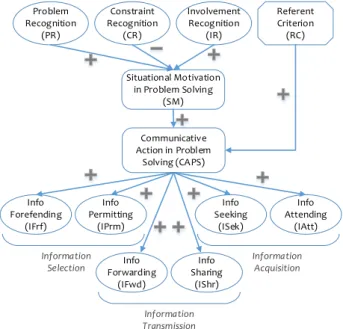
This research ventures to understand and categorise citizens’ communicative behaviour towards Natech risk information disclosure in the Japanese context through the prism of the Situational Theory of Problem Solving (STOPS) (Kim & Grunig, 2011). According to the Situational Theory of Problem Solving (STOPS) (Figure 1), the issue at hand is translated as a meta-problem stemming from the risk information deficiency concerning potential Natech accidents. An individual’s perception of the problematic situation concerning the lack of Natech risk information
(Problem Recognition), their perceived connection with it (Involvement Recognition) and the perceived obstacles which limit their ability to take action (Constraint Recognition), consist of the key factors of their Situational Motivation in Problem Solving.
Information Acquisition Info Forefending (IFrf) Info Permitting (IPrm) Information
Selection Forwarding Info
(IFwd) Info Sharing (IShr) Information Transmission Info Seeking (ISek) Info Attending (IAtt) Referent Criterion (RC) Problem Recognition (PR) Constraint Recognition (CR) Involvement Recognition (IR) Situational Motivation in Problem Solving (SM) Communicative Action in Problem Solving (CAPS)
Figure 1. STOPS Conceptual Model
Along with any potential subjective knowledge, experiences and expectations (Referent Criteria), Situational Motivation determines the individual’s engagement in Communicative Action as a means to seek out and exchange information to resolve this issue. In turn, this communicative behaviour is categorised in three types of actions: Information Acquisition, Information Selection and Information Transmission (Kim & Grunig, 2011). For the purposes of collecting data to validate the model’s hypotheses, a household questionnaire survey has been carried out in 2018 in two residential, urban locations near industrial complexes along the coast of Osaka Bay: Higashinada Ward, Kobe and Sakai-Senboku area.
Results
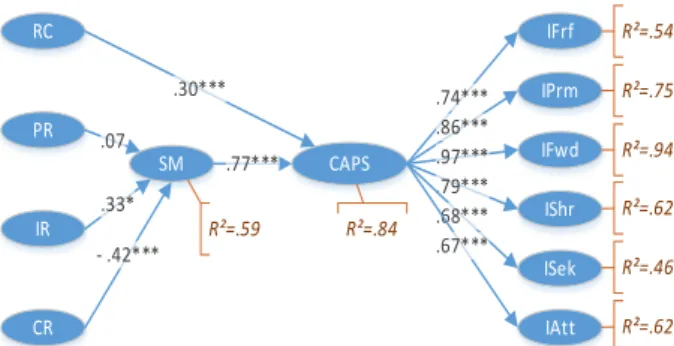
The degree to which households perceived constraints was the most influential factor in shaping citizens’ situational motivation for problem-solving, followed by involvement recognition (Figure 2). The effect of problem recognition could not be statistically supported, but logically inferred. As it turns out, these three factors explain an impressive 59% of the observed households’ motivation to do something about the Natech risk information deficiency. All of these measures were considerably high; accordingly, there seems to be a community appetite for more chemical and Natech information disclosure.
PR IR CR RC SM IFrf IPrm IFwd IShr ISek IAtt CAPS .07 .74*** .86*** .79*** .97*** .68*** .67*** .77*** .33* - .42*** .30*** R²=.59 R²=.84 R²=.54 R²=.75 R²=.94 R²=.62 R²=.46 R²=.62 Figure 2. Summary Structural Model Results for STOPS Almost nine out of ten respondents belong in either an aware or active/activist public (Figure 3). This distribution describes a state in which the dominant majority of citizens acknowledge to a large extent the significance of the problems stemming from the absence of publicly available chemical risk information, and are ready to communicate in order to solve them. Furthermore, those specific publics exhibited the highest communicative activeness, meaning essentially that the largest portion of citizens is actively communicating and seeking information about the chemical and Natech risk.
Figure 3. Public Segmentation for Natech Risk Info Deficiency
This study deals with a risk communication issue associated with complex and technological hazards, in particular chemical and Natech risk information disclosure. In order to analyse this emerging topic, a novel framework is presented through employing established methods from the Public Relations field. The research contributions in this regard are both theoretical and applied; the study introduces a new perspective concerning risk communication and community engagement in disaster risk management processes, while the survey findings highlight citizens’ perceptions towards Natech risk information disclosure around Osaka bay.
Conclusions
The conclusions of this research project demonstrated a strong community appetite for chemical and Natech risk information. The elevated public perceptions concerning the Natech risk information deficiency, subsequently lead to high situational motivation to engage in communicative action and seek out information. Nonetheless, significant perceived constraints were identified, indicating a fairly challenging to overcome problem, which may in part explain the underlying causes of the rather passive communicative behaviour adopted by the residents. Risk management policy is suggested to focus at introducing chemical risk information disclosure regulatory initiatives and encouraging citizen engagement.
References
Kim, J.-N. & Grunig, J. E. (2011). Problem Solving and Communicative Action: A Situational Theory of Problem Solving. Journal of Communication, 61(1), 120–149.
Klinke, A. & Renn, O. (2010). Risk Governance: Contemporary and Future Challenges, in: Eriksson, J., Gilek, M., and Rudén, C. (Eds.), Regulating Chemical Risks, (pp. 9–27). Dordrecht: Springer Netherlands.
Samaddar, S., Okada, N., Choi, J. & Tatano, H. (2017). What Constitutes Successful Participatory Disaster Risk Management? Insights from Post-Earthquake Reconstruction Work in Rural Gujarat, India. Natural Hazards, 85(1), 111–138. 0 40 80 120 160 200
Nonpublic Latent Public