C15
Three-dimensional Numerical Study on the Processes of Turbidity Currents in
Shihmen Reservoir, Taiwan
〇Peng An CHEN, Sameh KANTOUSH, Tetsuya SUMI, Doan Van BINH
INTRODUCTION
The Shihmen reservoir is the most important water supply for northern Taiwan. Due to serious sedimentation, more than 34% of the storage capacity has been lost. To maintain the useful life of a reservoir, various sediment management techniques can be adopted. Although significant rainfall availability (2500 mm/year), limited water supply (21% of rainfall) and demand challenges for the reservoir system are clearly acute due to most rainfall occurs in summer and the loss the storage capacity. Therefore, with the situations in water resource scarcity, turbidity current venting, which can pass sediment alone without drawdown the reservoir water level (Kondolf et al. 2014), is suitable for Taiwanese reservoirs.
To increase the efficiency of turbidity current venting, the venting time (Chamoun et al. 2018) and multilevel venting operation (Chamoun et al. 2016) are critical for venting high sediment concentration flow in real-time without wasting clear water. Various numerical models have been applied to simulate the processes of turbidity current, such as SRH-2D (Huang et al. 2019), FLOW-3D (Abd El-Gawad et al. 2012), ANASYS CFX (Chamounet al. 2017) and TELEMCA-3D (Perez-Diaz et al. 2019). To consider the multilevel venting operation, the three-dimensional numerical model is adopted in this study. Jodeau et al. (2019) reveal that compare to ANASYS CFX, TELEMCA-3D is easily modified and allows to simulate the bed evolution. Moreover, the open-source numerical model is available to add a suitable equation, especially the critical equation, fall
velocity (Huang et al. 2019). Overall, in this study, the TELEMAC-3D is applied to simulate the turbidity current in the Shihmen reservoir.
PHYSICAL MODEL AND DATA
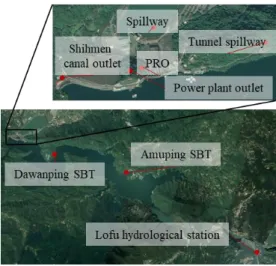
The Shihmen reservoir has been completed for over 50 years. With increasing time, the sedimentation gets worse. To increase the amount of sediment routing, two sediment bypass tunnels (SBT) are planned by the water resources planning institute in Taiwan. The distorted physical model with scale of 1/100 in horizontal and vertical was built for determining the location of SBT and investigating the venting efficiency. The location and information of outlets are shown in Fig. 1 and Table 1. Due to the turbidity current cannot successfully flow into the Dawanping SBT, the elephant trunk steel pipe is built.
With the law of similarity, the model scale of critical terms in physical model are expressed: velocity scale= 1/10; time scale= 1/10; discharge scale= 1/100000; sediment concentration scale= 1. Based on the above information, the inflow discharge and sediment concentration from Typhoon Aere, which causes serious sedimentation in the Shihmen reservoir, are used in the physical model.
RESULTS AND DISCUSSIONS
The four scenarios are constructed to investigate the venting efficiency. In scenario Sc# 1, it represents the existing outlets of the dam. Then, three alternative structures that combine operation with Dawanping SBT, Dawanping SBT with the elephant trunk steel pipe and Amuping SBT, are named Sc# 2, 3 and 4,
Fig. 1 The location of outlets in Shihmen reservoir Table 1 The elevation, diameter and discharge of each outlet Outlet Elevation (m) Outlet diameter (m) Designed discharge (m3/s)
Spillway 235 10*14 11400
Tunnel spillway 220 9 2400
Shihmen canal outlet 192.5 2.5 18.4 Power plant outlet 173 4.57 137.2
PRO 169.5 1.37 34
Amuping SBT 235 12 1600
Dawanping SBT 220 10*10 1200
Elephant trunk steel pipe 195 10 1200
respectively. The sediment concentration of each outlet from Sc# 1 to Sc# 4 is shown in Fig. 2. The PRO and power plant outlet cannot vent through all of turbidity current, the muddy lake occurs in front of the dam. With increasing time, the elevation of the muddy lake rises and vent through from Shihmen canal outlet, the important water supply construction for people's livelihood. Fig. 2 depicts there is at least 2 hours lag time for the muddy lake to affect water supply by using SBT. It indicates that the operation of SBT can effectively extend the water supply time.
In this study, we focus on increasing turbidity current venting efficiency. Therefore, the venting efficiency of PRO, power plant outlet, Dawanping SBT and Amuping SBT from Sc# 1 to Sc# 4 are discussed and listed in Table 2. It clearly shows that the sediment bypass tunnel can effectively increase venting efficiency. As Table 2 shown, the elephant trunk steel pipe can significantly increase the venting efficiency of Dawanping SBT.
To discuss the operational timing and multilevel venting operation, the TELEMAC-3D is adopted in this study. The mesh with 0.1 m size is built and the
Fig. 2 The measured sediment concentration from each case Table 2 The venting efficiency from each case
PRO Power plant outletDawanping SBT Amuping SBT Total
Sc# 1 2.4 28.9 - - 31.3 Sc# 2 2.1 26.4 8.2 - 36.7 Sc# 3 0.9 18.8 31.7 - 51.4 Sc# 4 2 28.8 - 7.7 38.5 ScenarioVenting efficiency (%)
measured data from physical model is used to calibrate the TELEMAC-3D.
REFERENCES
Abd El-Gawad, S.M., Pirmez, C., Cantelli, A., Minisini, D., Sylvester, Z., Imran, J. (2012): 3-D numerical simulation of turbidity currents in submarine canyons off the Niger Delta. Marine Geology, Vol. 326-328, pp. 55–66.
Chamoun, S. (2017): Venting of turbidity currents: When to act? Proceedings of the 37th IAHR World Congress, Kuala Lumpur, Malaysia.
Chamoun, S., De Cesare, G., Schleiss, A.J. (2016):
Experimental investigation on turbidity current venting under restrained outflow discharges. River Flow
Proceedings, Saint Louis, USA.
Chamoun, S., De Cesare, G., Schleiss, A.J. (2018): Influence of Operational Timing on the Efficiency of Venting Turbidity Currents. J Hydraul Res, Vol. 144, No. 9, pp. 04018062.
Huang, C.C., Lai, Y.G., Lai, J.S., Tan, Y.C. (2019): Field and Numerical Modeling Study of Turbidity Current in Shimen Reservoir during Typhoon Events. Journal of
Hydraulic Engineering, Vol. 145, No. 5, pp. 05019003.
Jodeau, M., Chamoun, S., Feng, J., De Cesare, G., Schleiss, A.J. (2018): Numerical Modeling of turbidity currents with Ansys CFX and Telemac 3D. E3S Web of
Conferences, Vol. 40, pp. 03014.
Kondolf, G.M., Gao, Y.X., Annandale, G.W., Morris, G.L., Jiang, E.H., Zhang, J.H., Cao, Y.T., Carling, P., Fu, K.D., Guo, Q.C., Hotchkiss, R., Peteuil, C., Sumi, T., Wang, H.W., Wang, Z.M., Wei, Z.L., Wu, B.S., Wu, C.P., Yang, C.T. (2014): Sustainable sediment management in reservoirs and regulated rivers: experiences from five continents. Earth's Future, Vol. 2, pp. 256–280.
Pérez-Díaz, B., Castanedo, S., Palomar, P., Henno, F., Wood, M. (2019): Modeling Nonconfined Density Currents Using 3D Hydrodynamic Models. J. Hydraul. Eng., Vol. 145, No. 3, pp. 04018088.