
On a Computer Security Incident Response System
6
0
0
全文
(2) IPSJ SIG Technical Report. concern seem to consider a traditional communication is faster. A traditional communication, however, tends to be a one-to-one communication, and information is limited to those two persons and cannot be shared with others, especially actual working-level operators. To make matters worse, information is wrongly propagated one after another, and the original information is lost. In addition, no record is rarely left because persons involved are in a hurry. This paper proposes and discusses a computer security incident response system that tries to deal with issues described above. The proposed system comprises of three sub-system, host locating system, host isolating system and incident tracking system. The contributions of this paper can be summarized as follows: • a suspicious host can be located within 10 seconds even though a database of all hosts in a network is not maintained, • a suspicious host can be isolate in 10 min. right after an external organization reports a security incident suspicion, • only a suspicious host can be isolated even though other hosts is on the same port which the suspicious host is connected to, and • a tracking system can help CSIRT in a organization to share correct information about a security incident and reduce operations. The rest of this paper is organized as follows. Section 4 proposes a computer security incident response system that comprises three sub-systems. Section 2 and 3 defines assumptions and requirements of a computer security incident response system, respectively. Section 5 presents our first prototype implementation. Section 6 disscusses various issues to be considered on a computer security incident response system. Section 7 refers to related works. Section 8 finally concludes this paper.. 2. Assumptions This section describes assumptions of information given by an external organization on an security incident suspicion and a network configuration in an organization. The proposed system assumes that: • an IP address of a suspicious host is given when an external organization report a security incident suspicion, • a Virtual Routing Forwarding (VRF) or a routing domain is given or no IP address is duplicately assigned to different hosts in a organization network, • Link Layer Discovery Protocol (LLDP) [2] or similar protocol such as Cisco Discovery Protocol (CDP) is enabled on all links where two neighboring switches directly connect in an organization, and • a department may install a its own router, and may be able to be operated only by an administrator in its department, not by an organization-wide administrator.. 3. Requirements This section defines requirements of a computer security incident response system. 3.1 Requirements for Host Locating System The host locating system is in charge of locating a suspicious. c 2017 Information Processing Society of Japan ⃝. Vol.2017-IOT-38 No.11 2017/6/24. host. When a security incident suspicion is reported, the host locating system must: ( 1 ) need no pre-defined host database that holds information about all hosts in an organization network, ( 2 ) require an IP address of one of routers or L3 switches in an organization network, ( 3 ) require an IP address of the suspicious host, ( 4 ) require a Route Distinguisher (RD) or name of VRF if and only if necessary, ( 5 ) produce location information of the suspicious host for the host isolating system, and ( 6 ) identify a responsible person, e.g., a user, of the suspicious host. 3.2 Requirements for Host Isolating System The host isolating system is in charge of immediately isolating a suspicious host from a network in an organization. The host isolating system must: ( 1 ) minimize the number of isolated hosts when the suspicious host is isolated, ( 2 ) avoid wrongly isolating hosts or other nodes, ( 3 ) require location information of the suspicious host that the host locating system produces, ( 4 ) isolate the suspicious host from a network, ( 5 ) notify an administrator that the suspicious host is isolated, ( 6 ) revert the isolation, and ( 7 ) support a dry run mode in which the suspicious host is not actually isolated. 3.3 Requirements for Incident Tracking System The incident tracking system is in charge of sharing information among staffs involved, recording actions that staffs involved take and observed phenomenon, and make an incident trackable. The incident tracking system must be able to: ( 1 ) share information among staffs involved in a security incident response, ( 2 ) issue a ticket for an incident, ( 3 ) differentiate open and closed issues. ( 4 ) merge the similar incidents into one ticket, ( 5 ) group members in an organization by department, ( 6 ) register staffs contact information in advance, ( 7 ) notify staffs involved of updates of an incident, ( 8 ) upload a file for an incident, ( 9 ) automatically produce a final report of an incident, and ( 10 )automatically produce a summary of incidents during specified duration.. 4. Computer Security Incident Response System This section proposes a computer security incident response system. The system comprises of three sub-system, host locating system, host isolating system and incident tracking system. 4.1 Host Locating System The host locating system dynamically locates a suspicious host; the suspicious host is connected to which port on which 2.
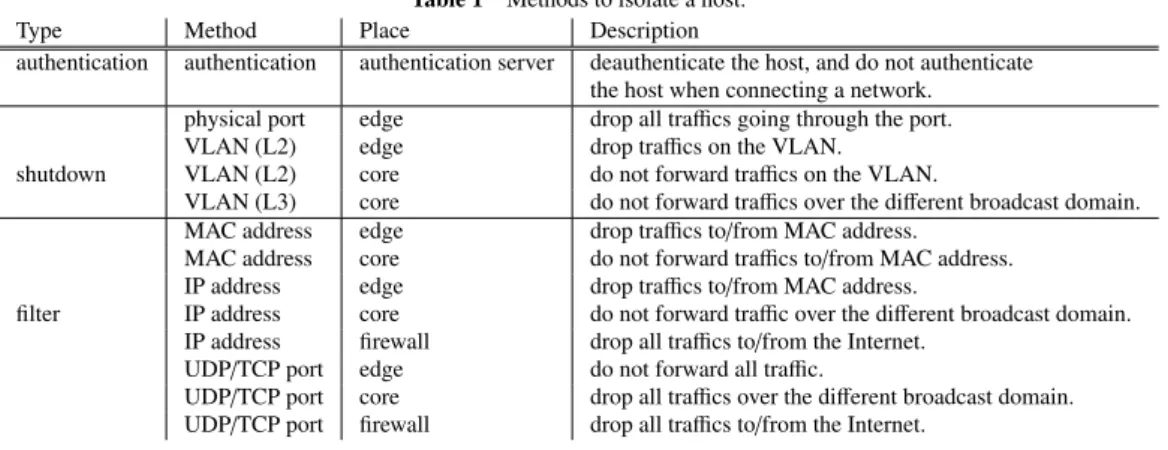
(3) Vol.2017-IOT-38 No.11 2017/6/24. IPSJ SIG Technical Report. switch. The host locating system requires only an IP address of the suspicious host and RD or name of VRF if necessary, and do not requires pre-defined host database. This nature reduces a load of an administrator in an organization network to establish or periodically update a host database. This nature can then locates even a host that is not registered to such host database. The host locating system is given an IP address of one of routers of L3 switches and VRF in an organization network, and then locates a suspicious host as follows. ( 1 ) connect to the router or L3 switch, ( 2 ) look up a route for an IP address of the suspicious host and VRF, ( 3 ) connect to the nexthop of the route if a route is not directly connected, ( 4 ) repeat (2) and (3) until a directly connected rout is found, i.e., locate a router that has a directly connected route for an IP address of the suspicious host and VRF, ( 5 ) identify a VLAN for the IP address at the router, ( 6 ) locate a directly connected router for the IP address on the VRF, ( 7 ) resolve a MAC address of the suspicious host from an Address Resolution Protocol (ARP) [3] table, ( 8 ) identify a port on which the MAC address is seen in a MAC address forwarding table, ( 9 ) discover a neighboring switch on the port, ( 10 )repeat from (8) to (9), and ( 11 )finally locate a port on a edge switch accommodating the MAC address. One can see more detailed pseudo code in Fig. 1. As shown in Fig. 1, note that there is a special case where a departmental router is installed and routes are directed to the departmental router, i.e., an organization-wide administrator cannot operate the departmental router, and a MAC address of the actual suspicious host cannot be resolved. In this case, a MAC address of the departmental router should be resolved and the departmental router should be isolated. This allows an organization to flexibly design an organization network. The host locating system also identifies a responsible person for the suspicious host. In many case, the responsible person may be a user of the suspicious host or an administrator of NAT/NAPT router or a departmental router. The host locating system then identifies a responsible person from logs of a various system that requires a login, e.g., a mail system or Shibboleth IdP/SP. 4.2 Host Isolating System The host isolating system enables to immediately isolate a suspicious host from a network in an organization. The host isolating system has several ways to isolate the suspicious host as shown in Table 1. Each method has both good and bad points, which are discussed later. The host isolating system isolates a suspicious host as follows. ( 1 ) an IP address, a VRF, a VLAN, a MAC address, an edge switch and its port accommodating the suspicious host are given by the host locating system, ( 2 ) connect to a router or edge switch, ( 3 ) shut down a port or filter an IP or MAC address,. c 2017 Information Processing Society of Japan ⃝. 1 2 3 4 5 6 7 8 9 10 11 12 13 14 15 16 17 18 19 20 21 22 23 24 25 26 27 28 29 30 31 32 33 34 35 36 37. def locate_host(core_router, gia) # resolve an internal IP address and VRF. (ip, vrf) = resolve_local_ip_address(gip) # find a directly connected router. router = core_router while router do route = router.lookup_route(ip, vrf) if route.is_directly_connected? break end # we cannot control user’s or # departmental router. if not route.nexthop.is_ours? ip = route.nexthop.ip_address break end router = route.nexthop end vlan = route.vlan mac = router.resolve_mac_address(ia, vlan) # locate an edge switch and port. sw = router while sw do port = sw.mac_address_table(vlan, mac) neighbor = port.get_neighbor # we cannot control user’s or # departmental router. if neighbor.nil? break end sw = neighbor done return sw, port done Fig. 1. A pseudo code to locate a suspicious host.. 3.
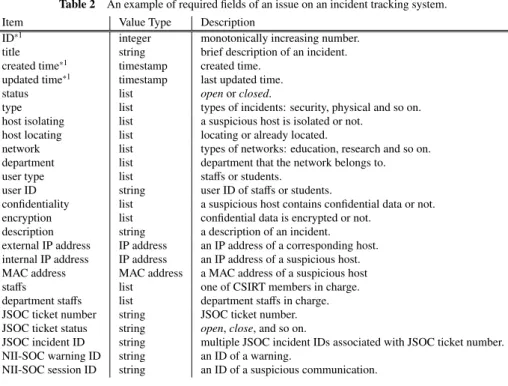
(4) Vol.2017-IOT-38 No.11 2017/6/24. IPSJ SIG Technical Report. Type authentication. shutdown. filter. Method authentication physical port VLAN (L2) VLAN (L2) VLAN (L3) MAC address MAC address IP address IP address IP address UDP/TCP port UDP/TCP port UDP/TCP port. Table 1 Methods to isolate a host. Place Description authentication server deauthenticate the host, and do not authenticate the host when connecting a network. edge drop all traffics going through the port. edge drop traffics on the VLAN. core do not forward traffics on the VLAN. core do not forward traffics over the different broadcast domain. edge drop traffics to/from MAC address. core do not forward traffics to/from MAC address. edge drop traffics to/from MAC address. core do not forward traffic over the different broadcast domain. firewall drop all traffics to/from the Internet. edge do not forward all traffic. core drop all traffics over the different broadcast domain. firewall drop all traffics to/from the Internet.. ( 4 ) quit if a port is not downstream, ( 5 ) compute how to revert a shutdown or filter, and ( 6 ) send an e-mail to an administrator, which includes executed commands and a reverting command. The host isolating system reverts isolating the suspicious host when an administrator executes a reverting command that is indicated in the e-mail. 4.3 Incident Tracking System The incident tracking system supports to share information among staffs involved in an incident. This incident tracking system also records actions that staffs involved take and observed phenomenon in order to make an incident trackable. The incident tracking system can then be built using an exiting Bug Tracking System (BTS) or Issue Tracking System (ITS) [4], [6], [7]. The incident tracking system, however, needs to assign a group of staffs involved to an incident, not a personal. This is very different from BTS or ITS. The incident tracking system should hold information as shown Fig. 2. 5. Implementation This section presents our first prototype implementation of a computer security incident response system. We have implemented a host locating and host isolating system as scripts written in a Ruby. Our implementation currently supports only two types of isolating methods: port shutdown at an edge switch and MAC address filtering at a core switch. The former is usually for a fixed host in a laboratory that never or rarely moves because this method can avoid a virus spreads into other hosts. On the other hand, the latter is mainly for a mobile host that usually belongs to a student. A student moves around in a campus with a host and, the host moves to connect to different networks and have different IP addresses. In this case, the former method cannot be applied because an incident may be detected for each network. We have used our host locating and isolating system, and it has appeared that out system can locate a suspicious host within 10 seconds after the IP address is given even though a database of all hosts in a network is not maintained. It has also appeared that a suspicious host can be isolate in 10 min. after an external organization reports a security incident suspicion. We have then implemented incident tracking system using red*1. mine [4]. We have currently just set up a normal redmine, and not modified yet. The current implementation lacks then many functions. The most important function that has not implemented yet is to group members in an organization by department and to send e-mail to them. We then must manually find contact persons and send e-mail. This task is very heavy for a staff when a security incident suspicion occurs because the staff should be in charge of many things. We will implement these lacking functions in the future.. 6. Discussions 6.1 Confidentiality of Security Events We are now planning to automatically isolate a suspicious host when we receive a report from an external organization such as JSOC and NII-SOC that reports an incident by a fixed-formatted e-mail. JSOC and NII-SOC, however, never send detailed information of a security event via an e-mail. They may consider that detailed information is confidential, and should not be sent via an e-mail. An administrator then needs to manually access to their portal sites in order to obtain detailed information. This manual operations results in longer time on an incident response. For example, an external organization usually gives only an global IP address of a suspicious host. In this case, we needs to resolve an internal private IP address when we employ NAPT. In case of authors’ environment, all traffic logs of firewall are held, and its size per day ranges from about 10GB to 24GB. It then takes approximately 20 min. to resolve an internal private IP address and VRF. In addition, manual operations to see detailed information prevents us from implementing to automatically isolate a suspicious host. It may be true that detailed information of a security event may be confidential. We, however, think that an IP address of a suspicious host should be reported in an e-mail for a quick response agains a security incident. 6.2 Host Isolation versus Forensics A malware may stop a malicious behavior when an infected host is isolated from a network, and authors have already experienced such malwares in the wild. One may say that such isolation makes digital forensics difficult. We, however, cannot help but isolate a suspicious host as soon as possible in order to avoid or reduce possibilities of compromising confidential information.. automatically generated. c 2017 Information Processing Society of Japan ⃝. 4.
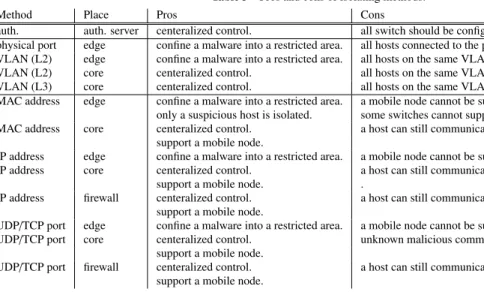
(5) Vol.2017-IOT-38 No.11 2017/6/24. IPSJ SIG Technical Report. Table 2 An example of required fields of an issue on an incident tracking system. Item ID*1 title created time*1 updated time*1 status type host isolating host locating network department user type user ID confidentiality encryption description external IP address internal IP address MAC address staffs department staffs JSOC ticket number JSOC ticket status JSOC incident ID NII-SOC warning ID NII-SOC session ID. Value Type integer string timestamp timestamp list list list list list list list string list list string IP address IP address MAC address list list string string string string string. Description monotonically increasing number. brief description of an incident. created time. last updated time. open or closed. types of incidents: security, physical and so on. a suspicious host is isolated or not. locating or already located. types of networks: education, research and so on. department that the network belongs to. staffs or students. user ID of staffs or students. a suspicious host contains confidential data or not. confidential data is encrypted or not. a description of an incident. an IP address of a corresponding host. an IP address of a suspicious host. a MAC address of a suspicious host one of CSIRT members in charge. department staffs in charge. JSOC ticket number. open, close, and so on. multiple JSOC incident IDs associated with JSOC ticket number. an ID of a warning. an ID of a suspicious communication.. 6.3 Host Isolation versus Availability This paper proposes the host isolating system. One may consider that the host isolating system reduces availability. The host isolating system may isolate all hosts in one laboratory when the laboratory employs NAPT. We, however, consider that locating and isolating a suspicious host take precedence over availability because an external organization report is enough accurate so far in authors’ environment. 6.4 Host Location Management This paper proposes the host locating system that requires no pre-defined host database. The proposed system, however, may be unable to locate a suspicious host that quickly or frequently moves. In order to solve this issue, we requires a host database that holds which host is connected to which port on which switch. We are now considering to build a host database using following methods: • periodical MAC address table dump • MAC address table change notification • user authentication • web authentication • MAC address authentication • IEEE802.1x authentication 6.5 Host Isolating Methods This paper proposes several isolating methods as shown in Table 1. We have then implemented two methods: port shutdown at an edge switch and MAC address filtering at a core switch. From the viewpoint of a security, port shutdown at an edge may be better to confine a suspicious host in a narrow area. For example, a ransomware called WannaCry spreads all over the world on May 12th, 2017. WannaCry intrudes a computer via not an attachment of an e-mail or phishing but a SMBv1 vulnerability. Wannacry may then quickly spread inside an institute once a few computers. c 2017 Information Processing Society of Japan ⃝. in the institute are infected. Filtering a traffic from the Internet to an institute may not work for WannaCry. Port shutdown may be then suitable for a malware such as WannaCry. Port shutdown is, however, not suitable for a suspicious host that quickly or frequently moves. That is, each method has both good and bad points. These good and bad points can be summarize as as shown in Table 3. 6.6 Information Error Ratio When we respond a security incident, information goes through many persons involved, e.g., laboratory staffs, department corresponding staff, CSIRT staffs, CIO, president. When the number of hops that information goes through increases, information errors may increase. We will try to clarify the its error ratio, and reduced error ratio by our proposed system. 6.7 Incident Tracking System Request Tracker for Incident Response (RTIR) [5] is a famous incident tracking system written in Perl. There are also BTSs or ITSs such as redmine [4] written in Ruby, trac[6] written in Python, mantis[7] written in PHP and so on. We will try to find a best system for our purpose.. 7. Related Works Information Security Management System (ISMS) ISO/IEC27001[8] briefly defines requirements of computer security incident responses. There are many security or network vendors such as TrendMicro, Paloalto, FireEye, Fortigate, Cisco, Alaxala and so on try to produce the best security solutions. NAGAI, Y. et al. investigated and reported differences between ISMSs in national universities in Japan[9]. They also presented their own incident management system using trac[6]. They then reported that their system could record information of only about a half of all security events because some of those events were. 5.
(6) Vol.2017-IOT-38 No.11 2017/6/24. IPSJ SIG Technical Report. Table 3 Pros and cons of isolating methods. Method auth. physical port VLAN (L2) VLAN (L2) VLAN (L3) MAC address. Place auth. server edge edge core core edge. MAC address. core. IP address IP address. edge core. IP address. firewall. UDP/TCP port UDP/TCP port. edge core. UDP/TCP port. firewall. Pros centeralized control. confine a malware into a restricted area. confine a malware into a restricted area. centeralized control. centeralized control. confine a malware into a restricted area. only a suspicious host is isolated. centeralized control. support a mobile node. confine a malware into a restricted area. centeralized control. support a mobile node. centeralized control. support a mobile node. confine a malware into a restricted area. centeralized control. support a mobile node. centeralized control. support a mobile node.. reported or discussed in meetings and their data was never input to the system. HASEGAWA, H. et al. proposes the supporting system against an incident caused by targeted attacks [10]. Their system automatically suggests 9 types of access filtering across VLANs to an administrator in accordance with a severity of an incident when a network configuration is pre-defined and given. They, however, assumes only filtering across VLANs, and do not consider the case where there is a router run by a department, not a information infrastructure department that is in charge of a management of a campus wide network. In addition, they do not consider a mobile host that moves around while our proposal do.. [10]. Cons all switch should be configured to authenticate a host. all hosts connected to the port are isolated. all hosts on the same VLAN are isolated. all hosts on the same VLAN still can communicates. all hosts on the same VLAN still can communicates. a mobile node cannot be supported. some switches cannot support. a host can still communicate between downstream switches. a mobile node cannot be supported. a host can still communicate on the same VLAN. . a host can still communicate all hosts in an organization. a mobile node cannot be supported. unknown malicious communications may succeed in. a host can still communicate all hosts in an organization.. dent Management Systems in Some National Universities, SIG Technical Reports, Vol. 2014-IS-127, No. 7, pp. 1–7 (2014). Hasegawa, H., Yamaguchi, Y., Shimada, H. and Takakura, H.: A Countermeasure Support System against Incidents caused by Targeted Attacks, Journal of Information Processing, Vol. 57, No. 3, pp. 836– 848 (2016).. 8. Concluding Remarks This paper has proposed a computer security incident response system that automatically locates and isolate a suspicious host. Our first prototype implementation has shown that a suspicious host can be isolated within 10 min. right after an external organization reports a security incident suspicion. Before our system, we had spent more than one hour to do the same isolation. We will improve our system in the future. References [1]. [2] [3]. [4] [5] [6] [7] [8] [9]. LAC Co., Ltd: Japan Security Operation Center(JSOC⃝R ) — Services and Products — LAC Co., Ltd., https://www.lac.co. jp/english/service/operation/jsoc.html (1995). Accessed: 2017/05/26. IEEE Std. 802.1ab-2004: Local and Metropolitan Area Networks: Virtual Bridged Local Area Networks: Station and Media Access Control Connectivity Discovery (2004). Plummer, D.: Ethernet Address Resolution Protocol: Or Converting Network Protocol Addresses to 48.bit Ethernet Address for Transmission on Ethernet Hardware, RFC 826 (Standard) (1982). Updated by RFCs 5227, 5494. Lang, J. P.: Overview - Redmine, http://www.redmine.org/ (2006). Accessed: 2017/05/19. Best Practical Solutions, L.: RT for Incident Response, https:// bestpractical.com/rtir/ (2002). Accessed: 2017/05/19. Software, E.: The Trac Project, https://trac.edgewall.org/ (2003). Accessed: 2017/05/19. MantisBT Team: Mantis Bug Tracker, https://www.mantisbt. org/ (2000). Accessed: 2017/05/19. ISO/IEC: Information Security Management Systems Requirements (2013). ISO/IEC27001:2013. NAGAI, Y., TADAMURA, K. and OGAWARA, K.: Considering Inci-. c 2017 Information Processing Society of Japan ⃝. 6.
(7)
図
関連したドキュメント
The uniqueness of an optimal control pair for the multi-group coupled within-host and between-host model is established using the Lipschitz properties for the state and
In other words, the generation schedule with staircase power output obtained from traditional SCUC formulation may not be realizable in terms of energy
Suppose D is a linear system. On the other hand, by the definition of a system composed with a pencil, the general curve of such a system may have a singular point only at the
(4) The basin of attraction for each exponential attractor is the entire phase space, and in demonstrating this result we see that the semigroup of solution operators also admits
After the initial pilot period of EuDML, it is envisioned that publishers should contribute to EuDML in this way: selecting a EuDML member that would host a copy of their content,
In [9] a free energy encoding marked length spectra of closed geodesics was introduced, thus our objective is to analyze facts of the free energy of herein comparing with the
For further analysis of the effects of seasonality, three chaotic attractors as well as a Poincar´e section the Poincar´e section is a classical technique for analyzing dynamic
An example of a completely good integrable contact Hamiltonian system of Reeb type that is not toric is given by the standard Sasakian contact structure on the Heisenberg group H
