Kwan-Ko-Dzu-Setsu (Ceramic Art) Held in the
Collection of the Museum of Fine Arts, Boston
(USA)
journal or
publication title
福井大学教育地域科学部紀要
volume
4
page range
325-350
year
2014-01-10
URL
http://hdl.handle.net/10098/8092
ABSTRACT(要旨) 米国マサチューセッツ州ボストン市にあるボストン美術館には、世界最大級の規模を誇る日本 陶器コレクションと、明治期の日本で刊行された日本陶磁書『観古図説 陶器之部』(1876-1879,全7 巻)が所蔵されており、両者はともに東京大学初代動物学教授エドワード・シルベスター・モース (Edward Sylvester Morse, 1838-1925)の旧蔵品である。大森貝塚の発見など専門以外の領域でも 日本に大きな足跡を残したモースは、日本滞在中に『観古図説 陶器之部』の著者である蜷川式のりたね胤 (1835-1882)に師事して日本陶器の鑑定法を学んだ。『観古図説 陶器之部』は刊行後直ちにヨー ロッパへ輸出され、日本よりはむしろヨーロッパ、とくにフランスに普及したことで知られる書 物である。一方で、同書を最も活用したのは他ならぬこのモースであり、同書はモースにとって のバイブルであった。同書は第7巻まで刊行されたが、ボストン美術館には未刊の第8巻の草稿が 残されているという。しかし、その詳細を扱った研究はこれまで皆無であった。 本稿の目的は、ボストン美術館には本当に『観古図説 陶器之部』第8巻の草稿があるのか、ある のであれば、それはどのような内容なのかを確認することである。2012年夏にボストン美術館で筆 者が実施した調査の結果に考察を加えた本稿では、同館が所蔵しているのは第8巻の草稿の一部で あり、その完成度はかなり低いということ、また同草稿には京都および地方で焼造された日本陶磁、 中国陶磁を模して焼造された日本陶磁、日本陶磁に影響を与えた中国陶磁が図示されていることを 確認した。同草稿には解説文が欠けているが、本稿は、その解説文が蜷川辰とき子こ著『観古図説 陶器 瓦之部』(1902)に記載されていることを明らかにした。蜷川式胤の実姉である辰子が式胤の遺稿 を集めて編んだ『観古図説 陶器瓦之部』の一部は、『観古図説 陶器之部』第8巻の草稿を基にして 編集されたと考えられるため、本稿の考察では、第8巻の草稿は蜷川辰子の手許、つまり日本にも 残されていたということも明らかになった。これら第 8 巻の草稿からは、『観古図説 陶器之部』の 第 6・7・8 巻はほぼ同時期に構想され、第 8 巻の内容は第 5 巻までの内容を補遺する目的で追刊さ れた第6・7巻と同様に、日本各地の窯で焼造された陶磁器を紹介するものであったと推測される。
Held in the Collection of the Museum of Fine Arts, Boston (USA)
Yūko IMAI
*(2013年9月30日 受付)
INTRODUCTION
In May 1877, American zoologist Edward Sylvester Morse (1838-1925) set out alone on a journey into Japan. Two days after his arriving in Japan, he was asked to teach at Tokyo University, where he took up the post of professor starting on July 12, a month after he arrived in Japan. At the university, Morse taught zoology and introduced the theory of evolution developed by Charles Robert Darwin (1809-1882). During his life, Morse visited Japan three times: a four month visit from June 17, 1877, to December 2, 1877; a year and four month visit between April 23, 1878, and September 3, 1879; and a final eight-month visit from June 4, 1882, to February 14, 1883. The purpose of his first visit was to collect and study mollusks, which abundantly inhabit Japan’s Pacific Ocean coast, and his second was to teach and research at Tokyo University. The third visit, however, was of a different nature: to collect Japanese pottery and folk utensils.
Though Morse specialized in zoology, he was extremely active in other spheres as well, and his diverse activities left a great legacy to Japan’s Meiji era. As his wide-ranging interests show, Morse’s great contributions to Japan were not only in the field of zoology but also in archeology, anthropology, folklore, and the study of ceramics in the Land of the Rising Sun. Indeed, one of his well-known pursuits was the discovery and excavation of the Ōmori shell midden, and he collected pottery, folk utensils and signboard, and other articles in Japan. Morse wrote two notable works in the field, penned after his return home: Japanese Homes and Their Surroundings (1886) and Japan Day by Day
(1917), which contributed to the understanding of Japanese culture in Western countries.
This article looks at Morse’s study of Japanese pottery. Today, the Museum of Fine Arts in Boston (hereafter just Museum) holds the finest Japanese pottery collection in the world. It also possesses the specialist book on Japanese ceramic entitled “Kwan-Ko-Dzu-Setsu (Ceramic Art) (fig.1),” which
was written and published by Mr. Noritane Ninagawa (蜷川式胤, 1835-1882) in Japan. Both came to the Museum from Morse’s private collection. The Kwan-Ko-Dzu-Setsu (Ceramic Art) (1876-1879, parts I-VII) was exported from Japan to Europe immediately after its publication. European lovers of pottery made use of this work as the only reference book on Japanese ceramic written in Japan. At the time, the books fed into the then vogue of Japonism. The notable feature of the work was its many colored plates. Noritane Ninagawa was Morse’s mentor while the later stayed in Japan, and the
Kwan-Ko-Dzu-Setsu (Ceramic Art) was a sort of Bible for Morse. Published in a total of seven different
parts, a descendent of Noritane Ninagawa has claimed that there is a draft of an unpublished part VIII of theKwan-Ko-Dzu-Setsu (Ceramic Art) in the Library of the Museum.1 Although it has been a long
time since the claim was made, the alleged draft has never been studied in detail.
This paper seeks to amend the gap and discusses the draft based on my examination of the manuscript at Museum in August 2012. The research set out to answer the question: Is there really a
draft of an unpublished volume in the Museum? If so, what is its content? This paper outlines answers to these questions.
I. Kwan-Ko-Dzu-Setsu in the Museum of Fine Arts, Boston
The Museum has no translated version of Noritane’s work, despite the ubiquity of the French version that spread in Europe, probably because Morse did not need it. The Museum holds a total of 20 copies of the work (3 copies respectively for parts I to VI, two copies of part VII), and all are of great value.2 Since these 20 copies are conserved together in the Museum, the grouping is very
ambiguous. However, if we look attentively at each copy, we can separate the 20 copies into 3 distinct sets:
Set No.① consisting of parts I to VII
- books wrapped in a deep blue folding case
- associated with 3 books in Japanese binding whose covers are plain blue - found a hand-written note reading: “not in collection” near illustrations
Set No.② consisting of parts I to VII
- Japanese word “種本(Tanehon)”(meaning a source book) is written on the cover of parts I and II
- Ninagawa’s red stamp is on the cover of parts III and IV - there are many hand-written notes in text of parts I to VI
Set No.③ consisting of parts I to VI
- Ninagawa’s red stamp appears on the cover of parts II and IV - there are many hand-written notes in text of part IV
Hand-written notes are found in particular inside copies belonging to sets No.① and ②. It is likely that “not in collection” (fig.2) means that a given piece of pottery pictured in the text was “not in Morse’s collection” when the notes were written. A case in point is that in part VII of Noritane’s work, we find a “not in collection” note near the illustration of an incense case made by Sōzen (fig.2). However, this incense case was added to the Museum collection in about 1925 (fig.20). Since Morse made an effort to procure pieces figured in Noritane’s work or similar items in his later years, notes of “not in collection” seem to have been written by Morse or his acquaintances.
The hand-written notes in the copies of set No.② were made in Japanese, and seem to have been written by Noritane himself (fig.3). In these, the Japanese word “種本”, meaning “a source book,” is found written on the covers of parts I and II (fig.4). This word tells us that the copies are the originals of the published work. In the introduction of the Catalogue of the Morse collection of
Japanese pottery (1901) Morse wrote: “I have derived much information from Ninagawa’s private
copy of his work, containing important additions and corrections by the author, as well as from MSS. letters and memoranda which came into my possession immediately after the death of this lamented antiquarian.” 3 The reference to “Ninagawa’s private copy of his work” refers to the Kwan-Ko-Dzu-Setsu in the collection of the Museum.
The works bound in deep blue cloth appear to be copies of Noritane’s works that were exported to Europe, since these were in most cases wrapped in a folding case made of deep blue cloth to protect them. The Museum has one of these folding cases (figs. 1 and 5). There is a paper bag inside the folding case (fig.1), upon which we see letters of “PORTRAIT OF THE AUTHOR, NORITANE NINAGAWA” (fig.6). This bag holds the portrait of Noritane Ninagawa (fig.7), on the back of which the following explanation is written in English and Japanese (fig.8):
<English>
NINAGAWA (Family name)
NORITANE (Surname or personal name)
Lived at No.2 Dô-san-machi, Tatsuno-Kuchi of Tokyo, now called MARU-NO-UCHI district, was 44 years 3 months old in July 1879. See Japan Day by Day Vol.Ⅱ, pp.106 etc.
Authority on Japanese pottery.
<Japanese>
東京 辰之口道三町ニ番地 蜷川式胤 四十四年三か月 明治十二年七月十五日写
(translation of the above: No.2 Dô-san-machi, Tatsuno-Kuchi of Tokyo, 44 years 3 months, photographed on July 15, 12th year of Meiji)
According to the descendant of Noritane Ninagawa, this portrait was taken in July 1878 at Morse’s request, one that went expressly against Noritane’s wishes.4 It is not clear who wrote the inscription
in English, but “See Japan Day by Day Vol.Ⅱ, pp.106...” seems to indicate that it was written before and after the publication of Japan Day by Day (1917).
cover of the works a small letter of “A,” “B,” and “C” is written with a pencil (fig.10). The letters A and C are written alone, but after the letter B “Vol. VIII” (fig.10) appears, which tells us that book B is a draft for part VIII. Further evidence supporting this claim is that in the title paper attached to the folding case, we see letters in Japanese “観古図説自壱至五”, which means
“Kwan-Ko-Dzu-Setsu parts I to V”. We find a line of cancellation above the Chinese numeral No. 5 “五” and Chinese
numeral No. 8 “八” written near “五” (fig.5). The Chinese numeral “八” seems to mean part VIII. The rest of the collection does not bare any easily recognizable trace of a draft for part VIII by its binding. Thus, book B is the likeliest candidate for the draft, and it is likely that books A and C are also drafts for part VIII because they have same binding as book B does. The next section sets out to examine in detail the three mysterious books.
II. Books A, B, C
Each volume of Noritane’s published work (parts I to VII) has text and plates. Compared to the format of the published works, there is basically no text in books A, B or C (with only a little text in book C). With regard to content, books B and C present ceramics, but book A looks at roofing tile. Since the work of Noritane that we are concerned with here is written on Japanese ceramics, it seems that the draft for part VIII is in books B and C, but A. So let us first look at books B and C in detail.
Firstly, Book B is composed of a total of 25 pages. However, six of the papers are repeated, so book B is actually formed of 19 pages and 35 illustrations of ceramics. The illustrations are rough, drawn by hand, and the text is partly handwritten. In fact, book B can be said to be the roughest draft of all the works, which are in comparison more polished. The roughness of the drafts is also demonstrated by the fact that the various illustrations of ceramics, which were baked in different Japanese kilns, are side-by-side in a disorderly fashion in book B. The lack of text accompanying the images means we cannot understand where a given ceramic was made or who made it.
The volumes of Noritane’s work that I have seen in Japan, France, Great Britain, the Netherlands and the United States have mostly been wrapped in a deep blue folding case with a title written in Japanese “観古図説自壱至五” (Kwan-Ko-Dzu-Setsu parts I to V) on the front (fig.11). Copies of the French version of the work contain only parts I to V, since these were the only volumes published (fig.12). On the cover of the Japanese editions, we also find the French title written on parts I to V (fig.13), but an English title appears on parts VI and VII (fig.14). It seems French was used for parts I to V because when Noritane’s work was exported to Europe, France was the most active market for Japanese art. It can also be presumed that Noritane’s work had gone across the sea as a complete set of parts I to V in its initial form.
In terms of content, Noritane’s published work examines pieces of ceramic made in Kyoto or in other provinces of Japan as follows.
Part I Pre-historic and early Japanese pottery
Part II Three-colored glazed pottery made in Nara, Pottery of the provinces (Seto and Bizen)
Part III Pottery of the provinces (Iga, Shigaraki, Tanba, Karatsu, Shidoro, Zeze, Asahi, Akahada, Kosobe, Takatori, Higo, Yatsushiro, Satsuma, Izumo and Sōma)
Part IV Pottery of Kyoto
Part V Pottery of Kyoto, Pottery of the provinces (Odo, Banko, Kutani, Agano, Goroshichi, Shino, Matsumoto, Kisyū and Awaji)
Part VI Pottery of the provinces (Sidoro, Okehazama, Narumi, Ōe, Seta, Bairin, Suzumegatani, Narayama, Zeze, Kosobe, Sakurai, Meppōdani, Kairakuen and Ōta)
Part VII Pottery of Kyoto, Pottery of the provinces (Sobogai, Setosuke, Tachikui, Satsuma and Mikawachi) as well as earthenware of Hyūga
Given the contents, it seems that parts VI and VII were published as supplements to the complete set of parts I to V. It is quite likely that a draft of part VIII contains illustrations of different kinds of ceramics made in different provinces. If so, it is reasonable to suppose that book B is a draft of part VIII, because book B is composed of illustrations of ceramic baked in some of Japan’s provinces.
Strangely enough, however, we find some of the same illustrations in parts VI and VII as we do in book B. As the remarks column of Table 2 shows [see table 2], book B contains three illustrations already published in part VI and two illustrations already published in part VII. To unpack the mystery a close look at several notes written by hand in book B solves the case. One note, for example, reads: “Part VII pl.17, figs. 29 and 28” (fig.15). This and notes like it tell us that the images are duplications. The question remains, however: Were these notes written by Morse? If book B was a draft for part VIII, it is incomprehensible that the draft for part VIII contains illustrations already used in parts VI and VII. Deducing the mystery, I suggest, can be done as follows: If the intention of the works was to introduce various kinds of Japanese ceramic made in the provinces, Noritane seems to have formed a plan to publish parts VI, VII, VIII at the same time. Thus, there was a possibility that the pieces selected for parts VI, VII, VIII would be figured in any of the parts. It seems that the reason for the duplication of illustrations came about in the editing process.
In seeking to verify that book B is a draft for part VIII, Morse’s written works prove to be remarkable resources. In the Catalogue of the Morse collection of Japanese pottery (1901) Morse
pointed out four pieces figured in part VIII when he noted: “Type Ninagawa. Figured on unpublished plate.” Comparing photographs printed in the Catalogue (figs. 16 and 18) and illustrations of book B (figs. 17 and 19), four photographed pieces match illustrations in book B.
Book B ill. No.3 Bowl, Awata ware (Morse No. 3142)
Book B ill. No.6 Tea-Jar, Agano ware (Morse No. 1486)
Book B ill. No.7 Tea-Jar, Agano ware (Morse No. 1487)
Book B ill. No.8 Shallow Bowl, Agano ware (Morse No. 1468)
Additionally, in the report of the Museum of Fine Arts Bulletin (1925), on a photograph of five pieces of pottery acquired by the Museum that year (fig.20), Morse wrote:
Through the will of Thomas Allen, Esq., the Museum has lately come into possession of five more originals figured in Ninagawa’s work on Japanese pottery. These objects consist of a beautiful covered jar by Iwakura, a Tamba bottle, an incense box by Sozen (date 1610), and two Satsuma tea-jars. The first three are figured in Part VII of Ninagawa’s work, and the two tea-jars in Part VIII, which was never published.5
Given the acquisition date, information about these five objects is not in the Catalogue of the Morse
collection of Japanese pottery (1901). The former three pieces were introduced in part VII, and the
latter two pieces match two tea-jars drawn in ill. No. 9 and 10 of book B (fig.21). Book B introduces them as tea-jars of Tateno kiln and Ryūmonji kiln, which means that both were baked in the province of Satsuma.
Book B ill. No.9 Tea-Jar, Tateno ware
Book B ill. No.10 Tea-Jar, Rūmonji ware
Confirming this hypothesis, in the same bulletin Morse wrote: “Part VIII was never published, but of these we possess sixteen.6” If we believe his words, in addition to the above -mentioned six pieces,
the Museum has 10 pieces figured in the draft for part VIII. As Table 2 shows [see table 2], I was able to check and identify 14 pieces that were not only introduced in book B but that were also entered into the collection of the Museum. This supports the idea that book B is a draft of part VIII of Noritane’s work. The numeral “Vol. VIII” was hand written following the letter “B,” apparently indicating that book B was meant to be Part VIII (fig.10), as stated above.
Next, let us look at book C. Composed of seven papers, with one page repeated, it has only six pages [see table 3] that contain a total of six illustrations. Each of the illustrations depict pieces that are not found in parts I to VII of Noritane’s work. Since the ceramics were named as Kōchi (交趾),
Seiji (青磁=celadon) or Kōrai (高麗=Goryeo) ware, it indicates that these pieces are foreign-made.
However, we do not know details about the pieces because there is so little text in book C. Given the title in Western languages of Noritane’s work: “Notice historique et descriptive sur les arts et
industries japonais, art céramique” in French and “A History of Japanese Antiquities, The Ceramic Art” in English, it is doubly clear that the purpose of the volumes was to introduce Japanese ceramic
arts, so why would these later volumes include foreign ceramics? Perhaps it was necessary to touch on the influence of foreign ceramics on Japanese ceramics, in this case, the author might have intended to insert illustrations of foreign ceramic. While it is possible that book C could be a draft for part VIII, the content of book C makes it more likely that it is a supplement of bookB. This point will be examined again shortly.
Finally, let us look at book A, which introduces roofing tile, and not ceramic, and is composed of 18 pages (without duplications) and contains 31 illustrations of roofing tile [see table 1]. Judging from the illustrations, which are minutely depicted in lithographs and hand-painted in color, book C appears to be the most complete of books A, B and C (fig.22). Noritane Ninagawa is named as the holder of most of the tiles figured (all but three). Illustration tell us that all of the tiles figured were used for the roofs of shrines, temples or castles in ancient Nara or Kyoto. According to a descendant of Noritane Ninagawa, Noritane used to walk around shrines and temples in Kyoto and Nara in his youth, did he collect them in those days? The answer remains a mystery, but it can be said for certain that book A is not a draft of part VIII, since book A does not introduce ceramics.
According to Chikamasa Ninagawa (蜷川親正), a descendant of Noritane Ninagawa, two other types of Kwan-Ko-Dzu-Setsu were published in 1902 by Tokiko Ninagawa (蜷川辰子), Noritane’s older sister: the Kwan-Ko-Dzu-Setsu (Tile) and Kwan-Ko-Dzu-Setsu (Ceramic Art and Tile). Chikamasa Ninagawa says that the former book came from plates of tile that Morse had procured immediately after the death of Noritane.7 Based on this, book A seems to have been a draft of the
Kwan-Ko-Dzu-Setsu (Tile). However, Tokiko’s book Tile9 is not now in the collection of the public
library or elsewhere, though it is in the possession of the Ninagawa family (fig.23). Unfortunately, I have not been able to compere book A with Tokiko’s book Tile. However, another
Kwan-Ko-Dzu-Setsu (Ceramic Art and Tile) is now in the collection of the National Diet Library of Japan, so a
III. Book A and the Kwan-Ko-Dzu-Setsu (Ceramic Art and Tile)
The National Diet Library in Japan holds Kwan-Ko-Dzu-Setsu (Ceramic Art and Tile). In fact, the library holds two copies of the work, and their contents are different. Owing to poor preservation, this writer could not peruse the real book, but rather a microfilmed reproduction.8 For the sake of
convenience, we take here one of the two Ceramic Art and Tile10 as type α and the other as type β
(distinguished by a cross mark in the cover). Let us consider the contents of both the types (figs. 24 and 25).
According to information written in the colophon of Ceramic Art and Tile, Tokiko Ninagawa is the author and the publisher of both type α and type β, and the printing office for both is Teishōdō (禎祥堂). However, the print date and the publication date of type α are different from those of type
β: type α was printed on July (June?) 5, 1902, and was published on July 10 in the same year, but type β was printed on June 10, 1902, and published on June 15 of the same year. Assuming that the information in the colophon is correct, both seem to have been printed and published at almost the same time, but the works are not the same. Type β is almost twice as large as type α in terms of quantity, and there are only three illustrations common to both. Indeed, the contents of the two are markedly different. What does this difference mean? Should we assume that type β was published and that type α was a draft? To probe these inscrutable points, let us look at type α and β in detail.
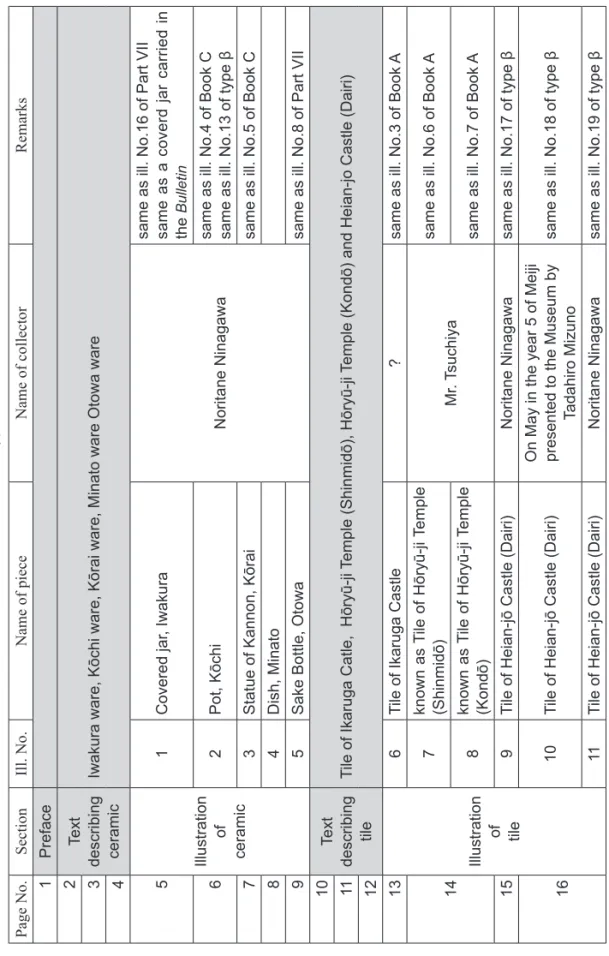
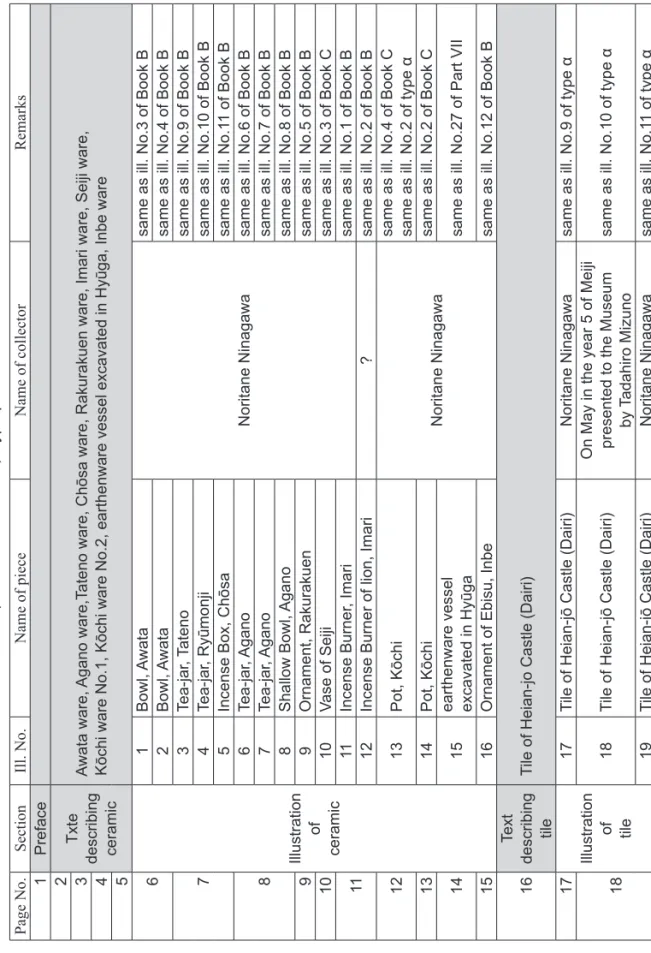
Detail of the two types of Tokiko’s book are shown in Table 4 and 5 [see table 4 and 5]. Both consist of two sections: the first half of the works are dedicated to ceramic and the latter half to tile. The first page of both type α and β is the preface, where Tokiko explains the circumstances behind the editing of Ceramic Art and Tile. According to the preface, after the death of Noritane, Tokiko lamented the state of Noritane’s moth-eaten manuscripts, apparently kept in the bottom of a box, and she gathered them together. After years of preparation, she finally finished Kwan-Ko-Dzu-Setsu
(Ceramic Art and Tile).
The first half of the book is dedicated to ceramic. After the preface, in both types, text relates an overview of Japanese ceramic history that summarizes the technique used in Japanese ceramic, and how the art was advanced thanks to the introduction of techniques in China and Korea. Next, the text explains provincial kilns and their pieces, and then pieces of ceramic are figured. In type α, ceramics from five kilns (Iwakura, Kōchi, Kōrai, Minato and Otowa) are presented. In type β,15 pieces from nine kilns (Awata, Agano, Tateno, Chōsa, Rakurakuen, Imari, Seiji, Kōchi and Inbe) are shown, as well as an earthenware vessel excavated in Hyūga (current Miyazaki prefecture). In total, in type α
and β,19 pieces of ceramic (an illustration is duplicated between the two) and an earthenware object are figured with text.
text, followed by illustration of tile. Type α has three pages of text to explain the tile. The first page explains the production methods of tile in ancient Japan (fig. 26), and the next two describe tiles of the Ikaruga castle, the Hōryū-ji temple and the Heian-jō castle. Next, tiles are figured. Type β, on the other hand, has only one page of text, an outline of the production of tile in ancient Japan and the tiles of the Heian-jō castle. Next, tiles are figured. As we have seen, type α figures six tiles and type β
figures three tiles. Three illustrations from type β are the same as the last three illustrations of type α. Comparing type α and β, on the whole, type β is twice as long in terms of quantity of information as type α, and type β is mostly dedicated to information of ceramic art. The illustration of “Kōchi pot”is figured in the two (fig. 29).
Careful examination of the illustrations [see tables 4 and 5] show the both in type α and β, there are three illustrations that are also used in Part VII of the Kwan-Ko-Dzu-Setsu (Ceramic Art) by Noritane. Moreover, as the remarks column of Table 4 and 5 tell us [see tables 4 and 5], type α has three of the same illustrations as book A, and two of the same illustrations as book C. Type β has 12 of the same illustrations as book B and three of the same illustrations as book C. Thus, most of illustrations in type α and β are the same as those in part VII of Noritane’s work, or books A, B and C, with the exception of four illustrations. However, book A has only three of the same illustrations as type α. Therefore, contrary to our supposition, we can see that book A and Kwan-Ko-Dzu-Setsu
(Ceramic Art and Tile) share few common features.
Judging from its formation, we can say that the Kwan-Ko-Dzu-Setsu (Ceramic Art and Tile) can be said to reflect the discretion of Tokiko more than that of Noritane. It is likely that at the very least, the idea creating of two sections (ceramic art and tile) was Tokiko’s. Concerning the extent of circulation of Tokiko’s Tile, and Ceramic Art and Tile, little is known. I have not been able to determine if the
Kwan-Ko-Dzu-Setsu (Ceramic Art and Tile) might be held elsewhere. Given that only the National
Diet Library holds this book, it is possible that this is the one and only copy in public holdings. Given the evidence, it is difficult to say for certain whether book A is a draft for Tokiko’s book Ceramic Art
and Tile.
Returning to our main concern, the verification of whether a draft for part VIII of the
Kwan-Ko-Dzu-Setsu (Ceramic Art) truly remains in the Museum of Fine Arts, Boston, and having put forward
a case for the manuscript, I would like to move forward and examine the approximate contents of the draft. Looking at Tokiko’s Ceramic Art and Tile from this point of view, it can be seen that the book contains more content on ceramic art than on tile. Additionally, most of the illustrations of ceramic in the book are the same as those in books B and C. Consequently, the relationship between book B, book C and Tokiko’s book Ceramic Art and Tile, must be addressed rather than just the relationship between book A and Tokiko’s book Ceramic Art and Tile.
IV. The relationship between book B, book C, the Kwan-Ko-Dzu-Setsu (Ceramic Art and Tile)
and Kwan-Ko-Dzu-Setsu (Ceramic Art) Part VI, VII
If book B is understood as a draft for part VIII of the Kwan-Ko-Dzu-Setsu (Ceramic Art), type
β of Tokiko’s book can be seen a comparable to the draft of part VIII, because type β has many illustrations as book B. In addition, some of the illustrations of Noritane’s part VII were mixed in Tokiko’s two types as well as book B. We also find in book B illustrations from part VI, and book C has same illustrations as type α and β. This mixing tells us that there is a point of contact between book B, book C, type α, type β and parts VI and VII.
Looking at a summary of the relationship between these six books, what is first obvious is that the collation (book B, book C, type α, type β and parts VI and VII) reveals duplications of illustrations as follows:
a) 12 duplicate illustrations between book B and type β b) 3 duplicate illustrations between book C and type β c) 2 duplicate illustrations between book C and type α
d) 1 duplicate illustration among book C, type α, and type β (figs. 29 and 30)
e) 2 illustration of part VII included in type α f) 1 illustration of part VII included in type β
g) 3 illustrations of part VI, and 2 illustrations of part VII included in book B
Judging by the inscription “Vol. VIII” written on the cover of book B, and the evidence of Morse’s testimony, it is reasonable to conclude that book B is a draft for part VIII. If this is indeed the case, we can surmise the following: one-third of the illustrations of the draft for part VIII are the same as most of illustrations in type β; twelve duplicate illustrations between book B and type β contain all the illustrations of six pieces that Morse wrote “Figured on unpublished plate.” There is no text in book B, but type β has both texts and illustrations. We can recognize from the text in explanation of the six pieces figured in type β that Tokiko also had a draft of part VIII of Noritane’s work. What is important is that Tokiko had both texts and illustrations though Morse had only illustrations.
Having already concluded that there is no firm evidence that book C is the draft for part VIII, and that the content of book C may have been a supplement of book B. It can now be suggested that type
β was partly compiled from the draft of part VIII, and that book C having the same illustrations as type β is also a draft for part VIII. To examine this possibility, we must confirm in detail the text and explanation of the duplicate illustrations between book C and type β. As book C has no text explaining its illustrations, let us look at the text in type β.
There are three duplicate illustrations between book C and type β: one of a Seiji vase and two of Kōchi pots. The text in type β, “Seiji ware” means that they are celadon made at Mikuni in Echizen (current Fukui prefecture) and also known as the “Mikuni ware.” Next, the text relates that the creator of the “Seiji ware” was a man named Tahei who learned the process for making ceramic in Kyoto and came back to Mikuni about 60 years before the completion of the type β. The text further states that Tahei, his son Hanbei and his grandson Hanjirō backed vases or ordinary utensils of porcelain imitating Chinese porcelain. Type β also introduces a vase (fig. 28) as a piece of “Seiji ware.” According to the text, this vase was made on the wheel after the model of high-quality Chinese celadon called “Kinuta-seiji” in Japan.
One of the two pieces of Kōchi ware figured in type β (fig.29) is the same as the pot featured in color in book C (fig.30) as well as in type α (No.2 of the type α). For this piece, the texts of type
α and β are almost the same. According to the text, this green-glazed Kōchi pot was an imported article whose pattern was shaped with a mold. It was made about 600 years before the completion of type β. In brief, this Kōchi pot is presented in book C, type α and β, and is a foreign-made ceramic. Originally, the term of “Kōchi” was the name given to the northern parts of Vietnam (near the environs of current Hanoi). Then, when Vietnam came under the rule of France, the southern part of Vietnam was called “Kōchi-China” (Cochin China). What was termed “Kōchi ware” in Japan, then, was made neither in “Kōchi” nor in “Cochin China.” “Kōchi ware” was rather named for its relationship to the ship from “Kōchi” into which it was loaded. Ceramics known as “Kōchi wares” were, in fact, three-color glazed pottery made in the southern part of China in the latter Ming period. While “Kōchi ware” was marked by its colorful soft glaze, another notable features is its special method of ornamentation, in which a pattern was rimed with a thin line of clay and filled up with glaze in and out of the rims, as we see on book C (fig. 30). In imitation of “Kōchi ware,” a lot of pottery was made in Japan in the same method.11 Thus, “Kōchi ware” is one of the foreign-made potteries that
impacted Japanese pottery.
Another piece of Kōchi ware figured in type β (fig. 31) was made in Japan. This pot is the same one that figured in book C (No.2 of the book C). According to the text in type β, this pot was made on a wheel using chestnut-colored clay and covered by a thick green glaze. It was made about 80 years before the completion of type β.
As we have seen, duplicate illustrations between book C and type β included two pieces of Japanese ceramics and one piece of foreign ceramic. The first two were made after the manner of foreign ceramics, and the latter was a foreign ceramic that influenced Japanese pottery. Therefore, the content of book C is not inconsistent with the nature of Noritane’s project of introducing Japanese ceramic. As presumed above, it is possible that book C is also a draft for part VIII.
Turning now to type α, the fact that one of duplicate illustrations shared by book C and type α, of a statue of Kannon (the Buddhist deity of mercy) of “Kōrai ware” (fig.32) gives some additional cues. According to the text that explains the image, “Kōrai ware” was made at Hagi in Nagato (current Yamaguchi prefecture), and the pictured statue was shaped by hand using grayish clay, then covered by grayish glaze and backed. The term of “Kōrai” in Japanese is the name of a dynasty of Korea. However, the text of type α tells us that “Kōrai ware” was not made in the Korean peninsula, further indicating that illustrations form type α were also derived from a draft for part VIII.
Given the gathered information, we can draw the following inference; Noritane Ninagawa was preparing to publish parts VI, VII, VIII of the Kwan-Ko-Dzu-Setsu (Ceramic Art) at the same time,
and artists were preparing illustrations for the three parts simultaneously. Although parts VI and VII were published, part VIII was left incomplete. When Noritane died in 1882, a draft of part VIII contained illustrations that had been used in Part VI and VII. Book B was made up of illustrations (including rough sketches) prepared for part VIII, and book C was also prepared as an addition to book B. It was in this state of incompletion that the two books were brought to the United State by Morse. Complicating matters, more than one illustration was lithographed and drawn by artists for each piece of ceramic, so Tokiko also had a draft of part VIII. Although Tokiko had proudly prepared the Kwan-Ko-Dzu-Setsu (Ceramic Art and Tile), she heedlessly inserted illustrations already used in
part VII in the book. This, then, explains why duplicate illustrations are found among the six books (book B, book C, type α, type β, part VI and VII). The works were therefore either drafts for part VIII or books derived from the drafts.
CONCLUSION
Given the evidence, it can be concluded that parts of drafts for an unpublished part VIII of the
Kwan-Ko-Dzu-Setsu (Ceramic Art) are currently held by the Boston Museum of Fine Arts, and
that books B and C are these drafts. Book B has illustrations of ceramic made in Kyoto and in the provinces of Japan, while book C has illustrations of ceramic crafted on the model of foreign ceramics and the foreign ceramic known as “Kōchi ware,” which had an influence on Japanese pottery. However, books B and C lack a great deal of necessary text. The missing texts, however, are partly recorded in the Kwan-Ko-Dzu-Setsu (Ceramic Art and Tile) published by Tokiko Ninagawa in 1902. Since it is clear that Tokiko’s book was partly derived from the draft of part VIII of the
Kwan-Ko-Dzu-Setsu (Ceramic Art), we can understand that Tokiko also had a part of drafts of part VIII that had both
The results of my investigation suggest that Noritane Ninagawa had intention to discuss in part VIII the variety of Japanese ceramic made in Japan’s provinces, much like parts VI and VII. A comparison of book A with the Kwan-Ko-Dzu-Setsu (Tile) remains as a matter for further discussion. Further, a better understanding of the circumstances surrounding the unpublished part VIII might to gained if we look over Noritane’s miscellaneous letters and memoranda. Unfortunately, I have not been able to observe these primary sources in person, though there is some evidence to suggest that they are held in the Peabody Essex Museum in Salem, Mass. (USA). If some person knows the details of these documents and their whereabouts, I would be grateful if they could please get in touch.
ACKNOWLEDGMENTS
When I visited the Boston Museum of Fine Arts, Ms. Angie Simonds, curator, afforded me every facility for perusing Ninagawa’s work. At the Library of the Museum, Mr. Paul McAlpine, librarian, kindly introduced me to the documents on Morse. Thanks to my investigation at the Museum, I was able to write this paper. I greatly appreciate the kindness of these two Bostonians.
NOTES
1 Ninagawa, Chikamasa, “Morse’s Collction of Japanese Pottery and Ninagawa Noritane”, E. S. Morse and Japan, edited by Takeshi Moriya, Tokyo: Shōgakukan, 1988, p.398.
2 The book number in the Museum is NK4167 N56.
3 Morse, Edward S., Catalogue of the Morse Collection of Japanese Pottery, Rutland, Vermont and Tokyo: Charles E. Tuttle, 1979. [Reprint of the edition of 1901].
4 Ninagawa, Chikamasa, op.cit., p.388.
5 Morse, Edward S., “Five Originals of Ninagawa’s Work”, Museum of Fine Arts Bulletin, Vol. 23, No. 136, April 1925.
6 Ibid., p. 12.
7 Ninagawa, Chikamasa, op.cit., p.414.
As for the Setsu published by Noritane Ninagawa, there are also two sorts: Kwan-Ko-Dzu-Setsu(Ceramic Art), 7 vols., 1876-1879 and Kwan-Ko-Dzu-Setsu (Castle), 1 vol., 1878.
8 The library reference number (microfiche) for the two works is the same: 400-76イ. 9 “Tile” refers to the same book as “Kwan-Ko-Dzu-Setsu (Tile)”.
10 “Ceramic Art and Tile” refers to the same book as “Kwan-Ko-Dzu-Setsu (Ceramic Art and Tile)”. 11 The word “Kōchi” is not used in the Catalogue of the Morse Collection of Japanese Pottery.
FIGURES
Fig.1 Kwan-Ko-Dzu-Setsu with
folding case Fig.3 Hand-written note in Japanese on part II of the Kwan-Ko-Dzu-Setsu (Set No.②)
Fig.2 Hand-written note near the ill. No. 3 of the Kwan-Ko-Dzu-Setsu, part VII (Set No. ①)
Fig.5 Title in Japanese on folding case
Fig.6 Paper bag of the folding case
Fig.8 Back of portrait
Fig.7 Portrait of Noritane Ninagawa
Fig.10 Letters written on the covers of books A, B and C
Fig.13 Title written in French on the cover of part one of the Kwan-Ko-Dzu-Setsu (Ceramic Art)
Fig.11 Folding case
Rijksmuseum Amsterdam (Netherlands) Rijksmuseum Amsterdam (Netherlands)
Fig.14 Title written in English on the cover of part VI of the Kwan-Ko-Dzu-Setsu (Ceramic Art)
Fig.15 Hand-written note written in English on Book B, page 25
Fig.16 Japanese Pottery in the Museum
(Case 27) Fig.17 book B ill.No.3
Bowl, Awata ware (Morse No.3142)
Fig.18 Japanese Pottery in the Museum (Case 14)
Fig.19 Book B, page4
(from the right, ill.No. 6, 7, 8) Fig.21 Book B, page 5(from the right, ill. No.9,10)
Fig.20 Five Originals of Ninagawa’s Work
right: Tea-jar, Agano ware (Morse No.1487) middle: Shallow Bowl, Agano ware (Morse No. 1468)
left: Tea-jar, Agano ware (Morse No. 1486)
left: Tea-jar, Ryūmonji ware right: Tea-jar, Tateno ware left: Shallow Bowl, Agano ware
middle: Tea-jar, Agano ware right: Tea-jar, Agano ware
In order from the right Bottle, Tamba ware Tea-Jar, Rūmonji ware Covered jar by Iwakura Tea-Jar, Tateno ware Incense box by Sozen
Fig.22 Book A, page1 Fig.23 Cover of the Kwan-Ko-Dzu-Setsu (Tile)
Fig.24 Cover of the Kwan-Ko-Dzu-Setsu
(Ceramic Art and Tile) type α Fig.25 Cover of the (Ceramic Art and Tile)Kwan-Ko-Dzu-Setsu type β
Fig.26 Text of an ancient tile
of the Kwan-Ko-Dzu-Setsu (Ceramic Art and Tile) type α, page10
Ninagawa family’s possession
SOURCE OF FIGURES
Figs. 11 and 12: © Yuko Imai. Courtesy of the Rijksmuseum Amsterdam (Netherlands) Fig.16: Catalogue of the Morse Collection of Japanese pottery (1901)
Fig.18: Ibid.
Fig.20: Museum of Fine Arts Bulletin, Vol.23, No.136 (1925) Fig.23: E.S. Morse and Japan (1988)
Other Figures: © Yuko Imai. Courtesy of the Museum of Fine Arts, Boston (USA)
Fig.27 Covered jar by Iwakura ill.No.1 of type α
Fig.29 Kōchi pot
ill.No.13 of type β
Fig.31 Kōchi pot
ill. No.14 of type β
Fig.28 Seiji vase
ill.No.10 of type β
Fig.30 Kōchi pot
ill. No.4 of Book C
Fig.32 Statue of Kannon
Table 1 Contents of Book A Page No. Ill. No. Name of Piece Name of Collector
Note written by hand
Remarks 1 1 Tile of Gank ō-ji Temple in Nara Noritane Ninagawa Yamato 200 years 2 Tile of K ōrai Temple in Nara Omi 1 100 years 2 3
Tile of Ikaruga Castle in Nara
?
Kioto 700 years
same as ill. No.6 of type
α 3 4 Tile of H ōry ū-ji Temple (Y umedono) in Nara Noritane Ninagawa Kiushiu 1000 years 5 Tile of H ōrin-ji (Mii-dera) Temple in Nara Tokio 200 years 4 6 know n as Ti le of H ōry ū-ji Temple (Shinmid ō) in Nara Mr . T suchiya Buzen 800 years
same as ill. No.7 of type
α 7 known as Tile of H ōry ū-ji Temple (Kond ō) in Nara Omi 1 100 years ?
same as ill. No.8 of type
α 5 8 Tile of Saidai-ji Temple in Nara Noritane Ninagawa Shimosa 900 years 9 Tile of K ōgen-ji Temple in Nara Yamato 500 years 6 10 Tile of K ōfuku-ji Temple in Nara Suruga 1000 years 11 Tile of Tachibana-dera Temple in Nara Kamakura 700 years 7 12 Tile of Tenan-ji
Temple in Kyoto in Nara
Yasaka Temple 13 Tile of Daian-ji Temple in Nara Yamato Temple 8 14 Tile of Asuka-dera Temple in Nara Kioto Temple 15 Tile of Tenan-ji Temple in Kyoto DaiButsu Temple 300 years, Yamato 9 16 Tile of Yakushi-ji Temple in Nara Yamato? 800 years 17 Tile of Tō dai-ji
Temple (Nandai-mon) in Nara
Omi 900 years 10 18 Tile of Tō dai-ji Temple (K ōd ō) in Nara Korea 1 100 years 19 Tile of H ōkki-ji Temple in Nara 2000 years, Asiatic Turkey? 11 20 Tile of Tō sh ōdai-ji Temple in Nara Korea 1200 years 21 Tile of Tō sh ōdai-ji Temple in Nara Oshiu 1 100 12 22 Tile of H ōrin-ji Temple in Kyoto Joshiu 1000 years 23 Tile of Ch ōsh ō-ji Temple in Nara Kawachi 1 100 13 24 Tile of Gang ō-ji Temple in Nara Raku Tokio 300? 14 25 Tile of Tō dai-ji Temple in Nara Kishiu 1 100 26 Tile of H ōry ū-ji Temple (Y umedono) in Nara K orea 1 100 15 27 Tile of K ōfuku-ji Temple in Nara Korea 1 100 16 28 Tile of Tachibana-dera Temple in Nara 29 Tile of Kudara-ji Temple in Nara Korea 1 100 years 17 30 Tile of Tō dai-ji
Temple (Daibutsu-den) in Nara
Yamato 1 100 18 31 Tile of Tō dai-ji
Temple (Daibutsu-den) in Nara
Table 2 Contents of Book B
Page No. Ill. No. Name of piece Name ofcollector Note written by hand Remarks
1 1 ? ? the mate of Morse No.4452, mentioned by Morsesame as ill. No.11 of type β 2 same as ill. No.12 of typeβ
2 3 Bowl, Awata
Noritane Ninagawa
Awata Morse No.3142, mentioned by Morsesame as ill. No.1 of type β 4 Bowl, Awata same as ill.No.2 of type β
3 5 Ornament,Rakurakuen Rakurakuyen same as ill. No.9 of type β
4
6 Tea-jar, Agano Morse No. 1486, mentioned by Morsesame as ill. No.6 of type β 7 Tea-jar, Agano Morse No. 1487, mentioned by Morsesame as ill.No.7 of type β 8 Shallow Bowl,Agano Morse No. 1468, mentioned by Morsesame as ill. No.8 of type β
5 (*6)
9 Tea-jar, Tateno Tateno same as a tea-jar published in the same as ill. No.3 of type β Bulletin 10 Tea-jar, Ryūmonji Ryumonji yaki same as a tea-jar published in the same as ill. No.4 of typeβ Bulletin 11 Incense Box, Chōsa Chosa? or Chiusa yaki,Satsuma same as ill.No.5 of type β
7 12 Ornament of Ebisu,Inbe Imbe same as ill. No.16 of type β 8 13 ? ? 14 9 (*11・ *23・ *24) 15
16 Part VI, pl. 10, fig. 19 same as ill. No.19 of Part VI Morse No. 742 10
(*12) 1718 Baien, Osaka87 years old Morse No. 3682 13 19
14 2021 Shoo
15 2223 inside of fig. 18Adachi, Iwaki inside of ill. No.18 of Book BMorse No. 4518 16 2425
17(*18) 26
19 27 Tsuyakuro, see 116, Uho Morse No. 1364 28 Asahi Tei, house
20 2930 31
21 32 Susumetani, YakusanPart VI, pl. 11, fig.21 same as ill. No.21 of Part VI 22 33 Nagarayama Part VI, pl.12, fig.22 same as ill. No.22 of Part VIMorse No. 789 25 34 Part VII, pl.17,figs. 29 and 28.
same as ill. No.28 of Part VII Morse No. 4399
35 same as ill. No.29 of Part VIIMorse No. 4457 The asterisk refers to a overlapping page.
Table 3 Contents of Book C
Page No. Ill. No. Name of piece Name ofcollector Note written by hand Remarks 1 1 Flower Vase, Kōchi
Noritane Ninagawa
Kochi yaki, 20 or 30 years,
stupid ? colors a little of text
2 2 Pot of Kōchi same as ill. No.14 of type β 3 3 Vase of Seiji same as ill. No.10 of type β 4 4 Pot of Kōchi same as ill. No.2 of type αsame as ill. No.13 of type β 5
(*6) 5 Statue of Kannon, Kōrai same as ill. No.3 of type α 7 6 Flower Vase ? text
Table 4 Contents of the Kwan-Ko-Dzu-Setsu (Ceramic Art and T ile) Type α Page No. Section Ill. No. Name of piece Name of collector Remarks 1 Preface 2 Text describing ceramic Iwakura ware, K ōchi ware, K
ōrai ware, Minato ware Otowa ware
3 4 5 Illustration of ceramic 1 Covered jar , Iwakura Noritane Ninagawa
same as ill. No.16 of Part VII sam
e as a c ov er d ja r ca rr ie d in the Bulletin 6 2 Pot, K ōchi
same as ill. No.4 of Book C same as ill. No.13 of type
β
7
3
Statue of Kannon, K
ōrai
same as ill. No.5 of Book C
8 4 D ish, Minato 9 5
Sake Bottle, Otowa
same as ill. No.8 of Part VII
10
Text
describing
tile
T
ile of Ikaruga Catle, H
ōry ū-ji Temple (Shinmid ō), H ōry ū-ji Temple (Kond
ō) and Heian-jo Castle (Dairi)
11 12 13
Illustration
of tile
6
Tile of Ikaruga Castle
?
same as ill. No.3 of Book
A 14 7 known as Tile of H ōry ū-ji Temple (Shinmid ō) Mr . T suchiya
same as ill. No.6 of Book
A 8 known as Tile of H ōry ū-ji Temple (Kond ō) same as ill. No.7 of Book A 15 9 Tile of Heian-j ō Castle (Dairi) Noritane Ninagawa
same as ill. No.17 of type
β
16
10
Tile of Heian-j
ō Castle (Dairi)
On May in the year 5 of Meiji presented to the Museum by
Tadahiro Mizuno
same as ill. No.18 of type
β
11
Tile of Heian-j
ō Castle (Dairi)
Noritane Ninagawa
same as ill. No.19 of type
Table 5 Contents of the Kwan-Ko-Dzu-Setsu (Ceramic Art and T ile) T ype β Page No. Section Ill. No. Name of piece Name of collector Remarks 1 Preface 2 Txte describing ceramic A wata ware, Agano ware,T ateno ware, Ch
ōsa ware, Rakurakuen ware, Imari ware, Seiji ware,
K
ōchi ware No.1, K
ōchi ware No.2, earthenware vessel excavated in Hy
ūga, Inbe ware
3 4 5 6 Illustration of ceramic 1 Bowl, Awata Noritane Ninagawa
same as ill. No.3 of Book B
2
Bowl,
Awata
same as ill. No.4 of Book B
7
3
Tea-jar
, T
ateno
same as ill. No.9 of Book B
4
Te
a-jar
, Ry
ūmonji
same as ill. No.10 of Book B
5
Incense Box, Ch
ōsa
same as ill. No.1
1 of Book B
8
6
Tea-jar
, Agano
same as ill. No.6 of Book B
7
Tea-jar
, Agano
same as ill. No.7 of Book B
8
Shallow Bowl,
Agano
same as ill. No.8 of Book B
9
9
Ornament, Rakurakuen
same as ill. No.5 of Book B
10
10
Vase of Seiji
same as ill. No.3 of Book C
11
11
Incense Burner
, Imari
same as ill. No.1 of Book B
12
In
cense Burner of lion, Imari
?
same as ill. No.2 of Book B
12
13
Pot, K
ōchi
Noritane Ninagawa
same as ill. No.4 of Book C same as ill. No.2 of type
α
13
14
Pot, K
ōchi
same as ill. No.2 of Book C
14
15
earthenware vessel excavated in Hy
ūga
same as ill. No.27 of Part VII
15
16
Ornament of Ebisu, Inbe
same as ill. No.12 of Book B
16
Text
describing
tile
T
ile of Heian-jo Castle (Dairi)
17 Illustration of tile 17 Tile of Heian-j ō Ca stle (Dairi) N oritane Ninagawa
same as ill. No.9 of type
α
18
18
Tile of Heian-j
ō Castle (Dairi)
On May in the year 5 of Meiji presented to the Museum
by
Tadahiro Mizuno
same as ill. No.10 of type
α
19
Tile of Heian-j
ō Castle (Dairi)
Noritane Ninagawa
same as ill. No.1
1 of type