Strategies
for
an
Optimized
simulation
of
granular
particles
in
a
Newtonian
Fluid,
Part 1:
Basics
Hans-Georg Matuttis,
University ofElectro-Communications, Department ofMechanical Engineeringand
Intelligent Systems, Chofu, Chofugaoka 1-5-1, Tokyo 182-8585 Japan
Abstract; In this article,
an
outline is given for an an “ideal” simulation ofgranular particles in fluids with respect to CPU-effort, accuracy etc. which
features should be incorporated in the underlying simulation, and which
nu-merical techniques should be used with respect to the time integration.
1
Introduction
Though many features of granular materials , especially those in connection with static
or
quasi-static regimes (heap-formation, arching), awhole class or granular phenomena isinfluenced by the surrounding fluid:
Fluidized beds and Sedimentation are the terms used to describe systemswhere
grains in various concentrations interact with the surrounding fluid under the influence
of gravity.
Pattern formation processes like rippling and dune formation take place in in air
and under water. Hydrological phenomenalike the formation ofcoastlines, the formation
and destruction of river banks and and the changeof river beds also belongs in this class.
Dust avalanches of powder snow, where the avalanche is supposed to ride on a
cushion of compressed air, are much faster, far reaching and
more
destructive than thefluid-tike avalanches of ”sherbet-like” snow,
Pneumatic transport is the field which deals with the intentional or unintentional
movement of granular materials by fluids, ranging from
vacuum
cleaners over devices in$\mathrm{c}\mathrm{h}\mathrm{e}$mical engineering to sandstorm $\mathrm{f},,$.
Porous Media is the field where the surrounding”granular matrix” is considered to
be stationary, and only the fluid it contains in the pore space is supposed to
mover
Landslides
are
the result of an interaction betweena
granulaJ matrix of a slopeanda pore fluid which destabilizes the whole system.
We will outline which features must be
incorpo-rated in a simulation to
access
the widest range ofthe above phenomena with the minim um amount of
computational effort while retaining physical
valid-ity. The granular materials shall be modeled on the
particle level (Lagrangian method), to be able to
in-vestigate micro-mechanicmechanisms ofmacroscopic
phenomena. The surrounding fluid should be simu- Figure 1: Grid artifact: Though
latedin agrid-based discretization
as
Newtonian fluid the relativepositionof particle Pi(Eulerian method),
so
that artifacts introduced by versu$\mathrm{s}$ P2 is thesame
as
that ofsome
grid-based methods (Lattice-Gas automata[9], particle P3versus
P4, in the firstLattice Boltzmann simulations$[6, 17]$, see Fig.1)
are case
the path between theparti-avoided. Particle based methods (moving particle cles is blocked, only in the latter
sem i-im plicitMPS$[16, 15]$, smoothedparticle dynam- case there is a pathfor the fluid,
1. it allows the input of realistic conditions (particle shape, friction, etc),
2. is able to reproduce themacroscopic (rippling,
. .
.) and mesoscopic (saltation, collapseof fluid-filled cavities,
. .
) behavior,3.
can
be used for low (sedimentation) and high (porous media) granular density alike,4. uses the ninimurn amount of computer time and storage in comparison with other
com putational methods and
5. maybe iseven faster (in realtime) than apurely “dry” simulationor a pure liquiddue
to a-prioriconsiderations which will be explained below.
Previous simulations have dealt with the incorporation of particles into
a
fluid byusinga straightforward approach, usingthe standard square grid with MAC[12] (marker
and cell) and the standard granularparticle simulation with round particles. Apart from thle problemthat the blocking of flow by particles cannot be treated with round particles,
most of the algorithmic effort went into the treatment of the incomm ensurability of the
straight grids and curved grain boundaries. Kajishima[14] used a brute-force approach, putting sub-meshes around the particles several orders of magnitude smaller than the
particle diam etcr; the accuracy gained in the description of the particle outline lead to a
huge blowup of the number of mesh-points, and accordingly, the CPU-effort is gigantic.
Schwarzeret $\mathrm{a}1[29.,$13,30] tried to match the particleswith asirriilar-sizedmesh, coupling
the particle motion to tracer particles in the fluid: In a sense, the fluid goes “through”
the particle, which
are
$’\backslash \mathrm{f}\mathrm{i}\mathrm{x}\mathrm{e}\mathrm{d}^{\backslash }$’ to the flow lineswith “springs”. These ”
$\mathrm{s}\mathrm{p}\mathrm{r}\mathrm{i}\mathrm{n}\mathrm{g}\mathrm{s}’\backslash$
(cou-pling constants) introduce additional degrees of freedom (stiffness, damping), for which
the timescale is difficult to predict, which leads to numerically instable choices of the
time-step. Moreover, most of the Computer time (99
%)
goes in the solution of theMAC-pressure-iterationfor the incompressibility-condition, due to incommensurability of
particle boundaries and grid positions. In this article, we will explain how to circumvent
the above problems by not choosing the most straightforward approach in the
model-ing of the primitives of the simulation (round particles, quadrilateral grid), but with tlie
advantageth at the treated ent of the particle-fluid interface becomes straightforward.
1.1
$\mathrm{C}\mathrm{o}\mathrm{n}\mathrm{t}\mathrm{i}\mathrm{n}\mathrm{u}\mathrm{u}\mathrm{m}/$Fluid
part
The sound velocity $c$ of a continuum solid
can
be calculated from its Young modulus $Y$and its density $\rho$as $c=\sqrt{Y/\rho}$Thesound velocity ofa chain made ofspherical particlesis
about 10 % of that of the continuum material the particles
are
madeof: $c_{chain}\approx 0.1\mathrm{c}$. Thesound velocity of a th ee-dim ensional disordered packing of mono-disperse particles $c_{\mathrm{d}\mathrm{j}\mathrm{s}}$
is again
on
order ofmagnitude less,so
that the relation $c_{\mathrm{d}}\mathrm{i}\mathrm{s}$ $\approx 0.\mathrm{l}\mathrm{c}\mathrm{c}\mathrm{h}\mathrm{a}\mathrm{i}\mathrm{n}\approx 0.0\mathrm{l}\mathrm{c}$hold[25].Therefore, the sound velocity of thegranular part
can
be considered considerably lowerthan that of the fluid part, which itselfisabout that ofacontinuumsolid. Therefore, the
fluid part will be best approxim ated as an incompressible fluid. If,
as
a starting point,the fluid is to be approximated
as
a Newtonian fluid, thismeans
that the incompressible(a) Spherical smooth glass (b) Smooth non-spherical (c) Rough,“crushed” glass
beads beads
Figure 2: Effect ofelongation and surface structure ofglass beads on the critical angle
1.2
Particle Modeling
The bulk properties of assemblies of circular $/\mathrm{s}\mathrm{p}\mathrm{h}\mathrm{e}\mathrm{r}\mathrm{i}\mathrm{c}\mathrm{a}\mathrm{l}$ granularparticles differ
consider-ably from that of non-spherical particles: Whereas the angle of repose for dry spherical
glass beads in Fig. $2(\mathrm{a})$ is about 20 degrees, if “straight” slopes can be identified at all,
for the elongatednon-sphericalparticles in Fig.$2(\mathrm{b})$oneobtains a more sand-like angleof
repose of about 30 degrees. Surface roughness of the grains and the size dispersion
rela-tion alsoeffects the angle of repose, as the angle of reposefor the rough glass’s in Fig.$2(\mathrm{c})$
shows. Anotherquantitativedifference
can
beseenin thestress-strain diagram,where the maximal yield strength of elongated polydisperse particles is twice that of round particles(Fig.$3(\mathrm{a})$)
$)$ and the differences in the density-strain diagram also shows that the internal
structure must be different (Fig.$3(\mathrm{b})$). For these reasons, a simulation ofgranular
parti-cles in
a
fluid should makeuse
of non-spherical particles, so that e.g. for sedim entation,the resulting slopescan be computed with acceptablestability and precision.
$\mathrm{J}\Omega\underline{\underline{0\alpha(n}}$
(a) Stress-strain,scaled by the external pres- (b) Density-strainscaled bythe density
be-fore$\mathrm{c}\mathrm{o}$mpression $\mathrm{i}>\iota\iota \mathrm{r}\mathrm{e}$
Figure 3: Granular properties of
a
typical single run of biaxial compression ofmono-disperse round particles (full line), polydisperse round particles (dashed line) and
poly-disperse elongated particles (dotted line) [21].
springmodel [7]
or
the numericalexactimplementation(”Conctact dynamics”$\mathrm{c}\mathrm{i}\mathrm{t}\mathrm{e}\mathrm{m}\mathrm{o}\mathrm{r}\mathrm{e}\mathrm{a}\mathrm{u}88,\mathrm{m}\mathrm{o}\mathrm{r}\mathrm{e}\mathrm{a}\mathrm{u}89$, or Ref.$\mathrm{c}\mathrm{i}\mathrm{t}\mathrm{e}\mathrm{H}\mathrm{a}\mathrm{i}\mathrm{r}\mathrm{e}\mathrm{r}:93$, p.199) is used : This
excludes the possibility ofmodeling the particles with elliptic potentials[32], which gives
only
a
force direction, but not a traceable contact point. All in all, the use ofpolygo-nal (polyhedral in three dimensions) particles in connection with a surrounding fluid is
preferable to e.g. particles with curved boundaries, because the geometric information is
geometrically better defined.
Finally, the use of soft particle models (with finite young modulus) is preferable over
“rigidparticles” (infiniteyoung modulus) in event-drivenparticle simutations$[19, 20]$ orin
contact mechanics$[23, 24]$: Event-driven simulations allow only the simulation of binary
collisions, and as there is a suspicion that the net interaction of particles submerged
under wateris attractive, this would disturb agglomeration. Contact mechanicscantreat
multiplecontact (at considerablelarger algorithmiceffort than the event-drivenmethod);
Adrawback is that modeling the granularparticleswith rigidcontactsresults in
an
infinitesoundvelocity,which is physically dubious and in the presence of
an
incompressiblefluidsmay lead to serious numerical instabilities due to thhe interference of two infinite signal
velocities.
1.3
Statistical Physics
In accuracy benchmarks in fluid mechanics, e.g. the flow behind an obstacle, “idealized”
boundary conditions for thelikewiseidealizedNewtonianfluidarechosensothat solutions
can
begivenor at least definedinarbitrary precision; in thecase
of Karmanvortices, thiswill be an ideal circle or sphere as obstacle. For low Reynolds numbers, this will be the
flow lines, for higher Reynoldsnumbers, where no stationarysolutionexists, one
can
stillexpect the existence ofprobabilitydistributions for e.g the size of vortices in the Karman
vortex street which should be reproduced exactly by simulations and experiments alike.
Physically, the relevance of such definitions may be actually doubtful, as experimentally
already for Reynolds numbers
as
low as 20, huge deviations have been found in thestreamlines of flow through a small orifice for polar and non-polar-simulations, on the
one
hand, and the numerical practically exact simulation on the other hand ([31] andReferences therein); A-priory, it is unclear why the experimentally used fluids (distilled
water, ethanol and liquid paraffin) deviate sostrongly from ideal Newtonian behavior.
In granular material research from thepoint ofstatisticalphysics,
on
the otherhand,one is not so much interested in single particle problems with arbitrary precision, but
tries to derive the macroscopic quantities based on the microscopic mechanisms. In that
respect,for the sedimentation of granular particles ina fluid, the experimentalverification
should not bea verification of the particle trajectory (impossible, because it is obviously
a nonlinear-chaotic problem), but the speed ofthe sedimentation fronts, and the angle of
theresulting slopes.
Whereas, as discussed in the previous paragraph, “high accuracy” is not an issue due
costs: No fluctuating noise terms due to lack ofprecision in the solution of the continuity equation should be introduced, because they might lead to unphysicallyoscillatory force
laws, sothat the granular phase would become fiuidized morethan is physically realistic.
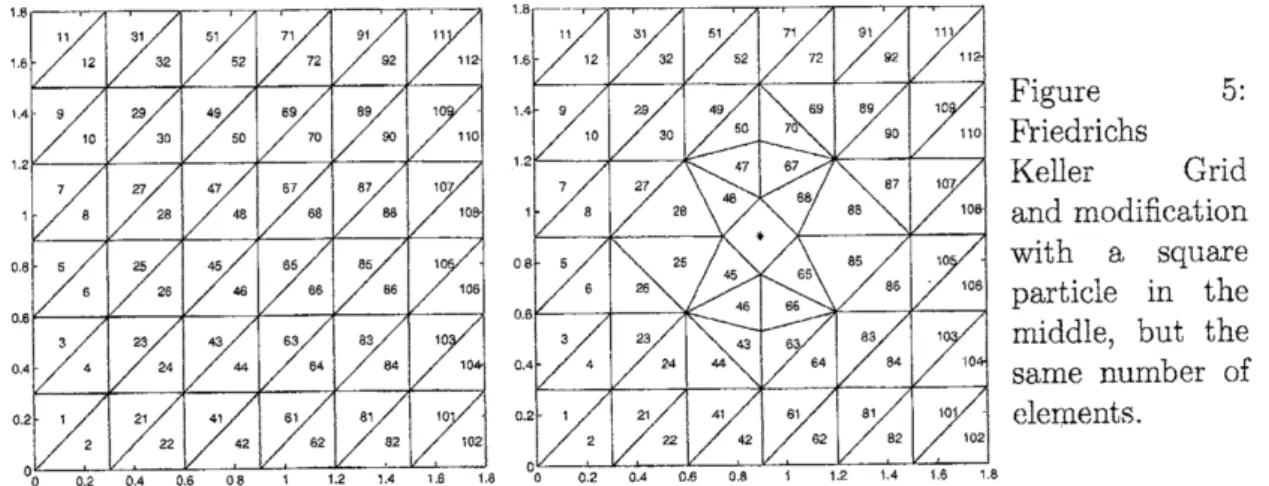
Figure 4: Delaunay-Triangulation$\mathrm{s}$ of a square-grid deformed with Gaussian-distributed
random numbers ($\sigma=0/Fr\mathrm{i}edr\mathrm{i}chs-K$eller- Grid, 0.05, 0.1,0.2 )
1.4
The
Grid
Structured grids have the advantage that the resulting system ofequation is
character-ized byaband Matrix,
so
that conventional LU-Solvers canbe used. Thedisadvantage isthat for complicated simulationgeometries, the construction of the grid is
an
arbitrarilycomplex task, even
more
soif the neighborhood relation ofthe gridpointsmust be takeninto account as an additional constraint. If two granular particles approach each other,
the space between them can become arbitrarily narrow: The treatment of the fluid with
a
more or
less uniform grid spacing, as prevalent inthe MAC-method, isnot suitable forthis case, because if the regular grid with the smallest gridsize (smallest particledistance)
is used, this leads tounnecessary manydegrees offreedom.
Unstructured gridsgivethe largest freedom for the distribution of themesh-points,
andcantherefore be optimally adaptedtothe particle- and flow-geometry. The
disadvan-tage isthat “numerically exact” LU-Solvers becomeinefficient, ad sparsematrixmethods
have to employed, which
are
numerically considerably less stable.Figure 5: Friedrichs Keller Grid and modification with a square particle in the
middle, but the
same
number ofelements.
To simulate polygonalparticles with a shape-matching grid, triangular elements
gen-erated via Delaunay triangulation will be easier to handle than quadrilateral elem ents,
There is a philosophy in fluid dynamics of immersed bodies which tries to to retain a rectangular grid structure for the fluid simulation at all costs, but introduce the
inter-faces between the fluid and the particle surface with computer science techniques (Ghost
Fluid method, CIP/Multi-Moment,MARS, Level Set method). We refrain from
imple-menting such methods, because each additional interface in a medium introduces a new wave $\mathrm{r}\mathrm{e}\mathrm{s}\mathrm{i}\mathrm{s}\mathrm{t}\mathrm{a}\mathrm{n}\mathrm{c}\mathrm{e}/$ mechanicalimpedance for the signal-
or
momentum-propagation in thatmedium, and the scattering properties of the above interfaces are far from clear: In the
worst caseh it rna7
serve as
asource
of noise which prevents the build-up of staticcon-figurations. Instead, particles form$\mathrm{n}$ the boundaries of the fluid (see Fig.1.4), and the
additional, unphysical degrees of freedom are a nuisance anyway because they increase
the computational complexity and the CPU-time alike. Chimera-Grids are popuiar for
si nulations of few particles ofcomplicated shape inside a fluid, e.g. for the cross-section
of wings, usually in connection with quadrilateral grids; due to
our
choice of granularparticles as polygons and the flexibility ofthe finite element method, the implementation
ofChimera Grids or finer meshes is not necessary
1.5
Discretization
Schemes for the fluid
For the grid part of the simulation, thle algorithm with the least degrees of freedom is
desirable: The leastcom putation effort for lattice methods (PartialDifferential Equations,
Lattice fermions .. ) for $N$ lattice points
can
in som $\mathrm{e}$ cases be obtained for a singletimestep within $N\log N$ operations (if Fourier-Type methods
can
be employed), morerealistic for general problems is a cost of $N^{2}$ operations per timestep. Therefore, the
number ofgrid points should be reduced as much
as
possible. Thiscan
be accomplishedby using larger meshes with higher-order discretization methods and by choosing the
particle boundary as boundary of the fluid,
so
that the corresponding grid points aredetermined by the $\mathrm{g}\mathrm{r}\epsilon‘ \mathrm{L}\mathrm{I}\mathrm{l}\mathrm{u}\mathrm{l}\mathrm{a}\mathrm{r}$ simulation, and inputted as boundary conditions into the
fluid part of the simulation.
Finite Differences have the advantage of being ”simple”, in the
sense
that thediscretized equations still resemble the original differential equations. The disadvantage
is that they work best (”computationa1 most efficient”) for rectangular grids, which
don’t work wellwith the polygonal particles we want to use.
TheFinite Volume method has problems with strongly varying meshsizes, and also
maybe with topological changes of the grid. The whole formalism is considerably metre
complicated than the finite difference method.
The Galerkin Finite Element Method (GFEM) is, ascomplicatedas finite volume
method (but not more so,
as
has been argued in Ref. [26]): it uses the weak form of thePDE, which
means
thatnot the originaldifferentialequationsare approximated, buttheirintegral This leads to
more
benign behavior for strongly varying solutions (the integralover a non-differentiable funciton is likely to be differentiable), but it also introduces
additionaldegressoffreedom (oscillatorysolutions additionally to the advective solutions
versatile method for complicated boundaries and unstructured meshes, we will base our
simulation of granular particles in fluids onthis method. The Navier-Stokes equations in
the “strong formulation” can bewritten as
$\frac{\partial u}{\partial t}=-\frac{\partial(u^{2})}{\partial x}-\frac{\partial(uv)}{\partial y}-\frac{\partial\phi}{\partial x}+f_{x}+\iota/(\frac{\partial^{2}u}{\partial x^{2}}+\frac{\partial^{2}u}{\partial y^{2}})$ (1)
$\frac{\partial v}{\partial t}=-\frac{\partial(vu)}{\partial x}-\frac{\partial(v^{2})}{\partial y}-\frac{\partial\phi}{\partial y}+f_{y}+"(\frac{\partial^{2}v}{\partial x^{2}}+\frac{\partial^{2}v}{\partial y^{2}})$ (2)
$0= \frac{\partial u}{\partial x}+\frac{\partial v}{\partial y}$ (3)
with the pressure fields $p$, and the velocity field $u$,$v$ for the flow in $\mathrm{x}/\mathrm{y}$ direction, and
with dynamic viscosity $l/$. The last equation, $\mathrm{e}\mathrm{q}\mathrm{n},3$, the ”continuity equation”,
assures
the incompressibility. as in the “weak formulation”,, the equations have been integrated
over
with basis functions (for $\mathrm{f}\mathrm{i}\mathrm{r}\mathrm{s}\mathrm{t}/\mathrm{s}\mathrm{e}\mathrm{c}\mathrm{o}\mathrm{n}\mathrm{d}$ order finite elements, with polynomials of$\mathrm{f}\mathrm{i}\mathrm{r}\mathrm{s}\mathrm{t}/\mathrm{s}\mathrm{e}\mathrm{c}\mathrm{o}\mathrm{n}\mathrm{d}$ order respectively) and then integrated out;
$\int\phi(\frac{\partial u}{\partial t})=\int\phi(-\frac{\partial(u^{2})}{\partial x}-\frac{\partial(uv)}{\partial y}-\frac{\partial\phi}{\partial x}+f_{x}+\iota/(\frac{\partial^{2}u}{\partial x^{2}}+\frac{\partial^{2}u}{\partial y^{2}}))$ (4)
$\int\phi(\frac{\partial v}{\partial t})=\int\phi(-\frac{\partial(vu)}{\partial x}-\frac{\partial(v^{2})}{\partial y}-\frac{\partial\phi}{\partial y}+f_{y},[perp]\iota/(\frac{\partial^{2}v}{\partial x^{2}}+\frac{\partial^{2}v}{\partial y^{2}}))$ (5)
$0= \int\phi(\frac{\partial u}{\partial x}+\frac{\partial v}{\partial y})$ $\backslash (6)$
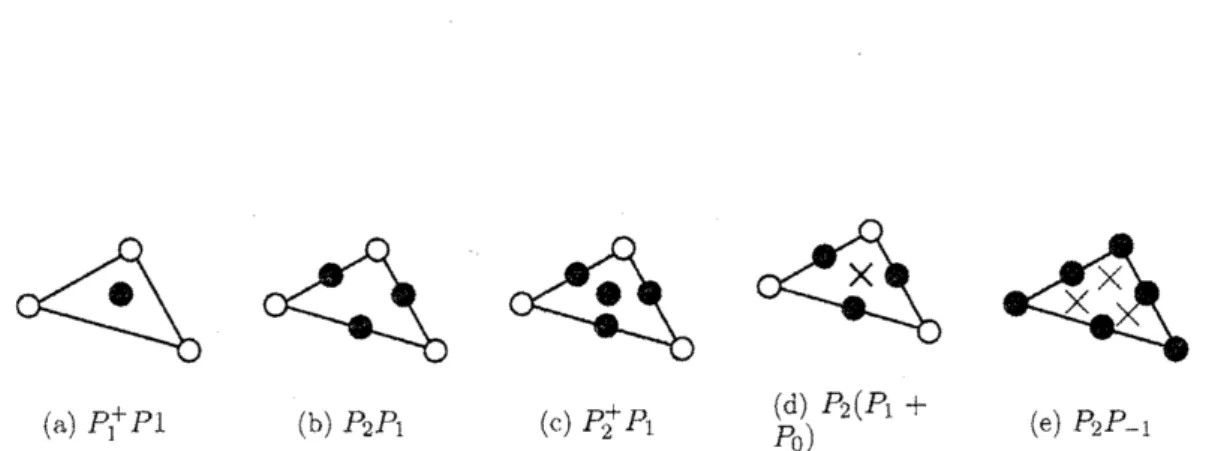
Thereis considerable freedom in thechoiceofelements, i.e. which pointson agrid should
be integrated out, and in which order the approximation should be performed, as can
be seen in Fig.6. Nowadays, there is a $\mathrm{c}\mathrm{o}\mathrm{n}\mathrm{s}\mathrm{e}\mathrm{n}\mathrm{s}\mathrm{u}\mathrm{s}[27_{\rfloor}^{\rceil}$ that because the Navier-Stokes equation is ofsecond order in velocity and first order in pressure, the approximation for
thevelocities should be one order higher than for the pressure, which at least eliminates
the $P_{1}^{+}P1$-element (first order in velocity, first order in pressure) in Fig.$6(\mathrm{a})$. This still
leaves considerable freedom for second order elements. Because $P_{2}(P_{1}+\mathrm{p}_{\mathrm{q}})$
conserves
the element mass, we expect problems due to the volume change of elements induced
by moving boundaries (granular particles), so we will not
use
this element. The $P_{2}P_{-1}$-element has no pressurepoints onthe element boundaries, so that
no
forces on granularparticles which act
as
element boundariescan
be computed, so theuse
of th is elementis also excluded. This leaves basically $P_{2}^{+}P_{1}$ and $P_{2}P_{1}$, the latter being simplest second
order element, whichwe will choose for our implementation.
2
Time Integration
2.1
Time consumption
Meaningful criteria for “the fastest algorithms” are not easy to
come
by. In the fieldof onte-Carlo simulations, ”updates per second” (UPS) are a common criterion, albeit
not a very meaningful one: Different updating methods come at different computational
{$\mathrm{a})$ $P_{1}^{+}P1$ (b) PfPl (c) $P_{2}^{+}P_{1}$ (e) $P_{2}P_{-1}$
(d) $P_{2}(P_{1}+$
$P_{0})$
Figure6: Various elements for fluid flow where $0$ indicatescontinuousvelocities and
con-tinuous pressures, $\bullet$ indicates continuous velocities and ix indicates discontinuous
pres-sures.
UPS, divided by the half-life time $\tau$ which characterizes the relaxation time. Likewise,
for ordinary differential equations, some time integration methods are more costly per time-step, thanothers, e.g. ingeneral implicit Runge-Kutta methodsare morecostly than
explicit Runge-Kuttamethods. though implicit predictorcorrectormethods ($\mathrm{G}\mathrm{e}\mathrm{a}\mathrm{r}/$
Back-ward $\mathrm{D}\mathrm{i}\mathrm{f}\mathrm{f}\mathrm{e}\mathrm{r}\mathrm{e}\mathrm{n}\mathrm{c}\mathrm{e}/\mathrm{B}\mathrm{D}\mathrm{F}$)
are
not necessarily more costly than explicit (Adams-Bashforth)methods. Higher order Runge-Kutta (RK) methods are
more
costly than lowermeth-ods because they need more function evaluations per timestep than lower order
meth-ods (n-th order methods RK methods need at least $\mathrm{n}$ function evaluations), whereas for
Predictor-Corrector methods usually a single function evaluation per time step is
suffi-cient. $.\backslash \mathrm{I}\mathrm{e}\mathrm{v}\mathrm{e}\mathrm{r}\mathrm{t}\mathrm{h}\mathrm{e}1\mathrm{e}\mathrm{f}^{\backslash },\mathrm{b}$, the decisive factor is the maximal size of the time step $dt_{\mathrm{r}\mathrm{n}\mathrm{a}\mathrm{x}}$ (called
“radius of stability” in the numerical literature) which
can
be used, so that a meaningfulcriterion for the fastest integratoris thethe largest possible timestep for agiven problem
$dt,$, divided by the number of necessary function evaluations. For particles of
mass
$m\epsilon \mathrm{x}t\mathrm{n}\mathrm{d}$Young modulus $Y$, the characteristic frequency of the corresponding undamped harmonic
oscillatoris$\omega$ $=\sqrt{Y/rr\iota}$. That 1eans that
over
awide range ofvelocities, the contact time$T$ for
a
single collisioncan
be approxim ated well as $T=2\pi/\omega$. Wc have found that forsuitable integrators (Gear-Predictor-Corrector/BDF). the timestep $dt_{1\mathrm{n}\mathrm{a}\mathrm{x}}$
can
be chosenof the order of$dt\approx T/10$. For particles in
a
fluid, themotion isadditionally damped: Thlecontact time becomes larger and larger time steps
seem
possible. Under the assumptionsthat the surfaces and the motiongranular particleserase vortices of small$\mathrm{d}\mathrm{i}\mathrm{a}\mathrm{m}\mathrm{e}\mathrm{t}\mathrm{e}\mathrm{r}/$ small
$\mathrm{t}\mathrm{i}$ me scale, larger grid sizes and larger time steps
seem
possible for the fluid part of thesimulation than for the simulation without particles.
2.2
Method of
Lines
Thediscretization 1n thetime direction will not bedone by finite elements with a
compo-nent in the time domain but with the method of lines[28], i.e. the partial time derivative
is treated as an ordinary derivative, and the solution
can
then be obtained withconven-tional ordinary differential equation solvers, making use of the substantial theory with
respect to accuracy and stability of that field[ll, 8]. For the simulation of partial
dif-ferential equations with explicit integrators (linearization ofthe time evolution), the size
of the maximal timestep is usually proportional to the lattice spacing. This criterion
based
on von
Neuman stability analysis (linearization of the time evolution operator foreach eigenmode) is usually not valid for implicit integrators, which
are
derived without2,3
Relaxation
vs.
”numerically exact” methods
In the MAC-method, the time integration is performed without taking the
incompress-ibility into account. Instead, at the new time step, the velocity is equilibrated with the relaxation condition
$v^{n+1,k+2}=v^{n+1,k+1}-\delta t\nabla(p^{n+1,k+1}-p^{n+1,k})$ ,$k\geq 0$.
This relaxation may take ”arbitrarily long” because the non-locality ofthe Navier-Stoke$\mathrm{s}$
equationmayleadto P-U-V-configurations with very largeerror; moreover, the relaxation
step $k$ does not have themeaning ofa real time, but is unphysical.
Nobody would treat a particle on a$\mathrm{s}\mathrm{t}\mathrm{r}\mathrm{i}\mathrm{n}\mathrm{g}/$rigid pendulum$\mathrm{n}$ witha relaxation dynam
-$\mathrm{i}\mathrm{c}\mathrm{s}\backslash$’ where first the pendulum is advanced to a point which corresponds to a change of
thelength, and afterwards the length is adapted again, Instead, the ”numerically exact”
treatment of the time integrationwhich
conserves
the constraint with “zeroerror” is theLagrange multiplier formalism$\mathrm{n}$ in Fig. 7,
For a pendulurn ofmass771 of unit length at Inserting this in the equation for $\ddot{g}(\mathrm{q})$, on
position $\mathrm{q}=$ ($\mathrm{x}_{1}$,X2) and unit length, the obtains
constraint equation (center at the
$\dot{g}(\mathrm{q})=\frac{\mathrm{f}+\hat{\mathrm{f}}}{m}\mathrm{q}+\dot{\mathrm{q}}\cdot\dot{\mathrm{q}}=0$.
$g( \mathrm{q})=\frac{1}{2}(\mathrm{q}\cdot \mathrm{q}-1)=0$.
From the principle of virtual work
(con-Additional equations follow fo$\mathrm{r}$
straint forces may not perform work
on a
$\dot{g}(\mathrm{q})$ $=$ $\mathrm{q}\cdot\dot{\mathrm{q}}=0$, system) followsthat
$\ddot{g}(\mathrm{q})$ $=$ $\ddot{\mathrm{q}}$ .$\mathrm{q}+\dot{\mathrm{q}}\cdot\dot{\mathrm{q}}=0$,
$\mathrm{f}\dot{\mathrm{q}}=0$,
by taking the derivative of the constraint
$g(q)$ with respect to time. From Newton’s
so
that the constraint force $\hat{\mathrm{f}}$must be
par-equation of motion follows that the acceler- allelto the coordinate vector $\mathrm{q}$, i.e.
$\hat{\mathrm{f}}=$ Aq,
motion $\mathrm{q}$ depends on the constraint force
$\hat{f}$
with the Lagrange multiplier A so that
and the external forces $f$ as
$\ddot{\mathrm{q}}=f+\hat{f}/m$.
$\mathrm{A}=\frac{-\mathrm{f}\cdot \mathrm{q}-m\mathrm{q}\cdot \mathrm{q}}{\mathrm{q}\cdot \mathrm{q}}$. (7)
Figure 7: Lagrange Multiplier Formalism fora single pendulum
2.4
Generalized Formulations
Inthe above examplefor the singlependulum, the Newton equations ofmotion havebeen
rewritten from
a
second-order equation to first order equations$M\dot{u}$ $=$ $f(q)$$u)$,
0 $=$ $g(q)$,
where, A is the vector of Lagrange multipliers and $M$ must be invertible. This differential
algebraic equation (DAE, ordinary differential equation with algebraic constraints)
can
berewritten in aso-called index-l formulation
as
$(\begin{array}{ll}M G^{T}(q)G(q) 0\end{array})(\begin{array}{l}u’\lambda\end{array})$ $=$ $(\begin{array}{ll}f(q u)-g_{qq}(u_{j} u)\end{array})$
where $M$ must not be invertible. It can be shown[27] that the GFEM discretization of
theNavier-Stokes equation with implicit-Euler-time discretization takes the form
$\ovalbox{\tt\small REJECT}$ $\frac{1}{\triangle t_{n}}lVI$
$+K[perp] N(u_{n+1})C^{T}$ $C\mathrm{O}]$ $(\begin{array}{l}u_{n+1}P_{n+1}\end{array})$ $=$ $(\begin{array}{l}\frac{1}{\Delta t_{n}}\mathit{1}\mathrm{v}Iu_{n}+f_{n+1}g_{n+1}\end{array})$.
In other words, one
sees
that in the generalized index-l formulation for DAE’s, thepres-seesinthe incom pressibleNavier-Stokes equationstake the role of Lagrange-multipliers.
Similar forms are obtained for other time integrators,
see
Ref. [27] The choice of initialconditions for the DAE’s is muchmore complexthan for Ordinary Differential Equations
(ODE’s), For the ordinary differential equations of a spring moving in two dimensions,
any initial conditions can be specified; for the rigid pendulum in eq. 7, only initial
con-ditions make sense where the absolute value of the position is equal to the length of the
pendulum, and the velocity vector is orthogonal on the position vector. If these initial
conditions are not given, the solution diverges rapidly (within few time-steps) towards
infinity, DAE’s need consistent initialconditions, in contrast to ODE’s. For the solution
of the Navier Stokes equation, this
means
that for initial state the continuity equationmust be fulfilled. The initial condition
can
be computed as thesolution of the stationaryNavier StokesequationviaNewton-Raphsoniteration (details inthe part II ofthispaper).
3
Summary and
Conclusions
For $\mathrm{p}\mathrm{o}\mathrm{l}\mathrm{y}\mathrm{g}\mathrm{o}\mathrm{n}\mathrm{a}\mathrm{l}/\mathrm{p}\mathrm{o}\mathrm{l}\mathrm{y}\mathrm{h}\mathrm{e}\mathrm{d}\mathrm{r}\mathrm{a}\mathrm{l}$granular particles,
we
have shown that there is a geometricallyideal discretization of thesurrounding incompressible flowin the framework of triangular
Galerkin Finite Elements. Though this approach is geometrically
more
demanding thanthe conventionalpairing of quadrilateral gridswith round particles, oneis rewarded with
a much
more
straightforward combination of particles and fluid. The time integrationperformed with the method oflines yields differential algebraic equations with the
pres-sure as Lagrange-parameter, so that no pressure iteration for the incompressible Navier
Stokes equations is necessary The whole concept will be only fruitful if implemented
on unstructured grids, so the whole concept hinges on the availability of ”cheap” and
accurate solution of the nonlinear system in each timestep. Such
a
solution method willbe discussed in the following article.
![Figure 3: Granular properties of a typical single run of biaxial compression of mono- mono-disperse round particles (full line), polydisperse round particles (dashed line) and poly-disperse elongated particles (dotted line) [21].](https://thumb-ap.123doks.com/thumbv2/123deta/6007541.1063291/3.892.114.754.650.991/granular-properties-compression-particles-polydisperse-particles-elongated-particles.webp)