JAIST Repository
https://dspace.jaist.ac.jp/
Title
Noise Reduction Based on Microphone Array and Post‑filtering for Robust Hands‑free Speech Recognition in Adverse Environments
Author(s) 李, 軍鋒
Citation
Issue Date 2006‑03
Type Thesis or Dissertation Text version author
URL http://hdl.handle.net/10119/973 Rights
Description Supervisor:赤木 正人, 情報科学研究科, 博士
Noise Reduction Based on Microphone Array and Post-filtering for Robust Hands-free Speech
Recognition in Adverse Environments
by
Junfeng Li
submitted to
Japan Advanced Institute of Science and Technology in partial fulfillment of the requirements
for the degree of Doctor of Philosophy
Supervisor: Professor Masato Akagi
School of Information Science
Japan Advanced Institute of Science and Technology
March, 2006
Abstract
This research proposes a noise reduction system using microphone array and post- filtering with the goal of improving the recognition accuracy and robustness of hands-free speech recognition systems in adverse environments.
Acoustic interfering noise signals dramatically degrade the performance of many speech applications, such as automatic speech recognition system and speech communication sys- tem, in practical environments. For example, for automatic speech recognition system, noises result in the mismatch between the training and testing conditions, further degrad- ing the performance of recognition system in real-world conditions. For speech commu- nication system, acoustic noises degrade the quality and intelligibility of received speech signals. Therefore, noise reduction has been a fundamental enabling technology and an indispensable component for these applications that must recognize or transmit speech in noisy environments.
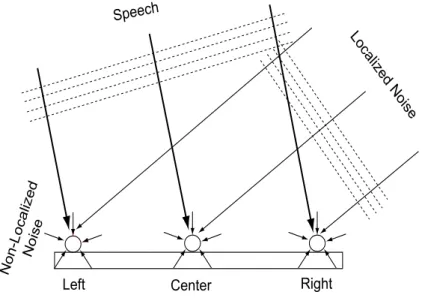
Though the problem of dealing with acoustic interfering noises has been researched for several decades and is still a challenging research topic due to the complex and time- varying characteristics of signals (speech and noise signals) and acoustic environments where the systems perform. In this research, interfering noise signals present in real conditions are considered to be of two components: localized noise coming from certain determinable directions and non-localized noise propagating in all directions. Note that localized noise might include stationary and non-stationary (e.g. sudden) noise compo- nents, white and colored noise components. Non-localized noise might include coherent and incoherent noise components as well. Noises with different characteristics from var- ious kinds of sources make it difficult to construct an effective noise reduction system.
Furthermore, the characteristics of noises do vary with time and environments, further increasing the difficulty of designing a noise reduction system. Moreover, only the system with small physical size is preferable because of the limited space, e.g., in car environ- ments or hearing aid. Also, considering the practical implementation, real-time processing is generally a “must” for noise reduction systems in real conditions.
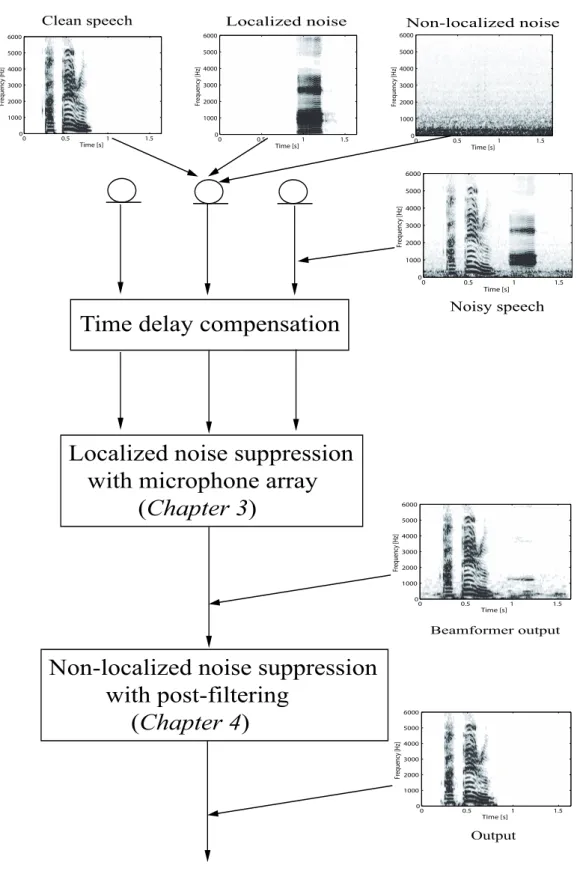
To suppress both localized and non-localized noises while keeping the desired speech signal distortionless, this research proposes a noise reduction system based on microphone array and post-filtering with the goal of improving the performance of speech recognition systems in adverse environments. This proposed noise reduction system follows the basic principle of the multi-channel Wiener filter, which is the optimal solution to the problem of minimizing the mean square error of the desired speech and its estimate and can further
be decomposed into a minimum variance distortionless response (MVDR) beamformer followed by a single-channel Wiener filter.
To deal with localized noise, Mizumachi et al. has reported a subtractive beamformer based algorithm which consists of three parts: noise direction estimation, noise spec- tral estimation and desired signal enhancement. However, this method fails to deal with localized noise in some frequencies and some directions because of the inherent spatial
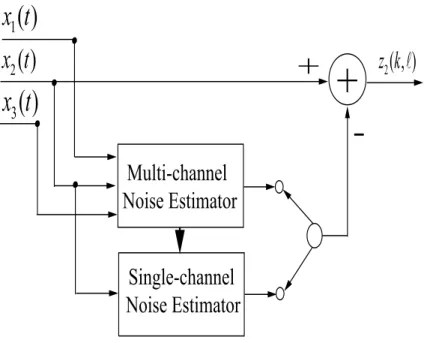
“NULLs” in its beam pattern. To solve this problem, we propose a hybrid noise estima- tion technique by combining the subtractive beamformer based multi-channel estimation approach and a soft-decision based single-channel estimation approach. The estimation accuracy of this hybrid technique is further improved by integrating arobust and accurate speech absence probability (RA-SAP) estimator. The experimental results show that this hybrid estimation technique provides much more accurate spectral estimates for localized noise than the multi-channel and single-channel estimation technique alone, respectively.
The estimated spectrum of localized noise is then compensated and suppressed from that of noisy observation on each microphone. This algorithm is able to suppress various lo- calized noise, especially sudden noise, using a small-size (3-channel) microphone array at a very low computational cost.
Moreover, note that the subtractive beamformer was derived based on paired micro- phones with the assumption of a perfectly coherent noise field. However, this assumption is seldom satisfied in practical environments. To solve this problem, we further develop a generalized subtractive beamformer by relaxing the assumption of a perfectly coherent noise field to the one of an arbitrary noise field. Following the ideas similar to those of the subtractive beamformer presented by Mizumachi et al., the generalized subtractive beamformer with a generalized sidelobe canceller (GSC) like structure is derived. The theoretical analysis is also presented to show the linkage between these two beamformers and to show the theoretical noise reduction performance of the generalized algorithm in the theoretically well-defined noise fields. The comparison of two beamformers is also discussed based on the realistic experimental results.
To further deal with the residual non-localized noise (coherent and incoherent noise components), post-filtering is normally used at beamformer output. Many post-filters, such as, Zelinski post-filter and McCowan post-filter, have been published so far. However, their performance is degraded due to the unrealistic assumption of a perfectly incoherent noise field (Zelinski post-filter) and the assumeda priori coherence function of the noise field (McCowan post-filter). To solve these problems, we propose a hybrid post-filter for microphone arrays with an assumption of a diffuse noise field which was proven to be successful in modelling the noise conditions in many practical environments (e.g., car environments and reverberant rooms). In the proposed hybrid post-filter, a modified Zelinski post-filter, which is estimated using the signals on the microphone pairs on which noises are uncorrelated by considering the correlation characteristics of noise impinging
on different microphone pairs, is applied to the high frequencies to suppress the spatially uncorrelated noise; a single-channel Wiener filter is applied to the low frequencies for cancellation of spatially correlated noise. The proposed hybrid post-filter shows some advantages: in theory, it is a Wiener filter; in practice, it can deal with both high- correlated and low-correlated noise components in a diffuse noise field. Experimental results using various recordings confirm the superiority of this hybrid post-filter with regard to other comparative post-filters.
The performance of the proposed noise reduction system is finally investigated as a front-end processor for a speech recognition system. The speech recognition experiments are performed using multi-channel real-world noise recordings, and the performance of the proposed noise reduction system is further compared with other traditional noise reduction systems in terms of speech recognition rate. The speech recognition results show that the proposed noise reduction algorithm outperforms the other traditional algorithms in improving the speech recognition performance in the tested adverse environments.
Compared with other traditional noise reduction algorithms, this proposed algorithm demonstrates some advantages: (1) in theory, it provides the optimal solution to the problem of multi-channel noise reduction for broad-band inputs inminimum mean square error (MMSE) sense; (2) it is able to deal with various kinds of noise signals, including localized and non-localized noise, stationary and non-stationary (e.g., sudden) noise; (3) it avoids the problems of slow convergence rate and low stability in practical environ- ments; (4) it can be implemented in real-time mode; (5) it is successful in improving the performance of hands-free speech recognition systems in adverse environments.
In addition to hands-free speech recognition systems, the noise reduction system pro- posed in this thesis is also useful and preferable to many other applications. For example, for speech communication system, it is able to improve the quality and intelligibility of the received speech signals. For hearing aid, it is able to provide more clean and intelligible speech, enhancing the performance of hearing aid to hearing impaired with a small-size microphone array at a low computational complexity in adverse conditions.
Acknowledgments
I am very happy to write this page because I can be expected to finish my doctor course soon. At this key time, I would like to express my sincere gratitude to the following people.
Firstly, I would like to acknowledge my supervisor, Professor Masato Akagi, for his great help and directions. I would like to thank Professor Akagi for his welcome me into his Lab. when I came to Japan knowing absolutely nothing about signal processing. I would like to thank Professor Akagi for frequently finding time for discussion, mitigating my confusion and successfully introducing me to the fascinating worlds of microphone array signal processing. Without his directions and help, it is impossible for me to finish my doctor course. The kindness, knowledgeability and personality of Professor Akagi deeply impressed me and will affect my career and my life for ever.
I would like to acknowledge Professor Jianwu Dang and Associate Professor Masashi Unoki, as two members of my thesis committee, for their invaluable suggestions and comments in my research. The discussions with Professor Dang and Associate Professor Unoki make my research progress continuously. The assistances from them make my life joyful in JAIST.
I would like to acknowledge Professor Yˆoiti Suzuki of Tohoku University in Sendai, Japan, as one member of my thesis committee, for his interest in my research and his kind welcome me into his Lab. for further research on microphone array signal processing after my graduation. I also would like to thank Professor Suzuki for his invaluable comments to improve the quality of this thesis and for finding the time to participate in the defense of my thesis.
I would like to acknowledge Professor Joerg Bitzer of University of Applied Sciences in Oldenburg, Germany, for his fruitful discussions and constructive suggestions in this research. He was very generous with his time and always quick to respond to my questions.
I would like to thank Dr. Xugang Lu for his help and discussions in my research, especially in speech recognition experiments. I am very happy to spend the past three years with him and we also have been good friends.
I would like to thank Dr. Mitsunori Mizumachi of Kyushu Institute of Technology in Fukuoka, Japan. As one alumni of our Lab., he gave me helpful suggestions and continuous encouragements in this research.
I would like to thank all the people that I know through my numerous business trips for their helpful discussions and for the great moments together. Especially, I would like to thank Professor Yutaka Kaneda of Tokyo Denki University in Tokyo, Japan, Dr. Sharon
Gannot of Bar-Ilan University in Ramat-Gan, Israel, and Dr. Wolfgang Herbord of ATR in Kyoto, Japan, for their constructive comments and suggestions.
I would like to thank Dr. Kazuhito Ito for his so kind help in the past years. Now, I still clearly remember that he took me to the hospital in the first year. He told me the exact time when I would go to hospital and then took me there. I was really surprised at his so impressive kindness.
I would like to thank my tutor, Mr. Hironori Nishimoto, for his so kind help in my daily life. So far, I still remember the scenario that Mr. Nishimoto picked me up at Komatsu station when I came to Japan on April 2, 2003. As my tutor and my first Japanese friend, he gave me a lot of help in my daily life and my research.
Also, I would like to thank Dr. Yuichi Ishimoto, Mr. Takeshi Saitou, Mr. Atsushi Haniu and all other members of the acoustic information science Lab. in JAIST who have always been helpful in making my life easier and colorful. Also, I would like to thank all my Chinese and Japanese friends in JAIST with who I have spent the past unforgettable three years.
There is no way I would be where I am today without the immeasurable love, support and encouragement of my parents. I can not thanks them enough for all the opportunities they have given me in my life and for always supporting me. They are an incredible inspiration to me.
Finally, I would like to thank the “Graduate Research Program (GRP)” in JAIST.
Since the beginning, this research was conducted as a program for the ”Fostering Talent in Emergent Research Fields” in Special Coordination Funds for promoting Science and Technology by Ministry of Education, Culture, Sports, Science and Technology. In the past years, I was supported by this program for my life in Japan and for my numerous business trips.
Contents
Abstract i
Acknowledgments iv
Glossary xiii
1 Introduction 1
1.1 Speech recognition applications . . . 2
1.2 Hands-free speech recognition challenges . . . 3
1.3 Noise reduction for hands-free speech recognition . . . 4
1.4 Noise reduction challenges . . . 5
1.5 State-of-the-art noise reduction techniques . . . 6
1.5.1 Single-channel noise reduction . . . 6
1.5.2 Multi-channel noise reduction . . . 8
1.6 Outline of the thesis and main contributions . . . 11
1.6.1 Research objectives . . . 11
1.6.2 Chapter by chapter overview and contributions . . . 13
1.7 Summary . . . 15
2 Basic principle and overview of the proposed noise reduction system 17 2.1 Characteristics of signals and acoustic field . . . 18
2.1.1 Speech signal . . . 18
2.1.2 Noise signal . . . 18
2.1.3 Acoustic environment . . . 19
2.2 Signal model and problem formulation . . . 19
2.2.1 Signal model . . . 20
2.2.2 Multi-channel noise reduction in the frequency domain . . . 21
2.3 Multi-channel Wiener filter . . . 22
2.4 Proposed noise reduction algorithm . . . 25
2.4.1 Signal model in the proposed system . . . 25
2.4.2 Overview of the proposed noise reduction algorithm . . . 25
2.5 Summary . . . 30
3 Localized noise suppression with microphone array 32
3.1 Introduction . . . 33
3.1.1 Fixed beamforming . . . 33
3.1.2 Adaptive beamforming . . . 33
3.2 Proposed localized noise suppression algorithm . . . 34
3.2.1 Overview of the proposed algorithm . . . 35
3.2.2 Hybrid noise estimation technique . . . 35
3.2.3 Localized noise suppression with spectral subtraction . . . 48
3.2.4 Experimental validation . . . 48
3.3 A generalized subtractive beamformer . . . 52
3.3.1 Problem formulation . . . 52
3.3.2 Derivation of the generalized subtractive beamformer . . . 53
3.3.3 Theoretical analysis . . . 56
3.3.4 Experimental validation . . . 58
3.3.5 Discussions . . . 62
3.4 Remarks on two subtractive beamformers . . . 63
3.5 Summary . . . 64
4 Non-localized noise suppression with post-filtering 71 4.1 Introduction . . . 72
4.2 Problem formulation . . . 74
4.3 Review of existing post-filters . . . 74
4.3.1 Zelinski post-filter . . . 74
4.3.2 McCowan post-filter . . . 75
4.4 Proposed microphone array post-filter . . . 76
4.4.1 Analysis of a noise field . . . 76
4.4.2 Proposed post-filter . . . 77
4.4.3 Analysis of proposed post-filter . . . 82
4.5 Experimental validation . . . 83
4.5.1 Experimental configurations . . . 83
4.5.2 Objective evaluation results . . . 84
4.5.3 Subjective evaluation results . . . 85
4.5.4 Discussions . . . 85
4.6 Summary . . . 86
5 Evaluation of proposed system with speech recognition 93 5.1 Introduction . . . 94
5.2 Principle of automatic speech recognition . . . 94
5.2.1 Feature extraction . . . 95
5.2.2 Decoding . . . 95
5.3 Speech recognition experiments . . . 98
5.3.1 Experimental configuration . . . 98
5.3.2 Experimental results . . . 100
5.3.3 Discussions . . . 102
5.4 Summary . . . 104
6 Conclusions and further research 105 6.1 Conclusions . . . 105
6.2 Suggestions for further research . . . 108
Appendix 110
References 112
Publications 126
List of Figures
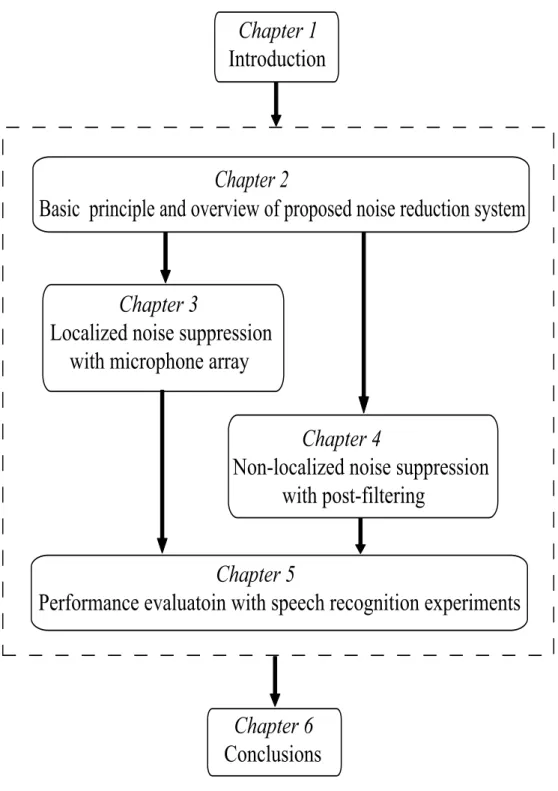
1.1 Schematic overview of the thesis. . . 16 2.1 Multi-channel noise reduction algorithm. . . 21 2.2 Microphone array and signal model assumed in the proposed noise reduc-
tion system. . . 26 2.3 Proposed noise reduction algorithm. . . 31 3.1 Microphone array for localized noise suppression. . . 35 3.2 Block diagram of the proposed algorithm for localized noise suppression. . 36 3.3 Block diagram of the proposed algorithm for localized noise suppression on
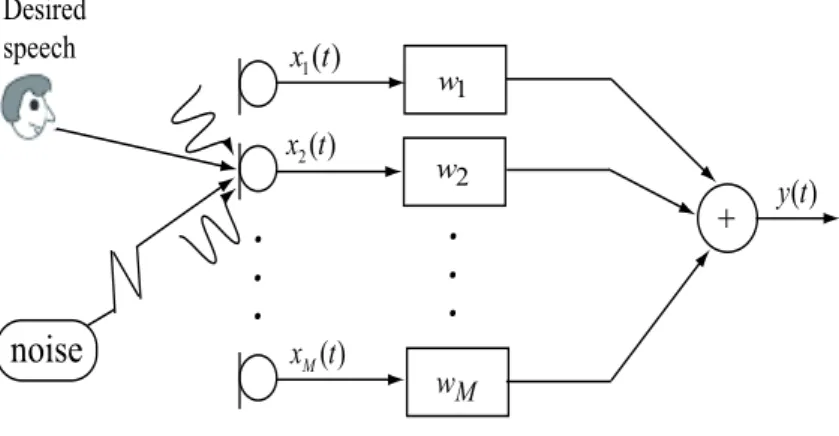
the second channel. . . 37 3.4 Multi-channel noise estimation approach. . . 39 3.5 Basic circuit of the multi-channel noise estimation/reduction system [1, 3]. 40 3.6 An example which shows the estimation error of the multi-channel estima-
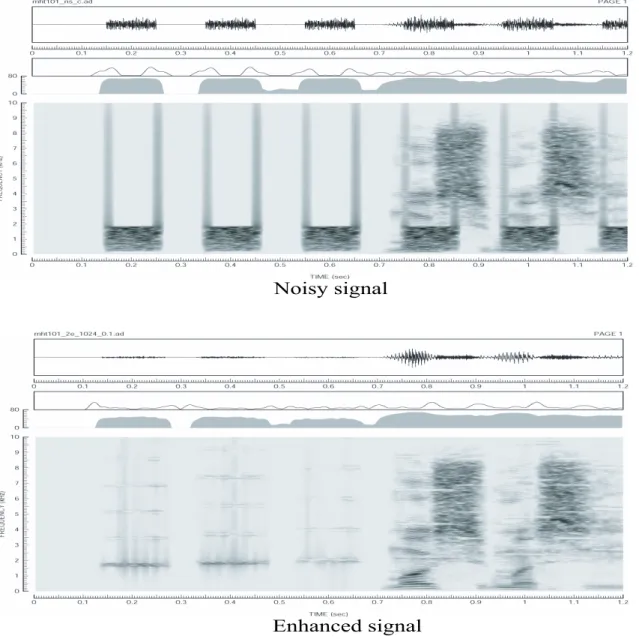
tion approach. Spectrogram of the noisy speech signal (top) and spectro- gram of the enhanced speech signal (bottom). . . 44 3.7 Normalized noise estimation error (dB) for signals processed by single-
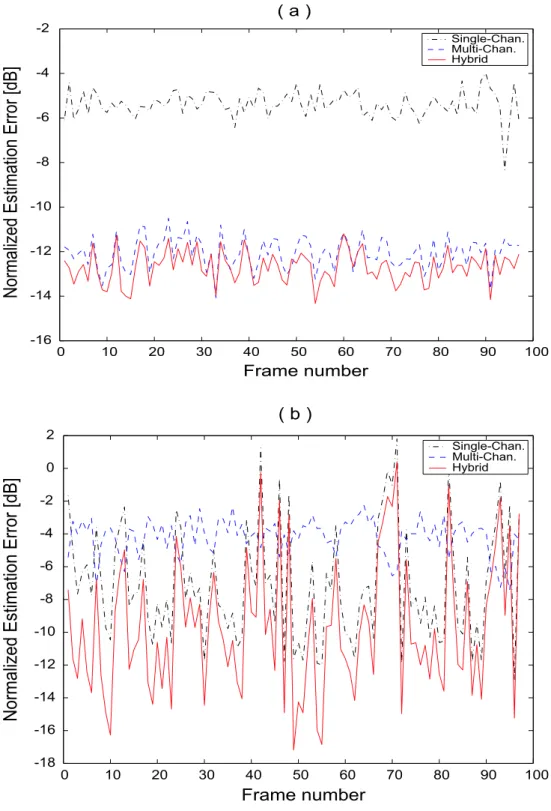
channel technique (dashdot), multi-channel technique (dashed) and hybrid technique (solid) under white noise conditions (a) and car noise conditions (b). . . 51 3.8 Block diagram of the generalized subtractive beamformer. . . 54 3.9 Noise reduction performance in a diffuse noise field for different numbers
of microphones (d= 10cm). . . 59 3.10 Noise reduction performance in a diffuse noise field for different distances
between adjacent microphones (M = 3). . . 59 3.11 Average segmental SNR (SEGSNR) inpseudo real-world environment
at delay-and-sum beamformer (DSBF) output (¤), original GSC beam- former (ORG-GSC) output (M), original subtractive beamformer based (ORG-SBF) algorithm output (♦) and proposed generalized subtractive beamformer based (PRO-GSBF) algorithm output(◦), in various noise con- ditions: speeds of 50km/h (a) and 100km/h (b). . . 65
3.12 Average segmental SNR (SEGSNR) inreal-world environmentat delay- and-sum beamformer (DSBF) output (¤), original GSC beamformer (ORG- GSC) output (M), original subtractive beamformer based (ORG-SBF) algo- rithm output (♦) and proposed generalized subtractive beamformer based (PRO-GSBF) algorithm output(◦), in various noise conditions: speeds of 50km/h (a) and 100km/h (b). . . 66 3.13 Average MFCC distance in pseudo real-world environmentat the first
microphone (×), delay-and-sum beamformer (DSBF) output (¤), original GSC beamformer (ORG-GSC) output (M), original subtractive beamformer based (ORG-SBF) algorithm output (♦) and proposed generalized subtrac- tive beamformer based (PRO-GSBF) algorithm output(◦), in various noise conditions: speeds of 50km/h (a) and 100km/h (b). . . 67 3.14 Average MFCC distance in real-world environment at the first mi-
crophone (×), delay-and-sum beamformer (DSBF) output (¤), original GSC beamformer (ORG-GSC) output (M), original subtractive beamformer based (ORG-SBF) algorithm output (♦) and proposed generalized subtrac- tive beamformer based (PRO-GSBF) algorithm output(◦), in various noise conditions: speeds of 50km/h (a) and 100km/h (b). . . 68 3.15 Speech spectrograms in pseudo real-world environment. (a) original
clean speech signal at the first microphone: “dozo yoroshiku”; (b) noisy signal at the first microphone (SNR = 10 dB); (c) delay-and-sum beam- former (DSBF) output; (d) original GSC beamformer (ORG-GSC) output;
(e) original subtractive beamformer based (ORG-SBF) algorithm output;
(f) proposed generalized subtractive beamformer based (PRO-GSBF) al- gorithm output. . . 69 3.16 Speech spectrograms in real-world environment. (a) original clean
speech signal at the first microphone: “hatinohe kesennuma yukuhasi”;
(b) noisy signal at the first microphone (SNR = 10 dB); (c) delay-and- sum beamformer (DSBF) output; (d) original GSC beamformer (ORG- GSC) output; (e) original subtractive beamformer based (ORG-SBF) al- gorithm output; (f) proposed generalized subtractive beamformer based (PRO-GSBF) algorithm output. . . 70 4.1 Magnitude-squared coherence functions of theoretical diffuse noise field
(solid), and in various car environments: 50km/h (dotted) and 100km/h (dashed). (d = 10cm). . . 77 4.2 Block diagram of the proposed post-filter. . . 78 4.3 Magnitude-squared coherence function of theoretical diffuse noise field (solid),
multi-microphone inputs (dash-dotted) and outputs of the localized noise suppression algorithm (dash). (d = 10cm). . . 82
4.4 Directivity index of the superdirective beamformer (M=3, d=10cm). . . . 84 4.5 Average segmental SNR (SEGSNR) inpseudo real-world environment
at beamformer output (¤), Zelinski post-filter output (♦), McCowan post- filter output (+), single-channel Wiener filter output (M), proposed post- filter output(◦), in various noise conditions: 50km/h (a) and 100km/h (b). 87 4.6 Average segmental SNR (SEGSNR) inreal-world environmentat beam-
former output (¤), Zelinski post-filter output (♦), McCowan post-filter output (+), single-channel Wiener filter output (M), proposed post-filter output(◦), in various noise conditions: 50km/h (a) and 100km/h (b). . . . 88 4.7 Average MFCC distance in pseudo real-world environmentat the first
microphone (×), beamformer output (¤), Zelinski post-filter output(♦), McCowan post-filter output(+), single-channel Wiener filter output(M), proposed post-filter output(◦), in various noise conditions: 50km/h (a) and 100km/h (b). . . 89 4.8 Average MFCC distance in real-world environment at the first micro-
phone (×), beamformer output (¤), Zelinski post-filter output(♦), Mc- Cowan post-filter output(+), single-channel Wiener filter output(M), pro- posed post-filter output(◦), in various noise conditions: 50km/h (a) and 100km/h (b). . . 90 4.9 Speech spectrograms in pseudo real-world environment. (a) Original
clean speech signal at the first microphone: “dozo yoroshiku”; (b) Noise signal at the first microphone; (c) Noisy signal at the first microphone (SNR = 10 dB); (d) Beamformer output; (e) Zelinski post-filter output; (f) McCowan post-filter output; (g) Single-channel Wiener post-filter output;
(h) Proposed post-filter output. . . 91 4.10 Speech spectrograms in real-world environment. (a) Original clean
speech signal at the first microphone: “hatinohe kesennuma yukuhasi”; (b) Noise signal at the first microphone; (c) Noisy signal at the first microphone (SNR = 10 dB); (d) Beamformer output; (e) Zelinski post-filter output; (f) McCowan post-filter output; (g) Single-channel Wiener post-filter output;
(h) Proposed post-filter output. . . 92 5.1 Calculation of mel-frequency cepstral coefficients from a frame of speech. . 96 5.2 Block diagram of the speech recognition system with a front-end processor
of the proposed noise reduction algorithm. . . 99 5.3 Speech recognition results for the data set Ain which speech signals are
corrupted by car noise. . . 103 5.4 Speech recognition results for the data data set B in which speech sig-
nals are corrupted by car noise and passenger’s interfering voice (localized interfering noise). . . 103
List of Tables
3.1 Average NEEs [dB] in various noise conditions . . . 50 5.1 Pronunciations of digits . . . 100 5.2 Specification of the speech recognition system . . . 101
Glossary
Mathematical Notation
s(t) desired speech signal xm(t) signal on m-th microphone
Xm STFT ofxm(t)
X stacked signal vector ofXm
XT transpose of X
XH complex transpose ofX
X† conjugation transpose of X
φxx auto-power spectral density of x(t)
φxy cross-power spectral density of x(t) and y(t) Φxy cross-power spectral density vector ofX and Y Φxx auto-power spectral density matrix of X
Φxy cross-power spectral density matrix of X and Y
Γµν noise coherence function betweenµ-th andν-th microphone signal
Γ noise coherence matrix
∂ differential operator
∀ for all
arg parameter operator
max maximum operator
< real part
P(w|O) probability of w given O P(w) probability of w
E{·} expectation operator
|Φ| cardinality of set Φ
{µ, ν} microphone pair of µ-th and ν-th microphones IFFT[·] inverse Fourier transform operator
Fixed Symbols
am impulse response between speech source and m-th microphone b normalized window for frequency smoothing
c velocity of sound
d distance between adjacent microphones (uniform linear array) dmf cc Mel-frequency cepstral coefficient distance
dµ,ν distance between µ-th microphone and ν-th microphone
e error signal
fs sampling frequency
ft transient frequency
ftm transient frequency of m-th microphone pair
h window function (hamming window)
i sub-band index
j imaginary unit: √
−1
k frequency index
k˜ frequency index in sub-band
l point index in a frame
m microphone index
mf cci i-th mel-frequency cepstral coefficient nm(t) additive noise signal onm-th microphone ncm(t) localized noise component on m-th microphone nucm(t) non-localized noise component on m-th microphone no noise signal at beamformer output
p index for localized noise
q speech absence probability
q0 the a priori speech absence probability so desired signal at beamformer output xm(t) observed noisy signal on m-th microphone
y system output
Am transfer function between speech source and m-th microphone
Bm m-th sub-band
D length of the normalized windowb
Di noise components after localized noise suppression Gmz gain function of modified Zelinski post-filter Gs gain function of single-channel Wiener post-filter
I number of sub-band
K length of short-time Fourier transform
L frame length, window length
Nm STFT of nm
Nˆc localized noise spectral estimate
Nˆmul,ic localized noise spectral estimate in i-th sub-band using the multi-channel technique
Nˆsig,ic localized noise spectral estimate in i-th sub-band using the single-channel technique
P number of localized noise sources
Plocal, Pglobal, Pf rame speech presence probability in a local frequency window, a larger frequency window, and neighboring frames
Q state number for a word
R frame shift
S STFT of s
SNRpriori the a priori SNR for post-filter Wiener post-filter SNRpost the a posteriori SNR for Wiener post-filter
Uµν STFT of uµν
Wm gain function on m-th channel
WM V DR gain function of the superdirective beamformer
Y STFT of y
YF BF fixed beamformer output
YN C noise canceller output
Yo output of the generalized subtractive beamformer Zi output of localized noise suppression
A transfer function vector ofAm
B blocking matrix
B1,B2 matrixes for blocking matrix
H noise canceller filter
Hopt optimal solution of H
Hˆopt estimate of ˆHopt
N noise signal vector of Nm
S set of all possible state sequences
s state sequence
W gain function vector
Wopt optimal gain function vector
w set of all possible word sequence that can be hypothesized by the recognition system
α overestimation factor
β spectral floor factor
αn, αs, βs forgetting factors
` frame index
ζ time delay of desired speech between adjacent microphones δp time delay of p-th localized noise between adjacent microphones
µ, ν index of microphone
uµν subtractive beamformer using signals xµ and xν
ε band-width of sub-band
ε1,ε2 thresholds
τ any value expect to zero
ξ the a priori SNR
γ the a posteriori SNR
ξ,˜ ˜γ frequency-smoothed ξ, γ ξ,¯ ¯γ time-frequency-smoothed ξ, γ
δµν time delay of localized noise between µ-th and ν-th microphone
Ωm m-th microphone pair set
φxx auto-power spectral density of x
µwıρ mean vector associated with the k-th Gaussian in the mixture density of state i of the HMM of word w
Φ set of frames with speech present
O sequence of feature vectors
N Gaussian distribution
Pw
ıρ covariance matrix associated with the k-th Gaussian in the mixture density of state ı of the HMM of wordw
Acronyms and Abbreviations
AR auto-regressive
ASR automatic speech recognition
BM blocking matrix
BSS blind source separation
DCT discrete cosin transform
DFT discrete Fourier transform
DI directivity index
DOA direction of arrival
DSBF delay-and-sum beamformer
DSWF delay-and-sum beamformer with Wiener post-filter
AR auto-regressive
ASR automatic speech recognition
BM blocking matrix
BSS blind source separation
DCT discrete cosin transform
DFT discrete Fourier transform
DI directivity index
DOA direction of arrival
DSBF delay-and-sum beamformer
DSWF delay-and-sum beamformer with Wiener post-filter
FBF fixed beamformer
GCC generalized cross-correlation GSC generalized sidelobe canceller
GSVD generalized singular value decomposition
HMM hidden markov model
ISTFT inverse short-time Fourier transform
ITD interaural time difference
KLT Karhunen-Loeve transform
LCMV linearly constrained minimum variance
LMS least mean square
MAP maximum a posterior
MA-LSA microphone arrays with OM-LSA based post-filtering MFCC mel-frequency cepstral coefficient
MMSE minminum mean square error
MSC magnitude-squared coherence
MVDR minimum variance distortionless response
MWF multi-channel Wiener filter
NC noise canceller
NEE normalized estimation error
NR noise reduction performance
OLA overlap-and-add
OM-LSA optimally-modified log-spectral amplitude
ORG-GSC original generalized sidelobe canceller ORG-SBF original subtractive beamformer
PATH phase transform
PRO-GSBF proposed generalized subtractive beamformer
PRO-MAPF proposed noise reduction algorithm with microphone and post-filtering
PSD power spectral density
RA-SAP robust and accurate speech absence probability
SAP speech absence probability
SEGSNR segmental SNR
SNR signal-to-noise ratio
STFT short-time Fourier transform
SVD singular value decomposition
TDC time delay compensation
TDE time delay estimation
TF-GSC transfer function generalized sidelobe canceller
VAD voice activity detection
Chapter 1 Introduction
Speech is the most natural and most important means of communication between human beings. Hence, research on speech sciences and technologies has been going on for cen- turies to understand the mechanism and process of the production, communication and perception of speech.
The production process begins with formulating a message that is to be transmitted from the talker to the listener via speech. The message is subsequently converted into a language code and a sequence of neuromuscular commands are executed, resulting in the vibration of a series of structures in the human vocal system and thereby producing an acoustic signal at the final output. The machine counterpart to the process of speech production is the speech synthesizer [127].
Once the speech signal is transmitted to the listener via communication channel, the perception process begins. The incoming acoustic signal is first analyzed along the basilar membrane in the inner ear. The output signal at the output of the basilar membrane is subsequently converted into activity signal. Finally the neural activity signal along the auditory nerve is converted into a language code, which is further understood and com- prehended within the brain. The machine counterpart to the process of speech perception is the speech recognizer [127].
From the point of view of signal processing, the field of speech signal processing is essentially an application of signal processing techniques to speech signals. The explosive advances in recent years in the field of digital signal processing have provided a tremen- dous boost to the field of speech signal processing. The rapid development of speech signal processing techniques has stimulated the emergence and application of many speech tech- niques and products, such as, speech synthesizer, mobile phone and automatic speech recognition (ASR) system.
1.1 Speech recognition applications
Among the speech applications which emerged in recent years, speech recognition systems are becoming increasingly important in many aspects in modern society. Some applica- tions of speech recognition systems are of high interest to be mentioned, which provide the interest and motivation to further research on the speech recognition technology.
Speech recognition systems have influenced on the writing process. The powerful and intricate connection between thought and speech has recently been recognized. Often, it is believed that dictating a document allows a writer to produce much more fluid, natural and expressive writing than if he/she had typed it manually. One extremely promising area in which speech recognition has already yielded significant benefits is enabling or facilitating the writing process for disabled writers [166].
Speech recognition systems have influenced on communication. At its core, speech recognition is a technology centered around the human voice and still our most fun- damental means of communicating, connecting, and collaborating with others. Speech recognition could unlock an altogether new form of human-computer communication:
the dialogue-based interface. Dialogue enhances the richness of the interaction and allows more complex information to be conveyed than is possible in a single utterance. Moreover, such a means of interaction would provide substantially more flexibility to the user and offer a more intuitive interface than do conventional systems. Speech recognition could also have a profound impact on the way humans communicate with each other. Current forms of interaction, such as blogging or instant messaging, might be forced to adapt (or become obsolete), as speech systems become more prevalent [166].
Speech recognition systems have influenced on the human-computer interface. Speech recognition systems hold the potential to unlock the treasure trove of data, creating a searchable index of information and placing it at users’ fingertips just as conventional search engines have done with the World Wide Web. Speech recognition systems have already been proven useful in a number of specific domains of knowledge. Gaming is another realm of human-computer interaction in which speech recognition could play a significant role. It has been recognized that the opportunity to add functionality and enhance the user experience using this technology, making games more lifelike [166].
Specifically, more and more recognition systems are put into use in our daily lives to switch lights on and off, to control electronic equipments (e.g., TV, keyboards and but- tons), etc. in a easy and user-friendly interface [123, 127]. Another promising application is in vehicle environments where recognition systems can be used to retrieve information from navigation system or perform simple control tasks [26, 61, 108, 119, 164]. As a fun- damental human activity, meetings also provide an important and potential application domain for ASR technology [120].
1.2 Hands-free speech recognition challenges
The past several decades have witnessed the significant advances on ASR technology. As a result, state-of-the-art recognition systems have demonstrated high recognition accuracy for the situations where there is a good match between testing and training conditions.
However, their performance drastically degrades when they are applied to real-world en- vironments. Obstacles to robust recognition systems include degradations produced by acoustical disturbances, the effects of linear filtering, nonlinearities in transduction or transmission, as well as impulsive interfering sources, and diminished accuracy caused by changes in articulation produced by the high-intensity noise sources (i.e. Lombard effect) [123, 127]. Additionally, when the language/dialogue model becomes more com- plex, the variability in talking style may increase and one can expect that the talker will often speak in spontaneous mode, which further deteriorates the performance of speech recognition systems [127]. As speech recognition and spoken language technologies are being transferred to real applications, therefore, robustness in recognition technology is increasingly called for.
This research is particularly interested in those environments in which either safety or convenience precludes the use of close-talking microphones. For example, while operating a vehicle, the act of wearing microphones is distracting and dangerous. In a meeting room, microphones restrict the movement of the participants. In these situations and others, the users suffer a frustrating experience caused by the close-talking interaction.
Hence, flexibility in the recognition technology is substantially called for to extend its use in a wide variety of real applications [51, 61, 63, 123].
One of the most attractive feature that improves the flexibility of recognition systems is hands-free interaction, where the user is not encumbered anymore by hand-held or head- mounted microphones and can talk up to a distance of some meters from the microphones.
Therefore, hands-free speech recognition offers a remarkable flexibility and represents a very ambitious task, especially when considered for the applications of moderate and high complexity [40, 42, 49, 50, 123, 131].
In hands-free technology, as the distances between the user and the microphones grow, the speech signals become increasingly corrupted by the effects of acoustical interfering signals (e.g., environmental noise, reverberation and acoustical echo) [42, 123]. Sources of ambient noises are abundant. For example, in a room, noise sources might include personal computer, typewriter (from some certain directions) and background conversation of other people (from all directions, or, from some undeterminable directions). In a vehicle, noises mainly come from all directions, e.g., generated by wind, especially when the car is running at high speeds; other noises might come from radio or other passengers with certain directions. Moreover, environments in which hands-free recognition systems perform are generally reverberant conditions to a certain degree, which is caused by the reflections of signals by the walls and the furniture existing in the room [40]. In addition, acoustic
echo is another type of disturbance for the signals picked up by distant microphones [145].
These acoustic interfering signals substantially degrade the speech recognition accuracy in noisy environments. Practically, to apply hands-free recognition system in real-world applications, it would be necessary to account for other various factors related to the means of hands-free interaction. For example, the talker’s position may be unknown and time-varying in an unpredictable fashion; head movements, even subtle movements, may influence the quality of the input signal, due to the sound attenuation and talker radiation effects [40, 119, 145, 164]. Especially, background noise and acoustic characteristics (e.g., reverberation and acoustic echo) of the environment play an important role for hands-free speech recognition systems.
For these reasons and others, there are many challenging and as yet unsolved problems in this field. As environmental noise has become one main obstacle to commercial use of speech recognition techniques in a hands-free interaction. This thesis is mainly focusing on combating environmental undesirable acoustic noises and enhancing the desired speech signal, with the objective of reducing the mismatch between training and testing condi- tions and further improving the performance and robustness of hands-free recognition systems in real-world adverse environments.
1.3 Noise reduction for hands-free speech recognition
In real conditions, speech recognition systems are often exposed to various kinds of noises, which might arise from audio equipments, traffic and other speakers present in the envi- ronments (i.e., cocktail party noise). Noises degrade the quality of speech, resulting in the mismatch between training and testing conditions and further degrading the recognition rate of speech recognition systems.
To combat the background acoustical noises and improve the performance of speech recognition systems in the presence of disturbances, two basic ways are possibly adopted:
(1) training the acoustic speech models of the recognizer engine using the speech database corrupted by the corresponding noises, which is referred to as model adaptation; (2) ap- plying a front-end noise reduction system to suppress the background noises and improve the quality of the speech signals which are to be recognized [119, 123, 127, 153]. The first option may yield robust and high recognition performance if sufficient noise scenarios are included in the training procedure, but the drastic recognition performance decrease is expected if only limited noise conditions are considered in the training phase (i.e., the mismatch between training and testing conditions can not be reduced) and/or high time- varying non-stationary acoustic noise signals are present. Therefore, although the model adaptation technique has shown acceptable recognition performance in some controlled conditions, only limited performance improvement can be achieved by using the model adaptation technique in real noisy conditions [123, 127, 153]. Considering the complex
and time-varying characteristics of real noisy environments, the second option (i.e., a front-end processor) provides a promising solution to the problem of suppressing the un- desired noise signals, and has been widely researched and used as a front-end processor for speech recognition systems due to its effectiveness and flexibility. This kind of algo- rithm is based on the fact that the increased speech quality will also improve the speech recognition performance, which was proved to be effective although they are not corre- lated directly [119, 123, 127, 153]. This research is focusing on developing a practically effective and computationally efficient noise reduction system as a front-end processor to improve the recognition performance and robustness of a speech recognition system in adverse environments.
1.4 Noise reduction challenges
As a very effective way of increasing the speech quality and improving the performance of speech recognition systems, noise reduction has been studied for several decades and is currently still a challenging research topic. So far, a wide variety of noise reduction algorithms have been published [1, 3, 6, 11, 13, 22, 28, 43, 44, 52, 54, 62, 79, 80, 100, 114, 152], however, few of them can be applied to and can achieve acceptable noise reduction performance in practical environments.
The challenges are mainly caused by the complex and time-varying characteristics of the signals (speech and noise signals) and practical acoustic environments where recogni- tion systems perform. Desired speech signals have a broad-band and high time-varying spectral components [40]. In practical environments, interfering noise signals are of very complex and time-varying properties. Take the noise condition in a car environment as an example. Noises generated by winds around the car come from all directions and have slow time-varying spectral components including coherent and incoherent noise compo- nents as well, which are generally modelled as diffuse noises [40, 88, 108]. Noises generated by engine come from certain directions and have slow time-varying spectral components.
While, undesired interfering noises, such as passenger’s voice and radio, have some de- terminable directions and highly non-stationary speech-like spectral components. Noises with different characteristics from various kinds of sources make it difficult to construct an effective noise reduction system. Furthermore, the characteristics of noises do vary with time and environments in a unpredictable fashion, further increasing the difficulty of designing a noise reduction system [26, 61, 119, 164]. Additionally, only the system with small physical size is preferable because of the limited space, e.g., in car environments and for hearing aids. Also, considering the practical implementation, real-time processing is generally a “must” for noise reduction systems in real conditions [1, 2, 3, 40, 145].
1.5 State-of-the-art noise reduction techniques
To suppress various background noises, a variety of noise reduction algorithms have been published in the literature [1, 2, 3, 6, 11, 13, 22, 28, 43, 44, 52, 54, 62, 79, 80, 100, 114, 142, 144, 152]. The different noise reduction algorithms can be classified into two categories, single-channel technique and multi-channel technique, according to the number of microphones needed in the implementation. In this section, we will summarize the different state-of-the-art noise reduction algorithms presented in the past several decades.
1.5.1 Single-channel noise reduction
A variety of single-channel noise reduction techniques, which exploits spectral and tem- poral differences between the speech and noise signals to suppress acoustical noises, have been proposed for speech recognition purposes [46, 67, 102]. Basically, these single-channel techniques compute estimates of the short-term spectral characteristics of the speech and the noise. These estimates are then combined according to a certain optimization criterion to produce an enhanced speech signal.
Single-channel noise reduction algorithms can be broadly classified into parametric and non-parametric approaches. Parametric techniques model the speech and sometimes also the noise as a stochastic auto-regressive (AR) model [53, 124]. Based on the es- timates of AR-parameters, a Kalman filter is computed which is then applied to the noisy speech signal. Non-parametric techniques do not estimate the speech parameters, but rather exploit an estimate of the noise statistics to produce an enhanced speech sig- nal [6, 13, 43, 44, 45, 152]. In recent years,non-parametric techniques have been paid more attention and been dominant techniques in the single-channel scenarios. Single-channel noise reduction and speech enhancement techniques normally operate in the transform domain: the frequency domain by the discrete Fourier transform (DFT) [6, 13, 43, 44], the wavelet domain by the wavelet transform [70], thediscrete cosin transform (DCT) do- main [142, 144] and in the domain using theKarhunen-Loeve Transform (KLT) [45, 128].
In non-parametric techniques, several typical noise reduction algorithms with their vari- ants are of interest to be mentioned. Spectral subtraction first calculates the short-time spectral estimates of noise signals and then reduce the noise estimates from those of noisy observations [6]. Some improvements on spectral subtraction were performed by non-linear techniques [13], in other transform domains (e.g., wavelet domain, cepstral domain and DCT domain) and by combining some other signal modelling or estima- tion techniques [64, 72, 121, 140, 162]. Wiener filter, in principle, is closely related to spectral subtraction and yield the optimal solution in minimum mean square error (MMSE) sense [146]. Single-channel subspace-based techniques decompose the space of noisy signals into the perpendicular noise-only subspace and speech-plus-noise subspace by the means of a generalized singular value decomposition (GSVD) (or the KLT). The
desired speech signal is then enhanced by extracting the speech components from the components in speech-plus-noise subspace based on some optimization criterion with cer- tain constraints [45, 128]. Another class of single-channel noise reduction techniques, referred to as stochastic modelling based algorithms, has been paid more attention in recent years [22, 58, 59, 107, 134]. In these techniques, speech and noise are assumed to follow a certain priori distribution (e.g., Gaussian distribution, Laplacian distribution and Gamma distribution) in some transformed domain (e.g., spectral domain, power spectral domain). Model parameters of speech signal are then estimated according to a certain optimization criterion (e.g., MMSE or maximum a posterior (MAP)) and speech signal is finally recovered based on the estimated parameters of speech model.
The key point for single-channel non-parametric noise reduction algorithms is to cal- culate the noise spectral estimates with a high accuracy. Generally, single-channel speech enhancement techniques assume that the noise statistics are more stationary than the statistics of speech so that they can be estimated during noise-only periods. Hence, tra- ditionally, the noise signal estimate is commonly adapted from the most recent recording, i.e., a few seconds before the speech is present, or voice activity detection (VAD) algo- rithms are used to distinguish the each frame and/or each frequency bin to noise-only or speech-plus-noise period and the noise signal is then estimated in the detected noise- only periods [15, 27, 58, 69, 150]. Recently, a minimum statistics approach has been proposed by Martin [105, 106]. In this approach, the power spectral densities of the observed noisy signals in the past several frames are stored and the noise power spec- trum is then estimated by tracking the minimum value of the stored spectra. This noise spectral estimate is finally compensated by the fixed [105] or adaptive [106] bias com- pensator. The minimum statistic noise estimation technique is able to update the noise spectrum even in speech present periods [105, 106]. In addition, note that the VAD-based noise estimation technique is exactly a hard-decision mechanism since each frame and frequency band are judged as speech-present or speech-absent state absolutely. The per- formance of this hard-decision technique can be further improved. Therefore, recently, a soft-decision based noise estimation approach has been proposed and widely used as well [5, 28, 29, 31, 32, 34, 55, 101, 141, 143]. The soft-decision estimation approach con- siders, from the stochastic point of view, the probability of one frame and one frequency band which include desired speech components. Therefore, it also can update the noise spectral estimates even in speech active periods in a soft-decision mode by integrating the speech presence/absence probability.
Remark
Although an increase in global SNR has been reported in many cases, single-channel noise reduction algorithms have so far produced no or limited benefit for improving the
local SNR in each frequency band since they can only differentiate between signals that have different temporal and spectral characteristics. Further, they only showed very limited capability in improving the performance of speech recognition systems [6, 13, 43, 44, 46, 67, 152]. This fact indicates that an increase in SNR does not automatically yield an increase in recognition rate. In real conditions, the speech and noise signals are considerably overlapped in the time-frequency domain, which makes it extremely difficult for single-channel techniques to substantially eliminate most of noise components without introducing speech distortion and artifacts (e.g., musical noises). Especially in low SNRs and spectrally highly non-stationary noise (such as babble noise) which are typical ingredients of a cocktail-party situation, the single-channel noise reduction techniques suffer from a low noise reduction performance [6, 44, 46, 67]. As a result, single-microphone techniques can achieve very limited improvements in suppressing noise and enhancing the speech recognition performance.
The limited benefit of single-microphone techniques for speech recognition is mani- fested by the growing tendency in the development of recognition systems towards the use of directional microphone(s) and/or multi-microphone techniques in recent years [12, 17, 111, 120, 127]. In addition to the temporal and spectral characteristics, the multi- microphone techniques also allow to exploit the spatial diversity of the speech and noise signals, resulting in the highly improved noise reduction performance and speech recog- nition accuracy [12, 17, 110, 111].
1.5.2 Multi-channel noise reduction
To overcome the performance limitations of single-channel noise reduction techniques which use the temporal/spectral characteristics of speech and noise signals, multi-channel techniques have attracted more research interests and showed great potential ability in reducing noise by exploiting the additional spatial information of signals and environ- ments [1, 2, 3, 8, 9, 12, 17, 18, 23, 24, 26, 32, 33, 34, 36, 39, 40, 42, 48, 49, 51, 52, 54, 61, 62, 73, 74, 79, 81, 82, 83, 95, 100, 103, 113, 114, 115, 120, 123, 135, 136, 145, 148, 154, 155, 157, 163, 164]. In most scenarios, the desired speech source and interfering noise source are physically located at different positions in space. Exploiting the spatial diver- sity of the signals, multi-channel techniques can steer a main beam towards the desired speech source and/or nulls towards the interfering noise sources. The use of spatial diver- sity further provides more noise reduction ability to multi-channel techniques. Generally, multi-channel techniques can be classified into beamforming techniques and blind source separation techniques.
Beamforming techniques
The first class of beamforming techniques is fixed beamforming. In fixed beamforming techniques, the filter coefficients are normally optimized so that a beam is steered to the direction of the desired signal while suppressing the background noise coming from other directions as much as possible. These optimized filters are fixed, independent of the input signals, and then applied to the multi-channel microphone inputs. Typical fixed beamforming techniques include delay-and-sum beamforming [17, 83], differential microphone arrays [42, 83] and superdirective beamforming [8, 39]. Fixed beamforming techniques are widely used in the conditions where the acoustical characteristics do not change with time. However, using the fixed beamforming techniques, it is generally not possible to design arbitrary spatial directivity patterns for arbitrary microphone array configurations and design spatial directivity patterns which can be optimized to the time- varying acoustical environments [83].
The second class of beamforming techniques is adaptive beamforming. In contrast to fixed beamforming techniques, adaptive beamforming techniques make use of data- dependent filter coefficients that are adapted to respond to time-varying environments, yielding a better noise reduction performance than fixed beamforming techniques, particu- larly if the number of interferences is small (i.e., smaller than the number of microphones) and in the acoustic environments with less reverberation [7, 12, 23, 24, 40, 49, 52, 62, 79, 83, 103, 108, 145].
Adaptive beamforming techniques (e.g., the Frost beamformer [52, 148]) typically solve a linearly constrained minimum variance (LCMV) optimization problem, keeping the signals arriving from the desired look-direction (i.e., ideally the direction of the desired speech source) distortionless while suppressing the signals from other directions by mini- mizing the output power or output noise power. A generalized sidelobe canceller (GSC) beamformer [62], first presented by Griffiths and Jim as an alternative implementation structure of the LCMV beamformer, has also been widely researched. The GSC beam- former transforms the constrained optimization problem as an unconstrained optimization problem. The GSC beamformer consists of a fixed beamformer, creating a so-called speech reference signal; a blocking matrix, creating the so-called noise reference signals; and a multi-channel adaptive filter, eliminating the (noise) components in the speech reference signal which are correlated with the noise reference signals. In addition, a wide variety of noise reduction algorithms based on the GSC beamformer have so far been suggested, which are of interest to be mentioned [8, 17, 34, 34, 49, 54, 69, 122, 145]. Bitzer et al. presented an alternative implementation algorithm with a GSC structure for the su- perdirective beamformer and its performance was also analyzed in a diffuse noise field [8].
Fischeret al. proposed to apply a Wiener filter in the upper path of the GSC beamformer to suppress the uncorrelated noise components and then the correlated noise components are then reduced by the adaptive noise canceller in the lower path [49]. Recently, the
GSC beamformer was extended to atransfer function generalized sidelobe canceller (TF- GSC) beamformer by considering the transfer functions which relate the speech source and the microphones [54], which was shown to yield high noise reduction performance in practical environments. Moreover, the theoretical performance of the GSC beamformer and TF-GSC beamformer was widely examined in the diffuse noise field [7, 122, 145].
However, in all variants of the LCMV and GSC beamformers, adaptive signal processing techniques (e.g., least mean square (LMS)) were normally used to avoid cancellation of the desired speech signal, which introduces low convergence rate in practical environments and low ability in reducing non-stationary noise (e.g., sudden noise) [40, 52, 62, 54, 145].
To accelerate the convergence rate of the adaptive beamformers, the frequency-domain implementation of the GSC beamformer and the two-dimensional LMS implementation were introduced and further applied to the GSC beamformer [4, 23]. However, adaptive processing systems still do not show a high enough convergence rate and a high stability in real conditions.
Another class of multi-channel noise reduction techniques is multi-channel Wiener filtering (MWF) [17, 40, 145]. These techniques provide a minimum mean square error (MMSE) estimate of the (reverberant) speech signal in one of the microphone signals.
In contrast to adaptive beamformer techniques, MWF techniques exploit both spectral and spatial differences between the speech and the noise sources, resulting in a higher noise reduction performance and inevitably introduces some speech distortion. Different MWF techniques include the GSC with single-channel post-filter [17], the MWF using calibration sequences [57] and the MWF with unknown reference [40, 145]. Traditionally, the MWF with unknown reference does not need the priori information about the signals, therefore, it provides much robust noise reduction performance. However, the MWF with unknown reference techniques introduces very high computational complexity, making it unreasonable and unfeasible for the practical real-time applications [40, 145].
Blind source separation
Blind source separation(BSS) is another class of multi-channel noise reduction techniques, which has also been researched in recent years [73, 100, 125, 153]. BSS recovers indepen- dent source signals by using only the information of mixed signals observed at all input channels. In this technique, neither the sources nor any information about the way these sources are mixed is known to the user. The basic assumption of BSS is that the source signals are statistically independent, which is however not always true in practical envi- ronments. For BBS technique, there are two basic kinds of implementation approaches, i.e., the time-domain BSS and the frequency-domain BSS. The time-domain BSS demon- strates a slow convergence rate due to its high computational cost for long FIR filters in the convolutive mixture scenarios. To accelerate the time-domain BSS, the frequency-domain BSS is widely considered by separately considering the instantaneous mixtures at each
frequency. However, some other problems, e.g., permutation problem, underdetermina- tion and circularity, are involved in the frequency-domain BSS [73, 100]. These problems are considered to be inevitable even if the time-domain BSS and the frequency-domain BSS are combined, where some benefits from the frequency-domain BSS are expected.
Therefore, although BSS seems to be promising approach to estimate speech signal (in another sense, reducing background noise), their performance will be degraded due to a large number of problems in the implementation procedure in practical environments.
Remark
Target speech and interfering noise generally originate from different spatial positions, though they might have similar spectral properties in the time-frequency domain. There- fore, in comparison of single-channel noise reduction algorithms, multi-channel noise re- duction algorithms have shown high noise reduction performance with minimum speech distortion due to the use of the spatial information of the signals in addition to the tempo- ral and spectral information of the signals. However, a large number of microphones (for the delay-and-sum beamformer) and adaptive signal processing techniques (for e.g., the Frost and GSC beamformes) are involved for the beamformering based algorithms, and the independent assumption between different sources are needed for the BSS algorithms.
Those associated problems degrade the noise reduction performance of the traditional multi-channel noise reduction algorithms, resulting in the limited improvement of the recognition accuracy of speech recognition systems in adverse environments. Hence, high- performance and small-size computationally efficient noise reduction system is preferred in the development of multi-microphone noise reduction algorithms for speech recognition systems in real-world conditions. This is also the research objective of this thesis.
1.6 Outline of the thesis and main contributions
In this section, we begin with describing the objectives of the research that is done in this thesis. Then, we provide a chapter by chapter overview of this thesis and summarize the main contributions that this research achieved.
1.6.1 Research objectives
In this research, we propose a noise reduction system which is constructed using micro- phone array and post-filtering for robust speech recognition in adverse environments.
As already mentioned, acoustic interfering noise signals degrade the performance of many applications in noisy conditions. For example, for speech recognition systems, background noises result in the mismatch between the training and testing conditions,
further drastically degrading their recognition performance. To improve the performance of recognition systems in noisy environments, noise reduction techniques are called for.
The objective of this research is to suppress undesired noises with the goal of improving the recognition performance of hands-free speech recognition systems in adverse environments.
Noise reduction in real conditions is a challenging research topic due to the complex- ity and time-variation of the signals and acoustic environments in real conditions. In practical conditions, interfering noises might include coherent and incoherent noises, sta- tionary and non-stationary noises, white and colored noises. Therefore, the developed system should be effective in suppressing various kinds of noise signals. In addition, since noise signals are also time-varying, the developed system should be adaptive to deal with time-changing acoustic environments. Moreover, because of some practical factors, e.g.
economy and space limitations, the noise reduction algorithm with small physical size is acceptable for practical applications, e.g. hearing aid and in car environments. In addi- tion, considering the practical implementation, real-time processing is generally a “must”
for noise reduction algorithms in real conditions.
In this thesis, we concentrate on dealing with the challenging problem of designing a low-computation, high-performance system with a small physical size to suppress various kinds of noise signals for further improving the performance of speech recognition systems in adverse environments. To do this, we propose a multi-channel noise reduction system.
This is motivated by the fact that more (temporal, spectral and spatial) characteristics of desired signals and interfering signals can be exploited in multi-channel techniques.
Consequently, compared to single-channel techniques, multi-channel techniques provide substantial superiority in reducing noise and enhancing speech due to their spatial filtering capability in suppressing the interfering signals coming from directions other than the specified look-direction. The high noise reduction capability of multi-channel techniques make them preferable to improving the performance and robustness of hands-free speech recognition systems in noisy conditions.
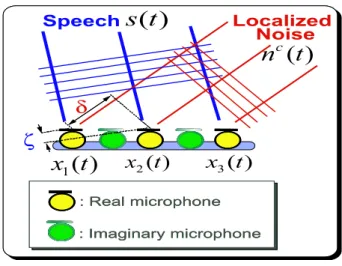
Specifically, in this research, the undesired noise signals are considered to be com- posed of localized noise components coming from certain directions and non-localized noise components coming from all (or, undeterminable) directions. Subsequently, we pro- pose a multi-channel noise reduction algorithm which applies a (3-channel) microphone array system based on the beamforming technique to eliminate the localized noise com- ponents due to the high ability of microphone arrays to suppress the localized noises, and applies a hybrid post-filter which is designed with the assumption of a diffuse noise field to eliminate the non-localized noise components which might be coherent or incoherent.
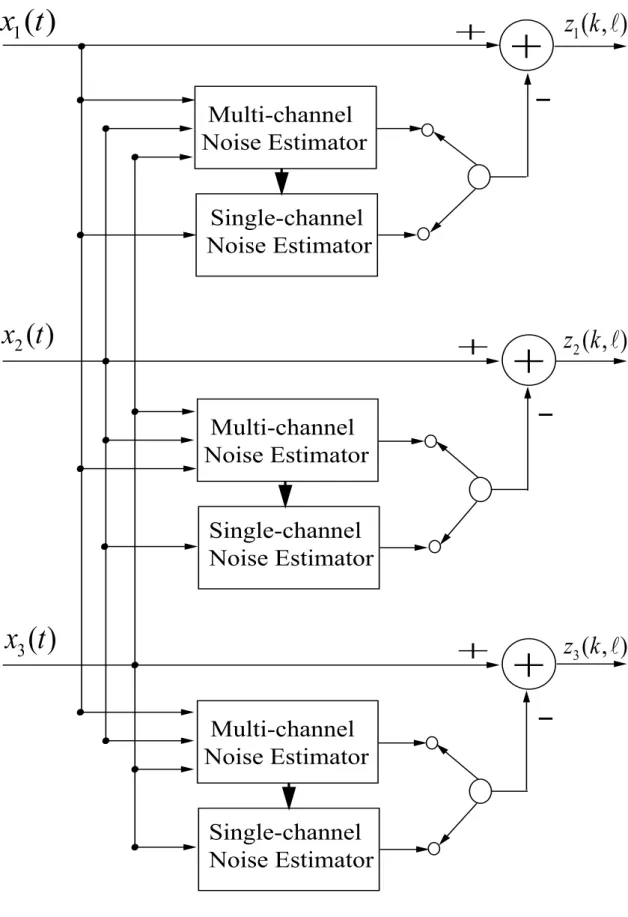
To suppress the localized noises, we propose a hybrid noise estimation technique which combines a multi-channel noise estimation approach and a single-channel noise estima- tion approach. This combination is further enhanced by integrating arobust and accurate speech absence probability (RA-SAP) which considers the strong correlation of speech ab-
![Figure 3.5: Basic circuit of the multi-channel noise estimation/reduction system [1, 3].](https://thumb-ap.123doks.com/thumbv2/123deta/6100597.1076343/61.892.173.720.116.413/figure-basic-circuit-multi-channel-noise-estimation-reduction.webp)