Introduction
The study of language teacher identity (LTI) appears to be gaining increasing attention from researchers in language teacher education and development, given the appearance of a seminal and comprehensive compilation of work on LTI (Barkhuizen, 2017) and at least two top-tier journals featuring special issues on LTI (TESOL Quarterly, 2016; Modern Language Journal, 2017).
Supporting this development, De Costa and Norton (2017) argue that LTI research is needed to “recognize the rich linguistic and personal histories that language teachers bring into the classroom in order to promote effective language teaching” (p. 3). Clarke (2009) also argues that engaging in LTI work is indispensable for language teachers to exercise their professional agency, in order to maximize their potential for development and growth in various contexts in which they work.
According to Varghese et al. (2005), the need for LTI study has emerged from two lines of inquiry into language teaching. One (e.g., Allwright, 1988) is informed by classroom-based research suggesting that classrooms are highly
complex environments where simplistic, cause- effect approaches to teaching methodology are not effective. This research also reveals that the teacher became the focus of attention due to their crucial role in organizing classroom practices, resulting in explorations of teacher beliefs, knowledge, and attitudes. Such explorations in turn converged on the holistic concept of the teacher identity, which is seen as an essential component in determining how language teaching is practiced.
Another avenue of study has investigated the sociocultural and sociopolitical dimensions of language teaching (e.g., Kubota, 2001; Norton, 1997). These perspectives demonstrate that many aspects of identity, such as race, gender, and sexual orientation, are also an important focus of attention in the language classroom; and that the teacher is not a neutral member of the classroom, but rather one whose positionality is influenced by the students and the broader context of the teaching environment. Thus, research has begun to appreciate LTI as a critical component in the sociocultural and sociopolitical perspectives of language teaching.
As a result of the abovementioned lines of
《論文》
言語教師アイデンティティについて
齊 藤 隆 春
Exploring Language Teacher Identity
TAKAHARU SAITO キーワード language teacher identity (LTI), the Douglas Fir Group
― 153 ―
― 152 ― 流通経済大学論集 Vol.54, No.1
inquiry into language teaching, researchers have attempted to gain a clearer sense of who language teachers are; exploring LTI, including individual, professional, cultural, and political identities, in order to better understand language teachers. In addition to these developments, by introducing influential identity studies (Duff & Uchida, 1997; Norton Peirce, 1995; Weedon, 1987), Varghese et al.
(2005) articulated three dominant notions of identity: “Identity as multiple, shifting, and in conflict; Identity as crucially related to social, cultural, and political context; and Identity being constructed, manifested, and negotiated primarily through discourse” (p. 35). A critical feature of these notions is their emphasis on the primacy of language teachers’ agency in identity construction, in relation to their situated social contexts, in order to understand them as intentional agents, as opposed to merely being determined by structural forces.
Varghese et al. also stressed that these central notions are particularly important for the study of LTI, because researchers have discovered a number of fundamental issues by focusing not merely on what happens in the classroom but on how outside factors shape both teaching and teachers’ lived experiences outside the classroom. Among these factors are (1) teachers’ experience of their professional and social marginalization both in and outside classrooms, (2) the position of nonnative speakers (who constitute the majority of language teachers worldwide) in relation to native-speaker teachers, who exert a hegemonic influence in many teaching contexts worldwide, (3) the status of the language teachers’ profession, in terms of the instability and changeability in their lives and work in various educational situations, and (4) the construction of teachers’ identity in
relation to their students, and the essentially hierarchical nature of that identity.
In particular, the dichotomy between native and nonnative English speaking teachers (NESTs and NNESTs) appears to have emerged as the focus of research attention with respect to LTI issues. In spite of the negative influence of this dichotomy, the NNEST movement (Braine, 2010), for example, has explored the linguistic, social, and political issues of NNESTs, revealing a wide range of factors, including NNEST credibility issues, hiring protocols, strengths, and professional development, in order to characterize their LTI. Introducing research on anti-NNEST bias, which examined the negative impact of societal ideology concerning NNESTs, De Costa and Norton (2017) argue that “accent hierarchies, which value the native speaker over the non-native speaker, are ultimately issues of identity” (p. 8). Lippi-Green (2012) also contends that native speaker identities are validated at the expense of non-native speaker identities, as the latter speakers do not employ the mythical ‘standard’ variety of a given language. These native/nonnative LTI studies have contributed to legitimization of the status of NNESTs, creating spaces for them to establish their professional and academic identities, and increasing their awareness of inequities within the field of language-teacher education.
In a further exploration of these LTI-related issues, the present study reexamined the identity construction of international graduate teaching assistants (IGTAs) teaching English composition at a U.S. university, by interpreting the data from Saito (2005) in terms of the recent transdisciplinary framework developed by the Douglas Fir Group (DFG, 2016), which conceives of language learning and teaching as
identity work. Before proceeding to the main discussion, we will explore the definition of and theoretical frameworks regarding LTI, and the effectiveness of the DFG’s framework for understanding LTI.
The Definition of Language Teacher Identity According to Richards and Schmidt (2010), identity is:
a person’s sense of themselves as a discrete separate individual, including their self- image and their awareness of self, and an important concept in sociocultural theory.
People’s sense of identity influences how they view themselves both as an individual and in relation to other people (p. 268).
This general conceptionof identity is clearly relevant to language teaching and applied linguistics; however, a more specific definition is needed for a deeper understanding of LTI. In response to this need, though admitting that any single definition of LTI tends to be exclusionary and counterproductive, Barkhuizen (2017) proposed the following definition, or “composite conceptualization of LTI” (p. 3), by summarizing the various conceptions of LTI provided by expert contributors to the collection:
Language teacher identities (LTIs) are cognitive, social, emotional, ideological, and historical – they are both inside the teacher and outside in the social, material and technological world. LTIs are being and doing, feeling and imagining, and storying.
They are struggle and harmony: they are contested and resisted, by self and others, and they are also accepted, acknowledged and valued, by self and others. They are core and peripheral, personal and professional, they are dynamic, multiple, and hybrid, and they are foregrounded and backgrounded. And LTIs change,
short-term and over time – discursively in social interaction with teacher educators, learners, teachers, administrators, and the wider community, and in material interaction with spaces, places and objects in classrooms, institutions, and online (p. 4).
This conception includes a variety of LTI characteristics, and as such, would benefit from more detailed elucidation. LTIs are cognitive, because language teachers constantly strive to make sense of who they are as professionals, reflecting on their beliefs and philosophies about language teaching. LTIs are emotional in terms of their hopes and desires to be good language teachers, and social because they are partially constructed in relation to the broader teaching environment. LTIs are historical, because teachers rely on their historically available resources such as their language learning and teaching experiences. LTIs are ideological, because language teachers and their students often struggle to negotiate their ideological differences due to the power relations between them. LTIs are inside the teacher, because they relate to the individual and particular characteristics of language teachers, and also outside in terms of the teacher’s interactions with people and places.
LTIs are being and doing, because they are manifested in what language teachers do or practice, and relational due to their roles in different educational settings. LTIs are feeling and imagining, because they are informed by teachers’ sensations and thoughts in response to classroom activities, and teachers constantly imagine themselves as ideal language teachers in the future. LTIs are storying, because language teachers exercise their own agency through the process of narrating who they are as professionals. LTIs are struggle and harmony, because they are multifarious, as
― 155 ―
― 154 ― 流通経済大学論集 Vol.54, No.1
language teachers assume different roles, with different self-conceptions, in the different encounters in their lives, as instructors, assessors, or department heads, and these are not always in harmony with each other.
LTIs are core and peripheral, dynamic, multiple, and foregrounded and backgrounded.
For example, gender may be a core identity category for language teachers, and influence the construction of self in their teaching lives.
In addition, language teachers have multiple identities, each of which influences the other and forms part of a single, complex, personal identity. Thus, choosing to foreground one identity over others may result in identity struggles. LTIs change, short-term and over time, because they are constantly evolving and developing through pedagogical practice, which is influenced by the teaching environment, and passed on from one generation to the next over time.
LTIs also change and are often constructed through material interaction with spaces, places, and objects in classrooms, institutions, and online. For example, classroom teaching materials are used differently depending on the different principles and beliefs held by teachers, and the latter are manifestations of the LTI.
In the process of LTI construction, such materiality may extend to the arrangement of the things, spaces and interactions of teachers’
lives, and to their educational practices.
In sum, Barkhuizen (2017) remarks that the abovementioned composite conceptualization of LTIs can be “interpreted from different theoretical perspectives as well as from different contextual realities, and possibly prompt alternative ways of thinking about LTI” (p. 3).
Theoretical Frameworks of LTI Varghese et al. (2005) conducted a plausible theoretical exploration of LTI. First, they articulated predominant theoretical themes identified in highly cited identity studies:
“(1) Identity as multiple, shifting, and in conflict; (2) Identity as crucially related to social, cultural, and political context; and (3) Identity being constructed, maintained, and negotiated primarily through discourse” (p.
35). Second, they summarized a number of substantive language teacher issues in the literature: “(1) marginalization; (2) the position of nonnative speaker teachers; (3) the status of language teaching as a profession; and (4) the teacher-student relation” (p. 35). Third, they introduced three data-based studies on LTI, which illustrated these theoretical themes and substantive issues.
In the book’s first cited study, Kimberly A.
Johnson utilizes social identity theory based on Tajfel (1978) to investigate the identity construction of a Mexican woman called Marc, a nonnative English speaking graduate student in an MA/TESOL program in the U.S. Social identity theory emphasizes societal categories such as nationality, race, gender, and class, which are relational in power and status. In this study, Marc demonstrates her multiple and sometimes conflicting identities, including assigned identities (ESL learner, NNEST, minority, etc.) and claimed identities (TESOL graduate student, ESL teacher, member of the NNEST Caucus, etc.). In particular, social identification as a NNEST is found to be significant in the establishment of her professional identity as an ESL teacher, due to her heightened awareness of NEST/NNEST issues resulting from her membership in the NNEST Caucus. Marc’s multiple and conflicting
identities in the U.S. higher education context reflect the first and second theoretical themes above, and her experience as a NNEST in contrast to NESTs reflects the first and second substantive issues above.
In the book’s second study, Varghese investigates the formation of LTI, based on the theory of situated learning, which emphasizes the process of becoming part of a community of practice, and views learning not as the cognitive acquisition of knowledge but as a process of acquiring an identity (Lave
& Wenger, 1991; Tsui, 2007; Wenger, 1998).
Varghese focuses on a group of bilingual teachers participating in a professional development program in the U.S. Using an ethnographic approach, she reveals that the teachers have been involved in a challenging process of seeking and negotiating an identity as bilingual teachers, and have developed conflicting and marginalized identities. She also explores the bilingual teachers’ different ways of being and engaging, according to their degree of motivation to participate in the program, and their struggles in dealing with antagonistic mainstream attitudes towards bilingual education in the U.S. The study reveals the complex interplay between the first two theoretical themes, as well as the current marginalization of the profession, suggested in the first and third substantive issues above.
In the book’s third study, Brian Morgan explores the notion of “identity as pedagogy,”
adopting Simon’s (1995) concept of “an image text” (students’ affective construction of a teacher’s identity) as a strategic resource to change conventional educational practices.
Reflecting poststructural approaches to discourse and identity, Morgan’s notion of identity as pedagogy emphasizes teachers’
identities as pedagogical resources, suggesting
that teachers can explore positive ways to project their professional identities for educational change, by becoming aware that teachers’ performance of identity in the classroom is determined by the subject positions offered in the broader educational discourse. Through an action research in a Chinese community center in Canada, he discovers that the interpersonal relations between him and his students are sometimes themselves texts, which create meanings through schooling, as facilitated by his image text. This study characterizes identity construction in relation to students’ discourse in schooling, reflecting the third theoretical theme and fourth substantive issue above.
In light of such empirical studies, Varghese et al. argue that “openness to multiple theoretical possibilities, and more particularly a juxtaposition of those possibilities, allow us to keep in mind the complexity of what we are studying” (p.
38). In a similar way, Barkhuizen (2017) notes that “different theoretical perspectives inform different understandings and uses of identity – poststructuralism, sociocultural and dialogical theories, community of practice, social identity theory – some more fashionable than others at different paradigmatic moments in time” (p.
1). In attempting to respond to the real-world complexity of LTI as thoroughly as possible, it goes without saying that some theoretical underpinnings are required in order to conduct research focusing on the areas of interest in LTI.
Poststructuralist approaches that emphasize the power relationship between individual agency and the social world are common in investigations of LTI construction. For example, Norton’s (2013) social identity theory views identity as “the way a person understands his or her relationship to the world, how that relationship is structured across time and space,
― 157 ―
― 156 ― 流通経済大学論集 Vol.54, No.1
and how the person understands the possibility for the future” (p. 4). This view recognizes that LTI indexes both human agency and social structure, which change over time in the social context. Furthermore, Norton (2017) insists that language teachers must deal with power relations in the classroom, and understand the possibilities and limitations in their teaching environment; theorizing identity as “multiple, changing, and a site of struggle,” and arguing that “the very multiplicity of identity can be productively harnessed in the interests of more productive language teaching” (p. 81).
The present study reexamined Saito’s (2005) study investigating the identity construction of NNESTs teaching English composition at a U.S.
university, from the perspective of Norton’s conception of social identity, because NNESTs’
identity can be fruitfully analyzed in relation
to their social world, which is informed by the hegemonic power of NESTs worldwide. In order to support the analysis of the relationship between language teachers and their social structures, the following section introduces the transdisciplinary framework recently developed by the Douglas Fir Group (2016), which characterizes language learning and teaching as identity work.
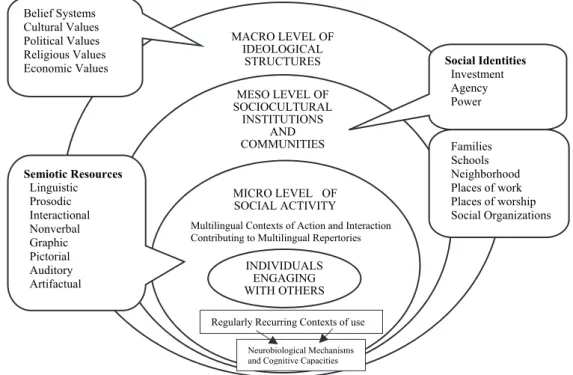
A Transdisciplinary Framework for LTI The seminal work of the Douglas Fir Group (2016) was crafted by a range of researchers from diverse disciplinary backgrounds, who attempted to develop a transdisciplinary framework for second language acquisition (SLA), for the purposes of capturing the complexity of SLA.
This framework conceives of language learning and teaching as a complex phenomenon described
Figure 1 The multifaceted nature of language learning and teaching. Adapted from “A Transdisciplinary Framework for SLA in a Multilingual World,” by the Douglas Fir Group, 2016, Modern Language Journal, 100 (Supplement 2016), p.25. Copyright 2016 by the Modern Language Journal.
9
The present study reexamined Saito’s (2005) study investigating the identity construction of NNESTs teaching English composition at a U.S. university, from the perspective of Norton’s conception of social identity, because NNESTs’ identity can be fruitfully analyzed in relation to their social world, which is informed by the hegemonic power of NESTs worldwide. In order to support the analysis of the relationship between language teachers and their social structures, the following section introduces the
transdisciplinary framework recently developed by the Douglas Fir Group (2016), which characterizes language learning and teaching as identity work.
A Transdisciplinary Framework for LTI
The seminal work of the Douglas Fir Group (2016) was crafted by a range of researchers from diverse disciplinary backgrounds, who attempted to develop a transdisciplinary framework for second language acquisition (SLA), for the purposes of capturing the complexity of SLA.
Figure 1. The multifaceted nature of language learning and teaching. Adapted from “A Transdisciplinary Framework for SLA in a Multilingual World,” bythe Douglas Fir Group,
MACRO LEVEL OF IDEOLOGICAL
STRUCTURES MESO LEVEL OF SOCIOCULTURAL
INSTITUTIONS COMMUNITIESAND
MICRO LEVEL OF SOCIAL ACTIVITY
INDIVIDUALS ENGAGING WITH OTHERS Semiotic Resources
Linguistic Prosodic Interactional Nonverbal Graphic Pictorial Auditory Artifactual Belief Systems Cultural Values Political Values Religious Values
Economic Values Social Identities
Investment Agency Power
Families Schools Neighborhood Places of work Places of worship Social Organizations Multilingual Contexts of Action and Interaction
Contributing to Multilingual Repertories
Regularly Recurring Contexts of use Neurobiological Mechanisms and Cognitive Capacities
9
The present study reexamined Saito’s (2005) study investigating the identity construction of NNESTs teaching English composition at a U.S. university, from the perspective of Norton’s conception of social identity, because NNESTs’ identity can be fruitfully analyzed in relation to their social world, which is informed by the hegemonic power of NESTs worldwide. In order to support the analysis of the relationship between language teachers and their social structures, the following section introduces the
transdisciplinary framework recently developed by the Douglas Fir Group (2016), which characterizes language learning and teaching as identity work.
A Transdisciplinary Framework for LTI
The seminal work of the Douglas Fir Group (2016) was crafted by a range of researchers from diverse disciplinary backgrounds, who attempted to develop a transdisciplinary framework for second language acquisition (SLA), for the purposes of capturing the complexity of SLA.
Figure 1. The multifaceted nature of language learning and teaching. Adapted from “A Transdisciplinary Framework for SLA in a Multilingual World,” bythe Douglas Fir Group,
MACRO LEVEL OF IDEOLOGICAL
STRUCTURES MESO LEVEL OF SOCIOCULTURAL
INSTITUTIONS COMMUNITIESAND
MICRO LEVEL OF SOCIAL ACTIVITY
INDIVIDUALS ENGAGING WITH OTHERS Semiotic Resources
Linguistic Prosodic Interactional Nonverbal Graphic Pictorial Auditory Artifactual Belief Systems Cultural Values Political Values Religious Values
Economic Values Social Identities
Investment Agency Power
Families Schools Neighborhood Places of work Places of worship Social Organizations Multilingual Contexts of Action and Interaction
Contributing to Multilingual Repertories
Regularly Recurring Contexts of use Neurobiological Mechanisms and Cognitive Capacities
by three interrelated dimensions of social context:
a micro level of social activity, a meso level of sociocultural institutions and communities, and a macro level of ideological structures. Social identities are seen as a component of the meso level, while the relationships in each level (e.g., macro (societal), meso (school), and micro (classroom)) are all highly interrelated. De Costa and Norton (2017) argue that this framework is useful for capturing the multifaceted and transdisciplinary nature of LTI research, and that the integration of practices in each level will influence the legitimacy of LTI in relation to teachers’ language proficiency and teaching practices. Furthermore, they point out that the framework can provide an opportunity to address how best to respond to the real issues of language teachers by reflecting on dominant ideologies (macro), institutional constraints (meso), and classroom possibilities (micro), in addition to positioning LTI research against a multilingual and globalized context. Thus, they hold that teachers can optimize their language teaching when their semiotic resources at the level of classroom interaction (micro) are valued by the school (meso) and society (macro)
in relation to LTI development.
The DFG model also identifies 10 fundamental themes related to the characteristics of the three (micro, meso, and macro) levels and their interconnectedness, in order to offer action possibilities that can be negotiated and transformed, and applied as means or constraints for L2 researching, learning, and teaching. Since the focus of the model is more on the learner, De Costa and Norton (2017) present an additional 10 fundamental themes that emphasize the teaching implications of the DFG model:
As can be seen from Theme 7, “language teaching is identity work,” the issues of LTI appear to be interconnected with each level of the DFG framework. According to De Costa and Norton, on a macro (societal) level, teachers across the globe have recently been facing growing neoliberalism, which demands greater teacher accountability and test scores to measure teachers’ ability to execute instruction effectively in the classroom. They note that the use of some generic measurement tools in the U.S. can have detrimental effects on foreign language teachers, because such tools are not
Table 1
10 Fundamental Themes and Their Implications for Language Teaching 1. Language competences are complex, dynamic, and holistic.
2. Language teaching is semiotic teaching.
3. Language teaching is situated and attentionally and socially gated.
4. Language teaching is multimodal, embodied, and mediated.
5. Variability and change are at the heart of language teaching.
6. Literacy and instruction mediate language teaching.
7. Language teaching is identity work.
8. Agency and transformative power are means and goals for language teaching.
9. Ideologies permeate all levels of language teaching.
10. Emotion and affect matter at all levels of language teaching.
Note. Adapted from “Introduction: Identity, transdisciplinarity, and the good language teacher,” by P. I. De Costa and B. Norton, 2017, Modern Language Journal, 101 (Supplement 2017), p. 8. Copyright 2016 by the Modern Language Journal.
― 159 ―
― 158 ― 流通経済大学論集 Vol.54, No.1
sufficiently sensitive to language diversity and learner backgrounds, and may contribute to identity crises in teachers, leading to emotional distress and burnout.
De Costa and Norton also argue that a denial of teachers’ linguistic capital, as measured by their proficiency, is a universal problem not limited to the United States. Valmori and De Costa (2016) for example, investigated how foreign language (FL) teachers in Italy experienced and responded to changes in their FL proficiency, and found that a non-native speaker teacher bias still influences their conception of a good language teacher when describing the challenges faced by FL teachers.
The study shows how language ideologies on the macro (societal) level may impact language teachers, who are also language learners.
Based on this study, De Costa and Norton contend that accent hierarchies, which tend to value native over nonnative speaker teachers, are LTI issues. Similarly, Lippi-Green (2012) insists that a second language (L2) accent in the United States often displays a negative image, which tends to stigmatize speakers with an L2 accent as illegitimate English speakers. She emphasizes that native speaker identities are validated at the expense of nonnative speaker identities, which are devalued because they are not associated with mythical ‘standard’ English ideologies.
Furthermore, De Costa and Norton suggest that ideological and identity challenges in terms of language teacher education not only exist at the macro level of ideological structures, but also percolate into the meso level of sociocultural institutions and communities (school), and the micro level of social activity (classroom).
Bernstein et al. (2015) argue that the impact of neoliberalism on second/foreign language education is observable at multiple levels, such
as “language as a commodified, technicized skill,” and “language teachers as expendable and replaceable knowledge workers” (p. 6).
Influenced by these effects, at the meso level, school administrators tend to consider the technicized notions of creativity, innovation, and proficiency as yardsticks in their selection of teachers, who effectively become contract workers for producing learners with language skills, not teachers who can cultivate lifelong learning in their students. At the micro level (classroom), Saito (2005) found that U.S. college students tended to show unwillingness to listen to international graduate student utterances in the classroom, due to L2 accent hierarchies.
Thus, the next section attempts to reexamine the identity construction of international graduate teaching assistants teaching English composition at a U.S. university, by interpreting the data in Saito (2005) in terms of the DFG framework, which conceives of language learning and teaching as identity work.
LTI: The Case of International Graduate Teaching Assistants at a U.S.University About Saito (2005)
The author completed his dissertation in 2005 (Saito, 2005). A brief outline of the study seems warranted. The purpose of the study was to examine identity construction among international graduate teaching assistants (IGTAs) teaching English composition at a U.S. university; one of the constituent groups of nonnative English speaking teachers. The study was conducted within the writing program community in the department of English at a large (approximate 35,000 student) public university in the western U.S. In the writing program community, a minority of IGTAs taught freshman English composition
to first-year undergraduate American and foreign students, with the majority being native English speaking graduate students.
The study relied on a phenomenological case study approach, in which the lived experience of IGTAs was analyzed in relation to wider language ideologies and practices. Data were generated in spring 2003 and fall 2003, through in-depth phenomenological interviews, classroom observations, questionnaires, and autobiographical accounts involving five research participants. The data were primarily analyzed using the constant comparison method. Guided by the social identity theory (Norton Peirce, 1995), with its emphasis on the relationship between the individual and the social world, the study revealed that identity construction among IGTAs, dynamic and contradictory in nature, remains challenging;
changing and growing over time, in relation to broader language ideologies and practices.
Therefore, the study findings rejected a fixed, unitary, and monolithic view of IGTA identity construction. In terms of practical implications, the study suggested that university programs
could support IGTAs in practicing mutual accommodation, through which IGTAs and their students could collaborate for improvement in learning English composition, and enrichment of cultural diversity in U.S.
higher education. The study also suggested that language educators should explore the role that nonnative English speaking teachers play in an era that sees the global spread of English producing highly proficient nonnative English speaking language specialists.
Reexamining Saito (2005) within the framework ofthe DFG (2016)
Participants’ information. Saito (2005) focused on five research participants with the following personal information.
Ms. J was raised in China. Upon graduation from university with a degree in English language and literature, she began to teach English at the university level in China. After teaching for six years, she went to Canada and earned an MA in applied linguistics, after which she went to the U.S. and enrolled as a doctoral studentin the applied linguistics program at Table 2
Participants information
PARTICIPANT BIRTH PLACE FIRST LANGUAGE
OTHER LANGUAGES LEARNED OR SPOKEN
AGE OF ARRIVAL IN U.S.
FIRST EXPOSURE TO ENGLISH
CONTEXT OF FIRST EXPOSURE TO ENGLISH
Ms. J China Chinese French 27 Junior high school EFL
Ms. K South Korea Korean Japanese, German 31 Junior high school EFL
Ms. M Unknown
(Asian country) Chinese (Mandarin)
Japanese, Korean, German, unknown language
14 Third grade EFL
Ms. S Spain Spanish
French, Italian, German, Latin, Greek
25 Sixth grade EFL
Ms. X China Chinese French, Chinese
local dialect 24 Fourth grade EFL
Note. EFL = English as a foreign language
― 161 ―
― 160 ― 流通経済大学論集 Vol.54, No.1
the aforementioned western university, where, like the other study participants, she taught freshman English composition to American and ESL students.
Ms. K grew up in South Korea. Upon graduation from university with a BA degree in education, she enrolled in the English program at the Korean branch of a U.S. university and obtained her second BA in English literature.
She then taught English at a private school and tutored high school students for eight years in her home country. After this, she went to the U.S. and enrolled in the MA/ESL program atthe western university.
Ms. M went to the U.S. from an Asian country (unknown) with her parents when she was 14 years old. She received two BAs, in Japanese and ESL, and an MA in linguistics, at Hawaii universities. While at the universities, she taught Chinese to children at a Chinese school for two years. She then came to theU.S.
mainland and enrolled in the MA/ESL program in the western university.
Ms. S was raised in Spain, where she received a BA in English philology. After graduation, she taught Spanish at a U.S. college for a year. She then went back to Spain to obtain a teaching certificate for secondary teachers of foreign languages, after which she returned to the United States and enrolled in the western university’s MA/ESL program.
Ms. X grew up in China, where she received a BA in English. After graduation, she taught English at a middle school and a language institute for two years in China. She then went to the United States and received the MA/ESL degree, after which she enrolled in the western university’s applied linguistics program as a doctoral student.
Iterative in-depth phenomenological interviews (Seidman, 1998) were conducted with these five
international graduate teaching assistants, to assess their teaching experiences in relation to their identity construction, as a primary data source. Other supplementary data, including classroom observations, questionnaires, and participants’ autobiographical accounts, were employed to support the interview data. The next section attempts to situate the data within the DFG framework, in order to elucidate IGTA identity construction in relation to its social contexts.
IGTA identity construction on the macro level of ideological structures
This level includes large-scale, society- wide ideological structures with a particular orientation toward language use and language learning/teaching. These structures both shape and are shaped by the meso level of sociocultural institutions and communities, as well as by the agency of individual members within their local contexts of action and interaction (the micro level of social activity).
Though no single study has clearly delimited the nature of language ideologies, Rumsey (1990), for example, broadly defines language ideology as “shared bodies of commonsense notions about the nature of language in the world” (p. 346).
Wiley and Lukes (1996) identify two widely accepted language ideologies in the U.S. The first is the ideology of English monolingualism, which views English as the normal condition and language diversity as an alien and divisive force. The second is the ‘standard language’ ideology, which is employed to position speakers of different varieties of English within a social hierarchy, stressing the superiority of unaccented English. Lippi-Green (2012) contends that the standard language ideology displays a bias toward an abstracted,
idealized, homogeneous spoken language, and aims at the suppression of variation. She also draws attention to the influence of the hegemony of standard English in the U.S., such as the U.S. language education policies that promote monolingual and standard English ideologies, and the mass media that promotes hegemonic ideas about acceptable accent and dialect. In particular, the ideology of standard English appears to influence IGTAs’ identity construction in relation to their teaching practices, as illustrated by the following narratives obtained from interviews:
[Students] don’t respect as much, I am not sure if respect is the right word…as soon as they listen to the teachers’ accent, they feel a little frustrated I would say…they don’t try hard to understand the teacher (interview with Ms. K, March 31, 2003).
Students always do written evaluations of the instructor…and I was really kind of depressed when I saw some of the students say things like, “I cannot understand her because of her accents….” They don’t pay attention in class (interview with Ms. J, April 9, 2003).
Such IGTAcomments indicate that when their American students heard their accents, influenced by their first language, their willingness to listen, or their openness as listeners, began to diminish. An open-ended questionnaire administered to their American students appears to echo this reluctance to listen to the teachers’ accented English:
・I can’t hear well, she has a strong accent.
・Very hard to understand, her tone is annoying.
・ Lots of times I had no idea what she was talking about, she would use weird ways of tying it all together and she has a strong accent.
・ The language barriers are hard sometimes
and we don’t always understand what she is saying.
These negative comments made by American students suggest that they had difficulty understanding English composition lessons because they felt uncomfortable with IGTAs’ accents, and saw this as forming a communication barrier between them and the IGTAs. Given the aforementioned scholarly results, and these narratives of IGTAs and their American students, accent hierarchies stemming from the ideology of standard language appear to persist on the U.S. societal level, and to constitute a key component of relevant ideological structures. In other words, a social world informed by a standard language ideology appears to influence IGTAs’ teaching practices in U.S. higher education, forcing them to construct their identity within a social framework defined by an ideology that may place them in a disempowered position.
IGTA identity construction on the meso level of sociocultural institutions and communities
The DFG framework conceives of social identity as a component on the meso level of sociocultural institutions and communities, because social identity is manifested in contexts of interaction in social institutions such as families, schools, and workplaces, though these are naturally interconnected with the influence of the macro (societal) and micro (classroom) levels. Though social identities have multiple and contradictory natures, IGTAs primarily take on the identity of teachers when they interact in activities associated with the social institution of a U.S. writing program.
In particular, the DFG framework emphasizes that “the institutions and communities at the meso level are powerfully characterized by pervasive social conditions (e.g., economic,
― 163 ―
― 162 ― 流通経済大学論集 Vol.54, No.1
cultural, religious, political), which affect the possibility and nature of persons creating social identities in terms of investment, agency, and power” (p. 24). At the same time, in the power relations within social contexts at the macro level, IGTAs may exert their human agency in order to construct their identities in teaching practices. Norton Peirce’s (1995) theoretical approach to social identity suggests that, though IGTAs may be positioned in a particular way within a given discourse, they might resist their subject position, or even establish a counter-discourse that positions them in a powerful rather than marginalized subject position.
In other words, though IGTAs may be situated in a marginalized position in relation to dominant native English speaking teachers, they may resist their marginalized social positions and create a counter-discourse that can situate themselves in a powerful position.
The following narrative examples appear to illustrate IGTAs’ site of struggle to gain credibility by creating counter-discourses against the dominant ideology of a standard language in U.S. educational settings:
Right at the beginning, I tell them, “you know, I am not a native speaker, and if you have trouble with my accent or my expression, if you find it’s not clear, just come to see me and I can clarify it for you;” but in terms of the writing, I can definitely do better than you…and so I figured out at least on the surface level…
they show respect in class (interview with Ms. J, second interview, April 9, 2003).
But after the first two semesters of bad experiences with my native speakers…at the very beginning of the class, I told them that I am a graduate student in the English department, in ESL…and I told them that
if they are not happy with a nonnative speaker teaching them—because I told them that I speak several other languages, and English is just one of them—if they are not happy with a nonnative speaker instructor, they can just change to another section (Interview with Ms. M, Additional interview, February 24, 2003).
In these examples, the IGTAs clearly highlighted their different educational and linguistic background from that of native English speakers, and their strengths as professional English writing instructors. And in creating such counter-discourse, they resisted their social identity as nonnative, and embraced their social identity as professionals with rich educational and linguistic backgrounds. They challenged what they understood to be the dominant discourse of a standard language ideology, and invested their agency in establishing themselves in a powerful position as professionals, instead of a marginalized position as nonnative English speakers. This appears to illustrate IGTAs’
site of struggle and the multifaceted nature of their identity construction, in support of Norton (2013). As a nonnative English speaking professional, Kubota (2002) also suggests a counter-hegemonic pedagogical strategy that appropriates marginality as an asset, to advocate for diversity and mutual accommodation between teacher and student.
In addition to social identity issues at the meso level, the writing program in the English department plays an important role in constructing IGTAs’ identity as English composition teachers. The writing program assigns a teaching advisor to each graduate teaching assistant, and offers a course for them to discuss credibility, curriculum, policy, and assessment issues. For example, Ms. J gained confidence after getting positive feedback from
her teaching advisor:
Especially when my TA (advisor) Susan Penfield came to observe my class…and generally speaking praised that class, saying, “ok, the content is good and you know how to handle the students,” but then offering some suggestions. I think, you know, really my confidence has begun to build up since then…(interview with Ms. J, March 12, 2003)
Characterizing the role of a teaching advisor for IGTAs, Professor P, Ms. J’s teaching advisor, identified herself as follows:
Oh, I am a cheerleader; well, actually as a teaching advisor, I think the most important thing is to talk to them about what to expect from American student behavior, and then how to deal with that, and also the issue of credibility; I spent a lot of time with the group that (Ms. J) was in…because it does require a kind of a culturally foreign idea of calling attention to yourself and promoting yourself (interview with Professor P, teaching advisor for IGTAs, February 2, 2004).
Professor P recognized herself as a “cheerleader”
who can encourage IGTAs to establish their credibility; but she also addressed practical issues, such as what to expect from American students’ behavior and how to deal with it, because some IGTAs were not familiar with the different U.S. classroom culture from the one in their home country. In a similar way, Zheng (2017) emphasizes the beneficial role of a supportive teaching advisor, and the establishment of a training program which can openly question the native speaker fallacy and provide effective strategies to address and transcend it, by helping IGTAs to explore what aspects of their identities could be utilized for pedagogy in practice.
IGTA identity construction on the micro level of social activity
The DFG model underlines how individual micro-level learning/teaching intersects with the meso level of sociocultural institutions and communities as well as the macro level of ideological structures. In other words, the extent to which the IGTAs in this study can develop a positive language teacher identity partly depends on how much their teaching practices on the micro-level are valued by the college writing program on the meso-level, and by the dominant ideological structures in U.S. society on the macro-level. In order for them to be valued on these various levels, they first went through a process of adaptive transformation into U.S. classroom culture, undergoing a significant transition from their home countries to the United States in order to teach English composition and pursue their graduate courses. The following IGTA reflections on teaching English composition appear to describe this process of adaptive transformation:
Since I transferred to this American educational setting…I found the classroom setting can be casual and students participate in class so much…the role of the teacher is an organizer…it’s not mainly knowledge provider, so student’s participation, and also creative writing, creative thinking, critical thinking, are pretty much encouraged in American education…individual thinking is valued in this country…
(interview with Ms. X,April 7, 2003).
I think what we should have is flexibility…
and be able to adapt to the system here, but we have to be aware of who we are teaching…then the skill to be able to adapt
― 165 ―
― 164 ― 流通経済大学論集 Vol.54, No.1
to different situations…(interview with Ms.
S, May 15, 2003).
These reflections suggest that the IGTAs enhanced their teacher identity on the micro level of teaching practices, and attempted to employ the new set of values endorsed in U.S. higher education, such as the students’
active classroom participation, and creative and critical thinking. Through the process of adaptive transformation, which is also a manifestation of their site of struggle on the micro level of teaching activity, IGTAs were able to establish their identity with distinctive teaching styles.
Classroom observation revealed these distinctive teaching styles among the IGTA’s:
Ms. K’ robust teaching with visual aids to avoid communication problems; Ms. J’s ability to explain the content of academic writing clearly and logically with her knowledge of the English language; Ms. S’s dynamic, conductor-like performance, giving personal attention to each student with a strong sense of responsibility;
Ms. X’s blending of knowledge of her own culture and language with the American student-centered classroom context, to facilitate the analysis of English writing; and Ms. M’s creation of an enjoyable and lively atmosphere to facilitate learning. Classroom observation also revealed that the IGTAs all used various kinds of communication-facilitating interactions, such as one-on-one interaction, group work activities, peer review activities, presentations, and conferences with their students; enriched by their native language while teaching English composition to American students in their additional language, English. This fact reflects the diverse linguistic reality of today’s globalized world, and illustrates the DFG model’s concept of language competence as complex, dynamic, and holistic.
Conclusion
Given Barkhuizen’scomposite definition of LTI and Norton’s social identity theory, which views identity as multiple, a site of struggle, and changing over time; combined with the social context provided by the DFG transdisciplinary framework; the IGTA identity appears to be one that challenges, changes, and evolves over time in the context of power relations with a dominant language ideology. On the micro level of their struggle in teaching English composition, IGTAs expressed the following attitude:
It is also very challenging…you have to prove to them that you are credible, you are the authority… (interview with Ms. J, May 17, 2003)
Now I am not scared anymore, so I assume my position and I am confident that what I am teaching is under control… (interview with Ms. S, December 18, 2003)
I incorporated a lot of the teaching materials I have used…another thing I think is the growing confidence accumulated from the past. (interview with Ms. J, January 15, 2004)
Your cultural identity is changing, especially as a teacher, you can see that as a nonnative instructor…you change yourself and you are growing, you are learning… (interview with Ms. X, January 7, 2004)
IGTA identity construction remains challenging, or a site of struggle, because of the multifaceted, even contradictory nature of this identity, founded in the tension between their efforts to accommodate U.S. paradigms of teaching through the process of adaptive transformation, and their human agency in creating a counter- discourse that reframes the power relations
with the dominant ideology of standard English.
At the same time, their identities are also changing and growing over time. While they gain professional development opportunities, such as in their teaching advisor’s support, they continue to develop their identities and increase in confidence as nonnative English teaching professionals, refining and expressing their own distinctive teaching styles.
In support of this nuanced and dynamic conception of identity construction, De Costa and Norton (2017) highlight the significance of the complex relationship between the macro, meso, and micro aspects of language learning and teaching, in which “teachers often have to struggle with power relations that press upon educational practices and discourses” (p. 11).
They also stress the importance of external sponsorship through professional development opportunities and teacher agency, as mediated through innovative pedagogical practices, in order to construct language teacher identity.
Exploring LTI research in terms of the DFG transdisciplinary framework is useful because this framework can place LTI against the backdrop of multilingualism and globalization.
The framework also provides language teachers with opportunities to reflect on how to navigate dominant ideologies, institutional constraints, and classroom possibilities. Further LTI research is needed, in various educational contexts, based on this transdisciplinary framework, in order to respond to the real-world concerns of language teachers and teacher educators in an era of multilingualism and a globalized world.
References
Allwright, D. (1988). Observation in the language classroom. London: Longman.
Barkhuizen, G. (Ed.). (2017). Reflections on language
teacher identity research. New York: Routledge.
Bernstein, K. A., Hellmich, E. A., Katznelson, N., Shin, J., & Vinall, K. (2015). Introduction to special issue:
Critical perspectives on neoliberalism in second/
foreign language education. L2 Journal, 7, 3-14.
Retrieved from http://repositories.cdlib.org/uccllt/
l2/vol7/iss3/art1/
Brain, G. (2010). Nonnative Speaker English Teachers.
New York: Routledge.
Clarke, M. (2009). The ethico-politics of teacher identity.
Educational Philosophy and Theory, 41(2), 185- 200. doi:10.1111/j.1469-5812.2008.00420.x
De Costa, P. I., & Norton, B. (2017). Introduction:
Identity, transdisciplinarity, and the good language teacher. Modern Language Journal, 101(Supplement 2017), 3-14. doi: 10.1111/modl.
12368
Douglas Fir Group. (2016). A transdisciplinary framework for SLA in a multilingual world.
Modern Language Journal, 100 (Supplement 2016), 19-47. doi:10.1111/modl.12301
Duff, P., & Uchida, Y. (1997). The negotiation of teachers’ sociocultural identities and practices in postsecondary EFL classroom. TESOL Quarterly, 31, 451-486. doi:10.2307/3587834
Kubota, R. (2001). Discursive construction of the images of U.S. classrooms. TESOL Quarterly, 35, 9-38.
doi.10.2307/3587858
Kubota, R. (2002). Marginality as an assent: Toward a counter-hegemonic pedagogy for diversity. In L.
Vargas (Ed.). Women faculty of color in the white classroom (pp. 293-307). New York: Peter Lang.
Lave, J., & Wenger, E. (1991). Situated learning:
Legitimate peripheral participation. Cambridge, England: Cambridge University Press.
Lippi-Green, R. (2012). English with an accent:
Language, ideology, and discrimination in the United States (2nd ed.). New York: Routledge.
Norton Peirce, B. (1995). Social identity, investment, and language learning. TESOL Quarterly, 29, 9-31.
doi:10.2307/3587803
Norton, B. (1997). Language, identity, and the ownership of English. TESOL Quarterly, 31, 409-429. doi:
10.2307/3587831
Norton, B. (2013). Identity and language learning:
Extending the conversation (2nd ed.). Bristol:
Multilingual Matters.
Norton, B. (2017). Learner investment and language teacher identity. In G. Barkhuizen (Ed.), Reflections on language teacher identity research (pp. 80-86).
New York: Routledge.
― PB ―
― 166 ― 流通経済大学論集 Vol.54, No.1
Richards, J. C. & Schmidt, R. (Eds.). (2010). Longman dictionary of language teaching and applied linguistics. Fourth edition. London: Longman.
Rumsey, A. (1990). Wording, meaning, and linguistic ideology. AmericanAnthropologist, 92, 346-361. doi.
org/10.1525/aa.1990.92.2.02a00060
Saito, T. (2005). Exploring nonnative-English-speaking teachers’ experiences in teaching English at a U.S.
university. (Unpublished doctoral dissertation). The University of Arizona, Tucson, AZ.
Seidman, I. (1998). Interviewing as qualitative research:
A guide for researchers in education and the social sciences (2nd). New York: Teachers College Press.
Simon, R. I. (1995). Face to face with alterity: Postmodern Jewish identity and the eros of pedagogy. In J. Gallop (Ed.), Pedagogy: The question of impersonation (pp.
90-105). Bloomington: Indiana University Press.
Tajfel, H. (1978). Differentiation between social groups:
Studies in the social psychology of intergroup relations. London: Academic.
Tsui, A. B. M. (2007). Complexities of identity formation:
A narrative inquiry of an EFL teacher. TESOL Quarterly, 41, 657-680. doi:10.1002/j.1545-7249.2007.
tb0098.x
Valmori, L., & De Costa, P. I. (2016). How do foreign language teachers maintain their proficiency?: A grounded theory approach. System, 57, 98-108.
doi:10.1016/j.system.2016.02.003
Varghese, M., Morgan, B., Johnston, B., &Johnson, K.
(2005). Theorizing language teacher identity: Three perspectives and beyond. Journal of Language, Identity, and Education, 4(1), 21-44. doi:10.1207/
s1532770jlie0401_2
Weedon, C. (1987). Feminist practice and poststructuralist theory. Oxford, England: Blackwell.
Wenger, E. (1998). Communities of practice: Learning, meaning, and identity. Cambridge, England:
Cambridge University Press.
Willey, T. G., & Lukes, M. (1996). English-only and standard English ideologies in the U.S. TESOL Quarterly, 30, 511-535. doi:org/10.2307/3587696 Zheng, X. (2017). Translingual identity as pedagogy:
International teaching assistants of English in college composition classrooms. Modern Language Journal, 101(Supplement 2017), 29-44. doi: 10.1111/
modl. 12373