Characteristics of counter movements in sport climbing
: A comparison between experienced climbers and beginners
DAICHI ASAKAWA, RPT, MS 1,2),MASAAKI SAKAMOTO, RPT, PhD 1)
1) Gunma University, Graduate school of Health Sciences: 3-39-22 Showa-machi, Maebashi, Gunma, Japan 2) Department of Rehabilitation, Kamimoku Spa Hospital: Minakami, Gunma, Japan
Abstract. [Purpose] This study aimed to evaluate the movement characteristics of sport climbing on the basis of the difference in basic movements between experienced climbers and beginners.
[Participants and Methods] Eighteen healthy men participated in this study, including 9 experienced climbers and 9 beginners. Two-dimensional motion analysis was conducted with two digital cameras.
The motion tasks were the counter-movement, including before and after the movement, which was classified into 5 phases. In each phase, the joint angles of the shoulder, elbow, hip, knee, and trunk were calculated. In the frontal plane, the center of gravity (COG) trajectory, motion speed, and motion time were calculated, which were compared between the climbers and beginners in each phase. [Results] A significant difference was observed in the horizontal direction of the COG movement width. The beginners tended to have a smaller shoulder flexion and abduction and larger elbow flexion on the supporting side and smaller hip flexion and abduction and knee flexion on the support side than the climbers. [Conclusion] This study suggests that climbers adopt a strategy to reduce the burden on the upper extremities by efficiently using the trunk and lower extremities to move their COG.
Key words: sport climbing, counter-movement, center of gravity
INTRODUCTION
Sport climbing uses holds to climb an artificial wall and varies depending on the techniques, height, and speed of the climber. It will become an additional event in the Tokyo Olympic Games in 2020, and attention on this sport has improved in recent years. For sport climbing, tasks are captured by holding, footwork, and balancing the center of gravity (COG) of the whole body against the route. These tasks require specific movements that effectively moves the body to reduce muscle fatigue and reach the next hold. One of the basic movements is counter-movement. As shown in Fig. 2, counter-movement is a basic task of moving such that the lower extremity is in the opposite side direction, counterbalancing against the reach of the upper extremity.
Climbing-related injuries are characterized by many injuries in the upper extremities. Frequently used and overloaded due to fatigue and unfamiliar movements, the upper extremities have an incidence of injuries of 57.6%
to 78% of all injuries, of which 27.5% to 43.7% are finger injuries1-3). If the severity is high, it may cause damage to finger pulleys and flexor tendons4,5).
When referring to the multifactorial model6), interpretation of the inciting event is required together with elements of internal and external risk factors. Therefore, the relevance of factors must be considered, including sport
climbing-specific movements. However, reports related to sport climbing movements are few7-9), and the movement factors are not clear. For this reason, this study aimed to provide suggestions on the movement characteristics of sport climbing based on the difference in basic movements between experienced climbers and beginners.
PARTICIPANTS AND METHODS
Eighteen healthy men participated in this study. Nine climbers (mean age, 30.5 ± 12.9 years, height of 168.7 ± 2.8 cm, weight of 57.6 ± 3.7 kg) with at least 1 year of sport climbing experience and nine beginners (mean age, 24.2 ± 0.8 years, height of 172.2 ± 4.0 cm, weight of 64.7 ± 6.8 kg) who had climbed fewer than five times were included in the study. The climbers had a mean climbing experience of 10.5 ± 11.1 years. The mean red point grade was 8.00 to 8.33 (metric scale). Red point is a climbing grade that can climb to the top hold in more than two attempts. Approval for this study was obtained from the Koutokukai Medical Corporation Ethics Committee (approval code KH30002).
Written informed consent was obtained from all the participants. This study was conducted in accordance with the
Declaration of Helsinki.
The testing facility was an indoor climbing wall (vertical wall). As shown in Fig. 1 and 2, the motion tasks consisted of counter-movement, including before and after the movement. Holds were set to an easy climbing grade so that beginners could climb the wall successfully. The participants warmed up and climbed after practicing the motion task.
Counter-movements were classified into five phases as follows: phase 1 is the time when the left foot leaves, phase 2 is the time when the left hand separates from the hold, phase 3 is the time when the left hand grips the next hold, phase 4 is the time the right hand is away from the hold, and phase 5 is the time when the right hand gripped the next hold.All participants climbed by the same procedure.
In the motion analysis, two digital cameras (Casio EXILM EX-FC150, sampling rate: 60 Hz) were used. Reflective markers were attached to individual body parts, and two points on the frontal and sagittal planes were recorded with respect to the wall. The cameras were positioned so that the full view of the motion task was reflected, and the calibration was carried out before any recording took place. Successful trials were recorded twice, and the trials were analyzed in short motion time. Nineteen reflective markers were used in this study. Both sides of the acromion and the olecranon, middle of the dorsal wrist, terminal part of the rib, posterior superior iliac spine, greater trochanter, femoral lateral epicondyle, lateral malleolus, seventh cervical spinous processes (C7), third lumbar vertebra spinous process (L3), and a second sacral spinous process (S2) were marked. Kinematic analysis was analyzed using Kinovea version 0.8.22. The joint angles were calculated from the reflective markers affixed to each part of the body. The calculation method is shown below. The shoulder flexion and abduction angle was defined as the angle between the terminal part of the rib and acromion and the olecranon. It was defined as a complex angle of flexion and abduction.
The elbow flexion angle was defined as the angle between the acromion and olecranon and the middle of the dorsal wrist. The hip flexion and abduction angle was defined as the angle between the terminal part of the rib and greater trochanter and the femoral lateral epicondyle. It was defined as a complex angle of flexion and abduction. The knee flexion angle was defined as the angle between the greater trochanter and femoral lateral epicondyle and the lateral malleolus. The trunk side flexion angle was defined as the angle among the C7, L3, and S2. It was defined as right- (+) and left-side flexion (−). In addition, vertical and horizontal COG movement width, total COG distance, maximum and minimum motion speeds, and total motion time were calculated from L3 on the projection of the COG in the frontal plane.
Statistical analyses were performed using SPSS version 25.0 for Windows. The Shapiro-Wilk test was used to assess the normality of the data. Height and weight, each joint angle and COG movement width (vertical and horizontal), total COG distance, motion speed, and motion time in each phase were compared between the climbers and the beginners by using an unpaired t test and Mann-Whitney U test. The significant level in the analyses was set at 5%.
Fig.2 Definition of diagonal move phase division phase 1: the time when the left foot leaves
phase 2: the time when the left hand separates from the hold phase 3: the time when the left hand grips the next hold phase 4: the time the right hand is away from the hold phase 5: the time when the right hand gripped the next hold Fig. 1 The motion task setting
R: right, L: left; P: phase; height: 163cm, width; 216cm
RESULTS
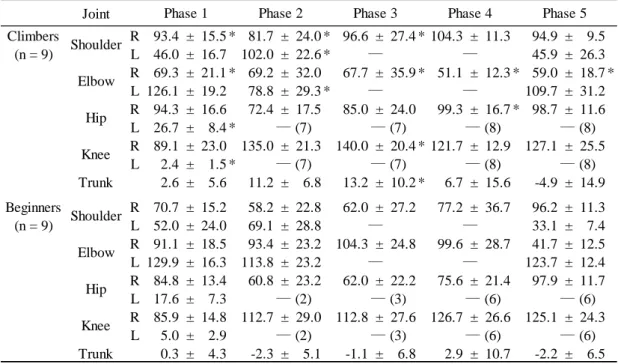
Climbers had a significantly lower height and lighter weight than beginners. Table 1 shows the data on each joint angle in each phase of climbing for climbers and beginners. A significant difference was observed in phase 1 in the right shoulder and elbow, and left hip and knee. Climbers had a significantly larger right shoulder flexion and abduction, and smaller right elbow flexion than beginners. In phase 2, a significant difference was observed in both shoulders and the left elbow. Climbers had a significantly larger shoulder flexion and abduction and smaller left
flexion. In phase 3, a significant difference was observed in the right shoulder, elbow, knee, and trunk. Climbers had significantly larger right shoulder flexion and abduction, and right knee flexion and smaller right elbow. The right- side flexion of the trunk was significantly larger. In phase 4, a significant difference was observed in the right elbow and hip. Climbers had a significantly smaller right elbow flexion and larger right hip flexion and abduction. In phase 5, a significant difference was observed in the right elbow. Climbers had significantly larger right elbow flexion.
Table 2 shows data on COG movement width, total distance, speed, and motion time of climbers and beginners. A significant difference was observed in the horizontal direction of the COG movement width, and the climbers showed a significantly larger movement width than the beginners. No significant differences were found in speed, total distance, and motion time.
In addition, there were subjects who were unable to trace the reflective markers in both groups. The numbers in parentheses in Table 2 show the number of untraceable participants. Many participants could not track the left greater trochanter in the beginners. There were also cases where the left hip and knee could not be analyzed.
DISCUSSION
This study enabled us to gain knowledge on some of the characteristics of the counter-movement that climbers have learned as skills in comparison with the beginners. Counter-movement as the motion task is the main task that moves the COG in the horizontal direction. When L3 is set as the projected point of COG in the frontal plane, climbers moved significantly in the horizontal plane as compared with the beginners. This suggests that the climbers could move their COG efficiently to the target hold. Therefore, it is crucial to determine which joints are used to make an efficient COG movement.
Phase 1 occurs before moving the left lower extremity to the contralateral side and shows the basic posture of the Joint
R 93.4 ± 15.5 * 81.7 ± 24.0 * 96.6 ± 27.4 * 104.3 ± 11.3 94.9 ± 9.5
L 46.0 ± 16.7 102.0 ± 22.6 * 45.9 ± 26.3
R 69.3 ± 21.1 * 69.2 ± 32.0 67.7 ± 35.9 * 51.1 ± 12.3 * 59.0 ± 18.7 *
L 126.1 ± 19.2 78.8 ± 29.3 * 109.7 ± 31.2
R 94.3 ± 16.6 72.4 ± 17.5 85.0 ± 24.0 99.3 ± 16.7 * 98.7 ± 11.6
L 26.7 ± 8.4 * (7) (7) (8) (8)
R 89.1 ± 23.0 135.0 ± 21.3 140.0 ± 20.4 * 121.7 ± 12.9 127.1 ± 25.5
L 2.4 ± 1.5 * (7) (7) (8) (8)
Trunk 2.6 ± 5.6 11.2 ± 6.8 13.2 ± 10.2 * 6.7 ± 15.6 -4.9 ± 14.9 R 70.7 ± 15.2 58.2 ± 22.8 62.0 ± 27.2 77.2 ± 36.7 96.2 ± 11.3
L 52.0 ± 24.0 69.1 ± 28.8 33.1 ± 7.4
R 91.1 ± 18.5 93.4 ± 23.2 104.3 ± 24.8 99.6 ± 28.7 41.7 ± 12.5
L 129.9 ± 16.3 113.8 ± 23.2 123.7 ± 12.4
R 84.8 ± 13.4 60.8 ± 23.2 62.0 ± 22.2 75.6 ± 21.4 97.9 ± 11.7
L 17.6 ± 7.3 (2) (3) (6) (6)
R 85.9 ± 14.8 112.7 ± 29.0 112.8 ± 27.6 126.7 ± 26.6 125.1 ± 24.3
L 5.0 ± 2.9 (2) (3) (6) (6)
Trunk 0.3 ± 4.3 -2.3 ± 5.1 -1.1 ± 6.8 2.9 ± 10.7 -2.2 ± 6.5 R: Right, L: Left; Trunk: right-side flex (+) and left-side flex (−); ― : missing numbers (Number)
Mean ± SD; *:significant between climbers and beginners (p < 0.05)
― ―
Knee ― ― ― ―
Beginners
(n = 9) Shoulder
― ―
Elbow
― ―
Hip ― ―
― ―
Knee ― ― ― ―
Climbers
(n = 9) Shoulder
― ―
Elbow
― ―
Hip ― ―
Table 1. Joint angles of the climbers and beginners in each phase
Phase 1 Phase 2 Phase 3 Phase 4 Phase 5
Climbers
(n = 9) 15.71 ± 3.91 75.30 ± 14.54 * 87.57 ± 22.46 0.63 ± 0.14 0.09 ± 0.07 2.58 ± 0.97 Beginners
(n = 9) 16.74 ± 5.36 56.61 ± 7.97 88.57 ± 25.80 0.51 ± 0.15 0.04 ± 0.03 5.09 ± 4.00 Mean ± SD; *:significant between climbers and beginners (p < 0.05) Table 2. COG movement width, total distance, motion speed, and time of the climbers and beginners
COG movement width (cm) Total distance (cm)
Motion speed (m/s) Time (sec)
Vertical Horizontal Max Min
climbing movement. At this time, the climber’s supporting side (right) has the shoulder flexed and abducted and the elbow relatively extended. On the other hand, it is presumed that in beginners, compared with climbers, the flexion and abduction of the left hip are smaller because the flexion of the elbow is larger and the movement of the COG to the support (right) side is faster.
Phases 2 and 3 occur when the left lower extremity moves the left upper extremity while taking counter-balance with respect to the right upper extremity support. As it moves horizontally while supporting the right upper and lower extremities, this phase occurs when the left shoulder is flexed and abducted, and the elbow is extended. However, the fact that the beginner had little change from phase 1 suggests that support in elbow flexion continued. Therefore, COG movement in the horizontal direction could not be obtained; even in phase 3, the right shoulder flexion and abduction were small, and elbow flexion was held at a wide angle. In addition, climbers moved not only their upper extremities efficiently but also the COG movement by flexion of the trunk to the right side. On the other hand, many beginners could not follow the markers of the left major trochanter. In almost all cases, trunk rotation in the progression (right) direction was observed. We infer that the support of the right upper extremity is strong and that the COG could not be moved sufficiently.
Phases 4 and 5 occur during switching from support of both hands to support of the left upper extremity and reaching the right upper extremity while returning the counterbalance of the left lower extremity. Regarding the beginners, even in phase 4, flexion of the right elbow was large, and the continuous time to support the elbow flexion position was longer than that of the climbers. In addition, as the climbers moved and supported the COG sufficiently on foot- holds, the flexion and abduction of the right hip were larger. Phase 5 was different from the previous phase, as climbers have a larger right elbow flexion. Thus, beginners used their elbow extensively because the COG movement in the horizontal direction was not enough.
Through all the phases, beginners had smaller shoulder flexion and abduction and larger elbow flexion of the upper extremities on the supporting side and smaller hip flexion and abduction and smaller knee flexion of the lower extremities on the support side (right) than the climbers. Therefore, it is estimated that a beginner must sustain a longer grasp on the hold at the elbow flexion position, and the load on the forearm muscle is large. The motion task was different, but experienced climbers were reported to have extended elbow and flexed knee as compared with the inexperienced climbers7). Previous studies reported that sport climbing leads to many upper extremity injuries, especially in the wrist and fingers1-3). Therefore, fatigue of the forearm muscles tends to accumulate easily due to the length of time of holding the elbow flexion position, which is likely to lead to chronic injury due to overuse. In phase 3, climbers utilize side flexion of the trunk with respect to the movement of the COG in the progression (right) direction. In phases 3 to 4, the strategy of keeping the stability with the support (right)-side hip and knee flexed by moving the COG on the foot-hold was observed. In other words, it was suggested that climbers adopt a strategy to reduce the burden on the upper extremities by efficiently using the trunk and lower extremities to move the COG.
This study could suggest a part of the characteristics of motion by comparing counter-movement between climbers and beginners. In addition, according to our view, our study provides basic data to prevent injuries and improve performance for those who begin sport climbing and want to improve.
This study has several limitations. First, this was a two-dimensional motion analysis study. In the climbing movement, three-dimensional movement, including rotation, is required to accommodate the wall surface. Therefore, this study was limited by the analysis of one plane and the fact that there were participants who could not track reflective markers. A more accurate view can be obtained using a three-dimensional analysis. Second, the sample size was small with only 9 participants in each group. As a result, significantly height and weight are difference between climbers and beginners. And also climbing grade and years of experience also varied, and the characteristics of movements must be examined by grade. Third, only climbing movement was compared, which was not considered to resemble physical function. Therefore, the results might have been influenced by the internal factorssuch as muscle strength10,11) and flexibility12) of each subject, and the relationship with climbing movement must be considered.
Conflicts of interest None.
REFERENCES
1) McDonald JW, Henrie AM, Teramoto M, et al.: Descriptive epidemiology, medical evaluation, and outcomes of rock climbing injuries. Wilderness Environ Med, 2017, 28: 185–196.
2) Backe S, Ericson L, Janson S, et al.: Rock climbing injury rates and associated risk factors in a general climbing population. Scand J Med Sci Sports, 2009, 19: 850–856.
3) Gerdes EM, Hafner JW, Aldag JC: Injury patterns and safety practices of rock climbers. J Trauma, 2006, 61, 1517–
1525.
4) Kubiak EN, Klugman JA, Bosco JA: Hand injuries in rock climbers. Bull NYU Hosp Jt Dis, 2006, 64: 172–177.
5) Schweizer A: Biomechanical properties of the crimp grip position in rock climbers. J Biomech, 2001,34: 217–223.
6) Meeuwisse WH: Assessing causation in sport injury: a multifactorial model. Clin J Sport Med, 1994, 4: 166–170.
7) Russell SD, Zirker CA, Blemker SS: Computer models offer new insights into the mechanics of rock climbing. Sports Technol, 2012, 5: 120–131.
8) Sibella F, Frosio I, Schena F, et al.: 3D analysis of the body center of mass in rock climbing. Hum Mov Sci, 2007, 26:
841–852.
9) Lee CK, Heo EY, Shin MH, et al.: Analysis of climbing postures and movements in sport climbing for realistic 3d climbing animations. Procedia Eng, 2015, 112: 52–57.
10) Schweizer A, Furrer M: Physiological determinants of climbing-specific finger endurance and sport rock climbing performance. J Sports Sci, 2007, 25: 1433-1443.
11) MacLeod D, Sutherland DL, Buntin L: Correlation of forearm strength and sport climbing performance.Isokinet Exerc Sci, 2007, 15.3: 211-216.
12) Draper N, Brent S, Hodgson C, et al.: Flexibility assessment and the role of flexibility as a determinant of performance in rock climbing. Int J Perform Anal Sport, 2009, 9: 67-89.